
Adobe Real-TimeCustomer Data Profile Developer Expert(RTCDP) Questions and Answers
A company collects customer data from various sources, including customer relationship management (CRM) systems, website interactions, and in-store purchases. To create a unified Real-Time Customer Profile in Adobe Experience Platform, which approach should be taken?
A data analyst needs to implement data governance in Adobe Real-Time CDP handling sensitive personal data and ensuring compliance with privacy regulations. What are the three most suitable actions to facilitate this process? (Choose three.)
A data architect is tasked with maintaining synchronization between Edge and Adobe Real-Time CDP profiles in a dynamic data environment. The developer needs to determine the frequency and extent of the synchronization between Edge and Adobe Real-Time CDP profiles. What is the primary factor that should be used to complete this task?
Which two activation patterns would be most suitable to implement when the marketer needs to send updates to a third-party tool at daily intervals? (Choose two.)
A data engineer creates a custom identity namespace within Adobe Experience Platform. However, this custom Identity namespace is the wrong Identity type. What would the data engineer do to correct the situation?
A retail organization is Introducing an e-commerce channel and would like to integrate the customer's browsing and online purchase data into the Real-Time Customer Profile The data structure of the clickstream event being captured is as follows:

The architect decides to separate 'pages.vislted" and 'purchases' Into different schemas.
Which Experience Data Model XDM schema classes would be used to model the browsing activity and the purchase activity?
A financial services customer wishes to suppress people from active credit card campaigns as soon as they submit an application for the associated credit card name. The business's goal is to optimize ad spend by suppressing people quickly who convert and use the savings to help funnel more money back into their acquisition strategies. The current data model that IT has provided from their data warehouse looks like the following:
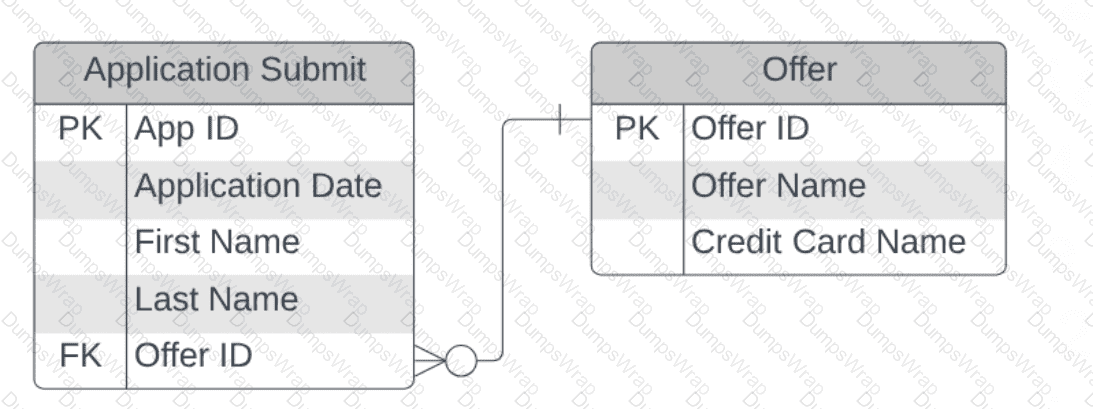
It is assumed that each application submit contains an offer that is always associated to a credit card name. Assuming all applications are streamed into the Real-Time Customer Profile, in which two ways could a developer model the application submit event to ensure the real-time suppression requirement is supported? (Choose two.)
Which type of user is most likely to receive alerts within Adobe Real-Time CDP related to data ingestion?
A data architect is building an XDM Experience Event Schema for loading event data from the Adobe Experience Platform (AEP) Web SDK. The data is intended to be used in the Real-Time customer profile and requires a primary identity to be present in the schema. The architect wants to be able to store both ambiguous and authenticated web data.
Does the data architect need to select a field as a primary identity?
An Adobe Real-Time CDP (RTCDP) consultant is working on a next-page personalization use case for an e-commerce client's website. The client wanted to use Adobe Target for delivering personalized experiences using Adobe Experience Platform (AEP) Edge segments. The client has already implemented Web SDK and configured Datastream to share website event data with AEP and Adobe Target. While implementing the delivery of personalized experiences, the RTCDP consultant was not able to get the right experience rendered successfully. Which two debugging steps can the RTCDP consultant take to identify the issue? (Choose two.)
A data engineer has loaded several profile fragments onto a Real-Time Customer Profile The profile fragments use an Individual Profile class-based schema, where user-id is the primary identity. The engineer checks each fragment, as follows:

However, upon Inspection of the profile, they realize that only the email from Fragment 1 appears, while mobile and location from Fragments 2 and 3 do not.
What is the most likely reason for the missing data in Real-Time Customer Profile'
A company has completed their implementation of Adobe Experience Platform (AEP) and is successfully onboarding data and profiles, but they are struggling with managing data across their services. What tool would best aid the company in inspecting, manipulating, and analyzing dataset data in AEP Data Lake?
A financial services broker firm provides training to brokers and agencies. Based on the different trainings attended and browsed through pages, the firm would like to personalize next session visits. The firm has Adobe Experience Platform WebSDK and Target implementation.
Which two applicable implementation options would achieve next session personalization? (Choose two.)
A customer needs to exclude profiles from re-entering an audience once they have already been in the audience. How can this be achieved?
What determines which records become part of the profile during Adobe Real-Time CDP's profile assembly process?
A data engineer is looking to ingest real-time streaming data into Adobe Experience Platform, sourced from a third-party API. What would be an appropriate strategy to effectively ingest this data?
A data engineer needs to ingest batch data from a third-party customer relationship management (CRM) system into Adobe Real-Time CDP for a major holiday marketing campaign. What should the engineer check for in the initial stages of creating a manual dataflow when considering the batch ingestion framework?
A company wants to provide access to specific schema fields in a sandbox to various internal teams based on their functions. What is the primary attribute of attribute-based access control (ABAC) feature which can be used to manage access to these specific schema fields?
A media and entertainment client wants to reduce the website latency by sending web event data to the Adobe Experience Platform Edge Network and then transfer the data to other Adobe products instead of leveraging individual product libraries. Which in-built field group in the schema configuration can help with the data collection on the Edge Network?
A company is onboarding multiple external data sources into Adobe Real-Time CDP and they want to ensure that the profile merge is performed efficiently. In what two ways could they configure the Identity Service to facilitate an efficient profile merge? (Choose two.)
