
AWS Certified Machine Learning Engineer - Associate Questions and Answers
A company has significantly increased the amount of data that is stored as .csv files in an Amazon S3 bucket. Data transformation scripts and queries are now taking much longer than they used to take.
An ML engineer must implement a solution to optimize the data for query performance.
Which solution will meet this requirement with the LEAST operational overhead?
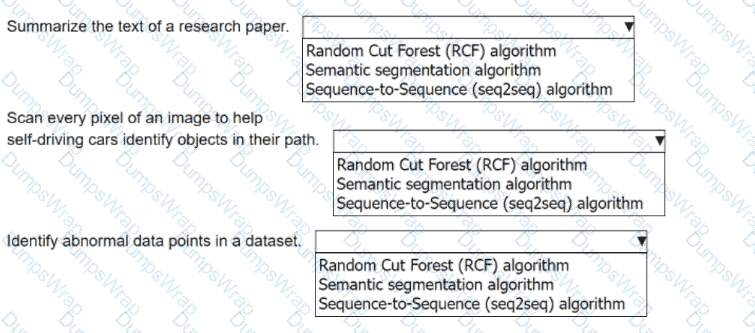
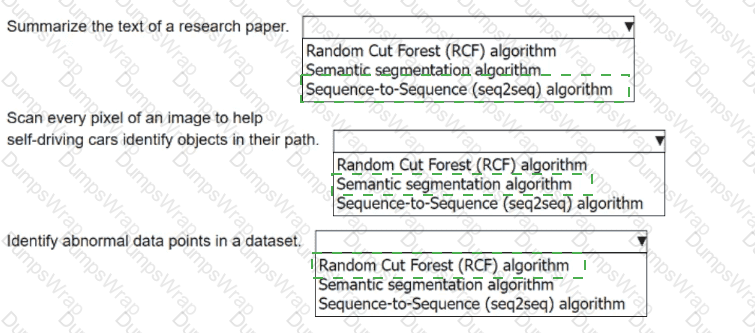
An ML engineer must choose the appropriate Amazon SageMaker algorithm to solve specific AI problems.
Select the correct SageMaker built-in algorithm from the following list for each use case. Each algorithm should be selected one time.
• Random Cut Forest (RCF) algorithm
• Semantic segmentation algorithm
• Sequence-to-Sequence (seq2seq) algorithm
A company ' s ML engineer has deployed an ML model for sentiment analysis to an Amazon SageMaker AI endpoint. The ML engineer needs to explain to company stakeholders how the model makes predictions.
Which solution will provide an explanation for the model ' s predictions?
A bank needs to use Amazon SageMaker AI to create an ML model to determine which customers qualify for a new product. The bank must use algorithms that SageMaker AI directly supports. The model must be explainable to the bank ' s regulators.
Which modeling approach will meet these requirements?
An ML engineer wants to deploy a workflow that processes streaming IoT sensor data and periodically retrains ML models. The most recent model versions must be deployed to production.
Which service will meet these requirements?
An ML engineer needs to create data ingestion pipelines and ML model deployment pipelines on AWS. All the raw data is stored in Amazon S3 buckets.
Which solution will meet these requirements?
A company uses a hybrid cloud environment. A model that is deployed on premises uses data in Amazon 53 to provide customers with a live conversational engine.
The model is using sensitive data. An ML engineer needs to implement a solution to identify and remove the sensitive data.
Which solution will meet these requirements with the LEAST operational overhead?
Case Study
A company is building a web-based AI application by using Amazon SageMaker. The application will provide the following capabilities and features: ML experimentation, training, a
central model registry, model deployment, and model monitoring.
The application must ensure secure and isolated use of training data during the ML lifecycle. The training data is stored in Amazon S3.
The company needs to run an on-demand workflow to monitor bias drift for models that are deployed to real-time endpoints from the application.
Which action will meet this requirement?
A company wants to deploy an Amazon SageMaker AI model that can queue requests. The model needs to handle payloads of up to 1 GB that take up to 1 hour to process. The model must return an inference for each request. The model also must scale down when no requests are available to process.
Which inference option will meet these requirements?
Case Study
A company is building a web-based AI application by using Amazon SageMaker. The application will provide the following capabilities and features: ML experimentation, training, a
central model registry, model deployment, and model monitoring.
The application must ensure secure and isolated use of training data during the ML lifecycle. The training data is stored in Amazon S3.
The company needs to use the central model registry to manage different versions of models in the application.
Which action will meet this requirement with the LEAST operational overhead?
An ML engineer is deploying a generative AI model-based customer support agent that uses Amazon SageMaker AI for inference. The customer support agent must respond to customer questions about topics such as shipping policies, refund processes, and account management. The generative AI model generates one token at a time.
Customers report dissatisfaction with how long the customer support agent takes to generate lengthy responses to questions. The ML engineer must apply an inference optimization technique to improve the performance of the customer support agent.
Which solution will meet this requirement?
An ML engineer needs to deploy ML models to get inferences from large datasets in an asynchronous manner. The ML engineer also needs to implement scheduled monitoring of data quality for the models and must receive alerts when changes in data quality occur.
Which solution will meet these requirements?
A company wants to use large language models (LLMs) supported by Amazon Bedrock to develop a chat interface for internal technical documentation.
The documentation consists of dozens of text files totaling several megabytes and is updated frequently.
Which solution will meet these requirements MOST cost-effectively?
A company collects customer data every day. The company stores the data as compressed files in an Amazon S3 bucket that is partitioned by date. Every month, analysts download the data, process the data to check the data quality, and then upload the data to Amazon QuickSight dashboards.
An ML engineer needs to implement a solution to automatically check the data quality before the data is sent to QuickSight.
Which solution will meet these requirements with the LEAST operational overhead?
A company is planning to use Amazon SageMaker to make classification ratings that are based on images. The company has 6 ТВ of training data that is stored on an Amazon FSx for NetApp ONTAP system virtual machine (SVM). The SVM is in the same VPC as SageMaker.
An ML engineer must make the training data accessible for ML models that are in the SageMaker environment.
Which solution will meet these requirements?
A streaming media company uses a churn risk model to assess the churn risk of its premium tier customers. Each month, the company runs an aggregation job on individual customers’ streaming data and uploads the user engagement features to an Amazon S3 bucket. The company manually re-trains the churn risk model with the user engagement data.
The current process requires manual intervention and is time-consuming. The company needs a solution that automatically re-trains the churn prediction model with the most recent data.
Which solution will meet these requirements with the SHORTEST delay?
A company uses an ML model to recommend videos to users. The model is deployed on Amazon SageMaker AI. The model performed well initially after deployment, but the model ' s performance has degraded over time.
Which solution can the company use to identify model drift in the future?
A hospital is using an ML model to validate x-ray results. The hospital runs a nightly batch inference job. The hospital needs to produce a daily report about model data quality and model performance.
Which solution will meet these requirements?
A company wants to use large language models (LLMs) that are supported by Amazon Bedrock to develop a chat interface for the company ' s internal technical documentation. The company stores the documentation as dozens of text files that are several megabytes in total size. The company updates the text files often.
Which solution will meet these requirements MOST cost-effectively?
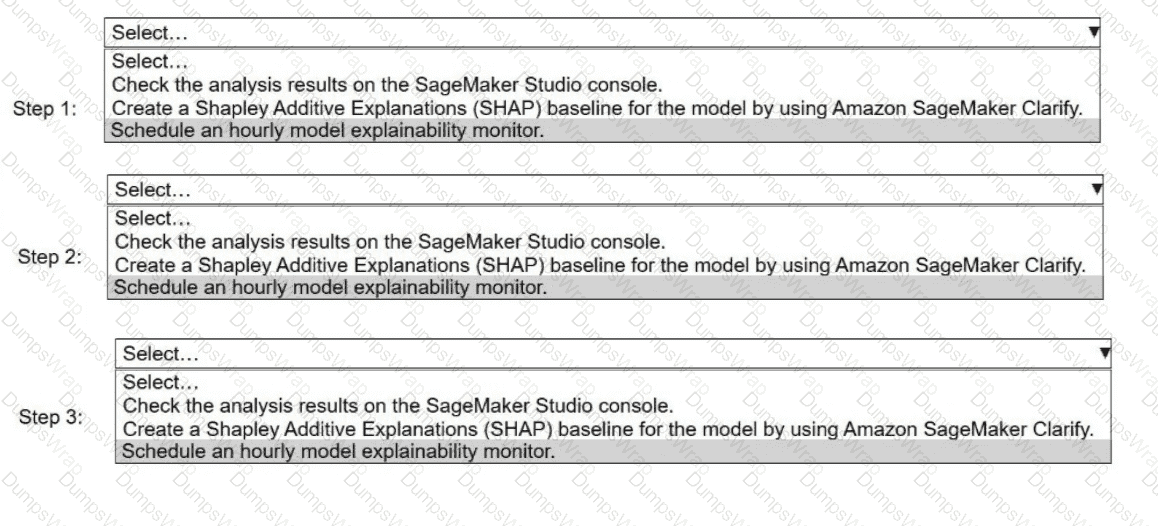
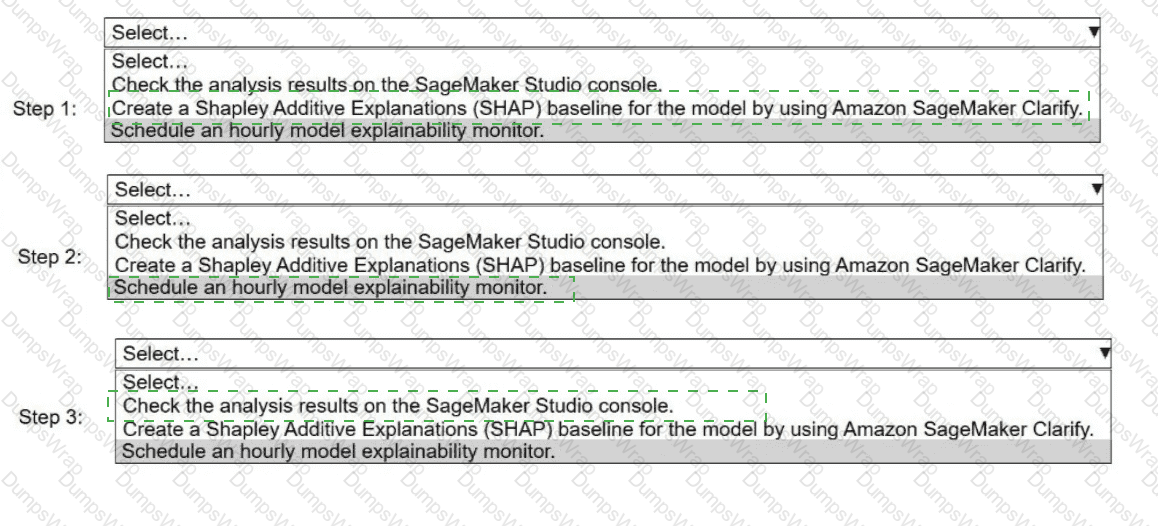
A company has deployed a model to predict the churn rate for its games by using Amazon SageMaker Studio. After the model is deployed, the company must monitor the model performance for data drift and inspect the report. Select and order the correct steps from the following list to model monitor actions. Select each step one time. (Select and order THREE.) .
Check the analysis results on the SageMaker Studio console. .
Create a Shapley Additive Explanations (SHAP) baseline for the model by using Amazon SageMaker Clarify.
Schedule an hourly model explainability monitor.
A company is developing an ML model to forecast future values based on time series data. The dataset includes historical measurements collected at regular intervals and categorical features. The model needs to predict future values based on past patterns and trends.
Which algorithm and hyperparameters should the company use to develop the model?
An ML engineer needs to deploy a trained model based on a genetic algorithm. Predictions can take several minutes, and requests can include up to 100 MB of data.
Which deployment solution will meet these requirements with the LEAST operational overhead?
A company stores time-series data about user clicks in an Amazon S3 bucket. The raw data consists of millions of rows of user activity every day. ML engineers access the data to develop their ML models.
The ML engineers need to generate daily reports and analyze click trends over the past 3 days by using Amazon Athena. The company must retain the data for 30 days before archiving the data.
Which solution will provide the HIGHEST performance for data retrieval?
An ML engineer is preparing a dataset that contains medical records to train an ML model to predict the likelihood of patients developing diseases.
The dataset contains columns for patient ID, age, medical conditions, test results, and a " Disease " target column.
How should the ML engineer configure the data to train the model?
A company uses Amazon SageMaker for its ML workloads. The company ' s ML engineer receives a 50 MB Apache Parquet data file to build a fraud detection model. The file includes several correlated columns that are not required.
What should the ML engineer do to drop the unnecessary columns in the file with the LEAST effort?
A company is gathering audio, video, and text data in various languages. The company needs to use a large language model (LLM) to summarize the gathered data that is in Spanish.
Which solution will meet these requirements in the LEAST amount of time?
A company uses Amazon SageMaker Studio to develop an ML model. The company has a single SageMaker Studio domain. An ML engineer needs to implement a solution that provides an automated alert when SageMaker AI compute costs reach a specific threshold.
Which solution will meet these requirements?
A company uses an Amazon SageMaker AI model for real-time inference with auto scaling enabled. During peak usage, new instances launch before existing instances are fully ready, causing inefficiencies and delays.
Which solution will optimize the scaling process without affecting response times?
An ML engineer needs to deploy ML models to get inferences from large datasets in an asynchronous manner. The ML engineer also needs to implement scheduled monitoring of the data quality of the models. The ML engineer must receive alerts when changes in data quality occur.
Which solution will meet these requirements?
A company has an application that uses different APIs to generate embeddings for input text. The company needs to implement a solution to automatically rotate the API tokens every 3 months.
Which solution will meet this requirement?
An ML engineer trained an ML model on Amazon SageMaker to detect automobile accidents from dosed-circuit TV footage. The ML engineer used SageMaker Data Wrangler to create a training dataset of images of accidents and non-accidents.
The model performed well during training and validation. However, the model is underperforming in production because of variations in the quality of the images from various cameras.
Which solution will improve the model ' s accuracy in the LEAST amount of time?
An ML engineer decides to use Amazon SageMaker AI automated model tuning (AMT) for hyperparameter optimization (HPO). The ML engineer requires a tuning strategy that uses regression to slowly and sequentially select the next set of hyperparameters based on previous runs. The strategy must work across small hyperparameter ranges.
Which solution will meet these requirements?
An ML engineer needs to use AWS services to identify and extract meaningful unique keywords from documents.
Which solution will meet these requirements with the LEAST operational overhead?
A company is running ML models on premises by using custom Python scripts and proprietary datasets. The company is using PyTorch. The model building requires unique domain knowledge. The company needs to move the models to AWS.
Which solution will meet these requirements with the LEAST effort?
An ML engineer is setting up a continuous integration and continuous delivery (CI/CD) pipeline for an ML workflow in Amazon SageMaker AI. The pipeline needs to automate model re-training, testing, and deployment whenever new data is uploaded to an Amazon S3 bucket. New data files are approximately 10 GB in size. The ML engineer wants to track model versions for auditing.
Which solution will meet these requirements?
A financial company receives a high volume of real-time market data streams from an external provider. The streams consist of thousands of JSON records every second.
The company needs to implement a scalable solution on AWS to identify anomalous data points.
Which solution will meet these requirements with the LEAST operational overhead?
A company has an ML model that generates text descriptions based on images that customers upload to the company ' s website. The images can be up to 50 MB in total size.
An ML engineer decides to store the images in an Amazon S3 bucket. The ML engineer must implement a processing solution that can scale to accommodate changes in demand.
Which solution will meet these requirements with the LEAST operational overhead?
A company has a binary classification model in production. An ML engineer needs to develop a new version of the model.
The new model version must maximize correct predictions of positive labels and negative labels. The ML engineer must use a metric to recalibrate the model to meet these requirements.
Which metric should the ML engineer use for the model recalibration?
A company is planning to create several ML prediction models. The training data is stored in Amazon S3. The entire dataset is more than 5 ТВ in size and consists of CSV, JSON, Apache Parquet, and simple text files.
The data must be processed in several consecutive steps. The steps include complex manipulations that can take hours to finish running. Some of the processing involves natural language processing (NLP) transformations. The entire process must be automated.
Which solution will meet these requirements?
A company plans to use Amazon SageMaker AI to build image classification models. The company has 6 TB of training data stored on Amazon FSx for NetApp ONTAP. The file system is in the same VPC as SageMaker AI.
An ML engineer must make the training data accessible to SageMaker AI training jobs.
Which solution will meet these requirements?
A company launches a feature that predicts home prices. An ML engineer trained a regression model using the SageMaker AI XGBoost algorithm. The model performs well on training data but underperforms on real-world validation data.
Which solution will improve the validation score with the LEAST implementation effort?
A company runs an Amazon SageMaker AI domain in a public subnet of a newly created VPC. The network is configured properly, and ML engineers can access the SageMaker AI domain.
Recently, the company discovered suspicious traffic to the domain from a specific IP address. The company needs to block traffic from the specific IP address.
Which update to the network configuration will meet this requirement?
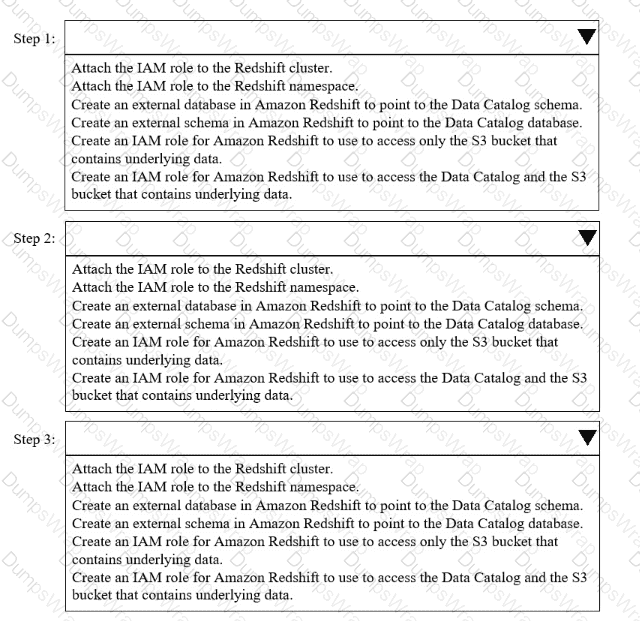
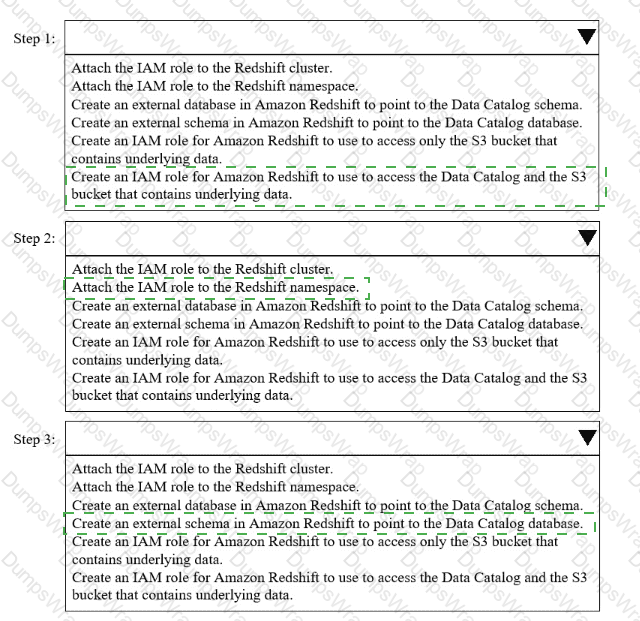
A company needs to combine data from multiple sources. The company must use Amazon Redshift Serverless to query an AWS Glue Data Catalog database and underlying data that is stored in an Amazon S3 bucket.
Select and order the correct steps from the following list to meet these requirements. Select each step one time or not at all. (Select and order three.)
• Attach the IAM role to the Redshift cluster.
• Attach the IAM role to the Redshift namespace.
• Create an external database in Amazon Redshift to point to the Data Catalog schema.
• Create an external schema in Amazon Redshift to point to the Data Catalog database.
• Create an IAM role for Amazon Redshift to use to access only the S3 bucket that contains underlying data.
• Create an IAM role for Amazon Redshift to use to access the Data Catalog and the S3 bucket that contains underlying data.
An ML engineer needs to use an Amazon EMR cluster to process large volumes of data in batches. Any data loss is unacceptable.
Which instance purchasing option will meet these requirements MOST cost-effectively?
A company is developing an application that reads animal descriptions from user prompts and generates images based on the information in the prompts. The application reads a message from an Amazon Simple Queue Service (Amazon SQS) queue. Then the application uses Amazon Titan Image Generator on Amazon Bedrock to generate an image based on the information in the message. Finally, the application removes the message from SQS queue.
Which IAM permissions should the company assign to the application ' s IAM role? (Select TWO.)
An ML engineer is configuring auto scaling for an inference component of a model that runs behind an Amazon SageMaker AI endpoint. The ML engineer configures SageMaker AI auto scaling with a target tracking scaling policy set to 100 invocations per model per minute. The SageMaker AI endpoint scales appropriately during normal business hours. However, the ML engineer notices that at the start of each business day, there are zero instances available to handle requests, which causes delays in processing.
The ML engineer must ensure that the SageMaker AI endpoint can handle incoming requests at the start of each business day.
Which solution will meet this requirement?
An advertising company uses AWS Lake Formation to manage a data lake. The data lake contains structured data and unstructured data. The company ' s ML engineers are assigned to specific advertisement campaigns.
The ML engineers must interact with the data through Amazon Athena and by browsing the data directly in an Amazon S3 bucket. The ML engineers must have access to only the resources that are specific to their assigned advertisement campaigns.
Which solution will meet these requirements in the MOST operationally efficient way?
An ML engineer needs to use an ML model to predict the price of apartments in a specific location.
Which metric should the ML engineer use to evaluate the model’s performance?
An ML engineer is setting up an Amazon SageMaker AI pipeline for an ML model. The pipeline must automatically initiate a re-training job if any data drift is detected.
How should the ML engineer set up the pipeline to meet this requirement?
A construction company is using Amazon SageMaker AI to train specialized custom object detection models to identify road damage. The company uses images from multiple cameras. The images are stored as JPEG objects in an Amazon S3 bucket.
The images need to be pre-processed by using computationally intensive computer vision techniques before the images can be used in the training job. The company needs to optimize data loading and pre-processing in the training job. The solution cannot affect model performance or increase compute or storage resources.
Which solution will meet these requirements?
A company has a Retrieval Augmented Generation (RAG) application that uses a vector database to store embeddings of documents. The company must migrate the application to AWS and must implement a solution that provides semantic search of text files. The company has already migrated the text repository to an Amazon S3 bucket.
Which solution will meet these requirements?
A company needs to create a central catalog for all the company ' s ML models. The models are in AWS accounts where the company developed the models initially. The models are hosted in Amazon Elastic Container Registry (Amazon ECR) repositories.
Which solution will meet these requirements?
An ML engineer has developed a binary classification model outside of Amazon SageMaker. The ML engineer needs to make the model accessible to a SageMaker Canvas user for additional tuning.
The model artifacts are stored in an Amazon S3 bucket. The ML engineer and the Canvas user are part of the same SageMaker domain.
Which combination of requirements must be met so that the ML engineer can share the model with the Canvas user? (Choose two.)
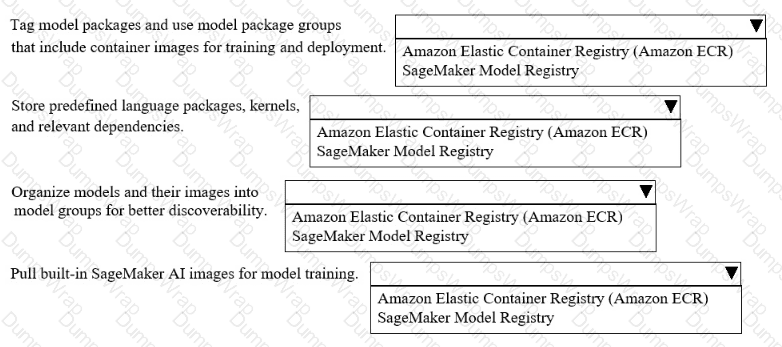
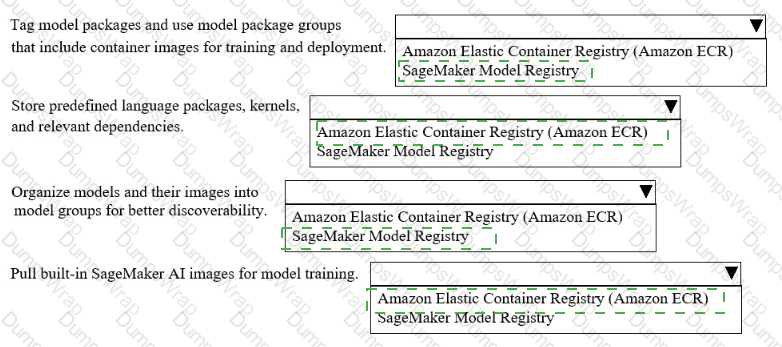
A company uses Amazon SageMakerAI to support ML workflows such as model training and deployment.
Select the correct registry from the following list to meet the requirements for each use case with the LEAST operational overhead. Each registry should be selected one or more times. (Select FOUR.)
• Amazon Elastic Container Registry (Amazon ECR)
• SageMaker Model Registry
An ML engineer is tuning an image classification model that performs poorly on one of two classes. The poorly performing class represents an extremely small fraction of the training dataset.
Which solution will improve the model’s performance?
A company wants to use Amazon SageMaker AI to host an ML model that runs on CPU for real-time predictions. The model has intermittent traffic during business hours and periods of no traffic after business hours.
Which hosting option will serve inference requests in the MOST cost-effective manner?
A company wants to predict the success of advertising campaigns by considering the color scheme of each advertisement. An ML engineer is preparing data for a neural network model. The dataset includes color information as categorical data.
Which technique for feature engineering should the ML engineer use for the model?
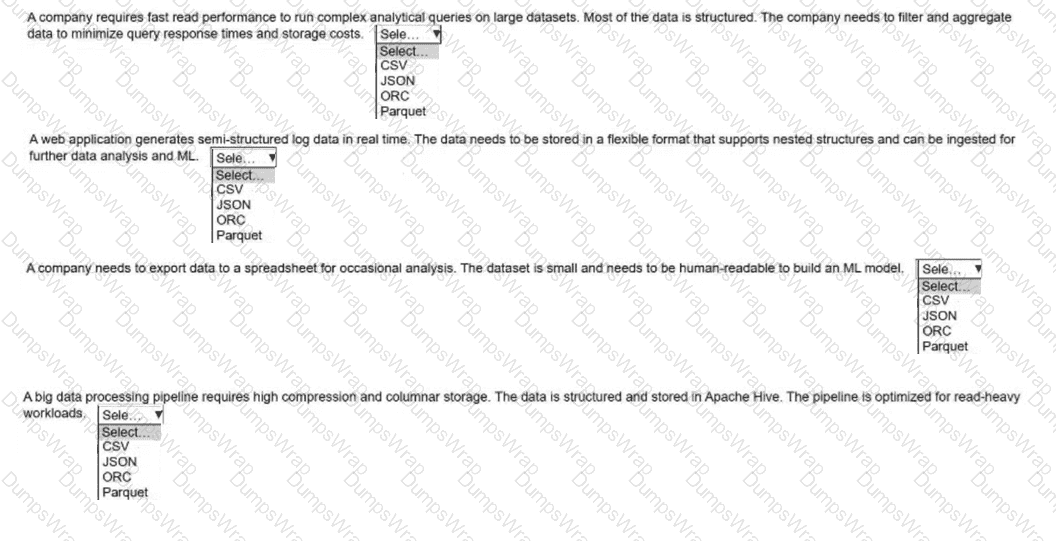
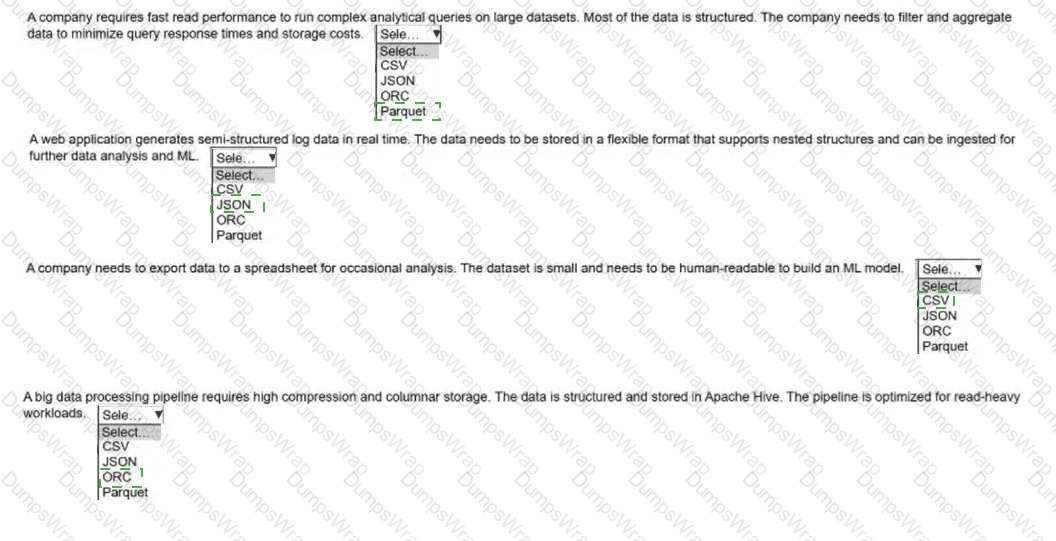
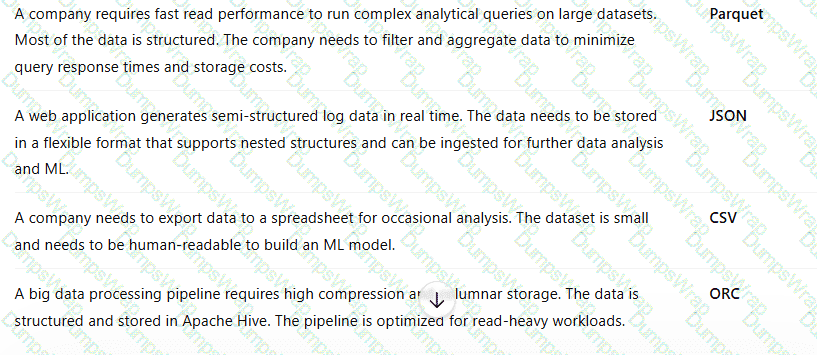
An ML engineer needs to choose the most appropriate data format for various data uses. Different teams will access the data for analytics, ML, and reporting purposes.
Select the correct data format from the following list to meet the requirements for each use case. Select each data format one time. (Select FOUR.)
A company has trained an ML model that is packaged in a container. The company will integrate the model with an existing Python web application. The company needs to host the model on AWS by using Kubernetes.
The company does not want to manage the control plane and must provision the resources in a repeatable manner. The infrastructure must be provisioned by using Python.
Which solution will meet these requirements?
A company is using an AWS Lambda function to monitor the metrics from an ML model. An ML engineer needs to implement a solution to send an email message when the metrics breach a threshold.
Which solution will meet this requirement?
A company is creating an application that will recommend products for customers to purchase. The application will make API calls to Amazon Q Business. The company must ensure that responses from Amazon Q Business do not include the name of the company ' s main competitor.
Which solution will meet this requirement?
A company is using an Amazon Redshift database as its single data source. Some of the data is sensitive.
A data scientist needs to use some of the sensitive data from the database. An ML engineer must give the data scientist access to the data without transforming the source data and without storing anonymized data in the database.
Which solution will meet these requirements with the LEAST implementation effort?
A company is building an Amazon SageMaker AI pipeline for an ML model. The pipeline uses distributed processing and training.
An ML engineer needs to encrypt network communication between instances that run distributed jobs. The ML engineer configures the distributed jobs to run in a private VPC.
What should the ML engineer do to meet the encryption requirement?
An ML engineer is using Amazon Quick Suite (previously known as Amazon QuickSight) anomaly detection to detect very high or very low machine operating temperatures compared to normal. The ML engineer sets the Severity parameter to Low and above. The ML engineer sets the Direction parameter to All.
What effect will the ML engineer observe in the anomaly detection results if the ML engineer changes the Direction parameter to Lower than expected?
A company is building an Amazon SageMaker AI pipeline for an ML model. The pipeline uses distributed processing and distributed training.
An ML engineer needs to encrypt network communication between instances that run distributed jobs. The ML engineer configures the distributed jobs to run in a private VPC.
What should the ML engineer do to meet the encryption requirement?
A company wants to migrate ML models from an on-premises environment to Amazon SageMaker AI. The models are based on the PyTorch algorithm. The company needs to reuse its existing custom scripts as much as possible.
Which SageMaker AI feature should the company use?
An ML engineer is setting up an Amazon SageMaker AI pipeline for an ML model. The pipeline must automatically initiate a re-training job if any data drift is detected.
How should the ML engineer set up the pipeline to meet this requirement?
A company uses the Amazon SageMaker AI Object2Vec algorithm to train an ML model. The model performs well on training data but underperforms after deployment. The company wants to avoid overfitting the model and maintain the model ' s ability to generalize.
Which solution will meet these requirements?
A company wants to improve its customer retention ML model. The current model has 85% accuracy and a new model shows 87% accuracy in testing. The company wants to validate the new model’s performance in production.
Which solution will meet these requirements?
An ML engineer is evaluating several ML models and must choose one model to use in production. The cost of false negative predictions by the models is much higher than the cost of false positive predictions.
Which metric finding should the ML engineer prioritize the MOST when choosing the model?
A company regularly receives new training data from the vendor of an ML model. The vendor delivers cleaned and prepared data to the company ' s Amazon S3 bucket every 3-4 days.
The company has an Amazon SageMaker pipeline to retrain the model. An ML engineer needs to implement a solution to run the pipeline when new data is uploaded to the S3 bucket.
Which solution will meet these requirements with the LEAST operational effort?
A company is creating an ML model to identify defects in a product. The company has gathered a dataset and has stored the dataset in TIFF format in Amazon S3. The dataset contains 200 images in which the most common defects are visible. The dataset also contains 1,800 images in which there is no defect visible.
An ML engineer trains the model and notices poor performance in some classes. The ML engineer identifies a class imbalance problem in the dataset.
What should the ML engineer do to solve this problem?
