Weekend Special - 75% Discount Offer - Ends in 0d 00h 00m 00s - Coupon code: w75best

Anthropic CCAR-P Dumps

Page: 1 / 11
Total 114 questions

Claude Certified Architect - Professional Questions and Answers

Question 1

A solutions architect is analyzing stakeholder feedback collected after the first quarter of a Claude-powered procurement automation deployment. The feedback includes four statements: (1) “Our procurement team is processing 3x more purchase orders per analyst per day.” (2) “We have eliminated the manual data entry role entirely and redeployed those staff to vendor relationship management.” (3) “The API integration costs are running 40% over the projected per-transaction budget.” (4) “Response latency during end-of-month batch runs is averaging 11 seconds, against our committed 5-second SLA.”

Which of the following correctly identifies the primary business value pillar each stakeholder statement represents?

Options:

A.

Statement 1: Efficiency; Statement 2: Transformation; Statement 3: Solution Cost; Statement 4: Performance SLA

B.

Statement 1: Productivity; Statement 2: Efficiency; Statement 3: Solution Cost; Statement 4: Performance SLA

C.

Statement 1: Transformation; Statement 2: Productivity; Statement 3: Solution Cost; Statement 4: Efficiency

D.

Statement 1: Efficiency; Statement 2: Productivity; Statement 3: Performance SLA; Statement 4: Solution Cost

Question 2

You are compiling a diagnostic toolkit for Claude Code operational issues.

Which two diagnostic actions belong in the toolkit? (Select two.)

Each correct answer presents a complete solution.

Options:

A.

Increase the model sampling temperature so that intermittent issues surface more frequently for analysis.

B.

File a support ticket with vendor support before any local reproduction or evidence collection.

C.

Reproduce the issue with a minimal reproduction case that isolates one variable at a time.

D.

Roll back to the previous Claude Code version immediately to confirm whether the issue is version specific.

E.

List the configured Model Context Protocol (MCP) servers and inspect server status to identify connection failures.

Question 3

A revenue projection assistant has missed its monthly cost target by 38 percent. Profiling shows three contributors: a 6,000-token policy preamble repeated on every call (45 percent of cost), retrieval of historical sales chunks averaging 3,000 tokens per call (30 percent), and inference on a flagship-tier model (25 percent). Stakeholders require that projection accuracy remain unchanged.

Which two optimizations should you sequence first to reduce cost without affecting accuracy? (Select two.)

Each correct answer presents part of the solution.

Options:

A.

Reduce the number of historical sales chunks retrieved across each query run.

B.

Truncate the policy preamble to remove non-essential clauses from the prompt.

C.

Enable prompt caching on the static policy preamble across the recurring calls.

D.

Switch the workload to a smaller, faster Claude model tier across all queries.

E.

Cache common retrieved sales chunks accessed across many of the daily queries.

Question 4

You are a platform architect designing an internal Claude-based assistant that serves both finance analysts and external auditors. Each population must access only documents permitted by its role.

Where should role-based access control be enforced in the pipeline?

Options:

A.

Inside the system prompt as a natural-language instruction for Claude to ignore unauthorized documents.

B.

At the retrieval layer, before any role-restricted content reaches the prompt-construction step or the model.

C.

Nowhere in the pipeline; rely on the model’s general refusal behavior to reject unauthorized document access without any enforced access control.

D.

After the response is generated, by post-filtering content that should not have been retrieved.

Question 5

You are integrating AI-assisted tooling into the team’s documentation workflow. The team wants generated documentation that stays grounded in the actual code.

Which integration approach best fits this requirement?

Options:

A.

Generate documentation from the model’s training-data recall without reading any of the actual repository code, accepting that the output will not reflect the current implementation.

B.

Have the subagents publish generated documentation directly to the public-facing site without passing through the team’s normal review workflow or any human approval step.

C.

Configure subagents that read the relevant code files via filesystem and code-search tools, generate the documentation, and emit changes through the team’s normal review workflow.

D.

Disable all filesystem and code-search tools so the subagents cannot read any repository code, accepting that documentation generation will be entirely disconnected from the actual implementation.

Question 6

You are producing an architecture guide for a new deployment and must complete the planning steps before drafting each section.

Which two steps must be completed BEFORE drafting each section of the guide? (Select two.)

Each correct answer presents part of the solution.

Options:

A.

Identify the audience and the questions the guide must answer for that audience.

B.

Translate the guide into the supported regional languages for the candidate population.

C.

Validate the guide with the implementation team and incorporate corrections.

D.

Establish the document under version control with a defined review cadence and approver list.

E.

Outline the guide sections covering the overview, components, contracts, flows, runbooks, and limitations.

Question 7

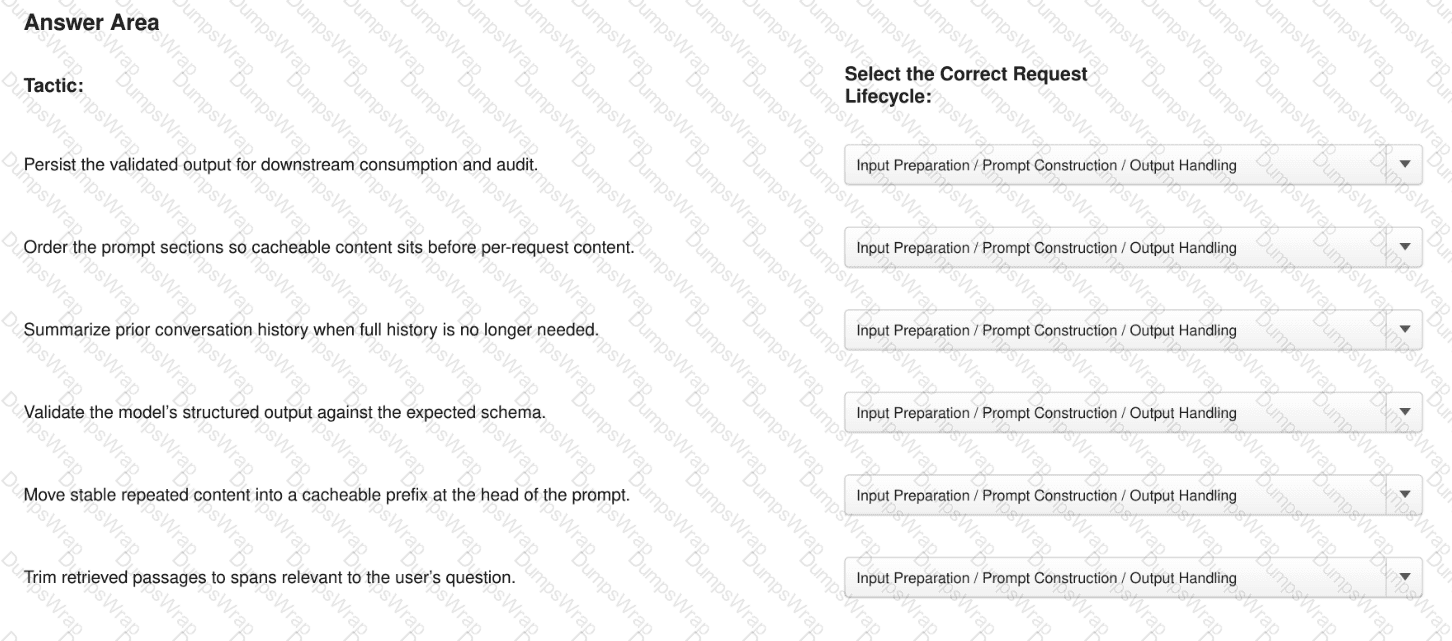
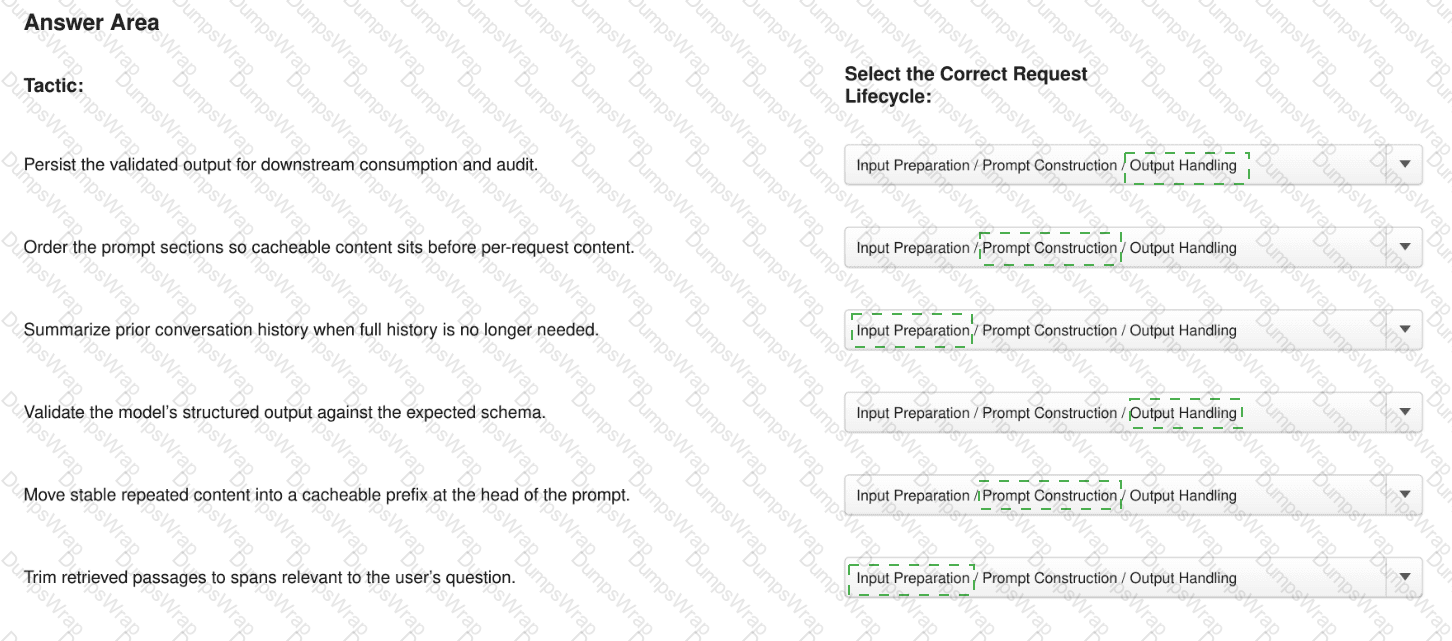
You are classifying chunking strategies by the corpus type each is best suited to.

For each chunking strategy, select the appropriate corpus type: “Long Structured Documents,” “Heterogeneous Short Records,” or “Code or Hierarchical Specifications.”

as

Options:

Question 8

Engineering leadership wants to roll out Claude Skills to 280 developers across 14 teams. Skills will encode internal coding standards, code-review checklists, and incident-postmortem templates. Leadership has asked how to govern Skill authorship so that Skills remain trustworthy without bottlenecking on a single central team.

Which governance model should you recommend?

Options:

A.

Per-developer authorship across the 280 engineers with no team-level coordination required.

B.

Centralized authorship by a single platform team responsible for every Skill produced.

C.

Fully decentralized authorship across the 14 teams with no review before publication.

D.

Federated authorship across the 14 teams with a central review and publication gate.

Question 9

You are designing a test strategy for a Claude-based pipeline that handles sensitive financial data.

Which two test types should be prioritized to cover both safety under attack and cross-component correctness? (Select two.)

Options:

A.

Adversarial tests using prompt-injection and malformed-input cases.

B.

Regression tests against a stable reference set of previously known-good outputs.

C.

Smoke tests that verify core paths after each deployment.

D.

Integration tests that verify end-to-end pipeline behavior across all components.

E.

Unit tests targeting only individual prompt-template rendering logic.

Question 10

You are preparing a HIPAA-eligible deployment for a healthcare customer.

Which configuration supports HIPAA compliance using Anthropic-offered tools?

Options:

A.

Claude Free with no contractual addendum, since consumer products meet HIPAA requirements out of the box.

B.

Claude Enterprise with a signed Business Associate Agreement, Zero Data Retention enabled, and audit logging configured for compliance tracking.

C.

Disabling all audit logging so that no PHI is recorded in any log store, on the assumption that the absence of logs satisfies HIPAA requirements without a signed BAA.

D.

An ad-hoc personal Claude account used by individual clinicians for PHI-related tasks, with no Business Associate Agreement, no Zero Data Retention, and no audit logging configured.

Question 11

A document analysis service processes legal filings averaging 80,000 tokens each. Each filing is queried by attorneys an average of 14 times during a case. The current architecture sends the full filing on every query. The CFO has asked you to reduce per-query costs while preserving response quality. The security officer requires that filing contents not be stored outside Fabrikam's tenancy.

Which optimization approach should you recommend?

Options:

A.

Summarize each filing once at intake and run all subsequent queries against the summary.

B.

Cache the filing as the prompt prefix for reuse across the 14 queries per case.

C.

Index filings in a vector store and retrieve only the relevant passages per query.

D.

Move the workload to a smaller Claude model to reduce the per-token cost paid.

Question 12

You are supporting an engineer whose Claude Code session reports a permission denial when the engineer expected the action to be allowed.

Which resolution step is most appropriate?

Options:

A.

Tell the engineer to retry the denied action verbatim repeatedly until the denial stops appearing, without inspecting the active permission rules to determine whether the denial is intentional.

B.

Disable the permission system entirely across all scopes to remove the denial, eliminating all tool-pattern and deny-rule controls rather than identifying and amending the specific rule.

C.

Inspect the active permission rules across all scopes—managed, command-line, local, project, and user—to identify which rule is denying the action and confirm whether it should be amended or remain denied.

D.

Grant the engineer unrestricted Bash access to bypass the specific rule causing the denial, removing all tool-pattern constraints rather than amending only the rule in question.

Question 13

You are compiling guardrail tactics for a customer-facing assistant.

Which two tactics belong on the guardrail list?

Each correct answer presents a complete solution.

Options:

A.

Embed approved override phrases that let trusted users relax guardrails on demand.

B.

Lower sampling temperature globally to reduce the chance of off-policy completions.

C.

Validate the model output against a structured schema before downstream actions are taken.

D.

Layer prompt-level guardrails with runtime content checks rather than relying on either alone.

E.

Rely on a single hardened system prompt that enumerates every disallowed behavior.

Question 14

You are supporting a team whose Claude Code sessions consistently load 60 or more MCP tools from many servers, exhausting context budget before the session begins.

Which adjustment most directly addresses this issue without removing capability?

Options:

A.

Enable Tool Search so tool definitions are deferred and discovered on demand rather than loaded into context upfront.

B.

Disable every MCP server in the configuration to free up context budget, accepting that the team loses all tool access and cannot perform any MCP-dependent task in the session.

C.

Increase the prompt’s verbosity with additional instructions and context, which consumes more of the context budget rather than reducing the tool-definition overhead causing the issue.

D.

Add additional MCP servers to give the team more capability, which increases rather than reduces the number of tool definitions loaded into the session’s context budget.

Question 15

You are integrating Claude Code into the team’s pull-request workflow. The team wants AI-assisted review without removing human approval.

Which integration design best fits this requirement?

Options:

A.

Claude Code reviews the pull request and posts a structured analysis as a comment, while a human reviewer retains the approval decision under the existing branch-protection rules.

B.

Claude Code merges every pull request automatically after completing its analysis, bypassing human approval and the existing branch-protection rules.

C.

Claude Code disables all existing branch-protection rules to streamline the merge process, removing human approval as a required gate.

D.

Claude Code silently deletes pull requests it assesses as low quality without posting a comment or notifying the author.

Question 16

You are selecting a model for a new production workload and must complete the upstream steps before testing candidate models empirically.

Which two steps must be completed BEFORE running a representative sample on a candidate model? (Select two.)

Each correct answer presents part of the solution.

Options:

A.

Select the lightest model that consistently meets the quality bar across the sample.

B.

Retest the model choice when a new model version becomes available.

C.

Choose a candidate model based on the requirements profile and known capabilities.

D.

Define the quality bar, latency tolerance, and expected volume for the workload.

E.

Sign off the production rollout plan with the platform and security teams.

Question 17

A Claude architect is designing a HIPAA-compliant pipeline that processes patient records.

Which two design decisions directly support HIPAA compliance requirements? (Select two.)

Options:

A.

Setting max_tokens to a low value to minimize the volume of text generated per request.

B.

Selecting the highest-capability Claude model to maximize diagnostic accuracy.

C.

Enforcing role-based access controls so that PHI is retrievable only by authorized personnel.

D.

Ensuring patient data is never included in training feedback loops sent to the model provider without a BAA in place.

E.

Using streaming responses to reduce perceived latency for clinical users.

Question 18

You are presenting an architectural decision to a mixed audience that includes an executive sponsor and the engineering leads who will implement the decision.

Which presentation strategy best serves both audiences?

Options:

A.

Open with a deep dive into low-level implementation details targeted at engineering leads, and stop there without addressing the business outcomes or trade-offs the executive sponsor needs.

B.

Lead with the decision, the business outcomes it serves, and the trade-offs accepted; follow with the technical rationale, alternatives, and implementation implications for the engineering audience.

C.

Skip the rationale, alternatives, and trade-off discussion entirely and simply announce the chosen decision, leaving both audiences without the context needed to implement or validate it.

D.

Present a single undifferentiated narrative that addresses technical and business concerns with equal weight throughout, treating both audiences as requiring the same depth on every section.

Question 19

You are selecting a protocol for a single low-latency stateless tool call from a Claude-based assistant to an internal pricing service that already exposes a stable HTTP API.

Which integration mechanism is the most appropriate?

Options:

A.

A direct API call to the existing endpoint with the appropriate scoped credentials.

B.

A long-lived stateful session protocol for a stateless single-call interaction.

C.

A bespoke streaming protocol layered over an unrelated asynchronous message bus.

D.

An agent-to-agent handoff that introduces another Claude-based agent in front of the pricing service.

Question 20

You are identifying the highest-impact optimization for a deployment whose token cost is dominated by a long, repeated system prompt and a large retrieved context per request.

Which optimization most directly targets the dominant cost driver?

Options:

A.

Increase retrieval depth on every request to maximize recall, worsening the dominant cost driver by adding more retrieved tokens per request rather than reducing them.

B.

Add additional repeated content to the system prompt to give the model more guidance.

C.

Move the long, repeated system prompt into a cacheable prefix and trim retrieved context to the spans relevant to each query.

D.

Switch every request to the heaviest available model to maximize output quality, accepting that higher per-request inference cost compounds rather than addresses the dominant cost driver.

Question 21

You are investigating an MCP server that fails on first launch but succeeds on subsequent runs. System permission dialogs appeared during the first launch.

Which response is most appropriate?

Options:

A.

Recognize the first-run permission grant as the cause, document the expected behavior in onboarding guidance, and confirm that subsequent runs succeed.

B.

Reinstall the operating system to clear all permission state without first confirming whether the one-time permission grant caused the failure.

C.

Disable operating-system permission dialogs entirely, accept the resulting security implications, and proceed without confirming whether the failure recurs.

D.

Treat the first-run failure as a permanent fault, replace the MCP server, and do not verify whether subsequent runs succeed.

Question 22

You are building a feedback-and-alignment routine for a multi-stakeholder deployment.

Which two practices belong in the routine? (Select two.)

Each correct answer presents a complete solution.

Options:

A.

Record each session and distribute the recording to stakeholders who could not attend live.

B.

Escalate any disagreement among stakeholders to the executive sponsor for binding resolution.

C.

Rotate facilitation among the participating stakeholder groups to share ownership of the routine.

D.

Set a regular cadence for revisiting expectations and assumptions as conditions evolve over time.

E.

Reconcile divergent stakeholder positions explicitly rather than papering over them in the moment.

Question 23

You are documenting an architectural decision to support future audit and onboarding.

Which artifact is the strongest fit?

Options:

A.

A slide deck in a presentation folder with no accompanying written rationale.

B.

A code comment in a single file that contains an opinion of one engineer.

C.

An Architecture Decision Record that states the context, the decision, the alternatives considered, the consequences, and the date and authors.

D.

A short verbal note shared during a hallway conversation with no written record.

Question 24

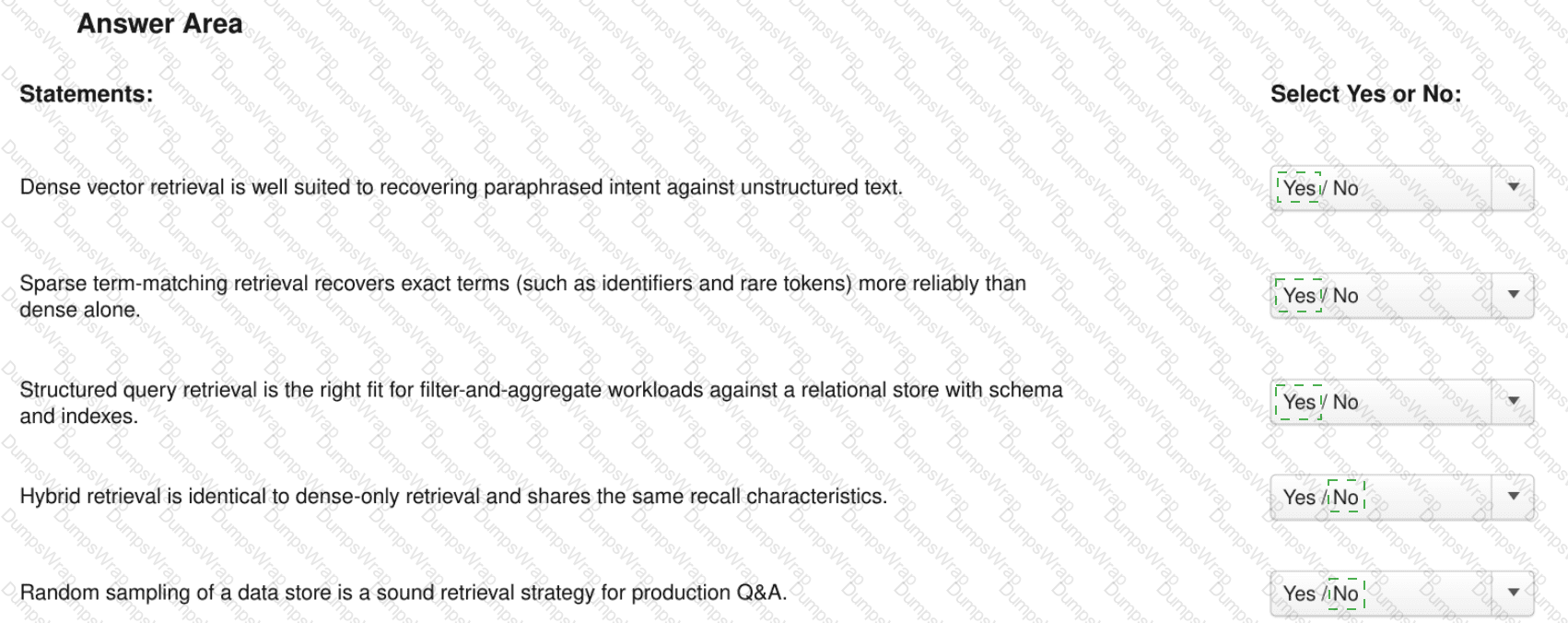
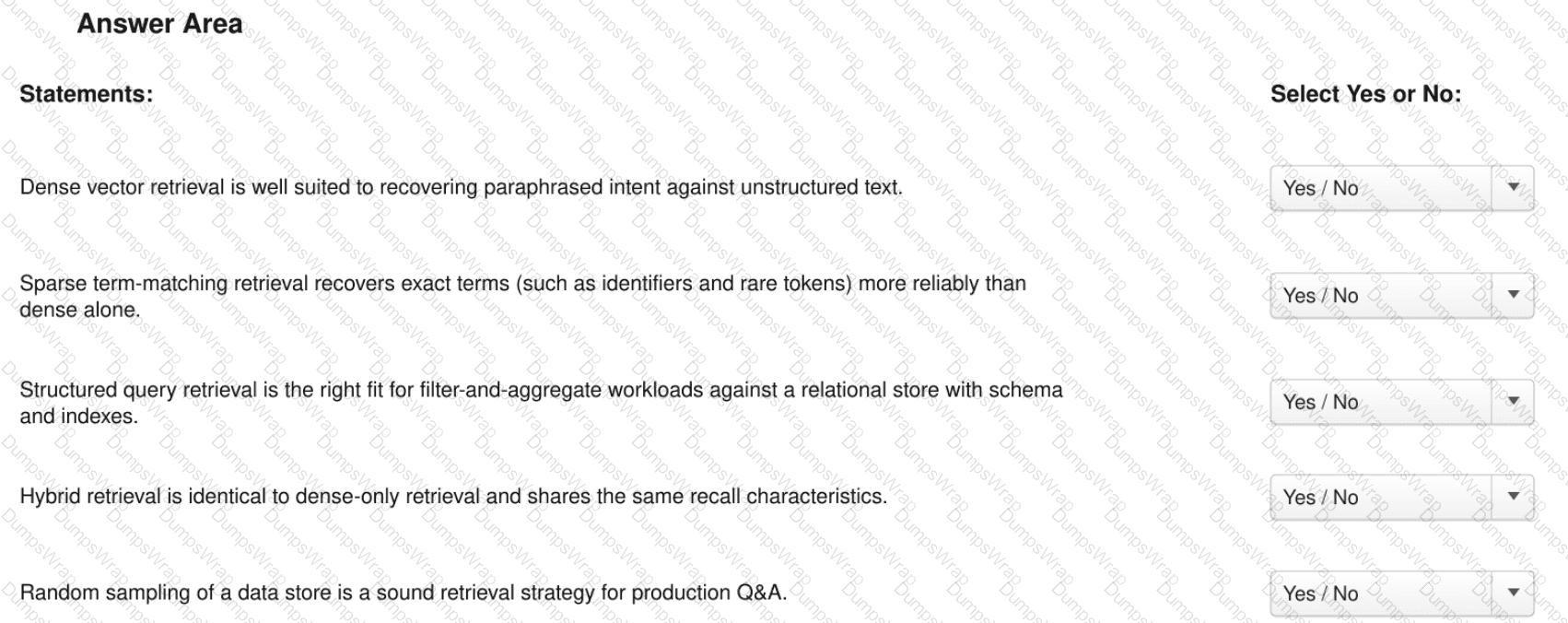
You are evaluating retrieval-strategy claims used by a peer team.

For each claim, select yes if the statement is generally accurate. Otherwise, select no.
as

Options:

Question 25

You are compiling team-setup practices for a Claude Code rollout across an engineering organization.

Which two practices belong on the list? (Select two.)

Each correct answer presents a complete solution.

Options:

A.

Use project scope for team-shared Model Context Protocol (MCP) servers and permission rules under version control.

B.

Apply managed configuration centrally for security-critical settings that must not be overridden by individual engineers.

C.

Use local scope for security-critical permission rules so each engineer can adapt them to ongoing work.

D.

Use user scope for team-shared MCP servers so every engineer on the team has consistent access.

E.

Use project scope for personal editor preferences so the preferences apply consistently within the project.

Question 26

You are rolling out a standardized Claude Code configuration to an engineering team and must complete the planning steps before piloting the configuration.

Which two steps must be completed BEFORE piloting the configuration with a small group of engineers? (Select two.)

Each correct answer presents part of the solution.

Options:

A.

Define the project-scope baseline covering Model Context Protocol (MCP) servers, permission rules, and subagents.

B.

Onboard every engineer in the organization to the new configuration through mandatory training sessions.

C.

Roll out the stabilized configuration to additional teams with documentation and a defined support channel.

D.

Identify the team workflows, security boundaries, and which decisions belong to managed configuration versus project scope.

E.

Iterate the configuration based on the pilot findings and stabilize the baseline before broader rollout.

Question 27

You are defining an SLA for a Claude-based assistant.

Which SLA definition is most operationally meaningful?

Options:

A.

A target tied to a stakeholder sentiment measure such as “the team feels satisfied,” which cannot be measured objectively or used to trigger a documented breach response.

B.

A measurable target with a defined metric, threshold, evaluation window, and consequence for breach—for example, “p95 per-request latency under 800 ms over a 28-day window.”

C.

A qualitative commitment such as “the system will be fast and reliable,” which names no metric, threshold, or evaluation window.

D.

A target that names the metric and threshold but omits the evaluation window and breach consequence, leaving compliance periods and remediation triggers undefined.

Question 28

You are running a risk assessment on a planned Claude-based deployment and must complete the inventory steps before assessing threats against assets.

Which two steps must be completed BEFORE assessing threats against assets to estimate likelihood and impact? (Select two.)

Each correct answer presents part of the solution.

Options:

A.

Document the assessment outcome with risks, mitigations, residual risk, and acceptance owners.

B.

Recommend mitigations and residual-risk acceptance for the risks that remain after analysis.

C.

Identify the assets that the deployment touches, along with the sensitivity of each asset.

D.

Recommend mitigations and residual-risk acceptance for risks that remain.

E.

Enumerate the threat actors and attack vectors relevant to the deployment.

Question 29

You are an architect supporting the iteration phase of a deployed Claude-based system.

Which activity most directly fits this phase?

Options:

A.

Rebuild the entire system architecture from scratch at the start of every iteration cycle regardless of what production telemetry, evaluations, and stakeholder feedback indicate is needed.

B.

Stop measuring production outcomes once the deployment has successfully launched, treating the go-live milestone as the end of the evaluation and iteration cycle.

C.

Discard the evaluation framework and reference set once the deployment is in production, accepting that future iterations will have no structured basis for measuring the impact of changes.

D.

Review production telemetry, sampled output evaluations, and stakeholder feedback to identify the highest-impact change for the next cycle, then plan the change against the evaluation framework.

Question 30

A loan pre-qualification assistant shows 94 percent approval recommendations that match the human underwriter decision. The fairness team has reviewed approval rate parity across protected groups and reported no significant difference. A board member has asked whether this evidence is sufficient to declare the assistant fair.

Which two Discernment-competency findings should you report? (Select two.)

Each correct answer presents part of the solution.

Options:

A.

Approval rate parity does not by itself assess error rate parity across protected groups.

B.

Match with human underwriters does not establish freedom from underwriter-introduced bias.

C.

The 94 percent match rate is sufficient evidence of fairness for the assistant’s decisions.

D.

The fairness team’s review process likely missed at least some of the protected groups studied.

E.

A larger sample is needed before any meaningful fairness claim can be made about the model.

Question 31

You must present an architectural recommendation to deploy a Claude-based contract review assistant to a steering committee that includes the CFO, the general counsel, and the CIO. Each stakeholder cares about different aspects of the decision.

How should you structure the recommendation document?

Options:

A.

Lead with the technical architecture diagram and the full component list before any other section.

B.

Lead with detailed cost projections across the full multi-year horizon before the rationale section.

C.

Present the same dense narrative throughout with no stakeholder differentiation in any section.

D.

Lead with the architectural decision, then address each stakeholder’s primary concerns directly.

Question 32

A managed agent deployment for claims triage has grown from 6 tools to 34 tools over 18 months as product teams added capabilities. Triage accuracy has declined from 91 percent to 78 percent, and average tool-selection latency has increased by 2.3 seconds. A junior engineer has proposed adding a tool-router agent in front of the current agent to filter the tool list per request.

Which two findings should you present to justify capability decomposition before adding the router? (Select two.)

Each correct answer presents part of the solution.

Options:

A.

Tool descriptions overlap across multiple claim categories within the agent’s tool set.

B.

Several tools have not been invoked across the most recent 90 days of traffic.

C.

The 34 tools serve four distinct claim-workflow domains within the triage scope.

D.

The router pattern is well documented across publicly available agent literature.

E.

The proposed router introduces an additional model call on every incoming request.

Question 33

You are supporting an EU-based deployment with GDPR obligations.

Which combination of measures best supports the deployment’s GDPR posture?

Options:

A.

enterprise-tier deployment with a signed Data Processing Addendum, defined data-retention configuration, redaction of personal data not needed for the task, and documented data-subject-rights handling

B.

disabling all data-retention configuration, redaction controls, and data-subject-rights handling to simplify day-to-day operations, accepting the resulting GDPR compliance exposure

C.

using a personal Claude account tier for processing EU personal data at scale, with no signed Data Processing Addendum and no documented data-subject-rights handling procedure

D.

pasting full EU personal data into every prompt to “give Claude complete context” without considering purpose limitation, data minimization, or the organization’s Data Processing Addendum obligations

Question 34

You are choosing the level of detail for an implementation guide. The audience is a delivery team that will build the deployment.

Which guidance composition best serves them?

Options:

A.

Component responsibilities, contracts between components, sequence diagrams of the dominant flows, configuration parameters with defaults, and operational runbooks.

B.

Component responsibilities and interface contracts only, without sequence diagrams of the dominant flows, configuration parameters with defaults, or runbooks to guide operational tasks.

C.

An architecture overview and sequence diagrams for the dominant flows, without interface contracts, configuration-parameter tables, or operational runbooks for the delivery team to follow.

D.

An architecture overview and a list of known limitations, without component-level diagrams, interface contracts, configuration parameters, or operational runbooks to support implementation.

Page: 1 / 11
Total 114 questions