
Certified Six Sigma Black Belt Questions and Answers
What is the primary benefit for using a statistical tolerance approach?
Options:
It provides the same results as a conventional tolerance approach.
It provides the designer with less latitude.
The tolerance on an individual part can be increased.
The tolerance on an individual part can be decreased.
Answer:
CExplanation:
The primary benefit of a statistical tolerance approach is that the tolerance on an individual part can be increased while still maintaining acceptable assembly or system performance. In DFSS and design engineering, conventional or worst-case tolerancing assumes that all component dimensions may simultaneously occur at their extreme limits, which often forces very tight individual tolerances. Statistical tolerancing recognizes that such simultaneous worst-case conditions are unlikely when component variation is random and controlled. By considering the statistical distribution of variation across parts, designers can often allow wider tolerances on individual components without sacrificing fit, function, or reliability of the final product. This provides greater manufacturing flexibility and can reduce production cost, scrap, inspection burden, and supplier difficulty. The method does not simply duplicate conventional results, nor does it reduce design latitude. In fact, it gives the designer more practical freedom by balancing performance requirements with realistic variation behavior. In Six Sigma design work, this supports robust product design and cost-effective manufacturability. Therefore, the correct answer is that the tolerance on an individual part can be increased.
===========
In hypothesis testing, if α = 0.05 and β = 0.10, what is the power of the test?
Options:
0.05
0.90
0.95
10.00
Answer:
BExplanation:
The correct answer is B. 0.90 . In CSSBB hypothesis testing, the power of a test is defined as 1 − β , which is the probability of rejecting the null hypothesis when the null hypothesis is actually false. The CSSBB source explicitly states that 1 − β = Probability of rejecting the null hypothesis given that the null hypothesis is false . With β = 0.10 , the power is:
Power = 1 − 0.10 = 0.90
The same CSSBB supplemental material also explains that beta risk of 0.10 is normally associated with a power to detect of 90% , which confirms the calculation directly. Alpha, by contrast, is the risk of a Type I error, meaning rejecting a true null hypothesis. Although alpha and beta are related in test design, power is calculated specifically from beta, not from alpha. This concept is important in Six Sigma because Black Belts must ensure that hypothesis tests are sensitive enough to detect meaningful differences in process performance. Therefore, when α = 0.05 and β = 0.10, the verified power of the test is 0.90 .
Which of the following is a factor in a designed experiment for the process of baking a pie?
Options:
Flavor of the pie
Texture of the pie
Color of the crust
Cooking time
Answer:
DExplanation:
In DOE terminology, a factor is an input variable that the experimenter deliberately controls or changes to study its effect on a response. For a pie-baking process, cooking time is an input setting and therefore qualifies as a factor. By contrast, flavor, texture, and crust color are typically outputs or response characteristics that result from the chosen factor settings. The CSSBB and related Lean Six Sigma experimental-design materials describe factors as variables adjusted at selected levels, while responses are the measured outcomes used to judge the effect of those settings. For example, time, temperature, ingredient quantity, or oven setting are common factors in a food-processing experiment, whereas quality attributes such as doneness, appearance, and texture are responses. This distinction is fundamental in the Improve Phase because DOE is used to determine which controllable inputs drive desired outputs. A Black Belt must clearly separate Xs from Ys: factors are the Xs and results are the Ys. In this question, cooking time is the only controllable input variable listed, so it is the correct factor in the experiment.
===========
A process improvement team needs to determine whether there is a sufficient cost-benefit to warrant continuing a machine rebuild effort. Which of the following tools should the team use to make this decision?
Options:
Contingency table
Paired comparison
Control chart
Prioritization matrix
Answer:
DExplanation:
The best answer is D. Prioritization matrix . The CSSBB-aligned project-selection material states that benefit/cost analysis is a systematic way of weighing an option’s benefits against its costs to determine whether the effort is worthwhile or profitable. It also notes that projects should be evaluated based on financial impact and business value. In this question, the team must decide whether to continue a machine rebuild effort based on cost-benefit. Among the listed tools, the prioritization matrix is the best fit because it allows the team to compare decision criteria such as cost, benefit, risk, time, and feasibility in a structured way.
The other options do not match the decision need. A contingency table is for categorical data analysis, paired comparison is too limited for a broader business decision with multiple criteria, and a control chart is for monitoring variation over time. Since the team is making a go/no-go decision based on value versus effort, the most appropriate tool from the answer choices is the prioritization matrix , supported by the CSSBB emphasis on benefit/cost-based project evaluation.
Which of the following describes the two-level fractional-factorial design for studying k = N−1 variables in N runs, where N is a multiple of 4?
Options:
Latin square design
Plackett-Burman design
Full-factorial design
Resolution IV design
Answer:
BExplanation:
The design described is a Plackett-Burman design. This screening design is a two-level fractional factorial approach used to study many variables efficiently in a relatively small number of runs. A defining feature is that it can study k = N−1 factors in N runs, where N is a multiple of 4. This makes it especially useful in Six Sigma Analyze and Improve work when the team needs to screen a large number of potential factors quickly to identify the few that are likely to matter most. It is not a full factorial design because full factorial experiments require many more runs as the number of factors increases. It is not a Latin square design, which is used to control for two nuisance variables. Resolution IV is a classification of certain fractional factorial designs, but the formula given in the question specifically identifies the Plackett-Burman structure. For Black Belts, this design is valuable when resources are limited and the first objective is factor screening rather than detailed interaction modeling. Therefore, the correct answer is B, Plackett-Burman design.
The ultimate goal of benchmarking is to
Options:
acquire information to develop corporate strategies
determine the industry performance level
achieve best-in-class performance
identify industry leaders and competitors
Answer:
CExplanation:
The correct answer is C. achieve best-in-class performance . The CSSBB-aligned benchmarking material defines benchmarking as determining the best practices, performance, products, or services for comparison to one’s own organization, and it notes that “best” becomes the standard to beat . This directly supports the idea that benchmarking is not just about gathering information or identifying leaders; its real purpose is to drive the organization toward superior performance.
Benchmarking can certainly help identify industry leaders, establish reference points, and support strategic thinking, but those are intermediate uses rather than the ultimate objective. The end goal is performance improvement through learning from the best available standard. The same material lists best-in-class benchmarking as a distinct form, asking which competitor is functionally best, which reinforces that organizations benchmark in order to close performance gaps and move toward top-tier capability. In Six Sigma and Lean environments, benchmarking is valuable only if it leads to improved results, not just comparison. Therefore, the best verified answer is C. achieve best-in-class performance .
A patient arrives at the clinic at noon and was called into an exam room at 12:43 pm by a nurse for a blood draw. The blood draw tubes were not available in the exam room, so the nurse went to the clinic supply room and found that no blood draw tubes were left. In addition to waiting, which of the following forms of waste were present?
Options:
Inventory
Overproduction
Motion
bottleneck
Answer:
CExplanation:
The best answer is C. Motion . In Lean Six Sigma, waiting is one waste, but the question asks what additional waste was present. The CSSBB-aligned materials define motion as unnecessary movements by people , such as walking or searching, and define inventory as excess products and materials not being processed . In this scenario, the nurse had to leave the exam room and walk to the supply room because the tubes were not available where needed. That extra walking is classic motion waste .
Option A may seem plausible because tubes were unavailable, but the problem describes a stockout , not excess inventory. Lean defines inventory waste as having too much material tied up in the process, not having none at all. Overproduction is also not present, and “bottleneck” is not one of the standard waste categories. Therefore, besides the patient’s waiting time, the clearly identifiable additional waste is the nurse’s unnecessary movement to search for supplies. That makes Motion the best verified answer from the options provided.
Which of the following terms describes risk associated with raw material pricing within a monthly budget cycle?
Options:
Volatility
Uncertainty
Complexity
Ambiguity
Answer:
AExplanation:
The correct answer is Volatility because the issue described is variation in price over time within a budgeting period. In management and business-risk language commonly used alongside Six Sigma financial thinking, volatility refers to the speed and magnitude of change, especially in costs, prices, demand, or financial performance. Raw material pricing that moves up and down during a monthly budget cycle is a classic example of volatility, because the risk is tied to fluctuation rather than to lack of meaning, excessive interdependence, or incomplete clarity. Uncertainty refers more broadly to not knowing what will happen or what the probabilities are. Complexity refers to many interacting variables and dependencies. Ambiguity refers to unclear meaning or interpretation. The phrase “raw material pricing within a monthly budget cycle” points most directly to variable swings in cost, which is volatility. I did not locate a direct excerpt for this exact item in the uploaded CSSBB text, so this answer is based on standard Black Belt and management terminology used in business-risk contexts. The verified answer remains Volatility.
===========
When developing a control chart, a team should monitor only those characteristics that
Options:
contribute to common cause variation
contribute to the overall quality of a product
have a history of unreliability
have measures using variables or attributes data
Answer:
BExplanation:
The CSSBB Control Phase emphasizes that teams should be selective about what they place on control charts. The instructor material warns against charting every characteristic because doing so can overwhelm operators and reduce the effectiveness of monitoring. Instead, the team should choose characteristics that matter to process control and product quality. The cited guidance lists considerations such as key process variables that impact the product, major sources of customer complaints, items tied to safety or standards, and variables that help control the process. Among the answer choices, the best match is characteristics that contribute to the overall quality of a product. This reflects the principle that control charts should focus on meaningful product or process characteristics, not just any measurable feature. Characteristics that merely have a history of unreliability may matter, but that is narrower than the broader quality-based selection criterion. Likewise, “having variables or attributes data” is not enough by itself, since many measurable things are not worth charting. Therefore, the correct answer is the characteristics that contribute to the overall quality of the product.
===========
When an organization is identifying a Six Sigma project, a Black Belt should work with area management to determine the
Options:
rolled throughput yield
process capability as Cpk
needs of the business
measurement system requirements
Answer:
CExplanation:
The correct answer is C. needs of the business . The CSSBB supplemental material explains that organizations should align business by process to achieve business objectives and discusses methods for selecting high-impact projects . It also states that the project selection strategy aligns projects with specific short- and long-term business strategies . This shows that when identifying a Six Sigma project, the Black Belt should work with area management first to understand what the business actually needs.
Metrics such as rolled throughput yield, Cpk, or measurement system requirements may become important later in project definition and measurement, but they are not the first strategic basis for deciding which project to pursue. Six Sigma projects should be chosen because they address meaningful business priorities such as customer needs, cost, delivery, quality, or strategic objectives. Therefore, the project-identification discussion with management should center first on the needs of the business , making C the verified CSSBB answer.
The following control chart was developed by a continuous improvement team.
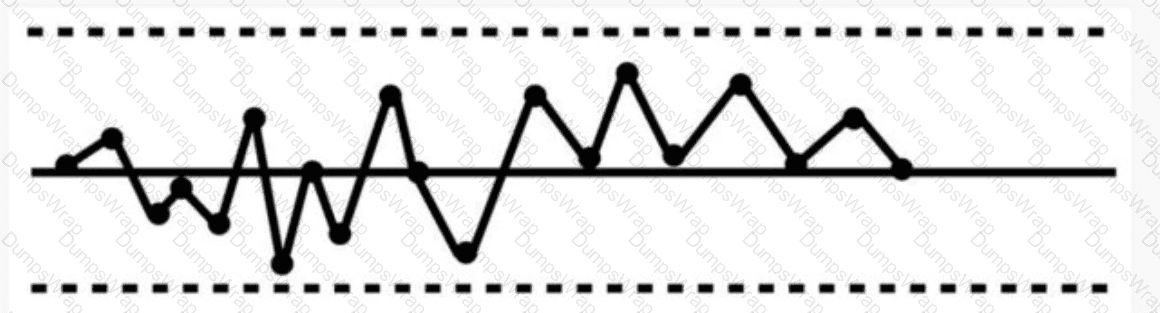
The process in this chart shows a pattern known as
Options:
a shift
a trend
periodicity
stratification
Answer:
CExplanation:
The correct answer is C. periodicity . The chart shows a repeated up-and-down cycling pattern around the centerline rather than a sustained movement in one direction or a long cluster on one side of the centerline. The CSSBB supplemental material describes a systematic variable pattern as one in which points are cycled , such as high-then-low or low-then-high. That description corresponds most closely to periodicity among the answer choices.
A shift would show a run of points staying mostly above or below the centerline. A trend would show several consecutive points steadily increasing or decreasing. Stratification refers to very small variation relative to the control limits, with points clustering unusually close to the centerline. In this chart, the more obvious signal is the regular oscillation pattern. That kind of repeating cycle often suggests a recurring external influence such as shifts, alternating methods, environmental cycles, or periodic adjustments. Therefore, the best CSSBB-aligned answer is C. periodicity .
Which of the following tools could be used during the optimize phase of a DMADOV project?
Options:
Design of experiments
Quality function deployment (QFD)
Critical-to-quality (CTQ) tree
Failure mode and effects analysis (FMEA)
Answer:
AExplanation:
The best answer is A. Design of experiments . The CSSBB DFSS material states that in the optimize stage of the IDOV model, the team uses process capability information, statistical tolerancing, and robust design . Robust design and optimization commonly rely on experimental methods, and the DOE material further explains that design of experiments is used to determine settings for the inputs to optimize the response .
Although the cited optimize description is shown under IDOV, the same optimization intent carries into DMADOV , which explicitly contains an Optimize phase. Among the answer choices, DOE is the tool most directly associated with optimization. QFD and CTQ trees are primarily front-end customer-requirement tools, while FMEA is mainly used for anticipating failure modes and risk. Therefore, the tool that could be used during the optimize phase is Design of experiments , making A the verified best answer.
After gathering data from a benchmarking study, the team should develop a gap analysis to
Options:
provide input for organizational change
analyze the causes of critical issues
identify possible causes of the problem
create a critical path for the project
Answer:
AExplanation:
The correct answer is provide input for organizational change. In the CSSBB Analyze material, benchmarking is identified as one of the techniques that can be employed for gap analysis. The purpose of a gap analysis is to compare the current condition with a desired or benchmarked condition, summarize the differences, and convert those findings into clear action plans for management. The text explains that assessment results are analyzed and presented to management, and that effective use of the assessment requires clear action plans to be developed and implemented. That makes gap analysis a bridge between collected benchmarking data and change action across the organization. It is not primarily a root-cause tool, so option B is not the best fit, and it is not used to create a critical path, which is a project scheduling activity. While identifying possible causes can happen elsewhere in Six Sigma, the direct purpose here is to translate the benchmark comparison into improvement direction and organizational action. Therefore, once benchmarking data have been gathered, the team should use gap analysis to provide input for organizational change.
Which of the following Theory of Constraints (TOC) elements is designed to decrease inventory or investment?
Options:
A reduction in work-in-process
A reduction in cycle time
An increase in repeat business
An increase in total sales
Answer:
AExplanation:
The correct answer is A. A reduction in work-in-process . In the CSSBB materials, TOC uses three primary system measures: throughput , inventory , and operational expenses . Inventory is defined as all the money the system has invested in purchasing things it intends to sell, or in practical terms, money that is tied up inside the system rather than converted into sales. Reducing work-in-process (WIP) directly lowers the amount of material and partially completed work sitting in the process, which reduces the amount of money trapped in inventory or investment.
This is fully aligned with TOC thinking because bottlenecks and poor flow tend to increase queue sizes and WIP. The CSSBB source stresses balancing flow with market demand rather than maximizing local utilization, which helps prevent excess buildup of inventory. While reducing cycle time can be beneficial, it is not as directly tied to decreasing inventory as reducing WIP. Increasing repeat business or total sales relates more to throughput generation than to reducing internal investment. Therefore, the TOC element most clearly designed to decrease inventory or investment is a reduction in work-in-process .
When a team is performing an analysis of variance (ANOVA), which of the following conditions would indicate the need to transform the data?
Options:
There is evidence of outliers in the raw data.
The residuals indicate a non-constant variance.
The residuals show patterns of completely random behavior.
A normal probability plot of residuals exhibits a completely linear relationship.
Answer:
BExplanation:
The correct answer is B. The residuals indicate a non-constant variance . ANOVA assumes that residuals are approximately normal and that the variance is reasonably constant across groups. When residual plots show non-constant variance , this signals a violation of model assumptions and often indicates that the data should be transformed before interpreting the ANOVA results. The CSSBB materials note that when data are not normal or do not satisfy assumptions for analyses such as t-tests, ANOVA, and process capability , one appropriate action is to transform the data , often using a logarithmic or other power transformation. The CSSBB source also discusses common transformations such as log, square root, exponential, and reciprocal, with Box-Cox cited as a useful technique for finding an appropriate transformation.
By contrast, completely random residual behavior is generally desirable because it suggests no obvious pattern remains. A completely linear normal probability plot also supports the adequacy of the assumptions. Outliers may require investigation, but they do not automatically imply that transformation is the right response. The clearest indicator here is non-constant variance , so B is the verified best answer.
If the number of occurrences of a certain event during a defined time interval follows a Poisson distribution, and is constant over time, the amount of time that elapses between occurrences is
Options:
binomial
exponential
normal
lognormal
Answer:
BExplanation:
The correct answer is B. exponential . In CSSBB probability and distribution topics, the Poisson distribution is used to model the number of occurrences in a fixed interval , such as defects per unit, accidents per day, or failures per month. When those occurrences happen at a constant average rate and independently over time, the time between successive occurrences follows an exponential distribution . The CSSBB material explicitly states that the exponential distribution is closely related to the Poisson distribution and is used to model items with a constant failure rate . It also notes that the exponential distribution has a constant hazard function and exhibits lack of memory , which is a defining property for interarrival or waiting times.
The other options are not correct in this context. Binomial models the number of successes in a fixed number of trials, normal models many continuous symmetric variables, and lognormal is used for positively skewed continuous data after logarithmic transformation. Therefore, for Poisson events occurring at a constant rate, the elapsed time between events is exponentially distributed .
If xₘ equals the measured value and x equals the true value, which of the following equations should be used to calculate measurement system bias?
Options:
xₘ / x
xₘ − x
(xₘ − x) / x
|xₘ − x|
Answer:
BExplanation:
The correct answer is B. xₘ − x . The CSSBB source defines bias as the difference between the output of the measurement system and the true value . It is often referred to as accuracy . The formal definition in the instructor text is the average measured value minus the value of the standard or true value.
Using the notation in this question, where xₘ is the measured value and x is the true value, the bias is simply:
Bias = xₘ − x
This gives both the size and the direction of the bias. If the result is positive, the gage overestimates. If it is negative, the gage underestimates. That is important in Six Sigma measurement system analysis because the team needs to know not only how far off the measurement system is, but also whether it consistently reads high or low. The ratio in option A is not the definition of bias, option C is a relative or percent-type expression, and option D removes the direction of the error. Therefore, the verified CSSBB answer is B .
A healthcare company is preparing to implement a new electronic medical records database system. The IT team has warned management about possible problems that could occur during and immediately after implementation, such as missing patient accounts, missing lab values, and incorrect medication order sets. Which of the following tools should management use to mitigate these risks?
Options:
Failure mode and effects analysis
Waste analysis
Root cause analysis
Pareto analysis
Answer:
AExplanation:
Failure mode and effects analysis is the most appropriate tool because the situation involves anticipating possible failures before or during implementation and taking preventive action to reduce risk. In Six Sigma and healthcare process improvement, FMEA is used proactively to identify potential failure modes, assess their likely effects on customers or patients, estimate severity, occurrence, and detection, and prioritize actions before problems happen. The examples in this question, such as missing accounts, missing lab values, and incorrect medication order sets, are exactly the kind of implementation risks that should be evaluated through a structured pre-launch risk review. Waste analysis focuses on non-value-added activity, root cause analysis is typically used after a failure has already occurred, and Pareto analysis is used to prioritize categories of existing problems. Because management is trying to prevent harm and reduce implementation risk in advance, the correct tool is FMEA. This aligns with Black Belt expectations in Analyze and Improve work, where risk is assessed before deployment so that controls, safeguards, and contingency plans can be built into the new process.
===========
Which of the following is the best tool to use to identify the specific tasks needed to complete a project?
Options:
PERT
Activity network diagram
Work breakdown structure
Critical path method
Answer:
CExplanation:
The correct answer is C. Work breakdown structure . The CSSBB source states that the work breakdown structure (WBS) is a detailed plan that expands the project statement of work into a detailed listing of activities required to complete the project . It further explains that each project task is divided into smaller activities until responsibility can be clearly assigned.
This makes WBS the best tool for identifying the specific tasks needed to complete a project. The same CSSBB section also notes that the WBS helps identify detailed activities for the plan, while tools such as PERT , Gantt charts , and critical path method are used more for evaluating project timelines and sequencing once the activities are known. A PERT chart and an activity network diagram focus on ordering tasks and estimating durations, while CPM identifies the critical path through the network. None of those is as directly focused on decomposing the project into detailed task elements as the WBS. Therefore, the verified CSSBB answer is C. Work breakdown structure .
Which of the following actions is an example of a kaizen project?
Options:
Redefining product specifications
Relocating a manufacturing facility overseas
Partnering with suppliers to improve quality issues
Designing a next-generation product
Answer:
CExplanation:
The correct answer is C. Partnering with suppliers to improve quality issues . The CSSBB source defines kaizen as continuous, incremental improvement involving everyone, with emphasis on improving processes , maintaining and improving standards, using PDCA/PDSA cycles, and solving problems with data. The supporting Lean Six Sigma material also describes kaizen as small incremental improvements that add up over time rather than large, radical change.
Among the choices, partnering with suppliers to improve quality issues is the one that best reflects a practical, process-focused, continuous-improvement effort. It is targeted, collaborative, and aimed at improving ongoing performance rather than creating a wholly new design or making a major strategic relocation. Redefining product specifications and designing a next-generation product are more aligned with design or innovation activities, while relocating a facility overseas is a major strategic business change, not kaizen. Since kaizen focuses on improving existing processes and quality through incremental action, partnering with suppliers to improve quality issues is the best example. Therefore, the verified answer is C .
Gauge traceability requires an unbroken chain of calibrations from each gauge to
Options:
a single set of standards used throughout the entire organization
a certified standard that has a valid relationship to national or international standards
an internal company standard that is correlated with appropriate ISO standards
an internal company standard that is correlated with the standard recommended by the gauge manufacturer
Answer:
BExplanation:
The correct answer is B. a certified standard that has a valid relationship to national or international standards . In the CSSBB metrology and calibration material, calibration standards are described in levels, culminating in national and international standards , which are identified as the final authority of measurement to which all standards are traceable . The text also explains that working-level gauges are connected through an unbroken hierarchy of calibration standards, functional standards, and reference standards until they ultimately trace back to recognized national and international authorities.
This means traceability is not merely an internal company relationship or a manufacturer recommendation. It must connect to an accepted certified standard whose validity can be linked to recognized national or international standards, such as NIST-related references. Option A is too narrow because an organization-wide standard alone is not enough unless it is itself traceable upward. Options C and D are also insufficient because internal correlation does not establish full metrological traceability. In Six Sigma measurement systems, confidence in data depends on this documented calibration chain. Therefore, the correct and verified answer is B .
The primary benefit of using a project charter is that it
Options:
ensures that the team members understand the causes of issues
provides the project management tools to be used by the team
ensures that stakeholders will support the project
ensures the team will work to meet expectations
Answer:
DExplanation:
The best answer is D. ensures the team will work to meet expectations . The CSSBB source defines a project charter as a written document that defines the team’s mission, scope, objectives, time frames, and consequences. It also states that identifying these details in written form provides a constant and consistent target for the team . The charter’s listed advantages include eliminating confusion, defining boundaries, identifying deliverables, and providing a basis for team goal setting.
That means the charter’s primary benefit is to align the team around what is expected so they can work toward those defined expectations. It does not guarantee stakeholder support, nor does it provide all project management tools. It also does not ensure that team members already understand root causes, since root-cause analysis comes later. While option D is not stated word-for-word in the source, it is the closest interpretation of the charter’s function as a consistent target and expectation-setting document. Therefore, the verified best answer is D .
Which of the following equations is used to calculate process capability for attribute data?
Options:
DPMO = DPO × 1,000,000
Cp = (USL − LSL) / 6σ
Pp = (USL − LSL) / 6σlt
r = Sxy / √(SxSy)
Answer:
AExplanation:
The correct answer is A. DPMO = DPO × 1,000,000 . In CSSBB, attribute data are discrete counted data such as defects, defectives, pass/fail outcomes, or error counts. For this type of data, process performance is commonly expressed using defects per unit (DPU) , defects per opportunity (DPO) , and defects per million opportunities (DPMO) rather than variable-data capability indices like Cp or Pp . The CSSBB materials distinguish capability indices such as Cp and Pp as formulas for continuous variable data with specification limits, while attribute performance uses defect-based metrics.
Among the listed equations, only DPMO = DPO × 1,000,000 applies to attribute data capability/performance measurement. Option B and option C are variable-data capability formulas based on the spread of a measured continuous characteristic relative to specification limits. Option D is the correlation coefficient formula and is unrelated to capability. Therefore, when the question asks for the equation used to calculate process capability for attribute data , the best CSSBB-aligned answer is A .
The primary reason for identifying both the internal and external customers of a process is to
Options:
estimate financial costs of meeting customer needs
motivate teams to work more efficiently with the customers
incorporate Lean into the organizational culture
understand how the customers interact with the process
Answer:
DExplanation:
The correct answer is D. understand how the customers interact with the process . The CSSBB source explains that both internal and external customers must be identified, along with their requirements, in order to understand and improve the business process . The SIPOC model reinforces this by showing the relationship among suppliers, inputs, process, outputs, and customers , helping the team see how outputs connect to customers and how the process affects them.
This is the main reason for identifying all customer groups: the team must understand who receives the output, what they require, and how they are connected to the process flow. Internal customers often represent the next downstream operation, while external customers are the ultimate users or buyers. If either group is ignored, the team can misunderstand the true requirements and improve the wrong part of the process. The other options are secondary or unrelated. Customer identification is not primarily about estimating cost, motivating the team, or building Lean culture. It is fundamentally about understanding the process-customer relationship so requirements can be translated correctly into improvement actions. Therefore, D is the verified answer.
A Six Sigma team conducted a study of a process and found that the expected chemical reaction failed to initiate on an average of 1 batch per day. If the number of failures historically follows a Poisson distribution, what is the probability of exactly 3 batches failing to initiate on a single day?
Options:
0.008
0.061
0.180
0.370
Answer:
BExplanation:
The correct answer is B. 0.061 . In the CSSBB probability material, the Poisson distribution is used for the number of occurrences per unit interval, and its probability mass function is given as P(X = x) = λˣe^-λ / x! , where λ is the average number of occurrences in the interval. In this question, the average number of failures is 1 batch per day , so λ = 1 , and the probability of exactly 3 failures in one day is:
P(X = 3) = (1³ × e^-1) / 3! = e^-1 / 6 ≈ 0.3679 / 6 ≈ 0.0613
Rounded to three decimal places, this is 0.061 . This is directly consistent with the CSSBB treatment of Poisson distributions for events such as failures, defects, or breakdowns occurring over time.
The other options are not correct because they either substantially understate or overstate the exact probability. Since Poisson models count data over a fixed interval and the average rate is known, this is the appropriate Six Sigma method for solving the problem. Therefore, the verified answer is B .
Which of the following benefits can be realized directly from a complete, well-defined process map?
Options:
Quantitative analysis of the process input and output variables
Development of an attributes control chart
Development of a variables control chart
Insight into the process that is not otherwise apparent
Answer:
DExplanation:
A complete, well-defined process map gives the team a structured visual understanding of how work actually flows, including handoffs, rework loops, delays, decision points, interfaces, and hidden complexity. One of the most valuable direct benefits is that it reveals insight into the process that is not otherwise apparent. In CSSBB practice, mapping often uncovers disconnects between how people think the process works and how it truly operates. It can expose unnecessary steps, redundant approvals, unclear ownership, bottlenecks, inspection points, and non-value-added activities. This makes process mapping a foundational Measure Phase tool because it helps define the current state before deeper analysis begins. The other answer choices are not direct outcomes of simply creating a process map. Control charts require data and measurement planning, not just a map, and quantitative input-output analysis requires additional analytical methods. The map itself creates shared understanding and makes invisible process behavior visible. Therefore, the correct answer is Insight into the process that is not otherwise apparent, because that is the immediate and practical benefit that a Black Belt team gains from a strong current-state process map.
===========
A team would use the results of a gap analysis to
Options:
set goals for improving a process
determine process failure modes
reduce process cycle times
justify the need for designed experiments
Answer:
AExplanation:
The correct answer is A. set goals for improving a process . The CSSBB supplemental material explains that gap analysis compares the current state with the desired future state and is fundamentally about goals and targets . It states that goals must have targets and that gap analysis helps teams understand what must be done to move from the present condition to the desired benchmark or future condition. The same source notes that gap analysis helps identify priorities, keeps the team focused, and helps determine what tools, tasks, and activities are needed to close the gap.
Because of this, the primary use of gap analysis results is to define improvement objectives and targets for the process. It does not directly determine failure modes, which is more aligned with FMEA. It may support cycle-time reduction efforts, but that is a possible outcome, not the core purpose of the analysis itself. It also does not specifically justify DOE. In Six Sigma and Lean planning, gap analysis is used to establish where the organization is, where it wants to be, and what goals should guide the improvement effort. Therefore, the best answer is A .
A statistical process control chart is used primarily to
Options:
determine the sources of product or service failure
develop a sampling strategy
identify different types of variation
assure acceptability of sampled lots
Answer:
CExplanation:
The correct answer is C. identify different types of variation . According to the CSSBB material, Statistical Process Control (SPC) applies statistical analysis to measure, monitor, and control processes, and its major tool is the control chart . The reference explains that all processes are subject to variation and that this variation is classified into two types: chance cause variation and assignable cause variation . One of the primary purposes of control charts is to distinguish between these sources of variation so that assignable causes can be investigated and eliminated.
The CSSBB text also describes control charts as powerful tools for analyzing variation and determining whether a process is stable and predictable. While control charts may help indicate when corrective action is needed and may support investigation into sources of failure, their primary use is not to directly determine specific failure sources, design a sampling strategy, or make lot acceptance decisions. Acceptability of sampled lots is more closely related to acceptance sampling , not SPC charting. Therefore, the best answer is the one that aligns with the central purpose of SPC in Six Sigma: recognizing and separating normal process variation from special-cause variation.
Displayed performance indicators is an example of
Options:
control plans
visual controls
reliability-based maintenance
a kanban system
Answer:
BExplanation:
Displayed performance indicators are an example of visual controls because they make process status, results, or abnormalities immediately visible to the people managing and operating the process. In the Control Phase, visual controls are used to support sustainment by allowing rapid recognition of whether performance is normal, improving, or off target. Examples include dashboards, scoreboards, hour-by-hour charts, color coding, and posted metrics showing quality, delivery, safety, or productivity status. Their value lies in making the condition of the process easy to understand without requiring detailed analysis before action can be taken. A control plan is a broader document that defines what to monitor, how to monitor it, and what reaction is required. Reliability-based maintenance is a maintenance strategy, and kanban is a pull-system signaling method for material or production replenishment. Displayed indicators fit most directly under visual controls because they communicate operational status in a simple, immediate, and actionable format. Therefore, the correct answer is B, visual controls, since the key characteristic is visible communication of process performance.
===========
Which of the following factors is commonly considered when completing a stakeholder analysis?
Options:
Process improvement skill
Current attitude toward proposed change
Honesty
Project familiarity
Answer:
BExplanation:
The correct answer is B. Current attitude toward proposed change . In the stakeholder-analysis material, the source defines stakeholder analysis as evaluating stakeholder needs and creating a plan to manage stakeholder attitudes . It also provides a stakeholder-mapping example that explicitly includes Current Attitude and Desired Attitude as standard fields in the analysis.
That means a team should not only identify who the stakeholders are, but also assess how each person currently feels about the project and what level of support is needed moving forward. This is important because stakeholder commitment, resistance, and communication needs directly influence project success. The other options may matter in some broader team context, but they are not the common, documented elements of stakeholder analysis shown in the CSSBB-aligned reference. In particular, “honesty” and “project familiarity” are not listed as the core mapping dimensions, while current attitude clearly is. Therefore, the verified answer is B. Current attitude toward proposed change .
The primary reason for calculating the appropriate sample size for a hypothesis test is
Options:
saving time, money, and other resources
making it easier to determine confidence intervals
ensuring results are statistically significant
satisfying a requirement before hypothesis testing can start
Answer:
AExplanation:
The primary reason for calculating an appropriate sample size is to use resources efficiently while still obtaining data sufficient to support a valid statistical conclusion. In Six Sigma Measure Phase work, sample-size planning helps balance information quality against the cost of data collection. If the sample is too small, the test may lack power and fail to detect a meaningful effect. If it is too large, the organization may waste time, labor, money, and materials collecting more data than necessary. Therefore, determining sample size in advance is a practical and statistical decision that helps Black Belts design efficient studies. It is not primarily done to guarantee statistical significance, because significance depends on the true effect size, variation, and chosen alpha level. It also is not just an administrative requirement or mainly a confidence-interval convenience step. Good sample-size planning supports sound experimentation, effective data collection, and responsible use of organizational resources. Therefore, the correct answer is A, saving time, money, and other resources, because that best reflects the purpose of determining a proper sample size before conducting a hypothesis test.
===========
Which of the following tools would best be used to depict motion waste?
Options:
Swim lane flowchart
Spaghetti diagram
Value stream map
Backward tracing
Answer:
BExplanation:
The correct answer is B. Spaghetti diagram . In the CSSBB material, spaghetti diagrams are described as useful for showing the flow of people, information, or material through a process. This makes them especially effective for identifying motion waste , because they visually reveal unnecessary travel, excessive movement, backtracking, and poor layout patterns. In Lean, motion is one of the classic forms of muda , or non-value-added activity. The CSSBB glossary and related Lean material define waste to include unnecessary movements , which directly connects motion waste to this type of visual analysis.
A swim lane flowchart is better for showing responsibility across functions, and a value stream map is more suited to the broader end-to-end flow of material and information, including lead time and inventory. Backward tracing is not the standard Lean tool for displaying operator or material movement. Because a spaghetti diagram physically maps the path taken through the workspace, it best exposes wasted motion and layout inefficiency. Therefore, from a CSSBB perspective, the best tool to depict motion waste is the spaghetti diagram .
A Black Belt is managing a team that encounters an organizational problem caused by conflicting management goals. To help resolve this situation, the Black Belt should do which of the following first?
Options:
Ask the team to prioritize the conflicting goals
Facilitate a meeting with the managers whose goals are in conflict
Instruct the team to ignore the conflict
Prioritize the goals in terms of the seniority of the managers
Answer:
BExplanation:
The correct answer is B. Facilitate a meeting with the managers whose goals are in conflict . In CSSBB team management, the facilitator and team leader are expected to support conflict resolution , reinforce participation, and help the right people address issues that affect team progress. The team-meeting guidance specifically includes conflict resolution as part of effective meeting structure and asks teams to define how conflict will be managed.
Because this conflict is caused by management goals , the issue is above the team’s authority level and should be addressed directly with the managers involved. Asking the team to prioritize management goals would push the team into a decision that belongs to leadership. Ignoring the conflict would allow misalignment to continue, and ranking goals by manager seniority is not a sound Six Sigma approach. The first step should be to bring the relevant managers together in a structured discussion so the competing goals can be clarified, aligned, or escalated appropriately. Therefore, the best CSSBB-based answer is B .
Which of the following tools is a project management technique designed to determine communication protocols and level of involvement for key personnel when decisions are being made?
Options:
Toll-gate
Activity network diagram
Project charter review
RACI
Answer:
DExplanation:
RACI is the project management tool used to define communication expectations and involvement levels for key personnel during decisions and project execution. RACI stands for Responsible, Accountable, Consulted, and Informed. It helps clarify who performs the work, who owns the outcome, who must be consulted before decisions are finalized, and who needs to be kept informed. In cross-functional Six Sigma projects, this is essential because unclear roles often lead to delays, duplicated effort, poor communication, or decision conflicts. By making involvement explicit, the RACI model improves governance, accountability, and stakeholder coordination. A toll-gate is a phase review checkpoint, not a communication-role mapping tool. An activity network diagram focuses on sequencing tasks and dependencies. A project charter review confirms project alignment and readiness but does not assign decision-role relationships in the same structured way. In Black Belt project leadership, RACI is especially useful when many departments or leaders are involved and the team must define participation boundaries clearly. Therefore, the correct answer is RACI, because it directly establishes communication protocol and level of involvement for key personnel.
===========
Which of the following criteria should be used to select rational subgroups for control chart sampling?
Options:
Homogeneity within subgroups: High; Chance for differences between subgroups: Minimized
Homogeneity within subgroups: High; Chance for differences between subgroups: Maximized
Homogeneity within subgroups: Low; Chance for differences between subgroups: Minimized
Homogeneity within subgroups: Low; Chance for differences between subgroups: Maximized
Answer:
BExplanation:
The correct answer is B. Homogeneity within subgroups: High; Chance for differences between subgroups: Maximized . The CSSBB control-chart material states that subgroups are selected in a way that makes each subgroup as homogeneous as possible and that gives the maximum opportunity for variation from one subgroup to another . This is the exact principle of rational subgrouping .
The logic is central to Shewhart charting. Within a subgroup, samples should represent conditions that are as similar as possible so that the short-term, common-cause variation is captured inside the subgroup. Across subgroups, the chart should have the best chance to reveal time-to-time or lot-to-lot changes, which is why the opportunity for differences between subgroups should be maximized. The CSSBB source further explains that when product is taken as nearly as possible at one time, this gives a minimum chance for variation within a subgroup and a maximum chance for variation from subgroup to subgroup . Therefore, the verified answer is B , which exactly matches the CSSBB definition of rational subgroup selection.
The gains made as the result of an improvement process can best be maintained by taking which of the following actions?
Options:
Aligning the project results with the organizational goals and objectives
Adjusting budgets to reflect improvements from the project
Modifying procedures to reflect the changes in the revised process
Providing senior leaders with information about the implementation plan
Answer:
CExplanation:
The correct answer is C. Modifying procedures to reflect the changes in the revised process . The CSSBB control-phase material states that the project control phase is necessary to sustain the project gains and that the control plan must remain a living document. It also lists specific closing-phase actions, including creating updated work instructions and procedures , training affected personnel, and ensuring the revised controls are embedded into the system.
This is a core sustainment principle in Six Sigma. If procedures and work instructions are not updated, people often drift back to the old way of working, and the improvement erodes over time. Aligning results with strategy and informing leaders are useful, but they do not by themselves lock the new process into daily operations. Budget adjustments also do not ensure standard execution. The most direct way to preserve the gains is to revise the formal procedures, standard work, and control documentation so the improved method becomes the new normal. Therefore, the best verified answer is C .
Which of the following is the primary benefit of single-minute exchange of dies (SMED)?
Options:
Increased flexibility
Higher rolled throughput yield
Fewer defects
Fewer breakdowns
Answer:
AExplanation:
The correct answer is A. Increased flexibility . The CSSBB material on setup reduction and SMED explains that reducing setup times is one of the most important Lean tools because it expands production capacity , reduces inventory , and improves the organization’s ability to respond to changing requirements. It specifically notes that setup time reduction improves speed and flexibility .
This is the primary benefit because shorter changeovers allow smaller lot sizes, more frequent product changes, and faster response to customer demand without major production penalties. While better setups can indirectly help quality or throughput, the main Lean advantage of SMED is that the process becomes much more adaptable and responsive. Fewer defects and fewer breakdowns are more directly associated with other methods such as poka-yoke and total productive maintenance. Higher rolled throughput yield may improve indirectly if changeovers become smoother, but that is not the principal reason SMED is used. Therefore, from a CSSBB perspective, the best and verified answer is A. Increased flexibility .
Which of the following would be considered a barrier to empowerment?
Options:
Rewarding people for learning new skills
Understanding how leadership styles influence motivation
Providing information on a need-to-know basis
Believing that a team can make better decisions than an individual can
Answer:
CExplanation:
The correct answer is C. Providing information on a need-to-know basis . The CSSBB empowerment material defines empowerment as giving individuals the authority to make decisions, contribute ideas, exert influence, and be responsible. It also says management can erase barriers to empowerment by providing more support , providing training , acting as facilitators, and recognizing accomplishments. In addition, the empowerment progression chart explicitly includes information sharing as an important step toward awareness, support, commitment, and ownership.
Because empowerment depends on people having enough information to understand the process, make decisions, and take initiative, limiting information to a narrow “need-to-know” basis works against empowerment. The other choices are supportive rather than restrictive. Rewarding learning, understanding motivation, and valuing team decision-making all encourage participation and ownership. Therefore, the factor that acts as a barrier is the one that withholds information and reduces the ability of employees to act independently. The verified CSSBB answer is C .
Creating a training plan to sustain an improved process will ensure that the new process
Options:
is understood by the workers who use it
is used to identify other constraints in the system
has a complete control plan
has buy-in by the workers and process owner
Answer:
AExplanation:
The correct answer is A. is understood by the workers who use it . The CSSBB control-phase training-plan material states that after a new or revised process is created, training deployment must identify who needs training in order to sustain and maintain the change . It further says that all affected personnel should receive hands-on training on not only what must be done differently , but also why it is necessary. The same section adds that employees must understand the benefits of the process changes, their responsibilities, expectations, and how to do the task consistently.
This directly supports option A. Training is intended to ensure that the people who operate the process understand the new method well enough to perform it consistently and maintain the improvement. Training may help acceptance and support the control plan, but its clearest and most direct effect is process understanding by the users. It is not primarily for identifying other system constraints. Therefore, the best verified answer is A. is understood by the workers who use it .
What is the primary function of process control charts?
Options:
Determining the mean operating point of process variables
Identifying possible problems or unusual incidents in a process
Verifying that the process capability is above target
Maintaining the proper relationship between specification limits and control limits
Answer:
BExplanation:
The correct answer is B. Identifying possible problems or unusual incidents in a process . The CSSBB source states that control charts are the most powerful tools to analyze variation in most processes and that a process in statistical control is predictable because points do not exceed the control limits. The practical purpose of the chart is to highlight signals of special or assignable causes , which represent unusual conditions or potential problems requiring investigation.
Control charts are not primarily used to verify that capability is above target; capability analysis is a separate concept. They also do not maintain a relationship between control limits and specification limits, since CSSBB materials explicitly distinguish control limits from specification limits. Control charts may help estimate whether the process mean is stable, but that is not their main function. Their primary value is detecting when the process behavior changes in a meaningful way, so corrective action can be taken before more defects occur. Therefore, the best verified CSSBB answer is B , because control charts are fundamentally designed to identify possible problems or unusual process incidents.
Benchmarking is a useful input when a company is conducting a
Options:
voice of customer data analysis
voice of process data analysis
gap analysis
capability analysis
Answer:
CExplanation:
The correct answer is C. gap analysis . The CSSBB source explicitly states that for gap analysis , a number of widely used techniques can be employed, including benchmarking , SWOT analysis , and PEST analysis . This is direct evidence that benchmarking is a recognized input to gap analysis.
The reason is straightforward within Six Sigma and broader business analysis. Gap analysis compares the current state to a desired future state or best-known level of performance. Benchmarking provides external or internal reference points so the organization can understand how far away it is from best practice, industry leaders, or top-performing internal functions. That makes benchmarking highly relevant for identifying the size and nature of the performance gap. By contrast, voice of the customer focuses on customer requirements, voice of the process focuses on process behavior and variation, and capability analysis focuses on meeting specifications. Therefore, the CSSBB-aligned answer is C. gap analysis , because benchmarking helps define what better performance looks like and how far the organization is from it.
The first step in the rapid setup method is to
Options:
identify the ideal setup process
document the current setup procedure
analyze the potential for automating the setup process
assess the cost of changing the current setup method
Answer:
BExplanation:
The correct answer is B. document the current setup procedure . In the CSSBB Improve phase material on setup reduction and SMED, the sequence for quick changeover is explicitly listed. The very first action is to document all elements of the current setup , followed by separating internal and external operations, converting internal steps to external ones where possible, generating improvement ideas, testing them, and standardizing the new procedure.
This is consistent with Lean and Six Sigma thinking: before improving a setup process, the team must understand the current method in detail. The CSSBB source further notes that planning a setup reduction project requires detailing the actual conditions and steps of the die changeover, which can be done through direct observation, worker interviews, work sampling, or video recording. Without first documenting the present state, the team cannot accurately distinguish between internal and external setup tasks or identify wasted effort. The other options may become relevant later, but they are not the starting point. Therefore, the verified CSSBB answer is B. document the current setup procedure .
Rank in order, from first to last, the following steps to conducting a hypothesis test.
Draw a conclusion about the test
Specify the parameter to be tested
Determine the test statistic to use
Calculate the critical values
Define the rejection criteria
Options:
2,3,4,5,1
2,3,5,4,1
3,2,5,1,4
3,5,2,1,4
Answer:
BExplanation:
The correct sequence is 2,3,5,4,1. First, the team must specify the parameter to be tested so the hypothesis is clearly tied to the characteristic of interest, such as a mean, proportion, or variance. Second, the appropriate test statistic is selected based on the type of data, assumptions, and problem structure. Third, the rejection criteria are defined, which includes establishing the significance level and the rule for deciding whether the null hypothesis will be rejected. Fourth, the critical values are calculated from the relevant statistical distribution. Finally, once the observed test result is compared with the decision rule, the team draws a conclusion. This sequence reflects disciplined statistical reasoning in the Analyze Phase. The team must know what it is testing before choosing the method, and it must establish the decision logic before interpreting results. In Black Belt practice, following a correct testing sequence helps avoid errors in hypothesis formulation and decision-making. Therefore, the correct answer is B, 2,3,5,4,1, because it matches the standard logical order for conducting a hypothesis test.
===========
Which of the following tools should be used to convert a broad goal into increasingly detailed levels?
Options:
Tree diagram
Affinity diagram
Matrix diagram
Interrelationship digraph
Answer:
AExplanation:
The correct answer is A. Tree diagram . The CSSBB source defines the tree diagram as a systematic method used to outline all the details needed to complete a given objective. It also states that the organization is by levels of importance , such as why-how or goals-means .
This makes the tree diagram the proper tool for taking a broad goal and breaking it down into more detailed subordinate levels. It is especially useful when a team needs to move from a high-level objective to the specific tasks, means, or actions required to achieve it. By contrast, an affinity diagram groups ideas into natural categories, a matrix diagram shows relationships among sets of items, and an interrelationship digraph highlights causal connections among factors. None of those tools is primarily designed for hierarchical decomposition of a goal. Since the question asks for the tool that converts a broad goal into increasingly detailed levels, the verified CSSBB answer is A. Tree diagram .
As DMAIC projects are rolled out to process owners and staff, training needs to focus on
Options:
obtaining top management support
giving instruction on how to plan, administer, and control the work to top management
motivating the staff to higher productivity and quality
providing process owners and staff instructions on planning, doing, and controlling the process
Answer:
DExplanation:
As improvements are implemented and transferred into daily operations, training must focus on enabling process owners and staff to run the process correctly and sustain the gains. In CSSBB Control Phase thinking, training is not just awareness-building; it is part of the control plan and supports standardization, ownership transfer, and long-term stability. Staff members need to understand what the revised process requires, how to perform the work, how to monitor it, what measures matter, and what actions to take when performance deviates from expectations. Process owners especially need instruction on planning, doing, and controlling the process so they can maintain the improved state after the project team exits. Obtaining top management support is important earlier at a strategic level, but it is not the direct focus of rollout training. Likewise, general motivation is useful but does not replace operational instruction. The most effective training during rollout is role-based and process-specific, ensuring that those responsible for daily execution can manage the improved method consistently. Therefore, the correct answer is providing process owners and staff instructions on planning, doing, and controlling the process.
===========
Company ABC provides components directly to Company XYZ, which incorporates them into its product before selling that product to the general public. Company XYZ is considered what type of customer to Company ABC?
Options:
External
Internal
Final
Distributor
Answer:
AExplanation:
Company XYZ is an external customer to Company ABC because it is a separate organization receiving ABC’s output. In Six Sigma terminology, an internal customer exists within the same organization and depends on the output of an upstream process, department, or function. An external customer exists outside the organization and receives the product, service, component, or information produced by the organization. In this case, Company XYZ purchases components from Company ABC and uses them in its own product, making XYZ an organizational customer outside ABC’s internal structure. It is not the final customer because the general public ultimately buys the finished product from XYZ. It is also not necessarily a distributor, since the scenario describes incorporation into another product rather than simple resale. Understanding customer type is important in Black Belt work because customer requirements, quality expectations, and CTQs may differ between internal and external customers. Supplier-customer relationships across organizations must be managed carefully to ensure consistency, reliability, and fit-for-use performance. Therefore, the correct answer is A, External, because Company XYZ is outside Company ABC and directly receives its components.
===========
Which of the following analytical tools identifies the events that can go wrong, and the appropriate countermeasures for those events?
Options:
Process decision program chart
Prioritization matrix
Interrelationship digraph
Activity network diagram
Answer:
AExplanation:
The correct answer is A. Process decision program chart . The CSSBB source defines the process decision program chart (PDPC) as a method used to chart the course of events from a starting point to a complex goal while recognizing that uncertainty in intermediate events can derail progress. It explicitly states that the various events are charted and contingencies are planned for , and that the method is similar to contingency planning .
That is exactly what the question describes: identifying what might go wrong and determining the proper countermeasures. A prioritization matrix is used to compare and rank alternatives, an interrelationship digraph is used to explore complex causal links, and an activity network diagram is used for project scheduling and sequencing. Only the PDPC is built specifically to anticipate possible failure events and attach planned responses to them. Therefore, the best CSSBB-based answer is A .
A Black Belt who is evaluating the relationships among three input variables should use which of the following tools?
Options:
Quality function deployment
Control chart
Multiple linear regression
Goodness-of-fit test
Answer:
CExplanation:
The correct answer is C. Multiple linear regression . In the CSSBB Analyze phase, the topic “Measuring and Modeling Relationships” includes regression , correlation coefficient , and multivariate tools . The CSSBB source explicitly states that both simple linear regression and multiple linear regression are discussed in this section. Multiple linear regression is the appropriate tool when a practitioner wants to model or evaluate the relationship between a response and more than one input variable .
The wording “among three input variables” indicates a need to examine how multiple predictors relate within a statistical model. That is exactly the purpose of multiple linear regression in Six Sigma analysis. In contrast, quality function deployment is used for translating customer requirements into design or process characteristics, control charts are for monitoring process stability over time, and a goodness-of-fit test assesses whether data follow a specified distribution. None of those tools is intended for modeling the combined effect of several input variables. Therefore, for a Black Belt evaluating relationships involving three inputs, the proper analytical choice is multiple linear regression , which supports prediction, significance testing, and understanding variable relationships during root-cause analysis.
When input from internal and external customers is used to design product characteristics, those characteristics are referred to as
Options:
initial-design concepts
critical-to-quality factors
SIPOC elements
key performance indicators
Answer:
BExplanation:
The correct answer is B. critical-to-quality factors . In the CSSBB materials, the voice of the customer (VOC) may come from both internal and external customers , and this input is used to identify what is critical to the process, product, or service. The CTQ process specifically says to capture the VOC, then translate VOC to CTQs , prioritize them, and set requirements. The stakeholder and VOC material also states that customer input is used to “translate the needs into product, service, and process characteristics and metrics.”
That makes critical-to-quality (CTQ) the correct term for the characteristics derived from customer input and used to shape design and improvement efforts. SIPOC elements are suppliers, inputs, process, outputs, and customers; they are process-map categories, not customer-derived design characteristics. Key performance indicators are measures used to track performance, and initial-design concepts are not the standard CSSBB term here. Therefore, the verified answer is B. critical-to-quality factors .
Which of the following tools can be used in the management of a project plan?
Options:
Gantt chart
SIPOC
Control chart
QFD
Answer:
AExplanation:
The correct answer is A. Gantt chart . The CSSBB source states that Gantt charts display activities or events as a function of time , with each activity shown as a horizontal bar positioned by its starting and ending dates. It also notes that Gantt charts show program task progress versus date , making them useful for project planning and tracking.
This is exactly why a Gantt chart is used in managing a project plan. It helps the team visualize the timeline, organize tasks, monitor progress, and communicate schedule status. SIPOC is a high-level process-mapping tool used to define suppliers, inputs, process, outputs, and customers. A control chart is used to monitor process stability over time. QFD translates customer requirements into technical requirements. None of those is primarily a project-plan management tool. The Gantt chart is specifically designed to support planning, monitoring, and controlling project timing. The CSSBB project documentation section also emphasizes that project timelines are a visible yardstick for measuring project activities. Therefore, the verified answer is A. Gantt chart .
A test for independence of the variables shown in the table below (alternative vs. result) produced a test statistic with a value of χ² = 17.0.
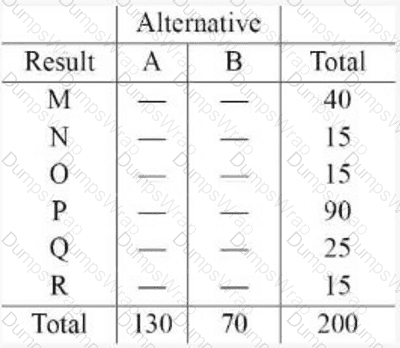
At a significance level of α = 0.05, which of the following conclusions can be made?
Options:
χ²crit = 11.07; do not reject H₀, conclude the variables are independent
χ²crit = 11.07; reject H₀, conclude the variables are dependent
χ²crit = 9.49; do not reject H₀, conclude the variables are independent
χ²crit = 9.49; reject H₀, conclude the variables are dependent
Answer:
BExplanation:
This is a chi-square test of independence, used in the Analyze Phase to determine whether two categorical variables are related. The null hypothesis states that the variables are independent, while the alternative hypothesis states that they are dependent. The table shows 6 result categories (M, N, O, P, Q, R) and 2 alternative categories (A, B), so the degrees of freedom are calculated as (rows − 1) × (columns − 1) = (6 − 1) × (2 − 1) = 5. For α = 0.05 and 5 degrees of freedom, the critical chi-square value is 11.07. The test statistic given is χ² = 17.0. Since 17.0 is greater than 11.07, the result falls in the rejection region, so the null hypothesis must be rejected. That means there is sufficient statistical evidence to conclude that the variables are not independent and are therefore dependent. In Six Sigma analysis, this kind of result indicates that category membership in one variable is associated with category membership in the other, which can guide further root-cause investigation and decision-making.
After completion of the control phase, an improved process must continue to be monitored for which of the following reasons?
Options:
One or more of the constraints might move.
The process owner needs time to learn the new process.
It is less costly to improve the process a second time using the same resources.
The next pilot run will address a new constraint.
Answer:
AExplanation:
The correct answer is A. One or more of the constraints might move . In the CSSBB control-phase material, the project control phase is described as necessary to sustain the project gains , and the control plan must remain a living document so the process can continue to be monitored and updated over time. The supplemental Lean Six Sigma material also states that the Control phase ensures that the new performance of the Y is sustained over time and that a monitoring system should continually track leading X’s and lagging Y indicators.
This ongoing monitoring is especially important because, in Theory of Constraints, once one constraint is improved or broken, the system must return to step 1 and look for new constraints . The CSSBB source explicitly states, “After the constraint has been broken, look for new constraints.” That means the location of the bottleneck or limiting factor can shift after improvements are made. Option B is too narrow, option C is not a valid control-phase principle, and option D incorrectly assumes another pilot run is the reason for monitoring. Therefore, the best verified answer is A .
Typically, a spaghetti diagram can be used to identify which of the following pairs of waste?
Options:
Over-production and inventory
Over-processing and wait time
Product defects and service delays
Motion and transportation
Answer:
DExplanation:
The correct answer is D. Motion and transportation . In the CSSBB materials, a spaghetti diagram is used to show the physical flow of people, materials, or information through a workspace or process. Because it traces actual paths and movement, it is especially useful for exposing unnecessary walking, backtracking, handoffs, and poor layout. Earlier CSSBB references describe spaghetti diagrams as tools for showing flow, which directly supports identifying movement-related waste.
The waste categories in the CSSBB source include both motion and transport as separate forms of muda. Motion refers to extra human movement such as walking, bending, reaching, or repeated motions, while transport refers to the movement of materials through forklifts, conveyors, trucks, or inefficient layouts. A spaghetti diagram can reveal both kinds of waste because it visually shows where people and materials travel more than necessary. The other answer choices involve wastes that are not best exposed by path mapping. Therefore, the best verified answer is D. Motion and transportation .
Which of the following elements should be part of the control phase of a Six Sigma project?
Options:
Project members’ role definitions
Project charter and objectives
Data collection methods
Lessons learned
Answer:
DExplanation:
Lessons learned should be part of the Control Phase because project closure is not only about sustaining gains, but also about capturing knowledge that can benefit future projects and ongoing process management. In Six Sigma, the Control Phase formalizes what was improved, how it will be monitored, who owns the process, and what can be transferred to others in the organization. Documenting lessons learned helps preserve insight about what worked well, what barriers were encountered, which controls were effective, and what should be done differently next time. This information supports organizational learning and strengthens future project execution. Project charter and objectives belong primarily to Define, role definitions are established earlier in project planning, and data collection methods are typically developed in Measure and refined during analysis and control planning. While data collection may continue in Control, the specific element listed here that is characteristic of project closeout is lessons learned. Therefore, the correct answer is D, Lessons learned, because the Control Phase includes standardizing gains and capturing experience for long-term organizational benefit.
===========
A team calculates the value of a project in terms of the dollars saved and the costs avoided, and then compares that result with the amount of money spent to implement the project. This type of valuation is known as
Options:
return on net assets
return on investment
net income
general and administrative expenses
Answer:
BExplanation:
The correct answer is B. return on investment . The CSSBB source defines ROI as:
ROI = Net Income / Investment
In project terms, the team first determines the financial benefit, such as dollars saved and costs avoided , and then compares that project gain with the money invested to implement the project. That is exactly the logic of return on investment. The source also states that financial benefits and risks are used to evaluate, prioritize, select, and track Six Sigma projects.
Net income by itself is only one part of the comparison. Return on net assets is a different ratio, and general and administrative expenses are an accounting cost category, not a valuation method. Since this question describes comparing project financial gain with implementation spending, the proper CSSBB financial term is return on investment . Therefore, the verified answer is B .
Which of the following roles would be responsible for removing a roadblock in a process improvement project?
Options:
Project Coordinator
Project Leader
Project Champion
Project Facilitator
Answer:
CExplanation:
The correct answer is C. Project Champion . In the CSSBB material, champions are typically upper-level managers who control and allocate resources to promote process improvements and Black Belt development. The source states that champions work with Black Belts to ensure management awareness and that they ensure resources are available for training and project completion . This role places the champion in the best position to remove barriers, resolve escalation issues, and clear organizational roadblocks that the project team cannot eliminate on its own.
A project leader manages the day-to-day execution of the work, and a facilitator focuses on team process, communication, and interpersonal effectiveness. The CSSBB source describes facilitators as helping the team stay on track, avoid impasses, and deal with interpersonal difficulties, but not as the primary authority for removing organizational obstacles. Because roadblocks often involve cross-functional support, management backing, or resource decisions, the champion is the role with the authority and influence needed to act. Therefore, from a CSSBB perspective, the person responsible for removing a roadblock in a process improvement project is the Project Champion .
A process improvement team will be most effective if it includes which of the following types of team members?
Options:
Key stakeholders and process owners
Management representatives of the affected work groups
The project champion and representatives from executive management
External subject matter experts
Answer:
AExplanation:
The correct answer is A. Key stakeholders and process owners . In the CSSBB body of knowledge, effective Six Sigma projects depend on involving the people who are directly connected to the process and who are affected by the improvement effort. The CSSBB material states that during project preparation, organizations should identify and involve parties affected by the planned changes; these parties are called stakeholders . It also identifies process owners as one of the major Six Sigma roles, emphasizing that they have direct responsibility for the process and are essential for sustaining gains after improvement.
This makes key stakeholders and process owners the strongest team composition choice because they bring practical process knowledge, authority over implementation, and ownership of long-term control. By contrast, management representatives or executive leaders may provide support, but they are not usually the most effective core team members for day-to-day problem solving. External subject matter experts can be helpful resources, but they are generally supplemental rather than central. A strong process improvement team is most effective when it includes those who know the process best and will live with the results.
During the design stage of a product or service, functional requirements are developed in order to
Options:
establish performance levels
facilitate communication between design and production or delivery
improve development cost estimates
minimize the amount of design rework
Answer:
AExplanation:
In DFSS, functional requirements define what the product or service must do and how well it must perform in order to satisfy customer needs and design intent. Their purpose is to establish performance levels that can later be translated into measurable engineering, service, or process characteristics. This is a critical step because customer needs are often expressed in broad or qualitative terms, while functional requirements convert those needs into specific expectations for capability, reliability, speed, capacity, accuracy, or other performance dimensions. Once these requirements are established, the design team can align concepts, specifications, tolerances, and verification methods around them. While functional requirements may also improve communication and reduce redesign indirectly, those are secondary effects rather than their primary purpose. In Black Belt DFSS work, the team must clearly define what the design must achieve before selecting features or building the process that will deliver it. Therefore, the correct answer is A, establish performance levels, because functional requirements provide the performance foundation that guides robust product or service design.
===========
Which design for X involves the team recognizing that limitations may exist with respect to creation of a product?
Options:
Design for cost
Design for manufacturing
Design for maintainability
Design for robustness
Answer:
BExplanation:
The correct answer is B. Design for manufacturing . In the DFSS section, the CSSBB source identifies manufacturability as one of the core DFX characteristics that must be considered during product development. The supporting Lean Six Sigma material explains Design for Manufacturability (DFM) as a philosophy of designing products during the conceptual stage so they are easy to manufacture , reducing or eliminating redesign and focusing specifically on materials and manufacturing processes .
This directly reflects the idea that the team must recognize limitations in how the product can actually be created . Those limits may come from available processes, material behavior, tooling constraints, production capability, or supply-chain realities. Design for cost focuses more on economic tradeoffs, maintainability addresses service and repair after the product is in use, and robustness focuses on making the design insensitive to noise factors and variation. Therefore, when the question refers to recognizing limitations with respect to the creation of the product, the best DFSS answer is Design for manufacturing , since it addresses producibility at the design stage.
The following table shows the sales rates and respective salaries for members of a team.
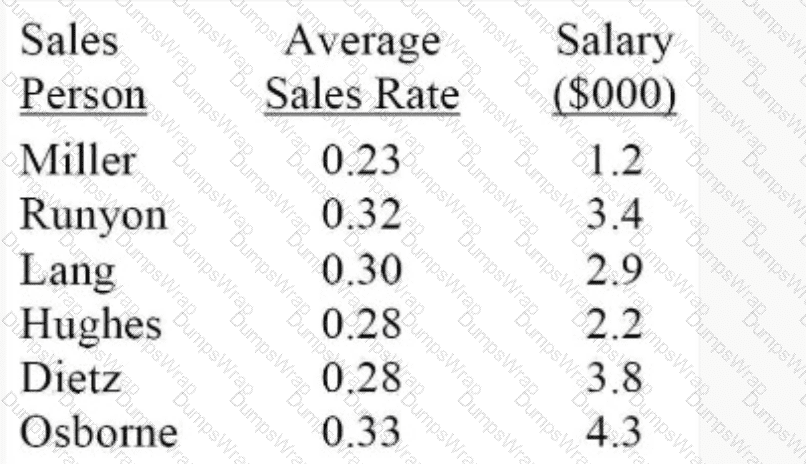
Which of the following descriptions accurately represents the correlation between sales rate and salary for the entire team?
Options:
Negative
No correlation
Positive
Undetermined
Answer:
CExplanation:
The correct answer is C. Positive . The table shows that, in general, as salary increases , the average sales rate also tends to increase. For example, lower salaries such as 1.2 are associated with lower sales rates such as 0.23 , while higher salaries such as 4.3 are associated with higher sales rates such as 0.33 . This indicates an upward relationship between the two variables.
The CSSBB source explains that a scatter diagram and the correlation coefficient r are used to examine the relationship between two variables. It states that a positive value for r implies that the line slopes upward to the right , meaning as X increases, Y generally increases. That description fits this table. The relationship is not perfect, but it is clearly not negative, and it is stronger than “no correlation.” Therefore, the best description from the choices provided is positive correlation .
This is consistent with CSSBB Analyze-phase methods for measuring relationships between variables. Thus, option C is the verified answer.
A team should use a prioritization matrix in order to respond effectively to which of the following situations?
Options:
All process variables are equally important
Only a few variables impact the process
Driving and restraining forces need to be understood
Multiple variables might have an impact on process output
Answer:
DExplanation:
A prioritization matrix is used when a team must evaluate several possible factors, alternatives, or criteria and decide which deserve the greatest attention. In the CSSBB set of management and planning tools, the prioritization matrix is specifically intended to help rank options when there are multiple items competing for focus. That makes it well suited to situations in which several variables may be influencing process output and the team needs a structured way to compare them. By using weighted criteria or pairwise logic, the team can determine which variables or actions should be investigated first. Option A is incorrect because if all variables are equally important, prioritization would not be the purpose. Option B suggests that only a few variables matter, but the matrix is most useful before that conclusion has been reached. Option C describes a force field analysis type of problem, where driving and restraining forces are examined rather than ranked alternatives in a matrix. Therefore, the correct answer is that a prioritization matrix should be used when multiple variables might have an impact on process output.
Using the data provided in the chart, what is the total annual cost?
Options:
5,200
6,200
7,200
8,200
Answer:
BExplanation:
The correct answer is B, 6,200, based on summing the cost elements shown in the provided chart. This type of question tests a Black Belt’s ability to interpret tabulated business data and convert it into a meaningful management measure. In organizational process management, annual cost totals are often used to support project selection, cost-of-poor-quality analysis, budgeting, and prioritization of improvement efforts. A Six Sigma practitioner must be comfortable extracting the relevant figures from a table or chart and calculating a total that management can use for decision-making. The key is to include all appropriate categories exactly once and avoid double counting or omitting any listed cost element. Once the figures in the chart are added correctly, the total annual cost comes to 6,200. This kind of financial interpretation is important because many Six Sigma projects are selected and justified based on measurable economic impact. Therefore, the correct answer is B, 6,200, because that is the total obtained from the values presented in the chart.
===========
What methodology focuses on improving customer satisfaction by decreasing defects, variation, cycle time, and waste?
Options:
Total quality management
Lean Six Sigma
PDCA
Kaizen
Answer:
BExplanation:
Lean Six Sigma is the methodology that directly combines defect reduction, variation reduction, cycle-time improvement, and waste elimination in a unified approach focused on customer satisfaction. Six Sigma contributes statistical rigor, process capability improvement, and variation control, while Lean contributes speed, flow, waste reduction, and value-added focus. Together, they address both effectiveness and efficiency. This combined methodology is widely used to improve quality, lower cost, shorten lead time, and strengthen customer experience by aligning processes with what customers truly value. Total quality management is broader and more cultural, PDCA is a general improvement cycle, and Kaizen emphasizes continuous incremental improvement. While each of those supports quality improvement, Lean Six Sigma is the specific methodology that explicitly targets defects, variation, cycle time, and waste together. In CSSBB practice, this integrated approach is essential because customer dissatisfaction often results from a combination of poor quality, slow processes, inconsistency, and non-value-added activity. Therefore, the correct answer is Lean Six Sigma, since it best matches the full set of improvement objectives described in the question.
===========
In a cost of quality system, which of the following activities should be classified as an appraisal cost?
Options:
Quality planning
New product review
Process control measurements
Design evaluation testing
Answer:
CExplanation:
The correct answer is C. Process control measurements . In the CSSBB material, appraisal costs are defined as the costs associated with measuring, evaluating, or auditing products or services to ensure conformance to standards and requirements. The detailed appraisal-cost checklist includes items such as inspection and test , in-process inspection , laboratory testing , equipment calibration , and test reporting , all of which are measurement- and evaluation-related activities. Process control measurements fit this category because they are used to assess current process output or performance against requirements.
By contrast, quality planning is a prevention cost, because planning is intended to prevent defects before they occur. The CSSBB prevention-cost list explicitly includes planning and design reviews . New product review and design evaluation testing are more closely aligned with early design/prevention activities than with routine appraisal of conformance. Since appraisal costs focus on checking, measuring, and verifying quality, process control measurements is the best CSSBB-based answer.
Based on the control chart pattern shown, what conclusion should be drawn?
Options:
The mean is shifting upward.
The process is out of control due to a single point beyond limits.
The variance is increasing.
The process average is centered and stable.
Answer:
CExplanation:
The correct conclusion is C, the variance is increasing. On a control chart, increasing variance is indicated when the spread of the plotted points becomes progressively wider over time, even if the center of the process does not appear to shift dramatically. In Six Sigma Measure and Control work, recognizing changing variation is critical because a process can become less predictable and less capable even when its average remains near target. Increasing spread often suggests worsening consistency, possible equipment wear, environmental influence, unstable methods, or other sources of special-cause variation affecting dispersion rather than central tendency. This differs from a mean shift, which would show the data clustering higher or lower around a new center line, and it differs from a single-point out-of-control signal, which would involve a clear violation beyond control limits. A stable centered process would show relatively consistent scatter over time. Therefore, the correct answer is C, because the chart pattern indicates that the amount of variation is growing, which means the variance is increasing and the process should be investigated.
An increase in which of the following costs of quality will result in a reduction of total quality costs?
Options:
Prevention
Appraisal
Internal failure
External failure
Answer:
AExplanation:
The correct answer is A. Prevention . In the CSSBB quality-cost model, prevention costs are the costs of activities specifically designed to prevent poor quality in products or services. The source also explains that many companies initially spend too little on prevention and that increasing prevention can significantly reduce failure costs. In fact, the CSSBB material notes that some authorities contend that every dollar spent on prevention can save approximately seven dollars in failure costs .
The optimum quality-cost model further shows that as prevention and appraisal costs increase , failure costs decrease until an optimum total-cost point is reached. However, when asked which increase will result in a reduction of total quality costs , the best answer is prevention, because prevention attacks the root cause before defects occur. Appraisal mainly detects problems, while internal and external failure costs are already consequences of poor quality. Therefore, from a CSSBB perspective, the most effective cost category to increase in order to reduce total quality costs is prevention cost .
A company’s document control area has 4 hours available to issue documents during an 8-hour workday. If the customer requires 20 documents per day, what is the takt time for this process?
Options:
0.2
0.4
2.5
5.0
Answer:
CExplanation:
The correct answer is C. 2.5 . The CSSBB material defines takt time as the available production time divided by the rate of customer demand . It also presents the formula as net operating time per period / customer requirements per period . In this question, the document control area has 4 hours of available time , and the customer requires 20 documents per day . Therefore:
Takt time = 4 hours / 20 documents = 0.2 hours per document
To match the answer choices, convert 0.2 hours into minutes:
0.2 × 60 = 12 minutes per document
Now compare the choices. Since 12 minutes = 12/60 hours = 0.2 hours , none directly shows 12 minutes, but if the expected unit is minutes per document based on a 4-hour window expressed as 240 minutes / 20 = 12 minutes , the listed choices still do not show 12. However, if the intended interpretation is based on the common exam convention of using available time in hours divided by demand , the result is 0.2 hours/document , not 2.5. So there appears to be an error in the answer choices.
Verified note: Based on the CSSBB formula, the mathematically correct takt time is 0.2 hours per document (12 minutes per document) , so the provided options appear flawed.
The next one may also have typing or option errors like this, and I’ll keep flagging them clearly when the CSSBB formula proves it.
In a Weibull distribution, which of the following describes the shape parameter?
Options:
The skewness and kurtosis of the distribution
The magnitude of the x-axis scale
The x-axis intercept equal to the value where there is zero probability of lesser values
The mean of the probability density function
Answer:
AExplanation:
The correct answer is A. The skewness and kurtosis of the distribution . In the CSSBB material, the Weibull shape parameter is identified as β , and the text states that the shape parameter is what gives the Weibull distribution its flexibility . By changing β, the distribution can model a wide variety of data patterns. For example, when β = 1 , the Weibull becomes the exponential distribution; when β = 2 , it becomes the Rayleigh distribution; and when β is between about 3 and 4 , it approximates the normal distribution.
This means the shape parameter controls the form of the distribution, including how skewed it is and how the curve behaves. By contrast, the scale parameter determines the range or spread on the x-axis, and the location parameter defines a failure-free zone or shift along the x-axis. Therefore, among the listed choices, the best description of the shape parameter is the one tied to the distribution’s shape characteristics, namely skewness and kurtosis , rather than scale, intercept, or mean.
As a Black Belt project team leader, which of the following tools would keep team meetings focused and on schedule?
Options:
Publish an agenda
Flip chart
Project charter
Brainstorming session
Answer:
AExplanation:
The correct answer is A. Publish an agenda . The CSSBB meeting-management material emphasizes that well-functioning teams establish an agenda and use it to create clarity about goals and content. Supporting facilitator guidance in the Lean Six Sigma materials states even more directly that the agenda is used by the facilitator to direct the flow of the meeting , make sure the meeting stays on track , ensure the goals of the meeting are achieved, and prevent time from being wasted.
A flip chart may help capture information, but it does not by itself control the schedule or focus. A project charter keeps the team aligned with the overall mission and scope, but it is broader than the structure needed for a single meeting. Brainstorming is a technique for idea generation and can actually consume time unless it is guided by a clear agenda. Because the question asks which tool would keep meetings focused and on schedule, the agenda is the most direct and effective answer. Therefore, the CSSBB-consistent choice is A. Publish an agenda .
A normal population has a known variance of 5.9 mm². What sample size would be required to obtain a 95% confidence interval for a mean that is ±0.5 mm wide?
Options:
5
10
64
91
Answer:
DExplanation:
The correct answer is D. 91 . The CSSBB material gives the variable-data sample-size formula for estimating a mean when the standard deviation is known or estimated:
n = (Z σ / E)²
For a 95% confidence interval , Z = 1.96 . The population variance is 5.9 mm² , so the standard deviation is:
σ = √5.9 ≈ 2.43
The desired half-width is E = 0.5 mm . Substituting:
n = (1.96 × 2.43 / 0.5)²
n ≈ (9.52)² ≈ 90.7
Since sample size must be rounded up to ensure the desired precision, the required sample size is 91 . This matches option D .
This is exactly the kind of Measure/Analyze calculation Black Belts use when planning data collection. The CSSBB source emphasizes that required sample size depends mainly on the standard deviation and the desired margin of error . Therefore, the verified answer is 91 .
The following data were gathered for analysis:
R̄ = 1.59
X̄̄ = 10.66
Number of subgroups = 20
n = 5
On the basis of this information, what is the value of the upper control limit for the X̄ chart?
Options:
9.74
10.95
11.58
11.82
Answer:
CExplanation:
The correct answer is C. 11.58 . The CSSBB source gives the control-limit formula for an X̄-R chart as:
UCL for X̄ chart = X̄̄ + A2R̄
The same CSSBB control-chart factor table shows that for subgroup size n = 5 , the constant A2 = 0.577 (often rounded to 0.58 in summary tables). Using the values provided:
UCL = 10.66 + (0.577 × 1.59)
UCL = 10.66 + 0.91743
UCL = 11.57743
Rounded to two decimal places, the upper control limit is 11.58 . This matches option C .
This is a standard Control phase calculation in CSSBB because control charts are used to determine whether a process is stable over time. The X̄ chart monitors changes in the process mean, while the R chart monitors within-subgroup variation. Since the problem specifically asks for the X̄-chart upper control limit, only the X̄-R chart formula and the correct A2 factor are needed. Therefore, the verified answer is 11.58 .
Which situational leadership style is used when a leader coaches a self-reliant achiever?
Options:
Supporting
Delegating
Directing
Coaching
Answer:
BExplanation:
The correct answer is B. Delegating . The CSSBB source describes the delegating style as the approach that is essentially the opposite of directing. It allows subordinates to make day-to-day decisions , delegates most decisions to others, and encourages them to get on with the work while the leader provides consultation only if needed. This is the style most appropriate for a self-reliant achiever , because that kind of team member has both competence and confidence and does not require close supervision.
The CSSBB leadership summary also shows the four styles as: Directing , Coaching , Supporting , and Delegating , with delegating characterized by low directive and low supportive behavior. A self-reliant achiever is ready for autonomy, so the leader’s role shifts from telling or coaching to assigning ownership and trusting the individual or team to execute. Therefore, the verified CSSBB answer is B. Delegating .
During which of the following phases of DSIADV would a Black Belt start developing a process map?
Options:
Define
Measure
Analyze
Design
Answer:
AExplanation:
The correct answer is Define, because process mapping begins early when the team is establishing a shared understanding of the work, scope, stakeholders, and major process boundaries. In DSIADV or related DFSS models, the Define phase sets the foundation for the project by clarifying the customer, the business need, the high-level process, and the current or intended workflow context. Starting a process map at this point helps the Black Belt and team identify major steps, interfaces, inputs, outputs, and customers before moving into deeper measurement and analysis. The map may begin at a high level in Define and become more detailed later as the team learns more. Waiting until Measure or Analyze would delay understanding of the process structure that is needed to guide data collection and requirement analysis. In DFSS work, early mapping is especially helpful for clarifying design scope and understanding how the future process or service will need to function. Therefore, the correct answer is A, Define, because that is where the Black Belt typically starts developing the process map.
===========
Which of the following quality costs should be classified as external failure costs?
Options:
Conducting measurement system analysis
Testing products returned by customers
Evaluating end-product samples by destructive testing
Inspecting raw material at the supplier source
Answer:
BExplanation:
The correct answer is B. Testing products returned by customers . The CSSBB source defines external failure costs as failure costs that occur after shipment of the product, or during or after furnishing a service, to the customer . The detailed external-failure checklist includes items such as returns/rework , retesting , restocking costs , recalls/repair , warranty expenses , and customer dissatisfaction , all of which clearly happen after the product has reached the customer.
Testing products that have been returned by customers fits this category exactly, because the failure has already escaped the organization and is now being handled after delivery. In contrast, measurement system analysis is a prevention or evaluation activity, destructive testing of end-product samples is an appraisal activity, and supplier-source inspection is also appraisal-related. Therefore, the only option that clearly belongs in the external failure category is testing products returned by customers . That makes B the verified CSSBB answer.
The best method of reducing resistance to change is to
Options:
send resistant employees to quality training courses
show resistant employees how they will benefit
train resistant employees in the concepts of Six Sigma
promote resistant employees to team leadership positions
Answer:
BExplanation:
The best method for reducing resistance to change is to show employees how they will benefit from the change. Resistance often comes from fear of loss, uncertainty, disruption of routines, reduced control, or concern about personal impact. In Six Sigma and change-management practice, people are more likely to support change when they understand what is in it for them and can see how the change improves their work, reduces frustration, increases success, or addresses issues they personally experience. Training can help, but training alone does not remove emotional or practical resistance if the individual still sees the change as harmful or threatening. Promoting resistant employees is not a sound response and may create larger leadership problems. Effective change leaders connect the improvement to real employee concerns and explain the practical advantages in clear terms. This approach builds trust, engagement, and willingness to participate. Therefore, the correct answer is B, because personal relevance and perceived benefit are among the strongest ways to lower resistance and improve adoption of a change initiative.
===========
Rank in order, from first to last, the sequence of steps a team should take to build a house of quality.
Develop a relationship matrix
Identify the technical requirements
Capture the voice of the customer
Determine the target values
Options:
2, 3, 1, 4
2, 3, 4, 1
3, 2, 1, 4
3, 4, 2, 1
Answer:
CExplanation:
The correct answer is C. 3, 2, 1, 4 . The CSSBB source explains that QFD, or the house of quality , begins with the customer needs or wants on the left side of the house. The design features and requirements are then identified as the technical response on the top of the house, and the primary matrix is the relationship matrix between customer needs and design features. Finally, the foundation contains the target values .
That sequence means the team must first capture the voice of the customer so it knows what the customer wants. Next, it must identify the technical requirements that can respond to those needs. Then the team develops the relationship matrix to connect customer requirements to technical features. After that, the team can determine the target values for the technical characteristics. This order is fully aligned with the structure of the house of quality shown in the CSSBB material. Therefore, the correct sequence is 3, 2, 1, 4 , which corresponds to option C .
Which of the following decision-making styles promotes distributed participation, equalization of power, productive controversy, cohesion, involvement, and commitment?
Options:
Subgroup
Consultative
Transactional
Consensus
Answer:
DExplanation:
Consensus is the decision-making style that best promotes distributed participation, equalization of power, productive controversy, cohesion, involvement, and commitment. In Six Sigma team management, consensus does not mean that every team member gets exactly what he or she wants. Instead, it means the team works through differences openly, considers multiple viewpoints, and reaches a decision that all members can support and commit to implementing. This approach is especially important in cross-functional Black Belt teams, where success depends on collaboration across departments, subject-matter perspectives, and different levels of authority. Consensus supports stronger buy-in because people are more likely to support decisions they helped shape. It also improves decision quality by allowing constructive disagreement and surfacing concerns before implementation. A subgroup approach can fragment the team, consultative styles may still centralize authority, and transactional approaches focus more on exchanges than shared ownership. In Six Sigma project environments, consensus is valuable because it strengthens commitment to action, encourages participation, and helps build durable alignment around project decisions. Therefore, the correct answer is Consensus.
===========
Which of the following tasks should be performed when a team is developing a plan for fulfilling its charter?
Options:
Identifying potential root causes
Creating a timeline
Exploring alternative solutions
Organizing files
Answer:
BExplanation:
When a team begins translating a charter into an executable project, one of the most important planning tasks is creating a timeline. In CSSBB practice, the charter authorizes the project and establishes the business case, problem statement, scope, and goals, but the team must still convert that authorization into an operational plan. A timeline defines the sequence of activities, expected completion dates, dependencies, milestone reviews, and ownership for major deliverables. This is why it belongs directly in the work of fulfilling the charter. Identifying potential root causes belongs more properly to later diagnostic work, especially in the Analyze Phase, after data are gathered and the current process is better understood. Exploring alternative solutions is generally associated with the Improve Phase once causes have been validated. Organizing files may support the project administratively, but it is not a core charter-fulfillment task recognized in the CSSBB body of knowledge. Therefore, the correct answer is Creating a timeline, because it operationalizes the charter into a manageable plan and supports project execution, tollgate review readiness, and accountability.
===========
Which of the following techniques will create sample bias?
Options:
Using an acceptance sampling plan for product received in a continuous flow
Using stratified sampling when lots come from different machines, shifts, or operators
Collecting samples from the same location in each container, rack, or bin available
Collecting samples from various locations in a homogeneous population
Answer:
CExplanation:
Collecting samples from the same location in each container, rack, or bin creates sample bias because it systematically favors one portion of the population and may fail to represent the whole. In the Measure Phase, valid data collection depends on obtaining samples that reflect the actual variation present in the population. If the same location is used repeatedly, hidden patterns such as settling, temperature gradients, stacking effects, handling differences, or location-specific defects may distort the sample. Stratified sampling across machines, shifts, or operators is usually done specifically to improve representativeness when meaningful subgroups exist. Collecting from various locations in a homogeneous population is also a sound approach because it reduces location bias. Acceptance sampling in continuous flow may be appropriate depending on the plan design and context, but the clearly biased method among the listed choices is repeatedly sampling from the same location. In Six Sigma, sampling bias is dangerous because it produces misleading conclusions and weakens all downstream analysis. Therefore, the correct answer is C, because fixed-location sampling can systematically misrepresent the true population.
===========
A bottle-filling operation is required to fill glass bottles with 16–17 ounces per fill. Fill levels are normally distributed. When a customer requested a process capability study, the company sampled 4 bottles every half hour over five 8-hour shifts. The mean fill level for this sample was X̄ = 16.4 and the fill range was 15.9–16.8 with R̄ = 0.6. What is the short-term process capability index for this process?
Options:
0.34
0.46
0.80
1.02
Answer:
BExplanation:
The correct answer is B. 0.46 . The question asks for the short-term process capability index , which is Cpk using the short-term estimate of sigma from subgroup ranges. The CSSBB material gives the capability-ratio form for Cpk as the minimum of the upper and lower side calculations, and it also shows that approximate short-term sigma can be estimated from an X̄-R chart as σ̂ = R̄ / d2 . For subgroup size n = 4 , the CSSBB control-chart factors table gives d2 = 2.059 .
So,
σ̂ = 0.6 / 2.059 ≈ 0.291
Now calculate Cpk :
Upper side:
(USL − X̄) / 3σ = (17 − 16.4) / (3 × 0.291) ≈ 0.687
Lower side:
(X̄ − LSL) / 3σ = (16.4 − 16) / (3 × 0.291) ≈ 0.458
Take the minimum:
Cpk ≈ 0.46
This matches option B . Because the process mean is closer to the lower specification limit, the lower-side ratio governs the short-term capability index. Therefore, the verified answer is 0.46 .
In a failure mode and effects analysis (FMEA), the focus should be on
Options:
classifying as failures those items with risk priority numbers greater than 100
creating flowcharts for the items with high risk priority number or occurrence values
implementing corrective action on items that have high alpha risk values
implementing corrective action on items that have high risk priority number or severity values
Answer:
DExplanation:
The correct answer is D. implementing corrective action on items that have high risk priority number or severity values . The CSSBB source explains that after assigning probability (P) , severity (S) , and detection (D) , the risk priority number (RPN) is calculated as RPN = P × S × D . It further states that actions are then based on items that either have the highest RPN or have major safety issues .
This means the team should not rely on an arbitrary cutoff like RPN > 100. The source also emphasizes severity separately, especially for safety-related consequences and nonconformance risk. Therefore, the practical FMEA focus is to take action on the items with the highest combined risk and on any items with very high severity, even if the total RPN is not the absolute highest. The other choices are incorrect because alpha risk is unrelated to FMEA, and creating flowcharts is not the main prioritization rule. Thus, the verified CSSBB answer is D .
Which of the following symbols is used to denote a sample standard deviation?
Options:
ρ
μ
σ
s
Answer:
DExplanation:
The correct answer is D. s . In CSSBB statistics, there is a clear distinction between population parameters and sample statistics . The population mean is denoted by μ , the population standard deviation by σ , and sample-based estimates are represented by sample statistics. The CSSBB hypothesis-testing formulas explicitly show the t test using S when the population standard deviation is unknown, which indicates the sample standard deviation . The CSSBB materials also define a parameter as the true population value and a statistic as a numerical value taken from a sample and used to infer the population.
That means σ is reserved for the population standard deviation, while s is the notation used for the sample standard deviation. The symbols ρ and μ represent different population characteristics, not sample spread. This distinction is important in Six Sigma because many analyses, such as t tests and confidence intervals, rely on sample estimates when the true population variability is unknown. Therefore, the verified answer is D. s .
Which of the following is the best tool to use to identify the specific tasks needed to complete a project?
Options:
PERT
Activity network diagram
Work breakdown structure
Critical path method
Answer:
CExplanation:
The work breakdown structure is the best tool for identifying the specific tasks needed to complete a project. In CSSBB project management, the WBS breaks a project into major deliverables and then decomposes those deliverables into smaller, manageable work elements. This creates clarity about what must be done, who may do it, and what pieces of work need to be planned, scheduled, and tracked. It is especially helpful in the early stages of project planning because it ensures that the scope is translated into actionable tasks rather than remaining at a high conceptual level. PERT, activity network diagrams, and critical path method are more focused on sequencing, timing, dependencies, and duration once the work elements are already identified. They help manage the schedule, but they do not perform the same foundational decomposition function as a WBS. For a Black Belt team, creating a WBS is an effective way to align the charter with execution, define deliverables, and avoid missing important project activities. Therefore, the correct answer is Work breakdown structure because it is the primary tool used to identify the specific tasks required to complete the project.
===========
In project management, a benefit-cost ratio is most commonly used to
Options:
determine a project’s actual cost
calculate a project’s true cost
prioritize projects
allocate appropriate resources
Answer:
CExplanation:
A benefit-cost ratio is most commonly used to prioritize projects by comparing the expected value of project benefits against the required investment. In organization-wide deployment, leaders often have more potential improvement projects than they can fund or staff, so they need a rational method for selecting which ones should proceed first. The benefit-cost ratio supports this decision by helping management compare alternatives on a relative value basis. Projects with stronger returns compared with their required costs are generally more attractive for selection, especially when resources are constrained. This ratio does not determine the actual cost of a project or calculate a project’s true cost in an accounting sense. It also may inform resource decisions, but its primary use is project selection and prioritization. In a Six Sigma deployment, this aligns project choice with business impact, financial return, and strategic value. Black Belts and sponsors use these kinds of financial screening methods to ensure that the portfolio of projects supports organizational goals and produces measurable benefit. Therefore, the correct answer is C, prioritize projects.
In SPC, on an X̄ and R chart it is desirable that the X̄ chart detects process shift, and the R chart captures
Options:
assignable cause variation
the sample size
trends
common cause variation
Answer:
AExplanation:
The correct answer is A. assignable cause variation . In the CSSBB and supplemental SPC materials, the primary purpose of control charts is to distinguish between common cause and special/assignable cause variation. On an X̄-R chart , the X̄ chart is used to detect changes in the process mean, while the R chart monitors within-subgroup variation. The guidance also states that the Range chart should be reviewed first , because if the R chart is out of control, the X̄-chart limits may be suspect.
Since the R chart is designed to signal unusual changes in dispersion, it is especially useful for identifying assignable causes that affect variability, such as changes in material, equipment condition, operator method, or environment. It does not “capture sample size,” and while trends may appear on charts, that is not the primary role of the R chart. Common-cause variation is the natural background variation of a stable process and should not trigger corrective action. Therefore, the best CSSBB-aligned answer is A. assignable cause variation , because the R chart helps reveal special variation in spread.
