Summer Sale Discount Flat 70% Offer - Ends in 0d 00h 00m 00s - Coupon code: 70diswrap

Cisco 500-420 Dumps

Page: 1 / 12
Total 124 questions

Cisco AppDynamics Associate Performance Analyst (CAAPA) Questions and Answers

Question 1

An online order portal for a restaurant has a “menu” transaction with different request types that must be monitored as separate transactions, such as “menu.salads” and “menu.entree.” A Performance Analyst wants to create one rule that separates the transactions instead of creating an individual rule for each request type. Which option should be enabled on a Custom Match rule?

Options:

A.

HTTP Request Data Collector

B.

Method Invocation Data Collector

C.

Split Transaction using JSON

D.

Split Transaction using request data

Question 2

What is the Node limit of the maximum Service Endpoints per node?

Options:

A.

50

B.

100

C.

250

D.

1000

Question 3

A Performance Analyst is evaluating the performance of a shopping application from a customer perspective. Which three Key Performance Indicators (KPIs) are quantifiable measurements used to determine user experience? (Choose three.)

Options:

A.

Network Incoming Errors

B.

Business Transactions 94th Percentile Response Time

C.

Machine Agent Availability

D.

End User Response Time

E.

Infrastructure Average CPU Used

F.

Business Transactions Errors per Minute

Question 4

Which two statements are correct about creating Information Points? (Choose two.)

Options:

A.

A wildcard can be used to select multiple methods for an Information Point.

B.

A wildcard can be used to select multiple classes for an Information Point.

C.

An Information Point can be created on the same class and method as a Custom Exit Point.

D.

An Information Point can be created on a class and method that is executed before the Business Transaction entry point.

Question 5

Which type of Data Collector will capture code data such as method arguments, variables, and return values?

Options:

A.

Method Invocation Data Collector

B.

Servlet Container Collector

C.

Transaction Data Collector

D.

URI Data Collector

Question 6

What must a Performance Analyst first configure in order to monitor end-to-end latency performance metrics in AppDynamics?

Options:

A.

additional demarcator methods

B.

define the end-to-end latency transaction

C.

slow end-point identity markers

D.

endpoints for asynchronous transactions

Question 7

Which data type can be collected as custom data by an Information Point?

Options:

A.

Integer

B.

Boolean

C.

String

D.

Float

Question 8

A Performance Analyst needs to define a special database Key Performance Indicator (KPI). Which menu options should be used?

Options:

A.

Databases > Metric Browser > Add

B.

Applications > Configuration > Instrumentation

C.

Databases > Configuration > Custom Metrics

D.

Applications > Configuration > Slow Transaction Thresholds

Question 9

Which view presents a calculated percentage of the slow, very slow, and stalled Business Transactions?

Options:

A.

Transaction Score

B.

Slow Responses under Troubleshoot

C.

Business Transactions

D.

Metric Browser

Question 10

Which values can be used to identify a split exit point?

Options:

A.

Variable application values

B.

Tetration application values

C.

Dynamic application values

D.

Static application values

Question 11

Which path is used to specify a metric that evaluates across multiple hardware entities or memory pools?

Options:

A.

Absolute metric path with a wildcard

B.

Wildcards are not available in the Metric Browser

C.

Relative metric path with a wildcard

D.

Relative and absolute paths cannot be used with a wildcard

Question 12

A team of developers deploys new Java servlet code that should create new business transactions in AppDynamics. After applying load on the new code function, there are no new Business Transactions on the Business Transaction Dashboard. Which two options should the developers check in AppDynamics to make sure the Business Transactions can be discovered?

[Choose two.)

Options:

A.

The metric browser to see if the new transactions appear under Business Transaction Performance.

B.

The tier with the new code does not have any rules excluding it.

C.

Auto discovery for service endpoints is turned on.

D.

There is a health rule created to check for transaction performance.

E.

Auto Discovery for servlet is turned on for Java agents.

Question 13

A Performance Analyst needs to define a set of Key Performance Indicators (KPIs) from a group of select metrics. The required performance information resides within the Transaction Analytics data set. Which method will accomplish this task?

Options:

A.

Experience Level Management

B.

Search Queries

C.

Business Outcome Milestones

D.

Metric Explorer

Question 14

If a user request results in the discovery of an entry point, what is the one key item that must be defined as one or more asynchronous activities are spawned?

Options:

A.

Business Transaction

B.

Custom Endpoint

C.

Asynchronous Metric

D.

Endpoint Metrics

Question 15

A client needs to reference a metric from different applications on an AppDynamics dashboard. Which of the following is true?

Options:

A.

Metrics from different applications can be cross referenced but cannot be combined in a single dashboard

B.

Metrics from different applications cannot be cross referenced or combined on an AppDynamics dashboard

C.

Metrics from different applications cannot be cross referenced on an AppDynamics dashboard

D.

Metrics from different applications can be cross referenced on an AppDynamics dashboard

Question 16

Which two views can a Controller-level custom dashboard provide? (Choose two.)

Options:

A.

Show a single view of only historical data.

B.

Aggregate and compare data from only a single application on the same Controller

C.

Aggregate and compare data from different applications on the same Controller

D.

A customized view of applications, servers, and database performance data

Question 17

What AppDynamics Alert Action does a Performance Analyst need to select to post an AppDynamics event to a third-party collaboration tool?

Options:

A.

Make an HTTP Request

B.

Take a thread dump

C.

Create or Update a JIRA Ticket

D.

Run a script or executable on problematic nodes

Question 18

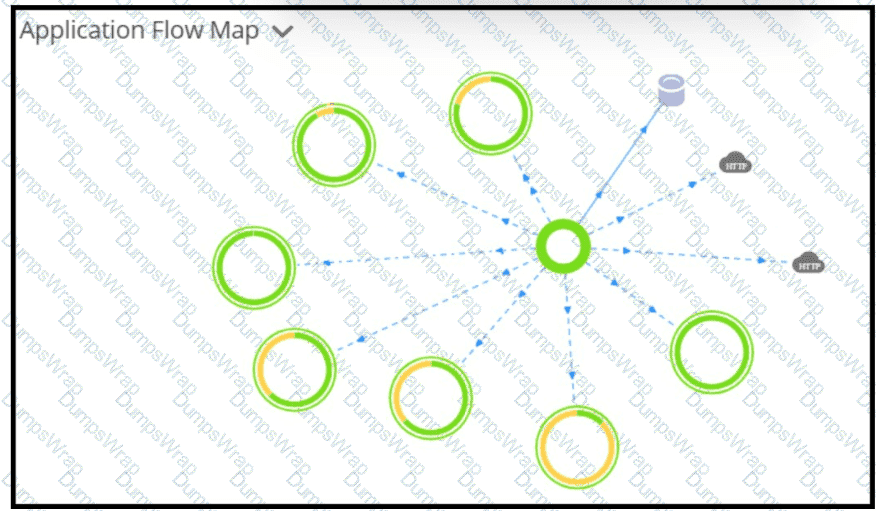
Refer to the exhibit.

as

The application flow map shows several downstream applications in yellow, while the flow lines are blue and activity within the current application appears normal. Because the tier depends on these downstream applications, how could a Performance Analyst quickly evaluate the map against previous performance?

Options:

A.

Use the function Compare Against Baseline

B.

Use Correlation Analysis

C.

Open and review the Health Rule Violations

D.

View the Metric Browser Baselines

Question 19

Which feature can be used to determine if a given Java class is visible in AppDynamics?

Options:

A.

Tools in Business Transaction Discovery Session

B.

Preview Business transactions in Business Transaction Discovery Session

C.

Use the thread dump feature on the node agent

D.

Use the object instance tracking feature in memory

Question 20

Which option should a Performance Analyst use in an environment where virtual machines are routinely created and destroyed?

Options:

A.

Dappdynamics.agent.auto.node.prefix and -Dappdynamics.cron.vm

B.

Dappdynamics.agent.reuse.nodeName and - Dappdynamics.agent.reuse.nodeName.prefix

C.

Dappdynamics.http.proxyHost and -Dappdynamcs.http. proxy User

D.

Dappdynamics.agent.node.metainfo and -Dappdynamics.agent.nodeName

Question 21

When using the REST interface, where would a Performance Analyst go to see all captured endpoints by service?

Options:

A.

Navigate to the Metric Browser, locate a specific metric, copy its REST URL, and use a wildcard query to retrieve metrics for the other Service Endpoints.

B.

Access the MySQL database, locate all endpoints in an application, drill down to the tiers and transactions, and select the REST feature enabled by the Service Endpoint.

C.

Navigate to the Applications browser, drill down to the requested endpoint, select the available dashboard and metric indicators, and then select the desired metric.

D.

Navigate to the Metric Browser, open the Consumed Endpoints location, and drill down into a specific endpoint to identify its services.

Question 22

In which two cases does AppDynamics start transaction snapshots? (Choose two.)

Options:

A.

AppDynamics determines the user experience for the Business Transaction to be slow, or the transaction incurred an error.

B.

AppDynamics collects snapshots when there is a surge in the Calls per Minute metric.

C.

AppDynamics collects snapshots during periodic snapshot collection.

D.

AppDynamics collects snapshots during an asynchronous session.

Question 23

Which three reports can be scheduled for periodic generation and delivery to email recipients? (Choose three.)

Options:

A.

Ad Hoc Data

B.

Error Trends

C.

Application Health

D.

Tier List

E.

Controller Audit

F.

Custom Dashboard

Question 24

Which three pieces of information are required when creating a new database collector? (Choose three.)

Options:

A.

Primary table name

B.

Database hostname/IP address

C.

System table name

D.

Database Type

E.

Port number

Question 25

Which permission allows snapshot archiving?

Options:

A.

" Can view data from all applications "

B.

" Configure Business Transactions "

C.

" Agent Advanced Operation "

D.

" Application level - Can create applications "

Question 26

A Performance Analyst has a third-party event management system API and wants to use the event management system to send alerts to Level 1 support. Which action is available in the AppDynamics Actions menu to configure this integration?

Options:

A.

Remediation

B.

Send an Email

C.

HTTP Request

D.

Send an SMS

Question 27

An AppDynamics deployment has Business Transaction Lock Down turned on. The company has just added an important service to its application and wants to track this service as a unique Business Transaction. What action is needed to achieve this?

Options:

A.

Modify the Automatic Transaction Discovery rule to include the Web Service Name and Operation Name

B.

Create a Custom Transaction Match Rule based on the Web Service Name and Operation Name

C.

Use Live Preview to identify the Business Transaction and register it from there

D.

Use the Business Transaction Dashboard for the tier-specific All Other Traffic to register the Business Transaction

Question 28

A Performance Analyst is reviewing Business Transactions with an application team. The application team wants to increase the Application Business Transaction limit because it needs visibility into all the different transactions. What should the Performance Analyst do?

Options:

A.

Do nothing because the limit is not important during configuration

B.

Increase the limit to the requested value

C.

Focus on the Business Transactions exceeding the limit and determine why

D.

Increase the limit halfway between the current level and the requested value

Question 29

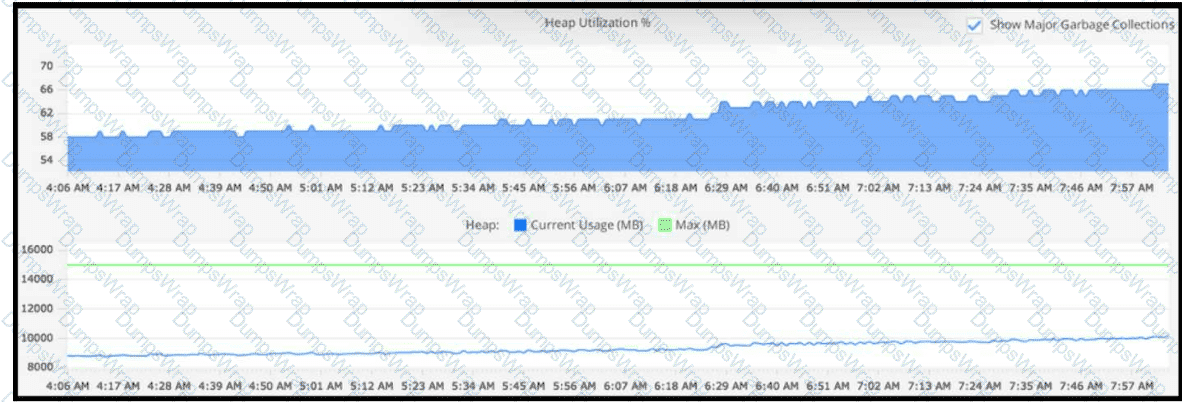
Refer to the exhibit.

as

Using this heap-utilization graph, which method is used to confirm whether a memory leak is occurring during a specific timeframe?

Options:

A.

In Metric Browser, navigate through Application Infrastructure > Hardware Resources and select Memory Total (MB) and Used (MB)

B.

In Tiers and Nodes, open the JMX tab and select JVM > Memory > Heap > Max Available (MB) and Current Usage (MB)

C.

In Metric Browser, navigate through Application Infrastructure > Hardware Resources and select Memory Total (MB) and Swap Used (MB)

D.

In Tiers and Nodes, open the Memory tab and visualize Heap Utilization (%) and Heap Current Usage (MB) versus Max (MB)

Question 30

Using the Business Transaction Discovery Sessions tools, which two items can a Performance Analyst browse? (Choose two.)

Options:

A.

Classes

B.

Methods

C.

Database Calls

D.

JMX MBeans

E.

Memory Objects

Question 31

Which statement is correct regarding controller-level and tier/node-level dashboards?

Options:

A.

The Performance Analyst can associate a controller-level dashboard with a tier or node through the My Dashboards tab

B.

From the controller-level dashboards list the Performance Analyst can access any tier/node-level dashboards outside the application in which they were created.

C.

Controller-level and tier/node-level dashboards are two separate sets. The Performance Analyst cannot cross-reference between these dashboards.

D.

Controller-level and tier/node-level dashboards are not scoped to be separate entities.

Question 32

A Performance Analyst has opened a database collector view. Which tab should be clicked on next to find slow queries?

Options:

A.

Schemas

B.

Queries

C.

Live View

D.

Object Browser

Question 33

What AppDynamics Alert Action does a Performance Analyst need to select to post an AppDynamics event to a third-party collaboration tool?

Options:

A.

Make an HTTP Request

B.

Create or Update a JIRA Ticket

C.

Take a thread dump

D.

Run a script or executable on problematic nodes

Question 34

An E-commerce application is built using microservices architecture design with several components. In AppDynamics, how should the Transaction Detection rules be grouped logically?

Options:

A.

Use Automatic Discovery

B.

Use Scope

C.

Use Transaction Group

D.

Use Backend Detection

Question 35

A Performance Analyst has a third-party event management system API and wants to use the event management system to send alerts to Level 1.

Which actions are available in the AppDynamics Actions Menu to set this up?

Options:

A.

Send an SMS

B.

HTTP Request

C.

Remediation

D.

Send an Email

Question 36

Which option, in addition to " minutes since creation " , would a Performance Analyst use while configuring Automatic Cleanup of stale Business Transactions?

Options:

A.

Transaction Type

B.

Number of Calls

C.

Regular Expression

D.

Class/Method Filter

Question 37

Which two rule types are available when creating new transaction detection rules? (Choose two.)

Options:

A.

Exclude Rule

B.

Automatic Discovery Rule

C.

Custom Match Rule

D.

Health Rule

E.

Include Rule

Page: 1 / 12
Total 124 questions