
CompTIA SecAI+ v1 Exam Questions and Answers
A company is adopting AI and wants to create policies and procedures that include a structure for evaluating, publishing, and approving patterns for AI usage.
Which of the following should the company establish to meet this goal?
Which of the following is required first in order to send a prompt query and response in a language model (LLM) system when authentication is enabled?
Which of the following International Organization for Standardization (ISO) standards contains compliance requirements for building an AI management system?
Which of the following describe the practice of providing examples in a prompt? (Choose two.)
An AI security team must assess the probability of an attack on its new system and the impact associated with such an attack.
Which of the following threat-modeling resources best addresses the threat landscape for machine learning (ML)?
An AI security administrator notices that the information referenced by the model is incorrectly formatted and missing values.
Which of the following job roles would most likely be responsible for correcting this error?
An organization recently developed an AI-powered product and discovers that it is vulnerable to attacks in which malicious actors can alter the input, causing the system to recommend inappropriate information.
Which of the following techniques is the most effective way to secure the system against manipulation attacks?
A security analyst notices that regardless of user-submitted prompts, an AI model always returns unsanitized responses. These responses are then passed to multiple plug-ins. The analyst is concerned with the potential security implications.
Which of the following Open Worldwide Application Security Project (OWASP) categories addresses this vulnerability?
A team of data scientists is ready to release a model for enterprise use. The team wants to protect the model from unintentional changes or tampering.
Which of the following is the most appropriate action?
An architect is using the firm ' s recommended large language model (LLM) to find an internal solution for content management.
Given the following:

Which of the following controls is the best for mitigating this issue?
A team of engineers builds an application using a large language model (LLM). The application is built on Linux and is hosted on a virtual server. Users must create an account in order to access and use the platform.
Which of the following should the team do to protect the account credentials?
An airline corporation wants to implement a chatbot application using a large language model (LLM) so its customers can ask questions and receive answers about flight details and have the option to upload files.
Which of the following security controls should the airline use to protect against malicious input and unauthorized use beyond the service-level agreement? (Choose two.)
A company develops an AI model to diagnose patients. Hospitals access the model through an integrated application programming interface (API). The security team performs a denial-of-service (DoS) attack via brute force on the model.
Which of the following controls would have prevented this issue?
A human resources officer is using AI to evaluate resumes and help select candidates that meet minimum criteria. To improve the results, the human resources officer adjusts the query parameters and includes an example resume that matches a successful candidate.
Which of the following best describes this query?
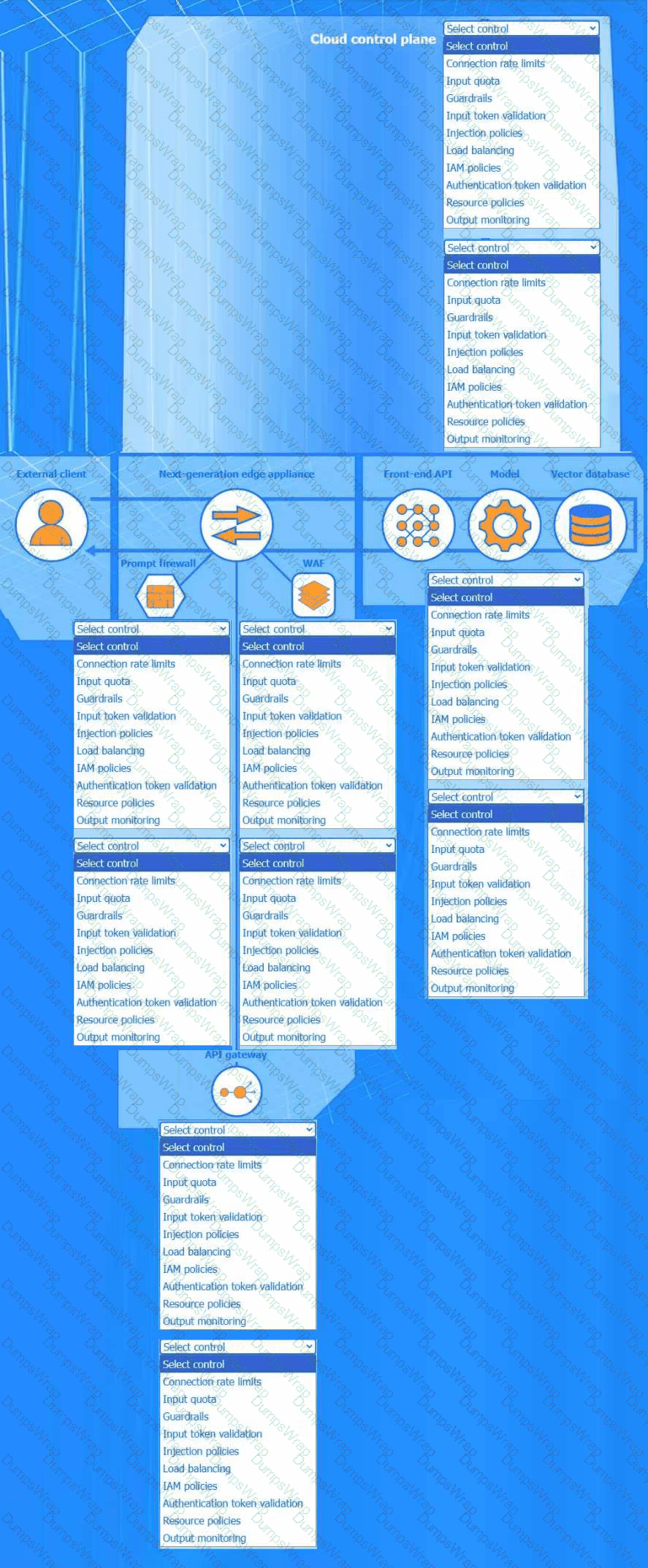
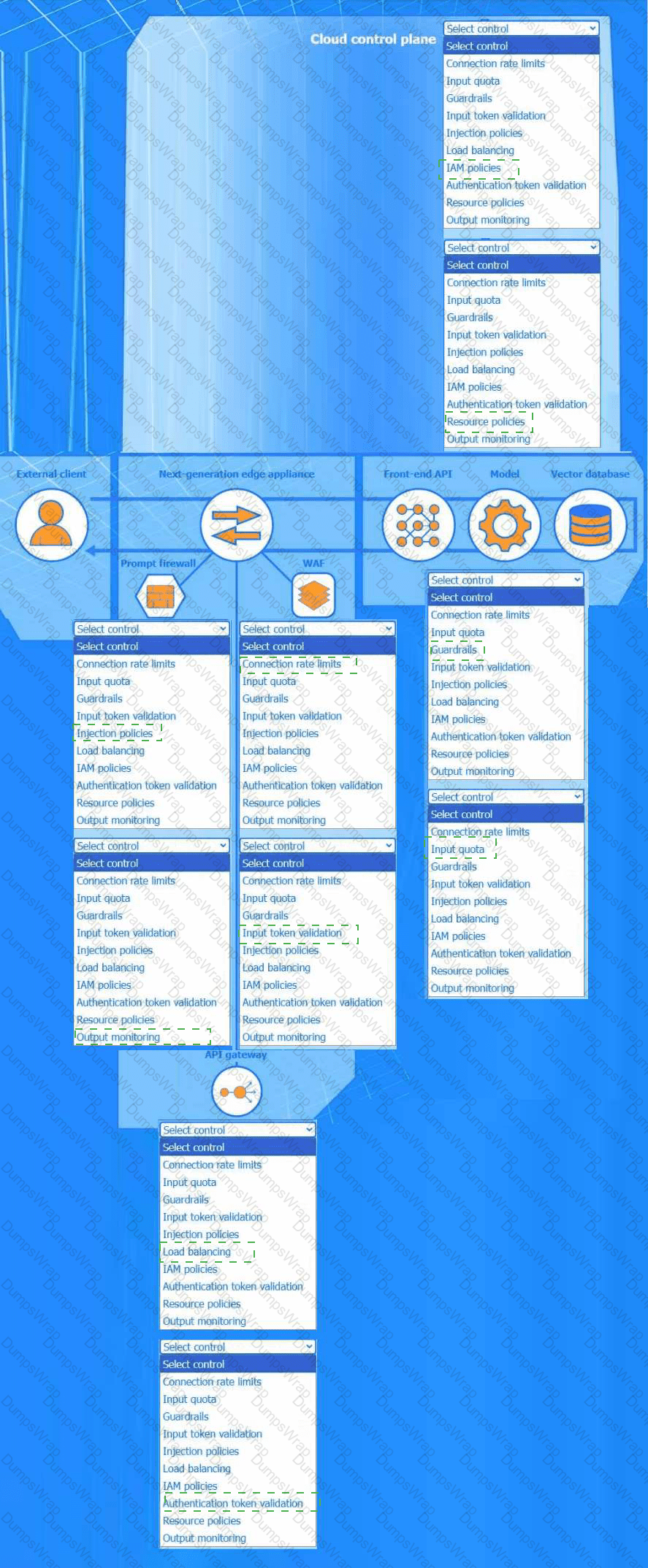
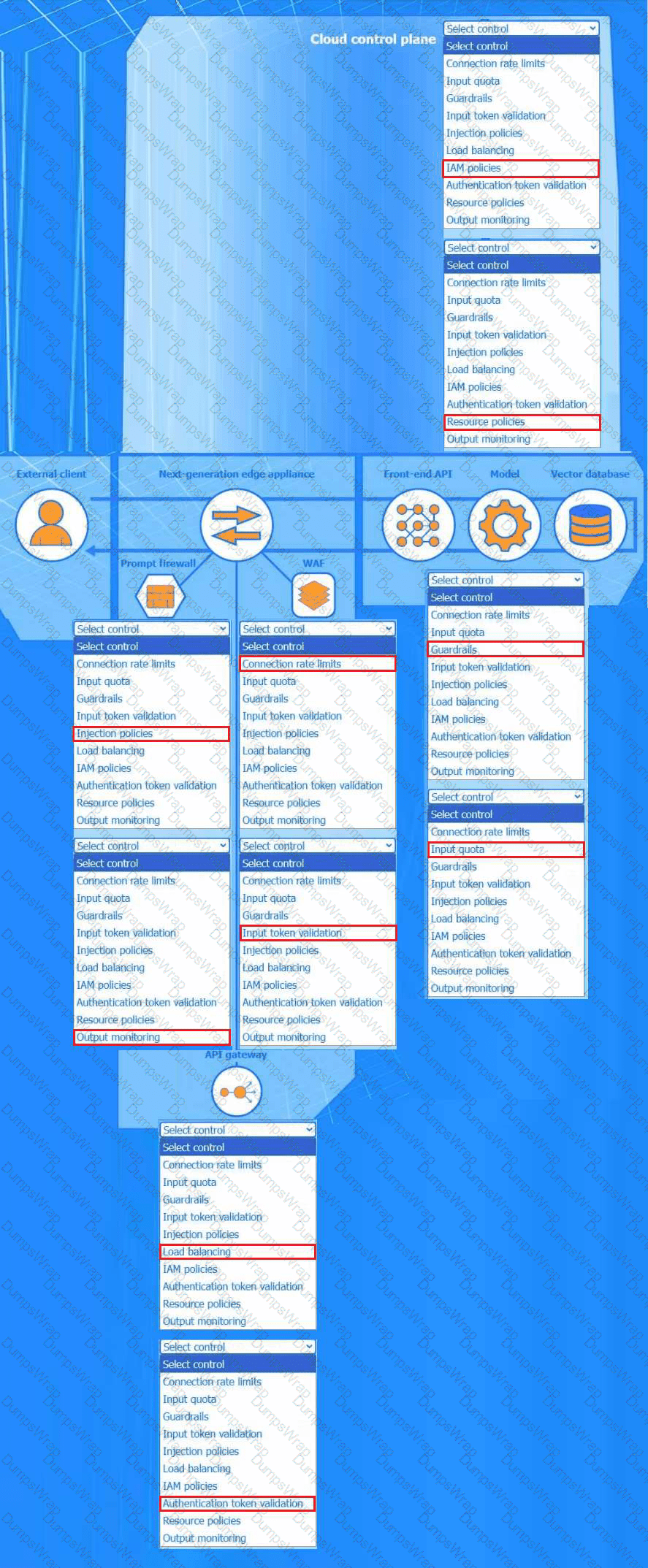
Instructions: Use the drop-down menus to define two appropriate security controls for each component of the AI system. Each control may be used only once.
An engineer is deploying a new AI system and wants to integrate it into the core system through an API.
Which of the following helps in managing potential security issues related to model training?
Which of the following explains the reason a cybersecurity analyst prefers a machine learning (ML) model over a statistical model for attack classification?
A threat intelligence team wants to automate the analysis and summary of its in-depth reports for multiple target audiences. Which of the following is the best solution?
Which of the following is the most concerning risk for a company that allows corporate end users to use public-facing large language models (LLMs)?
Which of the following is most resistant to AI manipulation?
A security analyst is preparing a presentation for the sales team that describes the most common vulnerabilities that are specific to AI applications.
Which of the following is the best source for the analyst to consult?
Which of the following should an auditor reference when reviewing a company ' s human resources AI systems for legal non-compliance?
A disgruntled employee changed the company policies that a chatbot references in order to create confusion and disrupt the business.
Which of the following AI-generated vulnerabilities is the employee exploiting?
An organization wants to reduce vulnerabilities after deployment. The organization decides to incorporate an AI-assisted early detection and vulnerability identification process in its development workflow.
Which of the following AI-assisted functions is the best option?
A cybersecurity analyst must use pattern recognition on a data set containing unstructured data.
Which of the following models is the best for this task?
An organization is developing and implementing AI features into a customer service application.
Which of the following practices should the organization put in place before releasing the application for customer trials?
User experience is declining since the launch of a large language model (LLM) in internal networks.
Which of the following should be the highest priority for the prompt engineers?
Which of the following is used to train an AI model with unstructured data?
A social media company with more than a million lines of code wants to reduce the mean time to fix bugs and issues.
Which of the following is the most balanced AI strategy to automate the vulnerability management flow?
A healthcare company deploys an AI chatbot that implements retrieval-augmented generation (RAG) using the company ' s historical data set. The chatbot output contains patient information.
Which of the following is the most effective technique to mitigate this vulnerability?
A security administrator wants to prevent prompt injection attacks and ensure responses have sanitized output.
Which of the following provides a primary compensating control for these requirements?
An employee wants a consulting company to procure a data set that contains age, ethnicity, and diabetes status. During development, the employer wants to ensure the integrity of the data.
Which of the following is the best strategy to accomplish this task?
Users report that the output of a generative AI application seems unrelated to the prompts and contains offensive content. A security team investigates and determines that there was an on-path attack.
Which of the following is the most likely attack method?
A user interface engineer adds new graphics to the latest release of an AI-integrated application. During the update, the engineer accidentally causes the model to retrain on unverified data. After the update, the model begins to return many errors.
Which of the following is the best way to mitigate future errors?
A customer using a travel chatbot reports that the chatbot responds with the following:
def choose_location(location):
if location == " United States of America " :
print( " You have selected an authorized travel destination " )
elif location == " Europe " :
print( " You have selected an unauthorized travel destination " )
Which of the following remediates this issue?
Which of the following resources most accurately covers the most widely recognized threat vectors and common vulnerabilities related to large language model (LLM) applications?
An internal user enters a client credit card number into an internal generative machine learning (ML) model:
#User prompt: Customer Jane Doe has a new credit card that she wants to add to her account. The number is 5555-5555-5555-5555
Which of the following is the most effective way to prevent prompt injection attacks against a large language model (LLM)?
An administrator, who works for a financial institution, is required to implement data security controls for data at rest within AI systems that involve data disclosure.
Which of the following is the most suitable control?
A line of business wants to onboard an application that uses a custom AI model for employee assessments. The Chief Information Officer (CIO) agrees to allow the engagement to proceed but first wants a threat model.
Which of the following is the most appropriate to use for an AI threat model?
A management team is concerned about an unexpected cost increase for a public-facing AI chatbot.
Which of the following should a security administrator examine first to determine the root cause?
A SOC team has an AI agent that performs web searches and calls to the SOAR solution. The team is concerned about enterprise uptime and case resolution time.
Which of the following is the most appropriate use of the AI agent?
Faculty members at a university are concerned about potential inherent bias and inconsistency in one department ' s AI plagiarism detection service.
Which of the following principles will most likely address their concerns?
Which of the following job roles in an organizational governance structure develops a model from business use cases?
Security analysts want to track potential user behavior anomalies over time. Which of the following is the most comprehensive approach?
After the latest software update, a developer receives reports that the system no longer requires reauthentication to display account balances because this issue was present in a previous release. Which of the following should the developer do to best mitigate the risk of recurrence?
A company introduces a large language model (LLM) in an application in order to monitor for a potential denial-of-service attack. Which of the following should the company use to measure the utilization of the LLM?
A large number of employees receive a video message in which the company ' s CEO states that the company will be filing for bankruptcy. After an investigation, it was discovered that the CEO did not send this message.
Which of the following is this scenario an example of?
