Summer Sale Discount Flat 70% Offer - Ends in 0d 00h 00m 00s - Coupon code: 70diswrap

CSI CSC2 Dumps

Page: 1 / 23
Total 232 questions

Canadian Securities Course Exam 2 Questions and Answers

Question 1

What does a simplified prospectus typically allow a fund company to do?

Options:

A.

Quality one or more mutual funds for sale.

B.

Provide up-to-date holding information to the public.

C.

Replace the financial reporting documents.

D.

To quality a real property funds for sale.

Question 2

What do a hedge fund’s liquidity dates indicate?

Options:

A.

The period that the hedge fund manager is forced to unwind all its investment positions.

B.

The period that existing investors in the hedge fund can redeem their shares.

C.

The period that non-accredited investors can enter a hedge fund by purchasing newly issued shares.

D.

The period that a hedge fund is expected to cover its short positions.

Question 3

Why are inverse exchange-traded funds effective in declining markets?

Options:

A.

They use physical commodities.

B.

They use borrowed capital.

C.

They use active management.

D.

They use derivatives.

Question 4

How is the ex-port real rate of return calculated?

Options:

A.

The ex-ante nominal rate of return adjusted by portfolio beta.

B.

The ex-post nominal rate of return minus the risk-free rate.

C.

The ex-ante nominal rate of return minus the annual inflation rate.

D.

The ex-post nominal rate of return minus the annual inflation rate.

Question 5

How are monthly Canada Pension Plan (CPP) benefits treated when both spouses are eligible for CPP?

Options:

A.

Each spouse receives the higher pension amount.

B.

Each spouse can only receive their own benefits.

C.

Each spouse receives the lower pension amount.

D.

Each spouse can share a portion of the total pension amount.

Question 6

According to the life-cycle hypothesis, what is the single most important determinant of a client ' s asset allocation, regardless of stage?

Options:

A.

Anticipating remaining life expectancy.

B.

Psychological willingness to bear risk.

C.

Market expectations.

D.

Current financial burdens.

Question 7

When a company issues a number of common shares, some of which are held by institutional investors, what are the institutional investors ' shares known as?

Options:

A.

Market capitalization shares.

B.

Outstanding shares.

C.

issued shares

D.

Public float shares.

Question 8

What is an example of a KYC requirement?

Options:

A.

KYC information can be shared between accounts for clients with multiple accounts.

B.

KYC information is limited to the main accountholder if account is joint.

C.

KYC information is discretionary when the client is not acting on the advisor’s recommendation.

D.

KYC information should include the customer’s personal circumstances.

Question 9

What correlation would an investor need in order to eliminate the variability in the total returns between two stocks?

Options:

A.

+0.5.

B.

-1.0.

C.

0.0.

D.

+1.0.

Question 10

When considering management accounts, what is most accurate regarding model-based account management?

Options:

A.

It is only intended for short-term use.

B.

It requires solicitation.

C.

It permits tax loss selling.

D.

It requires client permission before executing trades.

Question 11

What industry stocks tend to have lower betas than the market?

Options:

A.

Transportation

B.

Capital goods

C.

Utilities

D.

Automobiles and components

Question 12

What types of product would be immune to the effects to tracking error?

Options:

A.

Exchange-traded notes

B.

Mutual funds.

C.

Exchanged-traded funds.

D.

Segregated funds

Question 13

The following table presents annual returns on TUV common stock and the S & P/TSX Composite Index

over a three-year period.

What is TUV ' s beta relative to the S & P/TSX Composite Index over this three-year period?

Options:

A.

Between 0 and 1.

B.

Greater than 1.

C.

Exactly 1.

D.

Less than 0.

Question 14

When acting as a principal, how do investment dealers generate revenue?

Options:

A.

Through commissions

B.

Thrown tracers.

C.

Through brokerage changes.

D.

Through spreads on buy/sell prices.

Question 15

In what way do ETFs differ from mutual funds?

Options:

A.

Primarily trade liquid securities.

B.

Provider works with a designated broker to create and redeem units.

C.

Invest in emerging markets.

D.

Subject to National Instrument 81-102 regulations.

Question 16

Ella has invested her RRSP in a mutual fund where the distributions are automatically reinvested in the same fund. What will be the consequences of these distributions?

Options:

A.

Ella will be sent a T3 form reporting the types of income distributed that year.

B.

Ella’s income from distributions will be taxed at her personal rate in the year received.

C.

Ella will have more mutual fund units worth less each.

D.

Ella will be sent a T5 form reporting the types of income distributed that year.

Question 17

What might cause a company to have a high dividend payout rate?

Options:

A.

Unstable earnings that allow a high payout

B.

A company policy of buying back shares

C.

Earnings based on resources that are being depleted

D.

Stronger than expected earnings growth

Question 18

What is a disadvantage of fee-based accounts when compared to commission-based accounts?

Options:

A.

There may be a limit to the number of trades permitted.

B.

The advisor may be more inclined to do more frequent trading.

C.

The advisor may be unable to provide a broad range of services to clients.

D.

There is a more restricted selection of investment opportunities.

Question 19

What is a characteristic of provincial savings bonds?

Options:

A.

Backed by provincial assets

B.

Available only at a certain time

C.

Can be issued Internationally.

D.

Mature every six months

Question 20

What happens if a company ' s dividend payout ratio exceeds 100%?

Options:

A.

The company will be unable to repay its debts

B.

Profits will be reduced

C.

Shareholders ' equity will be eroded

D.

The share price will increase

Question 21

Which asset allocation technique is used to shift the portfolio away from its policy mix to take advantage of market opportunities?

Options:

A.

Dynamic

B.

Tactical

C.

Strategic

D.

Event-driven

Question 22

What type of equity analysis tracks the moving average in an attempt to identify buy or sell signals?

Options:

A.

Quantitative.

B.

Sentiment indicators.

C.

Cycle.

D.

Fundamental.

Question 23

What is the likely outcome at the end of a five-year term of a rate-reset preferred share if the issuer does not redeem the shares?

Options:

A.

The shareholder exchanges the rate-reset preferred share for a specified number of common shares.

B.

The shareholder exchanges the rate-reset preferred share for a fixed-rate preferred share.

C.

The shareholder exchanges the rate-reset preferred share for an unsecured bond

D.

The shareholder exchanges the rate-reset preferred share for a floating-rate preferred share

Question 24

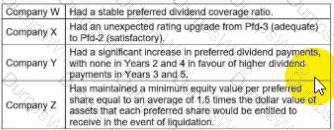
An advisor wants to explain the benefits of labour sponsored funds (LSVCC) to some of his clients. With which client should the advisor have this discussion?

as

Options:

A.

Client 1.

B.

Client 4.

C.

Client 2.

D.

Client 3.

Question 25

Jerry sells Company A’s regular bond because the thinks it is overvalued. Using the proceeds from the sale, jerry then busy Company A’s convertible bond because the thinks that the equity component is undervalued and that he convertible bond’s coupon rate is relatively attractive given his forecast of falling interest rates. What fixed-come management style is jerry most likely using?

Options:

A.

Market timing.

B.

Interest rate anticipation.

C.

Bond swap

D.

Immunization

Question 26

Which type of mutual funds tend to have the lowest management fees?

Options:

A.

Asset allocation

B.

Small cap

C.

Bond

D.

Index

Question 27

What method of trading claims to offer greater liquidity and lower transaction costs?

Options:

A.

Dark pool.

B.

High-frequency trading.

C.

Market timing.

D.

Algorithmic trading.

Question 28

What does a fundamental analyst believe that is contrary to the beliefs of a technical analyst?

Options:

A.

History repeats itself.

B.

Fiscal policy, monetary policy and inflation may be analyzed.

C.

The movements in price movements must be studied.

D.

The profitability of the issuer is paramount.

Question 29

What is one advantage of fund of hedge funds (FoHFs) as compared to single hedge funds?

Options:

A.

FoHFs offer more diversification for the same amount of investment.

B.

FoHFs employ more leverage to enhance the return potential.

C.

FoHFs entail lower costs and operating fees.

D.

FoHFs yield stronger returns than a single hedge fund.

Question 30

Why would a corporation choose to issue preferred shares rather than debt?

Options:

A.

Existing assets have excess financing capacity to justify the issue of preferred shares.

B.

The preferred dividend rate usually varies with the market interest rates

C.

issuing preferred shares would reduce the amount of leverage.

D.

The costs for issuing preferred shares are usually kwh than debt.

Question 31

Based on market capitalization. which sector of the SSP. ' TSX Composite index has one of the highest weightings within the index?

Options:

A.

Energy

B.

Health care

C.

Utilities

D.

Information technology

Question 32

What are examples of primary investment objectives?

Options:

A.

Growth and preservation of capital

B.

Tax minimization and safety of principal.

C.

Marketability and growth of capital.

D.

Marketability and tax minimization.

Question 33

What type of risk could theoretically be eliminated completely by buying a portfolio of shares comprising all S & P/TSX Composite Index stocks?

Options:

A.

Business risk.

B.

Specific risk.

C.

Default risk.

D.

Systematic risk.

Question 34

In March of this year, a client buys 1,000 PIL inc, common shares at $16 per share and pays a commission of $25 on the purchase. Several months later in the same year, the client sell the shares at $12 per share and pays commission of $50 on the sale. What is the client’s allowable capital loss on the transaction?

Options:

A.

$2,038

B.

$2,025

C.

$1,925

D.

$2,013

Question 35

Which individual is most likely to have income as an investment objective?

Options:

A.

Elaine, who is contributing to an RRSP with a plan to use the funds for the Lifelong Learning Plan in seven years.

B.

Naveed, who plans to use his investments to buy a house in five years.

C.

Hira, who is investing in her RRSP in anticipation of retirement in 15 years.

D.

Andrew, who is retired and needs to supplement his retirement pension.

Question 36

What does historical evidence suggest about the performance of hedge funds when compared to traditional markets?

Options:

A.

Hedge funds have underperformed traditional markets during periods of mild stress.

B.

Hedge funds have outperformed traditional markets during periods of stable growth.

C.

Hedge funds have mirrored traditional markets during periods of aggressive growth.

D.

Hedge funds have outperformed traditional markets during periods of extreme stress.

Question 37

Which vehicle is least appropriate for an institutional investor?

Options:

A.

Dark pool

B.

Family office

C.

Discount broker

D.

University endowment

Question 38

What item compares the expected return of the market portfolio to the riskless rate?

Options:

A.

Beta

B.

Risk premium

C.

Alpha

D.

Variance

Question 39

Which exchange trades all financial and equity futures and options listed for trading in Canada?

Options:

A.

ICE NGX Canada

B.

Canadian Securities Exchange

C.

Montreal Exchange

D.

Toronto Stock Exchange

Question 40

What is a key feature if index-linked GICs?

Options:

A.

They are currently regulated by National instrument 81-102.

B.

Redemptions can occur annually on the annual anniversary date.

C.

The guarantee a positive return regardless of market direction.

D.

They are insured by the CDIC

Question 41

What is a typical characteristic of managed fee-based accounts?

Options:

A.

They provide services to the client only on investment management.

B.

The fees are fixed and non-negotiable.

C.

The manager is a licensed portfolio manager with trading authority over the account.

D.

The fees for registered accounts are tax-deductible.

Question 42

What type of investment has the ability to bypass probate?

Options:

A.

Segregated fund.

B.

Mutual fund.

C.

Exchange-traded fund.

D.

Structured product.

Question 43

If the government wants to stimulate the economy through fiscal policy, what action should it take?

Options:

A.

Increase spending and money supply

B.

Decrease taxes and interest rates

C.

Decrease interest rates and increase money supply

D.

Decrease taxes and increase spending

Question 44

What is a restriction that a mutual fund manager must follow?

Options:

A.

Adherence to maximum exposure limits for short selling

B.

Purchases of no more than 20% of the net assets in the securities of a single issuer

C.

Limit of no more than 30% on purchases of net assets in companies engaged in the same industry

D.

No purchases of shares in the manager ' s own company allowed

Question 45

Which type of market participant is generally regulated as an alternative trading system?

Options:

A.

Venture exchange

B.

Pink sheets

C.

Dark pool

D.

Over-the-counter bulletin board.

Question 46

What is the difference between sinking funds and purchase funds concerning the redemption of bonds poor to maturity?

Options:

A.

Sinking funds have mandated redemptions while purchase funds can redeem only upon certain market conditions.

B.

Sinking funds can redeem bonds only if they trade below a stipulated price while purchase runes do not have such a requirement.

C.

Sinking funds involve the issuer determining when bonds are redeemed while purchase funds Involve the investor determining when the bonds are redeemed.

D.

Sinking funds can redeem fie bones any time while purchase funds follow a prearranged schedule.

Question 47

What is one at the most important factors to determine how much of a product people buy or sell in a given marketplace?

Options:

A.

Consumer satisfaction

B.

Government spending

C.

Price level

D.

Maximized profits

Question 48

What is the Sharpe ratio given the following information?

as

Options:

A.

1.5

B.

0.4

C.

20

D.

2.5

Question 49

What is an example of an activity that is restricted in a mutual fund?

Options:

A.

The purchase of 6% of net assets in the securities of a single issuer.

B.

The purchase of a put option on an equity index.

C.

The purchase of a silver futures contract.

D.

The purchase of an ETF, while netting out the fees.

Question 50

What is most likely true of a portfolio that is managed from a value basis?

Options:

A.

Portfolio turnover is high, so investors can expect to incur frequent capital gains

B.

The portfolio will realize higher dividend yields than a growth equity portfolio

C.

Stock selections tend to have a higher beta than those chosen by a growth manager

D.

This portfolio style tends to perform best in up markets, with minimal gains in down markets

Question 51

How does asset-backed commercial paper (ABCP) differ from mortgage-backed securities?

Options:

A.

ABCP minimizes roll-over risk.

B.

ABCP provides high liquidity.

C.

ABCP offers maturity dates of at least three years.

D.

ABCP guarantees principle repayment if held to maturity

Question 52

What is margin in an equity transaction?

Options:

A.

Loan that a dealer extends to a client to buy securities.

B.

Amount paid by a client when he uses credit to buy securities

C.

Good-faith deposit to ensure the client will make future financial obligations

D.

interest paid by the client to borrows securities.

Question 53

An investment analyst at a bank is reviewing the high, low and closing prices of a financial services stock. What type of analysis is this analyst conducting?

Options:

A.

Quantitative analysis

B.

Moving average analysis

C.

Chart analysis

D.

Cycle analysis

Question 54

What typically causes a designated broker to remove ETF units from the market?

Options:

A.

A client sells on the exchange.

B.

The broker delivers the basket of shares to the ETF provider.

C.

Demand of an ETF outstrips supply.

D.

There are arbitrage opportunities with the ETF price.

Question 55

What is one advantage of implementing indexing investing style?

Options:

A.

Provides preferential tax treatment to distributions in the form of derive-based income.

B.

Simple for investors to understand.

C.

Offers opportunity to outperform the market at a low cost.

D.

Suitable for short-term investing.

Question 56

The Bank of Canada uses an operating band to help manage the oversight rate. How wide is the operating Band?

Options:

A.

25 basis points

B.

75 basis points

C.

50 basis points

D.

100 basis points.

Question 57

What investment option is classified as a fixed-income asset?

Options:

A.

Preferred share.

B.

Rental property.

C.

Real estate investment trust security.

D.

Hedge fund.

Question 58

What do technical analysis and fundamental analysis have in common?

Options:

A.

They compare the intrinsic value against a security’s current price.

B.

They are nullified a according to the random walk theory.

C.

They are used to predict changes in security prices.

D.

They study the causes of security’ s price movements.

Question 59

All things being equal and assuming a stable economy, which factor most likely limits the effectiveness of fiscal policy?

Options:

A.

Level of tax rates.

B.

Level of inflation.

C.

Level of short-term interest rates.

D.

Time required to approve tax legislation.

Question 60

Which investor right must be disclosed in a Fund Fact document?

Options:

A.

Investors have the right to rescind the purchase if these is misrepresentation in the document.

B.

Investors have a right to withdrawal from their purchase within 24 hours after confirmation of the purchase is received.

C.

Investors can request a paper copy of the simplified prospectus for a small charge.

D.

Investors have the right to act or claim damages without any limitation.

Question 61

Which ratio helps compare the shares of companies within the same industry?

Options:

A.

Price-to-earnings.

B.

Asset coverage.

C.

Debt-to-equity.

D.

Working capital.

Question 62

What type of risk were mortgage-backed securities designed to address?

Options:

A.

Liquidity

B.

Interest rate

C.

Rollover

D.

Prepayment

Question 63

For which type of income distribution would the investment firm issue a T3 form to unitholders?

Options:

A.

Capital gains for stock traded in a non-registered account.

B.

Dividend distribution in mutual funds held in an RRSP account.

C.

Dividend distribution in mutual funds held in a non-registered account.

D.

Capital gains for stock traded in an RRSP account.

Question 64

Max bought $7,000 of fund units. Two years later, the total value of his portfolio went up to $10,000 and he decided to sell the fund. Max had received a total of $1,000 in reinvested dividends over the course of the holding period. What is the adjusted cost base of his investment?

Options:

A.

$8,000.

B.

$2,000.

C.

$7,000.

D.

$3,000.

Question 65

In a multi-mandate managed account, who sets the overall optimal asset mix?

Options:

A.

Investment advisor

B.

Sub-advisor

C.

Client

D.

Overlay manager

Question 66

Which action would most likely violate the Professionalism primary ethical value?

Options:

A.

Trading ahead of a client’s order.

B.

Not ensuring a trade is suitable for the client.

C.

Becoming a day trader while employed at a dealer.

D.

Failing to disclose a conflict of interest.

Question 67

What market condition is typically evident during the late contraction to end of contraction phases?

Options:

A.

Stock prices fall.

B.

Inverter yield curve.

C.

Tight monetary policy

D.

Interest rates fall

Question 68

What is the objective of a relative value strategy?

Options:

A.

To eliminate market risk by combining securities with perfect negative correlation

B.

To assume a net long position by combining both long and short positions on a basket of securities

C.

To exploit market price inefficiencies by simultaneously taking matched long and short positions

D.

To take long positions in convertible bond securities paired with long positions in equities

Question 69

Tracy invests $12,000 in a five-year PPN linked to the S & P/TSX 60, with a participation rate of 75% and a performance cap of 27%. On the issue date of the PPN, the index level was 825, and at the PPN ' s maturity, the level was 1,200. How much will Tracy receive upon the PPN ' s maturity?

Options:

A.

$14,813

B.

$17,455

C.

$16,091

D.

$15,240

Page: 1 / 23
Total 232 questions