Summer Sale Discount Flat 70% Offer - Ends in 0d 00h 00m 00s - Coupon code: 70diswrap

Databricks Databricks-Certified-Data-Analyst-Associate Dumps

Databricks Certified Data Analyst Associate Exam Questions and Answers

Question 1

A data analyst at an e-commerce company needs to process daily sales data. The data consists of approximately 50,000 records stored in a single CSV file, totaling about 20 MB. The analyst needs to perform aggregations and generate a summary report.

Which approach could the data analyst use in this situation?

Options:

A.

Deploy a real-time streaming solution using Spark Streaming to process incoming data.

B.

Use a local Python script with the pandas library to read and analyze the CSV file.

C.

Implement Apache Spark with a distributed cluster to process the data in parallel.

D.

Set up a Hadoop ecosystem with HDFS and MapReduce for distributed processing.

Question 2

A data engineering team has created a Structured Streaming pipeline that processes data in micro-batches and populates gold-level tables. The microbatches are triggered every minute.

A data analyst has created a dashboard based on this gold-level data. The project stakeholders want to see the results in the dashboard updated within one minute or less of new data becoming available within the gold-level tables.

Which of the following cautions should the data analyst share prior to setting up the dashboard to complete this task?

Options:

A.

The required compute resources could be costly

B.

The gold-level tables are not appropriately clean for business reporting

C.

The streaming data is not an appropriate data source for a dashboard

D.

The streaming cluster is not fault tolerant

E.

The dashboard cannot be refreshed that quickly

Question 3

A Data Analyst is working on sensor_df; this DataFrame contains two columns: record_datetime timestamp and record array.

Which code fragment returns a DataFrame that splits the record column into separate columns and has one array item per row?

Options:

A.

Uses withColumn, but selects sensor_id, status, and health as if they are already top-level columns.

B.

Selects nested fields before correctly creating the exploded column.

C.

exploded_df = sensor_df.withColumn( " record_exploded " , explode( " record " ))exploded_df = exploded_df.select( " record_datetime " , " record_exploded.sensor_id " , " record_exploded.status " , " record_exploded.health " )

D.

exploded_df = exploded_df.select( " record_datetime " , " record_exploded " )

Question 4

Which location can be used to determine the owner of a managed table?

Options:

A.

Review the Owner field in the table page using Catalog Explorer

B.

Review the Owner field in the database page using Data Explorer

C.

Review the Owner field in the schema page using Data Explorer

D.

Review the Owner field in the table page using the SQL Editor

Question 5

A BI analyst is building an analytical data model in Databricks using Delta Lake tables. The source system contains transactional sales data that changes frequently. The analyst chooses to apply the Data Vault 2.0 methodology to manage historical changes while ensuring scalability and auditability across multiple business domains.

Which component is used to capture the many-to-many relationship between hubs in a Data Vault v2 model?

Options:

A.

Hub Table

B.

Satellite Table

C.

Link Table

D.

Reference Table

Question 6

A data engineer wants to create a relational object by pulling data from two tables. The relational object does not need to be used by other data engineers in other sessions. In order to save on storage costs, the data engineer wants to avoid copying and storing physical data.

Which of the following relational objects should the data engineer create?

Options:

A.

Spark SQL Table

B.

View

C.

Database

D.

Temporary view

E.

Delta Table

Question 7

In which of the following situations will the mean value and median value of variable be meaningfully different?

Options:

A.

When the variable contains no outliers

B.

When the variable contains no missing values

C.

When the variable is of the boolean type

D.

When the variable is of the categorical type

E.

When the variable contains a lot of extreme outliers

Question 8

Which of the following SQL keywords can be used to convert a table from a long format to a wide format?

Options:

A.

TRANSFORM

B.

PIVOT

C.

SUM

D.

CONVERT

E.

WHERE

Question 9

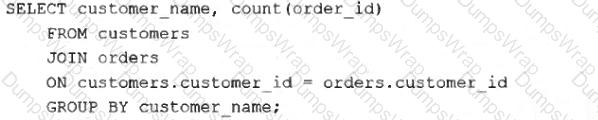
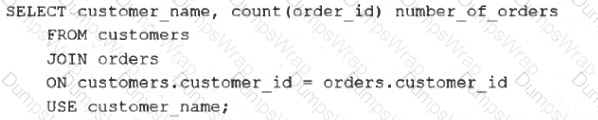
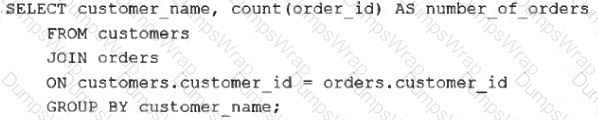
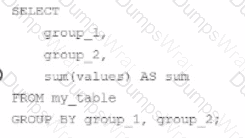
A data analyst wants the following output:

as

Which statement will produce this output?

A)

as

B)

as

C)

as

D)

as

Options:

A.

Option A

B.

Option B

C.

Option C

D.

Option D

Question 10

A data analyst is working with a nested array column products in table transactions. The analyst wants to return the first item in the array for each row.

The data analyst is using the following incomplete command:

SELECT

transaction_id,

_____ AS first_product

FROM transactions;

Which line of code should the data analyst use to fill in the blank so that it successfully completes the task?

Options:

A.

products.1

B.

products.0

C.

products[0]

D.

products[1]

Question 11

An analyst has been asked to combine the data in two tables: suppliers and new_suppliers. It is possible that some of the supplier_id values match in both tables, meaning those suppliers have already been added to the suppliers table. If that is the case, the data should be unchanged.

Which command will combine the two tables without duplicating the rows with the same supplier_id?

Options:

A.

Option AMERGE INTO suppliersUSING new_suppliersON suppliers.supplier_id = new_suppliers.supplier_idWHEN NOT MATCHED THEN INSERT *;

B.

Option BCOPY INTO suppliersUSING new_suppliersON suppliers.supplier_id = new_suppliers.supplier_idWHEN NOT MATCHED THEN INSERT *;

C.

Option CUPDATE suppliersUSING new_suppliersON suppliers.supplier_id = new_suppliers.supplier_idWHEN NOT MATCHED THEN INSERT *;

D.

Option DINSERT INTO suppliersUSING new_suppliersON suppliers.supplier_id = new_suppliers.supplier_idWHEN NOT MATCHED THEN INSERT *;

Question 12

Where can an admin or data owner grant database, table, and view permissions to a group?

Options:

A.

Dashboard

B.

Data

C.

SQL Warehouses

D.

Settings

Question 13

In which circumstance will there be a substantial difference between the variable’s mean and median values?

Options:

A.

When the variable is of the categorical type

B.

When the variable is of the boolean type

C.

When the variable contains no outliers

D.

When the variable contains a lot of extreme outliers

Question 14

Which of the following is a benefit of the Databricks Lakehouse Platform embracing open source technologies?

Options:

A.

Cloud-specific integrations

B.

Simplified governance

C.

Ability to scale storage

D.

Ability to scale workloads

E.

Avoiding vendor lock-in

Question 15

A data analyst has a managed table table_name in database database_name. They would now like to remove the table from the database and all of the data files associated with the table. The rest of the tables in the database must continue to exist.

Which of the following commands can the analyst use to complete the task without producing an error?

Options:

A.

DROP DATABASE database_name;

B.

DROP TABLE database_name.table_name;

C.

DELETE TABLE database_name.table_name;

D.

DELETE TABLE table_name FROM database_name;

E.

DROP TABLE table_name FROM database_name;

Question 16

A data engineer wants to schedule their Databricks SQL dashboard to refresh once per day, but they only want the associated SQL endpoint to be running when it is necessary.

Which of the following approaches can the data engineer use to minimize the total running time of the SQL endpoint used in the refresh schedule of their dashboard?

Options:

A.

They can ensure the dashboard’s SQL endpoint matches each of the queries’ SQL endpoints.

B.

They can set up the dashboard’s SQL endpoint to be serverless.

C.

They can turn on the Auto Stop feature for the SQL endpoint.

D.

They can reduce the cluster size of the SQL endpoint.

E.

They can ensure the dashboard’s SQL endpoint is not one of the included query’s SQL endpoint.

Question 17

A data analyst wants to generate insights from large, complex datasets. The analyst needs to quickly understand the meaning of various data columns, ask questions in natural language, and receive AI-driven recommendations for optimizing data queries and workflows.

Which Databricks component is primarily responsible for enabling these capabilities?

Options:

A.

Data Intelligence Engine

B.

Unity Catalog

C.

Genie Spaces

D.

Databricks Assistant

Question 18

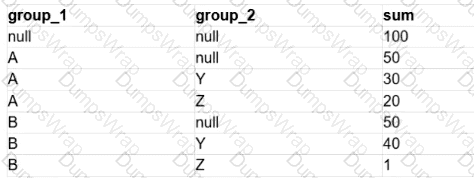
A data analyst is processing a complex aggregation on a table with zero null values and the query returns the following result:
as

Which query did the analyst execute in order to get this result?

A)

as

B)

as

C)

as

D)

as

Options:

A.

Option A

B.

Option B

C.

Option C

D.

Option D

Question 19

Data professionals with varying titles use the Databricks SQL service as the primary touchpoint with the Databricks Lakehouse Platform. However, some users will use other services like Databricks Machine Learning or Databricks Data Science and Engineering.

Which of the following roles uses Databricks SQL as a secondary service while primarily using one of the other services?

Options:

A.

Business analyst

B.

SQL analyst

C.

Data engineer

D.

Business intelligence analyst

E.

Data analyst

Question 20

A data engineer needs to use a Delta table as part of a data pipeline, but they do not know if they have the appropriate permissions.

In which of the following locations can the data engineer review their permissions on the table?

Options:

A.

Databricks Filesystem

B.

Jobs

C.

Dashboards

D.

Repos

E.

Data Explorer

Question 21

A data analyst runs the following command:

INSERT INTO stakeholders.suppliers TABLE stakeholders.new_suppliers;

What is the result of running this command?

Options:

A.

The suppliers table now contains both the data it had before the command was run and the data from the new suppliers table, and any duplicate data is deleted.

B.

The command fails because it is written incorrectly.

C.

The suppliers table now contains both the data it had before the command was run and the data from the new suppliers table, including any duplicate data.

D.

The suppliers table now contains the data from the new suppliers table, and the new suppliers table now contains the data from the suppliers table.

E.

The suppliers table now contains only the data from the new suppliers table.

Question 22

A data scientist has asked a data analyst to create histograms for every continuous variable in a data set. The data analyst needs to identify which columns are continuous in the data set.

What describes a continuous variable?

Options:

A.

A quantitative variable that never stops changing

B.

A quantitative variable Chat can take on a finite or countably infinite set of values

C.

A quantitative variable that can take on an uncountable set of values

D.

A categorical variable in which the number of categories continues to increase over time

Question 23

Which statement describes descriptive statistics?

Options:

A.

A branch of statistics that uses a variety of data analysis techniques to infer properties of an underlying distribution of probability.

B.

A branch of statistics that uses summary statistics to categorically describe and summarize data.

C.

A branch of statistics that uses summary statistics to quantitatively describe and summarize data.

D.

A branch of statistics that uses quantitative variables that must take on a finite or countably infinite set of values.

Question 24

A data analyst has been asked to use the below table sales_table to rank products within region by the sales.

Input table:

region product sales

WEST A 1880.59

EAST A 2045.99

EAST B 4583.23

WEST B 3391.19

The result of the query should look like this:

region product rank

EAST B 1

EAST A 2

WEST B 1

WEST A 2

Which query will accomplish this task?

Options:

A.

SELECT region, product, RANK() OVER ( ORDER BY sales DESC ) AS rankFROM sales_table;

B.

SELECT region, product, RANK() OVER ( PARTITION BY product ORDER BY sales DESC ) AS rankFROM sales_table;

C.

SELECT region, product, RANK() OVER ( PARTITION BY region ) AS rankFROM sales_table;

D.

SELECT region, product, RANK() OVER ( PARTITION BY region ORDER BY sales DESC ) AS rankFROM sales_table;

E.

Option A

F.

Option B

G.

Option C

Question 25

A data engineering team has created a Structured Streaming pipeline that processes data in micro-batches and populates gold-level tables. The microbatches are triggered every 10 minutes.

A data analyst has created a dashboard based on this gold level data. The project stakeholders want to see the results in the dashboard updated within 10 minutes or less of new data becoming available within the gold-level tables.

What is the ability to ensure the streamed data is included in the dashboard at the standard requested by the project stakeholders?

Options:

A.

A refresh schedule with an interval of 10 minutes or less

B.

A refresh schedule with an always-on SQL Warehouse (formerly known as SQL Endpoint

C.

A refresh schedule with stakeholders included as subscribers

D.

A refresh schedule with a Structured Streaming cluster

Question 26

A data analyst needs to use the Databricks Lakehouse Platform to quickly create SQL queries and data visualizations. It is a requirement that the compute resources in the platform can be made serverless, and it is expected that data visualizations can be placed within a dashboard.

Which of the following Databricks Lakehouse Platform services/capabilities meets all of these requirements?

Options:

A.

Delta Lake

B.

Databricks Notebooks

C.

Tableau

D.

Databricks Machine Learning

E.

Databricks SQL

Question 27

In a healthcare provider organization using Delta Lake to store electronic health records, a data analyst needs to analyze a snapshot of the patient_records table from two weeks ago before some recent data corrections were applied.

What approach should the Data Engineer take to allow the analyst to query that specific prior version?

Options:

A.

Truncate the table to remove all data, then reload the data from two weeks ago into the truncated table for the analyst to query.

B.

Identify the version number corresponding to two weeks ago from the Delta transaction log, share that version number with the analyst to query using VERSION AS OF syntax, or export that version to a new Delta table for the analyst to query.

C.

Restore the table to the version from two weeks ago using the RESTORE command, and have the analyst query the restored table.

D.

Use the VACUUM command to remove all versions of the table older than two weeks, then the analyst can query the remaining version.

Question 28

What is a benefit of using Databricks SQL for business intelligence (Bl) analytics projects instead of using third-party Bl tools?

Options:

A.

Computations, data, and analytical tools on the same platform

B.

Advanced dashboarding capabilities

C.

Simultaneous multi-user support

D.

Automated alerting systems

Question 29

Which of the following is a benefit of Databricks SQL using ANSI SQL as its standard SQL dialect?

Options:

A.

It has increased customization capabilities

B.

It is easy to migrate existing SQL queries to Databricks SQL

C.

It allows for the use of Photon ' s computation optimizations

D.

It is more performant than other SQL dialects

E.

It is more compatible with Spark ' s interpreters

Question 30

Which data lakehouse feature results in improved data quality over a traditional data lake?

Options:

A.

A data lakehouse stores data in open formats.

B.

A data lakehouse allows the use of SQL queries to examine data.

C.

A data lakehouse provides storage solutions for structured and unstructured data.

D.

A data lakehouse supports ACID-compliant transactions.

Question 31

A data analyst is using Databricks Unity Catalog. The datasets are tagged by sensitivity, and confidential data is marked with the tag key confidential. The data analyst needs to quickly find all tables tagged as confidential to review their access permissions in the Databricks workspace search bar.

Which search key text should the data analyst use to find these tables?

Options:

A.

confidential:true

B.

tag=confidential

C.

tag:confidential

D.

search tag = ' confidential '

Question 32

A data analyst has created a user-defined function using the following line of code:

CREATE FUNCTION price(spend DOUBLE, units DOUBLE)

RETURNS DOUBLE

RETURN spend / units;

Which of the following code blocks can be used to apply this function to the customer_spend and customer_units columns of the table customer_summary to create column customer_price?

Options:

A.

SELECT PRICE customer_spend, customer_units AS customer_price FROM customer_summary

B.

SELECT price FROM customer_summary

C.

SELECT function(price(customer_spend, customer_units)) AS customer_price FROM customer_summary

D.

SELECT double(price(customer_spend, customer_units)) AS customer_price FROM customer_summary

E.

SELECT price(customer_spend, customer_units) AS customer_price FROM customer_summary

Question 33

A data scientist wants to tune a set of hyperparameters for a machine learning model. They have wrapped a Spark ML model in the objective function objective_function, and they have defined the search space search_space.

As a result, they have the following code block:

num_evals = 100

trials = SparkTrials()

best_hyperparam = fmin(

fn=objective_function,

space=search_space,

algo=tpe.suggest,

max_evals=num_evals,

trials=trials

)

Which of the following changes do they need to make to the above code block in order to accomplish the task?

Options:

A.

Change SparkTrials() to Trials()

B.

Reduce num_evals to be less than 10

C.

Change fmin() to fmax()

D.

Remove the trials=trials argument

E.

Remove the algo=tpe.suggest argument

Question 34

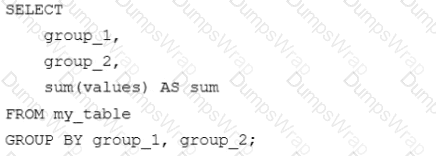
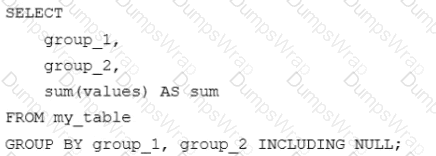
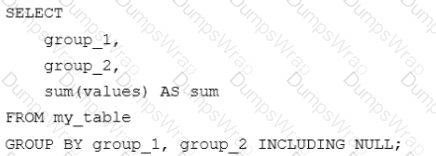
A data analyst is processing a complex aggregation on a table with zero null values and the query returns the following result:

Which query did the analyst execute in order to get this result?

A)
B)
C)
D)
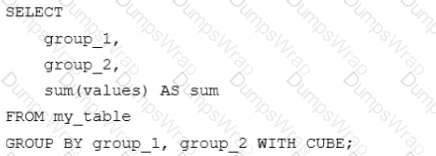
as

Options:

A.

Option A

B.

Option B

C.

Option C

D.

Option D

Question 35

A data analysis team has noticed that their Databricks SQL queries are running too slowly when connected to their always-on SQL endpoint. They claim that this issue is present when many members of the team are running small queries simultaneously. They ask the data engineering team for help. The data engineering team notices that each of the team’s queries uses the same SQL endpoint.

Which of the following approaches can the data engineering team use to improve the latency of the team’s queries?

Options:

A.

They can increase the cluster size of the SQL endpoint.

B.

They can increase the maximum bound of the SQL endpoint’s scaling range.

C.

They can turn on the Auto Stop feature for the SQL endpoint.

D.

They can turn on the Serverless feature for the SQL endpoint.

E.

They can turn on the Serverless feature for the SQL endpoint and change the Spot Instance Policy to “Reliability Optimized.”

Page: 1 / 12
Total 118 questions