Summer Sale Discount Flat 70% Offer - Ends in 0d 00h 00m 00s - Coupon code: 70diswrap

Databricks Databricks-Certified-Data-Engineer-Associate Dumps

Databricks Certified Data Engineer Associate Exam Questions and Answers

Question 1

Which type of workloads are compatible with Auto Loader?

Options:

A.

Streaming workloads

B.

Machine learning workloads

C.

Serverless workloads

D.

Batch workloads

Question 2

Which SQL code snippet will correctly demonstrate a Data Definition Language (DDL) operation used to create a table?

Options:

A.

DROP TABLE employees;

B.

INSERT INTO employees (id, name) VALUES (1, ' Alice ' );

C.

CRFATF tabif employees ( id INT, name suing

D.

ALTFR TABIF employees add column salary DECTMA(10,2);

Question 3

A data engineer is running code in a Databricks Repo that is cloned from a central Git repository. A colleague of the data engineer informs them that changes have been made and synced to the central Git repository. The data engineer now needs to sync their Databricks Repo to get the changes from the central Git repository.

Which of the following Git operations does the data engineer need to run to accomplish this task?

Options:

A.

Merge

B.

Push

C.

Pull

D.

Commit

E.

Clone

Question 4

A data engineer has configured a Lakeflow Job that runs daily to ingest customer transaction data from a legacy relational database. The extracted data must be written directly to a Unity Catalog table and be immediately queryable through SQL. The team must also preserve data lineage.

Which action enables this ingestion with direct landing in Unity Catalog, preserved lineage, and immediate SQL query capability?

Options:

A.

Use ODBC pooling to extract all records in one batch and write them to /dbfs/

B.

Use spark.read.format( " jdbc " ) and write the resulting DataFrame with saveAsTable( " catalog.schema.table " )

C.

Stage the data in cloud storage through a REST API and load it with a separate job

D.

Extract the data to a Pandas DataFrame, convert it to Spark, and use save() to write it to an external path

Question 5

A data engineer is migrating pipeline tasks to reduce operational toil. The workspace uses Unity Catalog and is in a region that supports serverless. The engineer wants Databricks to auto-select instance types, manage scaling, apply Photon, and handle runtime upgrades automatically for job runs.

How should the data engineer meet this requirement while adhering to Databricks constraints?

Options:

A.

Use a Pro SQL warehouse and schedule Python notebook tasks to execute as pipeline steps.

B.

Use an all-purpose cluster with cluster policies to enforce standard sizes and enable autoscaling.

C.

Create a job with a single-task job cluster and manually set the instance families and minimum/maximum workers.

D.

Run the job on a serverless compute for workflows configuration, ensuring Unity Catalog is enabled and regional support is available.

Question 6

An organization is building a data lakehouse and needs to ingest data from multiple sources into Unity Catalog-managed tables:

    Salesforce: More than 50 objects, frequent schema changes, and OAuth authentication

    An on-premises SQL Server database: More than 100 tables, CDC enabled, and private network connectivity required

    Daily JSON files landing in Azure Data Lake Storage Gen2

The organization wants all ingested data governed by Unity Catalog, minimal engineering effort for schema changes, and serverless processing wherever possible.

Which ingestion strategy meets these requirements?

Options:

A.

Use partner connectors such as Fivetran for all three sources through Partner Connect

B.

Use Auto Loader for all three sources, with custom Python code for Salesforce API calls and SQL Server CDC extraction

C.

Use Lakeflow Connect managed connectors for Salesforce and SQL Server, and Auto Loader for the ADLS files, within Lakeflow Spark Declarative Pipelines

D.

Use Lakeflow Connect managed connectors for all three sources

Question 7

A data engineer is onboarding a new Bronze ingestion pipeline in Databricks with Unity Catalog. The team wants Databricks to handle storage layout, apply platform optimizations over time, and simplify lifecycle management so that when a table is dropped, its underlying data is also cleaned up according to Databricks-managed retention policies.

Which table type should the data engineer create for these ingestion tables?

Options:

A.

Managed tables so that Unity Catalog manages both metadata and underlying data lifecycle

B.

External tables with a LOCATION pointing to an external volume for full control of file layout

C.

Foreign tables federated from an external catalog to delegate optimization to the source system

D.

Temporary views over files to avoid table-level governance and lifecycle coupling

Question 8

A data engineer has multiple Unity Catalog-managed Delta tables that require regular maintenance. Currently, the engineer manually schedules OPTIMIZE and VACUUM jobs for each table, adjusting their frequency according to how often each table is queried and updated.

The engineer needs to eliminate this manual maintenance overhead and allow Databricks to determine automatically when and how to run these operations.

Which action should the engineer take?

Options:

A.

Enable predictive optimization at the account, catalog, or schema level so Databricks automatically identifies and runs maintenance operations on managed tables.

B.

Configure Auto Loader with schema evolution enabled so it automatically triggers OPTIMIZE and VACUUM after each ingestion batch.

C.

Enable liquid clustering with CLUSTER BY on each table so it automatically compacts files and removes stale files on a schedule.

D.

Set delta.autoOptimize.autoCompact and delta.autoOptimize.optimizeWrite table properties to trigger automatic VACUUM and file compaction.

Question 9

A data engineer is cleaning a Bronze table. The requirement is to eliminate rows where either the customer_email field or the customer_phone field is NULL. The cleaning must be performed in one operation using a single method call.

Which PySpark approach supports filtering multiple columns for NULL values in one call?

Options:

A.

df.dropna(subset=[ " customer_email " , " customer_phone " ])

B.

df.where( " customer_email IS NOT NULL " ).where( " customer_phone IS NOT NULL " )

C.

df.na.drop(how= " all " )

D.

df.filter(col( " customer_email " ).isNotNull() & col( " customer_phone " ).isNotNull())

Question 10

A data engineer needs to provide access to a group named manufacturing-team. The team needs privileges to create tables in the quality schema.

Which set of SQL commands will grant a group named manufacturing-team to create tables in a schema named production with the parent catalog named manufacturing with the least privileges?

A)

as

B)

as

C)

as

D)

as

Options:

A.

Option A

B.

Option B

C.

Option C

D.

Option D

Question 11

A data engineer needs Task C to run only when Task A succeeds and Task B fails.

Which dependency configuration implements this conditional logic?

Options:

A.

Task C depends on Task A with Success, with Task B listed as a negative dependency.

B.

Use two dependency chains: one that proceeds only when Task A succeeds and another that proceeds only when Task B has at least one failure; Task C depends on both resulting branches.

C.

Create a Python task that checks dbutils.jobs.taskValues from Tasks A and B before running Task C.

D.

Configure Task C to depend on Task A and Task B with All done and use a notebook widget as the condition.

Question 12

A data engineering team needs to ingest historical CSV files from a cloud-storage location that already contains 50,000 existing files. The team also expects new files to arrive continuously. The team wants to use Auto Loader to incrementally process both the existing files and new arrivals efficiently.

Which Auto Loader mode should the team configure for this use case?

Options:

A.

Use file notification mode because it scales efficiently for both large numbers of existing files and continuous new arrivals by using cloud-storage events rather than repeatedly listing directories.

B.

Use directory listing mode because it provides better performance for the initial processing of 50,000 existing files through optimized incremental listing capabilities.

C.

Use directory listing mode initially to process the 50,000 existing files, and then reconfigure the stream to use file notification mode for ongoing ingestion of new arrivals.

D.

Use file notification mode only after all existing files have been processed because it cannot efficiently handle large volumes of pre-existing files.

Question 13

An organization has implemented a data pipeline in Databricks and needs to ensure it can scale automatically based on varying workloads without manual cluster management. The goal is to meet the company’s Service Level Agreements (SLAs), which require high availability and minimal downtime, while Databricks automatically handles resource allocation and optimization.

Which approach fulfills these requirements?

Options:

A.

Use Serverless compute in Databricks to automatically scale and provision resources with minimal manual intervention

B.

Deploy job clusters with fixed configurations, dedicated to specific tasks, without automatic scaling

C.

Use spot instances to allocate resources dynamically while minimizing costs, with potential interruptions

D.

Use interactive clusters in Databricks, adjusting cluster sizes manually based on workload demands

Question 14

Which of the following is stored in the Databricks customer ' s cloud account?

Options:

A.

Databricks web application

B.

Cluster management metadata

C.

Repos

D.

Data

E.

Notebooks

Question 15

A dataset has been defined using Delta Live Tables and includes an expectations clause:

CONSTRAINT valid_timestamp EXPECT (timestamp > ' 2020-01-01 ' ) ON VIOLATION DROP ROW

What is the expected behavior when a batch of data containing data that violates these constraints is processed?

Options:

A.

Records that violate the expectation are dropped from the target dataset and loaded into a quarantine table.

B.

Records that violate the expectation are added to the target dataset and flagged as invalid in a field added to the target dataset.

C.

Records that violate the expectation are dropped from the target dataset and recorded as invalid in the event log.

D.

Records that violate the expectation are added to the target dataset and recorded as invalid in the event log.

E.

Records that violate the expectation cause the job to fail.

Question 16

Which of the following describes the relationship between Gold tables and Silver tables?

Options:

A.

Gold tables are more likely to contain aggregations than Silver tables.

B.

Gold tables are more likely to contain valuable data than Silver tables.

C.

Gold tables are more likely to contain a less refined view of data than Silver tables.

D.

Gold tables are more likely to contain more data than Silver tables.

E.

Gold tables are more likely to contain truthful data than Silver tables.

Question 17

A data engineering team is designing the Gold layer in its Unity Catalog-governed lakehouse for downstream BI and analytics users. The team wants to expose business-ready metrics with fast query performance and consistent definitions while keeping the transformation logic in Spark notebooks.

Which type of Gold-layer object meets this requirement?

Options:

A.

A materialized view that precomputes aggregations from Silver tables on a schedule and is queried by BI tools for faster, consistent analytics

B.

A view that directly references raw Bronze tables so BI tools can define their own joins and aggregations

C.

A streaming table that continuously ingests raw events from source systems and exposes them directly to BI users

D.

A collection of CSV files stored in cloud object storage that BI users parse to query the Gold-layer data

Question 18

A data engineer is managing a data pipeline in Databricks, where multiple Delta tables are used for various transformations. The team wants to track how data flows through the pipeline, including identifying dependencies between Delta tables, notebooks, jobs, and dashboards. The data engineer is utilizing the Unity Catalog lineage feature to monitor this process.

How does Unity Catalog’s data lineage feature support the visualization of relationships between Delta tables, notebooks, jobs, and dashboards?

Options:

A.

Unity Catalog lineage visualizes dependencies between Delta tables, notebooks, and jobs, but does not provide column-level tracing or relationships with dashboards.

B.

Unity Catalog lineage only supports visualizing relationships at the table level and does not extend to notebooks, jobs, or dashboards.

C.

Unity Catalog lineage provides an interactive graph that tracks dependencies between tables and notebooks but excludes any job-related dependencies or dashboard visualizations.

D.

Unity Catalog provides an interactive graph that visualizes the dependencies between Delta tables, notebooks, jobs, and dashboards, while also supporting column-level tracking of data transformations.

Question 19

A data engineer has been given a new record of data:

id STRING = ' a1 '

rank INTEGER = 6

rating FLOAT = 9.4

Which of the following SQL commands can be used to append the new record to an existing Delta table my_table?

Options:

A.

INSERT INTO my_table VALUES ( ' a1 ' , 6, 9.4)

B.

my_table UNION VALUES ( ' a1 ' , 6, 9.4)

C.

INSERT VALUES ( ' a1 ' , 6, 9.4) INTO my_table

D.

UPDATE my_table VALUES ( ' a1 ' , 6, 9.4)

E.

UPDATE VALUES ( ' a1 ' , 6, 9.4) my_table

Question 20

A data engineer wants to create a relational object by pulling data from two tables. The relational object does not need to be used by other data engineers in other sessions. In order to save on storage costs, the data engineer wants to avoid copying and storing physical data.

Which of the following relational objects should the data engineer create?

Options:

A.

Spark SQL Table

B.

View

C.

Database

D.

Temporary view

E.

Delta Table

Question 21

A data engineer triggers a scheduled job but finds that the new run was not executed. The run history shows that the run was skipped with a concurrency-related queue message.

Which configuration should the engineer investigate?

Options:

A.

The cluster spot-instance availability in the cloud provider

B.

The SQL warehouse permissions for the task

C.

The job-level max_concurrent_runs setting and whether queueing is enabled

D.

The task-level timeout_seconds configuration

Question 22

A data engineer has a single-task Job that runs each morning before they begin working. After identifying an upstream data issue, they need to set up another task to run a new notebook prior to the original task.

Which of the following approaches can the data engineer use to set up the new task?

Options:

A.

They can clone the existing task in the existing Job and update it to run the new notebook.

B.

They can create a new task in the existing Job and then add it as a dependency of the original task.

C.

They can create a new task in the existing Job and then add the original task as a dependency of the new task.

D.

They can create a new job from scratch and add both tasks to run concurrently.

E.

They can clone the existing task to a new Job and then edit it to run the new notebook.

Question 23

A data engineer is standardizing repository layouts for multiple teams adopting Databricks Asset Bundles. The engineer wants to ensure every project has a single authoritative configuration file at the repository root that defines the bundle name, targets, workspace settings, permissions, and resource mappings (for jobs and pipelines).

Which strategy should the data engineer use to meet this goal?

Options:

A.

Place multiple databricks.yml files under each subfolder (for example, jobs/, pipelines/, workspace/) and merge them at deploy time using the include mapping.

B.

Place exactly one databricks.yml at the repository root; it is the main configuration file and may reference additional configuration files via the include mapping.

C.

Place a databricks.yml in a .databricks/ hidden folder at the repository root; only hidden locations are valid for bundle configs.

D.

Place a databricks.yml at the repository root and optional databricks.yml in subfolders; the CLI prefers .yaml over .yml when both exist.

Question 24

What are the transformations typically included in building the Bronze layer ?

Options:

A.

Perform extensive data cleansing

B.

Aggregate data from multiple sources

C.

Business rules and transformations

D.

Include columns Load date/time, process ID

Question 25

A new data engineering team has been assigned to work on a project. The team will need access to database customers in order to see what tables already exist. The team has its own group team.

Which of the following commands can be used to grant the necessary permission on the entire database to the new team?

Options:

A.

GRANT VIEW ON CATALOG customers TO team;

B.

GRANT CREATE ON DATABASE customers TO team;

C.

GRANT USAGE ON CATALOG team TO customers;

D.

GRANT CREATE ON DATABASE team TO customers;

E.

GRANT USAGE ON DATABASE customers TO team;

Question 26

A data engineer has joined an existing project and they see the following query in the project repository:

CREATE STREAMING LIVE TABLE loyal_customers AS

SELECT customer_id -

FROM STREAM(LIVE.customers)

WHERE loyalty_level = ' high ' ;

Which of the following describes why the STREAM function is included in the query?

Options:

A.

The STREAM function is not needed and will cause an error.

B.

The table being created is a live table.

C.

The customers table is a streaming live table.

D.

The customers table is a reference to a Structured Streaming query on a PySpark DataFrame.

E.

The data in the customers table has been updated since its last run.

Question 27

A data engineering team uses Declarative Automation Bundles, formerly known as Databricks Asset Bundles, to deploy the same codebase across development, test, and production environments. The team wants environment-specific behavior to be applied only through bundle configuration, without modifying notebooks, job definitions, or deployment logic during promotion.

Which approach applies environment-specific configuration while meeting this requirement?

Options:

A.

Deploy the same bundle once and edit job settings in the workspace UI for each environment after deployment.

B.

Define bundle variables and reference them from bundle resources, and then override the variable values for each environment using bundle targets.

C.

Use separate Git branches for each environment so each branch can contain environment-specific configuration values.

D.

Parameterize environment-specific values inside notebooks and set those parameters whenever each job run is triggered.

Question 28

What is the maximum output supported by a job cluster to ensure a notebook does not fail?

Options:

A.

10MBS

B.

25MBS

C.

30MBS

D.

15MBS

Question 29

A data engineering team needs to incrementally ingest customer transactions from a SaaS application into the Databricks Data Intelligence Platform with the following capabilities:

    Built-in change data capture, including updates and deletes

    Automatic schema evolution

    Serverless execution with retries and minimal maintenance

    OAuth support and basic monitoring

Which solution meets all the requirements?

Options:

A.

Use a Lakeflow Connect standard connector, implement MERGE-based CDC, schema evolution, and retries in workflows, and create a dedicated monitoring dashboard.

B.

Use Auto Loader on exported SaaS files and a Lakeflow Spark Declarative Pipeline that calls the SaaS APIs, handling CDC, schema changes, OAuth, and retries in custom code.

C.

Schedule regional batch jobs that call SaaS REST APIs and write directly to Silver tables using custom CDC and schema-evolution logic.

D.

Use a Lakeflow Connect managed connector for the SaaS application with built-in CDC, schema evolution, OAuth, and serverless compute with retries, and process the data downstream using Lakeflow Spark Declarative Pipelines.

Question 30

A data engineer needs to find all customers who have never placed an order. The customers table contains customer_id, customer_name, and other customer attributes. The orders table contains order_id, customer_id, and other order attributes. Both tables share customer_id as the join key. The result must include only customer columns, with no order-related columns in the output.

Which expression exactly achieves this requirement?

Options:

A.

A left outer join from orders to customers

B.

An inner join followed by filtering for a NULL order_id

C.

A left anti-join from customers to orders

D.

A full outer join followed by filtering where order_id IS NULL

Question 31

Which of the following Git operations must be performed outside of Databricks Repos?

Options:

A.

Commit

B.

Pull

C.

Push

D.

Clone

E.

Merge

Question 32

Identify a scenario to use an external table.

A Data Engineer needs to create a parquet bronze table and wants to ensure that it gets stored in a specific path in an external location.

Which table can be created in this scenario?

Options:

A.

An external table where the location is pointing to specific path in external location.

B.

An external table where the schema has managed location pointing to specific path in external location.

C.

A managed table where the catalog has managed location pointing to specific path in external location.

D.

A managed table where the location is pointing to specific path in external location.

Question 33

Which TWO items are characteristics of the Gold Layer?

Choose 2 answers

Options:

A.

Read-optimized

B.

Normalised

C.

Raw Data

D.

Historical lineage

E.

De-normalised

Question 34

A data engineer is maintaining an ETL pipeline code with a GitHub repository linked to their Databricks account. The data engineer wants to deploy the ETL pipeline to production as a databricks workflow.

Which approach should the data engineer use?

Options:

A.

Databricks Asset Bundles (DAB) + GitHub Integration

B.

Maintain workflow_config.j son and deploy it using Databricks CLI

C.

Manually create and manage the workflow in Ul

D.

Maintain workflow_conf ig. json and deploy it using Terraform

Question 35

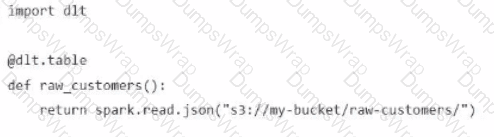
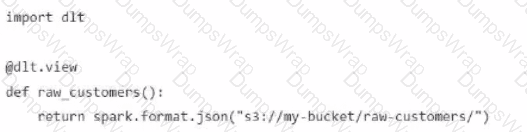
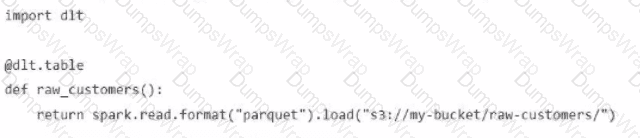
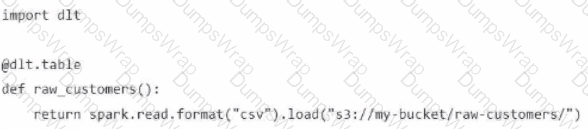
A Data Engineer is building a simple data pipeline using Delta Live Tables (DLT) in Databricksto ingest customer data. The raw customer data is stored in a cloud storage location in JSON format. The task is to create a DLT pipeline that reads the rawJSON data and writes it into a Delta table for further processing.

Which code snippet will correctly ingest the raw JSON data and create a Delta table using DLT?

A)
as

B)

as

C)

as

D)

as

Options:

A.

Option A

B.

Option B

C.

Option C

D.

Option D

Question 36

A company has a strict 15-minute service-level agreement for updating its currency-exchange dashboard. Source data arrives in small increments every few minutes. The team needs a Lakeflow Jobs trigger strategy that keeps end-to-end latency within the SLA while minimizing compute cost and DBU consumption.

Which strategy is recommended?

Options:

A.

Use a scheduled trigger every 1 minute.

B.

Use a file-arrival trigger whenever a single JSON file arrives.

C.

Use a continuous trigger.

D.

Use a scheduled trigger every 12 minutes, with the streaming task configured to use Trigger.AvailableNow.

Question 37

Which method should a Data Engineer apply to ensure Workflows are being triggered on schedule?

Options:

A.

Scheduled Workflows require an always-running cluster, which is more expensive but reduces processing latency.

B.

Scheduled Workflows process data as it arrives at configured sources.

C.

Scheduled Workflows can reduce resource consumption and expense since the cluster runs only long enough to execute the pipeline.

D.

Scheduled Workflows run continuously until manually stopped.

Question 38

A data engineer uploads a CSV file using the Create or modify a table using file upload option in Databricks. To avoid incorrect schema inference, the engineer disables Automatically detect column types before creating a Unity Catalog-managed table.

What is the outcome?

Options:

A.

All columns are created with the STRING data type.

B.

Numeric columns are inferred as numeric types, while all other columns use STRING.

C.

Table creation fails because column types are not specified.

D.

Previously inferred column types are preserved.

Question 39

A data engineer wants to schedule their Databricks SQL dashboard to refresh every hour, but they only want the associated SQL endpoint to be running when It is necessary. The dashboard has multiple queries on multiple datasets associated with it. The data that feeds the dashboard is automatically processed using a Databricks Job.

Which approach can the data engineer use to minimize the total running time of the SQL endpoint used in the refresh schedule of their dashboard?

Options:

A.

O They can reduce the cluster size of the SQL endpoint.

B.

Q They can turn on the Auto Stop feature for the SQL endpoint.

C.

O They can set up the dashboard ' s SQL endpoint to be serverless.

D.

0 They can ensure the dashboard ' s SQL endpoint matches each of the queries ' SQL endpoints.

Question 40

A data engineer is setting up a new Databricks pipeline that ingests clickstream events from Kafka and daily product catalogs from cloud object storage. To ensure auditability and easy reprocessing, the engineer wants to land all source data first. Later stages will handle cleaning, deduplication, and business modeling before the data is used in dashboards.

Which approach aligns with Medallion Architecture principles?

Options:

A.

Land both sources in Gold with denormalized star schemas to optimize BI while retaining full source fidelity

B.

Land streaming events from Kafka in Silver and the product catalog directly in Gold to minimize layers for batch data

C.

Land both sources in the Bronze layer append-only with minimal validation, then build Silver/Gold downstream for quality and analytics

D.

Land both sources directly into the Silver layer with schema enforcement and deduplication to reduce downstream complexity

Question 41

A Databricks Job with four sequential tasks is executed. The job fails at Task 3. After the root cause is fixed, the data engineer needs to complete the workflow without rerunning the successful Tasks 1 and 2.

Which action on the Job Run details page allows the engineer to resume execution from the point of failure?

Options:

A.

Run now

B.

Clone task

C.

Repair run

D.

Reset job

Question 42

A data engineer and data analyst are working together on a data pipeline. The data engineer is working on the raw, bronze, and silver layers of the pipeline using Python, and the data analyst is working on the gold layer of the pipeline using SQL The raw source of the pipeline is a streaming input. They now want to migrate their pipeline to use Delta Live Tables.

Which change will need to be made to the pipeline when migrating to Delta Live Tables?

Options:

A.

The pipeline can have different notebook sources in SQL & Python.

B.

The pipeline will need to be written entirely in SQL.

C.

The pipeline will need to be written entirely in Python.

D.

The pipeline will need to use a batch source in place of a streaming source.

Question 43

A data engineer needs to ingest from both streaming and batch sources for a firm that relies on highly accurate data. Occasionally, some of the data picked up by the sensors that provide a streaming input are outside the expected parameters. If this occurs, the data must be dropped, but the stream should not fail.

Which feature of Delta Live Tables meets this requirement?

Options:

A.

Monitoring

B.

Change Data Capture

C.

Expectations

D.

Error Handling

Question 44

Which of the following must be specified when creating a new Delta Live Tables pipeline?

Options:

A.

A key-value pair configuration

B.

The preferred DBU/hour cost

C.

A path to cloud storage location for the written data

D.

A location of a target database for the written data

E.

At least one notebook library to be executed

Question 45

A data engineer has finished developing a new Declarative Automation Bundle, formerly known as a Databricks Asset Bundle, for a streaming pipeline. The engineer must verify that the configuration is syntactically correct, deploy the code to the workspace, and finally trigger the pipeline to confirm that it runs as expected.

Which sequence of Databricks CLI commands performs these steps in the correct order?

Options:

A.

databricks bundle init → databricks bundle deploy → databricks bundle run

B.

databricks bundle validate → databricks bundle deploy → databricks bundle run

C.

databricks bundle validate → databricks bundle sync → databricks bundle execute

D.

databricks bundle check → databricks bundle upload → databricks bundle start

Question 46

Which of the following code blocks will remove the rows where the value in column age is greater than 25 from the existing Delta table my_table and save the updated table?

Options:

A.

SELECT * FROM my_table WHERE age > 25;

B.

UPDATE my_table WHERE age > 25;

C.

DELETE FROM my_table WHERE age > 25;

D.

UPDATE my_table WHERE age < = 25;

E.

DELETE FROM my_table WHERE age < = 25;

Question 47

Which of the following data workloads will utilize a Gold table as its source?

Options:

A.

A job that enriches data by parsing its timestamps into a human-readable format

B.

A job that aggregates uncleaned data to create standard summary statistics

C.

A job that cleans data by removing malformatted records

D.

A job that queries aggregated data designed to feed into a dashboard

E.

A job that ingests raw data from a streaming source into the Lakehouse

Question 48

A data engineer needs to process SQL queries on a large dataset with fluctuating workloads. The workload requires automatic scaling based on the volume of queries, without the need to manage or provision infrastructure. The solution should be cost-efficient and charge only for the compute resources used during query execution.

Which compute option should the data engineer use?

Options:

A.

Databricks SQL Analytics

B.

Databricks Jobs

C.

Databricks Runtime for ML

D.

Serverless SQL Warehouse

Question 49

A Delta Live Table pipeline includes two datasets defined using STREAMING LIVE TABLE. Three datasets are defined against Delta Lake table sources using LIVE TABLE.

The table is configured to run in Production mode using the Continuous Pipeline Mode.

Assuming previously unprocessed data exists and all definitions are valid, what is the expected outcome after clicking Start to update the pipeline?

Options:

A.

All datasets will be updated at set intervals until the pipeline is shut down. The compute resources will persist to allow for additional testing.

B.

All datasets will be updated once and the pipeline will persist without any processing. The compute resources will persist but go unused.

C.

All datasets will be updated at set intervals until the pipeline is shut down. The compute resources will be deployed for the update and terminated when the pipeline is stopped.

D.

All datasets will be updated once and the pipeline will shut down. The compute resources will be terminated.

E.

All datasets will be updated once and the pipeline will shut down. The compute resources will persist to allow for additional testing.

Question 50

A data engineer is building a Silver-layer pipeline that should execute only after the Bronze-layer table has been successfully updated with new records.

Which trigger type in Databricks Jobs is specifically designed to orchestrate this dependency by reacting to changes in the upstream Unity Catalog table?

Options:

A.

Table update trigger

B.

Continuous trigger

C.

Scheduled trigger

D.

File arrival trigger

Question 51

A data engineer has been using a Databricks SQL dashboard to monitor the cleanliness of the input data to a data analytics dashboard for a retail use case. The job has a Databricks SQL query that returns the number of store-level records where sales is equal to zero. The data engineer wants their entire team to be notified via a messaging webhook whenever this value is greater than 0.

Which of the following approaches can the data engineer use to notify their entire team via a messaging webhook whenever the number of stores with $0 in sales is greater than zero?

Options:

A.

They can set up an Alert with a custom template.

B.

They can set up an Alert with a new email alert destination.

C.

They can set up an Alert with one-time notifications.

D.

They can set up an Alert with a new webhook alert destination.

E.

They can set up an Alert without notifications.

Question 52

A data architect has determined that a table of the following format is necessary:
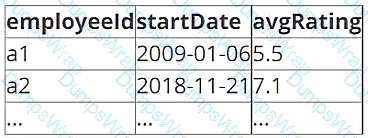
as

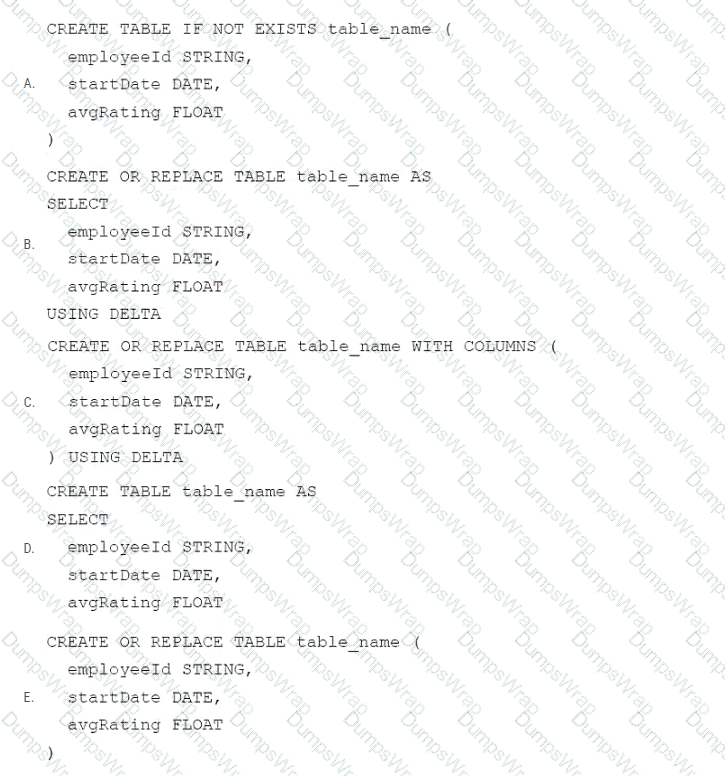
Which of the following code blocks uses SQL DDL commands to create an empty Delta table in the above format regardless of whether a table already exists with this name?
as

Options:

A.

Option A

B.

Option B

C.

Option C

D.

Option D

E.

Option E

Question 53

A data engineer is designing a data pipeline. The source system generates files in a shared directory that is also used by other processes. As a result, the files should be kept as is and will accumulate in the directory. The data engineer needs to identify which files are new since the previous run in the pipeline, and set up the pipeline to only ingest those new files with each run.

Which of the following tools can the data engineer use to solve this problem?

Options:

A.

Unity Catalog

B.

Delta Lake

C.

Databricks SQL

D.

Data Explorer

E.

Auto Loader

Question 54

A pipeline uses COPY INTO to ingest CSV files from cloud object storage into a Unity Catalog Delta table. Some files are occasionally re-uploaded with corrections using the same filename.

The engineer needs the corrected data to be ingested as soon as it becomes available.

What should the engineer do?

Options:

A.

Overwrite the target Delta table during every run.

B.

Load corrections as new files and apply updates to the target table.

C.

Recreate the target table before every run.

D.

Reload all files from the source path during every run.

Question 55

A data engineer is designing a cost-optimized, event-driven pipeline. They configure a Lakeflow Job with a File Arrival trigger to watch an Amazon S3 bucket. The job runs a notebook that uses Auto Loader with trigger(availableNow=True) to ingest data into a Bronze table.

What is the technical relationship between the File Arrival trigger and Auto Loader in this integration pattern?

Options:

A.

The File Arrival trigger starts the job run, while Auto Loader uses its internal checkpoint to independently identify and process only the new files that have arrived since the last successful commit.

B.

Auto Loader must be configured in File Notification mode to work with a Lakeflow Job File Arrival trigger.

C.

Using a File Arrival trigger requires the engineer to disable Auto Loader checkpointing to prevent the job from processing the same file multiple times.

D.

The File Arrival trigger automatically passes the specific file path of the new arrival to Auto Loader, allowing the engineer to omit the source-path configuration from the code.

Question 56

A data engineer is using the following code block as part of a batch ingestion pipeline to read from a composable table:
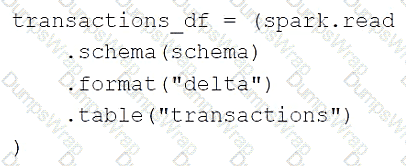
as

Which of the following changes needs to be made so this code block will work when the transactions table is a stream source?

Options:

A.

Replace predict with a stream-friendly prediction function

B.

Replace schema(schema) with option ( " maxFilesPerTrigger " , 1)

C.

Replace " transactions " with the path to the location of the Delta table

D.

Replace format( " delta " ) with format( " stream " )

E.

Replace spark.read with spark.readStream

Question 57

Which of the following is hosted completely in the control plane of the classic Databricks architecture?

Options:

A.

Worker node

B.

JDBC data source

C.

Databricks web application

D.

Databricks Filesystem

E.

Driver node

Question 58

A data engineer is joining a very large events_df DataFrame containing billions of rows with a small country_lookup_df DataFrame containing fewer than 10,000 rows. The DataFrames are joined on the country_code column. The join is slow because of data shuffling.

How should the data engineer improve performance?

Options:

A.

Broadcast events_df when performing the join.

B.

Cache both DataFrames, and then run the same join.

C.

Persist both DataFrames, and then run the same join.

D.

Broadcast country_lookup_df when performing the join.

Question 59

A data engineer needs to conduct Exploratory Analysis on data residing in a database that is within the company ' s custom-defined network in the cloud. The data engineer is using SQL for this task.

Which type of SQL Warehouse will enable the data engineer to process large numbers of queries quickly and cost-effectively?

Options:

A.

Serverless compute for notebooks

B.

Serverless SQL Warehouse

C.

Classic SQL Warehouse

D.

Pro SQL Warehouse

Question 60

A data engineer has developed a data pipeline to ingest data from a JSON source using Auto Loader, but the engineer has not provided any type inference or schema hints in their pipeline. Upon reviewing the data, the data engineer has noticed that all of the columns in the target table are of the string type despite some of the fields only including float or boolean values.

Which of the following describes why Auto Loader inferred all of the columns to be of the string type?

Options:

A.

There was a type mismatch between the specific schema and the inferred schema

B.

JSON data is a text-based format

C.

Auto Loader only works with string data

D.

All of the fields had at least one null value

E.

Auto Loader cannot infer the schema of ingested data

Question 61

A data engineer is inspecting an ETL pipeline based on a Pyspark job that consistently encounters performance bottlenecks. Based on developer feedback, the data engineer assumes the job is low on compute resources. To pinpoint the issue, the data engineer observes the Spark Ul and finds out the job has a high CPU time vs Task time.

Which course of action should the data engineer take?

Options:

A.

High CPU time vs Task time means an under-utilized cluster. The data engineer may need to repartition data to spread the jobs more evenly throughout the cluster.

B.

High CPU time vs Task time means efficient use of cluster and no change needed

C.

High CPU time vs Task time means over-utilized memory and the need to increase parallelism

D.

High CPU time vs Task time means a CPU over-utilized job. The data engineer may need to consider executor and core tuning or resizing the cluster

Question 62

A data engineer is writing a script that is meant to ingest new data from cloud storage. In the event of the Schema change, the ingestion should fail. It should fail until the changes downstream source can be found and verified as intended changes.

Which command will meet the requirements?

Options:

A.

addNewColumns

B.

failOnNewColumns

C.

rescue

D.

none

Question 63

A data engineer is preparing a Declarative Automation Bundle, formerly known as a Databricks Asset Bundle, to deploy a Lakeflow pipeline.

To ensure that the pipeline is deployed to the correct environment, where should workspace-specific configurations, such as the workspace host URL and root storage path, be defined within the bundle project?

Options:

A.

Inside the README.md file in the bundle’s root directory

B.

Within the Python source code of the Lakeflow pipeline

C.

In the targets section of the databricks.yml file

D.

In a global environment variable on the local development machine

Question 64

Which Databricks SQL predicate correctly performs a null-safe equality comparison so that rows are matched when both sides are NULL or when both are equal non-NULL values?

Options:

A.

WHERE customer_id < = > :cid

B.

WHERE customer_id = :cid

C.

WHERE customer_id < > :cid OR customer_id IS NULL

D.

WHERE COALESCE(customer_id, ' ' ) = COALESCE(:cid, ' ' )

Question 65

A data engineer has realized that the data files associated with a Delta table are incredibly small. They want to compact the small files to form larger files to improve performance.

Which of the following keywords can be used to compact the small files?

Options:

A.

REDUCE

B.

OPTIMIZE

C.

COMPACTION

D.

REPARTITION

E.

VACUUM

Question 66

Which two components function in the DB platform architecture’s control plane? (Choose two.)

Options:

A.

Virtual Machines

B.

Compute Orchestration

C.

Serverless Compute

D.

Compute

E.

Unity Catalog

Question 67

A data engineering team is using Kafka to capture event data and then ingest it into Databricks. The team wants to be able to see these historical events. Medallion architecture is already in place. The team wants to be mindful of costs.

Where should this historical event data be stored?

Options:

A.

Gold

B.

Silver

C.

Bronze

D.

Raw layer

Question 68

A single Job runs two notebooks as two separate tasks. A data engineer has noticed that one of the notebooks is running slowly in the Job’s current run. The data engineer asks a tech lead for help in identifying why this might be the case.

Which of the following approaches can the tech lead use to identify why the notebook is running slowly as part of the Job?

Options:

A.

They can navigate to the Runs tab in the Jobs UI to immediately review the processing notebook.

B.

They can navigate to the Tasks tab in the Jobs UI and click on the active run to review the processing notebook.

C.

They can navigate to the Runs tab in the Jobs UI and click on the active run to review the processing notebook.

D.

There is no way to determine why a Job task is running slowly.

E.

They can navigate to the Tasks tab in the Jobs UI to immediately review the processing notebook.

Question 69

A data engineer wants to schedule their Databricks SQL dashboard to refresh once per day, but they only want the associated SQL endpoint to be running when it is necessary.

Which of the following approaches can the data engineer use to minimize the total running time of the SQL endpoint used in the refresh schedule of their dashboard?

Options:

A.

They can ensure the dashboard’s SQL endpoint matches each of the queries’ SQL endpoints.

B.

They can set up the dashboard’s SQL endpoint to be serverless.

C.

They can turn on the Auto Stop feature for the SQL endpoint.

D.

They can reduce the cluster size of the SQL endpoint.

E.

They can ensure the dashboard’s SQL endpoint is not one of the included query’s SQL endpoint.

Page: 1 / 23
Total 230 questions