
Databricks Certified Generative AI Engineer Associate Questions and Answers
A Generative AI Engineer is developing a chatbot designed to assist users with insurance-related queries. The chatbot is built on a large language model (LLM) and is conversational. However, to maintain the chatbot’s focus and to comply with company policy, it must not provide responses to questions about politics. Instead, when presented with political inquiries, the chatbot should respond with a standard message:
“Sorry, I cannot answer that. I am a chatbot that can only answer questions around insurance.”
Which framework type should be implemented to solve this?
What is the most suitable library for building a multi-step LLM-based workflow?
A Generative AI Engineer is building a compound AI system for an organization. The goal is to automate the processing of incoming customer event reports against a coding system and corporate-guidelines documentation. The system must handle three distinct user-request types: answering questions from guidelines documents, extracting specific event codes from reviewers’ notes, and routing ambiguous requests to the appropriate specialized handler. All three capabilities must operate under a single entry point that interprets user intent and delegates accordingly.
Which Agent Brick should serve as the top-level orchestrator in this architecture?
A Generative AI Engineer is building a multi-turn chat app with LangGraph on Databricks. The app must persist chat history—messages, roles, timestamps, and session IDs—for many concurrent users, support SQL queries, and stay governed in Unity Catalog. The engineer also wants ACID guarantees, low-latency reads and writes, and an easy way to sync chat data into Delta tables for analytics and model training.
Which approach fits these requirements?
A Generative Al Engineer would like an LLM to generate formatted JSON from emails. This will require parsing and extracting the following information: order ID, date, and sender email. Here’s a sample email:
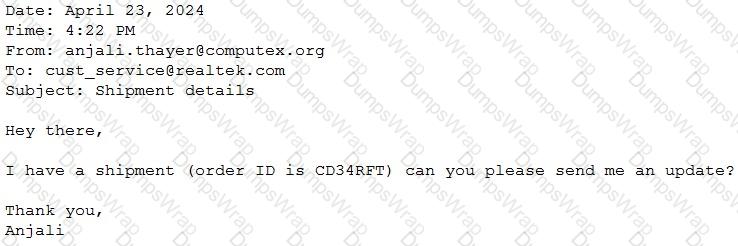
They will need to write a prompt that will extract the relevant information in JSON format with the highest level of output accuracy.
Which prompt will do that?
A Generative Al Engineer is building a RAG application that answers questions about internal documents for the company SnoPen AI.
The source documents may contain a significant amount of irrelevant content, such as advertisements, sports news, or entertainment news, or content about other companies.
Which approach is advisable when building a RAG application to achieve this goal of filtering irrelevant information?
A Generative AI Engineer is building an interactive catalog for a company’s inventory system that allows users to search for any item using a plain-text description. There are currently about 17,000 items, and new items are not frequently added. They need a solution that will be the most cost-effective and easy for the company to maintain.
Which solution should the engineer choose?
A Generative AI Engineer has been reviewing issues with their company ' s LLM-based question-answering assistant and has determined that a technique called prompt chaining could help alleviate some performance concerns. However, to suggest this to their team, they have to clearly explain how it works and how it can benefit their question-answering assistant. Which explanation do they communicate to the team?
A Generative AI Engineer is building a Generative AI system that suggests the best matched employee team member to newly scoped projects. The team member is selected from a very large team. The match should be based upon project date availability and how well their employee profile matches the project scope. Both the employee profile and project scope are unstructured text.
How should the Generative Al Engineer architect their system?
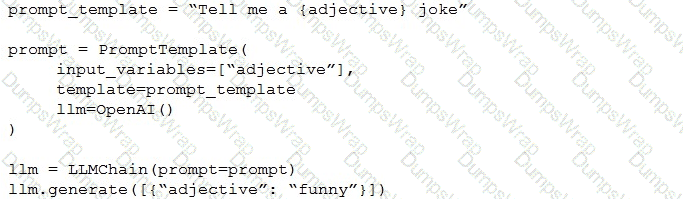
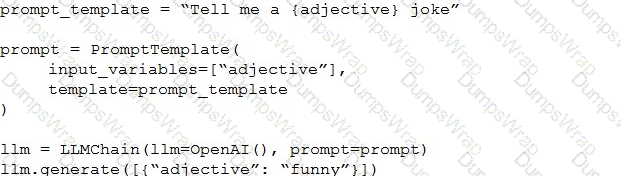
A Generative AI Engineer is testing a simple prompt template in LangChain using the code below, but is getting an error.
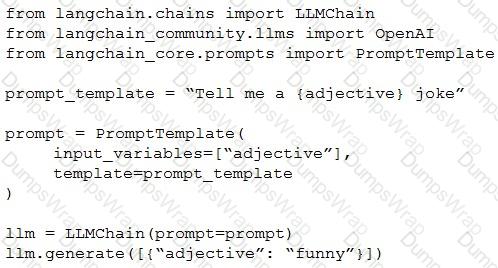
Assuming the API key was properly defined, what change does the Generative AI Engineer need to make to fix their chain?
A)
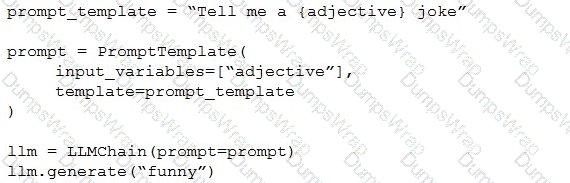
B)
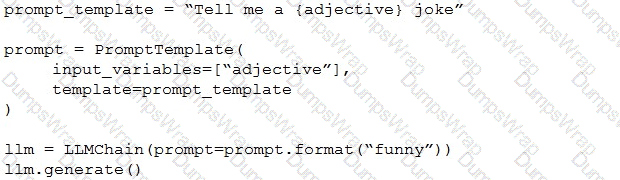
C)
D)
A Generative Al Engineer is developing a RAG system for their company to perform internal document Q & A for structured HR policies, but the answers returned are frequently incomplete and unstructured It seems that the retriever is not returning all relevant context The Generative Al Engineer has experimented with different embedding and response generating LLMs but that did not improve results.
Which TWO options could be used to improve the response quality?
Choose 2 answers
After changing the response generating LLM in a RAG pipeline from GPT-4 to a model with a shorter context length that the company self-hosts, the Generative AI Engineer is getting the following error:

What TWO solutions should the Generative AI Engineer implement without changing the response generating model? (Choose two.)
A Generative Al Engineer is tasked with improving the RAG quality by addressing its inflammatory outputs.
Which action would be most effective in mitigating the problem of offensive text outputs?
A Generative AI Engineer is developing a patient-facing healthcare-focused chatbot. If the patient’s question is not a medical emergency, the chatbot should solicit more information from the patient to pass to the doctor’s office and suggest a few relevant pre-approved medical articles for reading. If the patient’s question is urgent, direct the patient to calling their local emergency services.
Given the following user input:
“I have been experiencing severe headaches and dizziness for the past two days.”
Which response is most appropriate for the chatbot to generate?
A Generative Al Engineer is setting up a Databricks Vector Search that will lookup news articles by topic within 10 days of the date specified An example query might be " Tell me about monster truck news around January 5th 1992 " . They want to do this with the least amount of effort.
How can they set up their Vector Search index to support this use case?
A Generative AI Engineer is deploying an agent using Mosaic AI Model Serving. The agent needs to access various Databricks resources, including Vector Search, Databricks SQL, and Functions. They need to find the easiest and best-practice way to authenticate the deployed agent to access these resources.
What approach should they choose?
A Generative Al Engineer is helping a cinema extend its website ' s chat bot to be able to respond to questions about specific showtimes for movies currently playing at their local theater. They already have the location of the user provided by location services to their agent, and a Delta table which is continually updated with the latest showtime information by location. They want to implement this new capability In their RAG application.
Which option will do this with the least effort and in the most performant way?
Which of the following statements accurately identifies differences between the evaluation phase and the monitoring phase in the Generative AI application lifecycle within Databricks?
A Generative AI Engineer is creating an LLM-powered application that will need access to up-to-date news articles and stock prices.
The design requires the use of stock prices which are stored in Delta tables and finding the latest relevant news articles by searching the internet.
How should the Generative AI Engineer architect their LLM system?
Which indicator should be considered to evaluate the safety of the LLM outputs when qualitatively assessing LLM responses for a translation use case?
A Generative Al Engineer is deciding between using LSH (Locality Sensitive Hashing) and HNSW (Hierarchical Navigable Small World) for indexing their vector database Their top priority is semantic accuracy
Which approach should the Generative Al Engineer use to evaluate these two techniques?
A Generative AI Engineer is building a Databricks-hosted assistant that must (1) query Unity Catalog tables with row and column permissions enforced, and (2) avoid managing any external infrastructure. The team wants the LLM to use governed data access through tools exposed via MCP.
Which MCP server choice meets these constraints?
A Generative AI Engineer wants to build an LLM-based solution to help a restaurant improve its online customer experience with bookings by automatically handling common customer inquiries. The goal of the solution is to minimize escalations to human intervention and phone calls while maintaining a personalized interaction. To design the solution, the Generative AI Engineer needs to define the input data to the LLM and the task it should perform.
Which input/output pair will support their goal?
A Generative Al Engineer is using an LLM to classify species of edible mushrooms based on text descriptions of certain features. The model is returning accurate responses in testing and the Generative Al Engineer is confident they have the correct list of possible labels, but the output frequently contains additional reasoning in the answer when the Generative Al Engineer only wants to return the label with no additional text.
Which action should they take to elicit the desired behavior from this LLM?
A Generative Al Engineer has successfully ingested unstructured documents and chunked them by document sections. They would like to store the chunks in a Vector Search index. The current format of the dataframe has two columns: (i) original document file name (ii) an array of text chunks for each document.
What is the most performant way to store this dataframe?
A Generative AI Engineer I using the code below to test setting up a vector store:
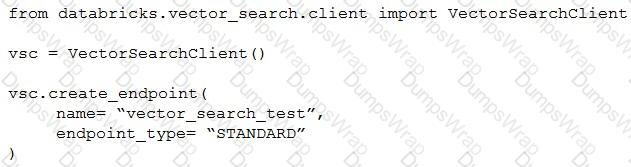
Assuming they intend to use Databricks managed embeddings with the default embedding model, what should be the next logical function call?
A Generative AI Engineer is implementing a supervisor agent and two specialist agents in Databricks: a Sales Analyst for revenue questions and an HR Analyst for staff questions. Each specialist must retrieve data only from its own governed domain, and the engineer wants to preserve that separation using Databricks-native data access for each agent rather than building custom retrieval logic.
What should the engineer implement?
