
Big Cyber Monday Sale Discount Flat 70% Offer - Ends in 0d 00h 00m 00s - Coupon code: 70diswrap

EMC D-CIS-FN-01 Dumps

Page: 1 / 12
Total 122 questions

Dell Cloud Infrastructure and Services Foundations v2 Exam Questions and Answers

Question 1

Which is a benefit of implementing target-based deduplication?

Options:

A.

Offloads the backup client from the deduplication process

B.

Reduces storage capacity and network bandwidth requirements

C.

Backup client sends only new and unique segments across the network

D.

Optimizes ROBO environments for centralized backup

Question 2

An organization wants to deliver applications quickly and effectively. They believe that it is the only way to stay competitive in this ever-changing digital world. The organization wants to adopt practices that promote collaboration across teams during various phases of the software development lifecycle.

Which practice will meet the organization’s requirements?

Options:

A.

Continuous Integration

B.

Waterfall model

C.

DevOps

D.

Continuous Delivery

Question 3

Why do organizations take advantage of virtual infrastructure?

Options:

A.

Require more data center space -

Resource underprovisioning -

Organizations have overutilized resources

B.

Organizations have underutilized resources

Ability to overprovision resources

Require more data center space

C.

Require no data center space -

Organizations have underutilized resources

Ability to overprovision resources

D.

Resource underprovisioning -

Organizations have overutilized resources

Require no data center space

Question 4

What is a benefit of secure multitenancy?

Options:

A.

Reduces unauthorized access to resources

B.

Blocks unauthorized access to resources

C.

Eliminates data breach risks

D.

Protects cloud infrastructure

Question 5

What term describes the ability of a system to continue functioning, even when a few of its components fail?

Options:

A.

Checkpointing

B.

Disaster recovery

C.

Fault tolerance

D.

Replication

Question 6

What are the benefits of modern applications compared to traditional applications?

Options:

A.

Designed to run independently and use a linear, continuous approach in development, build, test, and deploy

B.

Distributed system architecture, designed to run independently, and use multiple programming languages

C.

Single programming language and framework and scale by growing vertically

D.

Monolithic, built with interdependent modules, and use distributed system architecture

Question 7

Which data storage type uses a non-hierarchical address space to store data?

Options:

A.

Block

B.

Object

C.

File

Question 8

Which network feature enables dynamic distribution of applications I/O traffic across VMs?

Options:

A.

NIC Teaming

B.

Erasure Coding

C.

Link Aggregation

D.

Load Balancing

Question 9

What term refers to businesses that do not have a digital plan, and have limited initiatives or investments related to digital transformation?

Options:

A.

Digital Evaluators

B.

Digital Laggards

C.

Digital Adopters

D.

Digital Leaders

Question 10

What is a characteristic of reporting?

Options:

A.

Provides tabular or graphical views of monitored information

B.

Provides information about events or impending threats or issues

C.

Displays a personalized functional interface

D.

Presents service instances to consumers in real time

Question 11

Which solution can be used for automation of a customer environment?

Options:

A.

Ansible

B.

CloudWatch

C.

GitHub

D.

OpenStack

Question 12

What is an advantage of asynchronous remote replication?

Options:

A.

Ensures source LUN and replica have identical data at all times

B.

Supports replication across any geographic location without impacting response time

C.

Provides a near zero recovery point objective without impacting response time

D.

Requires less storage space for the replica than the source LUN

Question 13

What is true of a cloud service design best practice?

Options:

A.

Services should be readily available and dependent on one another.

B.

Services are inherently more complex and reduce administrative costs.

C.

Services should operate dependently.

D.

Services must be loosely coupled.

Question 14

What is a benefit of data archiving?

Options:

A.

Increases deduplication ratio and reduces storage costs

B.

Avoids performing data backups frequently

C.

Preserves data for future reference and adherence to regulatory compliance

D.

Moves frequently accessed data to lower-cost archive storage

Question 15

Which component presents service catalog and cloud interfaces, enabling consumers to order and manager cloud services?

Options:

A.

Cloud Operating System

B.

Orchestor

C.

Cloud Portal

D.

Service automation

Question 16

What provides workflows for performing automated tasks to accomplish a desired outcome?

Options:

A.

Cloud services

B.

Orchestration

C.

Software defined infrastructure

D.

Virtual infrastructure

Question 17

What type of infrastructure is defined as, "All the sources are bundled together and virtualized?

Options:

A.

Software-Defined

B.

Hyper-Converged

C.

Converged

Question 18

Which concept ensures accountability for security breaches or misuse of resources?

Options:

A.

Compliance

B.

Governance

C.

Risk management

Question 19

What is the effect of a denial-of-service attack?

Options:

A.

Privileges are misused to compromise data security.

B.

User credentials are captured and sent to the attacker

C.

Unauthorized access is gained to user accounts and data.

D.

Legitimate users are prevented from accessing services.

Question 20

What benefit is provided in subscription by peak usage chargeback model?

Options:

A.

Can start small with minimal cost

B.

Easy to implement - track user authentication

C.

Clear cost justification

D.

Easier to manage financially with a predetermined, reoccurring billing cycle

Question 21

What enables resource pooling and multi-tenancy in a cloud environment?

Options:

A.

Rapid elasticity

B.

On-demand provisioning

C.

Scalability

D.

Virtualization

Question 22

What is the correct sequence of steps in the service catalog design and implementation process?
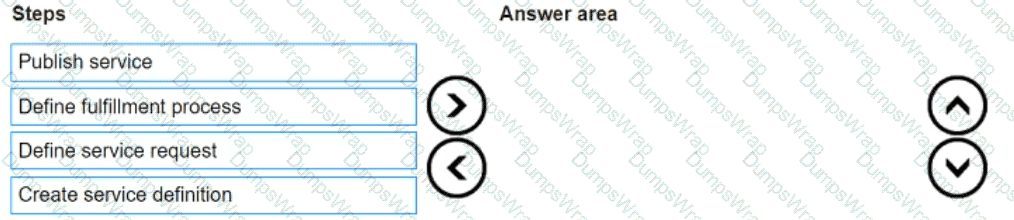
as

Options:

Question 23

Which cloud security design principle prevents an individual from improper access or system misuse?

Options:

A.

Least privilege

B.

Data privacy and ownership

C.

Separation of duties

D.

Secure multitenancy

Question 24

Which cloud role has the responsibility to perform independent cloud service assessments?

Options:

A.

Architect

B.

Broker

C.

Consumer

D.

Auditor

Question 25

What is the primary driver of application transformation?

Options:

A.

Drive adoption of a DevOps culture

B.

Integrate legacy applications

C.

Retire legacy applications

D.

Develop innovative IT solutions

Question 26

What activity is performed during the service planning phase of the cloud service lifecycle?

Options:

A.

Defining Orchestration Workflow

B.

Discovering Service Assets

C.

Developing Service Proposal

D.

Defining Service Offering

Question 27

An administrator must design a fault-tolerant IT environment for applications.

Which techniques meet this requirement?

Options:

A.

Active/Passive for Compute -

NIC Teaming for Network -

Dual disks for storage

B.

Active/Active for Compute -

Link Aggregation for Network -

Erasure Coding for storage

C.

Active/Passive for Compute -

Spanning for Network -

Dynamic Disk Sparing for storage

D.

Active/Standby for Compute -

Multipathing for Network -

RAID for storage

Question 28

Which cloud security objective provides the required secrecy of information to ensure that only authorized users have access to data held within the cloud?

Options:

A.

Integrity

B.

Authorization

C.

Authentication

D.

Confidentiality

Question 29

An organization requires double the processing capacity for a specific duration to handle increased workload. For the remaining period, the organization might want to release the idle resources to save costs. The workload variations may be seasonal or transient.

Which cloud characteristic enables the consumer to handle such variations in workloads and IT resource requirements?

Options:

A.

Resource pooling

B.

On-demand self-service

C.

Rapid elasticity

Question 30

What is used to update information in a configuration management database?

Options:

A.

Discovery tool

B.

Capacity management tool

C.

Configuration manager

D.

Performance management tool

Question 31

Which cloud security control mechanism monitors activity using video surveillance cameras and detects unusual activities using sensors and alarms?

Options:

A.

Administrative control

B.

Technical control

C.

Corrective control

D.

Physical control

Question 32

What steps appear in the service enablement roadmap?

Options:

A.

Define, Create, Plan, Enable, Terminate

B.

Understand, Plan, Build, Enable, Optimize

C.

Define, Observe, Understand, Enable, Act

D.

Plan, Action, Condition, Enable, End

Question 33

What are the key focus areas for IT transformation?

Options:

A.

Technology, Infrastructure, and Automation

B.

People, Process, and Technology

C.

Process, Infrastructure, and Technology

D.

People, Technology, and infrastructure

Question 34

Which are core attributes to a modern infrastructure?

Options:

A.

Adaptable, software-defined, and scale-out

B.

Resilient, scale-out, and cloud-enabled

C.

Flash, software-defined, and cloud-enabled

D.

Consolidation, flash, and scale-out

Question 35

What activity is included in a compliance checklist when moving data to the cloud?

Options:

A.

Determine if appropriate governance processes are available to meet consumers' requirements

B.

Ensure that IT infrastructure and data adhere to specific rules and regulations

C.

Review the financial stability of the provider to ensure its longevity

D.

Review and evaluate the usage of encryption to protect consumers' data

Question 36

What helps to recover the cost of providing the service, ensuring profitability, and meeting the provider’s return on investment and reinvestment goals?

Options:

A.

Service negotiation

B.

Service level objective

C.

Service valuation

D.

Service level agreement

Page: 1 / 12
Total 122 questions