
BIG-IP Administration Data Plane Configuration (F5CAB3) exam Questions and Answers
Users report that traffic is negatively affected every time a BIG-IP device fails over. The traffic becomes stabilized after a few minutes. What should the BIG-IP Administrator do to reduce the impact of future failovers?
Local Traffic Network Map: VS_HTTP → POOL_WEB → 192.168.212.30:80 Pool Member | Parent Node 192.168.212.30 Port 80
Why is the virtual server unresponsive to incoming connections?
In a pool there are 2 pool members (older servers) that can handle fewer connections than the other 3 newer servers.
Which load balancing method would allow more traffic to be directed to the newer servers? (Choose one answer)
In the BIG-IP Configuration Utility, a user requests a single screen view to determine the status of all Virtual Servers and associated pool members, as well as any iRules in use. Where should the BIG-IP Administrator instruct the user to find this view?
Which Virtual Server type prevents the use of a default pool?
A Standard Virtual Server for a web application is configured with SNAT Automap. The original client IP must be known by backend servers.
What should the BIG-IP Administrator configure?
A Standard Virtual Server for a web application is configured with Automap for Source Address Translation. The original client IP must be known by backend servers.
What should the BIG-IP Administrator configure?
DNS queries from internal DNS servers fail when sent through a BIG-IP Virtual Server.
Which Virtual Server property should be changed?
A virtual server is configured to offload SSL from a pool of backend servers. When users connect to the virtual server, they successfully establish an SSL connection but no content is displayed. A packet trace performed on the server shows that the server receives and responds to the request. What should a BIG-IP Administrator do to resolve the problem?
A BIG-IP Administrator needs to apply a health monitor for a pool of database servers named DB_Pool that uses TCP port 1521. Where should the BIG-IP Administrator apply this monitor?
A BIG-IP Administrator creates a new Virtual Server to load balance SSH traffic. Users are unable to log on to the servers.
What should the BIG-IP Administrator do to resolve the issue?
A Standard Virtual Server is configured with SNAT Automap. Backend servers must see the original client IP.
What should be configured?
Users are unable to reach an application. The Virtual Server shows a red diamond status in the Configuration Utility.
What is the cause?
A BIG-IP Administrator configures an SSH pool with five members.
Which health monitor should be applied?
A web server administrator informs the BIG-IP Administrator that web servers currently load-balanced require encrypted traffic. Starting next month, the web server administrator will offload SSL. Starting next month, the BIG-IP device will terminate SSL to reduce web server load. The BIG-IP device is already using Client SSL, Client port, and iRules on HTTP traffic. What actions should the BIG-IP Administrator take to achieve the desired configuration? (Choose one answer)
Refer to the exhibit.
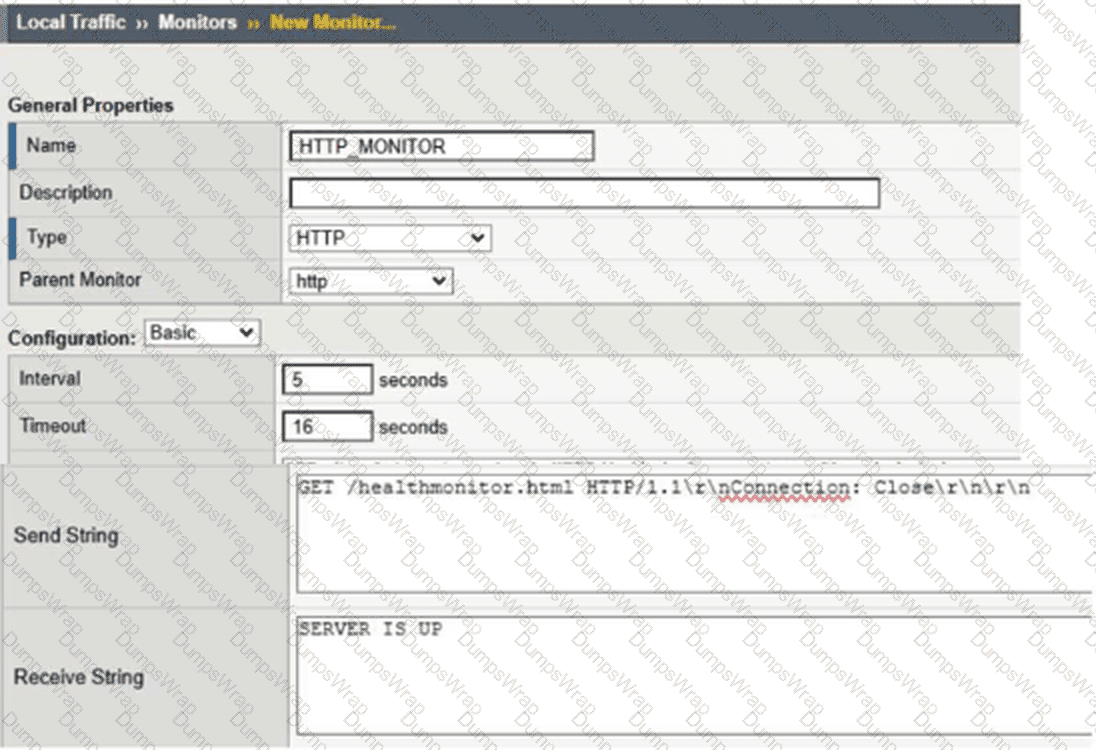
The BIG-IP Administrator has configured an HTTP health monitor and applied it to a pool of HTTP web servers that host the website www.f5.com , but all pool members show a “DOWN” status. From the monitor logging on the LTM, the BIG-IP Administrator notices that the web server is returning a response of “400 Bad Request.”
What would be the correct monitor Send string?
A BIG-IP Administrator is setting up a new BIG-IP device. The network administrator reports that the interface has an incompatible media speed. The BIG-IP Administrator needs to change this setting manually. From which location should the BIG-IP Administrator perform this task?
Application administrators are reporting that nodes different from those configured in the pool are selected. The use of an iRule is suspected. How can the BIG-IP Administrator check if an iRule is used for this traffic? (Pick the 2 correct responses below)
A BIG-IP Administrator creates a new Virtual Server. The end user is unable to access the page. During troubleshooting, the administrator learns that the connection between the BIG-IP system and server is NOT set up correctly. What should the administrator do to solve this issue? (Choose one answer)
The BIG-IP Administrator needs to load balance a pool of web servers. Load balancing should consider the number of connections that are active on that pool member.
Which load balancing method meets this requirement? (Choose one answer)
During a high-demand event, the BIG-IP Administrator needs to limit the number of new connections per second to a Virtual Server.
What should be applied?
In a pool there are 2 pool members out of the 5 members that are older servers. The number of connections these can handle is less than the other 3 pool members. Which load balancing method would allow more traffic to be directed to the newer servers?
A set of servers is used for an FTP application as well as an HTTP website via separate BIG-IP Pools. The server support team reports that some servers are receiving a lot more traffic than others. Which Load Balancing Method should the BIG-IP Administrator apply to even out the connection count?
To increase available bandwidth of an existing Trunk, the BIG-IP Administrator is adding additional interfaces. Which command should the BIG-IP Administrator run from within the bash shell?
A node is a member of multiple pools and hosts different applications. If one application becomes unavailable, only that pool member should be marked down.
What should the BIG-IP Administrator deploy?
