Pre-Summer Sale Discount Flat 70% Offer - Ends in 0d 00h 00m 00s - Coupon code: 70diswrap

Fortinet FCSS_LED_AR-7.6 Dumps

Fortinet NSE 6 - LAN Edge 7.6 Architect Questions and Answers

Question 1

You are troubleshooting a Syslog-based single sign-on (SSO) issue on FortiAuthenticator, where user authentication is not being correctly mapped from the syslog messages. You need a tool to diagnose the issue and understand the logs to resolve it quickly.

Which tool in FortiAuthenticator can you use to troubleshoot and diagnose a Syslog SSO issue?

Options:

A.

Debug logs > Remote Servers > Syslog Viewer

B.

Parsing Test Tool

C.

Debug logs > SSO Sessions page

D.

Debug logs > Single Sign-On > Syslog SSO

Question 2

In addition to requiring a FortiAnalyzer device to configure the Security Fabric, which license must be added to FortiAnalyzer to use Indicators of Compromise (IOC) rules?

Options:

A.

loT Security Add-on license

B.

IOC Subscription license

C.

IOC detection is included on FAZ-Basic license

D.

Threat Detection Service license

Question 3

A network administrator connects a new FortiGate to the network, allowing it to automatically discover andI register with FortiManager.

What occurs after FortiGate retrieves the FortiManager address?

Options:

A.

FortiGate establishes a secure tunnel to FortiManager over TCP port 541.

B.

The device needs to be manually authorized on FortiManager.

C.

FortiGate configures its interface settings based on a DHCP response from FortiManager.

D.

FortiGate sends a discovery request to all devices on the local network using UDP port 1068.

Question 4

Why is the suppression of rogue APs becoming more difficult with the introduction of new wireless security standards, such as 802.11w?

Options:

A.

802.11w increases the processing overhead on network devices, slowing down the detection of rogue APs.

B.

The 802.11w standard reduces the range of wireless signals, limiting the ability to detect rogue APs at a distance.

C.

802.11w encrypts all data traffic, making it difficult to identify rogue APs through packet inspection.

D.

802.11w requires that clients authenticate management frames as legitimate, which helps prevent spoofing attacks.

Question 5

Refer to the exhibits.

as

as

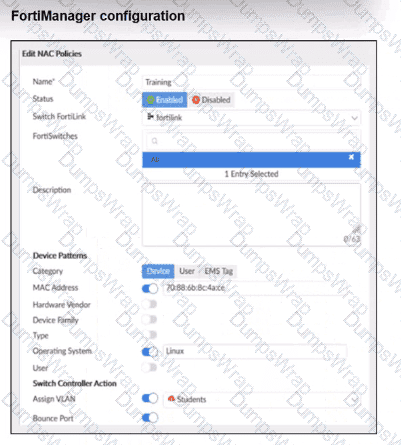
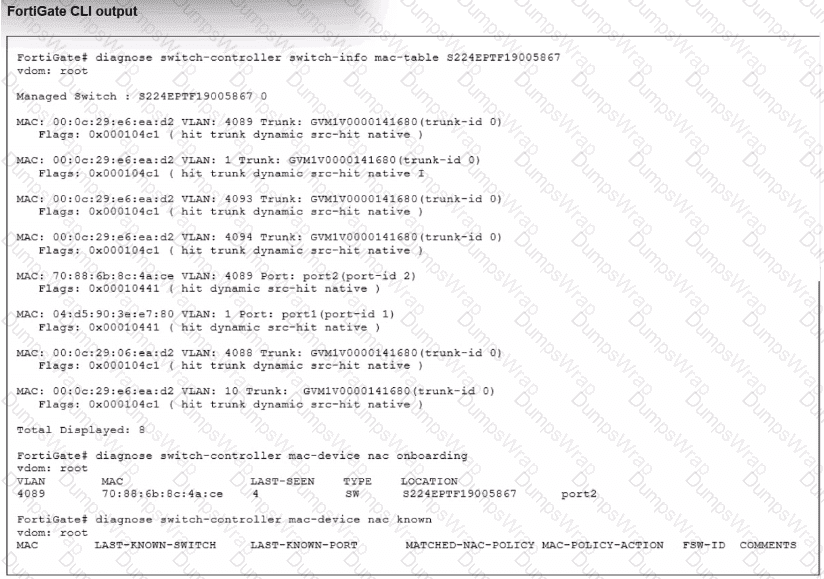
Examine the FortiManager configuration and FortiGate CLI output shown in the exhibit.

The NAC feature is being tested with a device connected to port2 on managed FortiSwitch S224SPTF19005867. The NAC policy has been applied to port2, and traffic was generated from the test device. However, the traffic from the test device does not match the NAC policy and remains in the onboarding VLAN.

What are two possible reasons why the test device is not being correctly classified by the NAC policy? (Choose two.)

Options:

A.

Device detection is not enabled on VLAN 4089.

B.

The device operating system detected by FortiGate is not Linux.

C.

Management communication between FortiGate and FortiSwitch is down.

D.

The MAC address configured on the NAC policy is incorrect.

Question 6

In each user certificate, you can define the subject field, expiration date. User Principal Name (UPN), URL for CRL download, and the OCSP URL. How does the detailed configuration of these attributes impact the certificate?
Options:

A.

It makes the certificate easier to revoke manually because it reduces the need for automatic checks.

B.

It limits the validity of the certificate to specific devices and applications, reducing its general usability.

C.

It enables precise identification of the user and ensures timely certificate revocation checks.

D.

It makes the certificate compatible with a wide range of applications and services by ensuring universal validity

Question 7

as

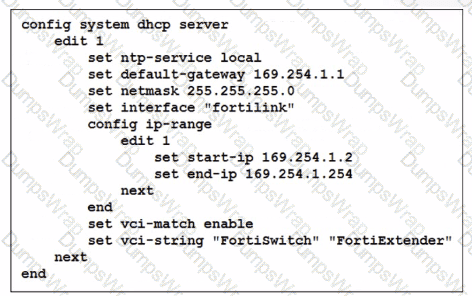
You ' ve configured the FortiLink interface, and the DHCP server is enabled by default. The resulting DHCP server settings are shown in the exhibit. What is the role of the vci-string setting in this configuration?

Options:

A.

To ignore DHCP requests coming from FortiSwitch and FortiExtender devices.

B.

To restrict the IP address assignment to devices that have FortiSwitch or FortiExtender as their hostname.

C.

To connect, devices must match the VCI string; otherwise, they will not receive an IP address.

D.

To reserve IP addresses for FortiSwitch and FortiExtender devices.

Question 8

When the MAC address of a device is placed in quarantine on FortiSwitch, what happens to its egress traffic?

Options:

A.

Traffic is sent to an access VLAN.

B.

Traffic is assigned to the native VLAN.

C.

Traffic is sent as untagged traffic.

D.

Traffic is sent to an allowed VLAN.

Question 9

Refer to the exhibits.

as

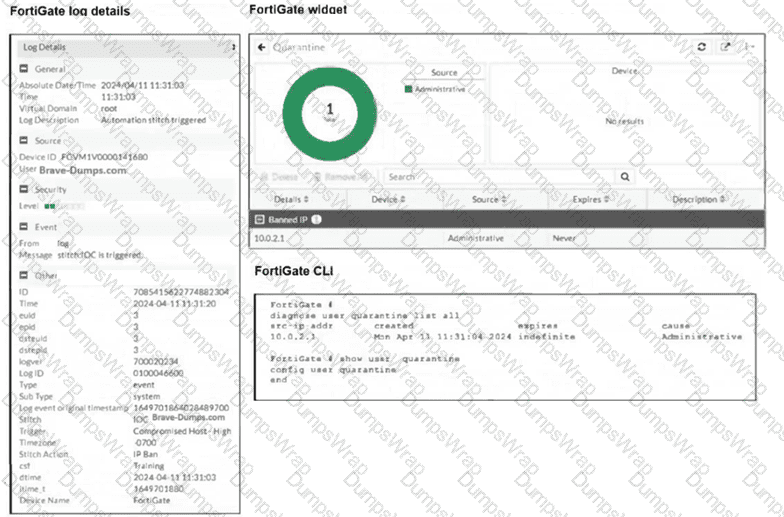
The exhibits show the FortiGate logs, widget, and CLI. Security Fabric quarantine automation is being tested using a device with the IP address 10.0.2.1, which is connected to a managed FortiSwitch. Shortly after attempting to access a malicious website, the device loses access to the internet and other VLANs within the network. However, it can still communicate with other devices within the same VLAN. Which configuration change is required to fix the issue?

Options:

A.

Replace the IP Ban action with Access Layer Quarantine.

B.

Adjust the IP Ban settings to the Quarantine action.

C.

Adjust the indicator of compromise (IOC) on FortiAnalyzer.

D.

Enable intra-VLAN traffic blocking in the Security Fabric quarantine settings.

Question 10

You are configuring FortiAuthenticator to integrate with FSSO for user identification. To enable FortiAuthenticator to extract user information from syslog messages and inject it into FSSO, you have configured syslog matching rules.

What is the role of syslog matching rules in the process of injecting user information into FSSO?

Options:

A.

To automatically update user group memberships in FSSO based on syslog events

B.

To enforce user authentication policies based on syslog message contents

C.

To define how syslog messages are parsed and extract user information, such as usernames and IP addresses

D.

To filter and block irrelevant syslog messages from being processed by the FortiAuthenticator

Question 11

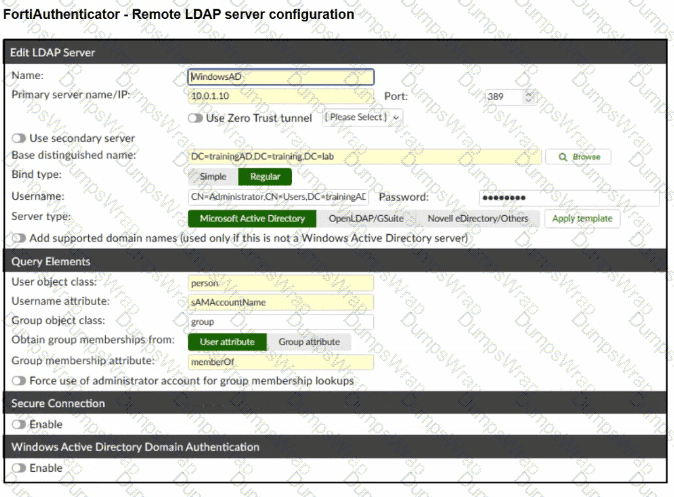
Refer to the exhibit.

as

as

as

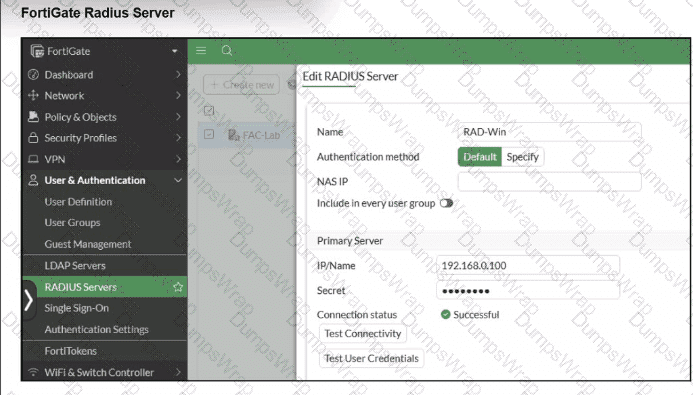
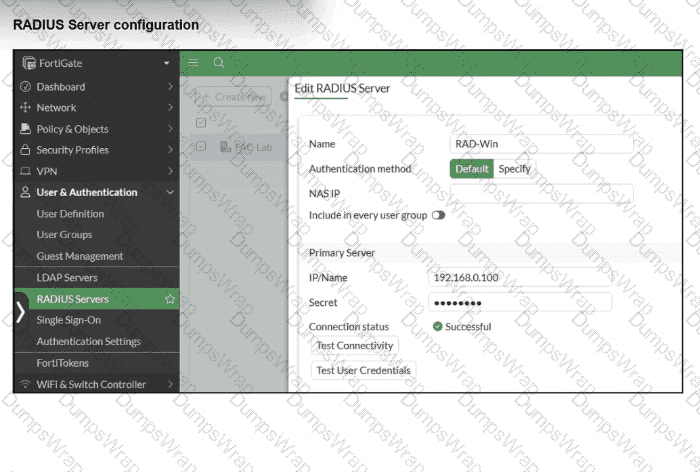
A RADIUS server has been successfully configured on FortiGate, which sends RADIUS authentication requests to FortiAuthenticator. FortiAuthenticator, in turn, relays the authentication using LDAP to a Windows Active Directory server.

It was reported that wireless users are unable to authenticate successfully.

The FortiGate configuration confirms that it can connect to the RADIUS server without issues.

While testing authentication on FortiGate using the command diagnose test authserver radius, it was observed that authentication succeeds with PAP but fails with MSCHAPv2.

Additionally, the Remote LDAP Server configuration on FortiAuthenticator was reviewed.

Which configuration change might resolve this issue?

Options:

A.

Change the RADIUS authentication protocol to CHAP

B.

Enable Windows Active Directory Domain Authentication.

C.

Manually add user credentials to the FortiAuthenticator local database

D.

Use RADIUS attributes under the FortiGate configuration.

Question 12

Refer to the exhibit.

as

On FortiGate, a RADIUS server is configured to forward authentication requests to FortiAuthenticator, which acts as a RADIUS proxy. FortiAuthenticator then relays these authentication requests to a remote Windows AD server using LDAP.

While testing authentication using the CLI command diagnose test authserver. the administrator observed that authentication succeeded with PAP but failed when using MS-CHAFV2.

Which two solutions can the administrator implement to enable MS-CHAPv2 authentication? (Choose two.)

Options:

A.

Enable Windows Active Directory domain authentication on FortiAuthenticator.

B.

Configure FortiAuthenticator to use RADIUS instead of LDAP as the back-end authentication server.

C.

Enable RADIUS attribute filtering on FortiAuthenticator.

D.

Change the FortiGate authentication method to CHAP instead of MS-CHAPv2.

Question 13

In a Windows environment using AD machine authentication, how does FortiAuthenticator ensure that a previously authenticated device is maintaining its network access once the device resumes operating after sleep or hibernation?

Options:

A.

It temporarily assigns the device to a guest VLAN until full reauthentication is completed.

B.

It sends a wake-on-LAN packet to trigger reauthentication.

C.

It uses machine authentication based on the device IP address.

D.

It caches the MAC address of authenticated devices for a configurable period of time.

Page: 1 / 5
Total 47 questions