Halloween Sale Special - 75% Discount Offer - Ends in 0d 00h 00m 00s - Coupon code: w75best

Fortinet NSE7_SSE_AR-26 Dumps

Fortinet NSE 7 - FortiSASE 26 Architect Questions and Answers

Question 1

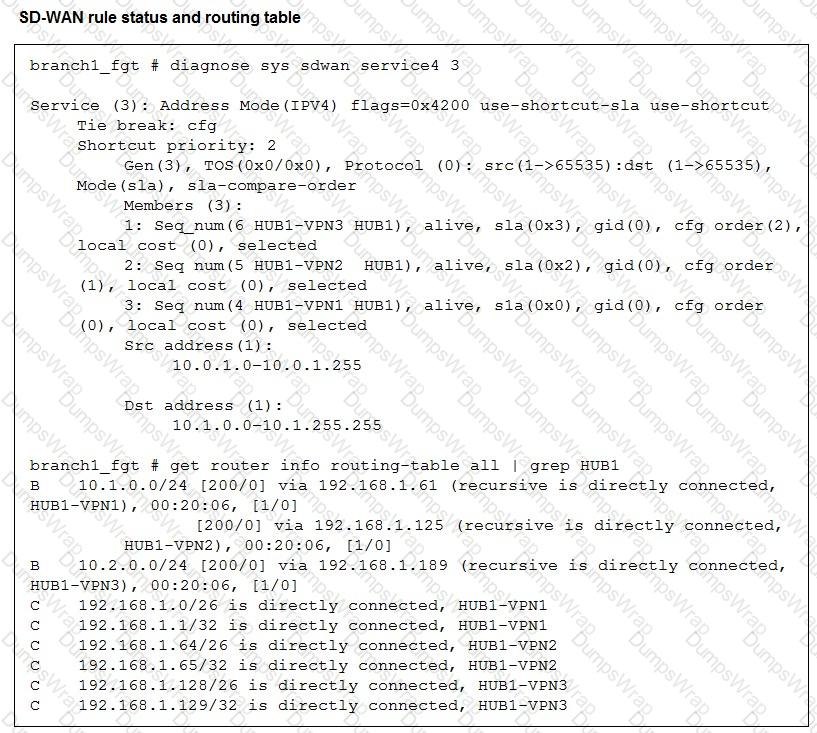
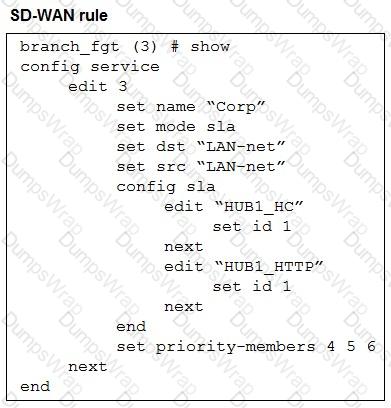
Refer to the exhibits, which show the configuration of an SD-WAN rule and the corresponding rule status and routing table. The administrator wants to understand the expected behavior for traffic matching the SD-WAN rule. Based on the exhibits, what can the administrator expect for traffic matching the SD-WAN rule?
as

Exhibit 1

as

Exhibit 2

Options:

A.

The traffic will be routed over HUB1-VPN3.

B.

The traffic will be routed over HUB1-VPN2

C.

The traffic will be routed over HUB1-VPN1.

D.

The traffic will be load balanced across all three overlays

Question 2

The SD-WAN overlay template helps to prepare SD-WAN deployments. To complete the tasks performed by the SD-WAN overlay template, the administrator must perform some post-run tasks. What are two mandatory post-run tasks that must be performed? (Choose two.)

Options:

A.

Configure routing through the overlay tunnels created by the SD-WAN overlay template.

B.

Create policy packages and assign them to the branch devices.

C.

Assign a hub id metadata variable to each hub device.

D.

Configure SD-WAN rules

E.

Assign an sdwan_id metadata variable to each device (branch and hub)

Question 3

SD-WAN interacts with many other FortiGate features. Some of them are required to allow SD-WAN to steer the traffic. Which three configuration elements that you must configure before FortiGate can steer traffic according to SD-WAN rules? (Choose three.)

Options:

A.

Firewall policies

B.

Interfaces

C.

Security profiles

D.

Traffic shaping

E.

Routing

Question 4

You are planning a new SD-WAN deployment with the following criteria: - Two regions - Most of the traffic is expected to remain within its region - No requirement for inter-region ADVPN To remain within the recommended best practices, which routing protocol should you select for the overlays?

Options:

A.

OSPF for the routing within each region and EBGP between the regions.

B.

IBGP with BGP on loopback within each region and EBGP between the regions.

C.

IBGP with BGP per overlays within each region and IBGP with BGP on loopback between the regions.

D.

IBGP within each region and between the regions.

Question 5

You are configuring SD-WAN to load balance network traffic and you want to take into account the link quality.

Which two facts should you consider? (Choose two.)

Options:

A.

When applicable, FortiGate load balances the traffic through all members that meet the SLA target.

B.

You can select the lowest cost service level agreement (SLA) strategy and allow SD-WAN load balancing.

C.

You can select the best quality strategy and allow SD-WAN load balancing.

D.

The best quality strategy is compatible with the session, spillover, and volume load balance algorithms.

Question 6

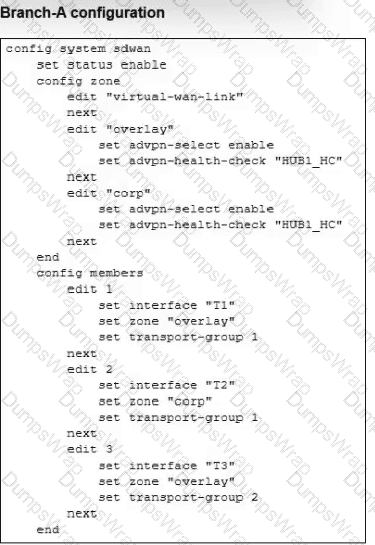
Refer to the exhibits.

The SD-WAN zones and members configuration of two branch devices are shown.

The two branch devices are part of the same hub-and-spoke topology and connect to the same hub. The devices are configured to allow auto-discovery VPN (ADVPN). The configuration on the hub allows the initial communication between the two spokes.

When traffic flows require it, between which interfaces can the devices establish shortcuts?
as

Exhibit — Branch-A SD-WAN zone and transport group

The visible recording shows the Branch-A configuration; the Branch-B configuration is not displayed in the captured video frame.

Options:

A.

Any interface in the overlay zones

B.

Between T2 on Branch-A and TB on Branch-B

C.

Between T1 on Branch-A and TA on Branch-B

D.

Any interface that belongs to the same zone

Question 7

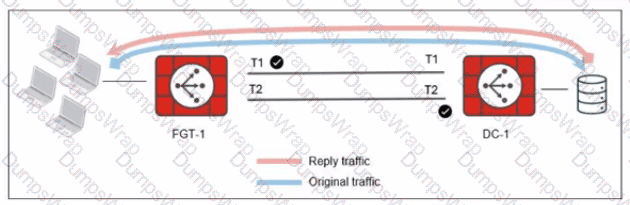
Refer to the exhibit. The administrator analyzed the traffic between a branch FortiGate and the server located in the data center, and noticed the behavior shown in the diagram. When the LAN clients located behind FGT1 establish a session to a server behind DC-1, the administrator observes that, on DC-1, the reply traffic is routed overT2. even though T1 is the preferred member in the matching SD-WAN rule. What can the administrator do to instruct DC-1 to route the reply traffic through the member with the best performance?
as

Exhibit 1

Options:

A.

Enable snat-route-change under config system global.

B.

Enable reply-session under config system sdwan.

C.

Enable auxiliary-session under config system settings.

D.

FortiGate route lookup for reply traffic only considers routes over the original ingress interface.

Question 8

You configured an SD-WAN rule with the best quality strategy and selected the predefined health check, Default_FortiGuard, to check the link performances against FortiGuard servers. For the quality criteria, you selected Custom-profile-1. Which factors does FortiGate use, and in which order. to determine the link that it should use to steer the traffic?

Options:

A.

Latency – Member configuration order – Link cost threshold

B.

Link quality index – Member configuration order – Link cost threshold

C.

Links that meet the SLA targets – Member configuration order – Member local cost

D.

Latency – Jitter - Packet loss – Bibandwidth – Member configuration order

Question 9

You are planning a large SD-WAN deployment with approximately 1000 spokes and want to allow ADVPN between the spokes. Some remote sites use FortiSASE to connect to the company ' s SD-WAN hub. Which overlay routing configuration should you use?

Options:

A.

BGP on loopback with dynamic BGP for ADVPN shortcut routing.

B.

BGP on loopback with IPsec phase 2 selectors for ADVPN shortcut routing.

C.

BGP per overlay with dynamic BGP for ADVPN shortcut routing.

D.

BGP per overlay with BGP next-hop convergence for ADVPN shortcut routing.

Question 10

In a FortiSASE proxy-based deployment, which two features protect against web-based threats? (Choose two.)

Options:

A.

Web application firewall (WAF) for web applications

B.

Intrusion prevention system (IPS) for web traffic

C.

SSL deep inspection for encrypted web traffic

D.

Malware protection with sandboxing capabilities

Question 11

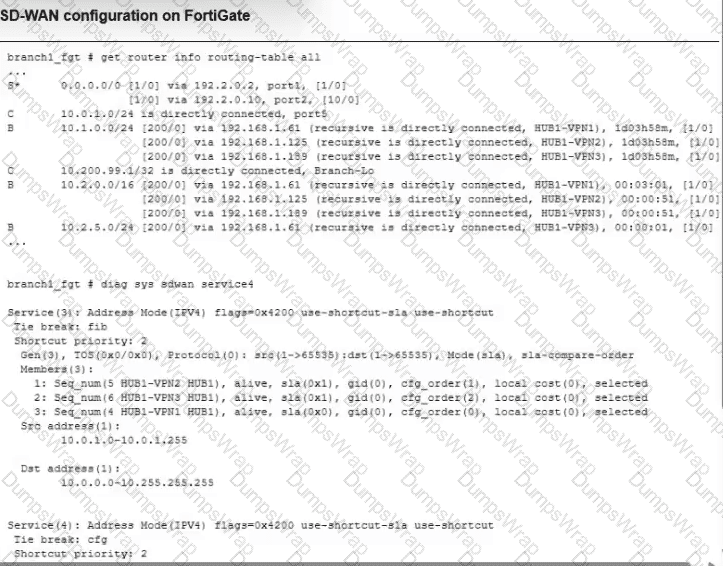
Refer to the exhibit.

Which SD-WAN rule and interface uses FortiGate to steer the traffic from the LAN subnet 10.0.1.0/24 to the corporate server 10.2.5.254?
as

Exhibit — SD-WAN rule and routing outputs

Options:

A.

SD-WAN service rule 3 and interface HUB1-VPN3.

B.

SD-WAN service rule 3 and interface HUB1-VPN2.

C.

SD-WAN service rule 4 and interface port2.

D.

SD-WAN service rule 4 and port1 or port2.

Question 12

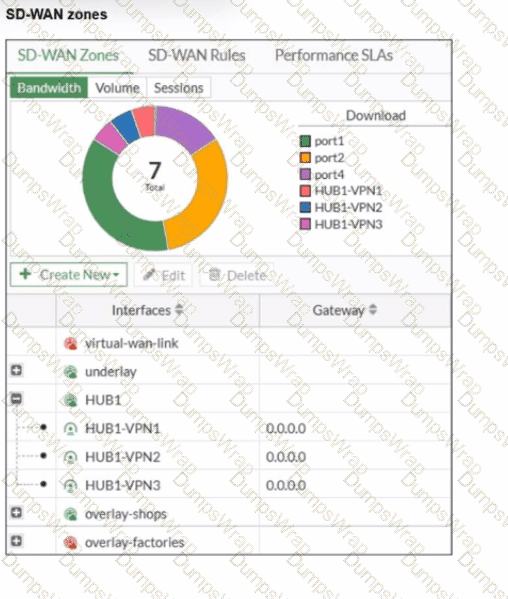
Refer to the exhibit, which shows an SD-WAN zone configuration on the FortiGate GUI. What can you conclude about the zone and member configuration on this device?
as

Exhibit 1

Options:

A.

The underlay zone contains three members.

B.

You can delete the virtual-wan-link zones.

C.

The overlay-factories zone contains no member.

D.

You can move HUB1-VPN3 from the HUB1 zone to the overlay-shops zone.

Question 13

As an IT manager for a healthcare company, you want to delegate the installation and management of your SD-WAN deployment to a managed security service provider (MSSP). Each site must maintain direct internet access and ensure that it is secure. You expected significant traffic flow between the sites and want to delegate as much of the network administration and management as possible to the MSSP. Which two MSSP deployment blueprints best address the customer’s requirements? (Choose two.)

Options:

A.

Use a shared hub at the MSSP premises with a dedicated VDOM for the new customer, and install the spokes at the customer premises.

B.

Use a shared hub at the MSSP premises and a dedicated hub at the customer premises and install the spokes at the customer premises.

C.

Install a dedicated hub at the MSSP premises for the new customer, and install the spokes at the customer premises.

D.

Install the hub and spokes at the customer premises and enable the MSSP to manage the SD-WAN deployment using FortiManager with a dedicated ADOM.

Question 14

Your FortiGate is in production. To optimize WAN link use and improve redundancy, you enable and configure SD-WAN. What must you do as part of this configuration update process?

Options:

A.

Replace references to interfaces used as SD-WAN members in the routing configuration.

B.

Purchase and install the SD-WAN license, and reboot the FortiGate device.

C.

Replace references to interfaces used as SD-WAN members in the firewall policies.

D.

Disable the interface that you want to use as an SD-WAN member.

Question 15

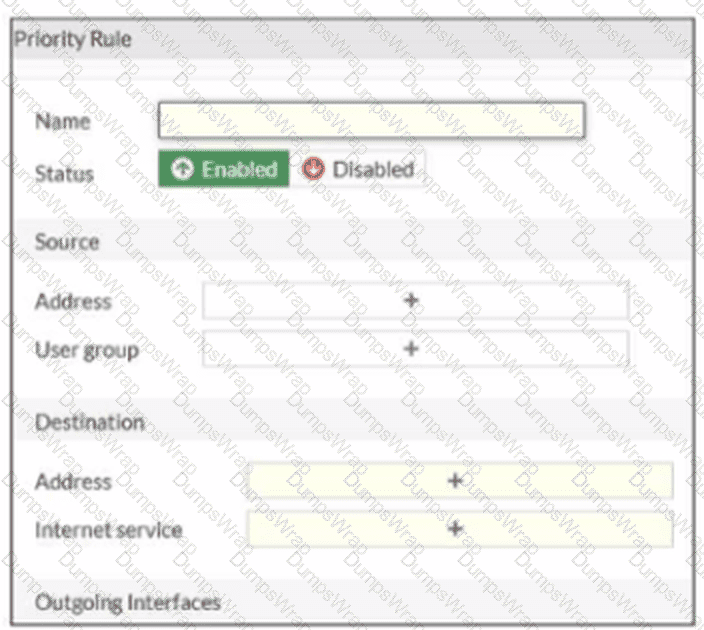
Refer to the exhibit. An administrator configures SD-WAN rules for a DIA setup using the FortiGate GUI. The page to configure the source and destination part of the rule looks as shown in the exhibit. The GUI page shows no option to configure an application as the destination of the SD-WAN rule Why?
as

Exhibit 1

Options:

A.

You cannot use applications as the destination when FortiGate is used for a DIA setup.

B.

FortiGate allows the configuration of applications as the destination of SD-WAN rules only on the CLI.

C.

You must enable the feature on the CLI.

D.

You must enable the feature first using the GUI menu System > Feature Visibility.

Question 16

As an MSSP administrator, you are asked to configure ADVPN on an existing SD-WAN topology. FortiManager manages the customer devices in a dedicated ADOM. The previous administrator used the SD-WAN overlay topology. Which two statements apply to this scenario? (Choose two.)

Options:

A.

You can activate auto-discovery VPN in the SD-WAN overlay template only if it is a single hub topology.

B.

When auto-discovery VPN is enabled, FortiManager updates the IPsec and BGP templates in the hub.

C.

After you enable auto-discovery VPN in the overlay template, you must select between ADVPN 2.0 and ADVPN 1.0.

D.

You can activate auto-discovery VPN in the SD-WAN overlay template for any type of topology, including a primary-primary dual-hub topology.

Question 17

You want FortiGate to use SD-WAN rules to steer local-out traffic. Which two constraints should you consider? (Choose two.)

Options:

A.

By default, FortiGate uses SD-WAN rules only for local-out traffic that corresponds to ping and traceroute.

B.

By default, local-out traffic does not use SD-WAN.

C.

You can steer local-out traffic only with SD-WAN rules that use the manual strategy.

D.

You must configure each local-out feature individually to use SD-WAN.

Question 18

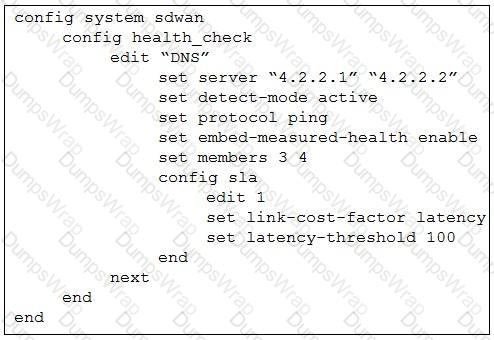
Refer to the exhibit. The exhibit shows the health-check configuration on a FortiGate device used as a spoke. You notice that the hub FortiGate doesn’t prioritize the traffic as expected. Which two configuration elements should you check on the hub? (Choose two.)
as

Exhibit 1

Options:

A.

The performance SLA has the parameter priority-out-sla configured.

B.

This performance SLA uses the same members.

C.

The performance SLA uses the same criteria.

D.

The performance SLA is configured with set embedded-measure accept.

Question 19

In a deployment of FortiSASE, a network architect is designing branch connectivity using the branch on-ramp feature to simplify secure access to cloud and Software-as-a-Service (SaaS) resources without requiring a full, traditional WAN infrastructure at each site.

What is the primary purpose of the FortiSASE branch on-ramp feature?

Options:

A.

To provide direct internet breakout from branch FortiGate only

B.

To extend secure connectivity from branches without full WAN infrastructure

C.

To replace all endpoint security agents with cloud-based inspection only

D.

To perform application performance optimization for SaaS traffic at the branch level

Question 20

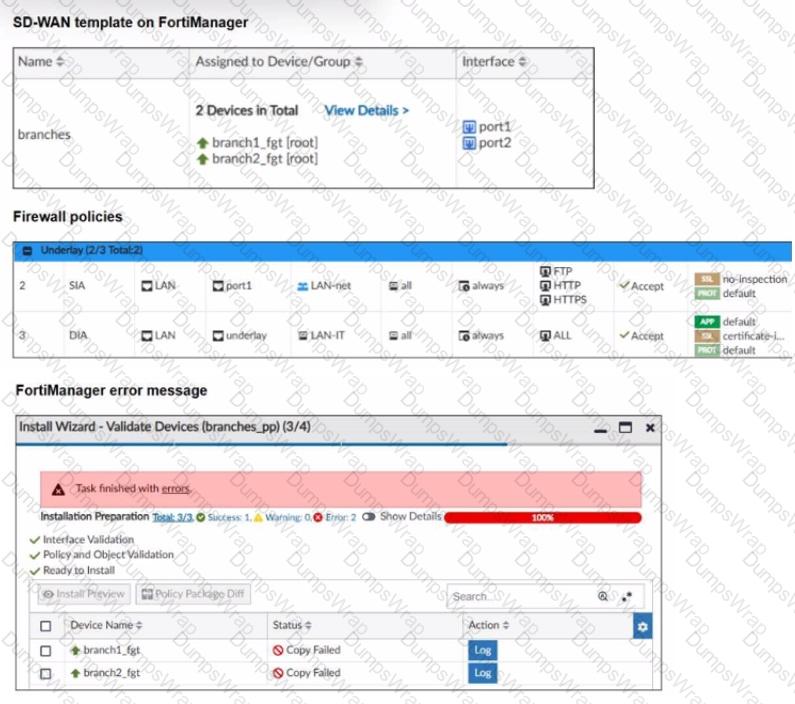
Refer to the exhibits. You use FortiManager to manage the branch devices and configure the SD-WAN template. You have configured direct internet access (DIA) for the IT department users. Now. you must configure secure internet access (SIA) for all local LAN users and have set the firewall policies as shown in the second exhibit. Then, when you use the install wizard to install the configuration and the policy package on the branch devices, FortiManager reports an error as shown in the third exhibit. Which statement describes why FortiManager could not install the configuration on the branches?
as

Exhibit 1

Options:

A.

You must direct SIA traffic to a VPN tunnel.

B.

You cannot install firewall policies that reference an SD-WAN zone.

C.

You cannot install firewall policies that reference an SD-WAN member.

D.

You cannot install SIA and DIA rules on the same device.

Question 21

A customer wants to ensure secure access for private applications for their users by replacing their VPN.

Which two SASE technologies can you use to accomplish this task? (Choose two.)

Options:

A.

SD-WAN on-ramp

B.

zero trust network access (ZTNA)

C.

secure SD-WAN

D.

secure web gateway (SWG) and cloud access security broker (CASB)

Question 22

Which statement describes FortiGate behavior when you reference a zone in a static route?

Options:

A.

FoftiGate installs ECMP static routes for the first two members of the zone.

B.

FortiGate ignores the static routes defined through members referenced in the zone.

C.

FortiGate routes the traffic through the best performing member of the zone.

D.

FortiGate installs a static route for each member in the zone.

Question 23

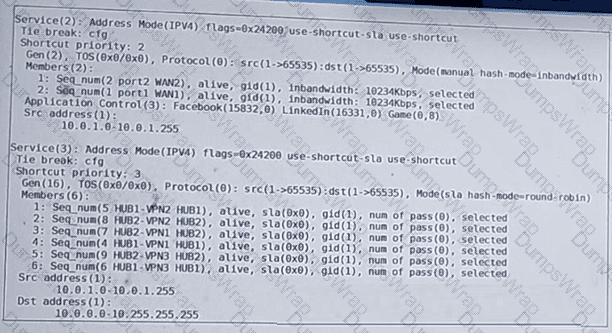
Refer to the exhibit. The administrator configured two SD-WAN rules to load balance traffic. Which interfaces does FortiGate use to steer the traffic from 10.0.1.124 to 10.0.0.254? Choose one answer.
as

Exhibit 1

Options:

A.

port1 or port2

B.

FortiGate routes the traffic according to the FIB.

C.

HUB1-VPN2

D.

Any interface in the HUB1 or HUB2 zones

Question 24

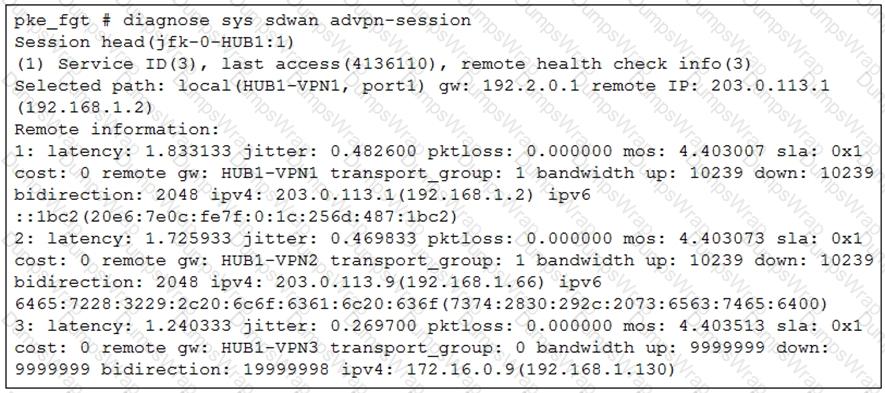
Refer to the exhibit that shows a diagnose output on FortiGate. Based on the output shown in the exhibit, what can you say about the device role and how it handles health checks?
as

Exhibit 1

Options:

A.

The device is a spoke. It receives health-check measures for the tunnels of another spoke.

B.

The device is a hub. It receives embedded health-check measures for each tunnel from the spoke.

C.

The device is a spoke. It provides embedded health-check measures for each tunnel to the hub.

D.

The device is a hub. It receives health-check measures for the tunnels of a spoke.

Question 25

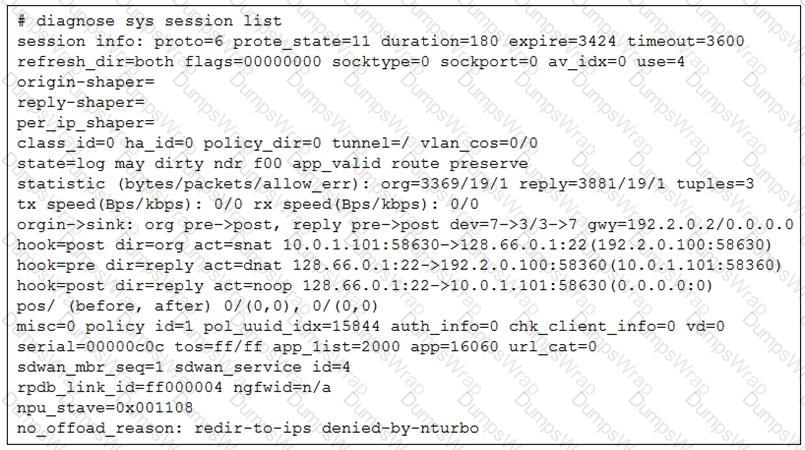
Refer to the exhibit. The administrator configured the SD-WAN rule ID 4 with two members (port1 and port2) and strategy lowest cost (SLA). What are the two characteristics of the session shown in the exhibit? (Choose two.)
as

Exhibit 1

Options:

A.

FortiGate steered this flow according to an SD-WAN rule 4.

B.

FortiGate will never re-evaluate this session.

C.

FortiGate steered this flow according to the application detected and the outgoing interface is port3.

D.

FortiGate will re-evaluate this session if the outgoing interface goes down.

Question 26

Which two statements correctly describe what happens when traffic matches the implicit SD-WAN rule? (Choose two.)

Options:

A.

The session information output displays no SD-WAN service id.

B.

Traffic is load balanced using the algorithm set for the v4-ecmp-mode setting.

C.

The traffic is distributed, regardless of weight, through all available static routes.

D.

Traffic does not match any of the entries in the policy route table.

E.

FortiGate flags the session with may_dirty and vwl_def ault.

Question 27

You configure the overlay tunnels for an SD-WAN hub-and-spoke topology defined with IPsec tunnels, BGP on loopback, and dynamic BGP.

Which are two recommended IPsec settings for this topology? (Choose two.)

Options:

A.

On the spoke, set the parameter net-device to enable.

B.

On the hub, set the tunnel type to static.

C.

On the spoke, configure the parameter localid .

D.

On the hub, set the parameter mode-cfg to enable.

Question 28

What are two benefits of deploying secure private access with SD-WAN? (Choose two.)

Options:

A.

A direct access proxy tunnel from FortiClient to the on-premises FortiGate

B.

ZTNA posture check performed by the hub FortiGate

C.

Inline security inspection by FortiSASE

D.

Support of both TCP and UDP applications

Question 29

Which three factors about SLA targets and SD-WAN rules should you consider when configuring SD-WAN rules? (Choose three.)

Options:

A.

Member metrics are measured only if a rule uses the SLA target.

B.

SLA targets are used only by SD-WAN rules that are configured with a Lowest Cost (SLA) strategy.

C.

SD-WAN rules can use SLA targets to check whether the preferred members meet the SLA requirements.

D.

When configuring an SD-WAN rule, you can select multiple SLA targets if they are from the same performance SLA.

E.

When configuring an SD-WAN rule, you can select multiple SLA targets from different performance SLAs.

Question 30

An administrator is attempting to create two static routes: one for the SD-WAN zone wan-link and one pointing to a specific SD-WAN member interface that currently belongs to the wan-link zone.

Which configuration is required to make this scenario valid? (Choose one answer.)

Options:

A.

The destination subnets of the two static routes must be different.

B.

Both routes must have the same administrative distance to allow equal-cost multipath (ECMP).

C.

The destination subnet configured on the SD-WAN zone cannot be a default route.

D.

SD-WAN member must be an IPsec interface.

Question 31

When you deploy SD-WAN, you can choose from several common designs. Each design best applies to specific contexts. Which two statements correctly associate a common SD-WAN design with its main indication or constraint? Choose two answers.

Options:

A.

Use a cloud on-ramp topology to improve the performance of cloud applications.

B.

Use a standalone design for sites with only one WAN link to the cloud.

C.

Use remote breakout to centralize traffic inspection and limit local management requirements.

D.

Use a direct internet access (DIA) design to increase the traffic security and allow local devices with limited capabilities.

Question 32

Refer to the exhibit. For your ZTP deployment, you review the CSV file shown in exhibit and note that it is missing important information. Which two elements must you change before you can import it into FortiManager? (Choose two.)

as

Exhibit 1

Options:

A.

You must associate a device blueprint with each device

B.

You must define a name for each device

C.

You must define a value for each device and each metadata variable that defines an IP address.

D.

You must define a value for each device and each user-defined metadata variable.

Question 33

An administrator is assessing FortiSASE deployment components and comparing a proxy-based agentless model with a deployment that integrates FortiClient. As part of this evaluation, the administrator wants to determine which additional capabilities become available when endpoints use FortiClient instead of relying solely on an agentless proxy approach.

Which two enhanced features are provided through FortiClient integration? (Choose two.)

Options:

A.

SSL inspection

B.

Device posture check

C.

Vulnerability management

D.

Inline-CASB protection

Page: 1 / 11
Total 110 questions