
Pre-Summer Sale Discount Flat 70% Offer - Ends in 0d 00h 00m 00s - Coupon code: 70diswrap

Google Professional-Machine-Learning-Engineer Dumps

Google Professional Machine Learning Engineer Questions and Answers

Question 1

You work for an online publisher that delivers news articles to over 50 million readers. You have built an AI model that recommends content for the company’s weekly newsletter. A recommendation is considered successful if the article is opened within two days of the newsletter’s published date and the user remains on the page for at least one minute.

All the information needed to compute the success metric is available in BigQuery and is updated hourly. The model is trained on eight weeks of data, on average its performance degrades below the acceptable baseline after five weeks, and training time is 12 hours. You want to ensure that the model’s performance is above the acceptable baseline while minimizing cost. How should you monitor the model to determine when retraining is necessary?

Options:

A.

Use Vertex AI Model Monitoring to detect skew of the input features with a sample rate of 100% and a monitoring frequency of two days.

B.

Schedule a cron job in Cloud Tasks to retrain the model every week before the newsletter is created.

C.

Schedule a weekly query in BigQuery to compute the success metric.

D.

Schedule a daily Dataflow job in Cloud Composer to compute the success metric.

Question 2

You work for a company that sells corporate electronic products to thousands of businesses worldwide. Your company stores historical customer data in BigQuery. You need to build a model that predicts customer lifetime value over the next three years. You want to use the simplest approach to build the model. What should you do?

Options:

A.

Access BigQuery Studio in the Google Cloud console. Run the CREATE MODEL statement in the SQL editor to create a deep neural network (DNN) regressor model.

B.

Create a Vertex AI Workbench notebook. Use IPython magic to run the CREATE MODEL statement to create a deep neural network (DNN) regressor model.

C.

Access BigQuery Studio in the Google Cloud console. Run the CREATE MODEL statement in the SQL editor to create an AutoML regression model.

D.

Create a Vertex AI Workbench notebook. Use IPython magic to run the CREATE MODEL statement to create an AutoML regression model.

Question 3

While performing exploratory data analysis on a dataset, you find that an important categorical feature has 5% null values. You want to minimize the bias that could result from the missing values. How should you handle the missing values?

Options:

A.

Remove the rows with missing values, and upsample your dataset by 5%.

B.

Replace the missing values with the feature’s mean.

C.

Replace the missing values with a placeholder category indicating a missing value.

D.

Move the rows with missing values to your validation dataset.

Question 4

You work for a bank You have been asked to develop an ML model that will support loan application decisions. You need to determine which Vertex Al services to include in the workflow You want to track the model ' s training parameters and the metrics per training epoch. You plan to compare the performance of each version of the model to determine the best model based on your chosen metrics. Which Vertex Al services should you use?

Options:

A.

Vertex ML Metadata Vertex Al Feature Store, and Vertex Al Vizier

B.

Vertex Al Pipelines. Vertex Al Experiments, and Vertex Al Vizier

C.

Vertex ML Metadata Vertex Al Experiments, and Vertex Al TensorBoard

D.

Vertex Al Pipelines. Vertex Al Feature Store, and Vertex Al TensorBoard

Question 5

You are developing a custom TensorFlow classification model based on tabular data. Your raw data is stored in BigQuery contains hundreds of millions of rows, and includes both categorical and numerical features. You need to use a MaxMin scaler on some numerical features, and apply a one-hot encoding to some categorical features such as SKU names. Your model will be trained over multiple epochs. You want to minimize the effort and cost of your solution. What should you do?

Options:

A.

1 Write a SQL query to create a separate lookup table to scale the numerical features.

2. Deploy a TensorFlow-based model from Hugging Face to BigQuery to encode the text features.

3. Feed the resulting BigQuery view into Vertex Al Training.

B.

1 Use BigQuery to scale the numerical features.

2. Feed the features into Vertex Al Training.

3 Allow TensorFlow to perform the one-hot text encoding.

C.

1 Use TFX components with Dataflow to encode the text features and scale the numerical features.

2 Export results to Cloud Storage as TFRecords.

3 Feed the data into Vertex Al Training.

D.

1 Write a SQL query to create a separate lookup table to scale the numerical features.

2 Perform the one-hot text encoding in BigQuery.

3. Feed the resulting BigQuery view into Vertex Al Training.

Question 6

You are an ML engineer at a large grocery retailer with stores in multiple regions. You have been asked to create an inventory prediction model. Your models features include region, location, historical demand, and seasonal popularity. You want the algorithm to learn from new inventory data on a daily basis. Which algorithms should you use to build the model?

Options:

A.

Classification

B.

Reinforcement Learning

C.

Recurrent Neural Networks (RNN)

D.

Convolutional Neural Networks (CNN)

Question 7

You work on a data science team at a bank and are creating an ML model to predict loan default risk. You have collected and cleaned hundreds of millions of records worth of training data in a BigQuery table, and you now want to develop and compare multiple models on this data using TensorFlow and Vertex AI. You want to minimize any bottlenecks during the data ingestion state while considering scalability. What should you do?

Options:

A.

Use the BigQuery client library to load data into a dataframe, and use tf.data.Dataset.from_tensor_slices() to read it.

B.

Export data to CSV files in Cloud Storage, and use tf.data.TextLineDataset() to read them.

C.

Convert the data into TFRecords, and use tf.data.TFRecordDataset() to read them.

D.

Use TensorFlow I/O’s BigQuery Reader to directly read the data.

Question 8

Your data science team has requested a system that supports scheduled model retraining, Docker containers, and a service that supports autoscaling and monitoring for online prediction requests. Which platform components should you choose for this system?

Options:

A.

Vertex AI Pipelines and App Engine

B.

Vertex AI Pipelines, Vertex AI Prediction, and Vertex AI Model Monitoring

C.

Cloud Composer, BigQuery ML, and Vertex AI Prediction

D.

Cloud Composer, Vertex AI Training with custom containers, and App Engine

Question 9

Your team has been tasked with creating an ML solution in Google Cloud to classify support requests for one of your platforms. You analyzed the requirements and decided to use TensorFlow to build the classifier so that you have full control of the model ' s code, serving, and deployment. You will use Kubeflow pipelines for the ML platform. To save time, you want to build on existing resources and use managed services instead of building a completely new model. How should you build the classifier?

Options:

A.

Use the Natural Language API to classify support requests

B.

Use AutoML Natural Language to build the support requests classifier

C.

Use an established text classification model on Al Platform to perform transfer learning

D.

Use an established text classification model on Al Platform as-is to classify support requests

Question 10

You are developing a model to predict whether a failure will occur in a critical machine part. You have a dataset consisting of a multivariate time series and labels indicating whether the machine part failed You recently started experimenting with a few different preprocessing and modeling approaches in a Vertex Al Workbench notebook. You want to log data and track artifacts from each run. How should you set up your experiments?

Options:

A.

B.

C.

D.

Question 11

You are designing an architecture with a serverless ML system to enrich customer support tickets with informative metadata before they are routed to a support agent. You need a set of models to predict ticket priority, predict ticket resolution time, and perform sentiment analysis to help agents make strategic decisions when they process support requests. Tickets are not expected to have any domain-specific terms or jargon.

The proposed architecture has the following flow:
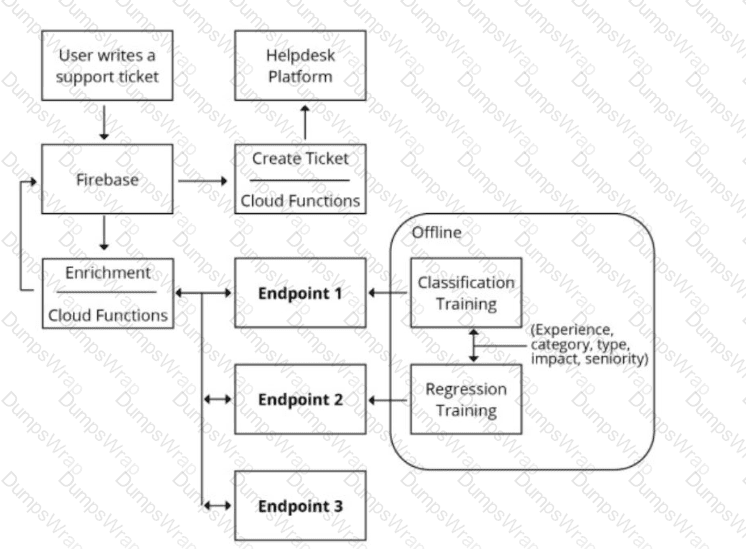
as

Which endpoints should the Enrichment Cloud Functions call?

Options:

A.

1 = Vertex Al. 2 = Vertex Al. 3 = AutoML Natural Language

B.

1 = Vertex Al. 2 = Vertex Al. 3 = Cloud Natural Language API

C.

1 = Vertex Al. 2 = Vertex Al. 3 = AutoML Vision

D.

1 = Cloud Natural Language API. 2 = Vertex Al, 3 = Cloud Vision API

Question 12

You work for an international manufacturing organization that ships scientific products all over the world Instruction manuals for these products need to be translated to 15 different languages Your organization ' s leadership team wants to start using machine learning to reduce the cost of manual human translations and increase translation speed. You need to implement a scalable solution that maximizes accuracy and minimizes operational overhead. You also want to include a process to evaluate and fix incorrect translations. What should you do?

Options:

A.

Create a workflow using Cloud Function Triggers Configure a Cloud Function that is triggered when documents are uploaded to an input Cloud Storage bucket Configure another Cloud Function that translates the documents using the Cloud Translation API and saves the translations to an output Cloud Storage bucket Use human reviewers to evaluate the incorrect translations.

B.

Create a Vertex Al pipeline that processes the documents1 launches an AutoML Translation training job evaluates the translations, and deploys the model to a Vertex Al endpoint with autoscaling and model monitoring When there is a predetermined skew between training and live data re-trigger the pipeline with the latest data.

C.

Use AutoML Translation to tram a model Configure a Translation Hub project and use the trained model to translate the documents Use human reviewers to evaluate the incorrect translations

D.

Use Vertex Al custom training jobs to fine-tune a state-of-the-art open source pretrained model with your data Deploy the model to a Vertex Al endpoint with autoscaling and model monitoring When there is a predetermined skew between the training and live data, configure a trigger to run another training job with the latest data.

Question 13

Your team is working on an NLP research project to predict political affiliation of authors based on articles they have written. You have a large training dataset that is structured like this:
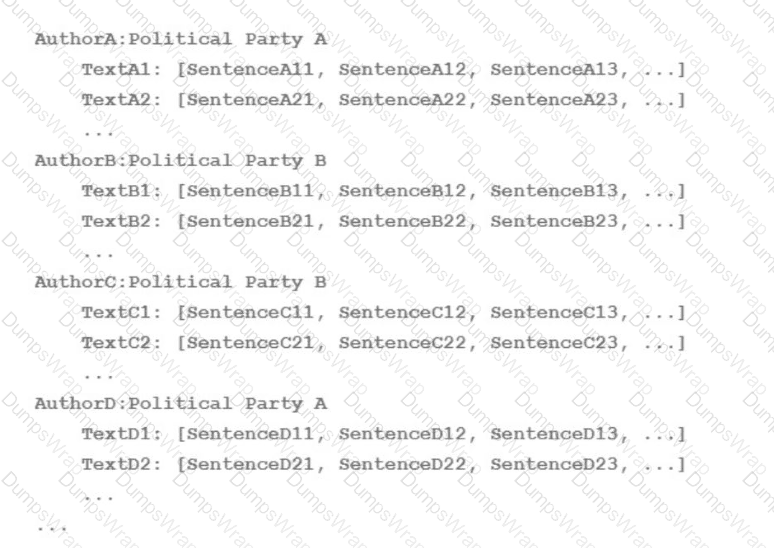
as

You followed the standard 80%-10%-10% data distribution across the training, testing, and evaluation subsets. How should you distribute the training examples across the train-test-eval subsets while maintaining the 80-10-10 proportion?

A)
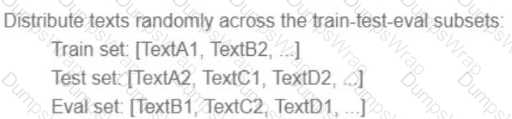
as

B)

as

C)

as

D)

as

Options:

A.

Option A

B.

Option B

C.

Option C

D.

Option D

Question 14

You are an ML engineer at a bank. You have developed a binary classification model using AutoML Tables to predict whether a customer will make loan payments on time. The output is used to approve or reject loan requests. One customer’s loan request has been rejected by your model, and the bank’s risks department is asking you to provide the reasons that contributed to the model’s decision. What should you do?

Options:

A.

Use local feature importance from the predictions.

B.

Use the correlation with target values in the data summary page.

C.

Use the feature importance percentages in the model evaluation page.

D.

Vary features independently to identify the threshold per feature that changes the classification.

Question 15

You work for a credit card company and have been asked to create a custom fraud detection model based on historical data using AutoML Tables. You need to prioritize detection of fraudulent transactions while minimizing false positives. Which optimization objective should you use when training the model?

Options:

A.

An optimization objective that minimizes Log loss

B.

An optimization objective that maximizes the Precision at a Recall value of 0.50

C.

An optimization objective that maximizes the area under the precision-recall curve (AUC PR) value

D.

An optimization objective that maximizes the area under the receiver operating characteristic curve (AUC ROC) value

Question 16

You work for a large hotel chain and have been asked to assist the marketing team in gathering predictions for a targeted marketing strategy. You need to make predictions about user lifetime value (LTV) over the next 30 days so that marketing can be adjusted accordingly. The customer dataset is in BigQuery, and you are preparing the tabular data for training with AutoML Tables. This data has a time signal that is spread across multiple columns. How should you ensure that AutoML fits the best model to your data?

Options:

A.

Manually combine all columns that contain a time signal into an array Allow AutoML to interpret this array appropriately

Choose an automatic data split across the training, validation, and testing sets

B.

Submit the data for training without performing any manual transformations Allow AutoML to handle the appropriate

transformations Choose an automatic data split across the training, validation, and testing sets

C.

Submit the data for training without performing any manual transformations, and indicate an appropriate column as the Time column Allow AutoML to split your data based on the time signal provided, and reserve the more recent data for the validation and testing sets

D.

Submit the data for training without performing any manual transformations Use the columns that have a time signal to manually split your data Ensure that the data in your validation set is from 30 days after the data in your training set and that the data in your testing set is from 30 days after your validation set

Question 17

You have created a Vertex Al pipeline that includes two steps. The first step preprocesses 10 TB data completes in about 1 hour, and saves the result in a Cloud Storage bucket The second step uses the processed data to train a model You need to update the model ' s code to allow you to test different algorithms You want to reduce pipeline execution time and cost, while also minimizing pipeline changes What should you do?

Options:

A.

Add a pipeline parameter and an additional pipeline step Depending on the parameter value the pipeline step conducts or skips data preprocessing and starts model training.

B.

Create another pipeline without the preprocessing step, and hardcode the preprocessed Cloud Storage file location for model training.

C.

Configure a machine with more CPU and RAM from the compute-optimized machine family for the data preprocessing step.

D.

Enable caching for the pipeline job. and disable caching for the model training step.

Question 18

You work for a delivery company. You need to design a system that stores and manages features such as parcels delivered and truck locations over time. The system must retrieve the features with low latency and feed those features into a model for online prediction. The data science team will retrieve historical data at a specific point in time for model training. You want to store the features with minimal effort. What should you do?

Options:

A.

Store features in Bigtable as key/value data.

B.

Store features in Vertex Al Feature Store.

C.

Store features as a Vertex Al dataset and use those features to tram the models hosted in Vertex Al endpoints.

D.

Store features in BigQuery timestamp partitioned tables, and use the BigQuery Storage Read API to serve the features.

Question 19

You work on the data science team at a manufacturing company. You are reviewing the company ' s historical sales data, which has hundreds of millions of records. For your exploratory data analysis, you need to calculate descriptive statistics such as mean, median, and mode; conduct complex statistical tests for hypothesis testing; and plot variations of the features over time You want to use as much of the sales data as possible in your analyses while minimizing computational resources. What should you do?

Options:

A.

Spin up a Vertex Al Workbench user-managed notebooks instance and import the dataset Use this data to create statistical and visual analyses

B.

Visualize the time plots in Google Data Studio. Import the dataset into Vertex Al Workbench user-managed notebooks Use this data to calculate the descriptive statistics and run the statistical analyses

C.

Use BigQuery to calculate the descriptive statistics. Use Vertex Al Workbench user-managed notebooks to visualize the time plots and run the statistical analyses.

D Use BigQuery to calculate the descriptive statistics, and use Google Data Studio to visualize the time plots. Use Vertex Al Workbench user-managed notebooks to run the statistical analyses.

Question 20

You have developed an AutoML tabular classification model that identifies high-value customers who interact with your organization ' s website.

You plan to deploy the model to a new Vertex Al endpoint that will integrate with your website application. You expect higher traffic to the website during

nights and weekends. You need to configure the model endpoint ' s deployment settings to minimize latency and cost. What should you do?

Options:

A.

Configure the model deployment settings to use an n1-standard-32 machine type.

B.

Configure the model deployment settings to use an n1-standard-4 machine type. Set the minReplicaCount value to 1 and the maxReplicaCount value to 8.

C.

Configure the model deployment settings to use an n1-standard-4 machine type and a GPU accelerator. Set the minReplicaCount value to 1 and the maxReplicaCount value to 4.

D.

Configure the model deployment settings to use an n1-standard-8 machine type and a GPU accelerator.

Question 21

You work for a retail company. You have a managed tabular dataset in Vertex Al that contains sales data from three different stores. The dataset includes several features such as store name and sale timestamp. You want to use the data to train a model that makes sales predictions for a new store that will open soon You need to split the data between the training, validation, and test sets What approach should you use to split the data?

Options:

A.

Use Vertex Al manual split, using the store name feature to assign one store for each set.

B.

Use Vertex Al default data split.

C.

Use Vertex Al chronological split and specify the sales timestamp feature as the time vanable.

D.

Use Vertex Al random split assigning 70% of the rows to the training set, 10% to the validation set, and 20% to the test set.

Question 22

You are working on a classification problem with time series data and achieved an area under the receiver operating characteristic curve (AUC ROC) value of 99% for training data after just a few experiments. You haven’t explored using any sophisticated algorithms or spent any time on hyperparameter tuning. What should your next step be to identify and fix the problem?

Options:

A.

Address the model overfitting by using a less complex algorithm.

B.

Address data leakage by applying nested cross-validation during model training.

C.

Address data leakage by removing features highly correlated with the target value.

D.

Address the model overfitting by tuning the hyperparameters to reduce the AUC ROC value.

Question 23

Your team is building a convolutional neural network (CNN)-based architecture from scratch. The preliminary experiments running on your on-premises CPU-only infrastructure were encouraging, but have slow convergence. You have been asked to speed up model training to reduce time-to-market. You want to experiment with virtual machines (VMs) on Google Cloud to leverage more powerful hardware. Your code does not include any manual device placement and has not been wrapped in Estimator model-level abstraction. Which environment should you train your model on?

Options:

A.

AVM on Compute Engine and 1 TPU with all dependencies installed manually.

B.

AVM on Compute Engine and 8 GPUs with all dependencies installed manually.

C.

A Deep Learning VM with an n1-standard-2 machine and 1 GPU with all libraries pre-installed.

D.

A Deep Learning VM with more powerful CPU e2-highcpu-16 machines with all libraries pre-installed.

Question 24

You work at a large organization that recently decided to move their ML and data workloads to Google Cloud. The data engineering team has exported the structured data to a Cloud Storage bucket in Avro format. You need to propose a workflow that performs analytics, creates features, and hosts the features that your ML models use for online prediction How should you configure the pipeline?

Options:

A.

Ingest the Avro files into Cloud Spanner to perform analytics Use a Dataflow pipeline to create the features and store them in BigQuery for online prediction.

B.

Ingest the Avro files into BigQuery to perform analytics Use a Dataflow pipeline to create the features, and store them in Vertex Al Feature Store for online prediction.

C.

Ingest the Avro files into BigQuery to perform analytics Use BigQuery SQL to create features and store them in a separate BigQuery table for online prediction.

D.

Ingest the Avro files into Cloud Spanner to perform analytics. Use a Dataflow pipeline to create the features. and store them in Vertex Al Feature Store for online prediction.

Question 25

Your data science team needs to rapidly experiment with various features, model architectures, and hyperparameters. They need to track the accuracy metrics for various experiments and use an API to query the metrics over time. What should they use to track and report their experiments while minimizing manual effort?

Options:

A.

Use Kubeflow Pipelines to execute the experiments Export the metrics file, and query the results using the Kubeflow Pipelines API.

B.

Use Al Platform Training to execute the experiments Write the accuracy metrics to BigQuery, and query the results using the BigQueryAPI.

C.

Use Al Platform Training to execute the experiments Write the accuracy metrics to Cloud Monitoring, and query the results using the Monitoring API.

D.

Use Al Platform Notebooks to execute the experiments. Collect the results in a shared Google Sheets file, and query the results using the Google Sheets API

Question 26

You are training an LSTM-based model on Al Platform to summarize text using the following job submission script:
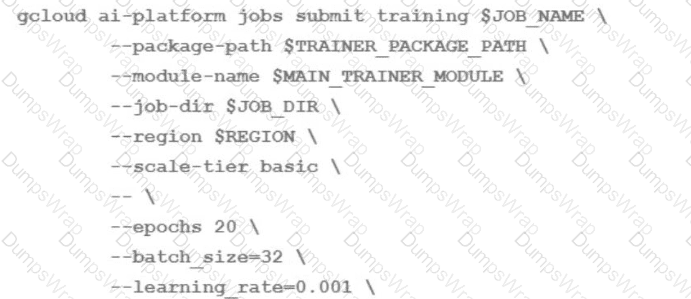
as

You want to ensure that training time is minimized without significantly compromising the accuracy of your model. What should you do?

Options:

A.

Modify the ' epochs ' parameter

B.

Modify the ' scale-tier ' parameter

C.

Modify the batch size ' parameter

D.

Modify the ' learning rate ' parameter

Question 27

You work for a company that is developing a new video streaming platform. You have been asked to create a recommendation system that will suggest the next video for a user to watch. After a review by an AI Ethics team, you are approved to start development. Each video asset in your company’s catalog has useful metadata (e.g., content type, release date, country), but you do not have any historical user event data. How should you build the recommendation system for the first version of the product?

Options:

A.

Launch the product without machine learning. Present videos to users alphabetically, and start collecting user event data so you can develop a recommender model in the future.

B.

Launch the product without machine learning. Use simple heuristics based on content metadata to recommend similar videos to users, and start collecting user event data so you can develop a recommender model in the future.

C.

Launch the product with machine learning. Use a publicly available dataset such as MovieLens to train a model using the Recommendations AI, and then apply this trained model to your data.

D.

Launch the product with machine learning. Generate embeddings for each video by training an autoencoder on the content metadata using TensorFlow. Cluster content based on the similarity of these embeddings, and then recommend videos from the same cluster.

Question 28

You work at a gaming startup that has several terabytes of structured data in Cloud Storage. This data includes gameplay time data, user metadata, and game metadata. You want to build a model that recommends new games to users that requires the least amount of coding. What should you do?

Options:

A.

Load the data in BigQuery. Use BigQuery ML to train an Autoencoder model.

B.

Load the data in BigQuery. Use BigQuery ML to train a matrix factorization model.

C.

Read data to a Vertex Al Workbench notebook. Use TensorFlow to train a two-tower model.

D.

Read data to a Vertex Al Workbench notebook. Use TensorFlow to train a matrix factorization model.

Question 29

You are developing an image recognition model using PyTorch based on ResNet50 architecture. Your code is working fine on your local laptop on a small subsample. Your full dataset has 200k labeled images You want to quickly scale your training workload while minimizing cost. You plan to use 4 V100 GPUs. What should you do? (Choose Correct Answer and Give References and Explanation)

Options:

A.

Configure a Compute Engine VM with all the dependencies that launches the training Train your model with Vertex Al using a custom tier that contains the required GPUs.

B.

Package your code with Setuptools. and use a pre-built container Train your model with Vertex Al using a custom tier that contains the required GPUs.

C.

Create a Vertex Al Workbench user-managed notebooks instance with 4 V100 GPUs, and use it to train your model

D.

Create a Google Kubernetes Engine cluster with a node pool that has 4 V100 GPUs Prepare and submit a TFJob operator to this node pool.

Question 30

You work for the AI team of an automobile company, and you are developing a visual defect detection model using TensorFlow and Keras. To improve your model performance, you want to incorporate some image augmentation functions such as translation, cropping, and contrast tweaking. You randomly apply these functions to each training batch. You want to optimize your data processing pipeline for run time and compute resources utilization. What should you do?

Options:

A.

Embed the augmentation functions dynamically in the tf.Data pipeline.

B.

Embed the augmentation functions dynamically as part of Keras generators.

C.

Use Dataflow to create all possible augmentations, and store them as TFRecords.

D.

Use Dataflow to create the augmentations dynamically per training run, and stage them as TFRecords.

Question 31

You want to train an AutoML model to predict house prices by using a small public dataset stored in BigQuery. You need to prepare the data and want to use the simplest most efficient approach. What should you do?

Options:

A.

Write a query that preprocesses the data by using BigQuery and creates a new table Create a Vertex Al managed dataset with the new table as the data source.

B.

Use Dataflow to preprocess the data Write the output in TFRecord format to a Cloud Storage bucket.

C.

Write a query that preprocesses the data by using BigQuery Export the query results as CSV files and use

those files to create a Vertex Al managed dataset.

D.

Use a Vertex Al Workbench notebook instance to preprocess the data by using the pandas library Export the data as CSV files, and use those files to create a Vertex Al managed dataset.

Question 32

You work at a gaming startup that has several terabytes of structured data in Cloud Storage. This data includes gameplay time data user metadata and game metadata. You want to build a model that recommends new games to users that requires the least amount of coding. What should you do?

Options:

A.

Load the data in BigQuery Use BigQuery ML to tram an Autoencoder model.

B.

Load the data in BigQuery Use BigQuery ML to train a matrix factorization model.

C.

Read data to a Vertex Al Workbench notebook Use TensorFlow to train a two-tower model.

D.

Read data to a Vertex AI Workbench notebook Use TensorFlow to train a matrix factorization model.

Question 33

Your team trained and tested a DNN regression model with good results. Six months after deployment, the model is performing poorly due to a change in the distribution of the input data. How should you address the input differences in production?

Options:

A.

Create alerts to monitor for skew, and retrain the model.

B.

Perform feature selection on the model, and retrain the model with fewer features

C.

Retrain the model, and select an L2 regularization parameter with a hyperparameter tuning service

D.

Perform feature selection on the model, and retrain the model on a monthly basis with fewer features

Question 34

You received a training-serving skew alert from a Vertex Al Model Monitoring job running in production. You retrained the model with more recent training data, and deployed it back to the Vertex Al endpoint but you are still receiving the same alert. What should you do?

Options:

A.

Update the model monitoring job to use a lower sampling rate.

B.

Update the model monitoring job to use the more recent training data that was used to retrain the model.

C.

Temporarily disable the alert Enable the alert again after a sufficient amount of new production traffic has passed through the Vertex Al endpoint.

D.

Temporarily disable the alert until the model can be retrained again on newer training data Retrain the model again after a sufficient amount of new production traffic has passed through the Vertex Al endpoint

Question 35

You recently used BigQuery ML to train an AutoML regression model. You shared results with your team and received positive feedback. You need to deploy your model for online prediction as quickly as possible. What should you do?

Options:

A.

Retrain the model by using BigQuery ML. and specify Vertex Al as the model registry Deploy the model from Vertex Al Model Registry to a Vertex Al endpoint.

B.

Retrain the model by using Vertex Al Deploy the model from Vertex Al Model Registry to a Vertex Al endpoint.

C.

Alter the model by using BigQuery ML and specify Vertex Al as the model registry Deploy the model from Vertex Al Model Registry to a Vertex Al endpoint.

D.

Export the model from BigQuery ML to Cloud Storage Import the model into Vertex Al Model Registry Deploy the model to a Vertex Al endpoint.

Question 36

Your team needs to build a model that predicts whether images contain a driver ' s license, passport, or credit card. The data engineering team already built the pipeline and generated a dataset composed of 10,000 images with driver ' s licenses, 1,000 images with passports, and 1,000 images with credit cards. You now have to train a model with the following label map: [ ' driversjicense ' , ' passport ' , ' credit_card ' ]. Which loss function should you use?

Options:

A.

Categorical hinge

B.

Binary cross-entropy

C.

Categorical cross-entropy

D.

Sparse categorical cross-entropy

Question 37

You work as an ML engineer at a social media company, and you are developing a visual filter for users’ profile photos. This requires you to train an ML model to detect bounding boxes around human faces. You want to use this filter in your company’s iOS-based mobile phone application. You want to minimize code development and want the model to be optimized for inference on mobile phones. What should you do?

Options:

A.

Train a model using AutoML Vision and use the “export for Core ML” option.

B.

Train a model using AutoML Vision and use the “export for Coral” option.

C.

Train a model using AutoML Vision and use the “export for TensorFlow.js” option.

D.

Train a custom TensorFlow model and convert it to TensorFlow Lite (TFLite).

Question 38

You have a custom job that runs on Vertex Al on a weekly basis The job is Implemented using a proprietary ML workflow that produces the datasets. models, and custom artifacts, and sends them to a Cloud Storage bucket Many different versions of the datasets and models were created Due to compliance requirements, your company needs to track which model was used for making a particular prediction, and needs access to the artifacts for each model. How should you configure your workflows to meet these requirement?

Options:

A.

Configure a TensorFlow Extended (TFX) ML Metadata database, and use the ML Metadata API.

B.

Create a Vertex Al experiment, and enable autologging inside the custom job

C.

Use the Vertex Al Metadata API inside the custom Job to create context, execution, and artifacts for each model, and use events to link them together.

D.

Register each model in Vertex Al Model Registry, and use model labels to store the related dataset and model information.

Question 39

You have recently developed a new ML model in a Jupyter notebook. You want to establish a reliable and repeatable model training process that tracks the versions and lineage of your model artifacts. You plan to retrain your model weekly. How should you operationalize your training process?

Options:

A.

1. Create an instance of the CustomTrainingJob class with the Vertex AI SDK to train your model.

2. Using the Notebooks API, create a scheduled execution to run the training code weekly.

B.

1. Create an instance of the CustomJob class with the Vertex AI SDK to train your model.

2. Use the Metadata API to register your model as a model artifact.

3. Using the Notebooks API, create a scheduled execution to run the training code weekly.

C.

1. Create a managed pipeline in Vertex Al Pipelines to train your model by using a Vertex Al CustomTrainingJoOp component.

2. Use the ModelUploadOp component to upload your model to Vertex Al Model Registry.

3. Use Cloud Scheduler and Cloud Functions to run the Vertex Al pipeline weekly.

D.

1. Create a managed pipeline in Vertex Al Pipelines to train your model using a Vertex Al HyperParameterTuningJobRunOp component.

2. Use the ModelUploadOp component to upload your model to Vertex Al Model Registry.

3. Use Cloud Scheduler and Cloud Functions to run the Vertex Al pipeline weekly.

Question 40

You work for an online grocery store. You recently developed a custom ML model that recommends a recipe when a user arrives at the website. You chose the machine type on the Vertex Al endpoint to optimize costs by using the queries per second (QPS) that the model can serve, and you deployed it on a single machine with 8 vCPUs and no accelerators.

A holiday season is approaching and you anticipate four times more traffic during this time than the typical daily traffic You need to ensure that the model can scale efficiently to the increased demand. What should you do?

Options:

A.

1, Maintain the same machine type on the endpoint.

2 Set up a monitoring job and an alert for CPU usage

3 If you receive an alert add a compute node to the endpoint

B.

1 Change the machine type on the endpoint to have 32 vCPUs

2. Set up a monitoring job and an alert for CPU usage

3 If you receive an alert, scale the vCPUs further as needed

C.

1 Maintain the same machine type on the endpoint Configure the endpoint to enable autoscalling based on vCPU usage.

2 Set up a monitoring job and an alert for CPU usage

3 If you receive an alert investigate the cause

D.

1 Change the machine type on the endpoint to have a GPU_ Configure the endpoint to enable autoscaling based on the GPU usage.

2 Set up a monitoring job and an alert for GPU usage.

3 If you receive an alert investigate the cause.

Question 41

You work at a mobile gaming startup that creates online multiplayer games Recently, your company observed an increase in players cheating in the games, leading to a loss of revenue and a poor user experience. You built a binary classification model to determine whether a player cheated after a completed game session, and then send a message to other downstream systems to ban the player that cheated Your model has performed well during testing, and you now need to deploy the model to production You want your serving solution to provide immediate classifications after a completed game session to avoid further loss of revenue. What should you do?

Options:

A.

Import the model into Vertex Al Model Registry. Use the Vertex Batch Prediction service to run batch inference jobs.

B.

Save the model files in a Cloud Storage Bucket Create a Cloud Function to read the model files and make online inference requests on the Cloud Function.

C.

Save the model files in a VM Load the model files each time there is a prediction request and run an inference job on the VM.

D.

Import the model into Vertex Al Model Registry Create a Vertex Al endpoint that hosts the model and make online inference requests.

Question 42

You are a lead ML engineer at a retail company. You want to track and manage ML metadata in a centralized way so that your team can have reproducible experiments by generating artifacts. Which management solution should you recommend to your team?

Options:

A.

Store your tf.logging data in BigQuery.

B.

Manage all relational entities in the Hive Metastore.

C.

Store all ML metadata in Google Cloud’s operations suite.

D.

Manage your ML workflows with Vertex ML Metadata.

Question 43

You need to train a natural language model to perform text classification on product descriptions that contain millions of examples and 100,000 unique words. You want to preprocess the words individually so that they can be fed into a recurrent neural network. What should you do?

Options:

A.

Create a hot-encoding of words, and feed the encodings into your model.

B.

Identify word embeddings from a pre-trained model, and use the embeddings in your model.

C.

Sort the words by frequency of occurrence, and use the frequencies as the encodings in your model.

D.

Assign a numerical value to each word from 1 to 100,000 and feed the values as inputs in your model.

Question 44

Your company ' s business stakeholders want to understand the factors driving customer churn to inform their business strategy. You need to build a customer churn prediction model that prioritizes simple interpretability of your model ' s results. You need to choose the ML framework and modeling technique that will explain which features led to the prediction. What should you do?

Options:

A.

Build a TensorFlow deep neural network (DNN) model, and use SHAP values for feature importance analysis.

B.

Build a PyTorch long short-term memory (LSTM) network, and use attention mechanisms for interpretability.

C.

Build a logistic regression model in scikit-learn, and interpret the model ' s output coefficients to understand feature impact.

D.

Build a linear regression model in scikit-learn, and interpret the model ' s standardized coefficients to understand feature impact.

Question 45

You have recently trained a scikit-learn model that you plan to deploy on Vertex Al. This model will support both online and batch prediction. You need to preprocess input data for model inference. You want to package the model for deployment while minimizing additional code What should you do?

Options:

A.

1 Upload your model to the Vertex Al Model Registry by using a prebuilt scikit-learn prediction container

2 Deploy your model to Vertex Al Endpoints, and create a Vertex Al batch prediction job that uses the instanceConfig.inscanceType setting to transform your input data

B.

1 Wrap your model in a custom prediction routine (CPR). and build a container image from the CPR local model

2 Upload your sci-kit learn model container to Vertex Al Model Registry

3 Deploy your model to Vertex Al Endpoints, and create a Vertex Al batch prediction job

C.

1. Create a custom container for your sci-kit learn model,

2 Define a custom serving function for your model

3 Upload your model and custom container to Vertex Al Model Registry

4 Deploy your model to Vertex Al Endpoints, and create a Vertex Al batch prediction job

D.

1 Create a custom container for your sci-kit learn model.

2 Upload your model and custom container to Vertex Al Model Registry

3 Deploy your model to Vertex Al Endpoints, and create a Vertex Al batch prediction job that uses the instanceConfig. instanceType setting to transform your input data

Question 46

You are the lead ML engineer on a mission-critical project that involves analyzing massive datasets using Apache Spark. You need to establish a robust environment that allows your team to rapidly prototype Spark models using Jupyter notebooks. What is the fastest way to achieve this?

Options:

A.

Configure a Compute Engine instance with Spark and use Jupyter notebooks.

B.

Set up a Dataproc cluster with Spark and use Jupyter notebooks.

C.

Set up a Vertex AI Workbench instance with a Spark kernel.

D.

Use Colab Enterprise with a Spark kernel.

Question 47

You work at a bank. You need to develop a credit risk model to support loan application decisions You decide to implement the model by using a neural network in TensorFlow Due to regulatory requirements, you need to be able to explain the models predictions based on its features When the model is deployed, you also want to monitor the model ' s performance overtime You decided to use Vertex Al for both model development and deployment What should you do?

Options:

A.

Use Vertex Explainable Al with the sampled Shapley method, and enable Vertex Al Model Monitoring to

check for feature distribution drift.

B.

Use Vertex Explainable Al with the sampled Shapley method, and enable Vertex Al Model Monitoring to

check for feature distribution skew.

C.

Use Vertex Explainable Al with the XRAI method, and enable Vertex Al Model Monitoring to check for feature distribution drift.

D.

Use Vertex Explainable Al with the XRAI method and enable Vertex Al Model Monitoring to check for feature distribution skew.

Question 48

You are creating a deep neural network classification model using a dataset with categorical input values. Certain columns have a cardinality greater than 10,000 unique values. How should you encode these categorical values as input into the model?

Options:

A.

Convert each categorical value into an integer value.

B.

Convert the categorical string data to one-hot hash buckets.

C.

Map the categorical variables into a vector of boolean values.

D.

Convert each categorical value into a run-length encoded string.

Question 49

You need to develop an image classification model by using a large dataset that contains labeled images in a Cloud Storage Bucket. What should you do?

Options:

A.

Use Vertex Al Pipelines with the Kubeflow Pipelines SDK to create a pipeline that reads the images from Cloud Storage and trains the model.

B.

Use Vertex Al Pipelines with TensorFlow Extended (TFX) to create a pipeline that reads the images from Cloud Storage and trams the model.

C.

Import the labeled images as a managed dataset in Vertex Al: and use AutoML to tram the model.

D.

Convert the image dataset to a tabular format using Dataflow Load the data into BigQuery and use BigQuery ML to tram the model.

Question 50

You work for a toy manufacturer that has been experiencing a large increase in demand. You need to build an ML model to reduce the amount of time spent by quality control inspectors checking for product defects. Faster defect detection is a priority. The factory does not have reliable Wi-Fi. Your company wants to implement the new ML model as soon as possible. Which model should you use?

Options:

A.

AutoML Vision model

B.

AutoML Vision Edge mobile-versatile-1 model

C.

AutoML Vision Edge mobile-low-latency-1 model

D.

AutoML Vision Edge mobile-high-accuracy-1 model

Question 51

You work for a retail company. You have been asked to develop a model to predict whether a customer will purchase a product on a given day. Your team has processed the company ' s sales data, and created a table with the following rows:

• Customer_id

• Product_id

• Date

• Days_since_last_purchase (measured in days)

• Average_purchase_frequency (measured in 1/days)

• Purchase (binary class, if customer purchased product on the Date)

You need to interpret your models results for each individual prediction. What should you do?

Options:

A.

Create a BigQuery table Use BigQuery ML to build a boosted tree classifier Inspect the partition rules of the trees to understand how each prediction flows through the trees.

B.

Create a Vertex Al tabular dataset Train an AutoML model to predict customer purchases Deploy the model

to a Vertex Al endpoint and enable feature attributions Use the " explain " method to get feature attribution values for each individual prediction.

C.

Create a BigQuery table Use BigQuery ML to build a logistic regression classification model Use the values of the coefficients of the model to interpret the feature importance with higher values corresponding to more importance.

D.

Create a Vertex Al tabular dataset Train an AutoML model to predict customer purchases Deploy the model to a Vertex Al endpoint. At each prediction enable L1 regularization to detect non-informative features.

Question 52

You work for a large retailer and you need to build a model to predict customer churn. The company has a dataset of historical customer data, including customer demographics, purchase history, and website activity. You need to create the model in BigQuery ML and thoroughly evaluate its performance. What should you do?

Options:

A.

Create a linear regression model in BigQuery ML and register the model in Vertex Al Model Registry Evaluate the model performance in Vertex Al.

B.

Create a logistic regression model in BigQuery ML and register the model in Vertex Al Model Registry. Evaluate the model performance in Vertex Al.

C.

Create a linear regression model in BigQuery ML Use the ml. evaluate function to evaluate the model performance.

D.

Create a logistic regression model in BigQuery ML Use the ml.confusion_matrix function to evaluate the model performance.

Question 53

You recently deployed a model lo a Vertex Al endpoint and set up online serving in Vertex Al Feature Store. You have configured a daily batch ingestion job to update your featurestore During the batch ingestion jobs you discover that CPU utilization is high in your featurestores online serving nodes and that feature retrieval latency is high. You need to improve online serving performance during the daily batch ingestion. What should you do?

Options:

A.

Schedule an increase in the number of online serving nodes in your featurestore prior to the batch ingestion jobs.

B.

Enable autoscaling of the online serving nodes in your featurestore

C.

Enable autoscaling for the prediction nodes of your DeployedModel in the Vertex Al endpoint.

D.

Increase the worker counts in the importFeaturevalues request of your batch ingestion job.

Question 54

Your organization ' s call center has asked you to develop a model that analyzes customer sentiments in each call. The call center receives over one million calls daily, and data is stored in Cloud Storage. The data collected must not leave the region in which the call originated, and no Personally Identifiable Information (Pll) can be stored or analyzed. The data science team has a third-party tool for visualization and access which requires a SQL ANSI-2011 compliant interface. You need to select components for data processing and for analytics. How should the data pipeline be designed?

Options:

A.

1 = Dataflow, 2 = BigQuery

B.

1 = Pub/Sub, 2 = Datastore

C.

1 = Dataflow, 2 = Cloud SQL

D.

1 = Cloud Function, 2 = Cloud SQL

Question 55

Your company needs to generate product summaries for vendors. You evaluated a foundation model from Model Garden for text summarization but found that the summaries do not align with your company ' s brand voice. How should you improve this LLM-based summarization model to better meet your business objectives?

Options:

A.

Increase the model’s temperature parameter.

B.

Fine-tune the model using a company-specific dataset.

C.

Tune the token output limit in the response.

D.

Replace the pre-trained model with another model in Model Garden.

Question 56

You are building a linear model with over 100 input features, all with values between -1 and 1. You suspect that many features are non-informative. You want to remove the non-informative features from your model while keeping the informative ones in their original form. Which technique should you use?

Options:

A.

Use Principal Component Analysis to eliminate the least informative features.

B.

Use L1 regularization to reduce the coefficients of uninformative features to 0.

C.

After building your model, use Shapley values to determine which features are the most informative.

D.

Use an iterative dropout technique to identify which features do not degrade the model when removed.

Question 57

You recently deployed a model to a Vertex Al endpoint Your data drifts frequently so you have enabled request-response logging and created a Vertex Al Model Monitoring job. You have observed that your model is receiving higher traffic than expected. You need to reduce the model monitoring cost while continuing to quickly detect drift. What should you do?

Options:

A.

Replace the monitoring job with a DataFlow pipeline that uses TensorFlow Data Validation (TFDV).

B.

Replace the monitoring job with a custom SQL scnpt to calculate statistics on the features and predictions in BigQuery.

C.

Decrease the sample_rate parameter in the Randomsampleconfig of the monitoring job.

D.

Increase the monitor_interval parameter in the scheduieconfig of the monitoring job.

Question 58

You have trained a model by using data that was preprocessed in a batch Dataflow pipeline Your use case requires real-time inference. You want to ensure that the data preprocessing logic is applied consistently between training and serving. What should you do?

Options:

A.

Perform data validation to ensure that the input data to the pipeline is the same format as the input data to the endpoint.

B.

Refactor the transformation code in the batch data pipeline so that it can be used outside of the pipeline Use the same code in the endpoint.

C.

Refactor the transformation code in the batch data pipeline so that it can be used outside of the pipeline Share this code with the end users of the endpoint.

D.

Batch the real-time requests by using a time window and then use the Dataflow pipeline to preprocess the batched requests. Send the preprocessed requests to the endpoint.

Question 59

You need to build classification workflows over several structured datasets currently stored in BigQuery. Because you will be performing the classification several times, you want to complete the following steps without writing code: exploratory data analysis, feature selection, model building, training, and hyperparameter tuning and serving. What should you do?

Options:

A.

Configure AutoML Tables to perform the classification task

B.

Run a BigQuery ML task to perform logistic regression for the classification

C.

Use Al Platform Notebooks to run the classification model with pandas library

D.

Use Al Platform to run the classification model job configured for hyperparameter tuning

Question 60

You have recently created a proof-of-concept (POC) deep learning model. You are satisfied with the overall architecture, but you need to determine the value for a couple of hyperparameters. You want to perform hyperparameter tuning on Vertex AI to determine both the appropriate embedding dimension for a categorical feature used by your model and the optimal learning rate. You configure the following settings:

For the embedding dimension, you set the type to INTEGER with a minValue of 16 and maxValue of 64.

For the learning rate, you set the type to DOUBLE with a minValue of 10e-05 and maxValue of 10e-02.

You are using the default Bayesian optimization tuning algorithm, and you want to maximize model accuracy. Training time is not a concern. How should you set the hyperparameter scaling for each hyperparameter and the maxParallelTrials?

Options:

A.

Use UNIT_LINEAR_SCALE for the embedding dimension, UNIT_LOG_SCALE for the learning rate, and a large number of parallel trials.

B.

Use UNIT_LINEAR_SCALE for the embedding dimension, UNIT_LOG_SCALE for the learning rate, and a small number of parallel trials.

C.

Use UNIT_LOG_SCALE for the embedding dimension, UNIT_LINEAR_SCALE for the learning rate, and a large number of parallel trials.

D.

Use UNIT_LOG_SCALE for the embedding dimension, UNIT_LINEAR_SCALE for the learning rate, and a small number of parallel trials.

Question 61

You work for an online travel agency that also sells advertising placements on its website to other companies.

You have been asked to predict the most relevant web banner that a user should see next. Security is

important to your company. The model latency requirements are 300ms@p99, the inventory is thousands of web banners, and your exploratory analysis has shown that navigation context is a good predictor. You want to Implement the simplest solution. How should you configure the prediction pipeline?

Options:

A.

Embed the client on the website, and then deploy the model on AI Platform Prediction.

B.

Embed the client on the website, deploy the gateway on App Engine, and then deploy the model on AI Platform Prediction.

C.

Embed the client on the website, deploy the gateway on App Engine, deploy the database on Cloud

Bigtable for writing and for reading the user’s navigation context, and then deploy the model on AI Platform Prediction.

D.

Embed the client on the website, deploy the gateway on App Engine, deploy the database on Memorystore for writing and for reading the user’s navigation context, and then deploy the model on Google Kubernetes Engine.

Question 62

You are working on a prototype of a text classification model in a managed Vertex AI Workbench notebook. You want to quickly experiment with tokenizing text by using a Natural Language Toolkit (NLTK) library. How should you add the library to your Jupyter kernel?

Options:

A.

Install the NLTK library from a terminal by using the pip install nltk command.

B.

Write a custom Dataflow job that uses NLTK to tokenize your text and saves the output to Cloud Storage.

C.

Create a new Vertex Al Workbench notebook with a custom image that includes the NLTK library.

D.

Install the NLTK library from a Jupyter cell by using the! pip install nltk —user command.

Question 63

You work for a rapidly growing social media company. Your team builds TensorFlow recommender models in an on-premises CPU cluster. The data contains billions of historical user events and 100 000 categorical features. You notice that as the data increases the model training time increases. You plan to move the models to Google Cloud You want to use the most scalable approach that also minimizes training time. What should you do?

Options:

A.

Deploy the training jobs by using TPU VMs with TPUv3 Pod slices, and use the TPUEmbedding API.

B.

Deploy the training jobs in an autoscaling Google Kubernetes Engine cluster with CPUs

C.

Deploy a matrix factorization model training job by using BigQuery ML.

D.

Deploy the training jobs by using Compute Engine instances with A100 GPUs and use the

t f. nn. embedding_lookup API.

Question 64

You have developed an application that uses a chain of multiple scikit-learn models to predict the optimal price for your company ' s products. The workflow logic is shown in the diagram Members of your team use the individual models in other solution workflows. You want to deploy this workflow while ensuring version control for each individual model and the overall workflow Your application needs to be able to scale down to zero. You want to minimize the compute resource utilization and the manual effort required to manage this solution. What should you do?

Options:

A.

Expose each individual model as an endpoint in Vertex Al Endpoints. Create a custom container endpoint to orchestrate the workflow.

B.

Create a custom container endpoint for the workflow that loads each models individual files Track the versions of each individual model in BigQuery.

C.

Expose each individual model as an endpoint in Vertex Al Endpoints. Use Cloud Run to orchestrate the workflow.

D.

Load each model ' s individual files into Cloud Run Use Cloud Run to orchestrate the workflow Track the versions of each individual model in BigQuery.

Question 65

You developed a Vertex Al ML pipeline that consists of preprocessing and training steps and each set of steps runs on a separate custom Docker image Your organization uses GitHub and GitHub Actions as CI/CD to run unit and integration tests You need to automate the model retraining workflow so that it can be initiated both manually and when a new version of the code is merged in the main branch You want to minimize the steps required to build the workflow while also allowing for maximum flexibility How should you configure the CI/CD workflow?

Options:

A.

Trigger a Cloud Build workflow to run tests build custom Docker images, push the images to Artifact Registry and launch the pipeline in Vertex Al Pipelines.

B.

Trigger GitHub Actions to run the tests launch a job on Cloud Run to build custom Docker images push the images to Artifact Registry and launch the pipeline in Vertex Al Pipelines.

C.

Trigger GitHub Actions to run the tests build custom Docker images push the images to Artifact Registry, and launch the pipeline in Vertex Al Pipelines.

D.

Trigger GitHub Actions to run the tests launch a Cloud Build workflow to build custom Dicker images, push the images to Artifact Registry, and launch the pipeline in Vertex Al Pipelines.

Question 66

You work for a hotel and have a dataset that contains customers ' written comments scanned from paper-based customer feedback forms which are stored as PDF files Every form has the same layout. You need to quickly predict an overall satisfaction score from the customer comments on each form. How should you accomplish this task ' ?

Options:

A.

Use the Vision API to parse the text from each PDF file Use the Natural Language API

analyzesentiment feature to infer overall satisfaction scores.

B.

Use the Vision API to parse the text from each PDF file Use the Natural Language API

analyzeEntitysentiment feature to infer overall satisfaction scores.

C.

Uptrain a Document Al custom extractor to parse the text in the comments section of each PDF file. Use the Natural Language API analyze sentiment feature to infer overall satisfaction scores.

D.

Uptrain a Document Al custom extractor to parse the text in the comments section of each PDF file. Use the Natural Language API analyzeEntitySentiment feature to infer overall satisfaction scores.

Question 67

You have trained a model on a dataset that required computationally expensive preprocessing operations. You need to execute the same preprocessing at prediction time. You deployed the model on Al Platform for high-throughput online prediction. Which architecture should you use?

Options:

A.

• Validate the accuracy of the model that you trained on preprocessed data

• Create a new model that uses the raw data and is available in real time

• Deploy the new model onto Al Platform for online prediction

B.

• Send incoming prediction requests to a Pub/Sub topic

• Transform the incoming data using a Dataflow job

• Submit a prediction request to Al Platform using the transformed data

• Write the predictions to an outbound Pub/Sub queue

C.

• Stream incoming prediction request data into Cloud Spanner

• Create a view to abstract your preprocessing logic.

• Query the view every second for new records

• Submit a prediction request to Al Platform using the transformed data

• Write the predictions to an outbound Pub/Sub queue.

D.

• Send incoming prediction requests to a Pub/Sub topic

• Set up a Cloud Function that is triggered when messages are published to the Pub/Sub topic.

• Implement your preprocessing logic in the Cloud Function

• Submit a prediction request to Al Platform using the transformed data

• Write the predictions to an outbound Pub/Sub queue

Question 68

You are training a Resnet model on Al Platform using TPUs to visually categorize types of defects in automobile engines. You capture the training profile using the Cloud TPU profiler plugin and observe that it is highly input-bound. You want to reduce the bottleneck and speed up your model training process. Which modifications should you make to the tf .data dataset?

Choose 2 answers

Options:

A.

Use the interleave option for reading data

B.

Reduce the value of the repeat parameter

C.

Increase the buffer size for the shuffle option.

D.

Set the prefetch option equal to the training batch size

E.

Decrease the batch size argument in your transformation

Question 69

You need to design an architecture that serves asynchronous predictions to determine whether a particular mission-critical machine part will fail. Your system collects data from multiple sensors from the machine. You want to build a model that will predict a failure in the next N minutes, given the average of each sensor’s data from the past 12 hours. How should you design the architecture?

Options:

A.

1. HTTP requests are sent by the sensors to your ML model, which is deployed as a microservice and exposes a REST API for prediction

2. Your application queries a Vertex AI endpoint where you deployed your model.

3. Responses are received by the caller application as soon as the model produces the prediction.

B.

1. Events are sent by the sensors to Pub/Sub, consumed in real time, and processed by a Dataflow stream processing pipeline.

2. The pipeline invokes the model for prediction and sends the predictions to another Pub/Sub topic.

3. Pub/Sub messages containing predictions are then consumed by a downstream system for monitoring.

C.

1. Export your data to Cloud Storage using Dataflow.

2. Submit a Vertex AI batch prediction job that uses your trained model in Cloud Storage to perform scoring on the preprocessed data.

3. Export the batch prediction job outputs from Cloud Storage and import them into Cloud SQL.

D.

1. Export the data to Cloud Storage using the BigQuery command-line tool

2. Submit a Vertex AI batch prediction job that uses your trained model in Cloud Storage to perform scoring on the preprocessed data.

3. Export the batch prediction job outputs from Cloud Storage and import them into BigQuery.

Question 70

You have created a Vertex Al pipeline that automates custom model training You want to add a pipeline component that enables your team to most easily collaborate when running different executions and comparing metrics both visually and programmatically. What should you do?

Options:

A.

Add a component to the Vertex Al pipeline that logs metrics to a BigQuery table Query the table to compare different executions of the pipeline Connect BigQuery to Looker Studio to visualize metrics.

B.

Add a component to the Vertex Al pipeline that logs metrics to a BigQuery table Load the table into a pandas DataFrame to compare different executions of the pipeline Use Matplotlib to visualize metrics.

C.

Add a component to the Vertex Al pipeline that logs metrics to Vertex ML Metadata Use Vertex Al Experiments to compare different executions of the pipeline Use Vertex Al TensorBoard to visualize metrics.

D.

Add a component to the Vertex Al pipeline that logs metrics to Vertex ML Metadata Load the Vertex ML Metadata into a pandas DataFrame to compare different executions of the pipeline. Use Matplotlib to visualize metrics.

Question 71

You are using Kubeflow Pipelines to develop an end-to-end PyTorch-based MLOps pipeline. The pipeline reads data from BigQuery,

processes the data, conducts feature engineering, model training, model evaluation, and deploys the model as a binary file to Cloud Storage. You are

writing code for several different versions of the feature engineering and model training steps, and running each new version in Vertex Al Pipelines.

Each pipeline run is taking over an hour to complete. You want to speed up the pipeline execution to reduce your development time, and you want to

avoid additional costs. What should you do?

Options:

A.

Delegate feature engineering to BigQuery and remove it from the pipeline.

B.

Add a GPU to the model training step.

C.

Enable caching in all the steps of the Kubeflow pipeline.

D.

Comment out the part of the pipeline that you are not currently updating.

Question 72

You work for a company that sells corporate electronic products to thousands of businesses worldwide. Your company stores historical customer data in BigQuery. You need to build a model that predicts customer lifetime value over the next three years. You want to use the simplest approach to build the model. What should you do?

Options:

A.

Access BigQuery Studio in the Google Cloud console. Run the create model statement in the SQL editor to create an ARIMA model.

B.

Create a Vertex Al Workbench notebook. Use IPython magic to run the create model statement to create an ARIMA model.

C.

Access BigQuery Studio in the Google Cloud console. Run the create model statement in the SQL editor to create an AutoML regression model.

D.

Create a Vertex Al Workbench notebook. Use IPython magic to run the create model statement to create an AutoML regression model.

Question 73

You work for a company that provides an anti-spam service that flags and hides spam posts on social media platforms. Your company currently uses a list of 200,000 keywords to identify suspected spam posts. If a post contains more than a few of these keywords, the post is identified as spam. You want to start using machine learning to flag spam posts for human review. What is the main advantage of implementing machine learning for this business case?

Options:

A.

Posts can be compared to the keyword list much more quickly.

B.

New problematic phrases can be identified in spam posts.

C.

A much longer keyword list can be used to flag spam posts.

D.

Spam posts can be flagged using far fewer keywords.

Question 74

You are developing a Kubeflow pipeline on Google Kubernetes Engine. The first step in the pipeline is to issue a query against BigQuery. You plan to use the results of that query as the input to the next step in your pipeline. You want to achieve this in the easiest way possible. What should you do?

Options:

A.

Use the BigQuery console to execute your query and then save the query results Into a new BigQuery table.

B.

Write a Python script that uses the BigQuery API to execute queries against BigQuery Execute this script as the first step in your Kubeflow pipeline

C.

Use the Kubeflow Pipelines domain-specific language to create a custom component that uses the Python BigQuery client library to execute queries

D.

Locate the Kubeflow Pipelines repository on GitHub Find the BigQuery Query Component, copy that component ' s URL, and use it to load the component into your pipeline. Use the component to execute queries against BigQuery

Question 75

You are training an object detection machine learning model on a dataset that consists of three million X-ray images, each roughly 2 GB in size. You are using Vertex AI Training to run a custom training application on a Compute Engine instance with 32-cores, 128 GB of RAM, and 1 NVIDIA P100 GPU. You notice that model training is taking a very long time. You want to decrease training time without sacrificing model performance. What should you do?

Options:

A.

Increase the instance memory to 512 GB and increase the batch size.

B.

Replace the NVIDIA P100 GPU with a v3-32 TPU in the training job.

C.

Enable early stopping in your Vertex AI Training job.

D.

Use the tf.distribute.Strategy API and run a distributed training job.

Question 76

You want to rebuild your ML pipeline for structured data on Google Cloud. You are using PySpark to conduct data transformations at scale, but your pipelines are taking over 12 hours to run. To speed up development and pipeline run time, you want to use a serverless tool and SQL syntax. You have already moved your raw data into Cloud Storage. How should you build the pipeline on Google Cloud while meeting the speed and processing requirements?

Options:

A.

Use Data Fusion ' s GUI to build the transformation pipelines, and then write the data into BigQuery

B.

Convert your PySpark into SparkSQL queries to transform the data and then run your pipeline on Dataproc to write the data into BigQuery.

C.

Ingest your data into Cloud SQL convert your PySpark commands into SQL queries to transform the data, and then use federated queries from BigQuery for machine learning

D.

Ingest your data into BigQuery using BigQuery Load, convert your PySpark commands into BigQuery SQL queries to transform the data, and then write the transformations to a new table

Question 77

You are developing an ML model in a Vertex Al Workbench notebook. You want to track artifacts and compare models during experimentation using different approaches. You need to rapidly and easily transition successful experiments to production as you iterate on your model implementation. What should you do?

Options:

A.

1 Initialize the Vertex SDK with the name of your experiment Log parameters and metrics for each experiment, and attach dataset and model artifacts as inputs and outputs to each execution.

2 After a successful experiment create a Vertex Al pipeline.

B.

1. Initialize the Vertex SDK with the name of your experiment Log parameters and metrics for each experiment, save your dataset to a Cloud Storage bucket and upload the models to Vertex Al Model Registry.

2 After a successful experiment create a Vertex Al pipeline.

C.

1 Create a Vertex Al pipeline with parameters you want to track as arguments to your Pipeline Job Use the Metrics. Model, and Dataset artifact types from the Kubeflow Pipelines DSL as the inputs and outputs of the components in your pipeline.

2. Associate the pipeline with your experiment when you submit the job.

D.

1 Create a Vertex Al pipeline Use the Dataset and Model artifact types from the Kubeflow Pipelines. DSL as the inputs and outputs of the components in your pipeline.

2. In your training component use the Vertex Al SDK to create an experiment run Configure the log_params and log_metrics functions to track parameters and metrics of your experiment.

Question 78

You need to train a ControlNet model with Stable Diffusion XL for an image editing use case. You want to train this model as quickly as possible. Which hardware configuration should you choose to train your model?

Options:

A.

Configure one a2-highgpu-1g instance with an NVIDIA A100 GPU with 80 GB of RAM. Use float32 precision during model training.

B.

Configure one a2-highgpu-1g instance with an NVIDIA A100 GPU with 80 GB of RAM. Use bfloat16 quantization during model training.

C.

Configure four n1-standard-16 instances, each with one NVIDIA Tesla T4 GPU with 16 GB of RAM. Use float32 precision during model training.

D.

Configure four n1-standard-16 instances, each with one NVIDIA Tesla T4 GPU with 16 GB of RAM. Use float16 quantization during model training.

Question 79

You are building an ML model to predict trends in the stock market based on a wide range of factors. While exploring the data, you notice that some features have a large range. You want to ensure that the features with the largest magnitude don’t overfit the model. What should you do?

Options:

A.

Standardize the data by transforming it with a logarithmic function.

B.

Apply a principal component analysis (PCA) to minimize the effect of any particular feature.

C.

Use a binning strategy to replace the magnitude of each feature with the appropriate bin number.

D.

Normalize the data by scaling it to have values between 0 and 1.

Question 80

You are profiling the performance of your TensorFlow model training time and notice a performance issue caused by inefficiencies in the input data pipeline for a single 5 terabyte CSV file dataset on Cloud Storage. You need to optimize the input pipeline performance. Which action should you try first to increase the efficiency of your pipeline?

Options:

A.

Preprocess the input CSV file into a TFRecord file.

B.

Randomly select a 10 gigabyte subset of the data to train your model.

C.

Split into multiple CSV files and use a parallel interleave transformation.

D.

Set the reshuffle_each_iteration parameter to true in the tf.data.Dataset.shuffle method.

Question 81

You work at an organization that manages a popular payment app. You built a fraudulent transaction detection model by using scikit-learn and deployed it to a Vertex AI endpoint. The endpoint is currently using 1 e2-standard-2 machine with 2 vCPUs and 8 GB of memory. You discover that traffic on the gateway fluctuates to four times more than the endpoint ' s capacity. You need to address this issue by using the most cost-effective approach. What should you do?

Options:

A.

Re-deploy the model with a TPU accelerator.

B.

Increase the number of maximum replicas to 6 nodes, each with 1 e2-standard-2 machine.

C.

Change the machine type to e2-highcpu-32 with 32 vCPUs and 32 GB of memory.

D.

Set up a monitoring job and an alert for CPU usage. If you receive an alert, scale the vCPUs as needed.

Question 82

You work for a multinational organization that has recently begun operations in Spain. Teams within your organization will need to work with various Spanish documents, such as business, legal, and financial documents. You want to use machine learning to help your organization get accurate translations quickly and with the least effort. Your organization does not require domain-specific terms or jargon. What should you do?

Options:

A.

Create a Vertex Al Workbench notebook instance. In the notebook, convert the Spanish documents into plain text, and create a custom TensorFlow seq2seq translation model.

B.

Create a Vertex Al Workbench notebook instance. In the notebook, extract sentences from the documents, and train a custom AutoML text model.

C.

Use Google Translate to translate 1.000 phrases from Spanish to English. Using these translated pairs, train a custom AutoML Translation model.

D.

Use the Document Translation feature of the Cloud Translation API to translate the documents.

Question 83

You work for an online retail company that is creating a visual search engine. You have set up an end-to-end ML pipeline on Google Cloud to classify whether an image contains your company ' s product. Expecting the release of new products in the near future, you configured a retraining functionality in the pipeline so that new data can be fed into your ML models. You also want to use Al Platform ' s continuous evaluation service to ensure that the models have high accuracy on your test data set. What should you do?

Options:

A.

Keep the original test dataset unchanged even if newer products are incorporated into retraining

B.

Extend your test dataset with images of the newer products when they are introduced to retraining

C.

Replace your test dataset with images of the newer products when they are introduced to retraining.

D.

Update your test dataset with images of the newer products when your evaluation metrics drop below a pre-decided threshold.

Question 84

You work for a semiconductor manufacturing company. You need to create a real-time application that automates the quality control process High-definition images of each semiconductor are taken at the end of the assembly line in real time. The photos are uploaded to a Cloud Storage bucket along with tabular data that includes each semiconductor ' s batch number serial number dimensions, and weight You need to configure model training and serving while maximizing model accuracy. What should you do?

Options:

A.

Use Vertex Al Data Labeling Service to label the images and train an AutoML image classification model.

Deploy the model and configure Pub/Sub to publish a message when an image is categorized into the failing class.

B.

Use Vertex Al Data Labeling Service to label the images and train an AutoML image classification model. Schedule a daily batch prediction job that publishes a Pub/Sub message when the job completes.

C.

Convert the images into an embedding representation Import this data into BigQuery, and train a BigQuery. ML K-means clustenng model with two clusters Deploy the model and configure Pub/Sub to publish a message when a semiconductor ' s data is categorized into the failing cluster.

D.

Import the tabular data into BigQuery use Vertex Al Data Labeling Service to label the data and train an AutoML tabular classification model Deploy the model and configure Pub/Sub to publish a message when a semiconductor ' s data is categorized into the failing class.

Question 85

You recently developed a wide and deep model in TensorFlow. You generated training datasets using a SQL script that preprocessed raw data in BigQuery by performing instance-level transformations of the data. You need to create a training pipeline to retrain the model on a weekly basis. The trained model will be used to generate daily recommendations. You want to minimize model development and training time. How should you develop the training pipeline?

Options:

A.

Use the Kubeflow Pipelines SDK to implement the pipeline Use the BigQueryJobop component to run the preprocessing script and the customTrainingJobop component to launch a Vertex Al training job.

B.

Use the Kubeflow Pipelines SDK to implement the pipeline. Use the dataflowpythonjobopcomponent to preprocess the data and the customTraining JobOp component to launch a Vertex Al training job.

C.

Use the TensorFlow Extended SDK to implement the pipeline Use the Examplegen component with the BigQuery executor to ingest the data the Transform component to preprocess the data, and the Trainer component to launch a Vertex Al training job.

D.

Use the TensorFlow Extended SDK to implement the pipeline Implement the preprocessing steps as part of the input_fn of the model Use the ExampleGen component with the BigQuery executor to ingest the data and the Trainer component to launch a Vertex Al training job.

Question 86

You are a data scientist at an industrial equipment manufacturing company. You are developing a regression model to estimate the power consumption in the company’s manufacturing plants based on sensor data collected from all of the plants. The sensors collect tens of millions of records every day. You need to schedule daily training runs for your model that use all the data collected up to the current date. You want your model to scale smoothly and require minimal development work. What should you do?

Options:

A.

Develop a custom TensorFlow regression model, and optimize it using Vertex Al Training.

B.

Develop a regression model using BigQuery ML.

C.

Develop a custom scikit-learn regression model, and optimize it using Vertex Al Training

D.

Develop a custom PyTorch regression model, and optimize it using Vertex Al Training

Question 87

You have been given a dataset with sales predictions based on your company’s marketing activities. The data is structured and stored in BigQuery, and has been carefully managed by a team of data analysts. You need to prepare a report providing insights into the predictive capabilities of the data. You were asked to run several ML models with different levels of sophistication, including simple models and multilayered neural networks. You only have a few hours to gather the results of your experiments. Which Google Cloud tools should you use to complete this task in the most efficient and self-serviced way?

Options:

A.

Use BigQuery ML to run several regression models, and analyze their performance.

B.

Read the data from BigQuery using Dataproc, and run several models using SparkML.

C.

Use Vertex AI Workbench user-managed notebooks with scikit-learn code for a variety of ML algorithms and performance metrics.

D.

Train a custom TensorFlow model with Vertex AI, reading the data from BigQuery featuring a variety of ML algorithms.

Question 88

You need to quickly build and train a model to predict the sentiment of customer reviews with custom categories without writing code. You do not have enough data to train a model from scratch. The resulting model should have high predictive performance. Which service should you use?

Options:

A.

AutoML Natural Language

B.

Cloud Natural Language API

C.

AI Hub pre-made Jupyter Notebooks

D.

AI Platform Training built-in algorithms

Page: 1 / 30
Total 296 questions


