Summer Sale Discount Flat 70% Offer - Ends in 0d 00h 00m 00s - Coupon code: 70diswrap

HashiCorp HCVA0-003 Dumps

Page: 1 / 32
Total 324 questions

HashiCorp Certified: Vault Associate (003) Exam Questions and Answers

Question 1

How does the Vault Secrets Operator (VSO) assist in integrating Kubernetes-based workloads with Vault?

Options:

A.

By enabling a local API endpoint to allow the workload to make requests directly from the VSO

B.

By using client-side caching for KVv1 and KVv2 secrets engines

C.

By injecting a Vault Agent directly into the pod requesting secrets from Vault

D.

By watching for changes to its supported set of Custom Resource Definitions (CRD)

Question 2

Your company ' s security policies require that all encryption keys must be rotated at least once per year. After using the Transit secrets engine for a year, the Vault admin issues the proper command to rotate the key named ecommerce that was used to encrypt your data. What command can be used to easily re-encrypt the original data with the new version of the key?

Options:

A.

vault write -f transit/keys/ecommerce/rotate < old data >

B.

vault write -f transit/keys/ecommerce/update < old data >

C.

vault write transit/encrypt/ecommerce v1:v2 < old data >

D.

vault write transit/rewrap/ecommerce ciphertext= < old data >

Question 3

You are using an orchestrator to deploy a new application. Even though the orchestrator creates a new AppRole secret ID, security requires that only the new application has the combination of the role ID and secret ID. What feature can you use to meet these requirements?

Options:

A.

Have the application authenticate with the role ID to retrieve the secret ID

B.

Use response wrapping and provide the application server with the unwrapping token instead

C.

Use a batch token instead of a traditional service token

D.

Secure the communication between the orchestrator and Vault using TLS

Question 4

Below is a list of parent and child tokens and their associated TTL. Which token(s) will be revoked first?

Options:

A.

├───hvs.y4fUERqCtUV0xsQjWLJar5qX - TTL: 4 hours

B.

├───hvs.FNiIFU14RUxxUYAl4ErLfPVR - TTL: 6 hours

C.

├───hvs.Jw9LMpu7oCQgxiKbjfyzyg75 - TTL: 4 hours (child of B)

D.

├───hvs.3IrlhEvcerEGbae11YQf9FvI - TTL: 3 hours

E.

├───hvs.hOpweMVFvqfvoVnNgvZq8jLS - TTL: 5 hours (child of D)

Question 5

Which of the following statements best describes the difference in cluster strategies between self-managed Vault and HashiCorp-managed Vault?

Options:

A.

Self-managed clusters require users to handle setup, maintenance, and scaling, whereas HCP Vault Dedicated is fully managed by HashiCorp and offloads most operational tasks

B.

Neither self-managed clusters nor HCP Vault Dedicated include enterprise security features such as replication or disaster recovery

C.

Both self-managed clusters and HCP Vault Dedicated require manual patching and upgrades, but only self-managed clusters are hosted in the user’s cloud

D.

In self-managed clusters, HashiCorp is responsible for scaling, upgrades, and patching, while HCP Vault Dedicated requires the user to handle all operational overhead

Question 6

What is the default maximum time-to-live (TTL) for a token, measured in days?

Options:

A.

32 days (768 hours)

B.

7 days (168 hours)

C.

14 days (336 hours)

D.

31 days (744 hours)

Question 7

Which of the following policies would permit a user to generate dynamic credentials on a database?

Options:

A.

path " database/creds/read_only_role " { capabilities = [ " generate " ] }

B.

path " database/creds/read_only_role " { capabilities = [ " update " ] }

C.

path " database/creds/read_only_role " { capabilities = [ " list " ] }

D.

path " database/creds/read_only_role " { capabilities = [ " read " ] }

Question 8

You’ve set up multiple Vault clusters, one on-premises intended to be the primary cluster, and the second cluster in AWS, which was deployed for performance replication. After enabling replication, developers complain that all the data they’ve stored in the AWS Vault cluster is missing. What happened?

Options:

A.

There is a certificate mismatch after replication was enabled since Vault replication generates its own TLS certificates to ensure nodes are trusted entities

B.

All of the data on the secondary cluster was deleted after replication was enabled

C.

The data was automatically copied to the primary cluster after replication was enabled since all writes are always forwarded to the primary cluster

D.

The data was moved to a recovery path after replication was enabled. Use the vault secrets move command to move the data back to its intended location

Question 9

True or False? All dynamic secrets in Vault are required to have a lease.

Options:

A.

True

B.

False

Question 10

When using the Vault Secrets Operator, where is the secret written to after being retrieved from Vault?

Options:

A.

The secret is never written to any service or persistent storage

B.

Directly to the filesystem of the pod

C.

Kubernetes Secrets

D.

To the cloud-provider’s native secret manager (Azure Key Vault, AWS Secrets Manager, etc.)

Question 11

From the unseal options listed below, select the options you can use if you ' re deploying Vault on-premises (select four).

Options:

A.

Certificates

B.

Transit

C.

AWS KMS

D.

HSM PKCS11

E.

Key shards

Question 12

After issuing the command to delete a secret, you run a vault kv list command, but the path to the secret still seems to exist. What command would permanently delete the path from Vault?

as

Options:

A.

vault kv delete -force kv/applications/app01

B.

vault kv destroy -versions=1 kv/applications/app01

C.

vault kv metadata delete kv/applications/app01

D.

vault kv delete -all kv/applications/app01

Question 13

You are deploying Vault in a local data center, but want to be sure you have a secondary Vault cluster in the event the primary cluster goes offline. In the secondary data center, you have applications that are running, as they are architected to run active/active. Which type of replication would be best in this scenario?

Options:

A.

Disaster Recovery replication

B.

Performance replication

Question 14

What could you do with the feature found in the screenshot below (select two)?
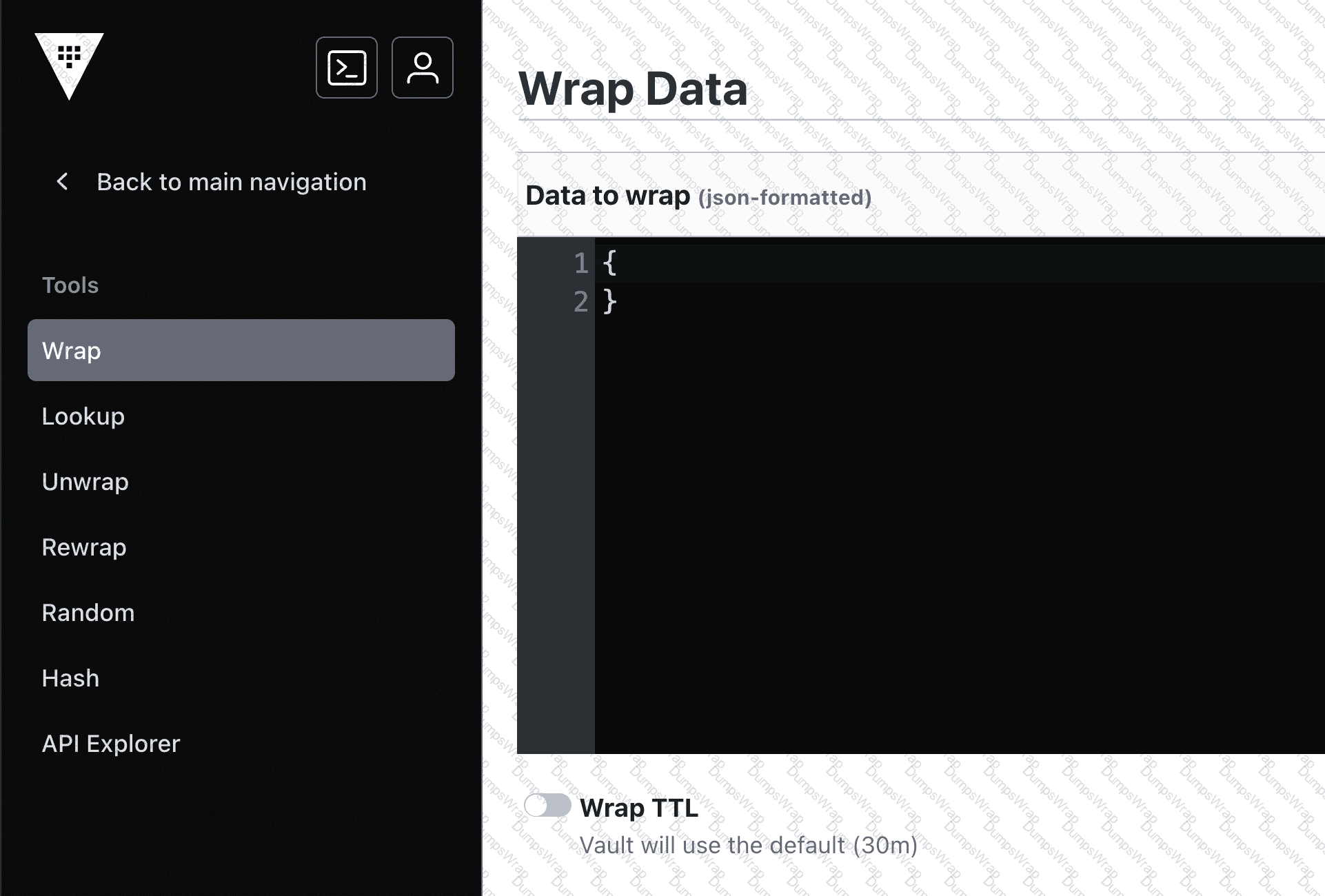
as

Options:

A.

Using a short TTL, you could encrypt data in order to place only the encrypted data in Vault

B.

Encrypt the Vault master key that is stored in memory

C.

Encrypt sensitive data to send to a colleague over email

D.

Use response-wrapping to protect data

Question 15

Which of the following is NOT a valid way in which a lease can be revoked in Vault?

Options:

A.

Using the user interface (UI)

B.

Automatically when the TTL or Max-TTL expires

C.

Using the API to call the /v1/sys/leases endpoint

D.

Via the CLI using the vault token command

Question 16

During a service outage, you must ensure all current tokens and leases are copied to another Vault cluster for failover so applications don’t need to authenticate. How can you accomplish this?

Options:

A.

Have Vault write all the tokens and leases to a file so you have a second copy of them

B.

Configure all applications to use the auto-auth feature of the Vault Agent

C.

Configure Disaster Recovery replication and promote the secondary cluster during an outage

D.

Replicate to another cluster using Performance Replication and promote the secondary cluster during an outage

Question 17

Jason has enabled the userpass auth method at the path users/. What path would Jason and other Vault operators use to interact with this new auth method?

Options:

A.

users/auth/

B.

authentication/users

C.

auth/users

D.

users/

Question 18

From the options below, select the auth methods that are better suited for machine-to-machine authentication (select five):

Options:

A.

Kubernetes

B.

GitHub

C.

TLS

D.

Token

E.

AppRole

F.

AWS

G.

LDAP

Question 19

True or False? When encrypting data with the Transit secrets engine, Vault always stores the ciphertext in a dedicated KV store along with the associated encryption key.

Options:

A.

True

B.

False

Question 20

Given the following policy, which command below would not result in a permission denied error (select two)?

path " secret/* " { capabilities = [ " create " , " update " ] allowed_parameters = { " student " = [ " steve " , " frank " , " jamie " , " susan " , " gerry " , " damien " ] } }

path " secret/apps/* " { capabilities = [ " read " ] }

path " secret/apps/results " { capabilities = [ " deny " ] }

Options:

A.

vault kv put secret/apps/results student03=practice

B.

vault kv put secret/apps/app01 student=bryan

C.

vault kv put secret/common/results student=frank

D.

vault kv get secret/apps/api_key

Question 21

You are the primary Vault operator. During a routine audit, an auditor requested the ability to display all secrets under a specific path in Vault without seeing the actual stored data. Which policy permits the auditor to display the stored secrets without revealing their contents?

Options:

A.

path " kv/apps/production/ " { capabilities = [ " list " ] }

B.

path " kv/apps/+/ " { capabilities = [ " list " ] }

C.

path " kv/+/production " { capabilities = [ " list " ] }

D.

path " kv/apps/* " { capabilities = [ " list " , " read " ] }

Question 22

You have logged into the Vault UI and see this screen. What Vault component is being enabled in the screenshot below?
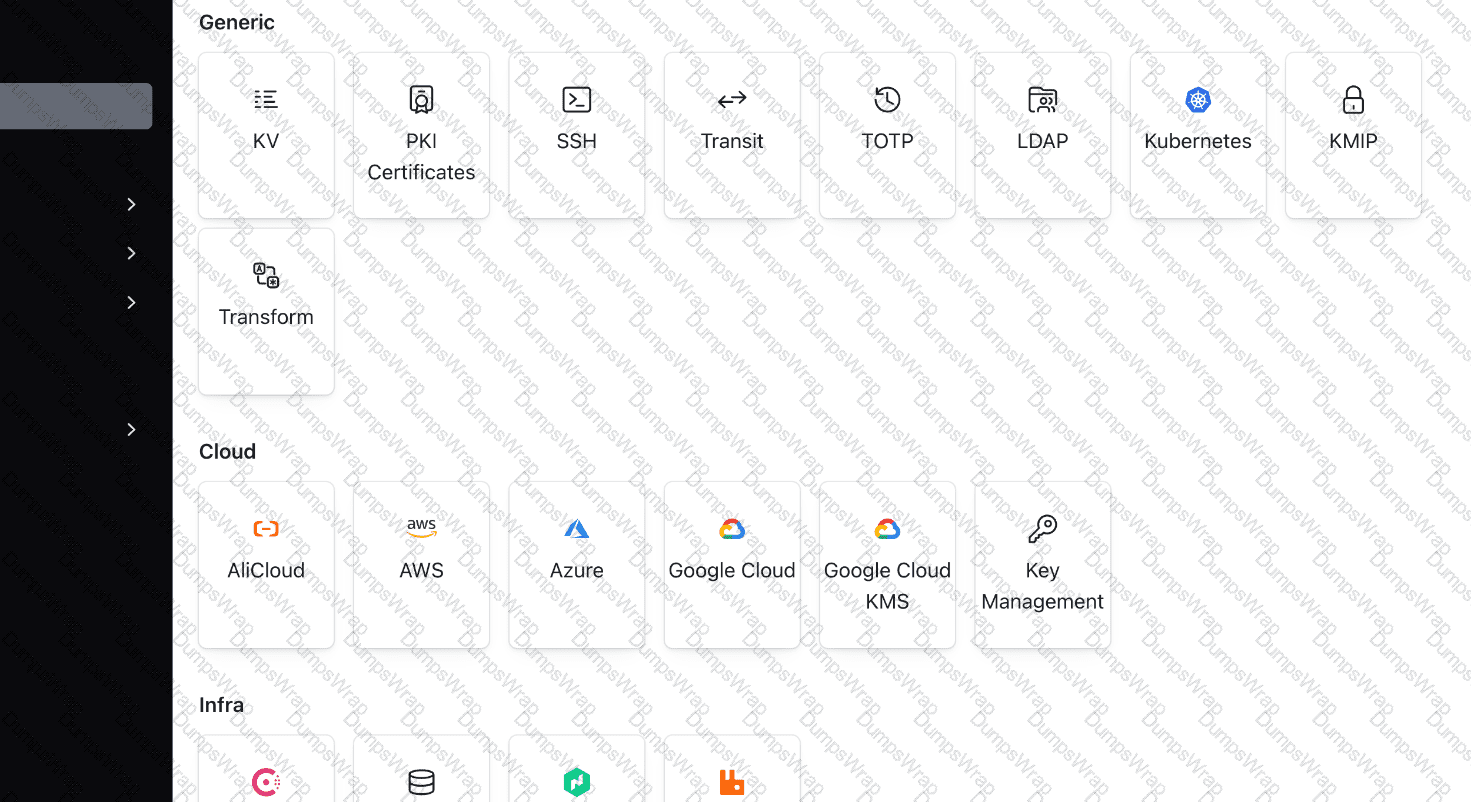
as

Options:

A.

Storage Backends

B.

Secrets Engine

C.

Auth Methods

D.

Audit Devices

Question 23

A MySQL server has been deployed on Google Cloud Platform (GCP) to support a legacy application. You want to generate dynamic credentials against this MySQL server rather than use static credentials. What Vault secrets engine would you use to accomplish this?

Options:

A.

The GCP secrets engine

B.

The Identity secrets engine

C.

The database secrets engine

D.

The Cubbyhole secrets engine

Question 24

You are using the Vault API to test authentication before modifying your CI/CD pipeline to properly authenticate to Vault. You manually authenticate to Vault and receive the response below. Based on the provided options, which of the following are true? (Select four)

    $ curl \

    --request POST \

    --data @payload.json \

    | jq


    *******************************************************************************

    ******* RESPONSE BELOW ********************************************************

    *******************************************************************************


    {

    " request_id " : " f758e8da-11b6-8341-d404-56f0c370a7fa " ,

    " lease_id " : " " ,

    " renewable " : false,

    " lease_duration " : 0,

    " data " : null,

    " wrap_info " : null,

    " warnings " : null,

    " auth " : {

    " client_token " : " hvs.CbzCNJCVWt63jyzyaJakgDwz " ,

    " accessor " : " rffwXzKFcxvaQi6Vgo8tY4Lt " ,

    " policies " : [

    " training " ,

    " default "

    ],

    " token_policies " : [

    " training " ,

    " default "

    ],

    " metadata " : {

    " username " : " bryan.krausen "

    },

    " lease_duration " : 84600,

    " renewable " : true,

    " entity_id " : " f1795f6a-c576-d619-b2d5-74c0aee08edb " ,

    " token_type " : " service " ,

    " orphan " : true

    }

    }

Options:

A.

The token required to retrieve a secret is hvs.CbzCNJCVWt63jyzyaJakgDwz

B.

The returned token is a batch token

C.

The user needs to retrieve .auth.client_token in order to perform other actions

D.

The accessor will be used to authenticate to Vault to retrieve secrets

E.

The user is using the userpass auth method

F.

The user’s password is stored in a file named payload.json

Question 25

Vault is configured with the oidc auth method and you need to log in using the CLI. What command would you use to authenticate so you can make configuration changes to Vault?

Options:

A.

vault login -method=oidc username=bryan

B.

vault auth oidc

C.

vault login auth/oidc/users/bryan

D.

vault login username=bryan

Question 26

You have a CI/CD pipeline using Terraform to provision AWS resources with static privileged credentials. Your security team requests that you use Vault to limit AWS access when needed. How can you enhance this process and increase pipeline security?

Options:

A.

Enable the SSH secrets engine and have Terraform generate dynamic credentials when deploying resources in AWS

B.

Enable the Transit secrets engine to encrypt the AWS credentials and have Terraform retrieve these credentials when needed

C.

Store the AWS credentials in the Vault KV store and use the Vault provider to obtain these credentials on each terraform apply

D.

Enable the aws secrets engine and configure Terraform to dynamically generate a short-lived AWS credential on each terraform apply

Question 27

Your organization recently suffered a security breach on a specific application, and the security response team believes that MySQL database credentials were likely obtained during the event. The application generated the credentials using the database secrets engine in Vault mounted at the path database/. How can you quickly revoke all of the secrets generated by this secrets engine?

Options:

A.

vault token revoke database/*

B.

vault secrets disable mysql

C.

vault lease renew database/creds/mysql

D.

vault lease revoke -prefix database/

Question 28

Your Azure Subscription ID is stored in Vault and you need to retrieve it via Vault API for an automated job. The Subscription ID is stored at secret/cloud/azure/subscription. The secret is stored on a KV Version 2 secrets engine. What curl command below would successfully retrieve the latest version of the secret?

Options:

B.

curl --header " X-Vault-Token: hvs.CbzCNJCVWt63jyzyaJakgDwz " https://vault.krausen.com:8200/v1/secret/cloud/azure/subscription

C.

curl --header " X-Vault-Token: hvs.CbzCNJCVWt63jyzyaJakgDwz " https://vault.krausen.com:8200/v1/secret/data/cloud/azure/subscription

D.

curl --header " X-Vault-Token: hvs.CbzCNJCVWt63jyzyaJakgDwz " https://vault.krausen.com:8200/secret/data/cloud/azure/subscription/latest

Question 29

Your co-worker has asked you to perform certain operations in Vault and has provided you with a token accessor (not the token itself). What Vault operations would you be allowed to perform using only the provided accessor? (Select three)

Options:

A.

Renew the token to extend the TTL

B.

Revoke the token in Vault to make it invalid

C.

Create child tokens associated with the same policies as the related token

D.

Lookup properties of the token, such as the TTL, policies, and metadata

Question 30

Your organization has applications in a primary data center and a secondary warm-standby site. You want to configure Vault replication between the primary and secondary clusters. If the primary fails over to the secondary, the applications must interact with Vault without re-authenticating. What type of Vault replication would you use?

Options:

A.

Performance Replication

B.

Integrated Storage

C.

Disaster Recovery Replication

D.

Vault Secrets Operator

Question 31

Sara uses the Vault CLI for administrative tasks on the production cluster. However, she encounters permission-denied errors when making changes and needs to check which policies are attached to her token to view and adjust permissions. What command can she run on the Vault node to see the attached policies?

Options:

A.

vault operator diagnose

B.

vault policy list

C.

vault token capabilities

D.

vault token lookup

Question 32

Your organization is integrating its legacy application with Vault to improve its security. However, you have discovered that the application has issues when the token changes for authentication during testing. What type of token could be used to help alleviate this issue without compromising security?

Options:

A.

Periodic Service Token

B.

Root Token

C.

Orphan Service Token

D.

Batch Token

Question 33

True or False? Performing a rekey operation using the vault operator rekey command creates new unseal/recovery keys as well as a new root key?

Options:

A.

True

B.

False

Question 34

Over a few years, you have a lot of data that has been encrypted by older versions of a Transit encryption key. Due to compliance regulations, you have to re-encrypt the data using the newest version of the encryption key. What is the easiest way to complete this task without putting the data at risk?

Options:

A.

Rotate the encryption key used to encrypt the data

B.

Decrypt the data manually and encrypt it with the latest version

C.

Use the transit rewrap feature

D.

Create a new master key used by Vault

Question 35

To secure your applications, your organization uses certificates generated by a public CA. However, this strategy has proven expensive and you have to revoke certificates even though they have additional time left. What Vault plugin can be used to quickly generate X.509 certificates to secure your internal applications?

Options:

A.

Identity secrets engine

B.

PKI secrets engine

C.

SSH secrets engine

D.

Transit secrets engine

Question 36

What is the primary role of the Vault Security Operator (VSO) in a Kubernetes environment?

Options:

A.

Managing Vault server deployments and auto-scaling Vault instances in Kubernetes

B.

Enforcing Kubernetes network policies for Vault communication

C.

Automating the injection and lifecycle management of Vault secrets for Kubernetes workloads

D.

Replacing Kubernetes Secrets with a built-in alternative that does not require Vault

Question 37

Your organization runs workloads on both AWS and Azure for production applications. The security team has requested that a single Vault authentication mechanism be enabled to support applications on both public cloud platforms. Which of the following would be a valid auth method you can use?

Options:

A.

AWS

B.

GitHub

C.

AppRole

D.

Azure

Question 38

You are using Vault to generate dynamic credentials for a Microsoft SQL server to perform queries for a month-end report. The report seems to be taking much longer than expected due to degradation on the underlying server, and you are afraid that Vault might automatically revoke the credentials. How can you extend the time the credentials are valid to ensure your month-end query is successful?

Options:

A.

Renew the lease

B.

Generate a new lease

C.

Create a new role within the secrets engine for the database

D.

Revoke the lease

Question 39

Which core component of Vault can store, generate, or encrypt data for organizations?

Options:

A.

auth method

B.

storage backend

C.

secrets engine

D.

audit device

Question 40

By default, what methods of authentication does Vault support? (Select four)

Options:

A.

SSH

B.

Kubernetes

C.

VMware

D.

LDAP

E.

AppRole

F.

JWT

Question 41

True or False? Although AppRole is designed for machines, humans can use it to authenticate to Vault if you wish.

Options:

A.

True

B.

False

Question 42

Julie is a developer who needs to ensure an application can properly renew its lease for AWS credentials it uses to access data in an S3 bucket. Although the application would generally use the API, what is the equivalent CLI command to perform this action?

Options:

A.

vault renew aws/roles/s3-read-only/39e6b9a2-296-83d9-2fe0-c11e846bdc99

B.

vault lease renew aws/creds/s3-read-only/39e6b9a2-296-83d9-2fe0-c11e846bdc99

C.

vault lease renew aws/roles/s3-read-only/39e6b9a2-296-83d9-2fe0-c11e846bdc99

D.

vault lease renew aws/creds/s3-read-only

Question 43

Your organization has many applications needing heavy read access to Vault. As these applications integrate with Vault, the primary Vault cluster’s performance is negatively impacted. What feature can you use to scale the cluster and improve performance?

Options:

A.

Add additional standby nodes

B.

Enable multiple secrets engines for the applications

C.

Enable control groups

D.

Add performance standby nodes

Question 44

Which of the following secrets engines can store static secrets in Vault for future retrieval?

Options:

A.

KV

B.

PKI (certificates)

C.

Database

D.

Transit

Question 45

Your organization operates active/active applications across multiple data centers for high availability. Which Vault feature should be used in the secondary data centers to provide local access to secrets?

Options:

A.

Performance standby nodes

B.

Customized plugins for the Vault cluster

C.

Disaster recovery cluster

D.

Performance replication cluster

Question 46

Although batch and service tokens share many characteristics, which of the following are true only about batch tokens? (Select three)

Options:

A.

Can create child tokens

B.

Are renewable up until the max TTL

C.

Maintain a single fixed TTL

D.

They are valid for either the primary or any secondary clusters

E.

They are not persisted to disk

Question 47

Which of the following features in Vault will replicate service tokens between clusters?

Options:

A.

Disaster Recovery Replication

B.

Performance Replication

C.

Vault Agent

D.

Integrated Storage

Question 48

Which of the following are supported auth methods for Vault? (Select six)

Options:

A.

AWS

B.

Kubernetes

C.

Token

D.

OIDC/JWT

E.

Userpass

F.

Cubbyhole

G.

AppRole

Question 49

Vault operators can create two types of groups in Vault. What are the two types?

Options:

A.

External groups

B.

Security groups

C.

Policy groups

D.

Internal groups

Question 50

What occurs when a Vault cluster cannot maintain a quorum while using the Integrated Storage backend?

Options:

A.

Vault continues to operate in read-only mode until quorum is restored

B.

The cluster becomes unavailable and cannot commit new logs

C.

Vault automatically promotes a standby node to a leader to restore quorum

D.

Vault temporarily switches to local storage until quorum is regained

Question 51

Which of the following actions can be performed if you only had access to a token’s accessor? (Select four)

Options:

A.

Look up a token’s properties

B.

Renew the token

C.

Retrieve the actual token ID

D.

Revoke the token

E.

Look up a token’s capabilities on a path

Question 52

What header must be included in an API request in order to provide authentication validation?

Options:

A.

X-Token-Vault

B.

X-Vault-Token

C.

X-Token-Creds

D.

X-Vault-Creds

Question 53

What features are offered by the Vault Agent? (Select three)

Options:

A.

Auditing

B.

Templating

C.

Auto-auth

D.

Secret caching

Question 54

Hanna is working with Vault and has been assigned a namespace called integration, where she stores all her secrets. Hanna configured her application to use the following API request, but the request is failing. What changes below will help Hanna correctly retrieve the secret? (Select two)

$ curl \

--header " X-Vault-Token:hvs.lzrmRe5Y3LMcDRmOttEjWoag " \

--request GET \

Options:

A.

$ curl --header " X-Vault-Token:hvs.lzrmRe5Y3LMcDRmOttEjWoag " --request GET\integration https://vault.example.com:8200/v1/secret/data/my-secret

B.

$ curl --header " X-Vault-Token:hvs.lzrmRe5Y3LMcDRmOttEjWoag " --request GET --namespace " integration " https://vault.example.com:8200/v1/secret/data/my-secret

C.

$ curl --header " X-Vault-Token:hvs.lzrmRe5Y3LMcDRmOttEjWoag " --request GET https://vault.example.com:8200/v1/integration/secret/data/my-secret

D.

$ curl --header " X-Vault-Token:hvs.lzrmRe5Y3LMcDRmOttEjWoag " --header " X-Vault-Namespace:integration " --request GET https://vault.example.com:8200/v1/secret/data/my-secret

Question 55

Which of the following auth methods are intended for machine-to-machine authentication, and not necessarily human (operator) authentication? (Select four)

Options:

A.

Okta

B.

Tokens

C.

TLS Certificates

D.

Cloud-based Auth methods (AWS, Azure, GCP)

E.

LDAP

F.

AppRole

Question 56

What is the default value of the VAULT_ADDR environment variable?

Question 57

You need a simple and self-contained HashiCorp Vault cluster deployment with minimal dependencies. Which storage backend is best suited for this use case, providing all configuration within Vault and avoiding external services?

Options:

A.

Local File Storage Backend

B.

Integrated Storage (raft) Backend

C.

Consul Backend

D.

In-Memory Backend

Question 58

True or False? You can create and update Vault policies using the UI.

Options:

A.

True

B.

False

Question 59

A DevOps engineer has set up LDAP and GitHub auth methods. The engineer must ensure user Sarah, who authenticates via either method, has consistent access permissions. Which approach correctly describes how to achieve this in Vault?

Options:

A.

Create an entity for Sarah and map both her LDAP and GitHub identities as entity aliases to this single entity

B.

Create an external group and add the LDAP and GitHub providers as members of the group

C.

Create separate policies for each auth method and manually ensure they remain synchronized

D.

Configure a trust relationship between the LDAP and GitHub providers to ensure Sarah’s account is synced

Question 60

You need to decrypt customer data to provide it to an application. When you run the decryption command, you get the output below. Why does the response not directly reveal the cleartext data?

$ vault write transit/decrypt/phone_number ciphertext= " vault:v1:tgx2vsxtlQRfyLSKvem... "

Key Value

--- -----

plaintext aGFzaGljb3JwIGNlcnRpZmllZDogdmF1bHQgYXNzb2NpYXRl

Options:

A.

The user does not have permission to view the cleartext data

B.

The output is base64 encoded

C.

The output is actually a response wrapped token that needs to be unwrapped

D.

The original data must have been encrypted

Question 61

Vault supports which type of configuration for source limited token?

Options:

A.

Cloud-bound tokens

B.

Domain-bound tokens

C.

CIDR-bound tokens

D.

Certificate-bound tokens

Question 62

Your DevOps team would like to provision VMs in GCP via a CICD pipeline. They would like to integrate Vault to protect the credentials used by the tool. Which secrets engine would you recommend?

Options:

A.

Google Cloud Secrets Engine

B.

Identity secrets engine

C.

Key/Value secrets engine version 2

D.

SSH secrets engine

Question 63

Which of the following is a reason to rekey a Vault cluster?

Pick the 2 correct responses below.

Options:

A.

A keyholder joins or leaves the organization.

B.

A compliance policy mandates rotating the root key at a regular interval.

C.

Additional Vault nodes are added to a cluster.

D.

Upgrading Vault Community Edition to Vault Enterprise.

E.

The root token is lost.

Question 64

Which command implements the AppRole authentication method?

Options:

A.

vault auth enable approle

B.

vault mount approle

C.

vault mount enable approle

D.

vault enable approle

Question 65

Which of the following cannot define the maximum time-to-live (TTL) for a token?

Options:

A.

By the authentication method t natively provide a method of expiring credentials

B.

By the client system f credentials leaking

C.

By the mount endpoint configuration very password used

D.

A parent token TTL e password rotation tools and practices

E.

System max TTL

Question 66

When creating a policy, an error was thrown:
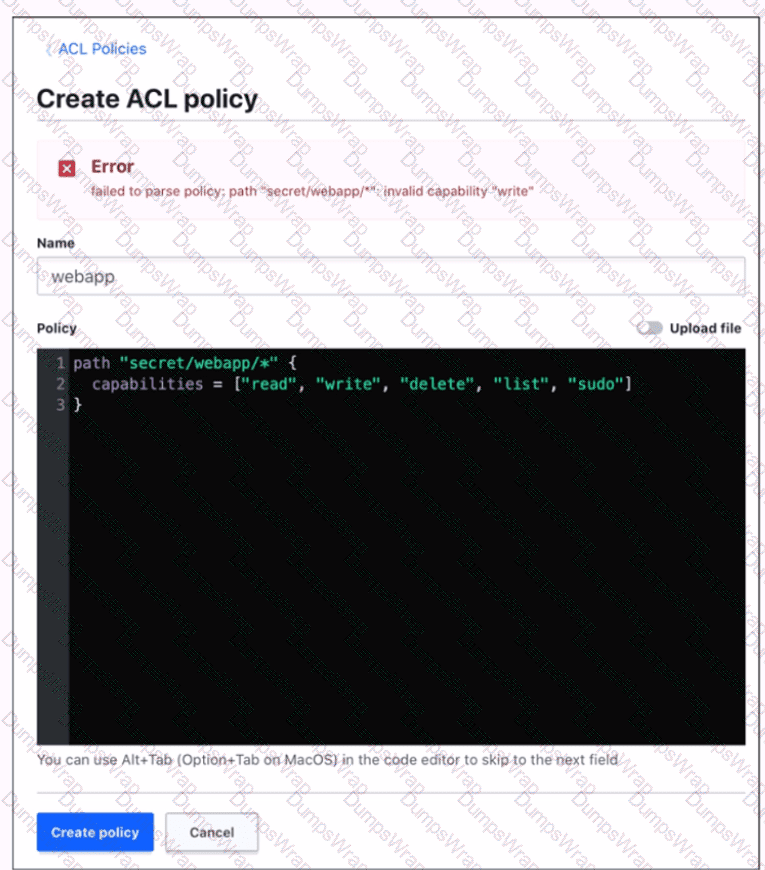
as

Which statement describes the fix for this issue?

Options:

A.

Replace write with create in the capabilities list

B.

You cannot have a wildcard ( " • " ) in the path

C.

sudo is not a capability

Question 67

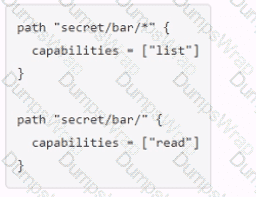
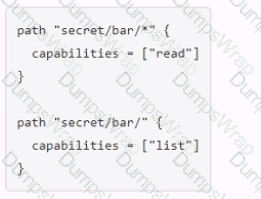
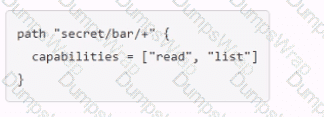
You have been tasked with writing a policy that will allow read permissions for all secrets at path secret/bar. The users that are assigned this policy should also be able to list the secrets. What should this policy look like?

Options:
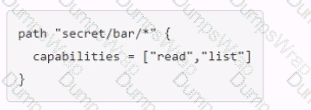
A.

B.

C.

D.

Question 68

Which of the following are benefits of Vault Agent Caching?

Pick the 2 correct responses below.

Options:

A.

Reduces the number of Vault secrets engines which must be mounted.

B.

Renders secrets using the Consul Template markup.

C.

Reduces the latency to retrieve secrets from Vault.

D.

Secret requests may be handled by the local cache, reducing load on the Vault servers.

E.

Eliminates the need for disaster recovery clusters.

Question 69

Which of the following describes usage of an identity group?

Options:

A.

Limit the policies that would otherwise apply to an entity in the group

B.

When they want to revoke the credentials for a whole set of entities simultaneously

C.

Audit token usage

D.

Consistently apply the same set of policies to a collection of entities

Question 70

How would you describe the value of using the Vault transit secrets engine?

Options:

A.

Vault has an API that can be programmatically consumed by applications

B.

The transit secrets engine ensures encryption in-transit and at-rest is enforced enterprise wide

C.

Encryption for application data is best handled by a storage system or database engine, while storing encryption keys in Vault

D.

The transit secrets engine relieves the burden of proper encryption/decryption from application developers and pushes the burden onto the operators of Vault

Question 71

You can only create orphan tokens using the root token.

Options:

A.

True

B.

False

Question 72

Where can you set the Vault seal configuration? Choose two correct answers.

Options:

A.

Cloud Provider KMS

B.

Vault CLI

C.

Vault configuration file

D.

Environment variables

E.

Vault API

Question 73

A web application uses Vault ' s transit secrets engine to encrypt data in-transit. If an attacker intercepts the data in transit which of the following statements are true? Choose two correct answers.

Options:

A.

You can rotate the encryption key so that the attacker won’t be able to decrypt the data

B.

The keys can be rotated and min_decryption_version moved forward to ensure this data cannot be decrypted

C.

The Vault administrator would need to seal the Vault server immediately

D.

Even if the attacker was able to access the raw data, they would only have encrypted bits (TLS in transit)

Question 74

Which of the following describes the Vault ' s auth method component?

Options:

A.

It verifies a client against an internal or external system, and generates a token with the appropriate policies attached

B.

It verifies a client against an internal or external system, and generates a token with root policy

C.

It is responsible for durable storage of client tokens

D.

It dynamically generates a unique set of secrets with appropriate permissions attached

Question 75

The vault lease renew command increments the lease time from:

Options:

A.

The current time

B.

The end of the lease

Question 76

The Vault CLI can output to formats such as JSON, YAML, and Table.

Options:

A.

True

B.

False

Question 77

What is a benefit of response wrapping?

Options:

A.

Log every use of a secret

B.

Load balanc secret generation across a Vault cluster

C.

Provide error recovery to a secret so it is not corrupted in transit

D.

Ensure that only a single party can ever unwrap the token and see what ' s inside

Question 78

Which CLI command would enable a versioned Key/Value secrets engine in Vault at path my-secrets?

Options:

A.

vault auth enable userpass

B.

vault secrets enable -path= " my-secrets " kv-v2

C.

vault secrets enable -path= " my-secrets " kv

D.

vault secrets enable -version=2 kv

Question 79

Which of the following statements describe the CLI command below?

S vault login -method-1dap username-mitche11h

Options:

A.

Generates a token which is response wrapped

B.

You will be prompted to enter the password

C.

By default the generated token is valid for 24 hours

D.

Fails because the password is not provided

Question 80

Which of these functions can a secrets engine in Vault perform?

Options:

A.

Encrypt data.

B.

Store secrets.

C.

Assign identity.

D.

All of the above can be performed by a secrets engine in Vault.

Question 81

Which statement best describes the process of sealing a Vault instance?

Options:

A.

Disable the TLS certificates on the Vault server by running vault secrets disable pki, blocking all requests.

B.

Run vault operator rotate to rotate the Vault tokens for all clients, causing them to reauthenticate with the Vault.

C.

Run the vault operator seal command, which securely discards the master key from memory and prevents further operations until unsealed.

D.

Revoke all leases so no secrets can be accessed using vault lease revoke, but keep the master key in memory for quick recovery.

Question 82

Without logging into another interface, what feature can Chad use to execute a simple CLI command to enable a new secrets engine?
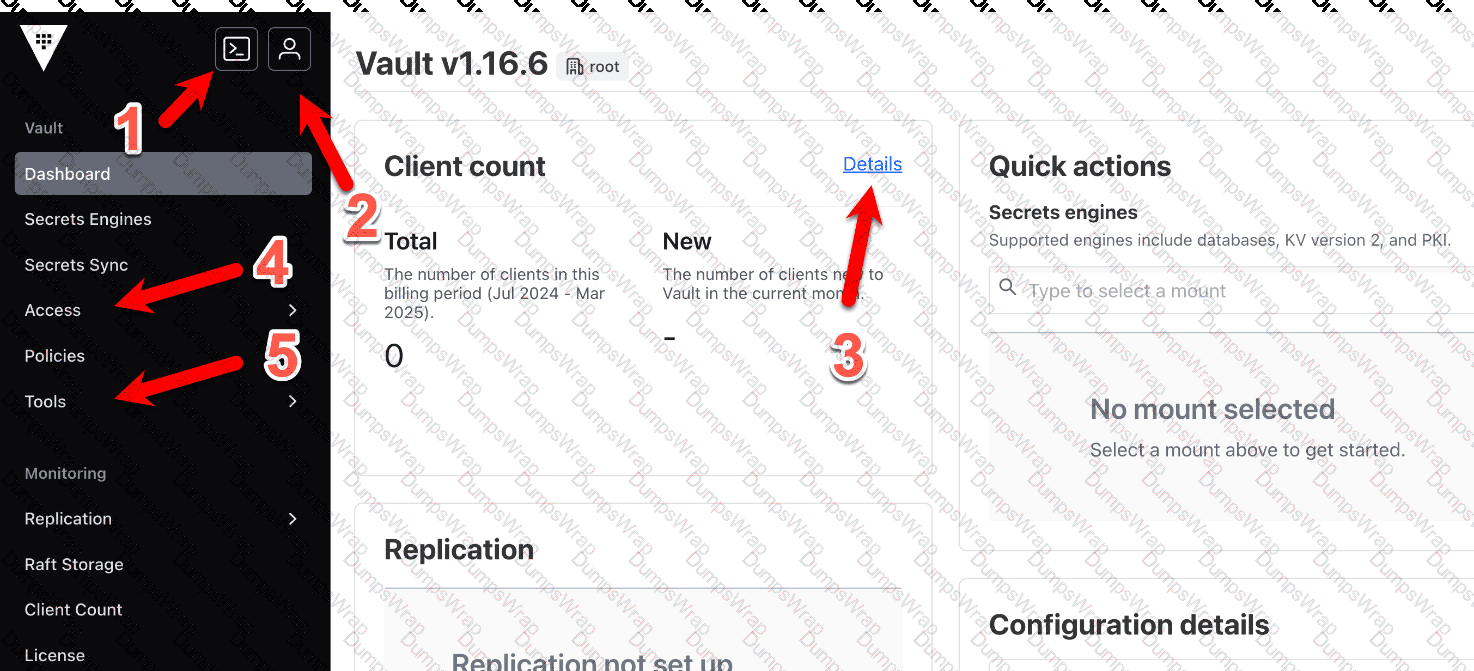
as

Options:

A.

CLI emulation in the Vault UI (Feature 1)

B.

User information button (Feature 2)

C.

Client count details (Feature 3)

D.

Access management link (Feature 4)

Question 83

Which two interfaces automatically assume the token for subsequent requests after successfully authenticating? (Select two)

Options:

A.

CLI

B.

API

C.

UI

Question 84

You need to write a Vault operator policy and give the users access to perform administrative actions in Vault. What path is used for Vault backend functions?

Options:

A.

/security

B.

/admin

C.

/vault

D.

/system

E.

/sys

F.

/backend

Question 85

Which of the following best describes the function of the Vault Secrets Operator in a Kubernetes environment?

Options:

A.

It replaces the Kubernetes secrets API entirely and operates purely as a certificate authority for all workloads.

B.

It is a standalone Vault server that automatically applies security policies and rotates root tokens.

C.

It continuously reconciles and synchronizes secrets from Vault to Kubernetes, ensuring secrets are always updated

D.

It provides an interface to dynamically provision Kubernetes clusters through Vault’s infrastructure secrets.

Question 86

Which statement best explains the role and usage of storage backends in HashiCorp Vault?

Options:

A.

They store Vault’s persistent data, affecting the scalability and performance of managing Vault.

B.

They handle the encryption of all secrets so that Vault remains completely stateless.

C.

They store only ephemeral tokens, ensuring no persistent data is ever saved.

D.

They store only unseal keys, while all secret data remains in Vault’s memory.

Question 87

What is the default method of authentication after first initializing Vault?

Options:

A.

TLS certificates

B.

GitHub

C.

Admin account

D.

Tokens

E.

AppRole

F.

Userpass

Question 88

An application has authenticated to Vault and has obtained dynamic database credentials with a lease of 4 hours. Four hours later, the credentials expire, and the application can no longer communicate with the backend database, so the application goes down. What should the developers instruct the application to do to prevent this from happening again while maintaining the same level of security?

Options:

A.

Go back to using static credentials

B.

Renew the lease before expiration

C.

Revoke the lease before expiration

D.

Use a different auth method

Question 89

Which of the following are benefits of using the Vault Secrets Operator (VSO)? (Select three)

Options:

A.

Support for syncing from multiple secret sources

B.

Bi-directional sync between Vault and Kubernetes Secrets

C.

Automatic secret drift and remediation

D.

Automatic secret rotation for multiple Kubernetes resource types

Question 90

By default, what happens to child tokens when a parent token is revoked?

Options:

A.

The child tokens are revoked

B.

The child tokens are renewed

C.

The child tokens are converted to parent tokens

D.

The child tokens create their own child tokens to be used

Question 91

You are trying to create a new orphan token but receiving a Permission Denied error. What capabilities are required to create this token without using a root token?

Options:

A.

write privileges on the path auth/token

B.

write privileges on the path sys/mounts

C.

sudo privileges on the path auth/token/create

D.

sudo privileges on the path sys/mounts/token

Question 92

You have deployed an application that needs to encrypt data before writing to a database. What secrets engine should you use?

Options:

A.

Transit

B.

SSH

C.

PKI

D.

TOTP

Question 93

You need to connect to and manage a new HCP Vault cluster using the Vault CLI on your laptop. What environment variables should you set to establish connectivity?

Options:

A.

VAULT_CLIENT_KEY= < path-to-key-file > , VAULT_TOKEN= < token-here >

B.

VAULT_NAMESPACE=root, VAULT_REDIRECT_ADDR= < cluster-address >

C.

VAULT_ADDR=https:// < cluster-address > :8200, VAULT_NAMESPACE=admin

D.

VAULT_TOKEN= < token-here > , VAULT_CLUSTER_ADDR=https:// < cluster-address > :8200

Question 94

Based on the following output, what command can Steve use to determine if the KV store is configured for versioning?

text

CollapseWrapCopy

$ vault secrets list

Path Type Accessor Description

---- ---- -------- -----------

automation/ kv kv_56f991b9 Automation team for CI/CD

cloud/ kv kv_4426c541 Cloud team for static secrets

cubbyhole/ cubbyhole cubbyhole_9bd538e per-token priv secret storage

data_team/ kv kv_96d57692 Data warehouse KV for certs

identity/ identity identity_0042595e identity store

network/ kv kv_3e53aaab Network team secret storage

secret/ kv kv_d66e2adc key/value secret storage

sys/ system system_d6f218a9 system endpoints

Options:

A.

vault secrets list -all

B.

vault kv get automation

C.

vault secrets list -detailed

D.

vault kv list

Question 95

Which auth method is ideal for machine-to-machine authentication?

Options:

A.

Okta

B.

UserPass

C.

GitHub

D.

AppRole

Question 96

True or False? After initializing Vault or restarting the Vault service, each individual node in the cluster needs to be unsealed.

Options:

A.

True

B.

False

Question 97

True or False? To prepare for day-to-day operations, the root token should be safely saved outside of Vault in order to administer Vault.

Options:

A.

True

B.

False

Page: 1 / 32
Total 324 questions