
Aruba Certified Campus Access Associate Exam Questions and Answers
What type of information can be found in a device's view to assist with physical-layer troubleshooting?
Options:
Logs and error reports for diagnostic purposes.
VLAN configurations and interface settings.
CPU and memory usage statistics.
Current uptime and alert status.
Answer:
AExplanation:
Comprehensive and Detailed Explanation
HPE Press guide context | PDF page 1002 | HPE Press, Aruba Certified Associate – Campus Access Official Certification Study Guide
Technical Deep Dive — Original Chat Wording
Physical-layer troubleshooting focuses on the transmission medium and the hardware responsible for establishing communication links.
Typical problems include defective copper cables, damaged fiber connections, transceiver failures, optical signal problems, and interface errors.
Device-specific diagnostic information helps administrators identify these conditions.
Logs and error reports are particularly valuable because they can reveal events such as repeated interface transitions, link negotiation failures, and hardware faults.
For Ethernet interfaces, relevant counters may include CRC errors, frame errors, and other indicators of transmission problems.
An increasing CRC error count can indicate corrupted frames caused by cabling faults, electrical interference, or other physical-layer conditions.
HPE Aruba Networking Central provides troubleshooting views containing device events and collected diagnostic information.
Its official documentation also describes interface error views that include CRC errors, error frames, and collision measurements.
Administrators can correlate these measurements with device logs to identify when a problem began and which interface is affected.
VLAN and interface configuration information can also be useful during broader troubleshooting, but VLAN membership primarily concerns Layer 2 configuration rather than direct physical error diagnosis.
CPU and memory metrics address system resource utilization.
Uptime and alert status provide useful operational context without necessarily identifying the physical fault.
Therefore, Option A (Logs and error reports for diagnostic purposes) is the best answer.
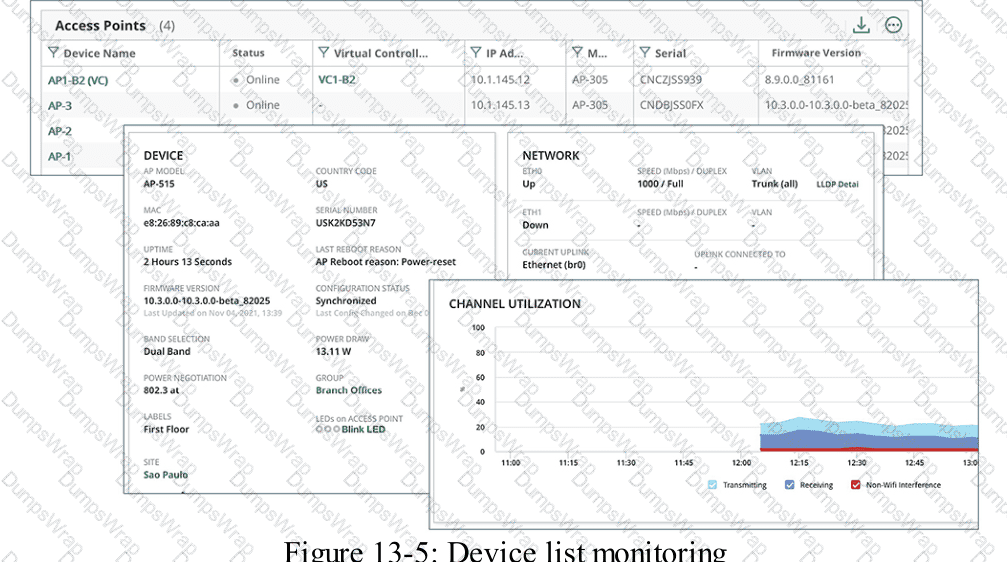
HPE Press study-guide figure / related learning illustration · Q113 Fig 13-5 Device List
A network technician is testing 802.1X connectivity from a known corporate laptop to the employee SSID. AP3 and AP4 have the same configuration. The corporate laptop connects successfully to AP4; however, it cannot successfully connect to AP3. HPE Aruba Networking ClearPass displays a RADIUS error in the event viewer.
What should be checked to establish a successful connection to both AP3 and AP4?
Options:
Verify the RADIUS passphrase for AP3 in HPE Aruba Networking Central.
Verify change of authorization (CoA) is enabled for AP3 in ClearPass.
Verify the employee SSID on AP3 in HPE Aruba Networking Central.
Verify the RADIUS passphrase for AP3 in ClearPass.
Answer:
DExplanation:
Comprehensive and Detailed Explanation
HPE Press guide context | PDF page 818 | HPE Press, Aruba Certified Associate – Campus Access Official Certification Study Guide
Technical Deep Dive — Original Chat Wording
IEEE 802.1X authentication uses an endpoint supplicant, a network authenticator, and an authentication server.
In this scenario, the corporate laptop successfully connects through AP4 but cannot authenticate through AP3.
Because the same laptop and employee network operate successfully through AP4, the client's credentials and general authentication-service availability are less likely to be the underlying problem.
The presence of a RADIUS error in ClearPass is an important diagnostic clue.
RADIUS communication relies on a shared secret configured between the RADIUS client and the authentication server.
If the secret configured for an AP's RADIUS client identity does not match the corresponding secret in ClearPass, authentication packets may fail validation.
This can prevent a valid endpoint from completing the authentication process.
The technician should examine the ClearPass Event Viewer to identify the specific error.
Next, the technician should verify the RADIUS client entry corresponding to AP3, including its IP address and shared secret.
The ClearPass configuration must match the shared secret used by the actual RADIUS client.
In some Aruba architectures, a gateway or controller acts as the RADIUS client instead of the individual AP. In that case, the appropriate gateway or controller entry must be checked.
Change of Authorization is used to modify an established authorization state and is not the initial corrective action for a shared-secret mismatch.
The SSID configuration is reported as identical on both APs.
Therefore, Option D (Verify the RADIUS passphrase for AP3 in ClearPass) is the best answer.
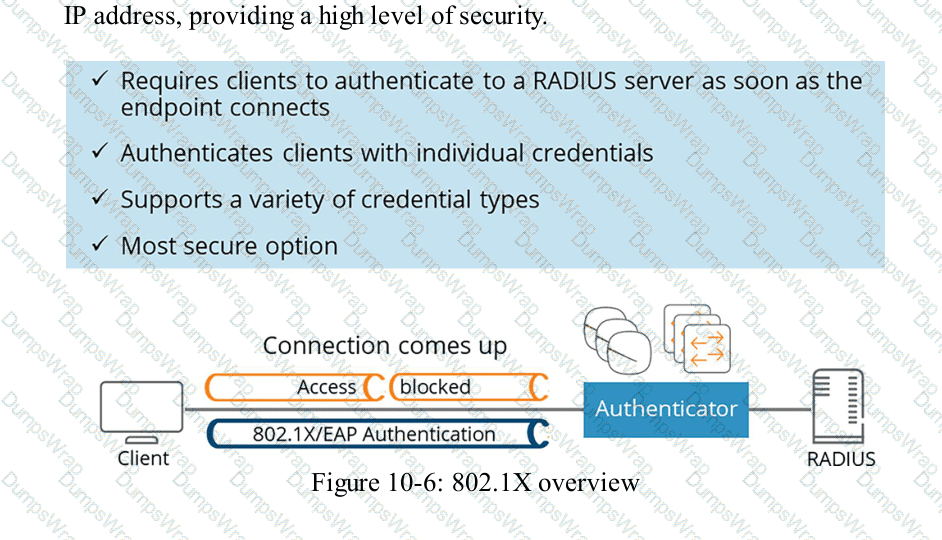
HPE Press study-guide figure / related learning illustration · Q180 Fig 10-6 8021X
Which command is used to configure a default route to 10.4.5.1 on an AOS-CX switch when in-band management via an SVI is in use?
Options:
ip route 0.0.0.0/0 10.4.5.1 vrf mgmt
default-gateway 10.4.5.1
ip route 0.0.0.0/0 10.4.5.1
ip default-gateway 10.4.5.1
Answer:
CExplanation:
Comprehensive and Detailed Explanation
HPE Press guide context | PDF page 232 | HPE Press, Aruba Certified Associate – Campus Access Official Certification Study Guide
Technical Deep Dive — Reconstructed (Original Chat Text Not Recoverable)
In-band management via an SVI uses the default VRF routing table. Add the default route `ip route 0.0.0.0/0 10.4.5.1` in the normal context. A command specifying `vrf mgmt` changes the management VRF instead, and `ip default-gateway` is not the normal routed AOS-CX syntax.
The selected answer corresponds to C: ip route 0.0.0.0/0 10.4.5.1. This matches the mechanism or management behavior described in the scenario rather than merely a related network feature.
A disciplined investigation compares the observed symptom with expected behavior, tests the most likely failure stage, and verifies recovery rather than assuming that a single command has resolved the problem.
Collecting interface counters, event timestamps, configuration history, and service-test results helps determine whether a symptom originates locally or depends on another device.
The practical deployment consequence is important: a plausible configuration can still fail when the peer interface, device role, licensing scope, or physical medium is mismatched. Checking that surrounding dependency avoids a misleading diagnosis.
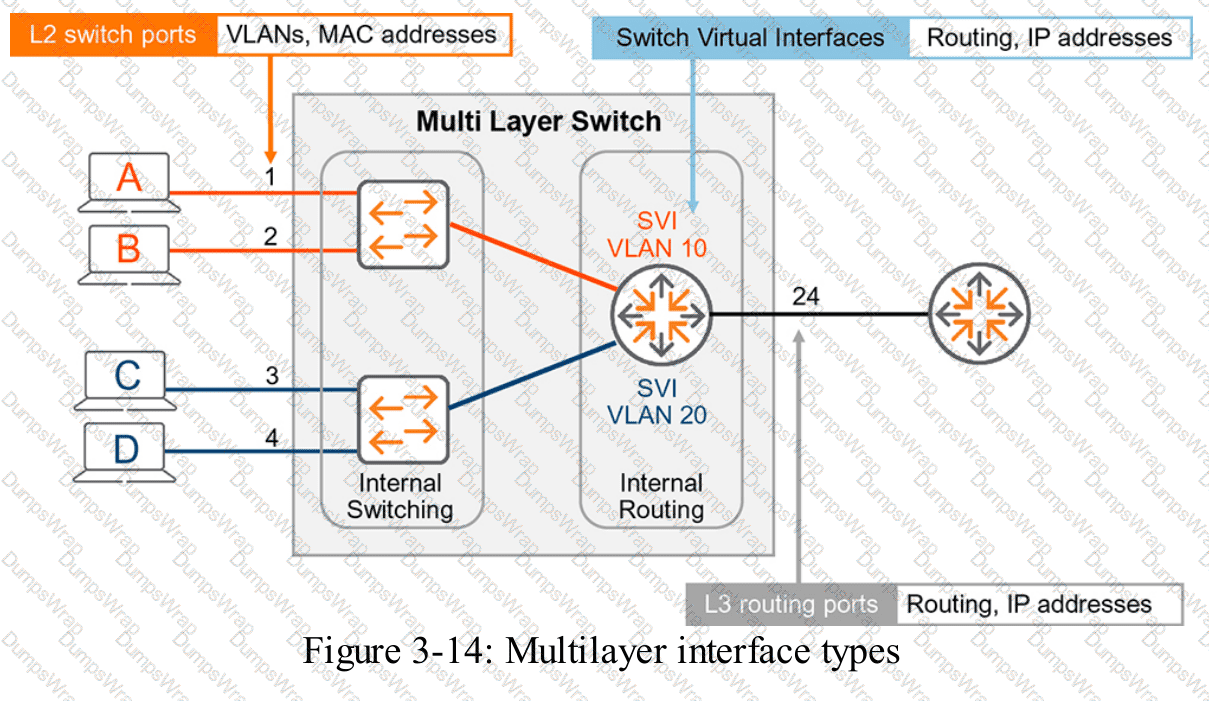
HPE Press study-guide figure / related learning illustration · Fig 3-14 SVI
The noise floor is measured at .000000001 milliwatts, and the receiver’s signal strength is -65dBm.
What is the Signal to Noise Ratio?
Options:
45 dBm
25 dBm
15 dBm
35 dBm
Answer:
BExplanation:
Comprehensive and Detailed Explanation
HPE Press guide context | PDF page 717 | HPE Press, Aruba Certified Associate – Campus Access Official Certification Study Guide
Technical Deep Dive — Reconstructed (Original Chat Text Not Recoverable)
Noise power of 0.000000001 mW is -90 dBm. With received signal -65 dBm, SNR is -65 - (-90) = 25 dB, which is dimensionless in decibels, not dBm. The offered answer '25 dBm' uses the wrong unit; numeric 25 is correct.
The selected answer corresponds to B: 25 dBm. This matches the mechanism or management behavior described in the scenario rather than merely a related network feature.
Optimization should consider both immediate performance and its tradeoffs in RF capacity, airtime, reliability, security, and operational overhead.
Use measurements rather than assumptions: compare the RF or switch metrics before and after making a controlled change.
When reviewing alternatives, identify which one directly addresses the stated requirement, rather than selecting a related capability that is useful elsewhere but does not fulfill the requested task.
The wrong choices may describe real technologies, but they perform different functions, apply to another layer, or omit a required prerequisite. Select the answer that resolves the exact scenario, not a nearby administrative task.
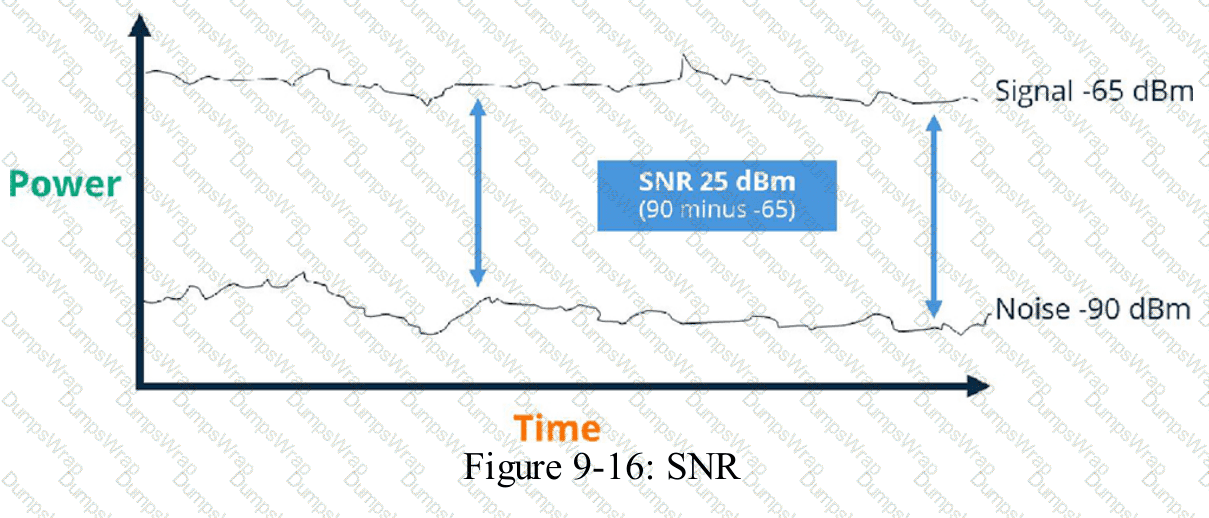
HPE Press study-guide figure / related learning illustration · Fig 9-16 SNR
Match each IP address range to its correct designation.
Drag & Drop
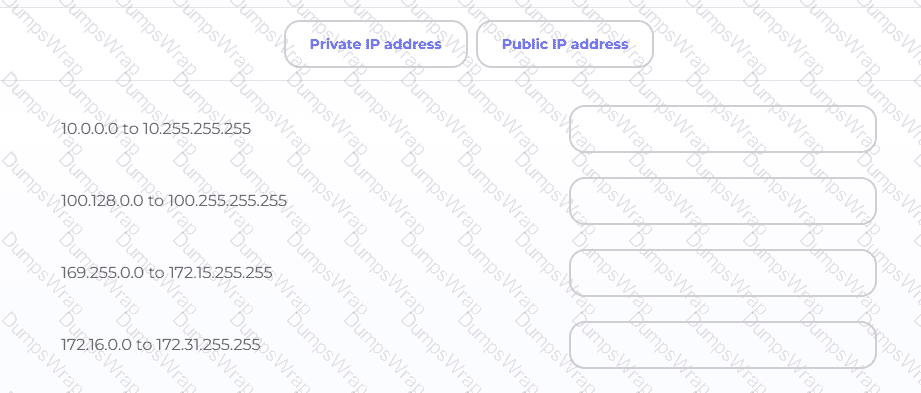
Options:
Answer:
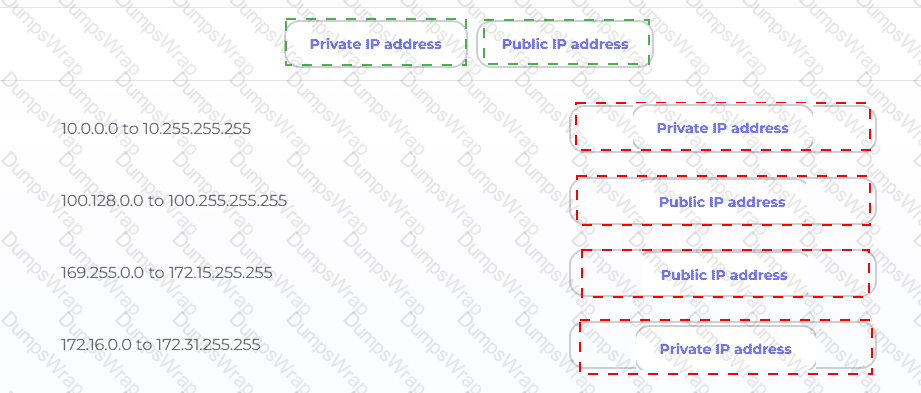
Explanation:
Exhibit item
Correct match
10.0.0.0 to 10.255.255.255
Private
100.128.0.0 to 100.255.255.255
Public (non-RFC1918)
169.255.0.0 to 172.15.255.255
Public (non-RFC1918)
172.16.0.0 to 172.31.255.255
Private
Comprehensive and Detailed Explanation
HPE Press guide context | PDF page 922 | HPE Press, Aruba Certified Associate – Campus Access Official Certification Study Guide
Technical Deep Dive — Original Chat Wording
IPv4 addresses are classified according to their allocation and intended use. RFC 1918 defines three address blocks reserved for private networks.
These addresses can be used internally without being globally unique across organizations. However, they are not intended to be routed directly across the public Internet.
The range 10.0.0.0–10.255.255.255 corresponds to 10.0.0.0/8 , making it private.
The range 172.16.0.0–172.31.255.255 corresponds to 172.16.0.0/12 , also making it private.
The address block 100.128.0.0–100.255.255.255 is outside the RFC 1918 private ranges. It is also outside the special shared-address block 100.64.0.0/10 , used for carrier-grade NAT. It is therefore classified as public address space for this question.
Similarly, 169.255.0.0–172.15.255.255 lies outside the RFC 1918 private blocks. Notably, the IPv4 link-local range is 169.254.0.0/16 , which is not included here.
Private addresses typically require Network Address Translation (NAT) when accessing public Internet resources.
The central principle is that addresses beginning with 172 are not automatically private; only 172.16.0.0/12 is reserved under RFC 1918.
Therefore, the correct sequence is Private, Public, Public, Private .
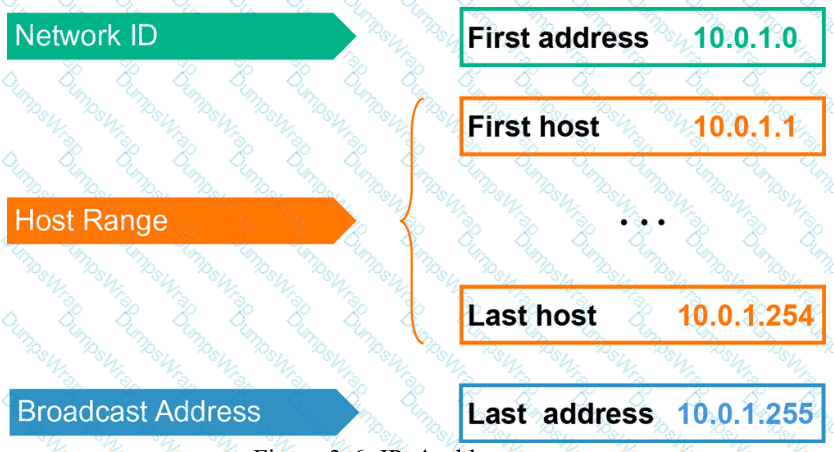
HPE Press study-guide figure / related learning illustration · Q151 Fig 3-6 IP types
During live firmware upgrades of HPE Aruba Networking APs, which technology divides all APs according to RF-neighborhood data to minimize the impact on clients?
Options:
HPE Aruba Networking AI Insights
HPE Aruba Networking ESP
HPE Aruba Networking ClientMatch
HPE Aruba Networking AirMatch
Answer:
CExplanation:
Comprehensive and Detailed Explanation
HPE Press guide context | PDF page 798 | HPE Press, Aruba Certified Associate – Campus Access Official Certification Study Guide
Technical Deep Dive — Reconstructed (Original Chat Text Not Recoverable)
ClientMatch RF-neighborhood awareness can group APs into upgrade cohorts and help orchestrate live updates with minimized client impact. The feature relates to clients' relationships with neighboring APs rather than simply the broader ESP platform. AirMatch is a radio-configuration optimization tool, not the RF-neighbor steering mechanism stated here.
The selected answer corresponds to C: HPE Aruba Networking ClientMatch. This matches the mechanism or management behavior described in the scenario rather than merely a related network feature.
Operational workflows should preserve consistent inventory, authorization, configuration history, and monitoring so that administrators can locate and manage devices predictably.
The operational view should be interpreted together with its underlying records: an alert, subscription count, or device status may describe management state rather than physical availability.
The answer should be validated against both the control-plane state and the forwarding or management outcome. A successful individual command alone is not proof that the end-to-end requirement is satisfied.
When troubleshooting or designing a change, verify compatibility between all participating devices, the management scope, and the applicable software release. The most useful evidence is the state observed on both sides of the affected connection.
Which file format can be used to download or receive reports from HPE Aruba Networking Central?
Options:
XLSX
CSV
JSON
TXT
Answer:
BExplanation:
Comprehensive and Detailed Explanation
HPE Press guide context | PDF page 1029 | HPE Press, Aruba Certified Associate – Campus Access Official Certification Study Guide
Technical Deep Dive — Original Chat Wording
HPE Aruba Networking Central includes centralized reporting capabilities that allow administrators to analyze network activity, device health, security events, and other monitored information.
Reports can be generated on demand or according to a configured schedule.
For example, an administrator may configure recurring reports covering connected clients, network infrastructure utilization, or security-related conditions.
CSV, or Comma-Separated Values, is a text-based tabular data format commonly supported by management and analytics platforms.
A CSV file organizes information into rows and columns, with values separated by delimiters such as commas.
Its principal advantage is interoperability.
CSV reports can be imported into spreadsheet applications, database systems, data-analysis tools, and custom automation workflows.
For example, a network administrator could export client inventory information into CSV and analyze trends across multiple sites.
CSV also supports downstream processing with scripts or business intelligence applications.
PDF is another supported format and is typically more suitable for formatted presentation and distribution.
Although XLSX is widely used for spreadsheet work, it is not the correct listed format for the reporting workflow tested by this question.
JSON is commonly used for structured API responses, but it is not the specified report-download format.
TXT is a general text-file extension rather than the supported report-export selection.
Therefore, Option B (CSV) is correct.
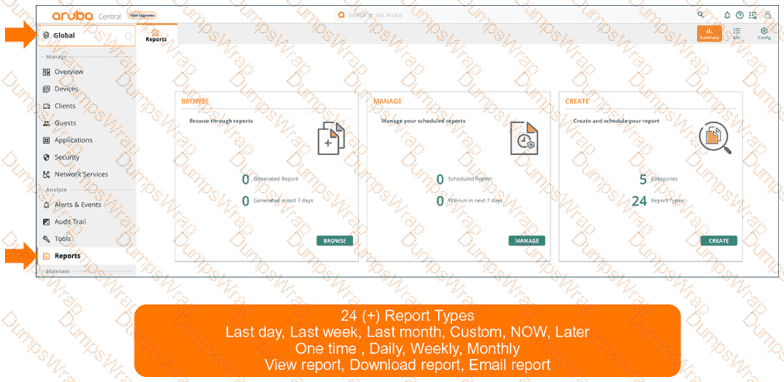
HPE Press study-guide figure / related learning illustration · Fig 13-34 Reports
Which feature can network administrators use to centralize RF planning and optimization services when using an HPE Aruba Networking Mobility Conductor architecture?
Options:
AirWave
Client Match
Client Wave
AirMatch
Answer:
DExplanation:
Comprehensive and Detailed Explanation
HPE Press guide context | PDF page 798 | HPE Press, Aruba Certified Associate – Campus Access Official Certification Study Guide
Technical Deep Dive — Reconstructed (Original Chat Text Not Recoverable)
AirMatch uses centralized RF planning and optimization under Mobility Conductor management. It evaluates radio/channel and power conditions across the WLAN and produces RF configuration choices. ClientMatch chiefly steers client associations; AirWave focuses on monitoring rather than central RF orchestration in this architecture.
The selected answer corresponds to D: AirMatch. This matches the mechanism or management behavior described in the scenario rather than merely a related network feature.
In campus network design, a successful decision must satisfy the customer's capacity, topology, physical environment, and lifecycle constraints.
An effective plan translates the requirement into measurable acceptance criteria, such as reachability, port capacity, redundancy, or RF service quality.
The answer should be validated against both the control-plane state and the forwarding or management outcome. A successful individual command alone is not proof that the end-to-end requirement is satisfied.
When troubleshooting or designing a change, verify compatibility between all participating devices, the management scope, and the applicable software release. The most useful evidence is the state observed on both sides of the affected connection.
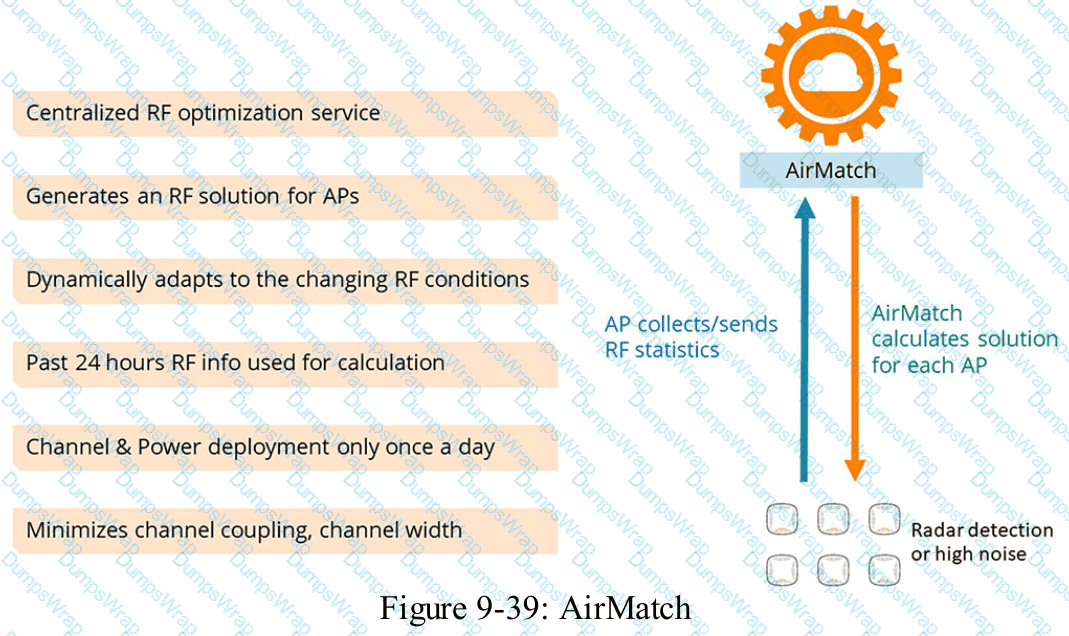
HPE Press study-guide figure / related learning illustration · Q64 AirMatch
Which card lets you view your network’s health status in HPE Aruba Networking Central?
Options:
Client Health card
Device Health card
Configuration Health card
Device Inventory card
Answer:
BExplanation:
Comprehensive and Detailed Explanation
HPE Press guide context | PDF page 1002 | HPE Press, Aruba Certified Associate – Campus Access Official Certification Study Guide
Technical Deep Dive — Original Chat Wording
The Device Health card provides a consolidated view of the operational condition of managed network infrastructure.
It allows administrators to assess the health of supported device categories, including switches, access points, and gateways.
Rather than inspecting every device individually, the administrator can review a summary of the network's infrastructure-health distribution.
The card can identify devices classified into different health states and allow further investigation of affected sites or devices.
For example, if several switches show degraded health, the network operations team can open the relevant details to investigate the associated alerts or performance conditions.
This helps identify problems before they result in widespread service disruption.
The Client Health card provides a different perspective. It focuses on the experience and health of connected client devices rather than the infrastructure itself.
The Device Inventory card primarily summarizes registered devices, their types, and related inventory information.
Configuration Health is not the matching overview card specified by the documentation.
The Device Health card therefore provides the best starting point for assessing the current operational health of the managed network equipment.
Detailed troubleshooting may require examining interface status, system events, resource utilization, and other device-specific information.
Therefore, Option B (Device Health card) is correct.
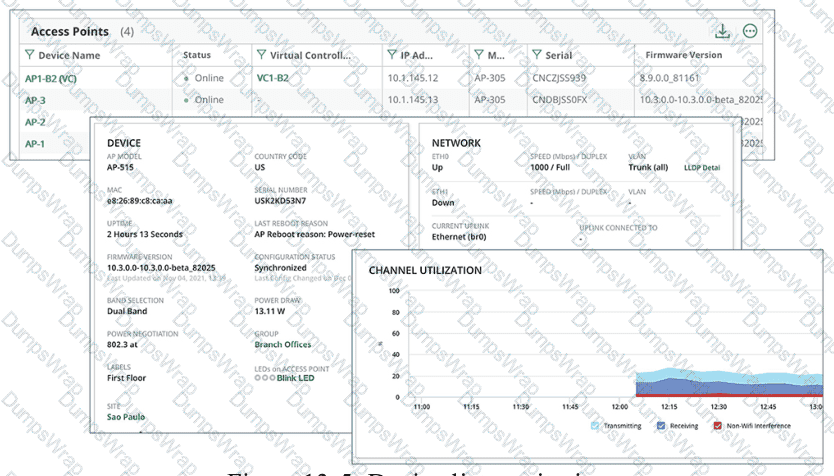
HPE Press study-guide figure / related learning illustration · Q160 Fig 13-5 Device
Why is WPA3-Personal authentication a more secure choice than WPA2-PSK authentication?
Options:
The client TPM module generates a unique encryption key for each attempted connection.
Simultaneous Authentication of ‘Equals’ is used to generate a fresh Pairwise Master Key for each attempted connection.
WPA3 requires longer, more secure passphrases.
WPA3 encrypts authentication traffic using TLS.
Answer:
BExplanation:
Comprehensive and Detailed Explanation
HPE Press guide context | PDF page 958 | HPE Press, Aruba Certified Associate – Campus Access Official Certification Study Guide
Technical Deep Dive — Reconstructed (Original Chat Text Not Recoverable)
WPA3-Personal replaces the conventional reusable WPA2-PSK PMK derivation with SAE, which negotiates fresh keying material for each authentication. SAE improves resistance to offline dictionary attacks and offers forward-secrecy properties. TPM hardware, TLS, or simply imposing a longer passphrase are not the fundamental reason given by the guide.
The selected answer corresponds to B: Simultaneous Authentication of ‘Equals’ is used to generate a fresh Pairwise Master Key for each attempted connection.. This matches the mechanism or management behavior described in the scenario rather than merely a related network feature.
In an AOS-CX or Aruba Central deployment, the relevant settings must be applied in the correct interface, profile, policy, or management scope and then validated operationally.
For example, an apparently healthy physical port may still fail to serve a client when VLAN assignment, AAA policy, or Layer 3 gateway context is wrong.
A strong verification step is to compare the expected outcome with operational status before and after the change. This confirms not only that a configuration was accepted, but also that the required service actually functions.
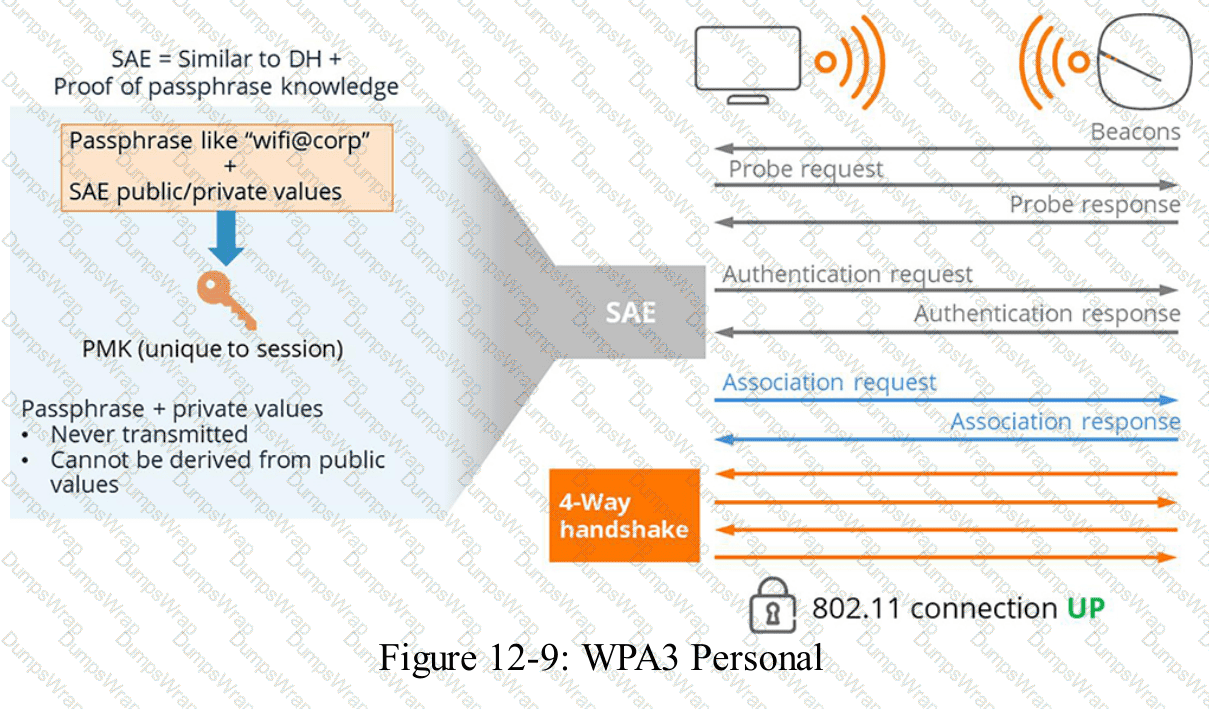
HPE Press study-guide figure / related learning illustration · Fig 12-9 SAE
Which certificate in the server’s chain of trust is self-signed?
Options:
Subordinate CA certificate
Root CA certificate
Issuing CA certificate
Intermediate CA certificate
Answer:
BExplanation:
Comprehensive and Detailed Explanation
HPE Press guide context | PDF page 822 | HPE Press, Aruba Certified Associate – Campus Access Official Certification Study Guide
Technical Deep Dive — Reconstructed (Original Chat Text Not Recoverable)
A root certification authority issues a trust anchor whose certificate is generally self-signed. Intermediate and issuing CAs receive signatures from their parent CA. During EAP-TLS validation a certificate chain terminates in a trusted root, and each subordinate signature is validated with the issuer's public key.
The selected answer corresponds to B: Root CA certificate. This matches the mechanism or management behavior described in the scenario rather than merely a related network feature.
Operational workflows should preserve consistent inventory, authorization, configuration history, and monitoring so that administrators can locate and manage devices predictably.
Consistent RBAC, accurate inventories, and retained audit records simplify support handovers and reduce uncertainty during incident investigations.
When reviewing alternatives, identify which one directly addresses the stated requirement, rather than selecting a related capability that is useful elsewhere but does not fulfill the requested task.
The wrong choices may describe real technologies, but they perform different functions, apply to another layer, or omit a required prerequisite. Select the answer that resolves the exact scenario, not a nearby administrative task.
How does a UXI sensor establish connectivity while being onboarded?
Options:
Through Ethernet or Wi-Fi
Through Bluetooth Low Energy
By using LAN over Powerline
By using direct cloud connection
Answer:
AExplanation:
Comprehensive and Detailed Explanation
HPE Press guide context | PDF page 1035 | HPE Press, Aruba Certified Associate – Campus Access Official Certification Study Guide
Technical Deep Dive — Original Chat Wording
HPE Aruba Networking User Experience Insight (UXI) uses dedicated sensors and supported software agents to evaluate network connectivity from an endpoint's perspective.
A physical UXI sensor can test wired Ethernet connections and wireless networks.
When monitoring a wired network, the sensor communicates through its Ethernet interface.
When monitoring a wireless network, it associates with the configured WLAN and performs supported authentication procedures.
The sensor then measures the steps required to obtain functional network connectivity.
These can include DHCP address assignment, DNS resolution, gateway reachability, and application access.
For example, a sensor monitoring an employee WLAN can attempt to associate with the SSID, complete authentication, acquire an IP address, and access a specified application.
If one stage fails, UXI records diagnostic information that helps the administrator identify the likely point of failure.
This provides more useful visibility into user experience than infrastructure availability checks alone.
Bluetooth Low Energy and powerline networking are not the ordinary wired or wireless testing methods described in the question.
Technical distinction: The HPE Press guide also explains that physical UXI sensors may initially use cellular connectivity or standard PoE during provisioning. Cellular connectivity can provide a management bootstrap path, but the monitored network experience is tested through wired Ethernet or Wi-Fi.
Therefore, Option A (Through Ethernet or Wi-Fi) is correct.
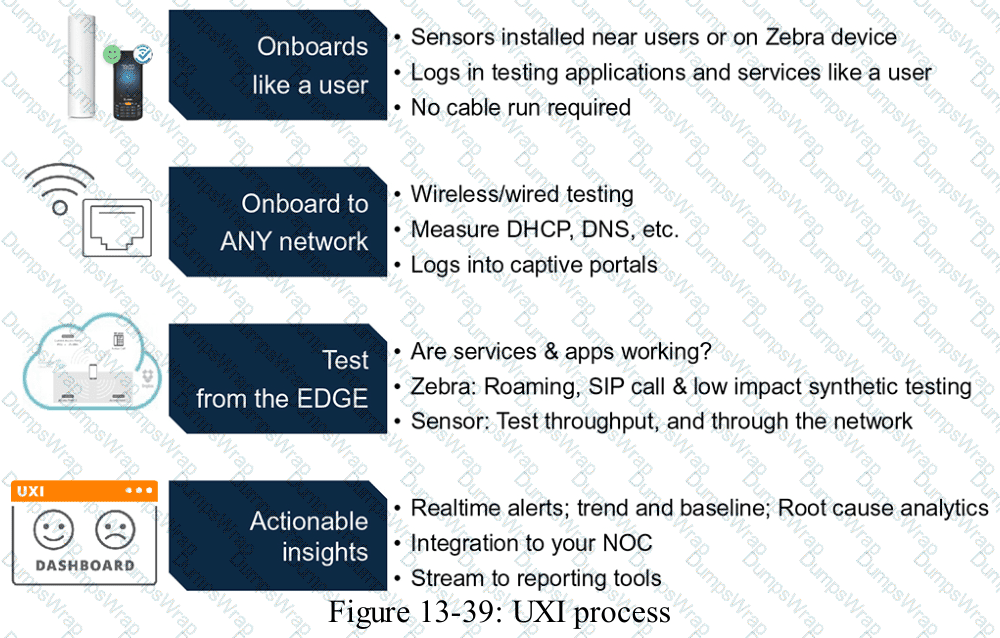
HPE Press study-guide figure / related learning illustration · Q195 Fig 13-39 UXI
Why must devices be managed during onboarding in HPE Aruba Networking Central?
Options:
To install firmware updates remotely.
To assign software licenses automatically.
To back up device logs daily.
To start the initial configuration of the devices.
Answer:
DExplanation:
Comprehensive and Detailed Explanation
HPE Press guide context | PDF page 567 | HPE Press, Aruba Certified Associate – Campus Access Official Certification Study Guide
Short exact extract: “The onboard device process starts at the device inventory.”
Technical Deep Dive — Original Chat Wording
HPE Aruba Networking Central provides centralized provisioning, configuration, and management for supported access points, switches, and gateways.
The onboarding workflow establishes a device's association with the management account and prepares it to receive its intended configuration.
The process involves registering the device in the inventory, assigning an appropriate management subscription, and enabling connectivity to Central.
Once these prerequisites are satisfied, the administrator can assign the device to the appropriate group or management scope.
The corresponding configuration can then be delivered through the management platform.
For example, an organization deploying new campus access switches can register their serial numbers and MAC addresses, assign the necessary subscriptions, and provision common VLAN, security, and interface configurations.
This eliminates much of the repetitive configuration normally required on individual switches.
Automatic firmware upgrades may be configured as an additional lifecycle-management function, but they are not the primary purpose of completing the initial management workflow.
Subscription assignment is a prerequisite for management, rather than the reason the device must be managed.
Daily log backup is a separate operational process.
The principal objective is to make the device available for initial centralized configuration and subsequent management.
Therefore, Option D (To start the initial configuration of the devices) is correct.

HPE Press study-guide figure / related learning illustration · Q106 Fig 7-1 Onboarding
Describe what functionality ARP provides.
Options:
ARP uses multicast to build the ARP table.
ARP maps MAC addresses to switch ports.
Clients do not have an ARP cache and always ask for the default gateway
ARP maps layer-3 IP addresses to layer-2 MAC addresses.
Answer:
DExplanation:
Comprehensive and Detailed Explanation
HPE Press guide context | PDF page 50 | HPE Press, Aruba Certified Associate – Campus Access Official Certification Study Guide
Technical Deep Dive — Reconstructed (Original Chat Text Not Recoverable)
Address Resolution Protocol resolves a known local-subnet IPv4 address into a Layer 2 MAC address. An endpoint broadcasts an ARP request and normally receives a unicast ARP reply, then caches the binding. Routers use ARP to resolve the next-hop's MAC address on their outgoing Ethernet network. Switch MAC address tables are learned separately from frame source MACs.
The selected answer corresponds to D: ARP maps layer-3 IP addresses to layer-2 MAC addresses.. This matches the mechanism or management behavior described in the scenario rather than merely a related network feature.
Operational workflows should preserve consistent inventory, authorization, configuration history, and monitoring so that administrators can locate and manage devices predictably.
The operational view should be interpreted together with its underlying records: an alert, subscription count, or device status may describe management state rather than physical availability.
The practical deployment consequence is important: a plausible configuration can still fail when the peer interface, device role, licensing scope, or physical medium is mismatched. Checking that surrounding dependency avoids a misleading diagnosis.
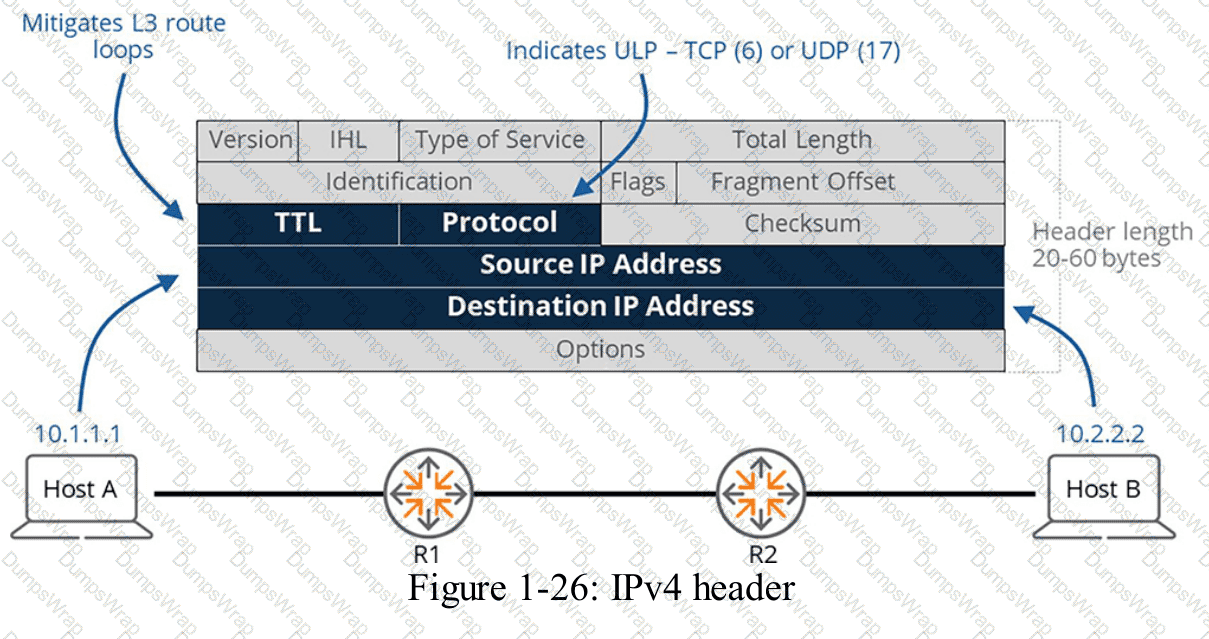
HPE Press study-guide figure / related learning illustration · Fig 1-26 IPv4
Which statement describes alerts in HPE Aruba Networking Central?
Options:
Alerts are displayed only on dashboards
Alerts summarize historical performance trends
Alerts display device status in real time
Administrators can set thresholds for triggering alerts
Answer:
DExplanation:
Comprehensive and Detailed Explanation
HPE Press guide context | PDF page 1028 | HPE Press, Aruba Certified Associate – Campus Access Official Certification Study Guide
Technical Deep Dive — Original Chat Wording
HPE Aruba Networking Central provides alerting to notify administrators when monitored infrastructure conditions require attention.
An alert is generally triggered when a specific event or measured condition meets the configured criteria.
For example, an administrator may configure an AP-disconnection alert with an evaluation duration so that a brief interruption does not immediately generate an operational incident.
Depending on the alert type, administrators may be able to configure severity, duration, applicable devices, and notification recipients.
Thresholds help distinguish significant problems from ordinary fluctuations.
This reduces unnecessary notifications and improves the effectiveness of network monitoring.
Alerts can be presented within dashboards, event lists, and supported notification channels.
Therefore, they are not limited exclusively to dashboard displays.
Historical performance reporting is a separate function that summarizes trends over time.
Likewise, real-time device status is normally represented through infrastructure-health and device-monitoring views.
Alerts may report conditions derived from device status, but they are event-driven notifications rather than simply a continuously updated device-status display.
Administrators should configure alert thresholds according to business impact and expected operational behavior.
Excessively sensitive thresholds can produce alert fatigue, while poorly chosen thresholds may delay detection of significant failures.
Therefore, Option D (Administrators can set thresholds for triggering alerts) is correct.
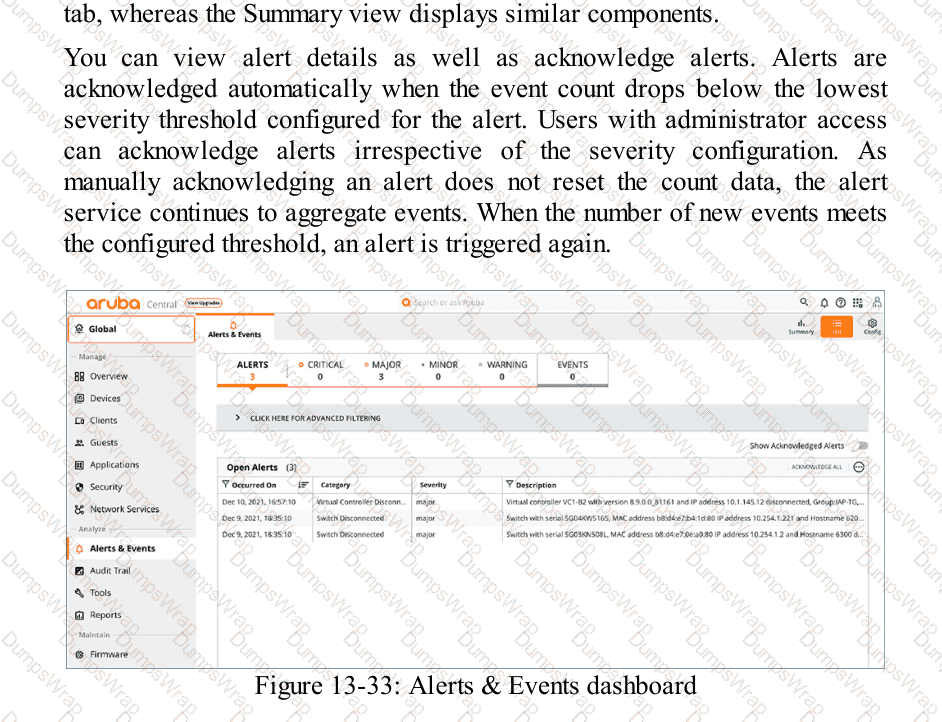
HPE Press study-guide figure / related learning illustration · Q174 Fig 13-33 Alerts
How is Equivalent Isotropic Radiated Power (EIRP) computed?
Options:
(power provided by PoE port) – (the cable loss) + (antenna gain)
(power provided by the radio) – (the cable loss) + (antenna gain)
(power provided by the radio) – (the cable loss) – (antenna gain)
(power provided by PoE port) – (the cable loss) – (antenna gain)
Answer:
BExplanation:
Comprehensive and Detailed Explanation
HPE Press guide context | PDF page 712 | HPE Press, Aruba Certified Associate – Campus Access Official Certification Study Guide
Technical Deep Dive — Reconstructed (Original Chat Text Not Recoverable)
Equivalent Isotropically Radiated Power is calculated using transmitter radio power, minus losses between the transmitter and antenna, plus antenna gain. Values must all be expressed consistently in dBm and dB. A PoE power budget is electrical supply capacity, not RF transmit power, so it cannot be substituted into the EIRP equation.
The selected answer corresponds to B: (power provided by the radio) – (the cable loss) + (antenna gain). This matches the mechanism or management behavior described in the scenario rather than merely a related network feature.
Optimization should consider both immediate performance and its tradeoffs in RF capacity, airtime, reliability, security, and operational overhead.
Use measurements rather than assumptions: compare the RF or switch metrics before and after making a controlled change.
For an administrator preparing for the associate certification, the key distinction is the precise protocol or Central workflow involved. Similar-sounding features often operate at different OSI layers or management stages.
The wrong choices may describe real technologies, but they perform different functions, apply to another layer, or omit a required prerequisite. Select the answer that resolves the exact scenario, not a nearby administrative task.
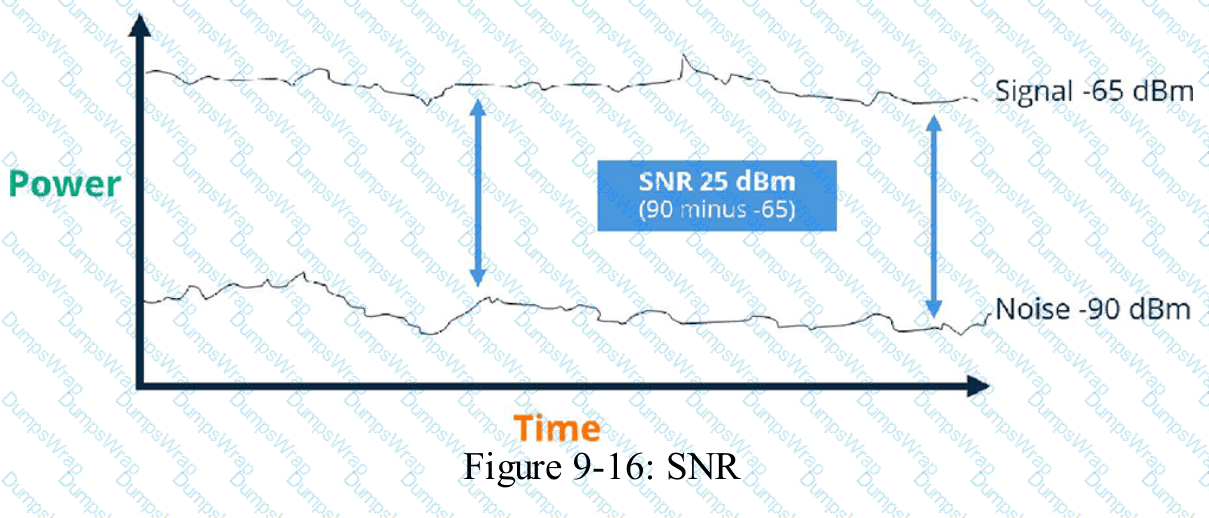
HPE Press study-guide figure / related learning illustration · Fig 9-16 SNR
Where are wireless-client roaming decisions made?
Options:
HPE Aruba Networking Central
Joint decision made by the origination and destination APs
Client device
Virtual Controller
Answer:
CExplanation:
Comprehensive and Detailed Explanation
HPE Press guide context | PDF page 769 | HPE Press, Aruba Certified Associate – Campus Access Official Certification Study Guide
Technical Deep Dive — Reconstructed (Original Chat Text Not Recoverable)
Roaming is ultimately initiated and chosen by the wireless client, even when infrastructure supplies 802.11k neighbor reports, 802.11v transition advice, or 802.11r fast roaming. Neither Central nor an AP can guarantee a station will choose a particular neighboring BSS.
The selected answer corresponds to C: Client device. This matches the mechanism or management behavior described in the scenario rather than merely a related network feature.
Optimization should consider both immediate performance and its tradeoffs in RF capacity, airtime, reliability, security, and operational overhead.
Use measurements rather than assumptions: compare the RF or switch metrics before and after making a controlled change.
For an administrator preparing for the associate certification, the key distinction is the precise protocol or Central workflow involved. Similar-sounding features often operate at different OSI layers or management stages.
The wrong choices may describe real technologies, but they perform different functions, apply to another layer, or omit a required prerequisite. Select the answer that resolves the exact scenario, not a nearby administrative task.
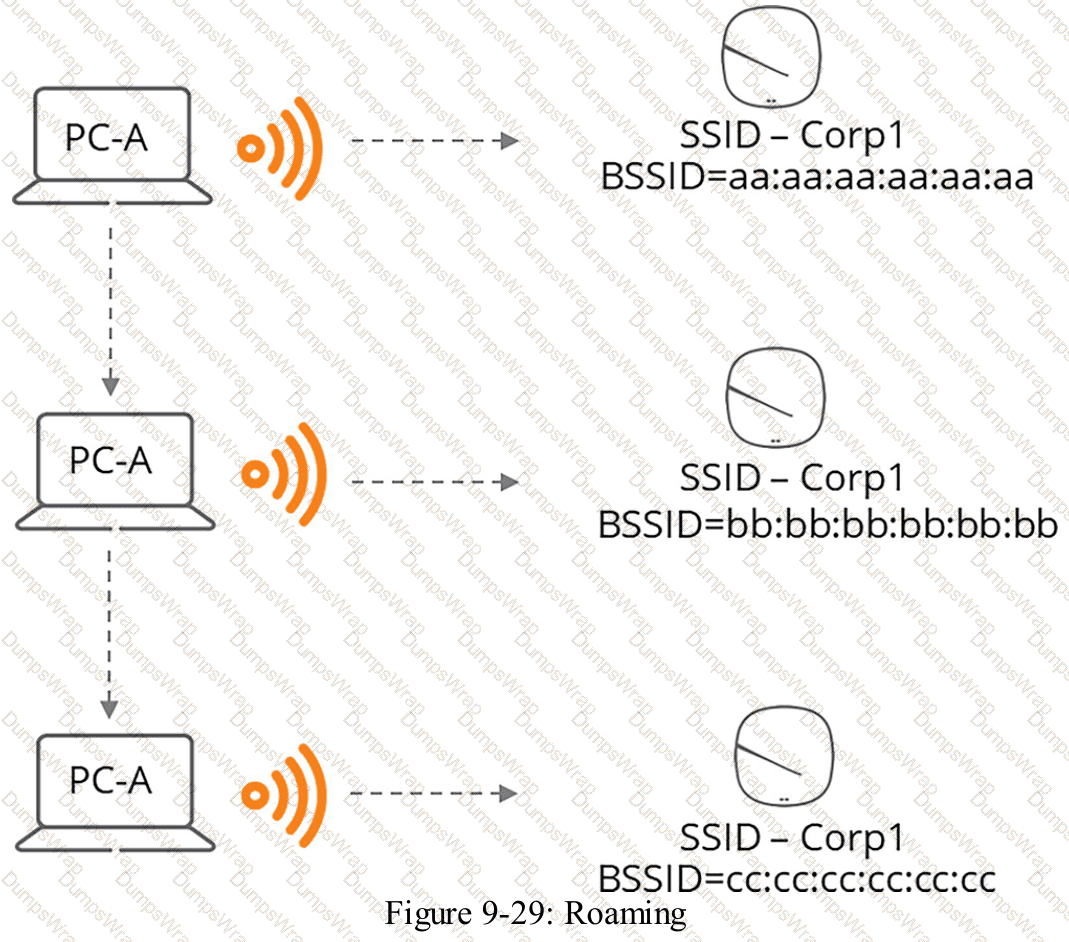
HPE Press study-guide figure / related learning illustration · Q68 Roaming
Which characteristics describe VSF?
Choose two
Options:
VSF helps to simplify the network design by reducing the number of logical devices.
VSF forms virtual device by using proprietary stacking cables.
VSF-Stacks are limited to 7 members.
VSF forms a virtual device by using standard 10 Gbps/25 Gbps/50 Gbps ports.
VSF-Stacks are primarily used at the core layer.
Answer:
A, DExplanation:
Comprehensive and Detailed Explanation
HPE Press guide context | PDF page 477 | HPE Press, Aruba Certified Associate – Campus Access Official Certification Study Guide
Technical Deep Dive — Reconstructed (Original Chat Text Not Recoverable)
Virtual Switching Framework makes several compatible AOS-CX switches operate as one logical control/management system, simplifying administration. It uses supported standard Ethernet high-speed interfaces for its stacking connections rather than requiring proprietary special cables. VSF is principally employed at access/distribution, while VSX is common for high-availability aggregation/core pairs.
The selected answer corresponds to A: VSF helps to simplify the network design by reducing the number of logical devices.; D: VSF forms a virtual device by using standard 10 Gbps/25 Gbps/50 Gbps ports.. This matches the mechanism or management behavior described in the scenario rather than merely a related network feature.
Operational workflows should preserve consistent inventory, authorization, configuration history, and monitoring so that administrators can locate and manage devices predictably.
Consistent RBAC, accurate inventories, and retained audit records simplify support handovers and reduce uncertainty during incident investigations.
When reviewing alternatives, identify which one directly addresses the stated requirement, rather than selecting a related capability that is useful elsewhere but does not fulfill the requested task.
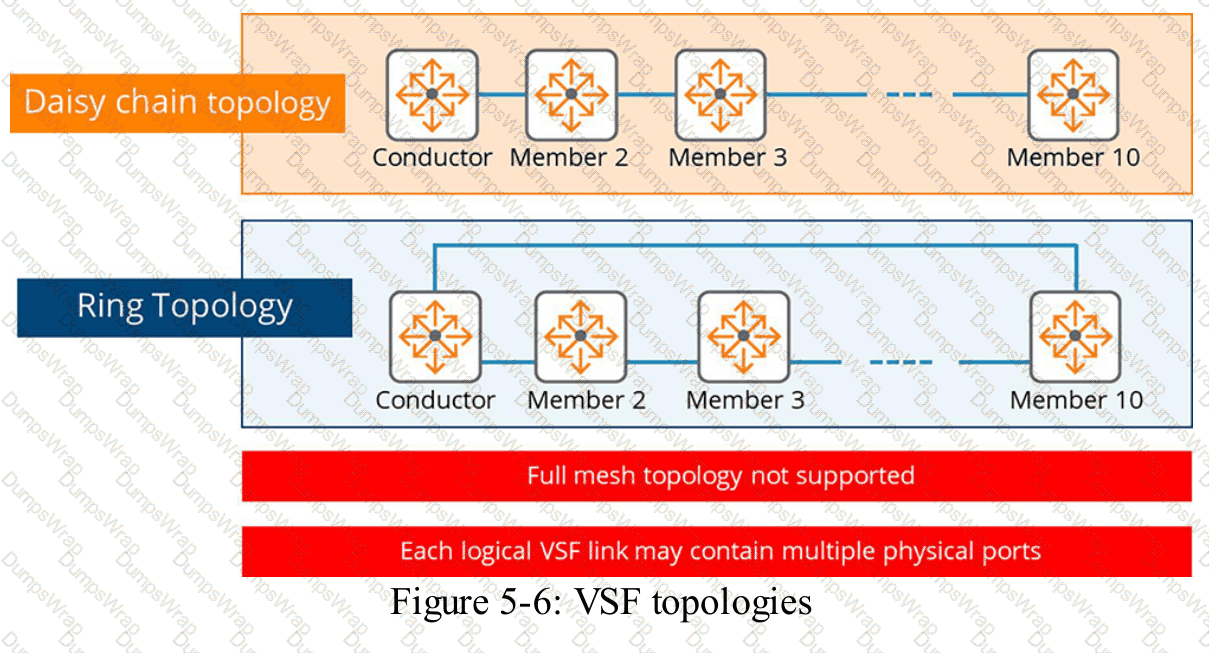
HPE Press study-guide figure / related learning illustration · Fig 5-6 VSF
When viewing the Device Inventory and Subscriptions card in HPE Aruba Networking Central, what information is available?
Options:
The device firmware versions currently running in the network.
The current subscription tier assigned to each device.
The number of devices requiring site assignment.
The uptime status for each device as a colored bar.
Answer:
CExplanation:
Comprehensive and Detailed Explanation
HPE Press guide context | PDF page 579 | HPE Press, Aruba Certified Associate – Campus Access Official Certification Study Guide
Technical Deep Dive — Original Chat Wording
The Inventory and Subscriptions card provides a consolidated overview of infrastructure devices and their management-subscription status.
It helps administrators identify devices that have not completed important onboarding and organizational steps.
A key metric is the number of devices without an assigned site.
Site assignment organizes infrastructure according to physical locations such as offices, campuses, and branches.
This organization is important because Central uses sites for location-based visibility, operational monitoring, and supported management workflows.
The card also summarizes device totals, available subscriptions, and devices without subscriptions.
Administrators can select relevant counts to investigate the affected device inventory.
For example, when ten newly purchased switches have been registered but not assigned to a branch site, the Without Site metric helps identify that outstanding task.
The current subscription tier for an individual device may be available in the detailed Device Inventory table, but the question specifically asks about information shown on the overview card.
Firmware versions and uptime are also available through other device-management views.
Therefore, Option C (The number of devices requiring site assignment) is correct.
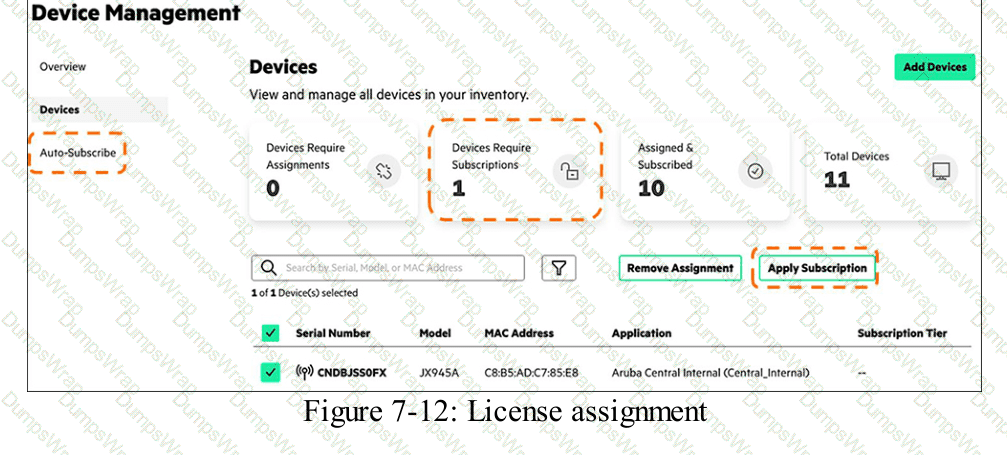
HPE Press study-guide figure / related learning illustration · Q116 Fig 7-12 License
Which two features characterize HPE Aruba Networking ClientMatch?
Choose two
Options:
It helps to move sticky clients to another AP.
It is used to locate a client.
It is an HPE Aruba Networking patented technology.
An algorithm to adjust RF patterns
It optimizes channels of an AP.
Answer:
A, CExplanation:
Comprehensive and Detailed Explanation
HPE Press guide context | PDF page 783 | HPE Press, Aruba Certified Associate – Campus Access Official Certification Study Guide
Technical Deep Dive — Reconstructed (Original Chat Text Not Recoverable)
ClientMatch uses Aruba client-management algorithms to identify sticky clients and encourage their transition to better neighboring APs. The feature is Aruba-specific and uses measurements supplied by the WLAN infrastructure. It does not perform physical client location, which is a separate location-services function; AirMatch rather than ClientMatch optimizes RF channels.
The selected answer corresponds to A: It helps to move sticky clients to another AP.; C: It is an HPE Aruba Networking patented technology.. This matches the mechanism or management behavior described in the scenario rather than merely a related network feature.
Optimization should consider both immediate performance and its tradeoffs in RF capacity, airtime, reliability, security, and operational overhead.
A proper optimization decision balances a local performance improvement against the resulting effect on neighboring clients and the wider campus.
The practical deployment consequence is important: a plausible configuration can still fail when the peer interface, device role, licensing scope, or physical medium is mismatched. Checking that surrounding dependency avoids a misleading diagnosis.
What type of question should you ask stakeholders to determine how the network may need to grow in the future?
Options:
Ask about the most critical network needs today.
Ask about the anticipated growth of the environment.
Ask about the existing network's pain points.
Ask about the current number of connected devices.
Answer:
BExplanation:
Comprehensive and Detailed Explanation
HPE Press guide context | PDF page 567 | HPE Press, Aruba Certified Associate – Campus Access Official Certification Study Guide
Technical Deep Dive — Original Chat Wording
Future growth requirements are essential inputs when designing a campus network that must remain effective over several years.
A network designed exclusively for current demand may quickly become insufficient as the organization expands.
Asking stakeholders about anticipated growth helps the network engineer understand expected changes in employee numbers, device populations, office locations, application usage, and wireless client density.
For example, a shopping center may initially support 500 connected devices but anticipate an increase to 1,500 devices over three years.
This growth affects switch port density, uplink bandwidth, PoE capacity, wireless AP placement, IP address planning, and infrastructure licensing.
An HPE Aruba Networking solution may need additional VSF stack capacity, higher-speed uplinks, or greater wireless coverage to accommodate that expansion.
The engineer should also investigate upcoming construction projects, new branches, increased IoT adoption, and potential changes to security requirements.
Understanding present-day network problems and current device counts remains important, but those questions primarily establish the baseline.
They do not directly reveal the organization's future expansion plans.
A strong planning process compares the current environment with expected growth and translates those differences into capacity and scalability requirements.
Therefore, Option B (Ask about the anticipated growth of the environment) is correct.
When configuring an AOS firewall role, where can you configure the client’s broadcast domain?
Options:
Access Control Rules
WLAN Settings
Role-based VLAN override
Bandwidth Controls
Answer:
CExplanation:
Comprehensive and Detailed Explanation
HPE Press guide context | PDF page 842 | HPE Press, Aruba Certified Associate – Campus Access Official Certification Study Guide
Technical Deep Dive — Reconstructed (Original Chat Text Not Recoverable)
A role-based VLAN override is a role attribute that can influence the client's assigned broadcast domain after authorization. Firewall rules filter permitted traffic and bandwidth controls impose traffic limits, but neither is the role attribute used to place a client in a VLAN. For wireless users the guide recommends setting VLAN through the WLAN where possible.
The selected answer corresponds to C: Role-based VLAN override. This matches the mechanism or management behavior described in the scenario rather than merely a related network feature.
In an AOS-CX or Aruba Central deployment, the relevant settings must be applied in the correct interface, profile, policy, or management scope and then validated operationally.
For example, an apparently healthy physical port may still fail to serve a client when VLAN assignment, AAA policy, or Layer 3 gateway context is wrong.
In production, the decision should be documented and checked against the supported software release and platform model, because interface names, licensing tiers, and management workflows can change across Central and AOS-CX generations.
A customer with 1,860 employees has just deployed user and device certificates through a company-wide Group Policy Object (GPO).
When authenticating to the network, which EAP method chains user and machine authentication in a single RADIUS session?
Options:
EAP-TEAP
EAP-TTLS
EAP-TLS
PEAP
Answer:
AExplanation:
Comprehensive and Detailed Explanation
HPE Press guide context | PDF page 825 | HPE Press, Aruba Certified Associate – Campus Access Official Certification Study Guide
Technical Deep Dive — Reconstructed (Original Chat Text Not Recoverable)
EAP-TEAP performs tunneled user and machine authentication chaining within a single protected exchange, allowing ClearPass to evaluate both identities together. Certificate rollout via GPO supports machine/user certificate availability, but the question targets the specific chained EAP method, not ordinary single-identity EAP-TLS.
The selected answer corresponds to A: EAP-TEAP. This matches the mechanism or management behavior described in the scenario rather than merely a related network feature.
In an AOS-CX or Aruba Central deployment, the relevant settings must be applied in the correct interface, profile, policy, or management scope and then validated operationally.
For example, an apparently healthy physical port may still fail to serve a client when VLAN assignment, AAA policy, or Layer 3 gateway context is wrong.
A strong verification step is to compare the expected outcome with operational status before and after the change. This confirms not only that a configuration was accepted, but also that the required service actually functions.
For practical use, confirm the prerequisite conditions first, then verify the resulting operational state. This separates an intended configuration from a working network service and avoids accepting a misleading result.
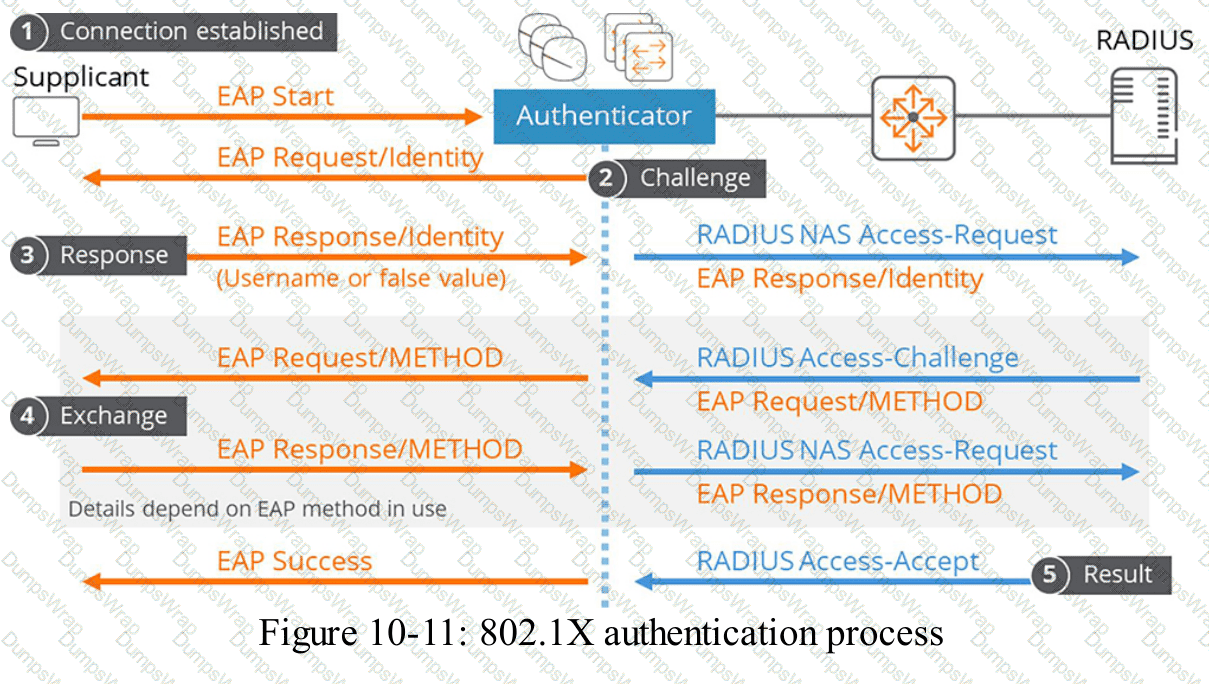
HPE Press study-guide figure / related learning illustration · Fig 10-11 EAP
What does the “ALFOE” status indicate when you check LACP by using show lacp interfaces?
Options:
LACP is working with no problems.
LACP is not configured on the peer side.
LACP is a synchronizing process.
The interface on the local switch is configured as static-LAG.
Answer:
BExplanation:
Comprehensive and Detailed Explanation
HPE Press guide context | PDF page 155 | HPE Press, Aruba Certified Associate – Campus Access Official Certification Study Guide
Technical Deep Dive — Reconstructed (Original Chat Text Not Recoverable)
The LACP actor state `ALFOE` contains flags indicating active LACP but an out-of-sync/defaulted partner. It commonly appears when the peer is not correctly participating in LACP negotiation. Inspect `show lacp interfaces` on both ends, verify that logical LAGs are dynamic, and confirm physical membership and permitted VLANs.
The selected answer corresponds to B: LACP is not configured on the peer side.. This matches the mechanism or management behavior described in the scenario rather than merely a related network feature.
Operational workflows should preserve consistent inventory, authorization, configuration history, and monitoring so that administrators can locate and manage devices predictably.
For example, a cloud-managed infrastructure device may be registered successfully but still require the correct subscription, site, group, and configuration scope.
A strong verification step is to compare the expected outcome with operational status before and after the change. This confirms not only that a configuration was accepted, but also that the required service actually functions.
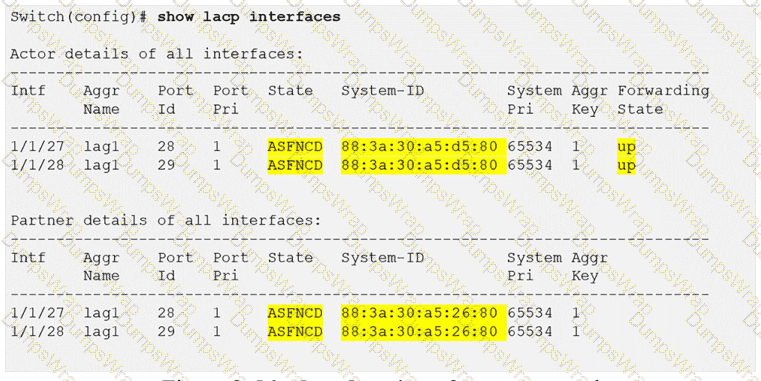
HPE Press study-guide figure / related learning illustration · Fig 2-56 LACP state
Which statement concerning ZTP switch provisioning with HPE Aruba Networking Central is accurate?
Options:
ZTP requires DHCP but does not require DNS.
ZTP does not require DHCP but does require DNS.
ZTP does not require DHCP and DNS.
ZTP requires DHCP and DNS.
Answer:
DExplanation:
Comprehensive and Detailed Explanation
HPE Press guide context | PDF page 575 | HPE Press, Aruba Certified Associate – Campus Access Official Certification Study Guide
Technical Deep Dive — Reconstructed (Original Chat Text Not Recoverable)
AOS-CX zero-touch provisioning normally needs DHCP for addressing and discovery options and DNS to resolve cloud-service hostnames. The switch must reach required management endpoints through a permitted network path. Manual provisioning may avoid DHCP by using static addressing, but fully automatic deployment depends on both services in the expected workflow.
The selected answer corresponds to D: ZTP requires DHCP and DNS.. This matches the mechanism or management behavior described in the scenario rather than merely a related network feature.
In an AOS-CX or Aruba Central deployment, the relevant settings must be applied in the correct interface, profile, policy, or management scope and then validated operationally.
Useful validation normally includes examining the effective running configuration, the relevant show-command output, and the actual client or infrastructure behavior.
The answer should be validated against both the control-plane state and the forwarding or management outcome. A successful individual command alone is not proof that the end-to-end requirement is satisfied.
When troubleshooting or designing a change, verify compatibility between all participating devices, the management scope, and the applicable software release. The most useful evidence is the state observed on both sides of the affected connection.

HPE Press study-guide figure / related learning illustration · Q199 Fig 7 1 Device Onboarding
What is one benefit of using Layer 2 MAC authentication?
Options:
MAC identifiers are hard to spoof.
No setup is required on the client.
It matches user names to MAC address.
MAC allow lists are easily maintained over time.
Answer:
BExplanation:
Comprehensive and Detailed Explanation
HPE Press guide context | PDF page 815 | HPE Press, Aruba Certified Associate – Campus Access Official Certification Study Guide
Technical Deep Dive — Reconstructed (Original Chat Text Not Recoverable)
Layer 2 MAC authentication does not require users to install an 802.1X supplicant or enter credentials on the endpoint. The authenticator checks the source MAC address against policy. However, MAC addresses can be spoofed and managed allowlists are operationally burdensome, so this is a weaker identity assurance method than certificate-based 802.1X.
The selected answer corresponds to B: No setup is required on the client.. This matches the mechanism or management behavior described in the scenario rather than merely a related network feature.
In an AOS-CX or Aruba Central deployment, the relevant settings must be applied in the correct interface, profile, policy, or management scope and then validated operationally.
For example, an apparently healthy physical port may still fail to serve a client when VLAN assignment, AAA policy, or Layer 3 gateway context is wrong.
A strong verification step is to compare the expected outcome with operational status before and after the change. This confirms not only that a configuration was accepted, but also that the required service actually functions.
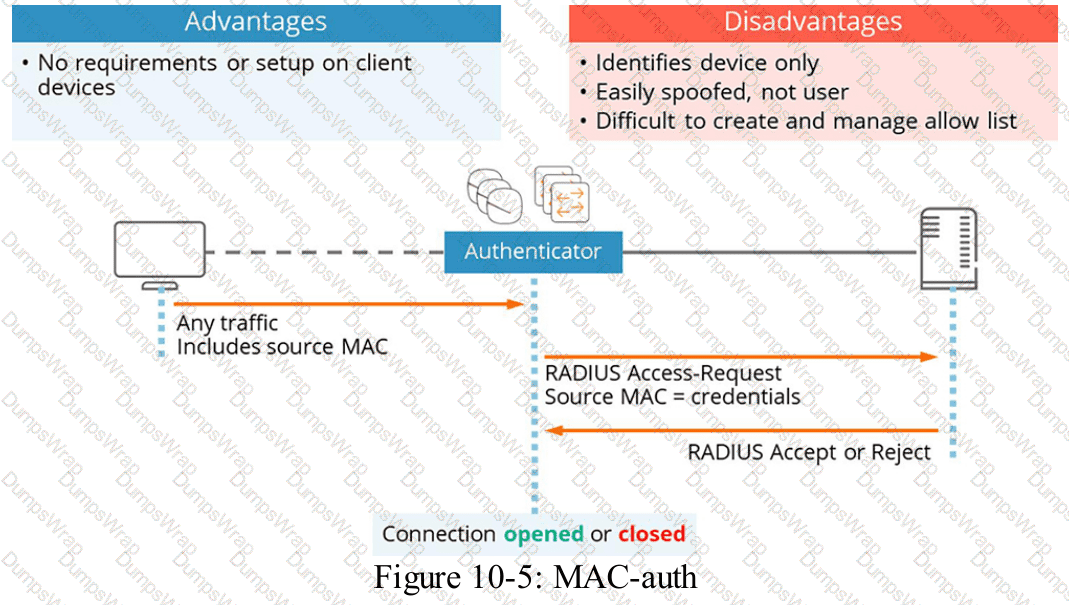
HPE Press study-guide figure / related learning illustration · Q66 MAC auth
What is the common LAN use case for fiber-optic cabling?
Options:
Link telephones to a switch
Aggregate traffic for a printer
For connecting network devices over long distances
For connecting indoor AP to switches
Answer:
CExplanation:
Comprehensive and Detailed Explanation
HPE Press guide context | PDF page 43 | HPE Press, Aruba Certified Associate – Campus Access Official Certification Study Guide
Technical Deep Dive — Original Chat Wording
Fiber-optic cabling is commonly used for high-speed network connections over distances that exceed the limits of conventional twisted-pair copper Ethernet.
It transmits data using optical signals instead of electrical signals.
This allows fiber to provide high bandwidth while avoiding electrical interference affecting copper transmission media.
Fiber is frequently deployed between network wiring closets, distribution switches, campus buildings, and data-center equipment.
For example, two buildings separated by 500 meters may be connected using compatible fiber-optic cable and optical transceivers.
Standard twisted-pair Ethernet links generally have a maximum channel length of 100 meters, making fiber a better choice for many longer connections.
Single-mode fiber can support particularly long distances when paired with appropriate optical modules.
Multimode fiber is commonly used for shorter optical connections within buildings and data centers.
Network telephones and indoor access points commonly use twisted-pair copper because it can simultaneously support Ethernet communication and Power over Ethernet (PoE).
Fiber does not provide ordinary PoE delivery to these endpoints.
Connecting a printer normally does not require a long-distance optical link.
Fiber is therefore especially appropriate for infrastructure interconnections where distance, bandwidth, or electrical isolation makes copper impractical.
Therefore, Option C (For connecting network devices over long distances) is correct.
You need to discard excessive broadcast traffic entering an AOS-CX switch. Which technology is best suited to this task?
Options:
DWRR queuing
Strict queuing
Rate limiting
QoS shaping
Answer:
CExplanation:
Comprehensive and Detailed Explanation
HPE Press guide context | PDF page 188 | HPE Press, Aruba Certified Associate – Campus Access Official Certification Study Guide
Technical Deep Dive — Reconstructed (Original Chat Text Not Recoverable)
Storm control or inbound rate limiting is the relevant approach to discard excess broadcast traffic at a switch port. QoS shaping delays outgoing packets and queuing algorithms choose transmission order; they do not directly suppress an ingress broadcast storm. Configure limits appropriate to legitimate discovery and broadcast traffic.
The selected answer corresponds to C: Rate limiting. This matches the mechanism or management behavior described in the scenario rather than merely a related network feature.
Operational workflows should preserve consistent inventory, authorization, configuration history, and monitoring so that administrators can locate and manage devices predictably.
The operational view should be interpreted together with its underlying records: an alert, subscription count, or device status may describe management state rather than physical availability.
The answer should be validated against both the control-plane state and the forwarding or management outcome. A successful individual command alone is not proof that the end-to-end requirement is satisfied.
When troubleshooting or designing a change, verify compatibility between all participating devices, the management scope, and the applicable software release. The most useful evidence is the state observed on both sides of the affected connection.
When using an Aruba standalone AP, you select Native VLAN for Client VLAN Assignment.
In which subnet will the client IP addresses reside?
Options:
The same subnet as the mobility conductor
The same subnet as the HPE Aruba Networking ESP gateway
The same subnet as the mobility controller
The same subnet as the access point
Answer:
DExplanation:
Comprehensive and Detailed Explanation
HPE Press guide context | PDF page 771 | HPE Press, Aruba Certified Associate – Campus Access Official Certification Study Guide
Technical Deep Dive — Reconstructed (Original Chat Text Not Recoverable)
When a standalone Aruba AP assigns the WLAN's native VLAN to wireless clients, clients are bridged into the same Layer 2 subnet as the AP's native network, provided that uplink VLAN handling matches. The mobility controller or conductor is not necessarily the forwarding gateway in standalone mode.
The selected answer corresponds to D: The same subnet as the access point. This matches the mechanism or management behavior described in the scenario rather than merely a related network feature.
In an AOS-CX or Aruba Central deployment, the relevant settings must be applied in the correct interface, profile, policy, or management scope and then validated operationally.
For example, an apparently healthy physical port may still fail to serve a client when VLAN assignment, AAA policy, or Layer 3 gateway context is wrong.
In production, the decision should be documented and checked against the supported software release and platform model, because interface names, licensing tiers, and management workflows can change across Central and AOS-CX generations.
Which action must you perform after adding a service to HPE GreenLake?
Options:
Assign the device to an HPE Aruba Networking Central instance.
Assign the device to a device group for easier management.
Apply a digital certificate to the device for secure communication.
Assign the device to a specific site within your organization.
Answer:
AExplanation:
Comprehensive and Detailed Explanation
HPE Press guide context | PDF page 574 | HPE Press, Aruba Certified Associate – Campus Access Official Certification Study Guide
Technical Deep Dive — Original Chat Wording
HPE GreenLake provides an account-level platform for managing infrastructure resources and associated HPE services.
HPE Aruba Networking Central is a network-management service that operates within the supported GreenLake management architecture.
Adding a service or registering a device in GreenLake does not automatically complete all network-management prerequisites.
The device must be associated with the appropriate Central management environment.
The workflow generally includes registering the device, assigning it to the relevant application or service, satisfying applicable subscription requirements, and completing the necessary configuration.
For example, a company purchasing new AOS-CX switches can register their devices in the GreenLake inventory.
The administrator then associates the devices with Aruba Central so they become available for the intended management and provisioning operations.
Once the assignment is complete, the devices can be organized into appropriate management scopes, including sites and device groups, according to the supported deployment architecture.
Device-group and site assignment help organize configuration and monitoring, but those steps do not replace association with the Central management service.
Applying a digital certificate manually is not a universal prerequisite for ordinary Aruba Central onboarding.
The management system uses supported secure communication mechanisms during device registration and management.
The distinction is between registering infrastructure in GreenLake and making that infrastructure available to Aruba Central .
Therefore, Option A (Assign the device to an HPE Aruba Networking Central instance) is correct.
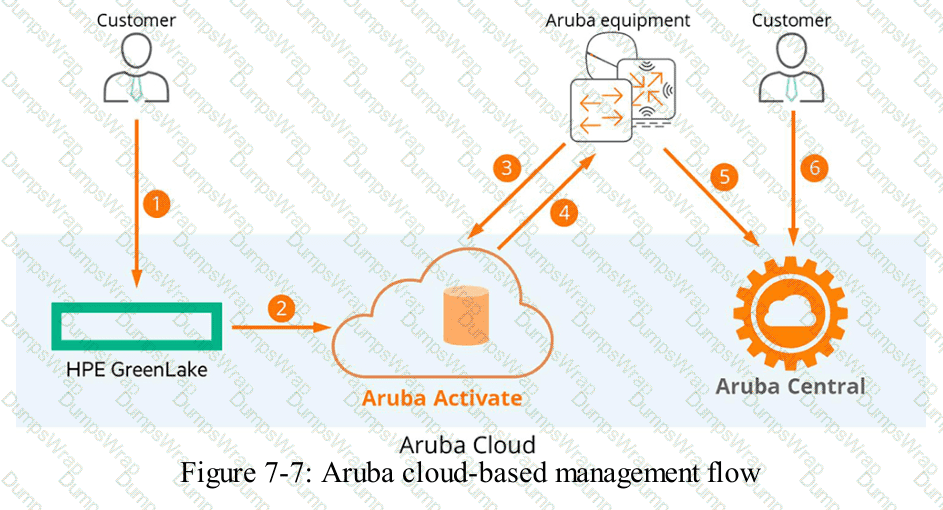
HPE Press study-guide figure / related learning illustration · Q133 Fig 7-7 Cloud Flow
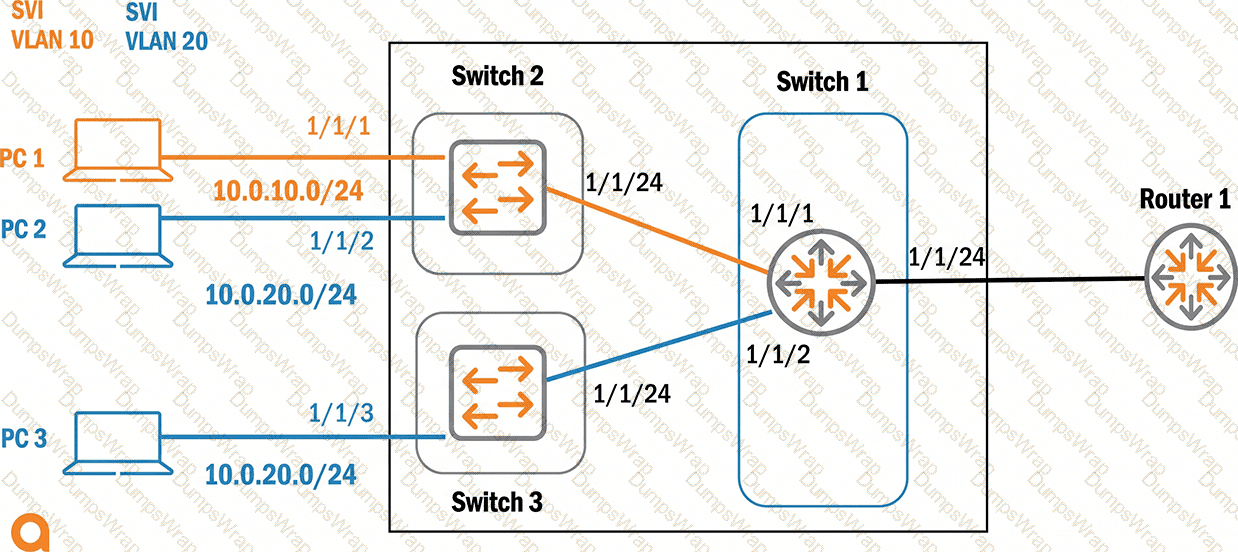
Refer to the exhibit.
Based on the given topology, how do you configure Switch 1 with IP address 10.20.0.1/24 so that PC 2 and PC 3 can use this interface as their default gateway?
Options:
vlan 20, ip default gateway 10.20.0.1
router 20, ip address 10.20.0.1/24
vlan 20, ip address 10.20.0.1/24
int vlan 20, ip address 10.20.0.1/24
Answer:
DExplanation:
Comprehensive and Detailed Explanation
HPE Press guide context | PDF page 221 | HPE Press, Aruba Certified Associate – Campus Access Official Certification Study Guide
Technical Deep Dive — Original Chat Wording
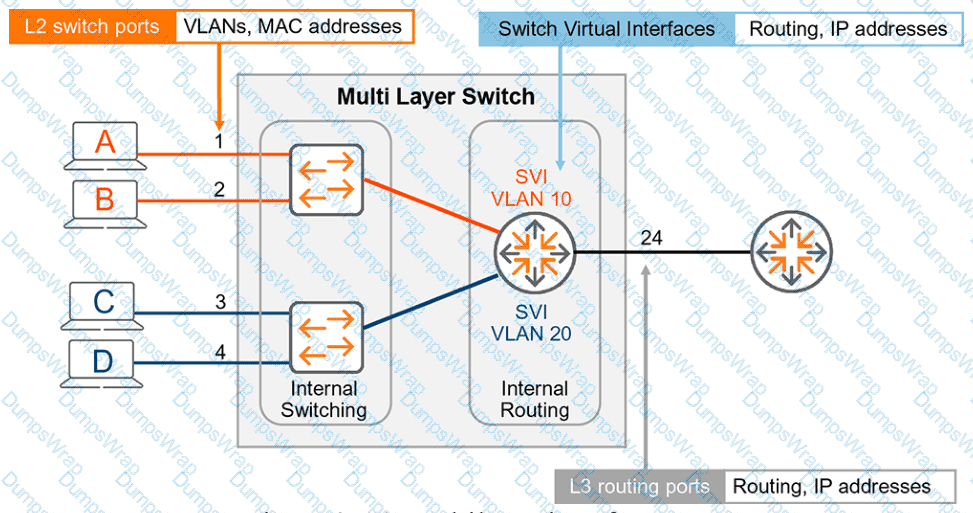
A Switched Virtual Interface (SVI) is a logical Layer 3 interface associated with a particular VLAN.
It enables a multilayer switch to provide default-gateway services for hosts within that VLAN's IP subnet.
The exhibit shows PC 2 and PC 3 connected through separate access switches but belonging to the same VLAN 20 subnet.
Both hosts should use Switch 1's VLAN 20 SVI address as their default gateway.
The appropriate AOS-CX configuration is:
configure terminal
vlan 20
interface vlan 20
ip address 10.20.0.1/24
no shutdown
The interface vlan 20 command creates or enters the SVI configuration context.
The ip address command assigns the required Layer 3 address and subnet prefix.
Switch 1 must also have operational Layer 2 connectivity to VLAN 20 through the downstream switch links.
PC 2 and PC 3 can then use 10.20.0.1 as their default gateway.
Option A confuses a switch's own default gateway with the gateway it provides to connected hosts.
Option B uses an incorrect interface context.
Option C attempts to configure an IP address directly under the Layer 2 VLAN context rather than the SVI.
Therefore, Option D is correct.
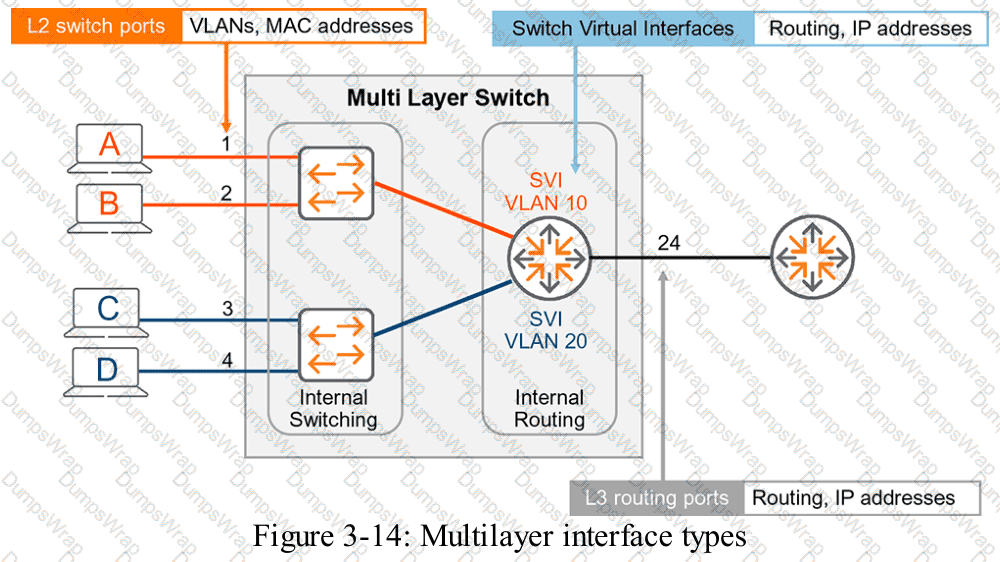
HPE Press study-guide figure / related learning illustration · Q185 Fig 3-14 SVI
Which option is an example of a device function in HPE Aruba Networking Central?
Options:
Top-Of-Rack switch
Campus Access Point
Branch router
Edge switch
Answer:
BExplanation:
Comprehensive and Detailed Explanation
HPE Press guide context | PDF page 589 | HPE Press, Aruba Certified Associate – Campus Access Official Certification Study Guide
Technical Deep Dive — Original Chat Wording
A device function identifies the role that a managed device performs in the network.
In the newer HPE Aruba Networking Central configuration architecture, device functions help determine which configuration profiles can be applied to infrastructure.
For switches, supported functions include Access Switch, Aggregation Switch, and Core Switch.
For wireless infrastructure, supported functions include Campus Access Point and Microbranch Access Point.
The device function is important because different infrastructure roles require different configuration capabilities.
For example, a Campus Access Point may need WLAN SSID profiles, radio-related settings, and wireless access policies.
An access switch instead requires profiles associated with Ethernet ports, switching, and supported authentication functions.
Central uses the assigned function to present applicable configuration workflows and profile categories.
This prevents administrators from treating devices with fundamentally different responsibilities as interchangeable configuration targets.
The official function identifier for Campus Access Point is CAMPUS_AP .
Top-Of-Rack switch, Branch router, and Edge switch are descriptive networking terms, but they are not the exact supported device-function names in the official list.
The distinction matters because examination questions may use terms that sound architecturally reasonable without matching Central's actual configuration terminology.
Therefore, Option B (Campus Access Point) is correct.
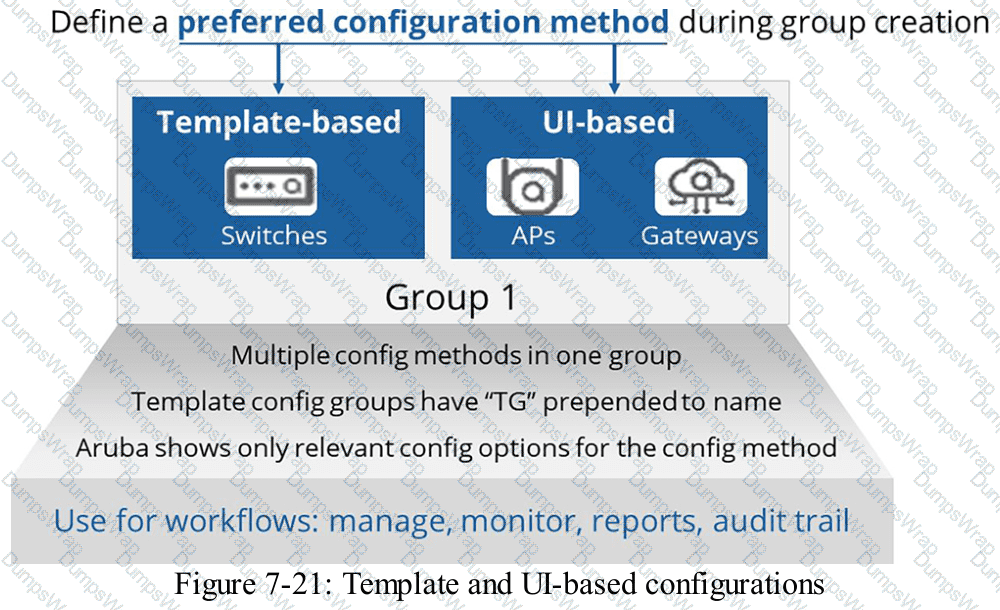
HPE Press study-guide figure / related learning illustration · Q183 Fig 7-21 config
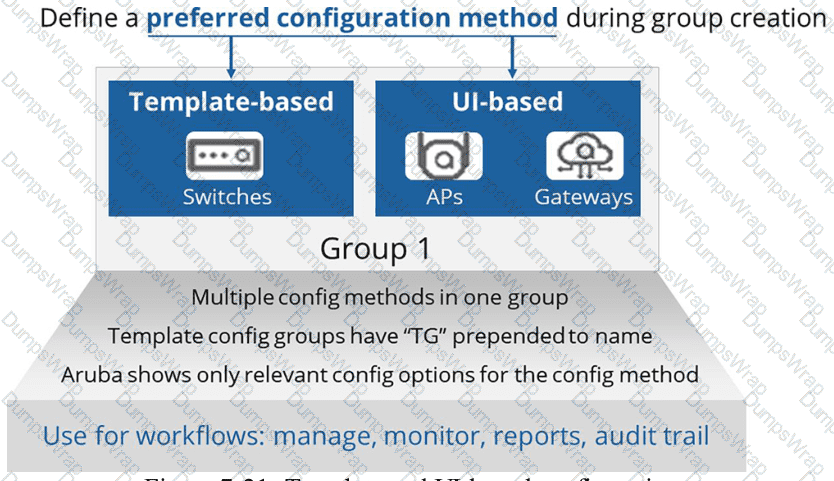
Which device configuration group types can a user define in HPE Aruba Networking Central when creating a group?
Choose two
Options:
ESP group
UI group
Template group
Default group
Answer:
B, CExplanation:
Comprehensive and Detailed Explanation
HPE Press guide context | PDF page 588 | HPE Press, Aruba Certified Associate – Campus Access Official Certification Study Guide
Technical Deep Dive — Reconstructed (Original Chat Text Not Recoverable)
Aruba Central group configuration can be template-based or UI-based. Templates permit shared CLI constructs with device-specific variables, while UI groups provide guided graphical workflows. ESP and Default are not the two device-configuration group categories that the question is testing.
The selected answer corresponds to B: UI group; C: Template group. This matches the mechanism or management behavior described in the scenario rather than merely a related network feature.
In an AOS-CX or Aruba Central deployment, the relevant settings must be applied in the correct interface, profile, policy, or management scope and then validated operationally.
A change that is applied to the wrong VRF, VLAN, user role, or device group can be syntactically valid while leaving the original network requirement unmet.
When reviewing alternatives, identify which one directly addresses the stated requirement, rather than selecting a related capability that is useful elsewhere but does not fulfill the requested task.
The wrong choices may describe real technologies, but they perform different functions, apply to another layer, or omit a required prerequisite. Select the answer that resolves the exact scenario, not a nearby administrative task.
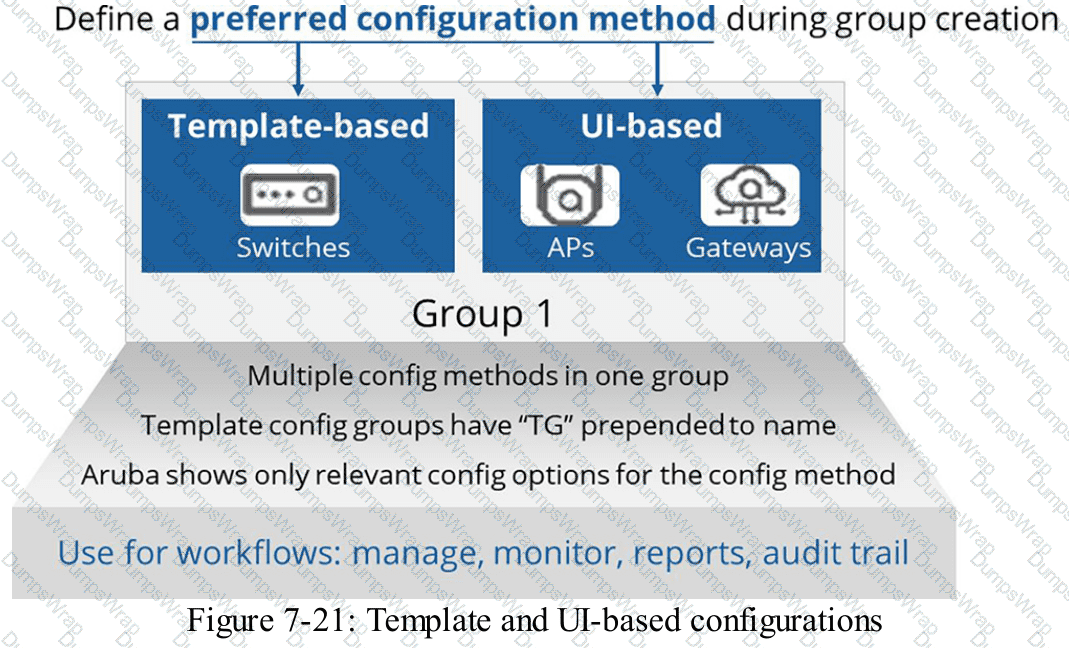
HPE Press study-guide figure / related learning illustration · Q71 UI Template
How do Audit Trail filters improve troubleshooting efficiency in HPE Aruba Networking Central?
Options:
They emphasize severe events without regard to time or source.
They show every log record without filtering.
By narrowing down logs to relevant actions, devices, or times
By speeding up event log retrieval to support all connected devices at once
Answer:
CExplanation:
Comprehensive and Detailed Explanation
HPE Press guide context | PDF page 680 | HPE Press, Aruba Certified Associate – Campus Access Official Certification Study Guide
Technical Deep Dive — Original Chat Wording
The Audit Trail records administrative activities and supported system events generated within HPE Aruba Networking Central.
These records are valuable when a network problem appears shortly after a configuration change.
However, an enterprise environment may generate substantial numbers of audit entries across numerous sites, devices, and administrators.
Filtering enables technicians to isolate records associated with a specific investigation.
For example, if a campus switch stops forwarding traffic after a planned maintenance window, the engineer can filter the Audit Trail to examine activity affecting that switch during the relevant period.
The resulting entries may identify a VLAN change, interface modification, or unsuccessful configuration operation.
Filters can also help determine which administrator initiated an action and whether the management system successfully completed it.
This reduces the amount of irrelevant information that must be reviewed.
Time filters are particularly useful because they allow engineers to correlate configuration events with the reported onset of a problem.
A general event-severity display does not provide the same targeted administrative history.
Displaying every record without filtering makes investigation less efficient.
Therefore, Option C (By narrowing down logs to relevant actions, devices, or times) is correct.
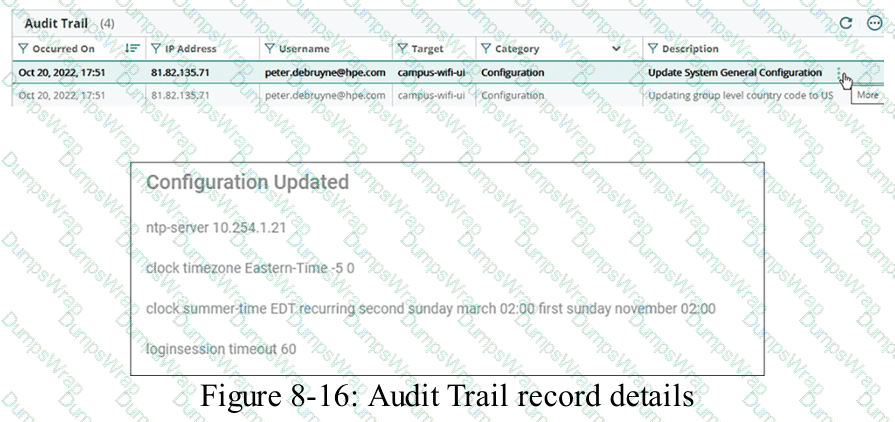
HPE Press study-guide figure / related learning illustration · Q186 Fig 8-16 Audit
When assessing an architect’s high-level network design, which information should be identified?
Options:
Each room's floor number and coordinates
Site-access requirements for every location
Location and building information
The physical address of each building site
Answer:
CExplanation:
Comprehensive and Detailed Explanation
HPE Press guide context | PDF page 667 | HPE Press, Aruba Certified Associate – Campus Access Official Certification Study Guide
Technical Deep Dive — Original Chat Wording
A high-level network design describes the overall architecture required to satisfy an organization's business and technical objectives.
It identifies major infrastructure components, network locations, logical segmentation, connectivity requirements, and important architectural dependencies.
Location and building information are essential because physical geography directly affects network topology and infrastructure planning.
For example, an organization may operate three office buildings connected through a campus distribution network.
The high-level design should identify these buildings, their general locations, and their connectivity relationships.
This information helps determine where access, aggregation, and core infrastructure should be positioned.
It also supports decisions involving inter-building fiber connections, network redundancy, wireless deployment, and management boundaries.
Detailed room coordinates and individual floor-plan measurements are normally developed during more detailed site surveys and low-level design activities.
Site-access requirements are also important, particularly for implementation planning, but the question asks for the broad physical information required to interpret the architecture.
A building's postal address may be useful, but it does not independently describe the building's role or relationship within the campus network.
The high-level design therefore needs a broader description of locations and buildings, rather than only mailing addresses or precise individual-room coordinates.
Therefore, Option C (Location and building information) is correct.
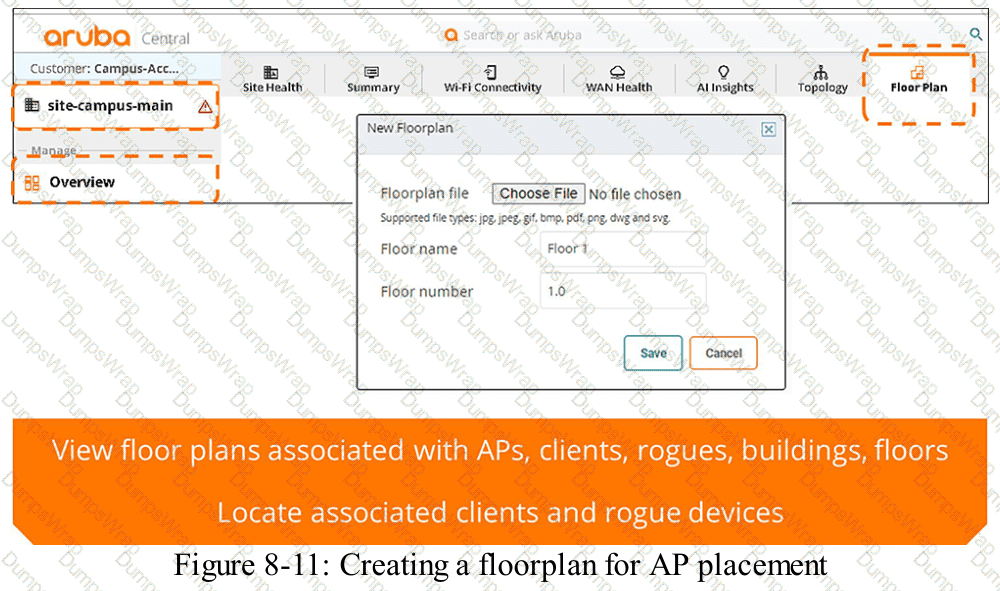
HPE Press study-guide figure / related learning illustration · Q194 Fig 8-11 floorplan
Which capabilities are available to users who are assigned the View Only role in HPE Aruba Networking Central?
Options:
Apply network configuration changes
View dashboards, reports, and analytics
Create and schedule new reports
Edit dashboards, reports, and analytics
Answer:
BExplanation:
Comprehensive and Detailed Explanation
HPE Press guide context | PDF page 588 | HPE Press, Aruba Certified Associate – Campus Access Official Certification Study Guide
Short exact extract: “Aruba Central allows you to manage configurations for different device types.”
Technical Deep Dive — Original Chat Wording
Role-Based Access Control (RBAC) is a security mechanism that associates administrative permissions with defined user roles.
HPE Aruba Networking Central uses RBAC to ensure administrators receive access appropriate to their responsibilities.
The View Only role is intended for personnel who need operational visibility without the ability to change network settings.
For example, monitoring personnel may need to review device availability, network-health dashboards, alerts, and reports while investigating service problems.
Providing read-only permissions allows these users to observe the environment without introducing unnecessary configuration risks.
This supports the principle of least privilege.
A View Only user can inspect permitted dashboards, reports, and analytics but does not receive the same capabilities as an administrator.
Applying network configuration changes requires appropriate write permissions.
Creating new reports and scheduling report generation also generally require report-management permissions beyond read-only access.
Editing dashboards, reports, or analytics configuration similarly requires an authorized management role.
Read-only privileges should not be confused with unrestricted access to every resource. Additional scope restrictions can determine which sites and devices a user is permitted to view.
Therefore, Option B (View dashboards, reports, and analytics) is correct.
HPE Press study-guide figure / related learning illustration · Q152 Fig 7-21 Groups
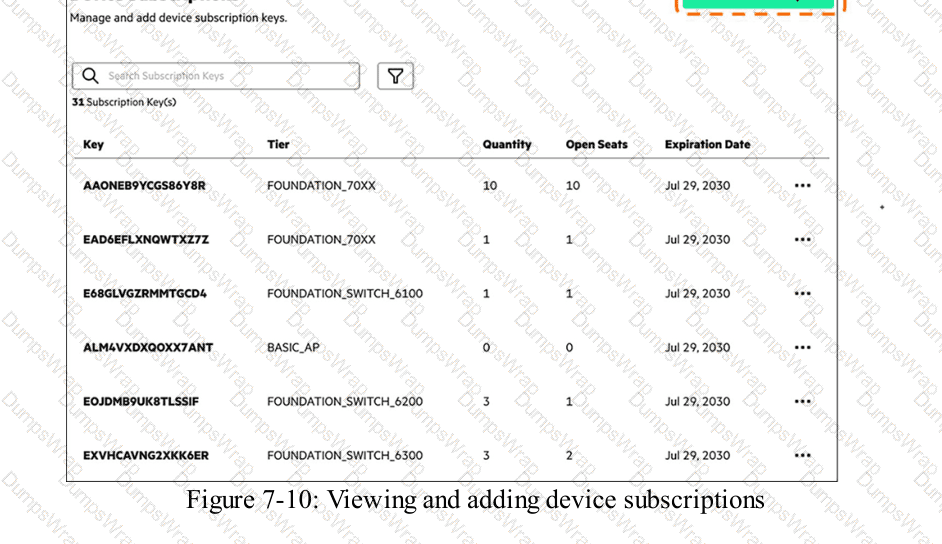
After selecting the Available Subscriptions number on the Inventory and Subscriptions card, what information is available to you?
Options:
Expiration information for subscription keys and subscriptions.
Firmware versions installed on devices in the subscription list.
Client onboarding success rates across different network segments.
Device assignment history for each onboarding attempt by user.
Answer:
AExplanation:
Comprehensive and Detailed Explanation
HPE Press guide context | PDF page 577 | HPE Press, Aruba Certified Associate – Campus Access Official Certification Study Guide
Technical Deep Dive — Original Chat Wording
HPE Aruba Networking Central uses subscription entitlements to authorize the management of supported switches, access points, and gateways.
The Inventory and Subscriptions card summarizes the number of registered devices and the available management subscriptions.
Selecting Available Subscriptions opens the detailed Subscription Keys page.
This page allows administrators to review subscription-related information, including available entitlements and their expiration status.
For example, a company may have multiple subscription keys purchased at different times.
Each key can have a different expiration date, making centralized subscription tracking important.
Administrators can identify subscriptions approaching expiration and plan renewals before management-service entitlements are interrupted.
The interface also helps organizations distinguish between available subscription capacity and subscriptions already assigned to managed devices.
Firmware versions are managed through device inventory and firmware-management functions.
Client onboarding success rates concern network-access performance and authentication processes.
Device assignment history may be recorded through applicable audit functions, but it is not the information specifically exposed by selecting Available Subscriptions.
Understanding subscription expiration is particularly important for networks that rely on continuous cloud-based infrastructure management.
Therefore, Option A (Expiration information for subscription keys and subscriptions) is correct.
HPE Press study-guide figure / related learning illustration · Q168 Fig 7-10 Subscriptions
Which actions help map high-level components to a low-level design?
Choose two
Options:
Apply subnetting to the allocated IP addressing space and plan the corresponding VLANs.
Select communication protocols for each device.
Define user roles and permissions.
Define the network topology design or define bandwidth requirements.
Answer:
A, BExplanation:
Comprehensive and Detailed Explanation
HPE Press guide context | PDF page 220 | HPE Press, Aruba Certified Associate – Campus Access Official Certification Study Guide
Technical Deep Dive — Original Chat Wording
High-level network design establishes the overall infrastructure architecture, including the principal network layers, connectivity models, redundancy strategy, and performance requirements.
Low-level design transforms these architectural decisions into configurations and implementation instructions.
One essential activity is defining the IP addressing structure.
Subnetting the allocated address space and assigning subnets to VLANs establishes the logical organization of the network.
For example, an architect may specify separate networks for employees, guests, and IoT devices.
The low-level design translates these requirements into VLAN IDs, IP prefixes, switched virtual interfaces, and gateway addresses.
Another important activity is selecting the communication protocols required by the design.
A campus implementation may use OSPF for routing, LACP for link aggregation, LLDP for neighbor discovery, and 802.1X for endpoint authentication.
These choices must ultimately be mapped to particular interfaces and devices.
Option D primarily describes high-level decisions—topology and bandwidth requirements—rather than their translation into implementation details.
Option C concerns access-control design and can also form part of a complete low-level security configuration.
However, the two strongest choices for mapping the question's network architecture components into a device-level design are IP/VLAN planning and communication-protocol selection.
Therefore, Options A and B are the best intended answers.
HPE Press study-guide figure / related learning illustration · Q138 Fig 3-14 SVI
After configuring the edge-switch uplink as requested, your colleague reports that they cannot ping the core. You ask them to confirm that the connection is plugged in and that the switch is powered on; they confirm both. You ping the core switch and verify that the ping also fails.
Knowing the nature of this deployment, which commands could you use to troubleshoot the issue?
Options:
Plaintext
Show run- to view the running configuration of the switch
Show run I begin 20 "vlan 20" -to ensure VLAN 20 was correctly added to the database
Show run I begin 20 "interface vlan 20"- to view the L3 SVI configuration
Show run interface 1/1/51,1/1/52- to ensure the physical interfaces are no shut and were added as members of LAG 1
Show run int lag1 -to verify LACP mode active was configur
Plaintext
ping 10.1.1.1 -ping the core to attempt to verify connectivity
Show lacp agg- to verify which link aggregations are currently configured using which physical ports
Show lacp int - to verify the LACP status and whether any links are blocking in your topology
Show lldp neighbors- to verify whether you are ablr to see the Core as an L2 neighbot to verify if the correct links are plugged in to the
Plaintext
Diagnostic diag
cable-diag 1/1/51
diag cable-diag 1/1/52-to view diagnostic information for the physical link to get a status on any interruptions to Layer 1
Connectivity
Show ip route- to verify that the default gateway is present in the routing table
Show ip ospf- to check whether there is a layer 3 routing protocol enabled
Show ip dns - to view whether there is a valid dns
Plaintext
Ping 10.1.1.1- ping the core to attempt to verify connectivity
Show trunk- to verify if the LAG interface was correclty added to the switch
Show spanning tree- to check for spanning-tree blocked states
Show port-access clients interface all-to view any port-access blocking states or failed authentication attempts on all interfaces
Show run interface vlan20 -to double check the layer 3 sv
Answer:
BExplanation:
Comprehensive and Detailed Explanation
HPE Press guide context | PDF page 154 | HPE Press, Aruba Certified Associate – Campus Access Official Certification Study Guide
Technical Deep Dive — Original Chat Wording
When a newly configured LACP uplink cannot establish connectivity to the core, troubleshooting should proceed systematically through physical connectivity, LACP negotiation, VLAN configuration, and Layer 3 addressing.
Option B contains the most appropriate command sequence because it examines each of these areas.
The ping 10.1.1.1 command tests connectivity to the core gateway.
The show lacp aggregates command identifies configured LAGs and their associated member interfaces.
The show lacp interfaces command reveals LACP negotiation state, synchronization, and forwarding conditions.
The show lldp neighbor-info command helps determine whether the expected core switch is physically connected to the appropriate ports.
The interface configuration checks then verify that the physical interfaces are enabled and assigned to the correct LAG.
The administrator must also check whether LAG 1 permits the required VLANs and whether VLAN 20 is configured as the correct native VLAN.
Finally, the SVI configuration must be inspected to verify the management IP address and operational status.
A concise troubleshooting command set is:
ping 10.1.1.1
show lacp aggregates
show lacp interfaces
show lldp neighbor-info
show running-config interface lag 1
show running-config interface vlan 20
Other diagnostic commands may be useful, but Option B provides the most complete and relevant workflow for this particular LACP-based deployment.
Therefore, Option B is correct.
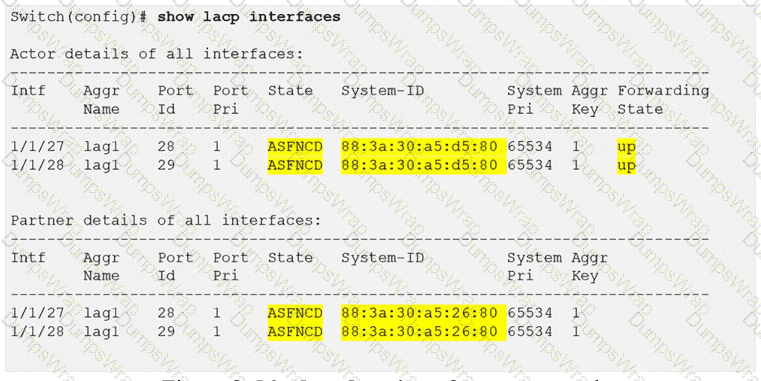
HPE Press study-guide figure / related learning illustration · Fig 2-56 LACP state
Which Protocol Data Unit (PDU) corresponds to the data link layer PDU?
Options:
PDU3 - Packet
PDU4 - Segment
PDU2 - Frame
PDU1 - Signal
Answer:
CExplanation:
Comprehensive and Detailed Explanation
HPE Press guide context | PDF page 34 | HPE Press, Aruba Certified Associate – Campus Access Official Certification Study Guide
Technical Deep Dive — Reconstructed (Original Chat Text Not Recoverable)
The OSI data-link layer encapsulates traffic as frames containing MAC addressing and error-detection fields. The network layer uses packets, the transport layer segments/datagrams, and the physical layer transmits bits or symbols. Protocol data unit names reflect the encapsulation handled at each layer.
The selected answer corresponds to C: PDU2 - Frame. This matches the mechanism or management behavior described in the scenario rather than merely a related network feature.
Operational workflows should preserve consistent inventory, authorization, configuration history, and monitoring so that administrators can locate and manage devices predictably.
For example, a cloud-managed infrastructure device may be registered successfully but still require the correct subscription, site, group, and configuration scope.
In production, the decision should be documented and checked against the supported software release and platform model, because interface names, licensing tiers, and management workflows can change across Central and AOS-CX generations.
For practical use, confirm the prerequisite conditions first, then verify the resulting operational state. This separates an intended configuration from a working network service and avoids accepting a misleading result.
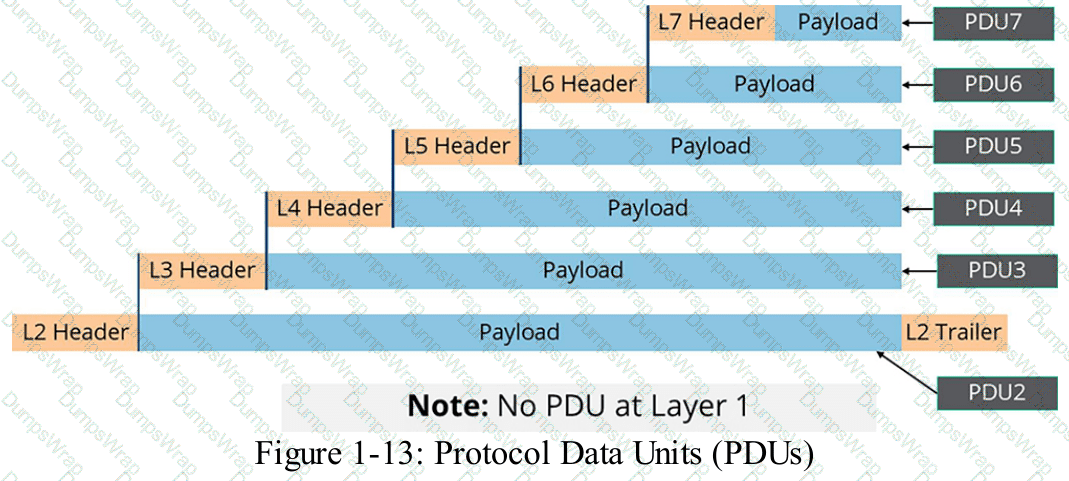
HPE Press study-guide figure / related learning illustration · Q63 PDU
Why is device management important when configuring a campus network in HPE Aruba Networking Central?
Options:
It ensures each device is properly set up for use.
It creates a backup of user data on every device.
It lets devices update their firmware automatically each time.
It helps assign the same network role to all devices.
Answer:
AExplanation:
Comprehensive and Detailed Explanation
HPE Press guide context | PDF page 567 | HPE Press, Aruba Certified Associate – Campus Access Official Certification Study Guide
Short exact extract: “The onboard device process starts at the device inventory.”
Technical Deep Dive — Original Chat Wording
Effective device management ensures that network infrastructure is registered, configured, monitored, and maintained according to organizational requirements.
HPE Aruba Networking Central provides a centralized management environment for supported switches, APs, and gateways.
During onboarding, administrators register devices, satisfy management-subscription requirements, and assign applicable configuration settings.
Once management is established, devices can receive the settings appropriate to their role in the network.
For example, a campus access switch may require user VLANs, 802.1X authentication, LACP uplinks, and PoE settings.
An aggregation switch may instead require Layer 3 routing, redundant uplinks, and different security controls.
Centralized management helps ensure that these distinct configurations are consistently deployed and maintained.
It also supports operational visibility, troubleshooting, and firmware lifecycle management.
However, the management process does not automatically back up user data stored on every connected endpoint.
Firmware automation is an available lifecycle capability, but updating every device on every occasion is neither the primary purpose nor universally appropriate.
Likewise, assigning an identical network role to every infrastructure device would ignore the different functions performed by access, aggregation, and core equipment.
The fundamental objective is to ensure each device is prepared for its intended operational purpose.
Therefore, Option A (It ensures each device is properly set up for use) is correct.

HPE Press study-guide figure / related learning illustration · Q157 Fig 7-1 Onboard
Which indicator can signify a fault in a module on the rear of a switch chassis?
Options:
A module LED slowly flashes amber.
The front-panel reset control stays lit.
A module light flashes quickly in green color.
A module light stays on in a blue color.
Answer:
AExplanation:
Comprehensive and Detailed Explanation
HPE Press guide context | PDF page 1006 | HPE Press, Aruba Certified Associate – Campus Access Official Certification Study Guide
Technical Deep Dive — Original Chat Wording
HPE Aruba Networking AOS-CX switches provide hardware status indicators that allow technicians to identify operational faults without relying exclusively on the command-line interface.
The Back LED is associated with rear-mounted modular components on applicable switch models.
Under normal conditions, the corresponding status indication is green.
A slow flashing amber indication means the switch has detected a fault affecting a module in the rear of the chassis.
This may involve a supported power or other modular hardware component, depending on the switch platform.
The technician should identify the affected component, inspect relevant environmental information, and determine whether the problem requires reseating or replacement.
Useful AOS-CX diagnostic commands can include:
show environment
show system
show events -r
Command availability and output vary by platform and software release.
The guide distinguishes the Back LED from the PoE LED.
A slow flashing amber PoE indicator identifies a PoE-related fault under the documented LED-mode conditions.
The reset control is a physical system-control mechanism rather than a status indication for rear modules.
A green indicator ordinarily represents a healthy or selected operating state, while blue may be used for identification functions on certain platforms.
Therefore, Option A (A module LED slowly flashes amber) is correct.
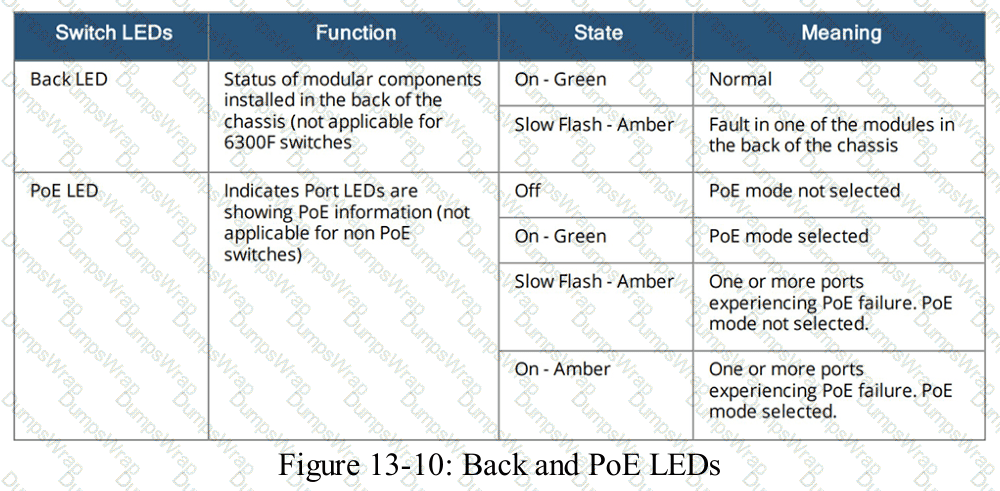
HPE Press study-guide figure / related learning illustration · Q184 Fig 13-10 LED
What occurs when an AP’s signal weakens because it is absorbed while traveling through an object?
Options:
HPE Aruba Networking Central dynamically moves clients to neighboring APs.
Signal to Noise Ratio (SNR) decreases.
Signal to Noise Ratio (SNR) increases.
APs will use bonded channels to decrease latency to clients.
Answer:
BExplanation:
Comprehensive and Detailed Explanation
HPE Press guide context | PDF page 717 | HPE Press, Aruba Certified Associate – Campus Access Official Certification Study Guide
Technical Deep Dive — Reconstructed (Original Chat Text Not Recoverable)
Absorption and penetration loss weaken received RF signal strength. If the noise floor is relatively unchanged, this reduces signal-to-noise ratio and can force lower modulation/coding rates or retransmissions. Central cannot automatically eliminate building material loss, and channel bonding does not directly compensate for lower SNR.
The selected answer corresponds to B: Signal to Noise Ratio (SNR) decreases.. This matches the mechanism or management behavior described in the scenario rather than merely a related network feature.
Optimization should consider both immediate performance and its tradeoffs in RF capacity, airtime, reliability, security, and operational overhead.
Use measurements rather than assumptions: compare the RF or switch metrics before and after making a controlled change.
For an administrator preparing for the associate certification, the key distinction is the precise protocol or Central workflow involved. Similar-sounding features often operate at different OSI layers or management stages.
The wrong choices may describe real technologies, but they perform different functions, apply to another layer, or omit a required prerequisite. Select the answer that resolves the exact scenario, not a nearby administrative task.
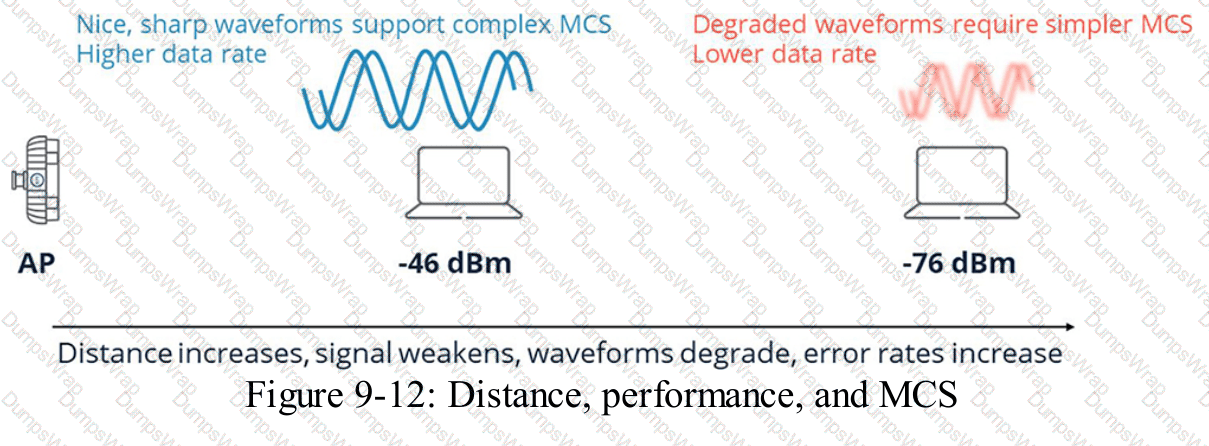
HPE Press study-guide figure / related learning illustration · Fig 9-12 Attenuation
Match the most cost-effective cabling option to each requirement. All lengths include the total cable length, including patch cables and service loops where used.
Drag & Drop
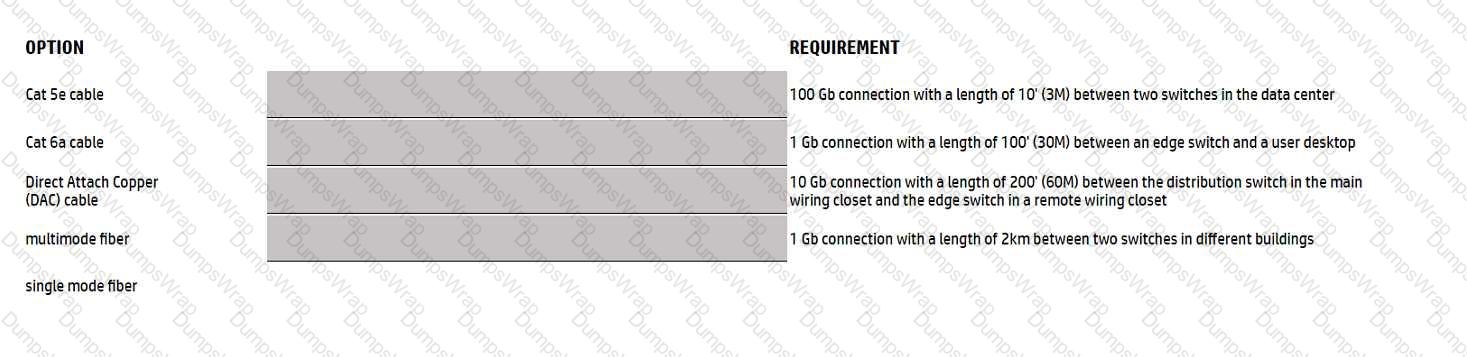
Options:
Answer:
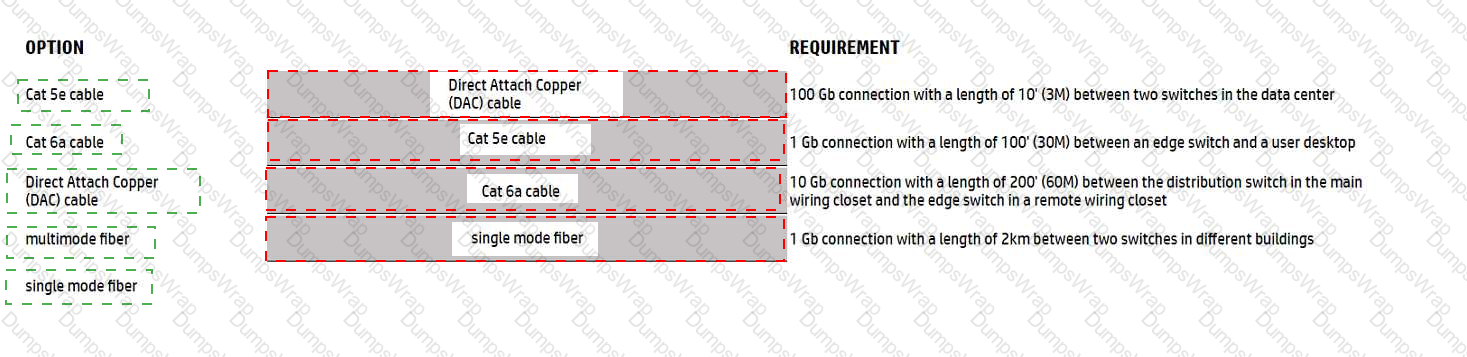
Explanation:
See mapping
Exhibit item
Correct match
100 Gb, 3 m, data center switches
Direct Attach Copper (DAC) cable
1 Gb, 30 m, access switch to desktop
Cat 5e cable
10 Gb, 60 m, distribution to access switch
Cat 6a cable
1 Gb, 2 km, between buildings
Single-mode fiber
Comprehensive and Detailed Explanation
HPE Press guide context | PDF page 43 | HPE Press, Aruba Certified Associate – Campus Access Official Certification Study Guide
Technical Deep Dive — Reconstructed (Original Chat Text Not Recoverable)
The 100-Gb/s three-meter switch interconnect is best served by a supported DAC; 1-Gb/s at 30 meters can use Cat 5e; 10-Gb/s at 60 meters requires suitable Cat 6a; and a two-kilometer 1-Gb/s inter-building connection requires compatible single-mode optical fiber. Optics must match fiber type, speed, wavelength, and distance.
The exhibit is a matching question: each original item must be paired with the applicable protocol, medium, security function, or address classification. The answer table below records the intended correspondence without changing the source exhibit.
In campus network design, a successful decision must satisfy the customer's capacity, topology, physical environment, and lifecycle constraints.
For example, a campus may have sufficient equipment for today but require additional switch ports, PoE budget, or wireless capacity as its user population grows.
A strong verification step is to compare the expected outcome with operational status before and after the change. This confirms not only that a configuration was accepted, but also that the required service actually functions.
A network technician is confirming that a customer connected successfully to the guest network after completing the captive portal. The technician reviews the access tracker in HPE Aruba Networking ClearPass.
Which role should appear on the OUTPUT tab for the customer’s session?
Options:
Guest authenticated
Guest logon
Captive portal login
Captive portal redirect
Answer:
AExplanation:
Comprehensive and Detailed Explanation
HPE Press guide context | PDF page 945 | HPE Press, Aruba Certified Associate – Campus Access Official Certification Study Guide
Technical Deep Dive — Original Chat Wording
HPE Aruba Networking ClearPass Policy Manager provides authentication and authorization services for enterprise and guest network access.
In a captive portal deployment, a guest initially connects to the wireless network and receives restricted connectivity.
The pre-authentication role normally permits essential network services, such as DHCP and DNS, and access to the captive portal.
The guest then completes the required registration or authentication process.
ClearPass evaluates the submitted credentials and applies the configured authorization policy.
When authentication succeeds, ClearPass can return RADIUS authorization information that allows the network infrastructure to assign the authenticated guest role.
The Access Tracker provides detailed information about the authentication transaction, including the request, authentication results, enforcement policy, and output attributes.
The OUTPUT tab helps administrators verify which authorization information was returned.
For the intended scenario, Guest authenticated indicates the post-authentication role.
A Guest logon role commonly represents the pre-authentication state in ArubaOS guest deployments.
Captive portal login and captive portal redirect refer to authentication or redirection functions rather than the requested authenticated guest role.
Importantly, actual role names are administrator-configurable. The study-guide lab uses an SSID-specific role name rather than a universal literal name of Guest authenticated .
Therefore, Option A is the intended answer, representing the successfully authenticated guest state.

HPE Press study-guide figure / related learning illustration · Q131 Fig 11-26 Guest Role
Which device in a WLAN is ultimately responsible for deciding to roam to a new AP?
Options:
The client device
The network gateway
The wireless controller
The access point
Answer:
AExplanation:
Comprehensive and Detailed Explanation
HPE Press guide context | PDF page 768 | HPE Press, Aruba Certified Associate – Campus Access Official Certification Study Guide
Technical Deep Dive — Reconstructed (Original Chat Text Not Recoverable)
The Wi-Fi client ultimately decides when to roam from one BSS to another. APs and WLAN management may provide 802.11k neighbor lists, 802.11v BSS transition advice, and 802.11r fast-transition support. However, the station controls the final association decision and timing.
The selected answer corresponds to A: The client device. This matches the mechanism or management behavior described in the scenario rather than merely a related network feature.
Optimization should consider both immediate performance and its tradeoffs in RF capacity, airtime, reliability, security, and operational overhead.
For example, higher PHY data rates do not guarantee higher useful throughput if airtime is lost to management traffic, contention, or retransmissions.
A strong verification step is to compare the expected outcome with operational status before and after the change. This confirms not only that a configuration was accepted, but also that the required service actually functions.
For practical use, confirm the prerequisite conditions first, then verify the resulting operational state. This separates an intended configuration from a working network service and avoids accepting a misleading result.
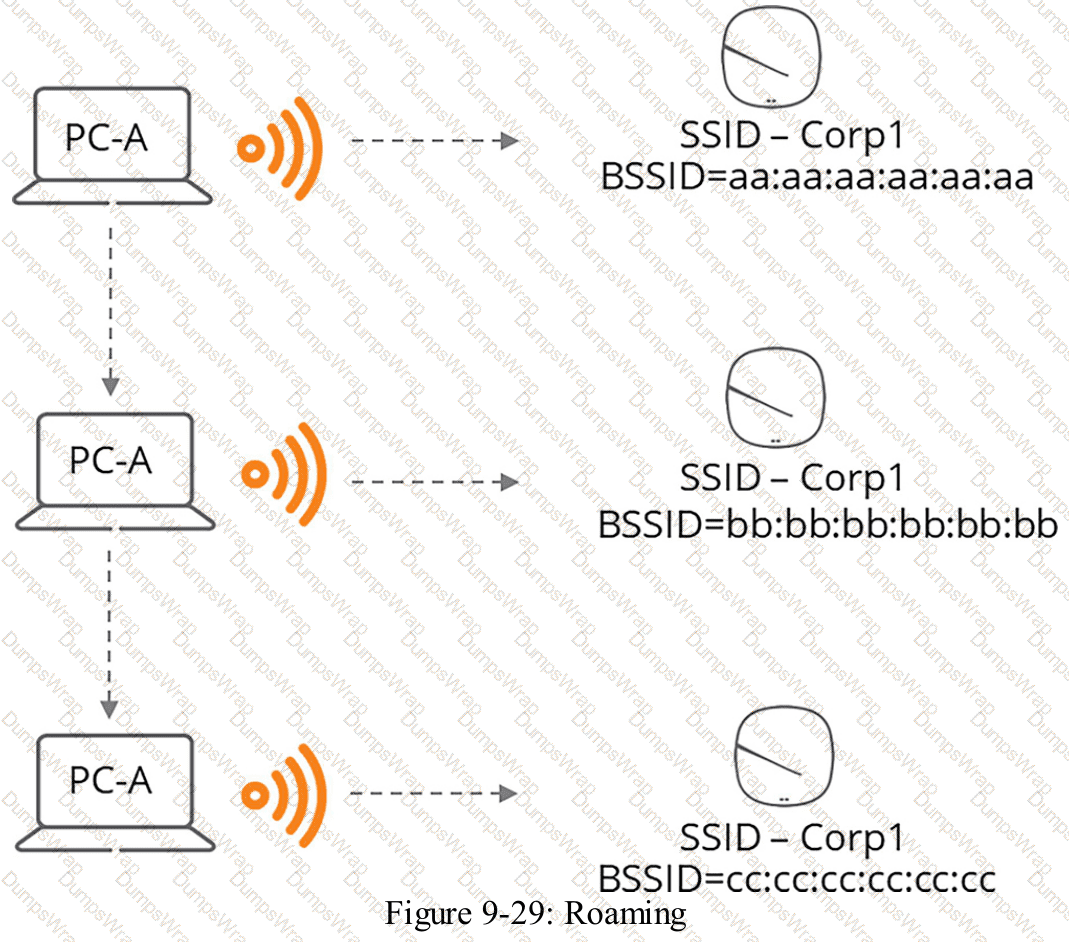
HPE Press study-guide figure / related learning illustration · Q68 Roaming
Why would you create a device group in HPE Aruba Networking Central?
Options:
Make configuration easier by organizing devices by administrator preference.
Assign unique subscription keys automatically based on device group.
Monitor Internet traffic usage for each device group in real time.
Restrict device firmware updates to specific hardware models only.
Answer:
AExplanation:
Comprehensive and Detailed Explanation
HPE Press guide context | PDF page 589 | HPE Press, Aruba Certified Associate – Campus Access Official Certification Study Guide
Technical Deep Dive — Original Chat Wording
Device groups provide a logical way to organize network infrastructure in HPE Aruba Networking Central.
The primary benefit is simplifying configuration management across multiple devices with similar operational requirements.
For example, an organization may have 50 access switches deployed across several branch offices.
Instead of configuring every switch individually, administrators can place compatible switches into an appropriate device group and apply common settings.
These settings may include VLAN configuration, authentication policies, interface parameters, and supported management options.
Central supports group-level configuration methods, including graphical workflows and templates.
When a device joins a group, it can inherit the configuration associated with that group, reducing repetitive administrative work and configuration inconsistencies.
Administrators can create separate groups according to organizational requirements, device types, configuration methods, or operational responsibilities.
However, group membership should reflect actual configuration compatibility rather than arbitrary personal preferences.
Device groups do not automatically generate unique management subscriptions for each member.
Although groups can be used as scopes for monitoring and firmware management, their fundamental purpose is not specifically Internet traffic accounting or restricting upgrades to particular hardware models.
They provide a reusable administrative configuration boundary.
Therefore, Option A (Make configuration easier by organizing devices) is correct.
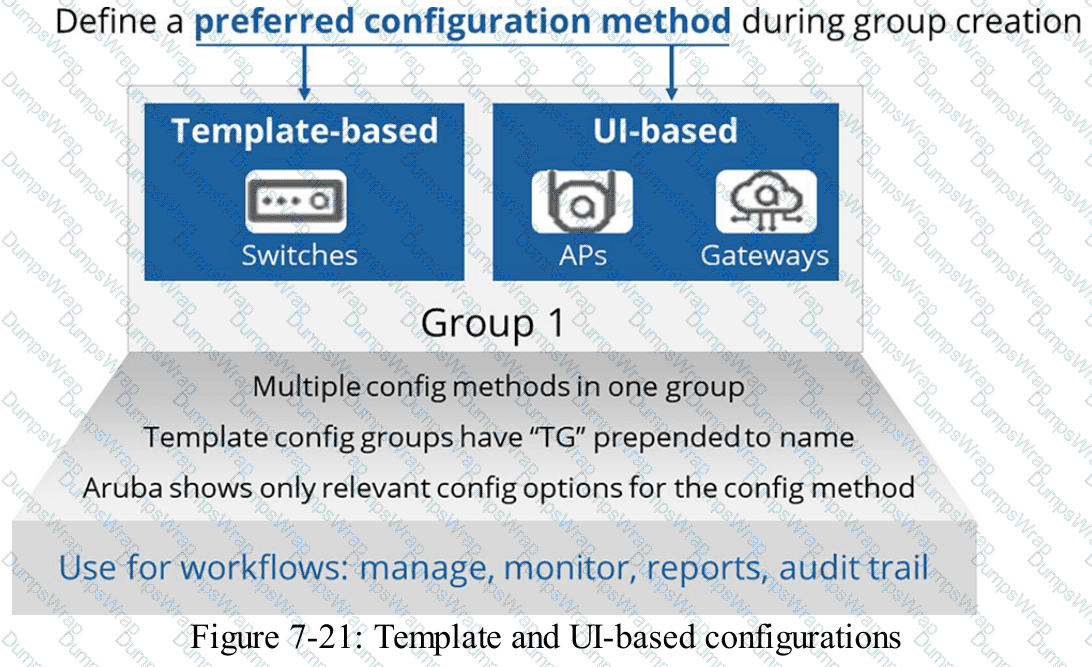
HPE Press study-guide figure / related learning illustration · Q197 Fig 7 21 Device Groups
A customer has recently implemented user and device certificates through a company-wide Group Policy Object (GPO).
Which EAP method requires client certificates to authenticate to the network?
Options:
EAP-TTLS
EAP-TEAP
EAP-TLS
PEAP
Answer:
CExplanation:
Comprehensive and Detailed Explanation
HPE Press guide context | PDF page 824 | HPE Press, Aruba Certified Associate – Campus Access Official Certification Study Guide
Short exact extract: “EAP-TLS is the preferred method and the one that you should implement for enterprise networks.”
Technical Deep Dive — Original Chat Wording
EAP-Transport Layer Security (EAP-TLS) is a certificate-based authentication method commonly used for secure enterprise wired and wireless networks.
It operates within the IEEE 802.1X authentication framework and provides mutual authentication between the supplicant and authentication server.
The authentication server presents its certificate so that the client can validate the server's identity.
The client also presents a valid certificate to authenticate its own identity.
This certificate-based approach avoids reliance on reusable passwords as the primary authentication secret.
In a Windows enterprise environment, Group Policy and certificate auto-enrollment can simplify certificate deployment to domain-managed computers and users.
HPE Aruba Networking ClearPass Policy Manager can validate presented certificates against trusted certificate authorities and apply authorization policies based on certificate attributes and other identity information.
EAP-TTLS and PEAP establish protected TLS tunnels, but they commonly support password-based inner authentication without requiring client certificates.
EAP-TEAP supports authentication chaining and may use certificates as part of its inner authentication methods. However, client certificates are not inherently required for every TEAP configuration.
EAP-TLS specifically requires the supplicant to possess a suitable certificate and private key for its normal certificate-based mutual authentication.
Certificate validation should also include appropriate trust-chain checks, validity periods, and identity verification.
Therefore, Option C (EAP-TLS) is correct.
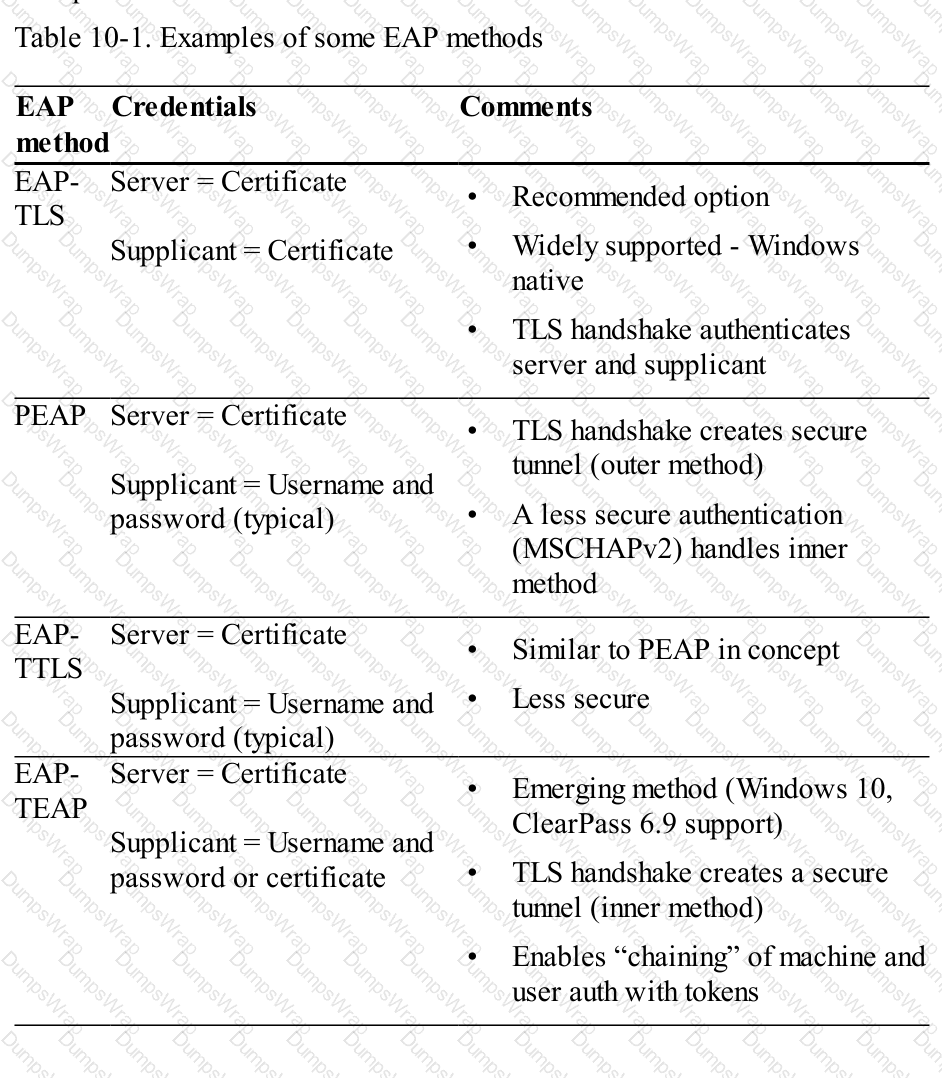
HPE Press study-guide figure / related learning illustration · Q123 Table 10-1 EAP TLS
Which command can be used to verify that all four 10G links in an LACP-LAG are operating correctly?
Options:
show interface lag verbose
show interface lag brief
show lacp
show link-aggregation summary
Answer:
BExplanation:
Comprehensive and Detailed Explanation
HPE Press guide context | PDF page 154 | HPE Press, Aruba Certified Associate – Campus Access Official Certification Study Guide
Technical Deep Dive — Reconstructed (Original Chat Text Not Recoverable)
The AOS-CX `show interface lag brief` command displays the active LAG interface and aggregate operational speed, which should be consistent with four active 10-Gb/s members. `show lacp interfaces` adds per-member partner and synchronization details. Generic commands from other switch vendors should not be assumed valid on AOS-CX.
The selected answer corresponds to B: show interface lag brief. This matches the mechanism or management behavior described in the scenario rather than merely a related network feature.
Operational workflows should preserve consistent inventory, authorization, configuration history, and monitoring so that administrators can locate and manage devices predictably.
The operational view should be interpreted together with its underlying records: an alert, subscription count, or device status may describe management state rather than physical availability.
The practical deployment consequence is important: a plausible configuration can still fail when the peer interface, device role, licensing scope, or physical medium is mismatched. Checking that surrounding dependency avoids a misleading diagnosis.
When troubleshooting or designing a change, verify compatibility between all participating devices, the management scope, and the applicable software release. The most useful evidence is the state observed on both sides of the affected connection.
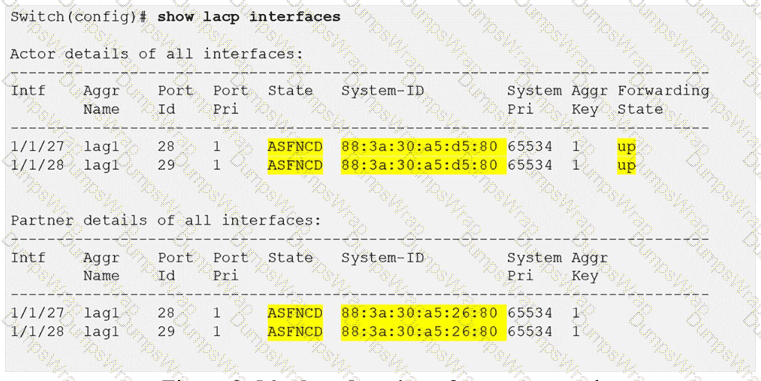
HPE Press study-guide figure / related learning illustration · Fig 2-56 LACP state
A network technician uses HPE Aruba Networking Central to troubleshoot network issues. Which dashboard can be used to view and acknowledge issues at the start of the troubleshooting process?
Options:
the Alerts and Events dashboard
the Audit Trail dashboard
the Reports dashboard
the Tools dashboard
Answer:
AExplanation:
Comprehensive and Detailed Explanation
HPE Press guide context | PDF page 1028 | HPE Press, Aruba Certified Associate – Campus Access Official Certification Study Guide
Technical Deep Dive — Reconstructed (Original Chat Text Not Recoverable)
Aruba Central Alerts & Events is the operational dashboard that lists relevant network conditions and supports acknowledging alerts. Reports provides scheduled historical summaries, Audit Trail tracks administrative actions, and Tools provides diagnostic tests. Start incident triage with the alert source and its impacted devices.
The selected answer corresponds to A: the Alerts and Events dashboard. This matches the mechanism or management behavior described in the scenario rather than merely a related network feature.
A disciplined investigation compares the observed symptom with expected behavior, tests the most likely failure stage, and verifies recovery rather than assuming that a single command has resolved the problem.
When possible, test the affected and unaffected paths in parallel; the differences often identify the precise dependency that is failing.
When reviewing alternatives, identify which one directly addresses the stated requirement, rather than selecting a related capability that is useful elsewhere but does not fulfill the requested task.
The wrong choices may describe real technologies, but they perform different functions, apply to another layer, or omit a required prerequisite. Select the answer that resolves the exact scenario, not a nearby administrative task.
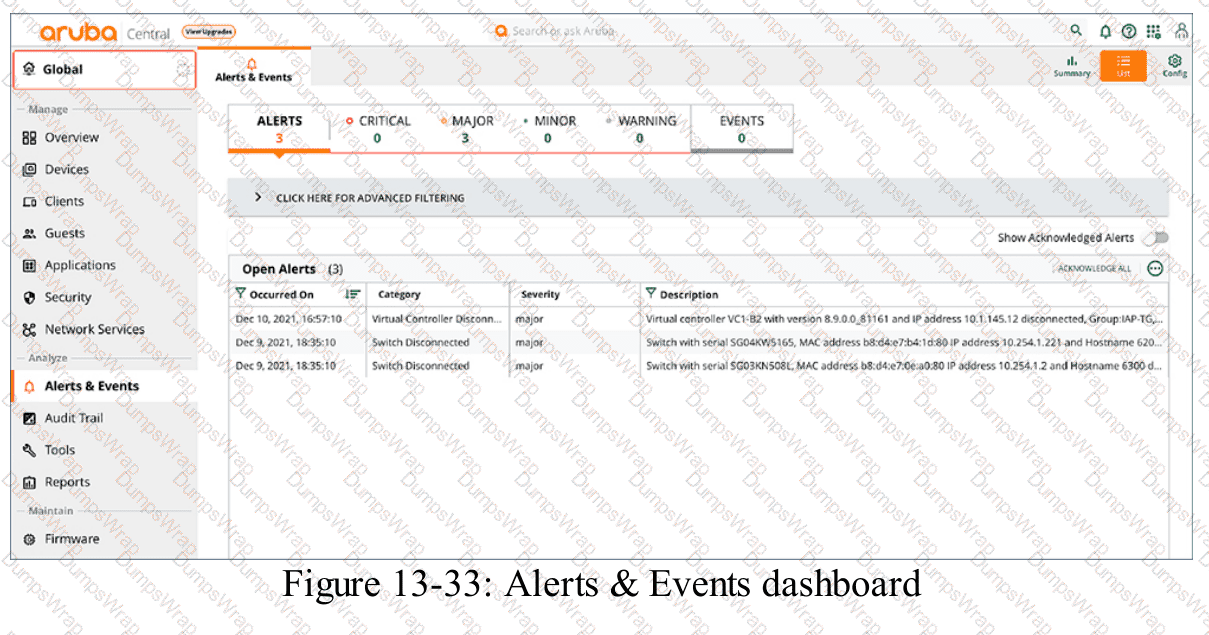
HPE Press study-guide figure / related learning illustration · Fig 13-33 Alerts
Match each switching technology to its appropriate use case.
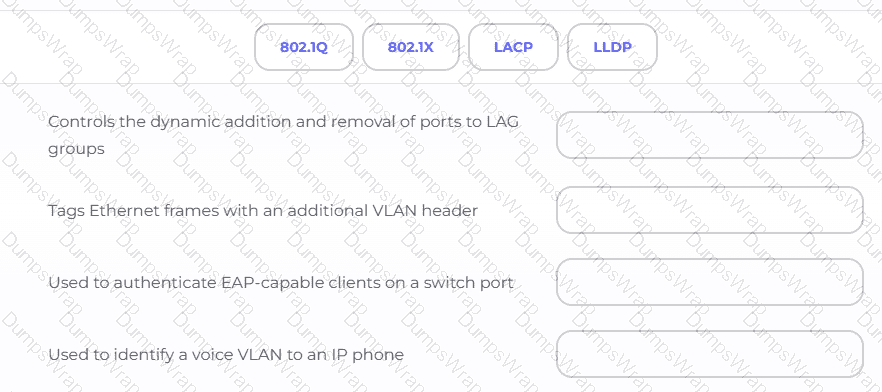
Options:
Answer:
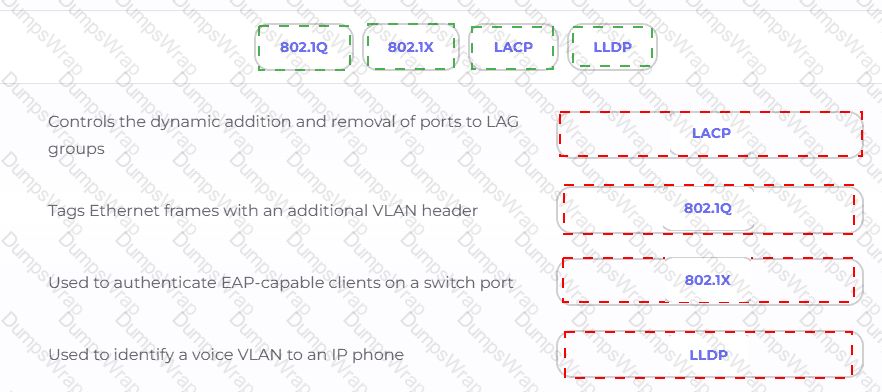
Explanation:
Exhibit item
Correct match
Dynamic addition and removal of LAG members
LACP
Tags Ethernet frames with VLAN header
802.1Q
Authenticates EAP-capable switch-port clients
802.1X
Identifies voice VLAN to an IP phone
LLDP
Comprehensive and Detailed Explanation
HPE Press guide context | PDF page 137 | HPE Press, Aruba Certified Associate – Campus Access Official Certification Study Guide
Technical Deep Dive — Reconstructed (Original Chat Text Not Recoverable)
LACP dynamically negotiates aggregated Ethernet members; IEEE 802.1Q tags Ethernet frames with VLAN identifiers; IEEE 802.1X performs access authentication using EAP; LLDP/LLDP-MED advertises neighbor and voice VLAN details. Each technology operates at a distinct networking function and should not be interchanged.
The exhibit is a matching question: each original item must be paired with the applicable protocol, medium, security function, or address classification. The answer table below records the intended correspondence without changing the source exhibit.
Operational workflows should preserve consistent inventory, authorization, configuration history, and monitoring so that administrators can locate and manage devices predictably.
Consistent RBAC, accurate inventories, and retained audit records simplify support handovers and reduce uncertainty during incident investigations.
For an administrator preparing for the associate certification, the key distinction is the precise protocol or Central workflow involved. Similar-sounding features often operate at different OSI layers or management stages.
The wrong choices may describe real technologies, but they perform different functions, apply to another layer, or omit a required prerequisite. Select the answer that resolves the exact scenario, not a nearby administrative task.
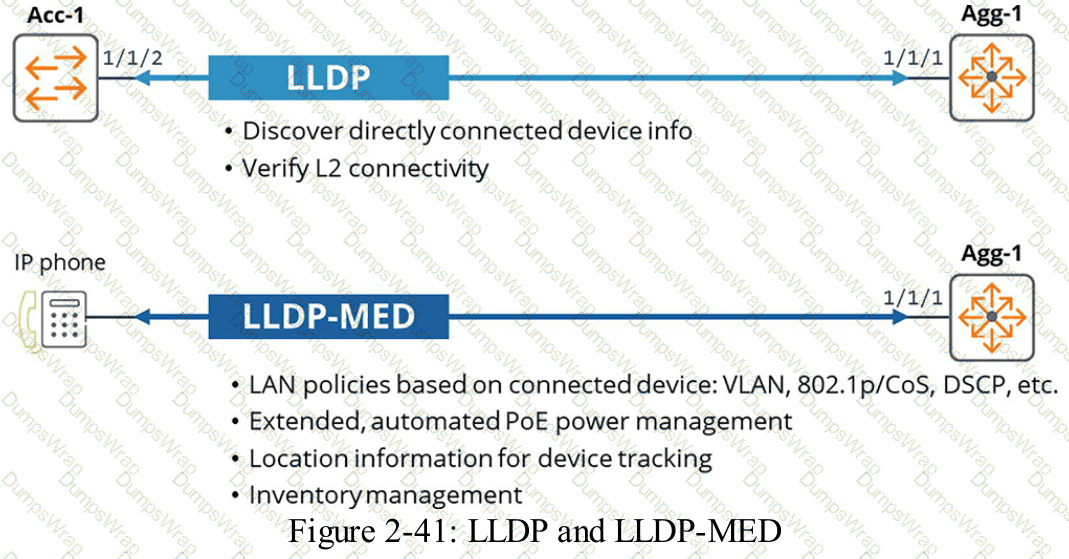
HPE Press study-guide figure / related learning illustration · Q74 LLDP MED
How can you indicate the importance or urgency of a network alert?
Options:
Set the priority level of the alert.
Record the alert details in a service log.
Escalate the alert to a different technician.
Assign the alert to a specific user group.
Answer:
AExplanation:
Comprehensive and Detailed Explanation
HPE Press guide context | PDF page 1042 | HPE Press, Aruba Certified Associate – Campus Access Official Certification Study Guide
Technical Deep Dive — Original Chat Wording
Network alerts help administrators identify operational conditions that may require investigation or corrective action.
In HPE Aruba Networking Central, alerts can represent infrastructure failures, connectivity problems, authentication errors, and other monitored events.
Alert priority identifies the operational urgency associated with a particular issue.
A critical service-impacting alert should generally receive more immediate attention than a low-impact informational event.
Central distinguishes between an alert's severity and its assigned priority .
Severity reflects the alert classification, such as Critical, Major, Minor, or Info.
Priority is used to organize the response workflow and can be adjusted according to operational requirements.
For example, an alert affecting a business-critical gateway may receive a Very High priority because the failure affects essential services.
A minor issue involving a noncritical device may receive a lower priority.
Administrators can use these classifications to organize troubleshooting activities and determine which issues require immediate escalation.
Recording an alert in a service log provides documentation but does not directly set its urgency.
Escalating an alert changes responsibility or workflow, while assigning an alert to a group identifies who may handle it.
Neither action replaces the explicit priority setting.
Therefore, Option A (Set the priority level of the alert) is correct.
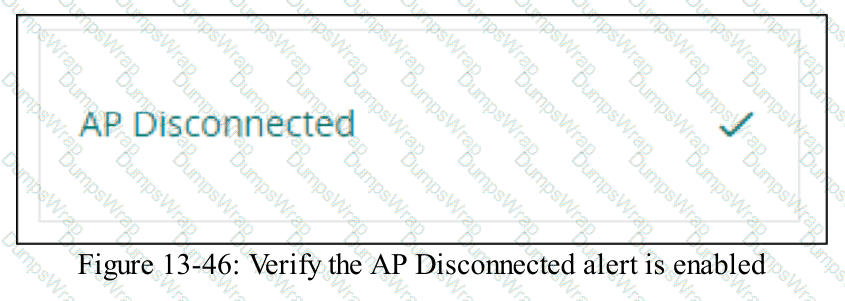
HPE Press study-guide figure / related learning illustration · Q122 Fig 13-46 Alerts
Which statement is true regarding role-based access control (RBAC) in HPE Aruba Networking Central?
Options:
Roles are assigned based on device groups
Permissions are assigned based on user roles
Permissions are granted to individual users directly
RBAC assigns access based on user location
Answer:
BExplanation:
Comprehensive and Detailed Explanation
HPE Press guide context | PDF page 842 | HPE Press, Aruba Certified Associate – Campus Access Official Certification Study Guide
Technical Deep Dive — Original Chat Wording
Role-Based Access Control (RBAC) is an authorization framework that determines which operations users are permitted to perform according to their assigned roles.
In HPE Aruba Networking Central, RBAC helps organizations separate administrative responsibilities and restrict access to sensitive network configuration functions.
Instead of independently defining every permission for every administrator, an organization assigns permissions to roles.
Users are then associated with the appropriate roles according to their operational responsibilities.
For example, an Administrator role can provide broad configuration and management permissions.
An Operator role can permit selected operational and troubleshooting activities without necessarily granting full administrative access.
A View Only role restricts users to permitted read-only operations.
This approach simplifies access management, particularly when organizations have large IT teams with different responsibilities.
RBAC also supports the principle of least privilege, whereby users receive only the permissions necessary to perform their assigned duties.
Modern Central deployments can additionally use scope and resource restrictions to control where those permissions apply.
However, location or device-group membership alone does not define RBAC permissions.
The essential relationship is that permissions belong to roles, and roles are assigned to users .
This distinction improves consistency, reduces administrative errors, and simplifies security auditing.
Therefore, Option B (Permissions are assigned based on user roles) is correct.
What should you do first to determine a project's goals and scope?
Options:
Define the project's technical requirements.
Set the project's budget limits.
List the organization's available resources.
Identify the organization's key stakeholders.
Answer:
DExplanation:
Comprehensive and Detailed Explanation
HPE Press guide context | PDF page 567 | HPE Press, Aruba Certified Associate – Campus Access Official Certification Study Guide
Technical Deep Dive — Original Chat Wording
A successful network implementation begins with understanding why the project exists and who is responsible for defining its objectives.
The first step is to identify the organization's key stakeholders.
Stakeholders may include business owners, IT managers, network architects, security teams, facilities personnel, and representatives of departments affected by the deployment.
Each group can contribute essential information about project expectations, operational constraints, business priorities, and acceptance criteria.
For example, the security department may require certificate-based authentication, while facilities personnel may identify restrictions on cabling or access-point placement.
Business stakeholders may specify availability targets and future expansion requirements.
After identifying these stakeholders, the network engineer can conduct requirements-discovery meetings and document the project's intended outcomes.
Technical requirements can then be developed from the confirmed business and operational needs.
Budget limits and resource availability are also important constraints, but defining them before establishing the stakeholder group may lead to incomplete assumptions.
The project scope should identify what is included, what is excluded, key dependencies, expected deliverables, and measurable acceptance criteria.
Understanding stakeholders first reduces the likelihood of overlooking critical requirements and helps establish clear decision-making authority.
Therefore, Option D (Identify the organization's key stakeholders) is correct.
Which Layer 3 IPv4 packet-header field helps mitigate Layer 3 routing loops?
Options:
Checksum
Protocol
Time To Live
Destination IP
Answer:
CExplanation:
Comprehensive and Detailed Explanation
HPE Press guide context | PDF page 61 | HPE Press, Aruba Certified Associate – Campus Access Official Certification Study Guide
Technical Deep Dive — Reconstructed (Original Chat Text Not Recoverable)
The IPv4 Time To Live field is decremented at each Layer 3 hop. A router discards a packet when TTL expires, preventing it from circulating indefinitely in a routing loop. Header checksum, protocol number, and destination address have other functions and do not impose the hop limit.
The selected answer corresponds to C: Time To Live. This matches the mechanism or management behavior described in the scenario rather than merely a related network feature.
Operational workflows should preserve consistent inventory, authorization, configuration history, and monitoring so that administrators can locate and manage devices predictably.
The operational view should be interpreted together with its underlying records: an alert, subscription count, or device status may describe management state rather than physical availability.
The practical deployment consequence is important: a plausible configuration can still fail when the peer interface, device role, licensing scope, or physical medium is mismatched. Checking that surrounding dependency avoids a misleading diagnosis.
When troubleshooting or designing a change, verify compatibility between all participating devices, the management scope, and the applicable software release. The most useful evidence is the state observed on both sides of the affected connection.
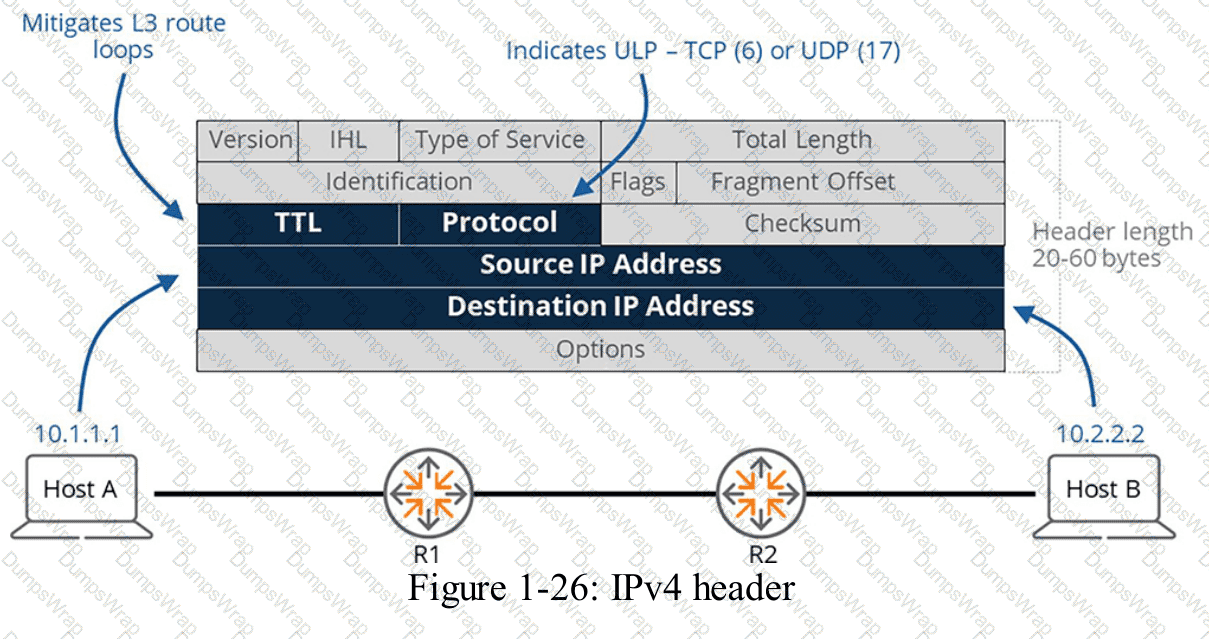
HPE Press study-guide figure / related learning illustration · Fig 1-26 IPv4
Which action is recorded in user audit logs in HPE Aruba Networking Central?
Options:
Policy usage
Configuration changes
Report imports
Mouse Clicks
Answer:
BExplanation:
Comprehensive and Detailed Explanation
HPE Press guide context | PDF page 679 | HPE Press, Aruba Certified Associate – Campus Access Official Certification Study Guide
Technical Deep Dive — Original Chat Wording
Audit logging provides a historical record of administrative and system activities performed within a network-management platform.
In HPE Aruba Networking Central, the Audit Trail helps administrators identify configuration changes and determine when they occurred.
Audit records can include information such as timestamps, the responsible account, affected devices, operation categories, and descriptions of the changes performed.
For example, an administrator may modify an AP group configuration or update an access-control policy.
The Audit Trail can record the associated management activity, allowing authorized personnel to investigate the change later.
This is particularly useful when troubleshooting a problem that begins after a configuration update.
An engineer can compare the time of the reported problem with relevant administrative events.
Audit records also support accountability and security investigations because they establish a record of management operations.
However, audit logging should not be confused with ordinary network traffic monitoring.
Policy usage statistics describe how traffic matches security or forwarding policies.
Mouse-click activity is not comprehensively recorded as a general-purpose user interaction history.
Report imports may generate particular system events, but they are not the fundamental audit function targeted by the question.
The primary purpose of the Audit Trail is to record administrative activity, including configuration modifications.
Therefore, Option B (Configuration changes) is correct.

HPE Press study-guide figure / related learning illustration · Q134 Fig 8-15 Audit
Which EAP method supports “chaining” machine and user authentication with tokens?
Options:
EAP-TEAP
EAP-TTLS
EAP-TLS
PEAP
Answer:
AExplanation:
Comprehensive and Detailed Explanation
HPE Press guide context | PDF page 825 | HPE Press, Aruba Certified Associate – Campus Access Official Certification Study Guide
Technical Deep Dive — Reconstructed (Original Chat Text Not Recoverable)
EAP-TEAP supports authentication chaining, allowing both machine and user credentials to be assessed within a protected TLS tunnel and a single 802.1X/RADIUS session. EAP-TLS normally performs certificate-based mutual authentication of one selected identity; PEAP and TTLS support tunneled inner methods but do not provide the same standard chaining behavior.
The selected answer corresponds to A: EAP-TEAP. This matches the mechanism or management behavior described in the scenario rather than merely a related network feature.
In an AOS-CX or Aruba Central deployment, the relevant settings must be applied in the correct interface, profile, policy, or management scope and then validated operationally.
A change that is applied to the wrong VRF, VLAN, user role, or device group can be syntactically valid while leaving the original network requirement unmet.
When reviewing alternatives, identify which one directly addresses the stated requirement, rather than selecting a related capability that is useful elsewhere but does not fulfill the requested task.
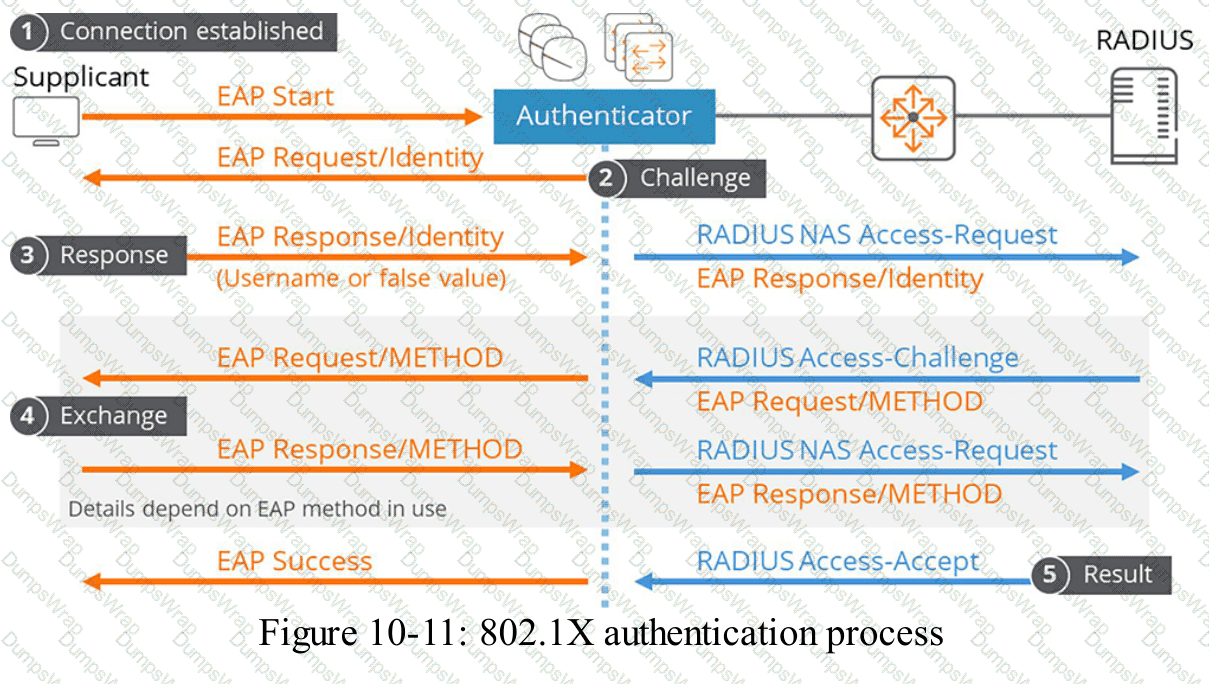
HPE Press study-guide figure / related learning illustration · Fig 10-11 EAP
Which HPE Aruba Networking access-switch model is ideal for cost-effectively connecting 200–380 clients, printers, and APs per distribution rack?
Options:
CX 6000
CX 6200
CX 6300
CX 6400
Answer:
BExplanation:
Comprehensive and Detailed Explanation
HPE Press guide context | PDF page 534 | HPE Press, Aruba Certified Associate – Campus Access Official Certification Study Guide
Technical Deep Dive — Reconstructed (Original Chat Text Not Recoverable)
CX 6200 access switches can be deployed in VSF stacks with enough 48-port units to supply hundreds of endpoint ports at practical cost. CX 6000 is smaller/basic, CX 6300 adds advanced access/distribution capabilities, and CX 6400 is modular. For the specified 200–380 endpoint/rack target, CX 6200 is the intended cost-conscious selection.
The selected answer corresponds to B: CX 6200. This matches the mechanism or management behavior described in the scenario rather than merely a related network feature.
Operational workflows should preserve consistent inventory, authorization, configuration history, and monitoring so that administrators can locate and manage devices predictably.
The operational view should be interpreted together with its underlying records: an alert, subscription count, or device status may describe management state rather than physical availability.
The answer should be validated against both the control-plane state and the forwarding or management outcome. A successful individual command alone is not proof that the end-to-end requirement is satisfied.
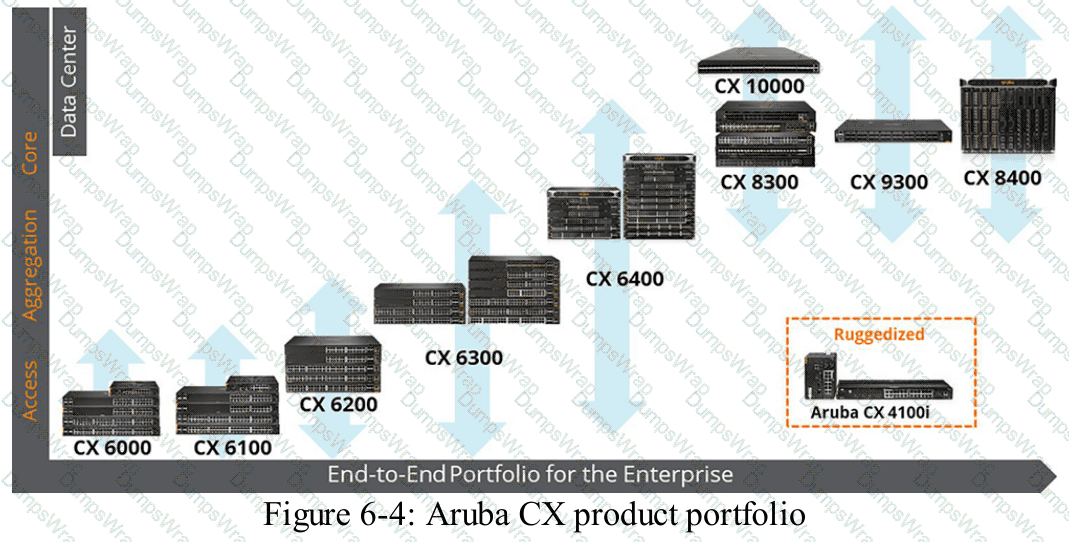
HPE Press study-guide figure / related learning illustration · Q70 CX portfolio
When working with well-defined, limited-scope problems, which tool or practice can make troubleshooting more efficient?
Options:
General guidelines
Manual probing
Well defined checklists
Broad experience
Answer:
CExplanation:
Comprehensive and Detailed Explanation
HPE Press guide context | PDF page 1059 | HPE Press, Aruba Certified Associate – Campus Access Official Certification Study Guide
Technical Deep Dive — Original Chat Wording
Structured troubleshooting is particularly effective when a problem has a clearly defined scope and predictable diagnostic requirements.
A checklist provides a consistent sequence of actions that technicians can follow to investigate known failure scenarios.
For example, when troubleshooting an access switch uplink that is not forwarding traffic, an appropriate checklist might include verifying physical link status, examining LACP negotiation, confirming VLAN membership, and checking Layer 3 connectivity.
The technician can systematically evaluate each condition and record the result.
This reduces the likelihood of overlooking an important diagnostic step.
Well-defined checklists are especially useful for recurring incidents handled by network operations teams.
They also allow junior technicians to perform standardized investigations while maintaining consistency with organizational procedures.
A checklist should identify the expected result of each diagnostic test and indicate when the issue requires escalation.
General guidelines are useful for broad investigations but may not provide sufficient detail for a narrowly defined problem.
Manual probing can identify failures, although an unstructured approach often wastes time.
Broad technical experience improves diagnostic judgment but is not a replacement for a repeatable procedure.
Checklists should also be updated when network architecture, firmware behavior, or operating procedures change.
Therefore, Option C (Well-defined checklists) is correct.
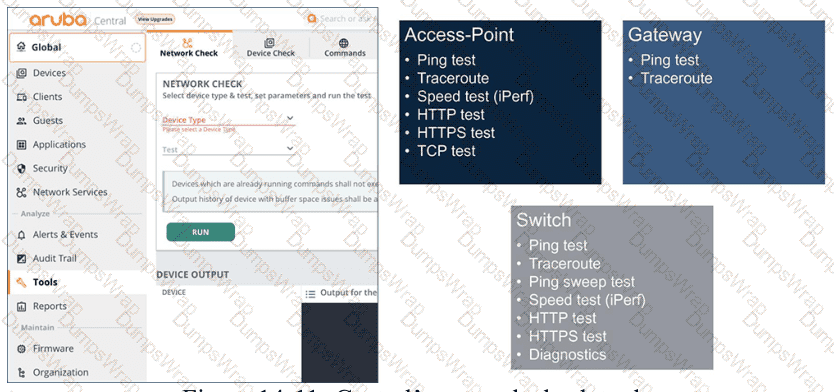
HPE Press study-guide figure / related learning illustration · Q158 Fig 14-11 Network Check
Which device type and group persona are needed to manage a Microbranch environment?
Options:
AOS-8 Branch Gateway Group Persona
AOS-10 AP Group Persona
AOS-10 Branch Gateway Group Persona
AOS-8 AP Group Persona
Answer:
BExplanation:
Comprehensive and Detailed Explanation
HPE Press guide context | PDF page 654 | HPE Press, Aruba Certified Associate – Campus Access Official Certification Study Guide
Technical Deep Dive — Reconstructed (Original Chat Text Not Recoverable)
Microbranch operation in AOS 10 uses APs assigned to an AOS 10 AP group/persona for distributed branch connectivity. It does not require treating the microbranch as an AOS 8 controller-based branch gateway group. Group architecture and software generation determine the supported configuration workflow.
The selected answer corresponds to B: AOS-10 AP Group Persona. This matches the mechanism or management behavior described in the scenario rather than merely a related network feature.
Operational workflows should preserve consistent inventory, authorization, configuration history, and monitoring so that administrators can locate and manage devices predictably.
Consistent RBAC, accurate inventories, and retained audit records simplify support handovers and reduce uncertainty during incident investigations.
When reviewing alternatives, identify which one directly addresses the stated requirement, rather than selecting a related capability that is useful elsewhere but does not fulfill the requested task.
The wrong choices may describe real technologies, but they perform different functions, apply to another layer, or omit a required prerequisite. Select the answer that resolves the exact scenario, not a nearby administrative task.
