
HPE Network Security Expert Written Exam Questions and Answers
A customer uses an AOS-10 architecture managed by HPE Aruba Networking Central. HPE Aruba Networking infrastructure devices authenticate clients against an HPE Aruba Networking ClearPass cluster.
In HPE Aruba Networking Central, you are reviewing network traffic flows for a wireless IoT device categorized as a “Raspberry Pi” client. You observe SSH traffic. You then inspect several additional wireless IoT clients and find that they are also sending SSH.
Refer to the scenario.
What potential issue does this indicate?
What could be a strong indication that a client has been compromised?
A customer is migrating from on-premises AD to Microsoft Entra ID (Azure AD) as its only domain solution. The customer also manages wired and wireless devices with Microsoft Endpoint Manager (Intune).
The customer wants to strengthen network-edge security. You are assisting with the design of an HPE Aruba Networking ClearPass deployment for this purpose. HPE Aruba Networking devices will authenticate wireless and wired clients to a ClearPass Policy Manager (CPPM) cluster that uses version 6.10.
The customer has several authentication requirements. Clients should pass EAP-TLS authentication only when a query to Microsoft Entra ID (Azure AD) confirms that they have accounts in Microsoft Entra ID (Azure AD). To further refine client privileges, ClearPass must also use information gathered by Intune to make access-control decisions.
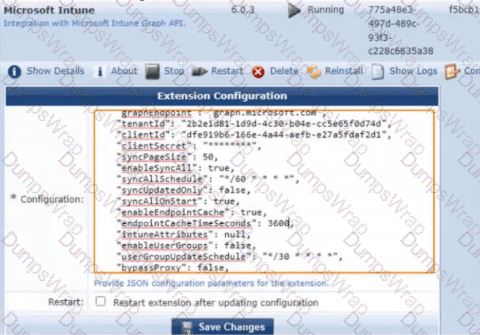
Extension Configuration:
graphEndpoint: graph.microsoft.com
syncPageSize: 50
enableSyncAll: true
syncAllSchedule: "*/60 * * * *"
syncUpdatedOnly: false
syncAllOnStart: true
enableEndpointCache: true
endpointCacheTimeSeconds: 3600
enableUserGroups: false
Refer to the scenario.
The Intune extension is configured as shown in this exhibit.
The customer wants to reduce the overhead of polling information from Intune to CPPM, but requires client information to be current at least once per hour. What should you recommend?
A customer needs the following rights for clients in the medical-mobile AOS firewall role on HPE Aruba Networking Mobility Controllers (MCs):
* They may receive IP addresses through DHCP.
* They may access DNS services at 10.8.9.7, and no other server.
* They may access all subnets in the 10.1.0.0/16 range, except 10.1.12.0/22, which must be denied.
* They must be denied access to other 10.0.0.0/8 subnets.
* They may access the Internet.
* They must be denied WLAN access for a period of time if they send any SSH traffic.
* They must be denied WLAN access for a period of time if they send any Telnet traffic.
* They must be denied access to all high-risk websites.
* External devices must not be allowed to initiate sessions with medical-mobile clients; they may send only return traffic.
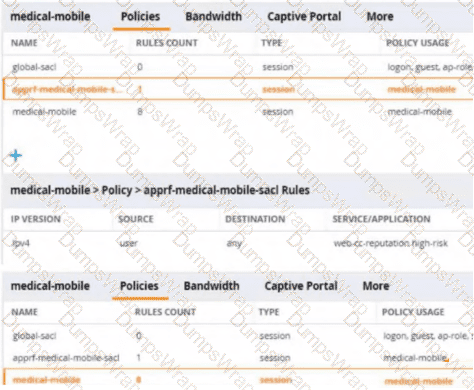
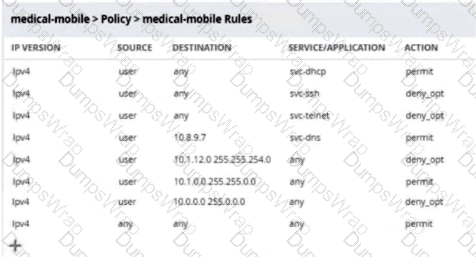
Refer to the scenario. The exhibits below show the role configuration.
* Role policies: `apprf-medical-mobile-sacl` (Rule: `user any web-cc-reputation high-risk deny`) and `medical-mobile` (8 rules configured).
Which setting not shown in the exhibits must you check to ensure the scenario requirements are met?
A customer uses an AOS-10 architecture managed by HPE Aruba Networking Central. HPE Aruba Networking infrastructure devices authenticate clients against an HPE Aruba Networking ClearPass cluster.
In HPE Aruba Networking Central, you examine network traffic flows for a wireless IoT device categorized as a "Raspberry Pi" client. You observe SSH traffic. After checking several additional wireless IoT clients, you find that they are also sending SSH traffic.
Refer to the scenario.
You need an easy way to communicate to HPE Aruba Networking ClearPass Policy Manager (CPPM) that an IoT client has used SSH.
What step should you take?
A customer has an AOS-10 architecture that includes HPE Aruba Networking APs. The customer recently enabled WIDS at the high level on the APs. Administrators see several "ad hoc using valid SSID" events.
What should you explain?
What benefit does an organization obtain by upgrading wireless security from WPA2-Personal to WPA3-Personal?
An organization wants an AOS-CX switch to trigger an alert when its RADIUS server (cp.acnsxtest.local) rejects an unusual number of client authentication requests each hour. After discussions with other HPE Aruba Networking administrators, you still do not know how many rejections are normal or unusual. You expect the value might differ on every switch.
You are helping the developer understand how to create an NAE script for this use case.
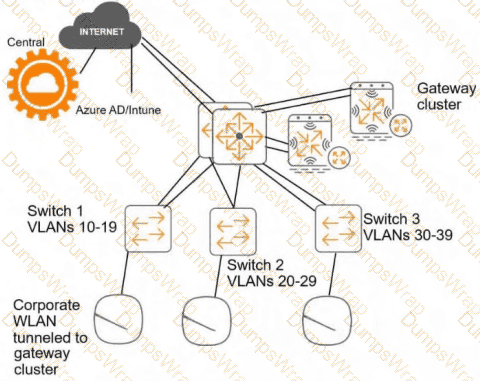
Refer to the scenario.
The developer explains that they intend to define the rule with logic like this: `monitor > value`
However, the developer asks what value to include.
What should you recommend?
You are helping a company add HPE Aruba Networking ClearPass to its network, which uses HPE Aruba Networking infrastructure devices.
The company already has a Windows domain and Windows CA. The Windows CA issues certificates to domain computers, domain users, and servers such as domain controllers.
ClearPass cluster IP addressing and hostnames
Publisher = 10.47.47.5
Subscriber 1 = 10.47.47.6
Subscriber 2 = 10.47.47.7
Virtual IP with Subscriber 1 and Subscriber 2 = 10.47.47.8
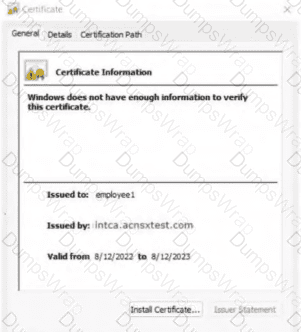
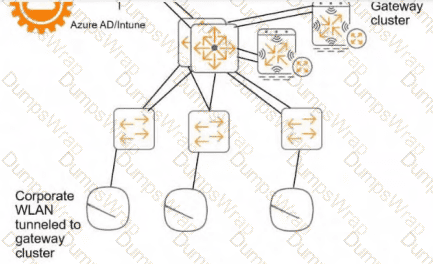
Refer to the scenario.
You have begun creating a CA to meet the customer's requirements for issuing certificates to mobile clients, as shown in the exhibit below.
Certificate Authority Settings:
Name: Exam Onboard CA
Mode: Root CA
Authority Info Access: Do not include OCSP Responder URL
Validity Period: 365 days
Clock Skew Allowance: 15
Subject Alternative Name: [X] Include device information in TLS client certificates
Digest Algorithm: SHA-512
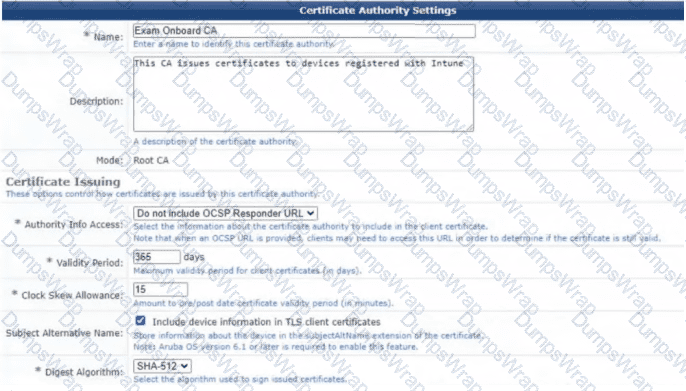
What change will help meet those requirements and the requirements for authenticating clients?
Introduction to the customer
You are assisting a company with adding HPE Aruba Networking ClearPass to its network, which uses HPE Aruba Networking infrastructure devices.
The company already has a Windows domain and Windows CA. The Windows CA issues certificates to domain computers, domain users, and servers such as domain controllers.
ClearPass cluster IP addressing and hostnames
A customer's ClearPass cluster uses these IP addresses:
Publisher = 10.47.47.5
Subscriber 1 = 10.47.47.6
Subscriber 2 = 10.47.47.7
Virtual IP with Subscriber 1 and Subscriber 2 = 10.47.47.8
The customer's DNS server contains these entries:
cp.acnsxtest.com = 10.47.47.5
cps1.acnsxtest.com = 10.47.47.6
cps2.acnsxtest.com = 10.47.47.7
radius.acnsxtest.com = 10.47.47.8
onboard.acnsxtest.com = 10.47.47.8
Refer to the scenario.
The Onboard CA uses the settings shown in the exhibits below.
* CA Name: Onboard CA, CA ID: 2
* Common Name: ClearPass Intune Certificate Authority
Microsoft Entra ID (Azure AD) administrators need assistance configuring the app registration for integration with ClearPass Onboard.
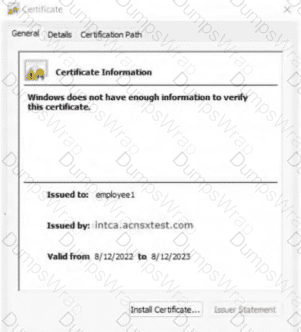
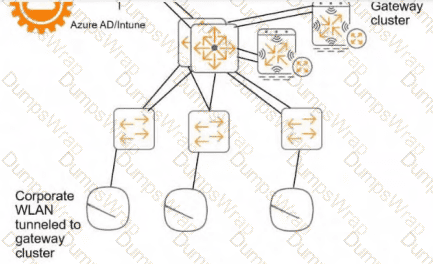
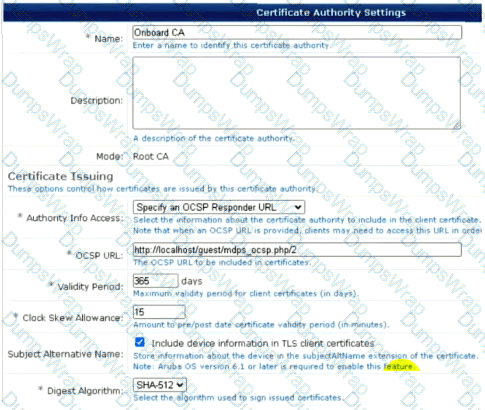
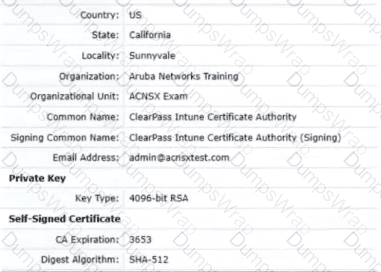
Which URL should you tell them to use?
A customer has an AOS-10 architecture managed by HPE Aruba Networking Central. HPE Aruba Networking infrastructure devices authenticate clients to an HPE Aruba Networking ClearPass cluster.
In HPE Aruba Networking Central, you are reviewing network traffic flows for a wireless IoT device categorized as a “Raspberry Pi” client. You observe SSH traffic. You then review several additional wireless IoT clients and find that they are also sending SSH.
Which element helps establish a foundation for robust network-security forensics?
A customer has an AOS-10 architecture consisting of HPE Aruba Networking APs and AOS-CX switches, managed through HPE Aruba Networking Central. The customer wants information about clients, including their general category and OS.
What should you explain?
You want to use HPE Aruba Networking ClearPass Device Insight tags as conditions in CPPM role-mapping or enforcement-policy rules.
Which guidelines should you follow?
A hospital uses an AOS-10 architecture managed by HPE Aruba Networking Central. The customer has deployed a pair of HPE Aruba Networking 9000 Series gateways, with Security licenses, at each clinic. The gateways run IDS/IPS in IDS mode.
The Security Dashboard displays several recent events with the same signature, as shown below:
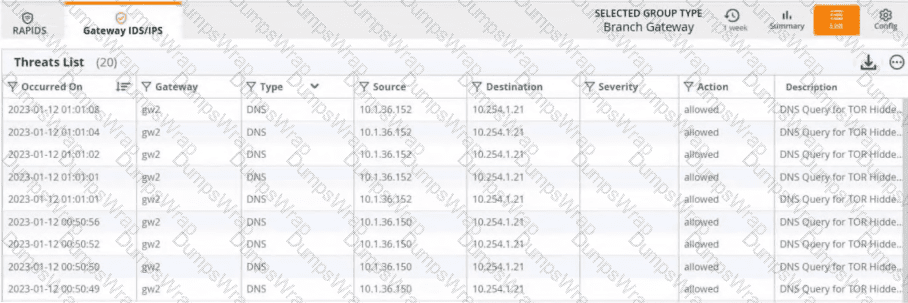
Occurred On: 2023-01-12 | Gateway: gw2 | Type: DNS | Source: 10.1.36.152 | Destination: 10.254.1.21 | Action: allowed | Description: DNS Query for TOR Hidden...
You want a record of the specific traffic that triggered the threat event. What should you do?
You are entering the following command on an AOS-CX switch:
radius-server host clearpass.example.com tls clearpass-username clearpass-password plaintext
Which credentials should you enter for clearpass-username and clearpass-password?
A customer operates two AOS-10 HPE Aruba Networking gateways at a site. The gateways are part of an SD-Branch solution managed by HPE Aruba Networking Central, and their cluster setting uses WLAN mode (the non-default gateway mode).
You are configuring a manual HPE Aruba Networking gateway cluster for dynamic authorization. The gateways have these IP addresses on a subnet that CPPM can access:
Gateway 1 = 10.56.20.2
Gateway 2 = 10.56.20.3
Which VRRP IP address assignments are valid for the gateways? Assume that all IP address options are available.
A customer uses an AOS-10 architecture managed by HPE Aruba Networking Central. HPE Aruba Networking infrastructure devices authenticate clients to an HPE Aruba Networking ClearPass cluster.
In HPE Aruba Networking Central, you are reviewing network traffic flows for a wireless IoT device categorized as "Raspberry Pi" clients. You observe SSH traffic. You then examine several additional wireless IoT clients and find that they are also sending SSH.
Refer to the scenario.
You need a fast way to find a list of all IoT clients that have used SSH.
What step can you take?
A hospital has an AOS-10 architecture managed by HPE Aruba Networking Central. The customer has deployed a pair of HPE Aruba Networking 9000 Series gateways with Security licenses at each clinic. The gateways implement IDS/IPS in IDS mode.
The Security Dashboard shows several recent events with the same signature, as shown below:
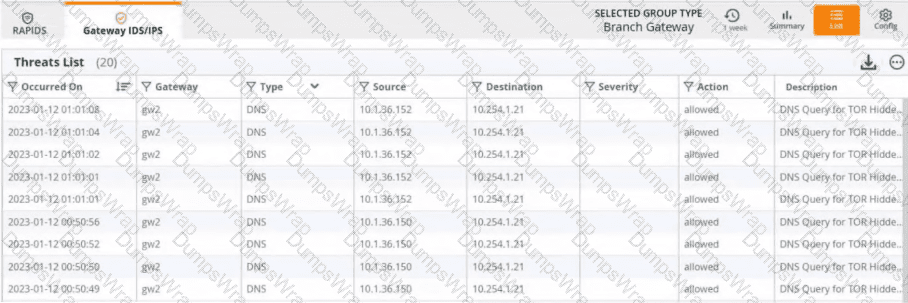
Occurred On: 2023-01-12 | Gateway: gw2 | Type: DNS | Source: 10.1.36.152 | Destination: 10.254.1.21 | Action: allowed | Description: DNS Query for TOR Hidden...
Refer to the scenario.
You have learned that nurse call stations are the source of the events. What can you conclude?
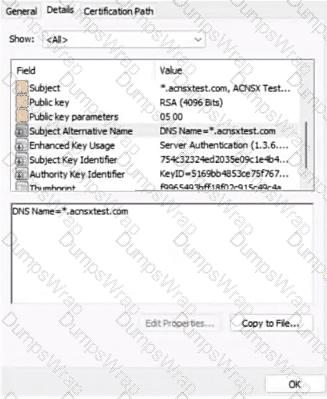
Refer to the exhibit.
Field: Subject
Value: .acnsxtest.com, ACNSX Test...
Field: Subject Alternative Name
Value: DNS Name=.acnsxtest.com
Field: Enhanced Key Usage
Value: Server Authentication (1.3.6.1.5.5.7.3.1)
You have received this certificate to install on an HPE Aruba Networking ClearPass server for RADIUS/EAP and RadSec use. What is one issue?
An organization wants an AOS-CX switch to generate an alert when its RADIUS server (cp.acnsxtest.local) rejects an abnormal number of client authentication requests each hour. After discussing this with other HPE Aruba Networking administrators, you still do not know how many rejections should be considered normal or abnormal. You expect this value may vary for every switch.
You are assisting the developer with developing an NAE script for this use case.
Refer to the scenario.
You are helping a customer define an NAE script for AOS-CX switches. The script will monitor statistics from a RADIUS server configured on the switch. To future-proof the script, you want administrators to be able to choose a different hostname or IP address for the monitored RADIUS server when they create an agent from the script.
What should you recommend?
How does HPE Aruba Networking Central secure site-to-site connections between AOS-10 gateways?
A customer wants to avoid using RadSec between AOS-CX switches and ClearPass Policy Manager (CPPM) in order to reduce the need to manage switch certificates. Given this condition, what can you recommend to enhance security?
