
HCIP-WLAN V2.0 Questions and Answers
On a WLAN, channel operating bandwidths can be categorized as 40 MHz+, 40 MHz−, 80 MHz, 80+80 MHz, and 160 MHz according to channel-bonding modes. Which statements about channel operating bandwidth are correct?
CHOOSE TWO
Options:
Two adjacent channels are bonded into channels of all types, excluding 80+80 MHz channels.
For a 40 MHz+ channel, the center frequency of the primary channel is higher than that of the secondary channel.
One of the four or eight 20 MHz channels is randomly selected as the primary channel in an 80 MHz or 160 MHz channel.
For a 40 MHz-channel, the center frequency of the primary channel is higher than that of the secondary channel.
Answer:
C, DExplanation:
Channel bonding increases available transmission bandwidth by combining multiple non-overlapping channels into a wider operating channel.
Huawei explains that two adjacent 20 MHz channels form a 40 MHz channel. Wider channels can be constructed using contiguous blocks, whereas 80+80 MHz operation combines two non-contiguous 80 MHz segments.
Option B is incorrect. In 40 MHz+ operation, the secondary channel has a higher center frequency than the primary channel.
Option D is correct. For 40 MHz− operation, the primary channel's center frequency is higher than the secondary channel's.
Option C reflects the intended principle. Huawei states that any of the four constituent 20 MHz channels in an 80 MHz channel can serve as the primary channel. Similarly, any of the eight constituent 20 MHz channels in a 160 MHz channel can be selected.
However, this does not mean the controller necessarily chooses the primary channel randomly.
Option A is imprecise. The Training Material states that two or more adjacent non-overlapping channels may be bonded. Therefore, the assertion that exactly two adjacent channels form every contiguous bandwidth category is incomplete.
C and D are the intended selections, but C would be technically clearer if randomly selected were replaced with selected.
Training Material reference: WLAN Planning Basics → WLAN Capacity Design → Channel Bonding, PDF p. 372, course slide 41.
────────────────────────────────────────────────────────
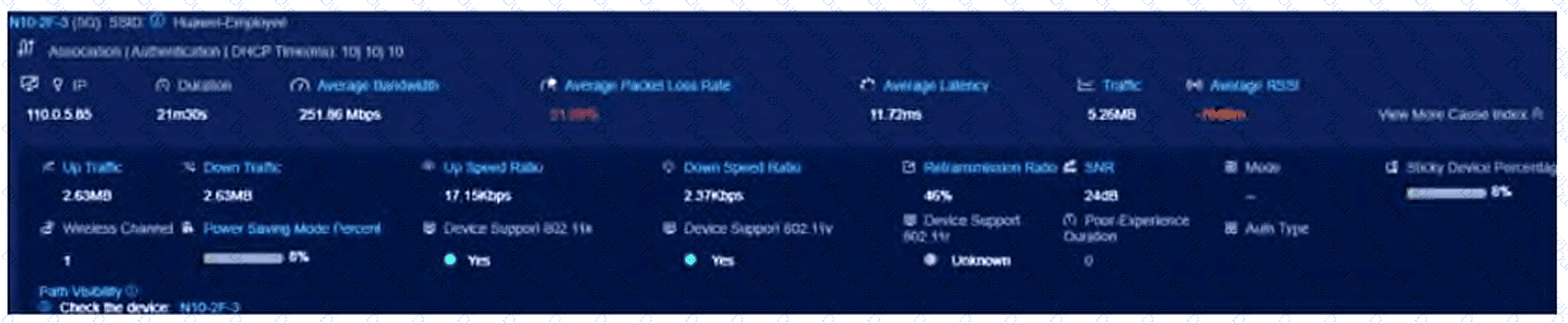
During acceptance testing of a customer’s wireless network, an engineer discovers that a terminal has a poor service experience. The engineer uses CampusInsight’s user journey function to check the terminal’s service experience, as shown below. Which of the following could cause the poor service experience?
Original exhibit: Q48 Enlarged Exhibit
Options:
The signal strength of the terminal is low, resulting in poor service experience.
The terminal does not support 802.11r and cannot perform 802.11r roaming, resulting in poor roaming effect.
The performance of the terminal is poor, resulting in a low negotiation rate.
The terminal enters the power-saving mode, resulting in packet loss.
Answer:
AExplanation:
Huawei CampusInsight provides user journey analysis to identify the causes of poor wireless experience by correlating individual user metrics with network events.
The exhibit displays terminal measurements including average bandwidth, average packet loss rate, average latency, average received signal strength indicator (RSSI), and wireless protocol capabilities.
The most significant indicators are the weak RSSI measurement and elevated average packet loss rate.
Poor RSSI indicates that the station is receiving a weak wireless signal. This may result from excessive distance from the AP, physical obstacles, signal attenuation, or an unsuitable AP installation position.
Weak signal conditions can increase frame errors and retransmissions, reducing throughput and degrading the user's application experience.
Option B is incorrect because the exhibit indicates that the terminal supports IEEE 802.11r.
Option C is not established because the screenshot does not provide sufficient evidence that the terminal's hardware performance is responsible for its experience problems.
Option D is also unsupported because the displayed power-saving information does not establish a causal relationship with the observed packet loss.
Huawei's Training Material presents the same diagnostic approach, identifying low RSSI and elevated packet loss as indicators of weak-signal coverage.
Therefore, option A is the supported answer.
Training Material reference: WLAN O and M → CampusInsight → Individual Issue Analysis: Journey Analysis, PDF p. 931, slide 43.
Lab Guide reference: Lab 11 — CampusInsight O & M → Monitoring and Experience Analysis.
────────────────────────────────────────────────────────
Provided WLAN network coverage is ensured, AP transmit power can be reduced to lessen co-channel interference.
Options:
TRUE
FALSE
Answer:
AExplanation:
AP transmit power directly affects the effective coverage area of a wireless radio. Increasing transmit power may extend signal coverage, but excessive power can also increase interference with neighboring APs operating on the same channel.
Co-channel interference occurs when multiple APs using an identical frequency channel operate within overlapping RF coverage areas. Because IEEE 802.11 uses a contention-based medium-access mechanism, these APs compete for the same available channel airtime.
Excessive overlap can increase channel utilization, reduce transmission opportunities, and degrade aggregate WLAN throughput.
Huawei recommends reducing AP transmit power when coverage requirements can still be satisfied. This limits unnecessary signal propagation beyond the intended service area and can improve spatial reuse of available radio channels.
However, transmit-power reduction must be performed carefully. Excessive reduction may create coverage holes, weaken signal levels at cell boundaries, and degrade roaming performance.
Huawei's radio calibration mechanism uses Transmit Power Control (TPC) to dynamically adjust transmit power according to RF conditions and coverage requirements.
Power optimization should therefore be coordinated with channel planning, AP placement, and validation of received signal strength throughout the coverage area.
Since the statement explicitly assumes that WLAN coverage remains adequate, reducing AP transmit power is an appropriate measure for limiting co-channel interference.
Therefore, the answer is TRUE.
Training Material reference: WLAN Planning Basics → Channel Design Rules, PDF p. 473; WLAN Radio Resource Management → Power Adjustment, p. 302.
────────────────────────────────────────────────────────
Which of the following statements are accurate about performing a WLAN site survey?
CHOOSE All that Apply
Options:
If there is an atrium area, a rangefinder can be used to measure and record the floor height.
You need to check whether the onsite building is consistent with the drawing.
You need to check whether hole drilling is allowed and easy on site.
The CloudCampus APP can be used to record onsite interference source information.
Answer:
A, B, C, DExplanation:
A WLAN site survey establishes the physical, environmental, and deployment information required to develop an accurate wireless network design. Huawei emphasizes that site-survey results directly affect AP placement, coverage prediction, cabling feasibility, and network performance.
Option A is correct. A rangefinder can measure ceiling or floor heights in atriums, halls, and lecture rooms. Accurate height measurements are necessary because installation elevation influences propagation distance, antenna selection, and coverage characteristics.
Option B is correct. Engineers must compare the architectural drawings with actual site conditions. Structural changes, new partitions, and unrecorded obstacles can invalidate an otherwise accurate simulation.
Option C is correct. Installation feasibility must be assessed before deployment. This includes checking mounting permissions, drilling restrictions, fireproof doors, structural walls, cable-routing paths, and access to equipment rooms.
Option D is correct. Huawei's CloudCampus APP supports recording interference sources during site surveys. Engineers can document competing Wi-Fi signals and non-Wi-Fi interference sources, including Bluetooth devices and microwave equipment.
The resulting information is incorporated into the WLAN planning process to improve the accuracy of AP placement and signal-coverage calculations.
All four statements correspond to specific activities described in Huawei's site-survey information collection procedure.
Training Material reference: WLAN Planning Process → Site Survey → Site Survey Information Collection, PDF pp. 450–454.
Lab Guide reference: Lab 9 — Indoor WLAN Planning → Requirements Analysis and WLAN Planning.
────────────────────────────────────────────────────────
Which statement below is false regarding STA roaming on a WLAN?
Options:
Users can perceive noticeable service interruption during STA roaming.
The STA access rights remain unchanged before and after roaming.
Reauthentication does not necessarily happen during STA roaming.
The STA’s IP address remains unchanged before and after roaming.
Answer:
AExplanation:
WLAN roaming enables a wireless station to move between access points belonging to the same extended service set while maintaining its network connectivity and service continuity.
The primary objective of roaming is to provide a seamless user experience. Huawei's Training Material explicitly identifies uninterrupted service transmission as a fundamental characteristic of WLAN roaming.
Option A is false because noticeable service interruption is not an intended characteristic of properly functioning WLAN roaming. Although real-world roaming introduces some handover latency and can occasionally cause packet loss, the architecture is designed to minimize those effects.
Option B is correct. A station retains its network access permissions after a supported roaming transition.
Option C is correct. Full authentication is not necessarily repeated during every roaming event. Fast-roaming mechanisms, including PMK caching and 802.11r Fast BSS Transition, can reduce authentication-related delays.
Option D is correct. Huawei's roaming architecture preserves the station's IP address during supported Layer 2 and Layer 3 roaming. During Layer 3 roaming, the network maintains reachability to the original service subnet through tunneling and home-agent mechanisms.
The distinction is that roaming changes the station's AP association without necessarily changing its IP identity or network permissions.
Therefore, option A is the false statement.
Training Material reference: WLAN Networking Technologies → WLAN Roaming → Background of Roaming and Definition of Roaming, PDF pp. 245–247.
Lab Guide reference: Lab 7 — WLAN Roaming → Observing STA Roaming Status.
────────────────────────────────────────────────────────
Which WAC reliability networking modes require the active and standby WACs to use the same models and software versions?
CHOOSE TWO
Options:
Dual-link HSB
Dual-link cold backup
VRRP HSB
N+1 backup
Answer:
A, CExplanation:
Huawei provides several wireless access controller reliability mechanisms, including VRRP hot standby backup, dual-link hot standby backup, dual-link cold backup, and N+1 backup. These mechanisms differ in their failover processes, state synchronization, and device compatibility requirements.
Dual-link HSB (A) requires the active and standby WACs to use identical models and software versions. APs establish primary and secondary CAPWAP connections, and the controllers synchronize relevant user information. Compatible hardware and software are necessary to support the coordinated standby relationship.
VRRP HSB (C) likewise requires matching WAC models and software versions. The controllers use VRRP-based redundancy to provide continuity when the active controller becomes unavailable.
Dual-link cold backup (B) requires matching software versions but does not impose the same requirement for identical controller models. Following a failure, clients generally need to re-establish their online sessions.
N+1 backup (D) supports one standby controller protecting multiple active controllers. Huawei permits different controller models and software versions in this architecture, although consistency may be recommended for operational reasons.
The course's comparison table explicitly distinguishes these compatibility requirements. Therefore, A and C are the two correct selections.
Training Material reference: WLAN Networking Technologies → WLAN Reliability Technologies → Comparison of WAC Backup Modes; VRRP HSB and Dual-Link HSB.
────────────────────────────────────────────────────────
Network Access Control (NAC) is an end-to-end security-control technology that works with AAA to provide access authentication. Which of the following statements about NAC and AAA are correct?
CHOOSE All that Apply
Options:
NAC is mainly used for interaction between users and access devices.
NAC provides three authentication modes: 802.IX authentication, MAC address authentication, and Portal authentication.
An AAA server controls network access rights of users through authentication, authorization, and accounting.
AAA is mainly used for interaction between access devices and authentication servers.
Answer:
A, B, C, DExplanation:
Network Access Control (NAC) and Authentication, Authorization, and Accounting (AAA) perform complementary functions in Huawei's wireless access security architecture.
NAC controls how clients initiate network access and how access devices enforce admission decisions. Therefore, option A correctly describes the interaction between users and access devices.
Huawei identifies three principal NAC authentication modes: 802.1X authentication, MAC address authentication, and Portal authentication. These mechanisms support different endpoint capabilities and deployment requirements. For example, 802.1X is commonly used for enterprise user authentication, MAC authentication for devices without interactive authentication capabilities, and Portal authentication for browser-based admission. This establishes option B.
AAA provides the framework for authenticating user identities, determining authorized network privileges, and recording relevant session or usage information. An AAA server returns the applicable authentication and authorization results, which are enforced by the network access device. Option C therefore accurately describes the server's role.
Option D is also correct because AAA communication principally occurs between the access device and the authentication server, commonly using RADIUS.
The architectural distinction is that NAC governs admission at the user-facing network edge, while AAA provides the supporting authentication, authorization, and accounting services.
Training Material reference: User Access and Authentication → Access Control Solution for Wireless Users → Overview of NAC → 802.1X, MAC Address, and Portal Authentication.
Lab Guide reference: Lab 6 — Portal Authentication and Authentication Server Configuration.
────────────────────────────────────────────────────────
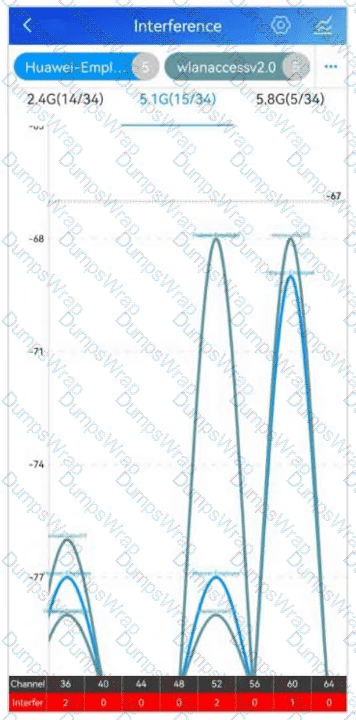
During WLAN optimization, an engineer uses the CloudCampus APP to test and identify interference from nearby wireless signals. The following figure displays the test results. Which statements are true about radio-signal interference in the current environment?
Original exhibit: Q24 Interference Exhibit
CHOOSE THREE
Options:
The radio signal strength on channel 36 is high, and it is recommended that channel 36 be avoided.
The current working frequency bandwidth of all channels is 20 MHz.
It is recommended that set the working channel of the AP be set to 44 to reduce interference.
Radio signals are mainly distributed on channels 36, 52, and 60.
Answer:
B, C, DExplanation:
Huawei's CloudCampus APP includes an interference-analysis function that identifies nearby wireless signals and displays their operating channels, signal strengths, and interference distribution.
The exhibit presents measurements from the 5 GHz radio environment. Three primary signal concentrations appear around channels 36, 52, and 60.
Option A is incorrect. The signals detected on channel 36 are relatively weak, approximately −76 to −78 dBm, compared with the stronger signals near channels 52 and 60, which reach approximately −68 to −69 dBm. Therefore, channel 36 is not the highest-interference channel shown.
Option B is the intended selection. The plotted channel footprints are treated as 20 MHz operating channels in the question's interpretation.
Option C is correct. Channel 44 shows no significant detected signal activity, making it a preferable candidate for avoiding the interference concentrations illustrated in the exhibit.
Option D is correct. The plotted signals are primarily concentrated around channels 36, 52, and 60.
In production, channel selection must also consider regulatory restrictions, channel utilization, neighboring AP configurations, and the selected channel bandwidth.
Training Material reference: WLAN Network Optimization Overview and Tools → CloudCampus APP → Interference Analysis, PDF pp. 840–842; WLAN Radio Resource Management → Wi-Fi Interference, pp. 293–295.
────────────────────────────────────────────────────────
Which of the following statements are correct regarding network optimization in the WLAN optimization solution?
CHOOSE THREE
Options:
The AP management VLAN and service VLAN cannot be set to VLAN 1 to prevent loops.
As there are a large number of APs, different service VLANs can be used when different SSIDs are configured.
It is recommended that AP/WAC management addresses be separated from user service addresses to facilitate management and control.
In scenarios where users move frequently, it is recommended that the lease of the address pool be shortened so that IP addresses can be reclaimed in a timely manner.
Answer:
B, C, DExplanation:
Huawei's WLAN network optimization methodology addresses wired-side architecture, VLAN planning, address allocation, and network service reliability.
Option B is correct. In large deployments, separate service VLANs can be allocated to different SSIDs. This reduces the size of broadcast domains and minimizes unnecessary broadcast traffic, improving network scalability.
Option C is correct. Huawei recommends separating management addresses used by WACs and APs from user service addresses. This improves operational control, isolates management traffic, and simplifies troubleshooting.
Option D is correct. In environments with frequent station movement, DHCP leases may continue consuming address-pool resources after users leave. Shortening the lease duration allows addresses to be reclaimed more quickly, reducing the risk of address exhaustion.
Option A contains an important wording problem. Huawei recommends that AP management VLANs and service VLANs should not use VLAN 1, and that management and service VLANs should be separated. However, the course presents these as network design recommendations rather than an absolute technical restriction preventing VLAN 1 configuration.
Therefore, B, C, and D are the three most defensible selections under a literal interpretation.
Training Material reference: WLAN Optimization Solution → Networking Optimization → Network Planning Optimization, PDF p. 846, course slide 15.
────────────────────────────────────────────────────────
Roaming handover time is a key factor affecting WLAN service experience when an STA roams. Fast roaming with PMK caching reduces roaming latency for 802.IX users and improves WLAN service experience. Which of the following helps reduce roaming latency in fast roaming that uses PMK caching?
Options:
STA reassociation is omitted.
Both 802.1X authentication and key negotiation are omitted.
Key negotiation is omitted.
802.1X authentication is omitted.
Answer:
DExplanation:
Pairwise Master Key (PMK) caching is a fast-roaming mechanism designed to reduce authentication overhead when an IEEE 802.1X-authenticated station moves between access points.
During initial association, the STA completes authentication and establishes a PMK. In supported inter-WAC roaming scenarios, the controller synchronizes PMK information with other controllers belonging to the same mobility group.
When the STA subsequently roams, it sends a Reassociation Request containing a PMK identifier (PMKID). The destination controller searches its PMK cache for the corresponding entry.
If a valid matching PMK is available, the controller can reuse the authentication result rather than requiring the STA to complete another full 802.1X authentication exchange with the authentication server.
However, key negotiation must still occur to establish the cryptographic keys required to protect traffic on the new wireless connection.
Consequently, option B is incorrect because both operations are not eliminated, while option C incorrectly identifies key negotiation as the omitted procedure.
Option A is incorrect because the STA must still perform reassociation with the destination AP.
The principal latency reduction comes from avoiding repeated 802.1X authentication. Therefore, D is correct.
Training Material reference: WLAN Networking Technologies → WLAN Roaming → Fast Roaming Using PMK Caching, PDF p. 265, course slide 25.
Lab Guide reference: Lab 7 — WLAN Roaming → Inter-WAC Roaming Configuration and Verification.
────────────────────────────────────────────────────────
APs may be deployed either automatically or manually in WLAN Planner. In most scenarios, manual AP deployment is recommended. Automatic AP deployment applies only to certain scenarios with simple structures.
Options:
TRUE
FALSE
Answer:
AExplanation:
Huawei WLAN Planner supports both automatic and manual AP deployment as part of the wireless network design process. The selection of the deployment method depends on the physical structure of the environment, wireless coverage requirements, installation restrictions, and the complexity of the proposed network.
Automatic AP deployment is primarily intended for environments with relatively simple structures and predictable coverage requirements. The tool uses the defined planning area, floor drawings, obstacle information, and coverage parameters to determine suitable AP positions. Although this mechanism can accelerate initial network design, its results must still be evaluated against actual implementation requirements.
Manual deployment offers greater control over AP placement. Engineers can select installation positions according to room layouts, wall attenuation, ceiling heights, expected user density, interference sources, and available cabling infrastructure.
For complex environments, manual deployment generally produces more practical designs because the engineer can incorporate deployment constraints that may not be adequately represented by automated placement calculations.
Following AP placement, WLAN Planner can calculate channel assignments, perform power calibration, and simulate wireless coverage. These capabilities allow engineers to refine the proposed design before physical installation.
Huawei's training material explicitly recommends manual deployment for most scenarios and reserves automatic deployment for simpler network structures.
Training Material reference: WLAN Planning Tools → WLAN Planner → Network Planning Procedure → Deploy Devices.
────────────────────────────────────────────────────────
In a restroom network-planning solution, when the men's and women's rooms are adjacent, one AP may be installed in the middle to provide signal coverage.
Options:
TRUE
FALSE
Answer:
BExplanation:
WLAN planning for restrooms requires particular attention to construction materials, wall attenuation, indoor coverage continuity, and practical AP installation locations.
Although adjacent rooms can sometimes be covered by a shared access point, restroom environments present additional RF propagation challenges. Restroom partition walls are commonly constructed using brick, concrete, ceramic tiles, and other materials that may significantly attenuate wireless signals.
Huawei's planning guidance specifically states that walls between adjacent restrooms are generally thick and that relying on wireless signals to penetrate these walls is not recommended.
Consequently, placing a single AP between men's and women's restrooms may produce inadequate coverage in one or both areas. Users could experience weak received signal strength, reduced physical-layer rates, retransmissions, or connectivity instability.
Huawei therefore recommends deploying an independent indoor AP in each restroom.
The recommended AP configuration uses omnidirectional antennas with ceiling-mounted installation, allowing radio coverage to be distributed within the individual restroom.
Where architectural appearance is important, the installation design should incorporate suitable aesthetic measures without compromising wireless performance.
This recommendation differs from planning for lightly partitioned office areas, where a shared AP may provide sufficient coverage across multiple rooms.
Therefore, the statement is FALSE.
Training Material reference: WLAN Planning Scenarios → WLAN Planning and Design for Typical Scenarios → WLAN Deployment Solution for Restrooms, PDF p. 544.
────────────────────────────────────────────────────────
Which of the following statements are true regarding STA steering?
Options:
STAs with voice or video services running are not steered.
An AP steers 802.11v-capable STAs in Deauthentication mode.
Before sending BTM or Deauthentication messages, an AP instructs neighboring APs to suppress association of STAs.
An AP steers 802.11v-incapable STAs in BTM mode.
Answer:
CExplanation:
STA steering is a WLAN optimization mechanism used to influence a wireless station's AP association when a better connection candidate is available.
Huawei supports steering modes according to the station's IEEE 802.11v capabilities.
For an 802.11v-capable station, the AP uses BSS Transition Management (BTM) messages to recommend a suitable target AP. The STA can evaluate the recommendation and initiate a transition.
For a station without 802.11v support, Huawei uses deauthentication-based steering because the station cannot process BTM requests.
Consequently, options B and D reverse the correct relationship between client capabilities and steering modes.
Option C is correct. Huawei explicitly describes a mechanism in which neighboring APs are instructed to suppress Probe or Authentication responses for the STA before the steering AP sends the BTM or deauthentication message. This helps direct the client toward the preferred target AP.
Option A contradicts the wording in the supplied Huawei Training Material, which states that stations running voice or video services may also be steered.
Steering decisions must nevertheless consider service continuity, candidate AP signal quality, and the effects of handover latency.
The course also specifies a five-minute interval following association or roaming during which a STA is not steered again.
Training Material reference: WLAN Radio Resource Management → STA Steering → STA Steering Mode, PDF p. 312; AP-Based Load Balancing → Implementation of Load Balancing, p. 322.
Lab Guide reference: Lab 8 — RRM Lab → Load Balancing Configuration.
────────────────────────────────────────────────────────
In Portal authentication scenarios where the WAC acts as the access device, Portal users cannot be authenticated. Which of the following could cause this issue?
CHOOSE FOUR
Options:
The shared key configured on the WAC is different from that on the Portal server.
The destination port configured on the WAC for communication with the Portal server differs from the listening port configured on the Portal server.
STA address learning is disabled on the WAC.
The Portal server detection function is enabled on the WAC, but not on the Portal server.
Answer:
A, B, C, DExplanation:
Huawei Portal authentication requires coordinated operation between the wireless access controller, Portal server, and authentication infrastructure. Configuration inconsistencies or incomplete user information can prevent the authentication transaction from completing.
Option A: The WAC and Portal server must use consistent shared-key settings. A mismatch prevents successful validation of the Portal protocol exchanges.
Option B: Portal communication depends on correctly configured destination and listening ports. When the WAC transmits Portal messages to a port that the server is not listening on, the required protocol exchange cannot complete.
Option C: The WAC must associate the station's IP address with its MAC address. If STA address learning is disabled, the controller may fail to identify the user corresponding to an authentication request and consequently reject or fail to process that request.
Option D: When Portal server detection is enabled on the WAC but is unsupported or disabled on the Portal server, Huawei identifies the server status as abnormal. This condition can interfere with automatic authentication-page delivery and prevent users from completing authentication.
The Huawei training material covers these problems under Portal authentication troubleshooting. The Lab Guide also demonstrates consistent shared-key, Portal port, server, and authentication-profile configuration.
All four conditions are valid potential causes.
Training Material reference: User Access and Authentication → Portal Authentication → Common Faults and Troubleshooting.
Lab Guide reference: Lab 6 — Portal Authentication; Lab 12 — Comprehensive Troubleshooting.
────────────────────────────────────────────────────────
On a network using Huawei’s traditional WLAN solution, all APs are managed by a WAC. If users experience STA roaming failures and degraded WLAN service, which of the following is not a possible cause?
Options:
The APs before and after roaming are configured with different data forwarding modes.
The signal coverage of APs is discontinuous, with coverage holes.
The APs before and after roaming have different security profile configurations.
The STA roams at Layer 3, but Layer 3 roaming is disabled on the device.
Answer:
AExplanation:
Huawei's WLAN roaming troubleshooting methodology identifies inconsistent security configurations, incorrect roaming settings, faulty mobility-group relationships, and discontinuous radio coverage as common causes of unsuccessful roaming.
Option B is a valid cause. If AP coverage areas are separated by coverage holes, a moving STA may lose its connection before it can associate with the destination AP.
Option C is a valid cause. The APs involved in roaming must use compatible security parameters. Huawei specifically requires consistent SSIDs, security-profile settings, authentication modes, and relevant authentication parameters.
Option D is a valid cause. When the STA must perform Layer 3 roaming because its destination VLAN differs from its original VLAN, disabling Layer 3 roaming prevents the required transition.
Option A is not inherently a cause of roaming failure. Huawei supports roaming with different data-forwarding architectures, including direct forwarding and tunnel forwarding. Different forwarding modes do not, by themselves, establish that roaming cannot operate.
The controller must still maintain the required forwarding path, service VLAN connectivity, and roaming configuration.
Huawei's troubleshooting flowchart focuses on security-profile consistency, Layer 3 roaming configuration, VLAN correctness, mobility-group status, continuous coverage, and duplicate SSIDs.
Therefore, A is the correct selection.
Training Material reference: WLAN Troubleshooting → Roaming Faults → Flowchart and Procedure for Troubleshooting STA Roaming Failures, PDF pp. 999–1002.
Lab Guide reference: Lab 7 — WLAN Roaming → Inter-WAC Layer 3 Roaming Configuration and Verification.
────────────────────────────────────────────────────────
On an agile distributed WLAN, RUs and central APs must be located on the same Layer 2 network, and each RU can associate with only one central AP.
Options:
TRUE
FALSE
Answer:
AExplanation:
Huawei's agile distributed WLAN architecture separates traditional AP functionality into central access points and remote units (RUs). A central AP provides centralized coordination and management functions, while RUs deliver wireless coverage in individual rooms or other physically separated areas. This architecture is particularly appropriate for hotels, hospitals, dormitories, and office environments containing many small rooms.
The communication relationship between the central AP and its RUs depends on Layer 2 connectivity. During onboarding, an RU obtains an IP address through DHCP or static configuration and uses broadcast discovery to locate its central AP. This discovery mechanism requires the central AP and RU to reside in the same Layer 2 network.
After discovery, the central AP supplies the information required for the RU to establish its control connection with the wireless access controller. The controller then distributes the applicable software and service configurations.
An RU operates under one central AP association at a time. Although one central AP can manage multiple RUs, this relationship does not mean an individual RU simultaneously associates with multiple central APs.
Consequently, both conditions described in the question are consistent with the agile distributed architecture.
Training Material reference: WLAN Networking Technologies → WLAN Networking Architectures → Agile Distributed Networking → RU Onboarding Process.
────────────────────────────────────────────────────────
