
HCIA-Cloud Service V3.5 Questions and Answers
Which of the following statements about Cloud Eye are correct?
Options:
The server monitoring of Cloud Eye can only monitor the operating system (OS), and not processes.
If you select 50 monitored objects and a monitoring template with 20 metrics in Cloud Eye, you can create a maximum of 1,000 alarms at once.
An alarm rule can be set on the Cloud Eye to trigger auto scaling when the ECS usage reaches the defined threshold.
The alarm rules of Cloud Eye must be created individually.
Answer:
B, CExplanation:
Statements B and C are correct . Huawei Cloud Eye supports batch creation of monitoring alarms. Huawei's documented quota specifically states that up to 50 monitored objects can be selected when creating an alarm rule and that up to 1,000 alarm rules can be created at one time . Huawei even provides the exact example used here: 50 monitored objects multiplied by 20 metrics produces 1,000 alarm rules. Therefore, B is directly supported.
Statement C is also valid. Cloud Eye alarm rules can provide monitoring triggers used with Auto Scaling. An alarm-based AS policy references a Cloud Eye alarm rule; when monitored metrics meet the configured threshold condition, the corresponding scaling action can be initiated.
Statement A is false because Cloud Eye server monitoring is not limited to OS-level resource metrics. With the Agent installed, Huawei Cloud Eye also provides process monitoring , including process CPU usage, memory usage, opened files, and customized process-monitoring tasks.
Statement D is false because alarm templates and batch alarm creation eliminate the requirement to create every alarm rule individually.
Reference topics: Cloud Eye Server Monitoring; Process Monitoring; Alarm Rules; Alarm Templates; Auto Scaling Integration.
===============
Huawei Cloud Elastic Cloud Servers (ECSs) and their extended network interfaces can belong to different Virtual Private Clouds (VPCs) or security groups.
Options:
TRUE
FALSE
Answer:
AExplanation:
The statement is TRUE, with an important implementation distinction. Huawei Cloud extended network interfaces provide flexible networking independently of the ECS primary network interface. An extended network interface can be associated with security groups that differ from those associated with the ECS's other interfaces. Huawei Cloud explicitly states that an extended network interface created through the console can be attached to an instance in the same VPC while using different security groups.
Huawei documentation additionally specifies that when an extended network interface is created through the appropriate API, it can be attached to an instance residing in a different VPC. Therefore, the broader proposition in the question—that an ECS and an extended interface can belong to different VPCs or security groups—is technically supported by Huawei Cloud.
For conventional console-based deployments, the normal architecture places the ECS's primary and extended interfaces in different subnets of the same VPC, with security rules independently assignable to individual interfaces. This provides traffic separation for service, management, internal, and external networks. The API capability extends this flexibility further.
Consequently, because Huawei officially supports both differentiated security-group association and cross-VPC attachment under the documented API scenario, the correct answer is TRUE.
Reference topics: Elastic Network Interfaces; Extension NICs; VPC Networking; Security Group Association.
===============
Which of the following operations can be performed on Relational Database Service (RDS) instances?
Options:
Changing the failover priority
Deleting a DB instance
Scaling up storage space
Rebooting a DB instance
Answer:
A, B, C, DExplanation:
All four operations are supported management actions for Huawei Cloud RDS instances, subject to the applicable database engine, instance type, current status, and other service constraints.
Changing the failover priority is supported for primary/standby RDS deployments. Huawei allows administrators to prioritize either Reliability , which emphasizes data consistency, or Availability , which emphasizes service continuity during failover.
Deleting a DB instance is a standard lifecycle-management operation available to appropriately authorized users. Huawei's RDS permission model includes the rds:instance:delete action for this purpose.
Scaling up storage space is likewise an established RDS modification operation. Administrators can increase allocated storage when database capacity requirements grow, and supported database engines can also provide storage autoscaling options.
Finally, rebooting a DB instance is a supported administrative action used when configuration changes, troubleshooting, or other operational circumstances require an instance restart. Huawei's CTS integration explicitly identifies both scaling storage and restarting an instance as auditable RDS operations.
Huawei's RDS API catalog lists deleting, scaling storage, rebooting, and changing failover priority as supported instance-management operations.
Reference topics: RDS Instance Management; Failover Priority; Storage Scaling; DB Instance Reboot; DB Instance Deletion.
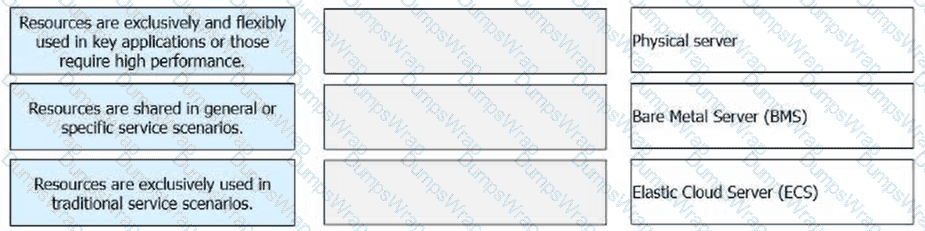
Match the following application scenarios with the corresponding server types:
Options:
Answer:

Explanation:
1 → Bare Metal Server (BMS)
2 → Elastic Cloud Server (ECS)
3 → Physical server
The first scenario maps to BMS because Bare Metal Servers combine exclusive access to physical resources with cloud-oriented provisioning and management. Huawei Cloud recommends BMS for key or mission-critical applications and services requiring high performance. BMS retains direct physical CPU and memory access while supporting capabilities such as automatic provisioning, VPC networking, image deployment, monitoring, and cloud storage. It therefore provides both resource exclusivity and cloud flexibility .
The second scenario maps to ECS . ECS instances operate on virtualized infrastructure, so physical server resources can be shared among virtual machines. This model is appropriate for general-purpose and specialized cloud workloads where virtualization, rapid deployment, elasticity, and efficient resource utilization are priorities.
The third scenario maps to a traditional physical server . A physical server also provides exclusive resources, but Huawei's comparison shows that traditional servers do not inherently provide cloud capabilities such as automatic provisioning, VPC integration, image-based deployment, and standardized cloud monitoring. This makes them characteristic of traditional dedicated-service environments.
Huawei's comparison explicitly records exclusive resources for BMS and physical servers, but not ECS.
Reference topics: BMS, Physical Server, and ECS Comparison; Resource Exclusivity; Automatic Provisioning; Compute Architecture.
===============
Which of the following can be used to control the inbound and outbound traffic of Elastic Cloud Servers (ECSs) in a Virtual Private Cloud (VPC)?
Options:
Security groups
IPsec Virtual Private Network (VPN)
Fingerprint authentication
Network ACLs
Answer:
A, DExplanation:
The correct mechanisms are security groups and network ACLs . A security group contains inbound and outbound access-control rules governing traffic to and from ECS instances associated with the group. Inbound rules regulate traffic entering an ECS, while outbound rules regulate traffic leaving it. Security groups therefore provide the instance-oriented access-control layer within a Huawei Cloud VPC.
Network ACLs operate at the subnet level . A network ACL is associated with one or more subnets and controls traffic entering and leaving those subnets. In the HCIA V3.5 networking architecture, network ACLs complement security groups and provide an additional layer of network protection. Huawei's VPC documentation explicitly presents security groups and network ACLs as complementary controls for comprehensive access management.
IPsec VPN does not serve this role. Its purpose is to establish encrypted network connectivity—for example, between VPCs or between Huawei Cloud and an external network. Fingerprint authentication is likewise not a VPC packet-filtering mechanism.
Therefore, only A and D directly provide inbound/outbound traffic-control functionality for ECS workloads.
Reference topics: VPC Access Control; Security Groups; Network ACLs; ECS Network Security.
===============
An image is a template used to create servers or disks. It contains an OS, service data, and necessary application software. Image Management Service (IMS) allows you to manage the full lifecycle of images. Which of the following statements about images is false?
Options:
A Marketplace image is a third-party image published in the Marketplace. It has an OS, application environment, and software pre-installed.
A public image is a system image provided by the cloud platform.
A private image is shared by other users.
A shared image cannot be encrypted.
Answer:
CExplanation:
Statement C is false because it gives the definition of a shared image rather than a private image. Huawei Cloud defines a private image as an image available to the user who created it. Such an image can contain an operating system, pre-installed public applications, service data, and the user's own applications. It is commonly used to rapidly create identically configured ECS instances.
A shared image , conversely, is a private image that another Huawei Cloud user has explicitly shared with the recipient. Therefore, saying that “a private image is shared by other users” reverses these concepts.
Option A is correct. Huawei describes Marketplace images as third-party images containing an operating system, application environment, and software already installed, allowing rapid deployment of application environments.
Option B is also correct: public images are standardized system images provided by the cloud platform and made available broadly to customers.
Option D conforms to Huawei IMS sharing restrictions. Huawei Cloud specifies that encrypted images cannot be directly shared with other tenants; an encrypted image must first be replicated as an unencrypted image if sharing is required.
Thus, C is the single incorrect statement .
Reference topics: Image Management Service; Public Images; Private Images; Shared Images; Marketplace Images; Image Encryption.
===============
A shared Elastic Volume Service (EVS) disk can be attached to multiple servers at the same time. Before you delete a shared EVS disk, it has to be detached from all servers.
Options:
TRUE
FALSE
Answer:
AExplanation:
The statement is TRUE . Huawei Cloud distinguishes ordinary EVS disks from shared EVS disks . A standard non-shared EVS disk can normally be attached to only one server at a time, whereas a shared disk is specifically designed so that multiple supported servers can access the same block-storage device. Huawei documentation states that a shared EVS disk can be attached to multiple servers simultaneously, with supported implementations allowing attachment to as many as 16 servers.
The deletion requirement is equally explicit. A shared EVS disk cannot remain attached to any server when the disk itself is being deleted. Huawei requires administrators to detach the shared disk from all servers before deletion . If the disk is attached to several servers and is detached from only some of them, it remains in the In-use state. Only after it has been detached from every server does its state return to Available, permitting subsequent deletion operations.
Huawei additionally cautions that shared block storage does not itself provide cluster coordination. Appropriate cluster software or shared-file-system mechanisms must manage simultaneous reads and writes to prevent corruption.
Thus, both parts of the question precisely reflect Huawei Cloud's EVS shared-disk lifecycle requirements.
Reference topics: Shared EVS Disks; Attaching Shared Disks; Detaching EVS Disks; EVS Lifecycle Management.
===============
Which of the following are included in the HUAWEI CLOUD security service system?
Options:
Application security
Network security
Computing security and security management
Data security
Answer:
A, B, C, DExplanation:
All four categories form part of Huawei Cloud's layered security architecture. Network security includes controls and services designed to protect network boundaries and traffic, such as Anti-DDoS, Advanced Anti-DDoS, VPC security controls, firewalls, and network isolation. Huawei Cloud describes network security as a core component of its full-stack cloud defense model.
Application security protects web applications and application-layer traffic. Representative Huawei Cloud services include Web Application Firewall, which detects and blocks HTTP/HTTPS attacks, and application vulnerability/security capabilities.
Computing security covers server and workload protection. Host Security Service protects ECS and other server workloads through vulnerability management, intrusion detection, account-security controls, malware detection, and web tamper protection. Security-management capabilities such as Cloud Bastion Host and centralized security operations provide access management, authentication, authorization, auditing, and operational control.
Finally, data security encompasses encryption, database protection, identity/access control, sensitive-data protection, and lifecycle safeguards. Huawei's security architecture explicitly identifies protection of confidentiality, integrity, availability, durability, and traceability as data-security objectives.
Therefore, A, B, C, and D are all included .
Reference topics: Huawei Cloud Security Architecture; Network Security; Application Security; Compute Security; Security Management; Data Security.
===============
How does Cloud Trace Service (CTS) notify subscribed users when key operations occur?
Options:
SMS
Phone call
Answer:
A, DExplanation:
The supported notification methods represented in this question are SMS and email , so the correct selections are A and D .
Huawei Cloud CTS supports key event notification for significant operations. Administrators can identify operations that require immediate awareness and configure notification delivery through Simple Message Notification (SMN). When the configured key event occurs, CTS works with SMN to deliver the corresponding notification to subscribed recipients.
Huawei's official CTS documentation specifically states that SMN can send key-event messages to users' mobile phones or email addresses . A notification sent to a mobile phone in this context corresponds to SMS messaging. Email subscriptions similarly deliver the notification to the registered email endpoint.
This mechanism provides proactive visibility into sensitive cloud operations rather than requiring administrators to continually query CTS records. Typical use cases include monitoring resource deletion, security configuration changes, permission-related operations, or other high-risk administrative actions.
Neither WeChat nor a conventional phone call is identified by Huawei CTS as one of the notification methods in this key-event mechanism. Those options therefore do not satisfy the documented CTS notification workflow.
Reference topics: CTS Key Event Notification; Simple Message Notification; Operation Auditing; O & M Notifications.
===============
Logs can be used for operation and maintenance of network devices, physical servers and services throughout their lifecycles.
Options:
TRUE
FALSE
Answer:
AExplanation:
The statement is TRUE . Logging is a fundamental component of cloud operation, maintenance, troubleshooting, security auditing, and lifecycle management. Huawei Cloud Log Tank Service is designed to collect and centrally process logs from a broad range of environments, including cloud services, ECSs, physical servers, containers, network-related systems, APIs, and other infrastructure components.
Huawei describes LTS as a platform for application O & M, security and compliance, and operations analysis . It provides full-stack log collection, high-speed searching, SQL analysis, visualization, alarm generation, processing, and log transfer. These capabilities allow administrators to track system behavior from deployment through normal operation, troubleshooting, scaling, upgrades, incident response, and eventual retirement.
Huawei's logging architecture also supports network-device information through protocols such as Syslog and SNMP, while ICAgent can collect logs from physical servers and ECSs. Cloud-service logs can be ingested directly from numerous Huawei Cloud services.
Logs therefore provide historical evidence and real-time operational insight throughout the lifecycle of infrastructure and applications. They are not limited to fault diagnosis after an incident; they are an integral O & M data source.
Reference topics: Log Management; LTS; Device O & M; Log Collection; Operational Analysis.
===============
In HUAWEI CLOUD Object Storage Service (OBS), an object policy is only applied to a single object in a bucket. A bucket policy applies to some or all of the objects in a bucket.
Options:
TRUE
FALSE
Answer:
AExplanation:
The statement is TRUE. Huawei Cloud OBS provides several resource-based authorization mechanisms, including bucket policies and object policies. Their principal distinction is the scope of resources to which they apply.
Huawei's official OBS Permission Configuration Guide explicitly states that an object policy applies to only one object in a bucket, whereas a bucket policy applies to multiple objects or all objects within the bucket. This enables administrators to select the authorization mechanism that best matches the required granularity.
An object policy is useful when permissions must be configured specifically for an individual object, such as granting another principal read or write permissions to one particular resource without broadening access to the rest of the bucket.
A bucket policy supports broader authorization scenarios. Its policy statements can define principals, actions, resources, effects, and conditions to grant or restrict access to selected objects, prefixes, or the entire bucket. Typical uses include allowing another Huawei Cloud account to access specified OBS resources or granting IAM identities access to defined bucket content.
The question therefore correctly distinguishes object-level policy scope from bucket-level multi-object policy scope.
Reference topics: OBS Permission Management; Object Policies; Bucket Policies; Resource-Based Authorization.
===============
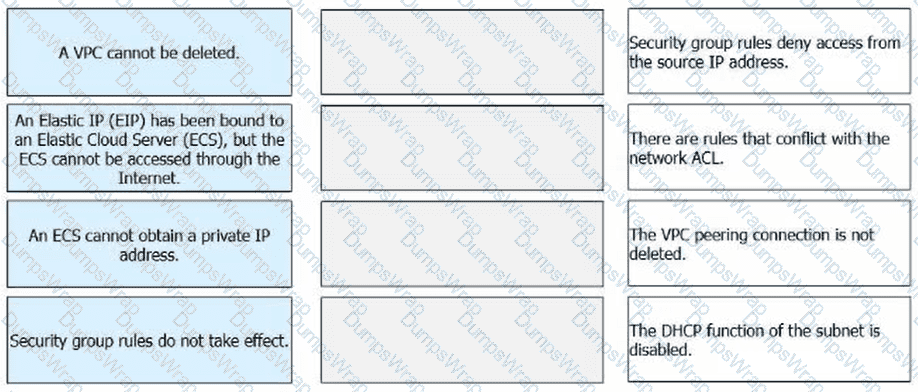
Match the following fault scenarios with possible causes:
Options:
Answer:

Explanation:
1 → C
2 → A
3 → D
4 → B
Each fault maps to a specific Huawei Cloud VPC control. A VPC cannot be deleted while dependent resources such as a VPC peering connection still use it, so scenario 1 maps to C. Huawei Cloud explicitly lists VPC peering connections among resources that must be removed before VPC deletion.
For scenario 2, merely binding an EIP does not override security-group filtering. If the relevant inbound security-group rule does not permit traffic from the source IP address and required protocol/port, the ECS remains inaccessible externally; therefore it maps to A.
Scenario 3 maps to D. Huawei Cloud uses DHCP to allocate private addresses dynamically, and its troubleshooting guidance specifically instructs administrators to verify whether the subnet's DHCP function is enabled when an ECS cannot obtain a private IP address.
Scenario 4 maps to B. Huawei documentation explicitly identifies conflicting network ACL and security-group rules as a cause of security-group rules appearing ineffective. The network ACL can block traffic that the security group otherwise permits.
Reference topics: VPC Troubleshooting; Security Groups; Network ACLs; DHCP; VPC Peering Connections.
===============
IAM users created by an administrator do not have default permissions. Which of the following statements about permissions is incorrect?
Options:
FullAccess permissions provide read-only access to all services except IAM.
Permissions are classified into roles and policies based on granularity.
To assign permissions to new users, add them to one or more groups, then attach permissions policies or roles to these groups. The users inherit permissions from their groups.
IAM users can perform operations on cloud services as specified by the assigned permissions.
Answer:
AExplanation:
Option A is incorrect because it confuses full-access permissions with a read-only role. In Huawei Cloud IAM, a permission whose name contains FullAccess normally represents full or administrator-level permissions for the corresponding service. For example, IAMFullAccess provides full permissions for IAM operations rather than read-only access.
Huawei Cloud separately defines Tenant Guest as providing read-only permissions for cloud services other than IAM. This distinction is important in HCIA IAM authorization concepts: FullAccess and ReadOnlyAccess represent materially different privilege levels.
The remaining statements correctly describe Huawei Cloud authorization. IAM supports roles and policies as authorization mechanisms, with policies providing more fine-grained control. User groups provide an efficient way to authorize multiple IAM users: an administrator assigns permissions to a group and then places users in that group, after which the users inherit the group's permissions. Finally, an IAM user can perform only the cloud-service operations allowed by the permissions granted to that identity.
Thus, option A incorrectly assigns the behavior of a read-only permission model to FullAccess and is the required answer.
Reference topics: IAM Permissions; Roles and Policies; User Groups; FullAccess; Tenant Guest.
===============
Which of the following statements about Object Storage Service (OBS) versioning is incorrect?
Options:
When versioning is enabled for a bucket, multiple versions of the same object can be stored in a bucket.
Users can enable or disable versioning as needed.
Deleting one version of an object does not affect any other versions of the object.
By default, versioning is not enabled for newly created OBS buckets. In such case, new objects will overwrite the existing objects with the same name.
Answer:
BExplanation:
Option B is incorrect because Huawei Cloud OBS does not allow a bucket that has already had versioning enabled to return to the original Disabled state. Versioning can initially be enabled on a bucket, but once enabled, it can subsequently only be suspended , not disabled.
Option A is correct. With versioning enabled, OBS assigns unique version IDs to uploaded objects, allowing multiple objects with the same key or name to coexist as different versions. This protects against accidental overwrites and provides point-in-time recovery capabilities.
Option C is also correct when a specific historical version is permanently deleted. Each object version is independently identified by its version ID, so deleting one specified version does not inherently remove the other retained versions.
Option D accurately describes the initial state. Huawei states that versioning is disabled by default for newly created OBS buckets. When versioning has never been enabled, uploading a new object with the same name replaces the existing object instead of maintaining multiple historical versions.
The critical distinction is therefore Disabled versus Suspended . Disabled is the initial state; after versioning is enabled, it cannot be restored to Disabled.
Reference topics: OBS Versioning; Version IDs; Suspending Versioning; Object Recovery.
===============
Which of the following basic aPaaS services is an out-of-the-box search service designed for enterprise digitalization?
Options:
KooPhone
KooMessage
KooSearch
KooMap
Answer:
CExplanation:
KooSearch is the Huawei Cloud service specifically designed to provide enterprise-grade search capabilities with an out-of-the-box service model. Huawei Cloud describes KooSearch as a one-stop intelligent enterprise search solution built on Cloud Search Service (CSS). It enables organizations to construct enterprise search, knowledge retrieval, AI search, and document Q & A applications without having to independently build the underlying search infrastructure. The service integrates enterprise knowledge sources, search models, vector search capabilities, and other components required for enterprise information retrieval.
This directly corresponds to the question's description of an out-of-the-box search service designed for enterprise digitalization . Huawei's current KooSearch documentation explicitly emphasizes its ready-to-use enterprise search and RAG capabilities. KooPhone is associated with cloud-phone capabilities, KooMessage concerns enterprise messaging and communication, and KooMap provides map-related services; none is the dedicated enterprise search offering.
Therefore, KooSearch is the only technically valid choice . This aligns with the HCIA-Cloud Service domain covering Huawei Cloud platform and other value-added cloud services.
Reference topics: KooSearch Service Overview; Cloud Search Service; Huawei Cloud PaaS/aPaaS Services.
===============
Cloud Backup and Recovery (CBR) allows users to easily back up cloud resources, including Elastic Cloud Servers (ECSs), Elastic Volume Service (EVS disks), and Scalable File Service (SFS) file systems. Which of the following statements about CBR are true?
Options:
Backups are usually performed manually by users to protect user data or service backups.
Policies that CBR supports include backup policies and replication policies.
CBR ensures that user data is never lost.
CBR uses vaults to store backups.
Answer:
B, DExplanation:
Statements B and D are correct. Huawei Cloud CBR architecture consists fundamentally of backups, vaults, and policies. A vault is the storage container used by CBR for backup data. Huawei documentation explicitly states that CBR stores backups in vaults and that different resource categories are associated with appropriate vault types, such as server backup vaults and disk backup vaults.
Statement B is also directly supported. Huawei categorizes CBR policies into backup policies and replication policies. A backup policy automatically runs backup operations according to configured schedules and retention parameters, while a replication policy periodically replicates eligible backup data to another vault or region.
Statement A is incorrect because CBR is specifically designed to automate protection through policies; regular backups do not normally need to depend on repeated manual execution. Huawei advises using backup policies for scheduled protection.
Statement C is too absolute. CBR substantially improves recoverability against accidental deletion, malware, software failures, and hardware faults, but no backup architecture legitimately guarantees that data can never be lost under every conceivable condition.
Therefore, B and D are the verified statements.
Reference topics: CBR Architecture; Vault Management; Backup Policies; Replication Policies.
===============
Which of the following statements is incorrect about the relationship between Bare Metal Server (BMS) and other cloud services?
Options:
With Auto Scaling (AS), users can flexibly scale in and out BMSs by customizing AS configurations and policies, reducing resource consumption and saving money on O & M.
With Cloud Eye, users can monitor BMSs. After Agent is installed on a BMS, the Agent will report monitoring data to Cloud Eye.
With Elastic Volume Service (EVS), users can attach EVS disks to a BMS and expand their capacity at any time.
With Image Management Service (IMS), users can use images to batch create identical BMSs, improving service deployment efficiency.
Answer:
AExplanation:
Option A is incorrect because Huawei Cloud Auto Scaling is designed to automatically adjust ECS instances and bandwidth resources , not Bare Metal Server instances. Huawei's AS documentation defines an AS group as a collection of ECS instances and states that scaling actions add or remove ECS instances according to alarm, scheduled, or periodic policies. BMS provides dedicated physical compute and is provisioned through the BMS service rather than being dynamically created and destroyed by an ECS Auto Scaling group.
The other relationships are valid. Cloud Eye supports BMS operating-system monitoring after the Cloud Eye Agent is installed; the BMS reports detailed CPU, memory, disk, and network metrics to Cloud Eye. EVS is integrated with BMS and additional supported EVS data disks can be attached when more storage is required. IMS is likewise an integral BMS service: images can be used to create consistently configured BMSs and to reinstall or change their operating systems, reducing repetitive deployment work. Huawei's BMS architecture explicitly lists VPC, IMS, EVS, Cloud Eye, and backup services as integrations supporting BMS operation.
Reference topics: Bare Metal Server Architecture; BMS and Other Cloud Services; Auto Scaling; Cloud Eye; IMS; EVS.
===============
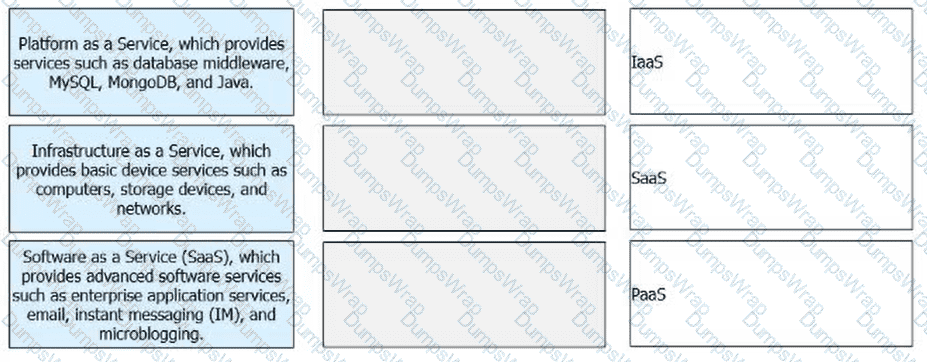
The three cloud computing service models are continuously being improved. Match the acronyms of the three models with their respective functions:
Options:
Answer:

Explanation:
1 → PaaS
2 → IaaS
3 → SaaS
The three mappings correspond directly to Huawei Cloud's definitions of the standard cloud service models. Infrastructure as a Service (IaaS) supplies foundational infrastructure resources such as compute, storage, and networking. Huawei Cloud services such as ECS, VPC, VPN, and OBS are representative infrastructure-level services. Therefore, the description referring to computers, storage devices, and networks maps to IaaS.
Platform as a Service (PaaS) provides managed platform capabilities used to develop, deploy, and operate applications. Huawei Cloud characterizes PaaS as including middleware, database platforms, development environments, microservice capabilities, and related application-platform resources. Consequently, the database/middleware/MySQL/MongoDB/Java-oriented description belongs to PaaS.
Software as a Service (SaaS) delivers complete applications to end users. Customers consume the application rather than maintaining the underlying operating system, middleware, runtime, and infrastructure. Enterprise applications, messaging systems, email services, collaboration applications, and similar ready-to-use software fit this model.
The correct progression is therefore PaaS → IaaS → SaaS for the three descriptions shown in the question.
Reference topics: Cloud Service Models; IaaS; PaaS; SaaS; Huawei Cloud Service Architecture.
===============
