
HCIP-Cloud Service Solutions Architect V3.5 Questions and Answers
Data Admin Service (DAS) is a cloud-based database management service. Which statement below about DAS is incorrect?
Options:
DAS can diagnose SQL statements, execute scheduled SQL tasks, synchronize database table structures across instances, and it allows you to import and export data.
DAS provides a web-based console for basic SQL operations, advanced database management, and intelligent O & M.
DAS is mainly for database developers and workload auditors.
DAS makes cloud and remote DB instance management simple, secure, and intelligent.
Answer:
CExplanation:
“DAS offers a web-based console for basic SQL operations, advanced database management, and intelligent O & M, boosting efficiency and security.”
“DAS helps you manage mainstream database types, such as RDS for MySQL, RDS for SQL Server, RDS for PostgreSQL, TaurusDB, Distributed Database Middleware (DDM), Document Database Service (DDS), GeminiDB Cassandra API, and GaussDB.”
“DAS is mainly designed for developers and database administrators (DBAs).”
Huawei source: Training PDF p. 322
Technical Deep Dive
Huawei Data Admin Service (DAS) is a managed, browser-based database development and administration platform. Option A is correct because DAS offers SQL diagnosis, supported scheduled SQL tasks, table-structure synchronization and data import/export functionality. Option B is correct because the service provides a web console for SQL execution, database administration and intelligent operations. Option D is also correct: DAS simplifies management of Huawei Cloud and supported remote databases through centralized tooling, diagnostic features and a secure console experience.
Option C is false because the official Huawei V3.5 slide identifies developers and database administrators (DBAs) as its main intended users—not 'workload auditors'. A DBA is responsible for database performance, configuration, maintenance, access and availability. Auditors may examine operational evidence, but they do not replace the DBA audience in the service definition.
For example, a DBA troubleshooting a slow customer-orders query can inspect SQL behavior, use available diagnosis tools and evaluate index recommendations. An engine-compatible EXPLAIN statement can reveal whether a query uses an index or performs an expensive table scan. DAS can also simplify editing table structures and working with multiple managed database products such as RDS, GaussDB and supported document services. These conveniences do not remove the need for least-privilege access, backups, change approvals and awareness of database-specific SQL syntax. The correct answer follows directly from the official target-user definition: C. The explanation should not conflate database performance analysis with a dedicated organizational role of 'workload auditor'.
Technical commands / calculations from the reviewed batch
EXPLAIN SELECT *
FROM orders
WHERE customer_id = 1001;
Web Application Firewall (WAF) can thoroughly inspect and protect service applications, intelligently recognize malicious request characteristics, and defend against unknown threats. Which of the following statements about WAF functions are correct?
Options:
WAF supports the following access modes: cloud mode CNAME access, cloud mode load balancer access, and dedicated mode.
WAF supports network border protection, domain name ICP filing, and ICP filing check.
WAF supports network protocols such as TCP, UDP, and SSL and protects Layer 2 and Layer 4 network services.
WAF supports the WebSocket and Server-Sent Events (SSE) protocols and enables them by default.
Answer:
A, DExplanation:
“WAF supports three deployment modes: Cloud Mode - CNAME, Cloud Mode - Load balancer, and Dedicated Mode.”
“WAF and CFW are different products provided by Huawei Cloud. WAF is used to protect your web services, while CFW is used to protect Internet border and VPC border traffic.”
[WebSocket and SSE default support are established by current official Huawei WAF product documentation rather than this slide. ]
Huawei source: Training PDF pp. 367, 369; official WAF protocol documentation
Technical Deep Dive
Huawei's V3.5 WAF chapter identifies three deployment modes: cloud mode with CNAME access, cloud mode through a load balancer and dedicated mode. Therefore option A is correct. These approaches differ in protected object, traffic path, billing and infrastructure integration. WAF protects HTTP/HTTPS web applications against malicious requests, including SQL injection, cross-site scripting and related application-layer attacks.
Option B is incorrect because network border protection belongs primarily to Cloud Firewall (CFW), while domain ICP filing is a separate regulatory or website-compliance process. Option C is incorrect because WAF is not a general-purpose Layer 2 Ethernet or Layer 4 arbitrary TCP/UDP firewall. Network protection and application security products have distinct responsibilities and inspection layers.
Option D is correct according to the relevant official Huawei WAF product documentation: WebSocket and Server-Sent Events are supported and enabled by default in the stated service behavior. WebSocket carries bidirectional messaging over an upgraded HTTP connection; SSE allows server-to-client event delivery. Support for forwarding a protocol should not be treated as evidence that all its payloads undergo identical deep inspection to ordinary HTTP requests; the product documentation qualifies WebSocket inspection behavior.
In production, a design should choose WAF mode according to the origin location, traffic volume, performance requirements and acceptable configuration changes. Origin access should be restricted to avoid bypassing the protection point. WAF does not replace CFW, API authentication or application security testing. The two supported choices are A and D.
The Internet of Things (IoT) is a network concept. It involves connecting information-sensing devices to the Internet for intelligent identification, locating, tracking, monitoring, and management. From basic sensor networks to complex system integration, IoT lets devices communicate with one another and exchange data for automated, intelligent control.
Options:
TRUE
FALSE
Answer:
AExplanation:
“The Internet of Things (IoT) is a network that links diverse sensors and devices through the Internet, enabling smart identification, positioning, tracking, monitoring, and management. It spans basic sensor networks to advanced integrated systems, facilitating device communication and data exchange for automated, intelligent operations.”
Huawei source: Training PDF p. 664
Technical Deep Dive
Huawei's V3.5 curriculum defines the Internet of Things as a network that connects sensors and devices so they can identify, locate, track, monitor and manage real-world objects and exchange data for automated operation. The statement accurately paraphrases that definition and is TRUE, option A.
An IoT architecture can be considered in four functional layers. Sensors and embedded controllers collect measurements at the device layer, such as temperature, pressure, motion or vibration. Network services carry messages over Ethernet, Wi-Fi, cellular connectivity, 5G or NB-IoT. An IoT platform authenticates and manages devices, receives telemetry, forwards data and exposes APIs. Business applications analyze measurements, display dashboards and issue supported remote-control commands.
Huawei Cloud IoTDA is an example of a managed platform used for registering and communicating with physical devices. Protocols may include MQTT, HTTPS and LwM2M over CoAP, depending on device capabilities. Consider an industrial sensor reporting temperature through MQTT: a cloud application can compare its readings with operational thresholds, alert engineers and instruct an appropriate actuator. For scenarios with strict latency, limited bandwidth or intermittent connectivity, local IoT Edge processing can operate before sending summarized data to the cloud. Secure IoT requires strong device identities, credential management, encryption, firmware updates and appropriate authorization. The user's description of intelligent identification, monitoring and automated control matches the official course.
What does Cloud Eye alerting for monitoring metrics allow you to do?
Select all that apply.
Options:
Monitor specific objects and specify metrics or events by configuring different alarm policies.
Use either a default or custom template to create alarm rules for resources in batches. This improves management efficiency.
View alarm information on the cloud. However, interconnection with third-party platforms such as Prometheus or Grafana is not supported.
Use auto scaling and multi-channel alarm notifications (including HTTP/HTTPS, FunctionGraph, voice, email, and SMS).
Answer:
A, B, DExplanation:
“Users can create alarm rules for key metrics of cloud services. When the conditions in the alarm rule are met, Cloud Eye reports the alarms using emails, SMS, or HTTP/HTTPS requests, enabling users to quickly respond to resource changes.”
[The slide lists] flexible policies, varied notifications through HTTP/HTTPS/FunctionGraph/SMS/email, Auto Scaling integration, and default or custom alarm templates.
Huawei source: Training PDF p. 591; official Cloud Eye documentation
Technical Deep Dive
Cloud Eye alarm management allows administrators to define resource- and metric-specific thresholds, triggering rules, notification routes and operational responses. Option A is true because alarm policies can be tailored to individual monitored objects, metrics and events. Option B is true because Huawei supplies standard and customizable templates that can be applied across resources in batches, reducing repetitive configuration and improving policy consistency.
Option D is true. The Huawei V3.5 alarm slide lists HTTP/HTTPS, SMS, email, FunctionGraph and Auto Scaling integration, while related official documentation confirms voice notification channels where supported. A Cloud Eye threshold can notify an operator, invoke an automated function or participate in a scaling policy. For instance, sustained CPU utilization above an agreed threshold can initiate capacity scaling while the operations team receives an alert.
Option C is false because Huawei supports monitoring integration with external observability systems. Cloud Eye metrics can be exposed through suitable exporter and API mechanisms to Prometheus-compatible environments, and those metrics can be visualized in Grafana as part of a broader monitoring architecture. The claim that such interconnection is categorically unsupported is therefore wrong. Operationally, alarm thresholds must account for duration, evaluation periods, retry behavior, resource scale and alert fatigue. Too-sensitive alerts can generate noise, while overly broad thresholds can miss failures. Automatic scaling requires sensible minimum and maximum capacities, cooldown settings and health checks. A, B and D are the supported capabilities; C is the inaccurate denial of integration.
High availability is an important design characteristic. Which of the following is not related to high availability?
Options:
Auto scaling supported by system
Elastic Load Balance (ELB) for controlling traffic distribution
Higher network bandwidth upper limit of a compute instance
Disaster recovery (DR) backup services for critical services
Answer:
CExplanation:
“HA is a system architecture capability that minimizes single points of failure and provides automatic failover, with the ultimate goal of delivering reliable, uninterrupted services.”
[Supporting material] High availability addresses component-level failures; disaster recovery addresses site-level failures and RTO/RPO targets.
Huawei source: Training PDF p. 18
Technical Deep Dive
High availability minimizes interruption from individual component failures. Option A is related because Auto Scaling can maintain necessary application capacity and, when health management is properly integrated, can provision replacement instances. Option B is related because ELB distributes requests across available backends and can exclude unhealthy servers using health checks.
Option D is also related to service continuity. Disaster recovery and backup services protect against more serious events, potentially including a site outage. DR is not synonymous with high availability: HA generally handles component-level failures and automatic failover, while DR focuses on recovery after more extensive disruptions. Nevertheless, they are complementary resilience strategies. Option C , by contrast, specifies a higher network bandwidth upper limit. Bandwidth increases potential throughput; it does not introduce additional service instances, redundancy, healthy failover targets or automated recovery.
For example, upgrading an ECS from a one-Gbit/s to a five-Gbit/s link may reduce congestion during high traffic, but the application still fails if its only server is lost. A more suitable HA architecture distributes instances across availability zones, configures ELB health checks, uses appropriate Auto Scaling policies and implements data-layer redundancy. Architects should evaluate both network performance and resilience, but should not use bandwidth capacity as a substitute for fault tolerance. Thus C alone is unrelated to the HA mechanism specified.
The architecture relies on small functional blocks, each centered on a single responsibility and function. A large, complex application is built as a suite of modular services. Which of the following architectures is described?
Options:
Virtualized architecture
Monolithic architecture
SOA architecture
Microservice architecture
Answer:
DExplanation:
“The microservice architecture breaks down applications into groups of small services called 'microservices', which cooperate with each other to provide business capabilities.”
“Each service runs as an independent process. Lightweight communication mechanisms (usually based on RESTful APIs) are used between services.”
“Each microservice is designed, developed, and tested by an independent team, and can be deployed independently and automatically in the production environment.”
Huawei source: Training PDF p. 507
Technical Deep Dive
The description is of microservice architecture, option D. A microservice solution decomposes a large application into smaller, loosely coupled services, each centered on a distinct business capability. A service runs independently and exposes an API or another lightweight communication interface. Teams can develop, test, deploy and scale individual services without automatically replacing the entire application.
Option A is incorrect because virtualization refers to computing-resource isolation rather than the division of application functionality. Option B is incorrect because monolithic architecture packages interdependent business features into one comparatively tightly coupled deployment unit. Option C , service-oriented architecture (SOA), also uses service boundaries, but usually emphasizes broader enterprise integration and may organize services at larger granularity. Huawei's training specifically describes independently deployable small functional units and language-agnostic APIs as microservice characteristics.
An e-commerce application can be divided into catalog, inventory, authentication, orders and payment services. Each group can deploy updates to its own service and scale according to its demand. This increases agility but introduces distributed-systems concerns: network latency, service discovery, traffic management, observability, API versioning, cross-service authentication, retries and data consistency. Huawei Cloud offers CCE, ServiceStage and Application Service Mesh to support relevant operational capabilities. Architecture selection should account for team maturity and application complexity; microservices are not automatically better for every small system. Nevertheless, the stem matches Huawei's official microservice definition precisely.
Scalability generally means that a system or service can accommodate changes in scale by flexibly adjusting its architecture or resource configuration as business demand increases. Which of the following are examples of vertical scaling?
Select all that apply.
Options:
Adding read replicas to an RDS instance
Downgrading RDS instance specifications from 8 vCPUs and 32 GB to 4 vCPUs and 16 GB
Increasing the number of ECSs from 2 to 5
Upgrading ECS specifications from 2 vCPUs and 4 GB to 4 vCPUs and 8 GB
Answer:
B, DExplanation:
“Vertical scaling is to replace existing IT resources with one of greater or lower capacity.”
[Course distinction] Horizontal scaling adds service nodes; vertical scaling changes the capacity of an existing resource.
Huawei source: Training PDF pp. 22–23
Technical Deep Dive
Vertical scaling, also called scaling up or scaling down, changes the capacity of an existing compute or database instance rather than increasing the number of instances. The distinction is architectural: vertical scaling changes resources assigned to a node; horizontal scaling adds or removes separate nodes.
Option B is correct because reducing RDS specifications from eight vCPUs and 32 GiB to four vCPUs and 16 GiB is vertical scale-down. Although capacity decreases, it remains vertical scaling. Option D is correct because increasing an ECS from two vCPUs and four GiB to four vCPUs and eight GiB is vertical scale-up. Option A is horizontal database scaling: creating read replicas increases the number of database nodes available to serve read requests. Option C is likewise horizontal: the ECS population grows from two to five instances.
On Huawei Cloud, ECS flavor changes and supported RDS instance-class modifications can implement vertical scaling. Some changes may require restarting the instance or using a maintenance window. Vertical scaling is limited by available hardware and maximum instance flavors. Horizontal scaling can increase aggregate capacity and resilience, but requires load balancing, session handling, data distribution and consistent application behavior. Neither design automatically solves all availability issues; the choice must reflect the workload bottleneck and recovery objectives.
A Kubernetes cluster is made up of master nodes and worker nodes. A master node manages the whole cluster. Which of the following components run on a master node?
Select all that apply.
Options:
API server
Docker
kubelet
Scheduler
Answer:
A, DExplanation:
“A master node is the machine where the control plane components run, including API server, scheduler, controller manager, and etcd. In a production environment, multiple master nodes are deployed to ensure high cluster availability.”
“A worker node is a compute node for running containerized applications in a cluster. Kubelet, kube-proxy, and container runtime are running on each worker node.”
Huawei source: Training PDF p. 415
Technical Deep Dive
Huawei's Kubernetes architecture places the API server, scheduler, controller manager and etcd in the control plane. Option A is correct because kube-apiserver exposes the Kubernetes API and receives administrative and controller requests. Option D is correct because the scheduler chooses suitable nodes for pending pods based on available capacity and scheduling constraints.
Option B , Docker, is not a Kubernetes control-plane component. Docker is a container platform/runtime technology. Modern Kubernetes typically uses a compatible container runtime such as containerd, and the runtime is associated with workload execution rather than the API/scheduling control functions. Option C , kubelet, is primarily described by Huawei's diagram as a worker-node agent that manages containers and pods according to control-plane instructions.
There is a technical ambiguity: real Kubernetes control-plane hosts can also run kubelet to manage static pods and other node-local components. Therefore it would be inaccurate to claim kubelet never runs on a master. The examination should ask which are control-plane components instead of which components merely run on a master host. Production Kubernetes commonly uses multiple control-plane nodes to avoid a single point of management failure, though application availability also depends on workers and data services. Useful validation commands include kubectl get nodes -o wide, kubectl cluster-info and kubectl get pods -n kube-system. Under the course's architectural classification, A and D are the defensible answers.
Technical commands / calculations from the reviewed batch
kubectl get nodes -o wide
kubectl get pods -n kube-system
kubectl cluster-info
A company plans to use a Virtual Private Network (VPN) to enable communication between its on-premises data center and multiple VPCs on Huawei Cloud. Which statement about VPN is false?
Options:
VPN connections use IKE and IPsec to encrypt transmitted data, ensuring service data security.
A VPN consists of a VPN gateway, a customer gateway, and VPN connections. VPN connections are secure channels between the VPN gateway and the customer gateway.
There are two types of VPNs: Site-to-Cloud VPN (S2C VPN) and Point-to-Cloud VPN (P2C VPN). S2C VPN uses IPsec, and P2C VPN uses SSL.
VPN connections can be created between VPN gateways in the same region on the cloud for cross-VPC communications.
Answer:
DExplanation:
“S2C VPN involves three key components: VPN gateway, customer gateway, and VPN connection.”
[Supporting content] Site-to-Cloud VPN uses IKE and IPsec; Point-to-Cloud VPN provides SSL-based remote access. For same-region VPC access, VPC peering or equivalent private routing is used.
Huawei source: Training PDF pp. 139–140; official VPN/VPC guidance
Technical Deep Dive
Huawei V3.5 describes Site-to-Cloud VPN as a secure communication mechanism involving a VPN gateway, customer gateway and VPN connection. IKE negotiates security parameters and IPsec protects traffic, supporting the claim in A. B correctly identifies the major Site-to-Cloud VPN components. C correctly differentiates Site-to-Cloud IPsec VPN from Point-to-Cloud SSL-based access in the curriculum.
Option D is the false statement for the architecture described. For VPCs in the same Huawei Cloud region, direct private connectivity through VPC peering or other supported routing mechanisms is recommended rather than setting up the posited VPN gateway-to-gateway link. VPN is used for scenarios involving encrypted connectivity between on-premises networks and cloud VPCs or appropriate cross-region environments.
For an enterprise that wants a single on-premises data center to reach several VPCs, the architect must decide whether to use Site-to-Cloud VPN, Direct Connect, Cloud Connect and/or an Enterprise Router based on latency, bandwidth, cost and redundancy requirements. After establishing a tunnel, verify the IKE phase, IPsec security associations, route tables, encryption-domain selectors, customer gateway configuration, network ACLs and security groups. A healthy tunnel does not guarantee application reachability if address ranges overlap or routes are missing. These caveats do not change the intended single false answer, D.
Both Cloud Connect and Direct Connect can establish high-speed, low-latency networks. Which of the following statements regarding their differences is false?
Options:
Direct Connect establishes a high-speed, low-latency, stable, and secure dedicated network connection that links an on-premises data center to the cloud.
Users can use Direct Connect to connect an on-premises data center to the cloud, and then use Cloud Connect to connect VPCs in different regions, so that the on-premises data center can access the VPCs across regions.
Cloud Connect can work with EIPs to enable private communications between on-premises servers and cloud instances.
Cloud Connect provides both cloud connections and central networks to connect VPCs in different regions. It can also work with Direct Connect to create a hybrid cloud network.
Answer:
CExplanation:
“Cloud Connect provides both cloud connections and central networks.”
“Cloud Connect can also work with Direct Connect to set up a hybrid cloud network that enables on-premises data centers to access the VPCs across regions.”
Huawei source: Training PDF p. 146
Technical Deep Dive
Direct Connect and Cloud Connect solve different segments of enterprise networking. Direct Connect creates high-speed private connectivity between an on-premises data center and Huawei Cloud through a dedicated physical link. Cloud Connect provides private inter-region connectivity using cloud connections and central networks, and can work alongside Direct Connect to extend on-premises reachability to VPCs across supported regions.
Option A accurately characterizes Direct Connect. Option B describes the documented hybrid pattern: attach on-premises infrastructure to the cloud, then interconnect VPCs in other regions through Cloud Connect. Option D also matches the official Cloud Connect feature description. Option C is false because it presents Elastic IPs as the mechanism by which Cloud Connect establishes private on-premises-to-cloud communications. EIPs are public addressing resources, not the inter-region backbone or the dedicated customer access circuit.
A typical design is: on-premises data center - > Direct Connect - > VPC - > Cloud Connect - > remote VPC. Routing must be configured end to end, with appropriate CIDR planning, propagation, bandwidth allocations and security controls. High availability may require redundant physical circuits, dual customer routers, resilient BGP sessions and careful route-preference design. Neither Cloud Connect nor Direct Connect removes the need for application-layer authentication and encryption where required by policy. The correct false statement is C; do not confuse a public EIP with private hybrid-cloud connectivity.
Elastic Load Balance (ELB) provides dedicated and shared load balancers. Which of the following statements about shared load balancers is false?
Select all that apply.
Options:
When backend servers receive requests from a shared load balancer, source IP addresses are translated into those in 100.125.0.0/16.
“Transfer Client IP Address” is enabled for Layer 4 and Layer 7 listeners by default. Users do not need to manually enable it.
After backend servers are added to a load balancer, users must check the security group rules and network ACL rules of the backend servers.
If “Transfer Client IP Address” is enabled for the Layer 4 listeners of a shared load balancer, each source IP address will be translated into an IP address in 100.125.0.0/16.
Answer:
B, DExplanation:
“Transfer Client IP Address is enabled for Layer 7 listeners by default. You do not need to manually enable it.”
[Supporting description] Enabling Transfer Client IP Address for Layer 4 listeners preserves the client source IP rather than translating it to the 100.125.0.0/16 range.
Huawei source: Training PDF p. 166
Technical Deep Dive
The question asks which statements about shared Elastic Load Balance are false. Option B is false because client-IP transfer behavior is not enabled in the same way by default for both Layer 4 and Layer 7 listeners. The Huawei V3.5 slide specifically states that Transfer Client IP Address is enabled by default for Layer 7 listeners; Layer 4 source-address preservation depends on the relevant listener setting.
Option D is also false. It reverses the behavior of enabling Transfer Client IP Address for a supported Layer 4 shared listener. When preservation is enabled, the backend receives the original client source address instead of a translated source address from the 100.125.0.0/16 range. Option A describes the shared ELB source-translation behavior when client-IP preservation is not applied and is generally true in the course context. Option C is true because backend security groups and network ACLs must permit load balancer requests and health-check traffic.
Client identity matters for auditing, geographic restrictions, rate limiting and incident analysis. For Layer 7 HTTP and HTTPS forwarding, applications may also use an X-Forwarded-For header to identify the originating client, but this is not the same as packet-level source-IP preservation. Engineers must configure trust boundaries around such headers so that arbitrary client-supplied values are not accepted as authoritative. The curriculum explicitly supports B and D as the false claims.
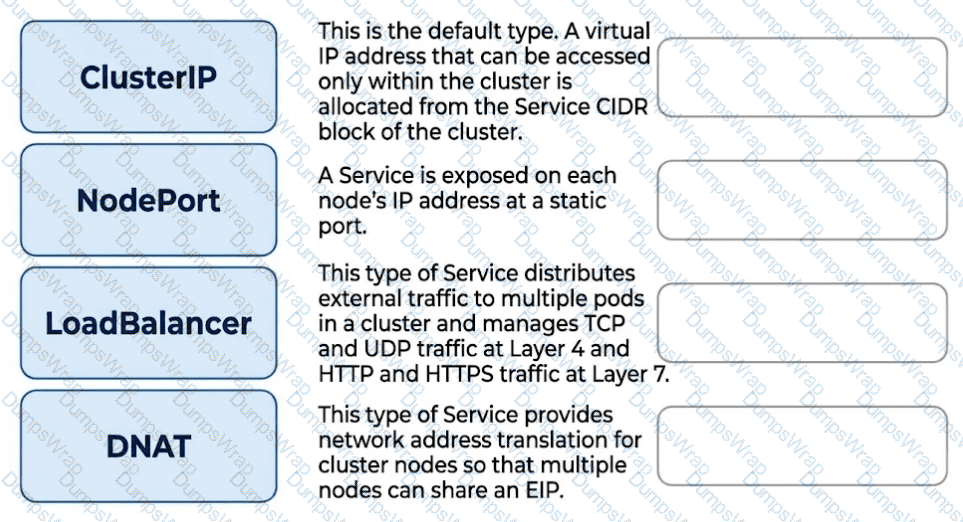
Cloud Container Engine (CCE) provides multiple Service network access modes. Match each description with its corresponding access mode.
Options:
Answer:
Explanation:
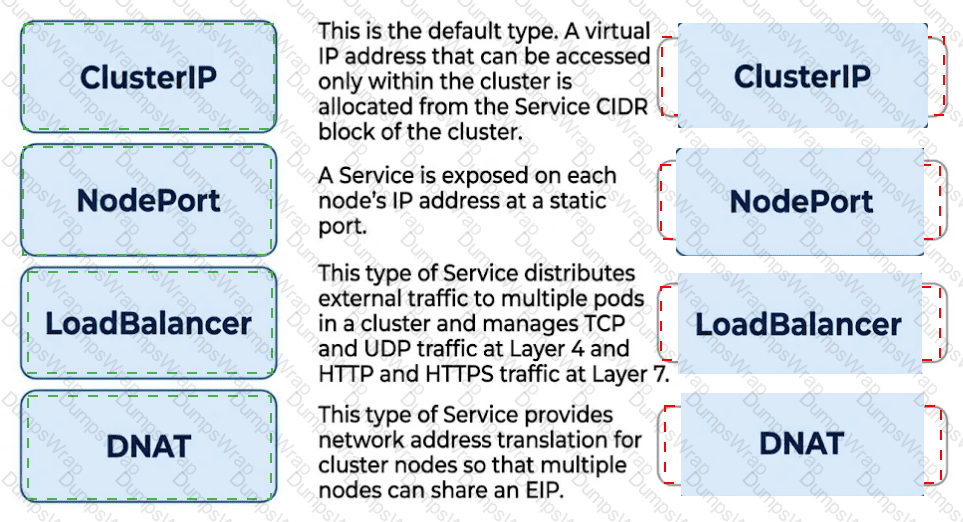
“ClusterIP: This is the default type. A virtual IP address that can be accessed only within the cluster is allocated from the Service CIDR block of the cluster.”
“NodePort: The Service is exposed on each node's IP address at a static port.”
“LoadBalancer: This type of Service adds an external load balancer on the top of a NodePort Service.”
“DNAT: This type of Service translates IP addresses for cluster nodes and enables multiple nodes to share an EIP.”
Huawei source: Training PDF pp. 458–459
Technical Deep Dive
This matching exercise tests four Huawei CCE network access modes. The first description is ClusterIP, option A: Kubernetes creates an internal virtual address from the Service CIDR range, normally usable only inside the cluster. The second is NodePort, option B: the Service is exposed on a static port of each node, allowing the relevant node address and port to reach the workload. NodePort traffic normally reaches a corresponding ClusterIP abstraction.
The third description is LoadBalancer, option C. An external load-balancing resource accepts traffic and distributes it to eligible pods; Huawei Cloud ELB supports Layer 4 and, through applicable listener implementations, Layer 7 traffic distribution. The fourth description is Huawei CCE's DNAT mode, option D. It uses network address translation to allow multiple cluster nodes to share an EIP and avoids tying the externally exposed service to a single node's directly bound EIP.
A Kubernetes Service provides a stable access mechanism even though backend pods may be scheduled, replaced or rescaled. Engineers can inspect configured Services with kubectl get services, check policy and endpoints with kubectl describe service, and verify corresponding EndpointSlices. ClusterIP, NodePort and LoadBalancer are standard Kubernetes Service types. Huawei's DNAT access mode is specific to the CCE service integration and should not be represented as an upstream Kubernetes Service.spec.type value. The original screenshot is retained with empty match boxes; the verified order is A, B, C, D.
Technical commands / calculations from the reviewed batch
kubectl get services
kubectl describe service my-service
kubectl get endpointslices
Description
Correct selection
1
A — ClusterIP
2
B — NodePort
3
C — LoadBalancer
4
D — DNAT
Serverless computing is a cloud-native development model. It enables developers to build and run applications without having to manage the underlying infrastructure, such as servers. Serverless means that no compute resources, including servers, are needed. To process services, you simply run your code in the cloud, which greatly lowers costs. This model lets developers concentrate more on service code, making it very developer-friendly.
Options:
TRUE
FALSE
Answer:
BExplanation:
“Serverless: Serverless computing is a cloud-native development model. It allows developers to build and run applications without the need to manage underlying infrastructure such as servers. Serverless does not mean there are no servers. Instead, it means all tasks related to server management, maintenance, and scaling are handled by cloud service providers.”
“Serverless computing does not mean that we no longer use servers to host and run code, or O & M engineers are no longer needed.”
Huawei source: Training PDF pp. 52, 475
Technical Deep Dive
The critical error is the claim that serverless computing uses no servers or compute resources. Huawei's V3.5 material explicitly states that serverless does not mean the absence of servers. Instead, it is an abstraction in which the cloud provider performs much of the infrastructure provisioning, maintenance and scaling that would traditionally be managed by the application developer. Physical computing capacity, operating systems, virtualization and runtime environments still execute the code.
In a conventional ECS deployment, a customer selects instance flavors, installs software, manages the guest OS and develops scaling and operational procedures. In a serverless environment such as Huawei FunctionGraph, developers upload functions or application code and configure triggers. The platform allocates and manages execution capacity based on incoming requests or events, while the developer focuses on business logic and function configuration.
Serverless can reduce operational effort and be cost-effective for intermittent or unpredictable demand. However, it is not automatically cheaper in every circumstance; persistent high utilization, runtime limits, concurrency requirements, cold starts and billing granularity can affect the economics. Backend as a Service (BaaS) and Function as a Service (FaaS) are related but distinct models. Serverless also does not eliminate security, logging, monitoring or governance responsibilities. The statement's initial description of reduced infrastructure management is accurate, but its assertion that no computing resources exist is false. Therefore choose B.
A customer bought compute-intensive Elastic Cloud Servers (ECSs) and deployed Linux applications to test services. The ECSs use pay-per-use billing. When no tests are running, some ECSs are stopped to reduce costs. After the ECSs are stopped, which of the following resources are not billed?
Select all that apply.
Options:
Elastic Volume Service (EVS) disks
Elastic IP
Memory
vCPUs
Answer:
C, DExplanation:
“BRS supports asynchronous replication with second-level RPO and an RTO under 30 minutes.”
“Cost-effective: When services run normally, DR-site ECSs remain stopped, so you only pay for OBS and EVS storage. No compute charges are incurred at the DR site.”
[Related context only: standard ECS stop-and-billing rules require the official ECS billing documentation; this DR excerpt is not the complete billing policy. ]
Huawei source: Training PDF p. 245; official ECS billing documentation
Technical Deep Dive
Huawei Cloud distinguishes ECS computing charges from the pricing of storage and networking resources. For a standard pay-per-use ECS that is eligible for stop-billing behavior, vCPU and memory charges are suspended after the instance is stopped. Consequently, C and D are correct. Memory and vCPUs form the basic compute allocation, whereas independently provisioned EVS and EIP resources continue to exist even if the application is not running.
Option A is not correct because EVS system and data disks continue occupying provisioned block-storage capacity and remain chargeable under their billing rules. Option B is not correct because EIPs and related bandwidth can continue to incur charges, depending on the allocation and billing mode. Stopping the compute instance is not equivalent to deleting its attached resources.
A material exception concerns special ECS configurations, including certain local-disk, FPGA or bare-metal-related instance categories. Their resource allocation and stop-billing behavior may differ, so a universally worded question should specify standard pay-per-use ECSs. A stopped instance may release its computing resources; restarting it can depend on available capacity. For short-lived development or testing environments, administrators should combine scheduled stopping with cost tracking and deletion of unneeded storage and EIP allocations. The Training Material's disaster-recovery excerpt illustrates suspended DR compute charging but is not, by itself, a complete reference for general ECS stop-billing rules.
Database Security Service (DBSS) offers database auditing, database encryption and access control, and database O & M capabilities. It records database user access in real time, produces fine-grained reports, and issues real-time alerts when attacks or risky operations are detected.
Options:
TRUE
FALSE
Answer:
AExplanation:
“DBSS provides database audit, database encryption and access control, and database O & M functions. It records user access to the database in real time, generates fine-grained audit reports, and sends real-time alarms for risky operations and attack behaviors.”
“DBSS provides the database audit function in out-of-path mode, which consumes very little database performance.”
Huawei source: Training PDF pp. 378–379
Technical Deep Dive
The statement closely reproduces the Huawei V3.5 Database Security Service (DBSS) definition, so it is TRUE, option A. DBSS provides database auditing, encryption and access-control-related capabilities and database O & M functions. It can record activity involving database users, produce fine-grained reports and alert administrators about suspicious or risky operations.
A central capability is database activity auditing. For example, an account unexpectedly executing a large series of SELECT statements against a customer-information table can be recorded for incident investigation. Database audit reports help correlate actions with users and sessions, support compliance review and identify unusual access patterns. Huawei's material describes an out-of-path auditing mode, intended to minimize the performance impact on ordinary database requests. It also identifies SQL-injection detection and operational risk alarms.
Audit functions must be distinguished from active prevention. An out-of-path collector primarily observes activity; database privileges, authentication, approved operational workflows and encryption require their own correct design. When an encryption gateway or other in-path protection mode is deployed, the traffic-handling architecture and failure characteristics differ. DBSS can complement IAM, HSS, WAF and Cloud Trace Service, but none replaces a carefully secured database engine. Architects should define audit coverage, retention, tamper protection, access to audit records, alert routing and acceptable performance overhead. The exact source statement includes the same real-time access recording and fine-grained reporting features, making A the correct exam answer.
A small or micro enterprise intends to use Huawei Cloud Elastic Cloud Server (ECS) to deploy a small web-based forum for technical and experience sharing and enterprise promotion. The enterprise wants data to be stored separately from ECSs and to support independent access. Which of the following storage services are recommended as cost-effective options?
Select all that apply.
Options:
Scalable File Service (SFS)
Object Storage Service (OBS)
Dedicated Distributed Storage Service (DSS)
Elastic Volume Service (EVS)
Answer:
A, BExplanation:
“SFS provides scalable, high-performance NAS file storage and supports shared file access from multiple ECSs, BMSs, and containers running on CCE and CCI.”
“OBS provides massive, secure, and reliable storage for data of any format and size at low cost.”
“EVS disks ... must be attached to cloud servers for use and cannot be used alone.”
Huawei source: Training PDF pp. 201, 210, 222
Technical Deep Dive
The enterprise needs cost-effective storage separated from the web forum's ECS instances and supporting access independent of a particular server. SFS and OBS meet those needs in different ways. Option A is correct because Scalable File Service offers managed Network Attached Storage with a shared filesystem interface. Multiple ECSs can mount the same eligible filesystem, allowing a scale-out web application to read and write shared documents or user uploads without maintaining separate local copies.
Option B is also correct. Object Storage Service provides scalable, durable object storage accessed through APIs, SDKs and supported HTTP/HTTPS endpoints. Forum images, attachments and static user content can be stored in OBS independently of the lifecycle of the ECS running the application. This is often more economical for media assets than reserving dedicated server-attached capacity.
Option C is not recommended for the small-forum scenario. Dedicated Distributed Storage Service provides dedicated storage infrastructure for demanding workloads such as critical databases and high-concurrency systems and generally entails unnecessary cost and capacity. Option D is block storage: EVS disks must be attached to supported cloud servers for ordinary filesystem use. Although their data can persist across server replacement, EVS does not provide the same independent API or shared file interface as OBS and SFS.
A well-designed forum can store structured posts and user records in RDS, media in OBS, and shared filesystem-based assets in SFS only when required. These distinctions support A and B.
