Pre-Summer Sale Discount Flat 70% Offer - Ends in 0d 00h 00m 00s - Coupon code: 70diswrap

Juniper JN0-351 Dumps

Page: 1 / 11
Total 107 questions

Enterprise Routing and Switching Specialist (JNCIS-ENT) Questions and Answers

Question 1

Which statement is correct about the IS-IS ISO NET address?

Options:

A.

An ISO NET address defined with a system ID of 0000.0000.0000 must be selected as the DIS.

B.

An ISO NET address must be unique for each device in the network.

C.

You can only define a single ISO NET address per device.

D.

The Area ID must match on all devices within a L2 area.

Question 2

Which two multicast IP addresses are used for link-state update packets? (Choose two.)

Options:

A.

224.0.0.5

B.

224.0.0.10

C.

224.0.0.9

D.

224.0.0.6

Question 3

Exhibit:

as

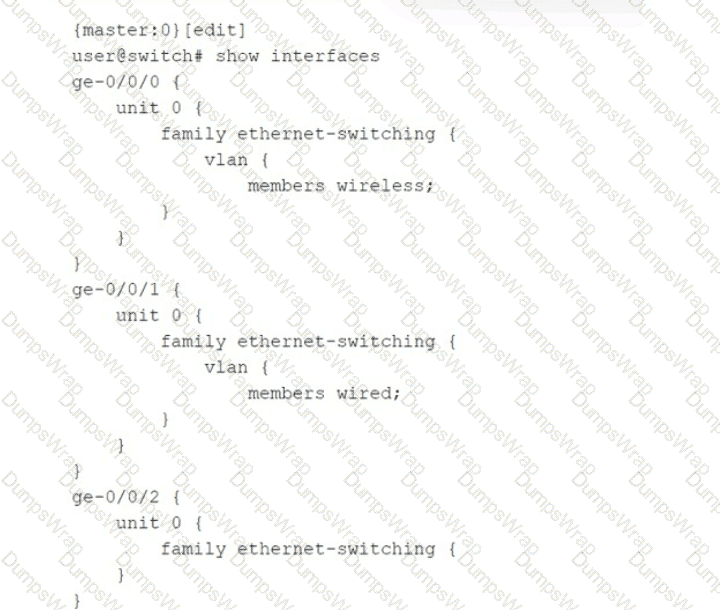
Which statement is correct about the configuration shown in the exhibit?

Options:

A.

The configuration will not complete the commit check process and will error out.

B.

The ge-0/0/0 and ge-0/0/1 interfaces are operating in trunk mode.

C.

All three interfaces are operating in access mode.

D.

The ge-0/0/2 interface is operating as a Layer 3 interface.

Question 4

Exhibit.

as

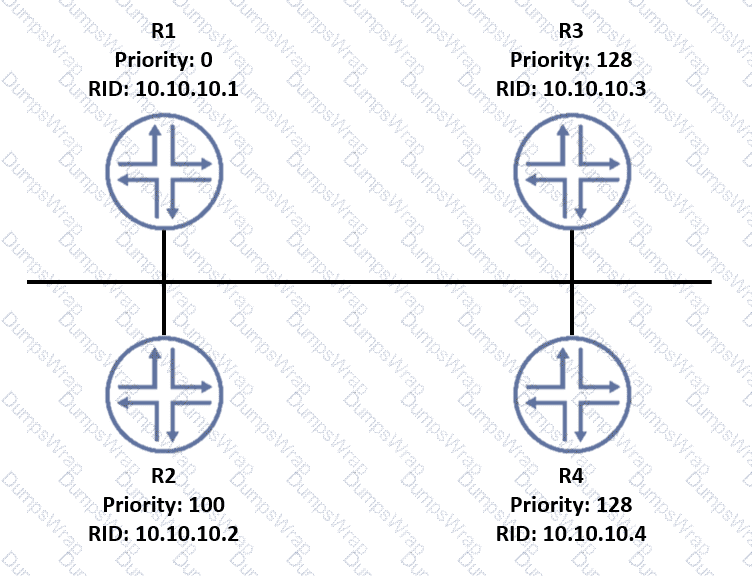
Which router will become the OSPF BDR if all routers are powered on at the same time?

Options:

A.

R4

B.

R1

C.

R3

D.

R2

Question 5

Click the Exhibit button.

as

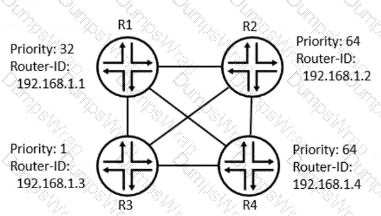
R1 was started at 4:00 PM. R2 and R3 were started at 6:00 PM. R4 was started at 10:00 PM. All routers are in Area 0 and there are no point-to-point links.

Referring to the exhibit, which router is the designated router?

Options:

A.

R4

B.

R1

C.

R2

D.

R3

Question 6

Exhibit.

as

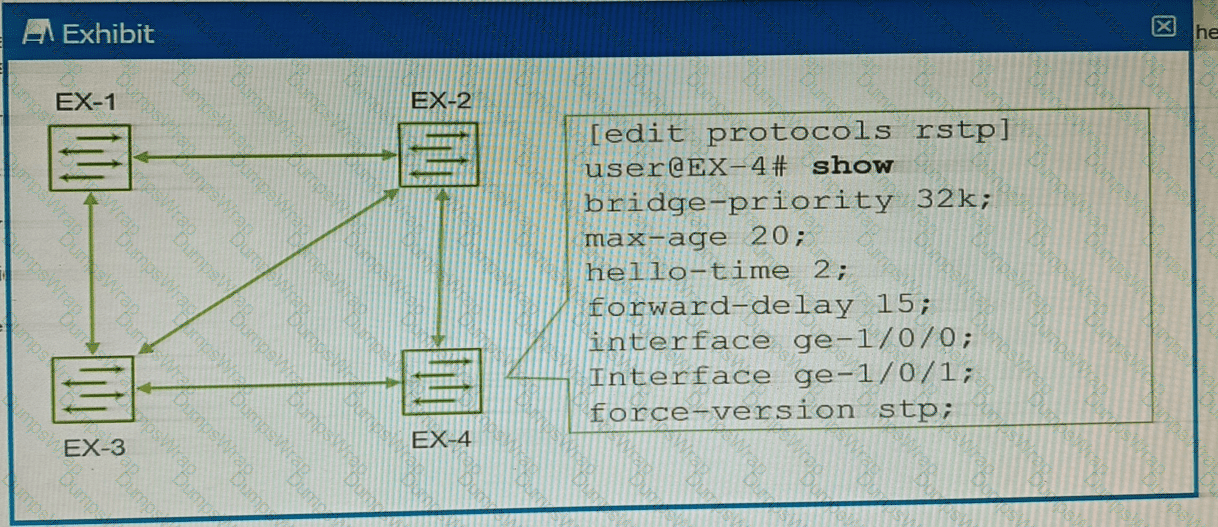
You have configured the four EX Series switches with RSTP, as shown in the exhibit. You discover that whenever a link between switches goes up or down, the switches take longer than expected for RSTP to converge, using the default settings.

In this scenario, which action would solve the delay in RSTP convergence?

Options:

A.

The hello-time must be increased.

B.

The force-version must be removed.

C.

The bridge priority for EX-4 must be set at 4000.

D.

The max-age must be increased to 20

Question 7

You have DHCP snooping enabled but no entries are automatically created in the snooping database for an interface on your EX Series switch. What are two reasons for the problem? (Choose two.)

Options:

A.

The device that is connected to the interface has performed a DHCPRELEASE.

B.

MAC limiting is enabled on the interface.

C.

The device that is connected to the interface has a static IP address.

D.

Dynamic ARP inspection is enabled on the interface.

Question 8

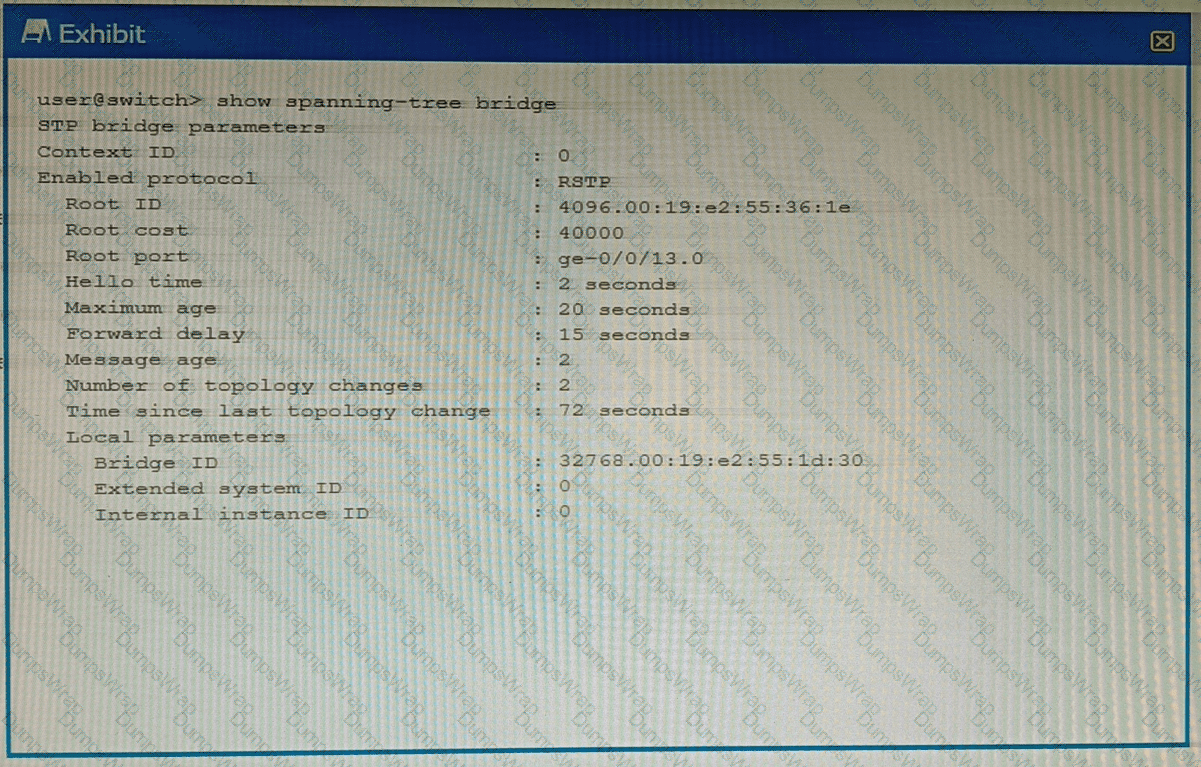
Exhibit

as

Referring to the exhibit, which statement is correct?

Options:

A.

The local device is using a bridge priority of 4k.

B.

The root bridge is using a bridge priority of 4k.

C.

The root bridge has not been elected for this RSTP topology.

D.

The local device is the root bridge for this RSTP topology.

Question 9

You are deploying an EX Series switch with a Wi-Fi access point. The access point needs all untagged traffic to use a specific VLAN.

In this scenario, which feature should you enable on the switch port?

Options:

A.

native VLAN

B.

VLAN tagging

C.

flexible VLAN tagging

D.

voice VLAN

Question 10

Which two statements are true about the default VLAN on Juniper switches? (Choose two.)

Options:

A.

The default VLAN is set to a VLAN ID of 1 by default

B.

The default VLAN ID is not assigned to any interface.

C.

The default VLAN ID is not visible.

D.

The default VLAN ID can be changed.

Question 11

Which two statements are correct about using firewall filters on EX Series switches? (Choose two.)

Options:

A.

You can deploy only stateless firewall filters on an EX Series switch.

B.

You can only apply firewall filters to Layer 2 traffic on an EX Series switch.

C.

You can apply firewall filters to both Layer 2 and Layer 3 traffic on an EX Series switch.

D.

You can deploy both stateless and stateful firewall filters on an EX Series switch.

Question 12

Which statement is correct about graceful Routing Engine switchover (GRES)?

Options:

A.

The PFE restarts and the kernel and interface information is lost.

B.

GRES has a helper mode and a restarting mode.

C.

When combined with NSR, routing is preserved and the new master RE does not restart rpd.

D.

With no other high availability features enabled, routing is preserved and the new master RE does not restart rpd.

Question 13

An update to your organization ' s network security requirements document requires management traffic to be isolated in a non-default routing-instance. You want to implement this requirement on your Junos-based devices.

Which two commands enable this behavior? (Choose two.)

Options:

A.

set routing—instances mgmtjunoa interface ge-0/0/0.0

B.

set routing—instances mgmt_junos interface em1

C.

set system management—instance

D.

set routing—instances mgmt_junos

Question 14

Two routers share the same highest priority and start time.

Options:

A.

In this situation, what is evaluated next when determining the designated router? The router with the lowest router ID become the DR.

B.

The router with the highest router ID becomes the DR

C.

The routers perform another DR election.

D.

The router with the highest MAC address become the DR

Question 15

Which two statements are correct about IS-IS? (Choose two.)

Options:

A.

IS-IS uses IPv6 as its transport protocol in the Junos OS Implementation.

B.

IS-IS has two metric types and Junos sends both by default.

C.

IS-IS sends a maximum metric value of 63 by default.

D.

IS-IS only allows you to configure two areas.

Question 16

A new network requires multiple topology support. You decide to use IS-IS in this situation. Which three protocol topologies are supported in this scenario? (Choose three.)

Options:

A.

IPsec

B.

anycast

C.

IPv6

D.

multicast

E.

IPv4

Question 17

Which two statements about BGP facilitate the prevention of routing loops within an autonomous system? (Choose two.)

Options:

A.

IBGP sessions must be configured as a logical full mesh.

B.

Routes learned from IBGP neighbors are not readvertised to other IBGP neighbors.

C.

Routes learned from IBGP neighbors are only advertised to other IBGP neighbors.

D.

IBGP sessions must be configured as a physical full mesh.

Question 18

What are two characteristics of RSTP alternate ports? (Choose two.)

Options:

A.

RSTP alternate ports block traffic while receiving superior BPDUs from a neighboring switch.

B.

RSTP alternate ports provide an alternate lower cost path to the root bridge.

C.

RSTP alternate ports provide an alternate higher cost path to the root bridge.

D.

RSTP alternate ports are active ports used to forward frames toward the root bridge.

Question 19

You are asked to explore adding BGP route reflectors to allow for increased scale in your core network. Which statement is correct in this scenario?

Options:

A.

Route reflectors are required whenever internal BGP (IBGP) sessions are needed.

B.

The cluster ID is required to prevent routing loops.

C.

Route reflectors require that the network is connected in a physical full mesh.

D.

The cluster ID is not required to use route reflectors.

Question 20

What does the MAC limiting feature do on EX Series switches?

Options:

A.

It limits the number of MAC addresses learned on an access port.

B.

It limits the number of MAC addresses learned on a trunk port.

C.

It limits the acceptable values for a MAC address to a specified range.

D.

It limits the time a learned MAC address stays in the MAC routing table.

Question 21

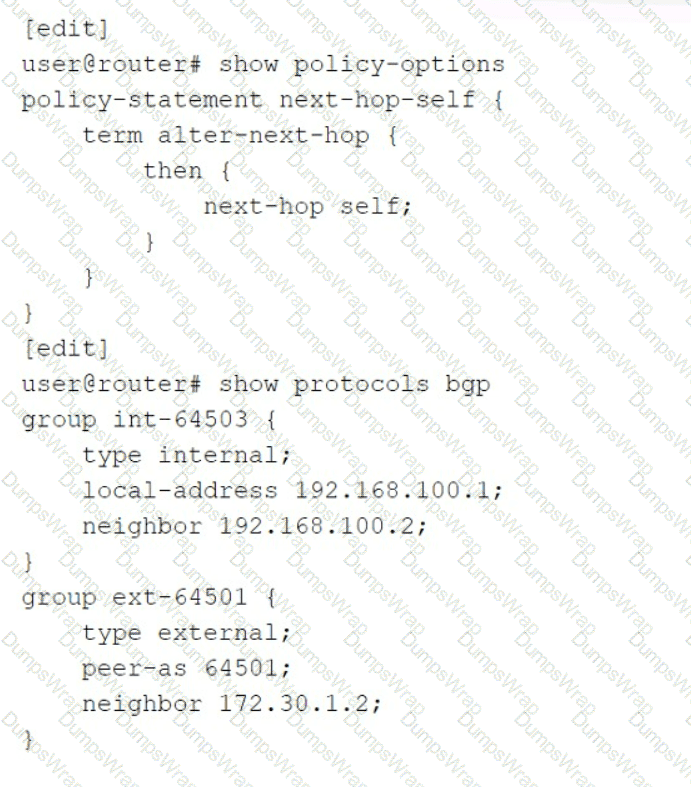
Click the Exhibit button.

as

R1 has a BGP session with a router that has a peer autonomous system number of 64501. It is exchanging routes, and is advertising those routes to IBGP peers. The downstream IBGP

peers, however, cannot pass traffic to the advertised networks.

Referring to the exhibit, which configuration change must occur to solve this problem?

Options:

A.

The BGP group ext-64501 must include the export next-hop-self policy.

B.

The BGP group int-64503 must include the import next-hop-self policy.

C.

The BGP group ext-64501 must include the import next-hop-self policy.

D.

The BGP group int-64503 must include the export next-hop-self policy.

Question 22

What is a purpose of using a spanning tree protocol?

Options:

A.

to look up MAC addresses

B.

to eliminate broadcast storms

C.

to route IP packets

D.

to tunnel Ethernet frames

Question 23

Which two statements are correct about Martian routes? {Choose two.)

Options:

A.

Martian routes are never installed in the route table.

B.

Additional prefixes can be added to the list of Martian routes.

C.

Martian routes only represent publicly used prefixes.

D.

Martian routes are always host addresses.

Question 24

You are concerned about spoofed MAC addresses on your LAN.

Which two Layer 2 security features should you enable to minimize this concern? (Choose two.)

Options:

A.

dynamic ARP inspection

B.

IP source guard

C.

DHCP snooping

D.

static ARP

Question 25

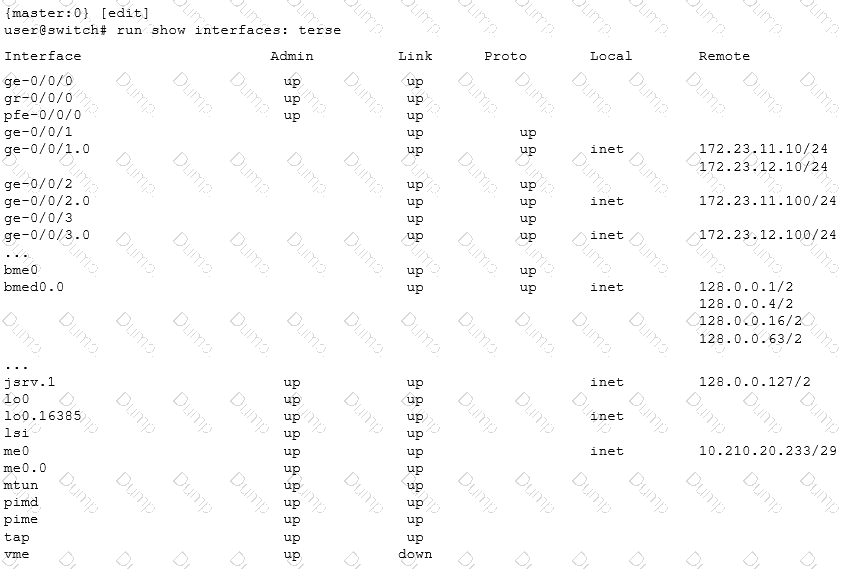
Exhibit.

as

What is the management IP address of the device shown in the exhibit?

Options:

A.

10.210.20.233

B.

172.23.12.100

C.

128.0.0.1

D.

172.23.11.10

Question 26

You are an operator for a network running 1S-IS. Two routers are failing to form an adjacency. What are two reasons for this problem? (Choose two.)

Options:

A.

There are mismatched router IDs on the L2 routers.

B.

There is no configured ISO address on any IS-IS interface.

C.

There is a mismatched area ID between the L2 routers.

D.

The family iso configuration is missing from the adjacency interface.

Question 27

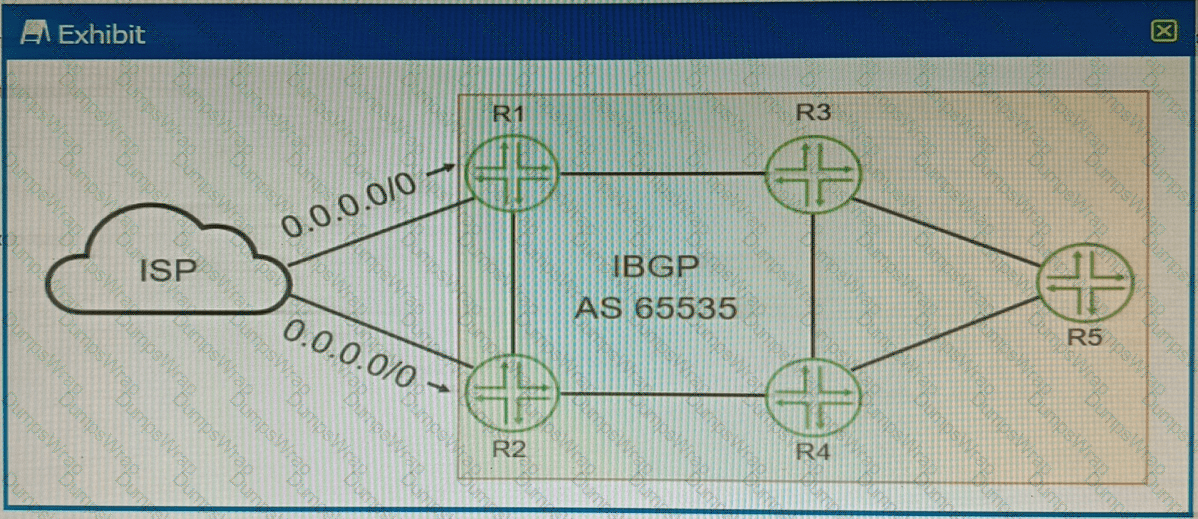
Exhibit

as

Your ISP is announcing a default route to both R1 and R2. You want your network routers to forward all Internet traffic through the R1 device

Which BGP attribute would you use?

Options:

A.

MED

B.

next-hop

C.

local preference

D.

origin

Question 28

Refer to the exhibit.

as

Referring to the output shown in the exhibit, which statement is correct?

Options:

A.

The state is normal for a DR neighbor.

B.

The state is normal for a DRother neighbor

C.

An MTU mismatch exists between the OSPF neighbors.

D.

An area ID mismatch exists between the OSPF neighbors

Question 29

You are asked to configure a redundant trunk group (RTG). Which two requirements would accomplish this task? (Choose two.)

Options:

A.

The RTG must be participating in a Spanning Tree topology.

B.

Interfaces within an RTG can be configured as access ports.

C.

Interfaces within an RTG must be configured as trunk ports.

D.

Both interfaces of an RTG must be configured to service the same VLANS

Question 30

You are configuring an IS-IS IGP network and do not see the IS-IS adjacencies established. In this scenario, what are two reasons for this problem? (Choose two.)

Options:

A.

MTU is not at least 1492 bytes.

B.

IP subnets are not a /30 address.

C.

The Level 2 routers have mismatched areas.

D.

The lo0 interface is not included as an IS-IS interface.

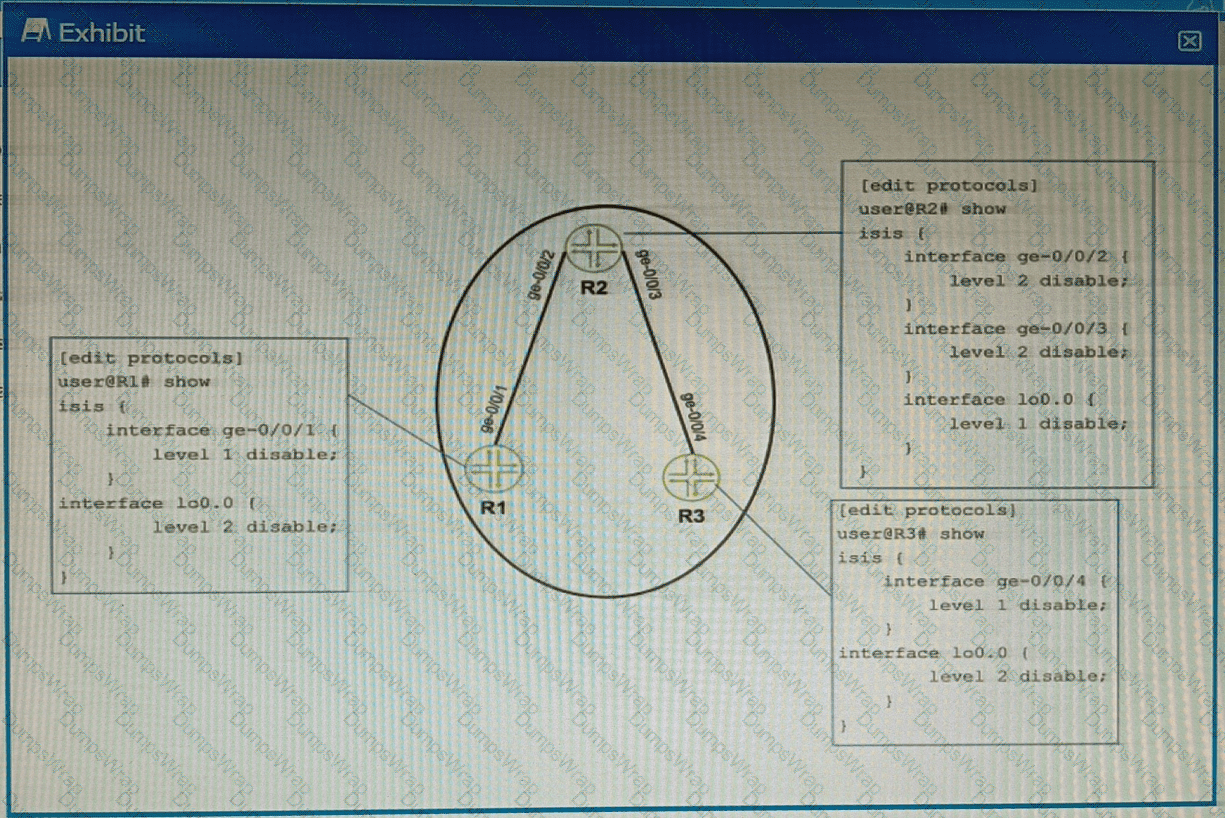
Question 31

Exhibit

as

Referring to the exhibit, which two configuration changes must you apply for packets to reach from R1 to R3 using IS-IS? (Choose two.)

Options:

A.

On R1, enable Level 1 on the ge-0/0/1 interface.

B.

On R3 disable Level 2 on the ge-0/0/4 interface.

C.

On R1, disable Level 2 on the ge-0/0/1 interface.

D.

On R3 enable Level 1 on the ge-0/0/4 interface

Question 32

You have two OSPF routers forming an adjacency. R1 has a priority of 32 and a router ID of 192.168.1.2. R2 has a priority of 64 and a router ID of 192.168.1.1. The routers were started at the same time and all other OSPF settings are the default settings.

Which statement is correct in this scenario?

Options:

A.

At least three routers are required for a DR/BDR election

B.

Router IDs must match for an adjacency to form.

C.

R2 will be the BDR.

D.

R1 will be the BDR.

Page: 1 / 11
Total 107 questions