Spring Sale Discount Flat 70% Offer - Ends in 0d 00h 00m 00s - Coupon code: 70diswrap

Juniper JN0-452 Dumps

Page: 1 / 12
Total 118 questions

Mist AI Wireless - Specialist (JNCIS-MistAI-Wireless) Questions and Answers

Question 1

According to the 802.11 standard, how wide are 2.4 GHz band OFDM channels?

Options:

A.

5 MHz

B.

22 MHz

C.

20 MHz

D.

3 MHz

Question 2

Which two statements are correct about Juniper Mist Dynamic Packet Capture? (Choose two.)

Options:

A.

No configuration is necessary for Mist’s Dynamic Packet Capture.

B.

It is automatically attached to a client event displayed on the Insights page.

C.

It must be globally configured at the organization level.

D.

It is automatically attached to the Affected Items list in the Successful Connects SLE.

Question 3

What happens first when a client requests to join a WLAN?

Options:

A.

802. 11 authentication

B.

ARP request

C.

802.11 association

D.

DHCP discovery

Question 4

Which pair of Wireless Assurance SLEs have a classifier on DHCP?

Options:

A.

Roaming and Coverage

B.

Time to Connect and Roaming

C.

Coverage and Throughput

D.

Successful Connects and Time to Connect

Question 5

You are asked to clone your Juniper Mist primary site configuration to use for a new site being added. In this scenario, which two configuration objects will be copied? (Choose two.)

Options:

A.

the Auto Firmware Upgrade settings

B.

the RF templates

C.

the site location

D.

the WLANs

Question 6

What information would be streamed through webhooks? (Choose two.)

Options:

A.

location coordinates of RFID tags

B.

alerts

C.

SLE metrics of clients

D.

audit logs

Question 7

Which Wireless Assurance SLE has classifiers of Association, Authorization, DHCP, and Internet Services?

Options:

A.

Roaming

B.

Coverage

C.

Time to Connect

D.

Capacity

Question 8

What are two functions of Mist Radio Resource Management (RRM)? (Choose two.)

Options:

A.

transmit power control

B.

WLAN scheduling

C.

channel assignment

D.

Ethernet configurations

Question 9

Click the Exhibit button.

as

Referring to the exhibit, what is the meaning of the AI VALIDATED status update?

Options:

A.

The issue was opened and is unresolved.

B.

The issue was opened and Marvis confirms it has been closed.

C.

The issue was opened and Marvis has closed it.

D.

The issue was opened and closed manually.

Question 10

Juniper Mist events are filtered into which three categories? (Choose three.)

Options:

A.

organization

B.

AP

C.

security

D.

client

E.

site

Question 11

Click the Exhibit button.

Referring to the exhibit, as part of the Throughput SLE in the Mist UI, the Coverage classifier indicates the signal strength of which device?

Options:

A.

the AP’s radio strength

B.

the signal strength between APs

C.

the client

D.

the AP’s radio for a single SSID

Question 12

Which two statuses are displayed on the Juniper Mist subscription page? (Choose two.)

Options:

A.

Demo

B.

Exceed

C.

Valid

D.

Active

Question 13

Administrators need to gather information regarding client dwell time and how clients move through a location. In this scenario, which real-time location service provides this capability?

Options:

A.

optimize workflow

B.

zone analytics

C.

wayfinding

D.

asset tracking

Question 14

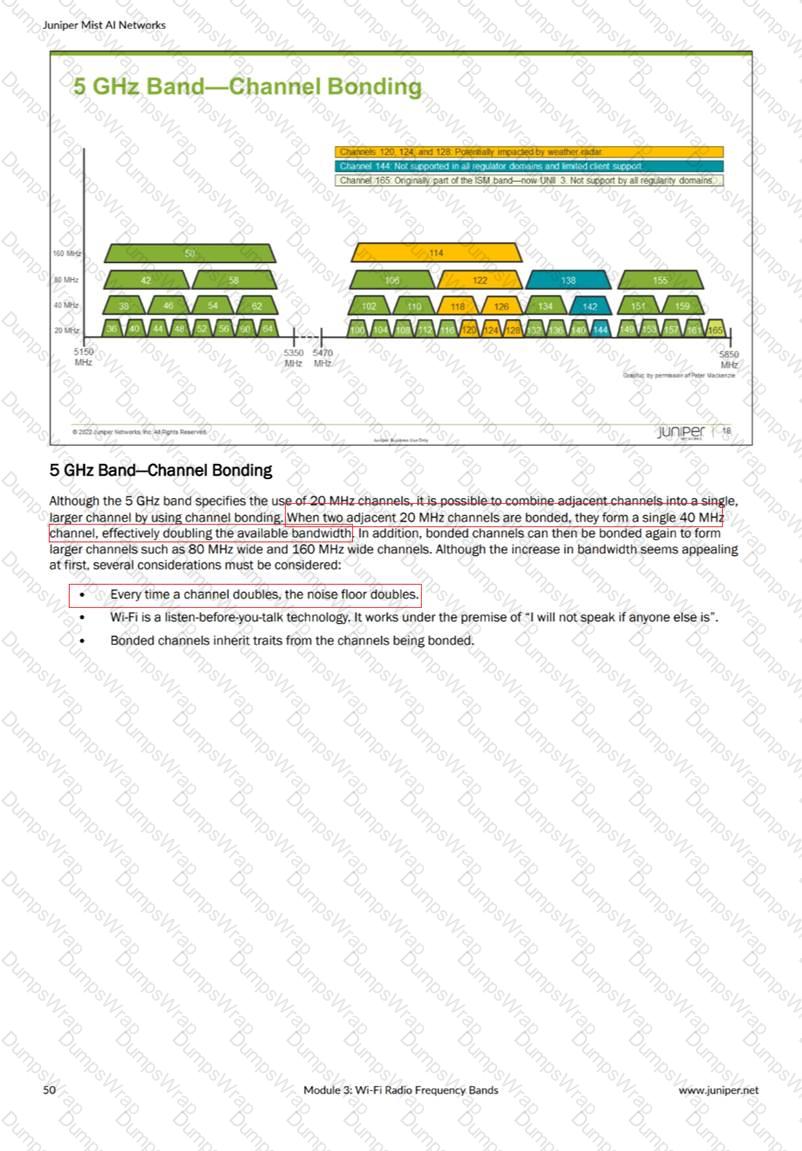
Which two statements are correct about the radio frequency rule of 10s and 3s? (Choose two.)
Options:

A.

If the signal strength increases by 3 dB, the power is doubled.

B.

If the signal strength decreases by 10 dB, the power decreases tenfold.

C.

If the signal strength increases by 3 dB, the power is tripled.

D.

If the signal strength decreases by 10 dB, the power is halved.

Question 15

You have received a Marvis Actions Missing VLAN notification.

In this scenario, where is the problem?

Options:

A.

The gateway is missing the VLAN.

B.

An access point is missing the VLAN.

C.

A client is missing the VLAN.

D.

A switch is missing the VLAN.

Question 16

You need to correlate the coordinates of tracked devices and turn this information into usable data for other applications. Which real-time location service component accomplishes this task?

Options:

A.

location system

B.

BLE tag

C.

triangulation service

D.

location sensor

Question 17

You are the only tenant in a building that has Wi-Fi. At times, the Wi-Fi network appears to be slow and you want to determine if the microwave oven is causing an issue because it is used throughput the day. Which SLE metric and classifier should you look at to determine the issue?

Options:

A.

throughput/network issues

B.

capacity/wifi interference

C.

throughput/coverage

D.

capacity/non-wifi interference

Question 18

A user with a PSK calls you and says, “The Wi-Fi worked for a week and now it does not work.” There have not been any recent configuration changes to the network. You suspect that a time-based setting has reset the key.

In this scenario, where would you begin troubleshooting?

Options:

A.

Site-level Pre-Shared Keys

B.

Organization-level Pre-Shared Keys

C.

WLAN-level Pre-Shared Keys

D.

RADIUS Pre-Shared Keys

Question 19

Click the Exhibit button.

Referring to the exhibit, which statement is true?

Options:

A.

The WLAN is configured to use DFS channels.

B.

The WLAN is configured to only broadcast on the 2.4 GHz spectrum.

C.

The WLAN is configured with the high-density data rate setting enabled.

D.

The WLAN is configured to use geofencing.

Question 20

Regarding the seven layer OSI networking model, which two layers are different between Ethernet and Wi-Fi? (Choose two.)

Options:

A.

media access control (MAC) sub-layer

B.

network layer

C.

logical link control (LLC) sub-layer

D.

physical layer

Question 21

All the access points (APs) on the site will obtain an IP address for the Management VLAN. You notice an additional IP address for each configured VLAN on the AP.

Which statement is correct in this scenario?

Options:

A.

The AP is configured to support wireless mesh.

B.

This behavior is enabled by default under the Site configuration.

C.

The Local Status Page has been enabled in the AP setting under the Site configuration.

D.

The AP MAC has a DHCP reservation.

Question 22

By default, which 6 GHz channels does Juniper Mist radio resource management (RRM) use?

Options:

A.

The preferred scanning channels (PSCs)

B.

The channels you select as primary channels

C.

Channels 1, 9, and 13

D.

Channels 13 through 221

Question 23

An access point discovers switch information using which protocol?

Options:

A.

CDP

B.

ARP

C.

SNMP

D.

LLDP

Question 24

You are deploying multiple Mist APs across many sites in your network. You must ensure that you apply consistent WxLAN and WLAN policies across all sites within the same organization.

Which configuration object should be used to accomplish this behavior?

Options:

A.

site labels

B.

an RF template

C.

a device profile

D.

a config template

Question 25

What is the AP’s role in the IEEE 802.1X authentication process?

Options:

A.

It acts as an authenticator.

B.

It acts as a RADIUS proxy server.

C.

It acts as a supplicant.

D.

It acts as an authentication server.

Question 26

Refer to Exhibit:

as

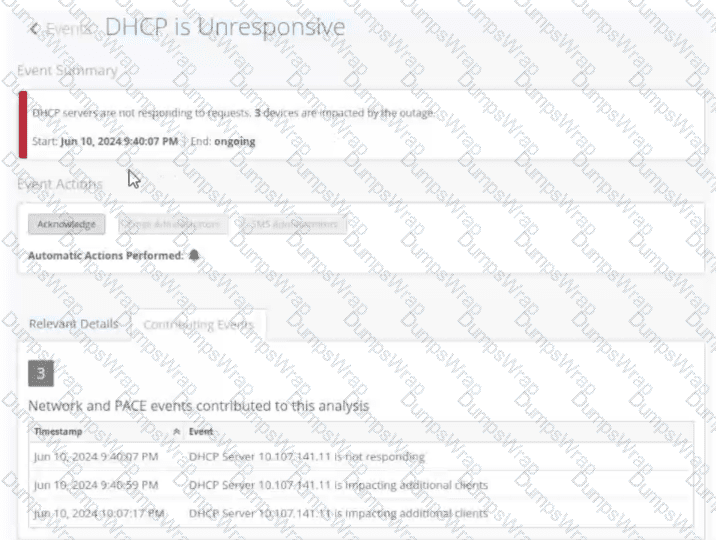
You notice that your site events show an unresponsive DHCP server in your network. You want to analyze the event by using the dynamic packet capture.

Referring to the exhibit, how would you access the packet capture for further analysis in Wireshark?

Options:

A.

Verify the impacted site and use the corresponding organization event to fetch the automatically generated packet capture.

B.

Verify the impacted site and use the corresponding site event to fetch the automatically generated packet capture.

C.

Verify the impacted client and use the corresponding site event to fetch the automatically generated packet capture.

D.

Verify the impacted client and use the corresponding client event to fetch the automatically generated packet capture.

Question 27

Once a client discovers an access point, what is the correct order of steps for successful 802.1X authentication?

Options:

A.

Open System Authentication -> 802.1X Authentication -> Association

B.

Association -> 802.1X Authentication -> Open System Authentication

C.

Association -> Open System Authentication -> 802.1X Authentication

D.

Open System Authentication -> Association -> 802.1X Authentication

Question 28

At which signal strength level range will an extra AP placed on the same channel cause co-channel contention?

Options:

A.

-45 dBm to -65 dBm

B.

-55 dBm to -80 dBm

C.

-25 dBm to -80 dBm

D.

-65 dBm to -85 dBm

Question 29

You are asked to perform a site survey on your enterprise by using a Juniper Access Point (AP) that is fully functional and visible by the Juniper Mist cloud. Your enterprise provides you with the portable equipment for elevating the Juniper AP and a battery that properly powers it. In this scenario, how would you ensure that the Juniper AP will be fully functional for site survey purposes?

Options:

A.

You will need to enable AP Config Persistence and disable AP Uplink Monitoring in the site configuration to force the Juniper AP to remember its configuration regardless of an Internet connection or not.1

B.

You will need to enable Site Survey Mode in the site configuration to force the Juniper AP to remember its configuration regardless of an Internet connection or not.2

C.

A Juniper AP will maintain its configuration by default as long as the Wi-Fi Assurance license has not expired.

D.

A Juniper AP will maintain its configuration by default once rebooted regardless of an Internet connection or not.

Question 30

Referring to the exhibit, what is the site ID?

Options:

A.

9777c1a0-6ef6-11e6-8bbf-02e208b2d34

B.

02e208b2d34

C.

02e208b2d34f

D.

978c48e6-6ef6-11e6-8bbf-02e208b2d34f

Question 31

What are basic data rates?

Options:

A.

fastest data rates

B.

optional data rates

C.

required data rates

D.

disabled data rates

Question 32

When does a Mist AP actually begin transmitting BLE?

Options:

A.

When it is claimed and placed on a site.

B.

When it is placed on a floor plan.

C.

When BLE is enabled at the Organization level.

D.

When BLE is enabled for the AP.

Question 33

What does Mist's patented 16-element vBLE Antenna Array do when "engagement" is enabled?

Options:

A.

performs radio resource management

B.

locates Wi-Fi assets

C.

transmits unique and directional BLE beams

D.

performs personal pre-shared key sharing

Question 34

You have four actions presented to you by Marvis. Three of these actions are found under the AP category. Upon inspecting the category, you notice that the sub-categories in the AP category contain a lock symbol so that you cannot select any of the sub-categories to view the root cause. In this scenario, which statement is correct?

Options:

A.

It takes more time for the root cause report to be prepared by Marvis Actions.

B.

You need to enable Marvis Minis.

C.

A subscription is needed.

D.

The issue was identified as an AP issue, but Marvis Actions could not find the actual root cause.

Question 35

You are installing and booting up your first Juniper Mist AP at your site.

By default, which two statements are correct in this scenario? (Choose two.)

Options:

A.

The AP will attempt to connect to the Mist cloud using port 443.

B.

The AP will send DHCP requests using the native VLAN.

C.

The AP will send DHCP requests with a VLAN ID of 10.

D.

The AP will attempt to connect to the Mist cloud using port 8080.

Page: 1 / 12
Total 118 questions