New Year Sale Discount Flat 70% Offer - Ends in 0d 00h 00m 00s - Coupon code: 70diswrap

Juniper JN0-650 Dumps

Page: 1 / 7
Total 65 questions

Enterprise Routing and Switching - Professional (JNCIP-ENT) Questions and Answers

Question 1

Your organization uses 802 1X with a RADIUS server. If the RADIUS server stops responding, you want the fallback action to continue to permit access for devices that currently have authorization but deny any new access attempts.

Which fallback action provides this capability?

Options:

A.

deny

B.

vlan-name

C.

permit

D.

use-cache

Question 2

You have several switches in your network that use Cisco's PVST+ protocol. You want your Juniper switches to interoperate with those devices.

In this scenario, which protocol would you use?

Options:

A.

RPVST+

B.

MSTP

C.

VSTP

D.

RSTP

Question 3

Exhibit

As shown in the exhibit, you have implemented CoS classifiers using Differentiated Services Code Point (DSCP)

In this scenario, which two statements are correct? (Choose two.)

Options:

A.

This custom DSCP classifier must be associated with logical interfaces.

B.

This custom DSCP classifier must be associated with physical interfaces.

C.

The configuration imports all default classification assignments that are not specified.

D.

The default classification assignment overwrites all specified classifications

Question 4

Exhibit

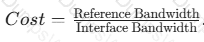
You are receiving the 203 0.113.0/24 route from both upstream ISPs You are asked to ensure that ISP A is the preferred ISP for traffic being sent to the 203.0.113.0/24 network from devices in AS 65512.

Referring to the exhibit, which two statements will accomplish this behavior? (Choose two.)
Options:

A.

You should assign a local preference that is lower than 100 for the route learned from ISP A.

B.

You should assign a local preference that is higher than 100 for the route learned from ISP A.

C.

You should assign a local preference that is lower than 100 for the route learned from ISP B.

D.

You should assign a local preference that is higher than 100 for the route learned from ISP B.

Question 5

Exhibit.

as

Referring to the exhibit. Ieaf2 is elected the designated forwarder

Which two statements are correct if server2 generates a broadcast frame*? (Choose two.)

Options:

A.

The broadcast frame will be forwarded to leaf1 and Ieaf2.

B.

The broadcast frame will not be forwarded to leaf1.

C.

Only Ieaf2 will forward the broadcast frame to server1

D.

Only leaf1 will forward the broadcast frame to server1.

Question 6

You have a P-VLAN that spans multiple switches.

In this scenario, how do you enable communication across the P-VLAN?

Options:

A.

Configure trunk ports with inter-switch-link on the switches

B.

Configure trunk ports with private-vlan isolated on the switches.

C.

Configure trunk ports with private-vlan community on the switches.

D.

Configure trunk ports with isolated-vian on the switches.

Question 7

Your existing enterprise network uses OSPFv3 on Juniper devices. You need to extend the networking into a new building, and it needs to be in its own OSPF area. Your team is debating about making the area a stub

Which two statements are correct in this scenario? (Choose two.)

Options:

A.

Stub areas can have an ASBR

B.

Stub areas can also be not-so-stubby areas.

C.

Stub areas do not support virtual links.

D.

Stub areas can be converted into totally stubby areas.

Question 8

Which two statements are correct about EVPN/VXLAN deployments? (Choose two.)

Options:

A.

VNIs are used for encapsulating and de-encapsulating traffic entering and leaving the tunnels

B.

VTEPs are used for encapsulating and de-encapsulating traffic entering and leaving the tunnels.

C.

VTEPs are used to identify broadcast domains within an EVPN/VXLAN environment.

D.

VNIs are used to identify broadcast domains within an EVPN/VXLAN environment.

Question 9

Exhibit

Referring to the exhibit output, which statement is correct?

Options:

A.

The device with an IP address of 192.168.100 2 is attached to VNI 5010

B.

The output shows the router ID of the device sending the EVPN Type 2 routes

C.

The output shows the route distinguisher of the device sending the EVPN Type 2 routes

D.

IP addresses 10.1.1.1 and 10.1 2.3 are connected to the same VNI.

Question 10

Your router is discarding an EBGP route because the next hop is not directly connected. Which BGP configuration would you use to override this behavior?

Options:

A.

accept-remote-nexthop

B.

multihop

C.

advertise-inactive

D.

multipath

Question 11

You have configured DSCP CoS in your network and have applied BA and multifield classifiers to all interfaces.

In this scenario, which statement is correct?

Options:

A.

If traffic matches both classifiers, then the multifield classifier determines into which forwarding class the traffic is assigned

B.

You must set the BA classifier to take precedence over the multifield classifier or the configuration is ignored

C.

You must set the multifield classifier to take precedence over the BA classifier or the configuration is ignored.

D.

If traffic matches both classifiers, then the BA classifier determines into which forwarding class the traffic is assigned.

Question 12

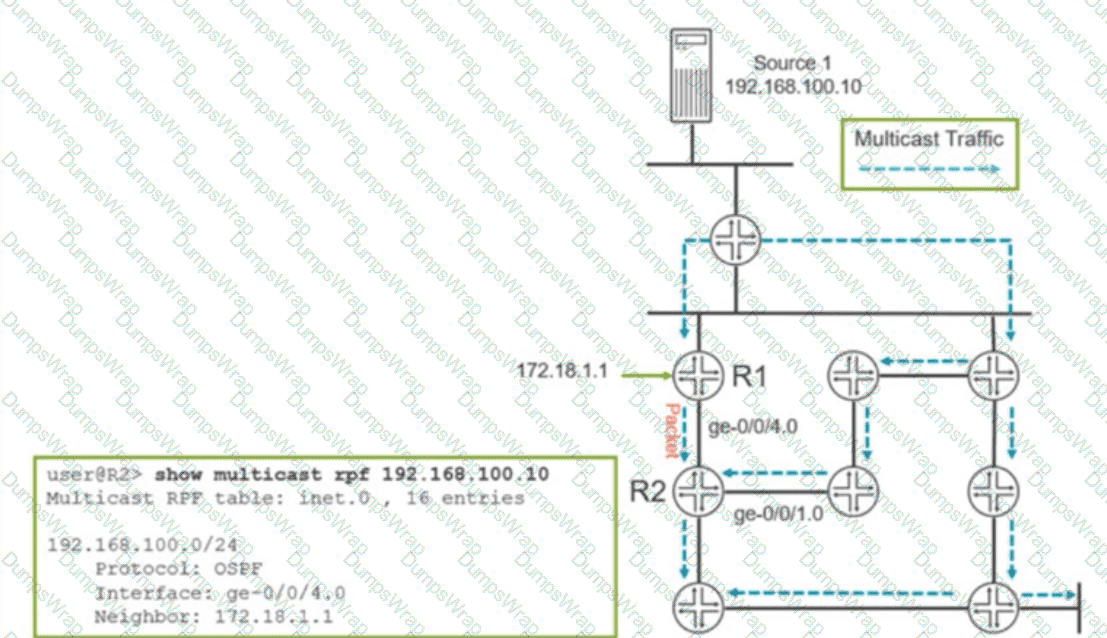
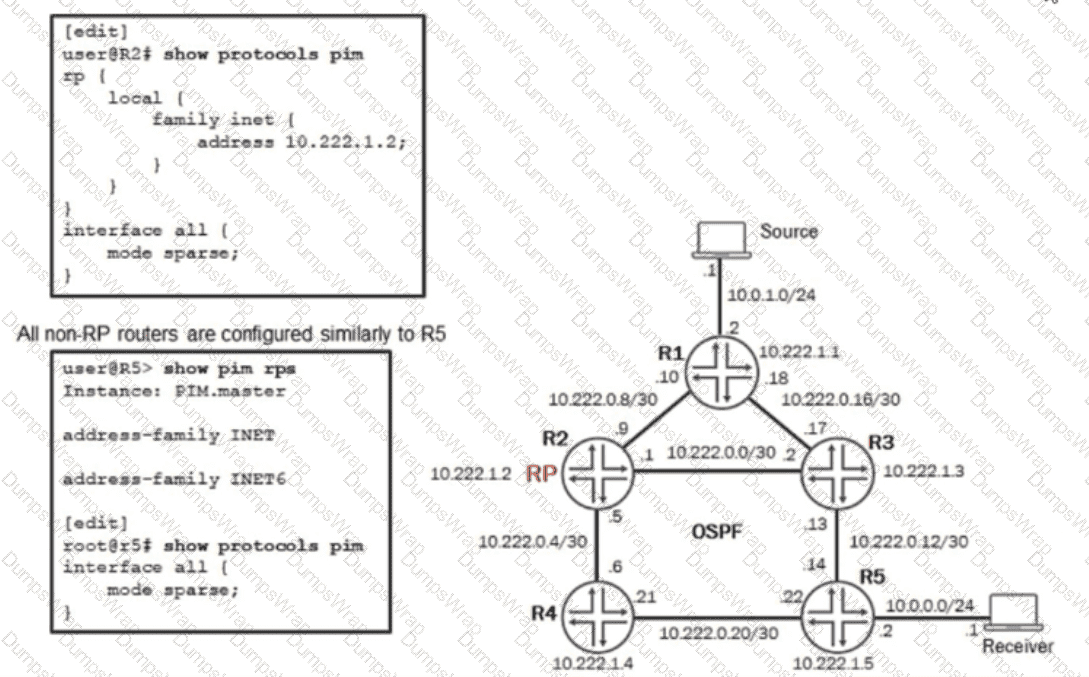
You are troubleshooting a multicast deployment in a network. Some multicast groups operate in PIM-ASM mode and others operate in PIM-SSM mode. While troubleshooting, you note the following:

- The network uses IGMPv2 for some segments and IGMPv3 for others.

- For group 232.1.1.1, receivers know the exact source IP of the multicast sender

- For group 239.10.10.10. receivers do not know the source address in advance.

Which two statements correctly describe the operational differences between these two modes in Junos OS? (Choose two.)

Options:

A.

PIM-ASM supports multiple active sources for a group without requiring receivers to know them in advance, whereas PIM-SSM requires explicit source knowledge

B.

In PIM-ASM. the DR first sends a PIM register message to the RP before switching to the shortest-path tree.

C.

PIM-SSM requires an RP for initial joins, whereas PIM-ASM can operate without one.

D.

PIM-SSM relies on IGMPv3 to signal both the source and the group in the join message, bypassing the RP entirely.

Question 13

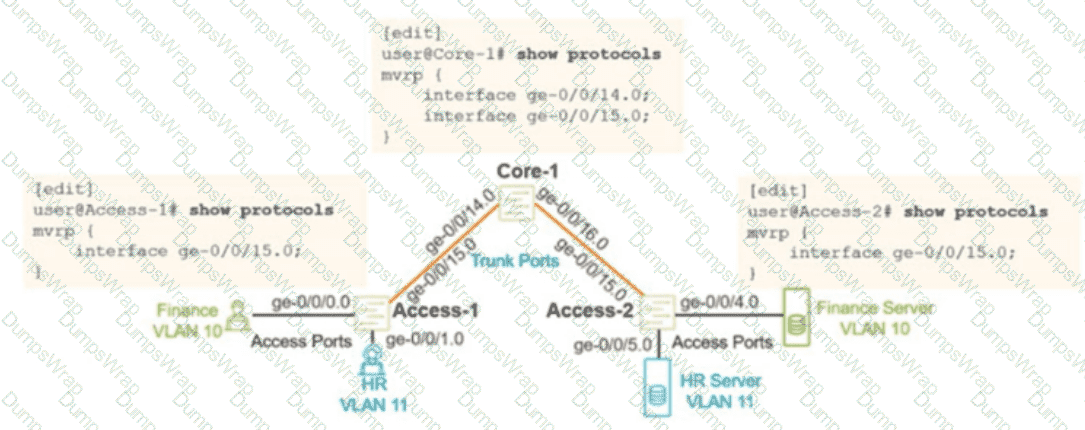
You configured MVRP in your Layer 2 network and you are adding two new interfaces to your distribution switch. You are asked to ensure that if a rogue device that uses MVRP is connected to these interfaces, that the MVRP PDUs are ignored

In this scenario, what should you configure to accomplish this task?

Options:

A.

Configure the join-timer to 500 ms.

B.

Configure the no-dynamic-vlan feature under MVRP.

C.

Configure the two new interfaces as point-to-point.

D.

Configure the two new interfaces under MVRP using the forbidden registration mode.

Question 14

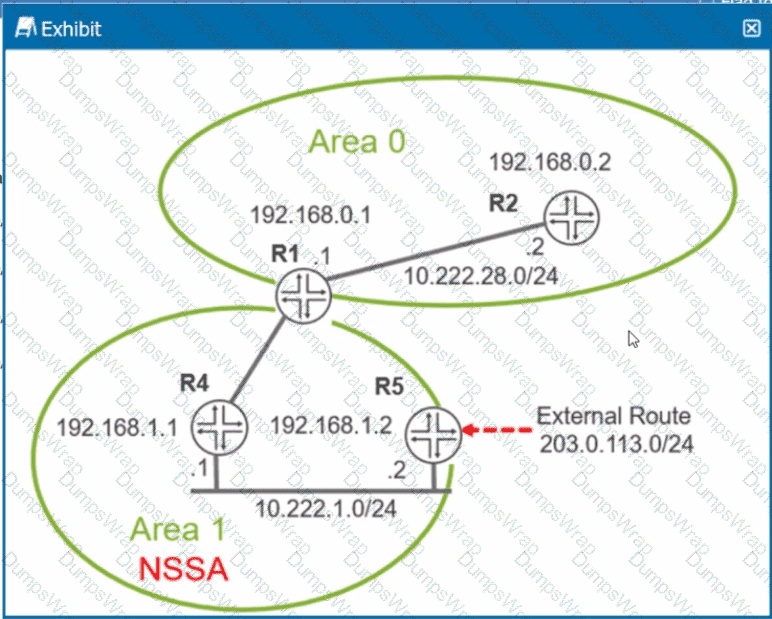
Exhibit.

as

Referring to the exhibit, which two statements are correct? (Choose two.)

Options:

A.

R1 will advertise the 203 0.113.0724 route as an OSPF Type 7 LSA into Area 0.

B.

R5 will advertise the 203 0.113 0/24 route as an OSPF Type 5 LSA into Area 1.

C.

R1 will advertise the 203 0.113.0/24 route as an OSPF Type 5 LSA into Area 0

D.

R5 will advertise the 203 0.113.0/24 route as an OSPF Type 7 LSA into Area 1.

Question 15

You want to implement a system in your network to simplify VLAN management that can also dynamically create and prune VLANs. How would you accomplish this task?

Options:

A.

Enable GVRP on access interfaces.

B.

Enable MVRP and GVRP on all interfaces.

C.

Enable MVRP on trunk interfaces.

D.

Enable MVRP on access interfaces.

Question 16

You have created a private community VLAN called RND The private community VLAN works fine within switch S1, but traffic in the private RND community VLAN does not reach VLAN members connected to switch S2.

Which statement is correct in this scenario?

Options:

A.

The RND Community VLAN needs to have the same 802.1Q tag as its parent VLAN

B.

The RND community VLAN needs to have an associated 802.1Q tag associated with it.

C.

The RND Community VLAN needs to be stripped of all 802.1Q tags.

D.

The RND community VLAN needs to be defined as an isolated VLAN.

Question 17

You want to validate a recursive lookup for an EVPN route designation. Which route table query will accomplish this task?

Options:

A.

inet.2

B.

default-switch.evpn.0

C.

inet.3

D.

vxlan.inet.

Question 18

You are configuring CoS throughout your enterprise network using DSCP. You have configured MF classification on your edge devices and are using BA classifiers throughout the core You are using the EZQoS template provided on your EX Series switches that are acting as your edge devices. You have loaded the configuration group and applied it to the appropriate interfaces. Classification and scheduling are working properly on your edge devices; however, traffic is not being classified correctly when it reaches your core devices

In this scenario, which statement is correct about solving this problem?

Options:

A.

You should configure and apply a policer to the edge devices' egress interfaces toward the core.

B.

You must configure the core devices using the EZQoS template as well

C.

You should configure and apply rewrite rules on the edge devices' egress interfaces toward the core

D.

You must configure the edge devices to use BA classifiers instead of MF classifiers

Question 19

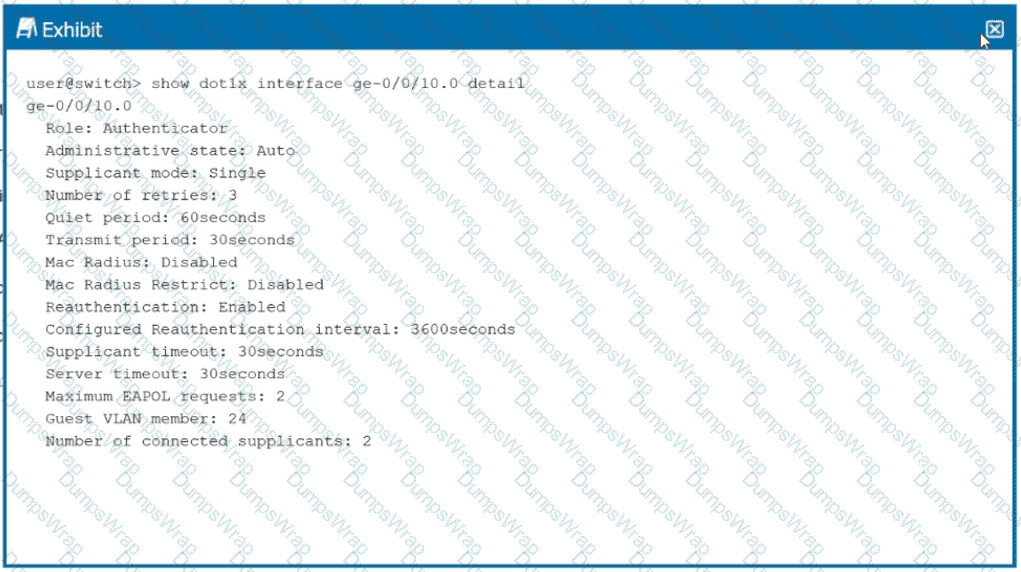
You have deployed 802.1X with server fail fallback enabled on an EX Series switch and specified the vlan-name feature for all access ports. The RADIUS server is unavailable.

Which two statements are correct in this scenario? (Choose two )

Options:

A.

All clients already authenticated will immediately be disconnected before the re-authentication timer expires.

B.

All clients already authenticated will be unaffected until reauthentication is required.

C.

All new clients will be granted access only if their requested VLAN matches the configuration

D.

All new clients will be placed in the referenced VLAN in the configuration and given access.

Page: 1 / 7
Total 65 questions