
Cilium Certified AssociateCCA Questions and Answers
The application team would like to observe egress traffic with application level information for workloads running in a Cilium based Kubernetes Cluster Which features would offer this without the need for additional tooling?
Options:
Cilium Load Balancing
Fluentd and Grafana
Kubernetes Network Policies
Hubble Ul and CLI
Answer:
DExplanation:
Technical explanation
Hubble UI and Hubble CLI are Cilium’s integrated interfaces for examining workload network flows. Hubble records source and destination identities, namespaces, workloads, addresses, ports, forwarding verdicts, and drop reasons. When Layer 7 visibility is configured, its flow output can also contain application-level information such as HTTP methods, URLs, response codes, latency, and DNS queries. Filters can narrow the results by source workload, namespace, destination, protocol, port, or verdict, making Hubble appropriate for investigating egress behavior.
Hubble CLI provides detailed event-oriented inspection, while Hubble UI presents flows and service dependencies graphically. Hubble Relay aggregates the per-node Hubble APIs so these clients can obtain cluster-wide visibility.
Load balancing directs traffic but is not an observability interface. Kubernetes NetworkPolicy expresses permitted communications but does not by itself display application-level flow records. Fluentd and Grafana are external logging and visualization components and would violate the requirement to avoid additional tooling.
Layer 7 information requires supported traffic to be redirected through Cilium’s L7 proxy. Hubble then exposes the resulting application-layer flow events through the built-in CLI or UI, making D the complete answer.
Official references
Network Observability with Hubble ; Inspecting Network Flows .
Study Guide topic: Network Observability.
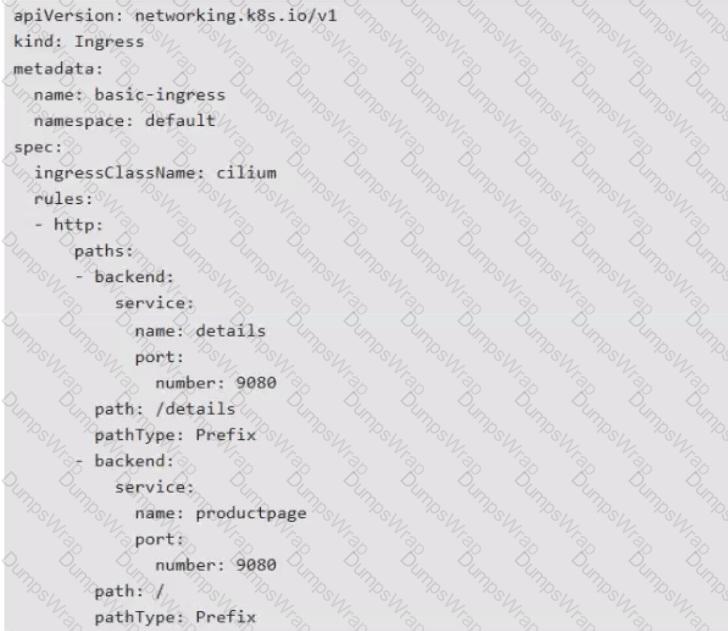
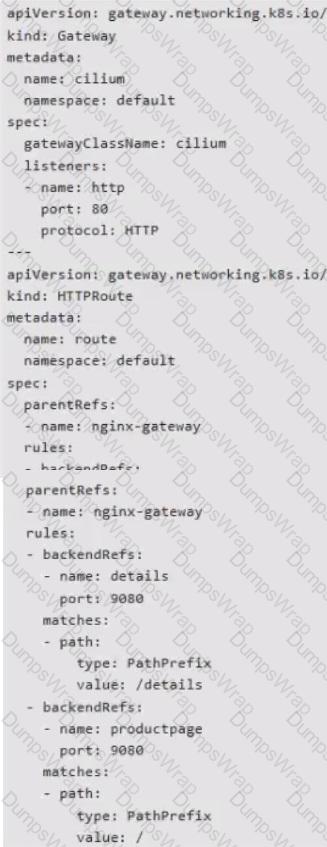
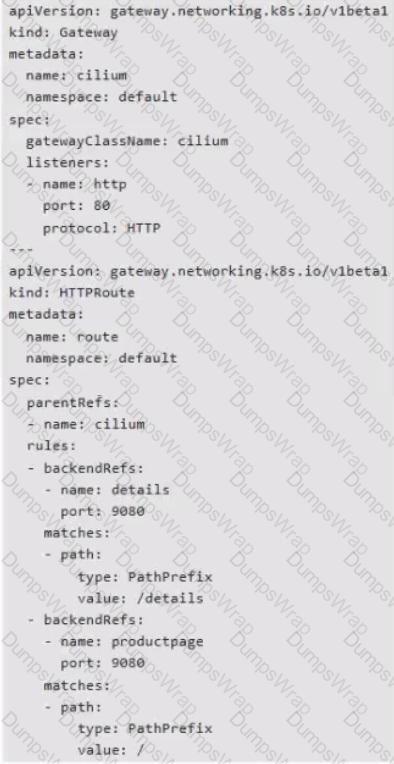
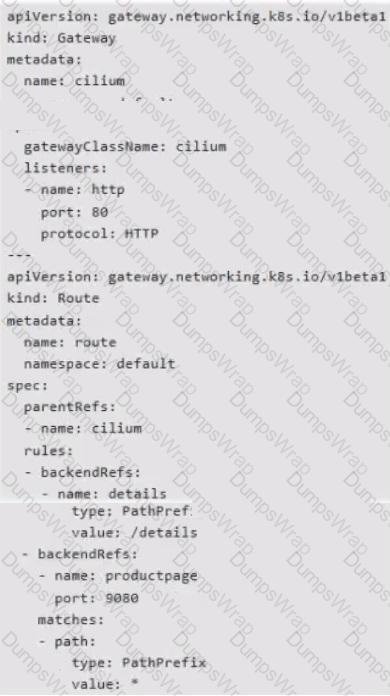
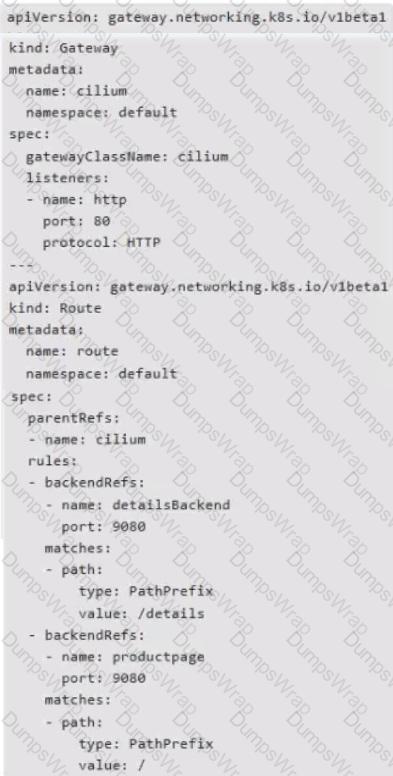
This an Ingress configuration. What is the equivalent Gateway API configuration?
Question 19 source Ingress
A)
Question 19 option A
B)
Question 19 option B
C)
Question 19 option C
D)
Question 19 option D
Options:
Option A
Option B
Option C
Option D
Answer:
BExplanation:
Technical explanation
Option B correctly represents the Ingress as a Gateway and an attached HTTPRoute . The Gateway is named cilium , uses gatewayClassName: cilium , and exposes an HTTP listener on port 80. The HTTPRoute uses parentRefs with the same Gateway name, cilium , so the route attaches to the declared listener. Its two rules preserve the original routing behavior: /details with PathPrefix targets the details Service on port 9080, while / with PathPrefix targets productpage on port 9080.
Option A declares a Gateway named cilium but attaches its route to nginx-gateway . Because the parent reference does not identify the displayed Gateway, it is not equivalent. Options C and D use kind: Route ; the correct resource kind for HTTP path routing is HTTPRoute . They also contain malformed or altered backend and matching fields. Option D changes the details backend name, while option C contains incorrect route structure and path content.
Cilium’s official migration example uses the same conversion pattern: the Ingress class becomes the Gateway’s class, paths move into HTTPRoute.rules , and the route identifies its Gateway through parentRefs .
The supplied key incorrectly identifies A. The verified answer is B.
Official references
HTTP Migration Example .
Study Guide topic: Service Mesh.
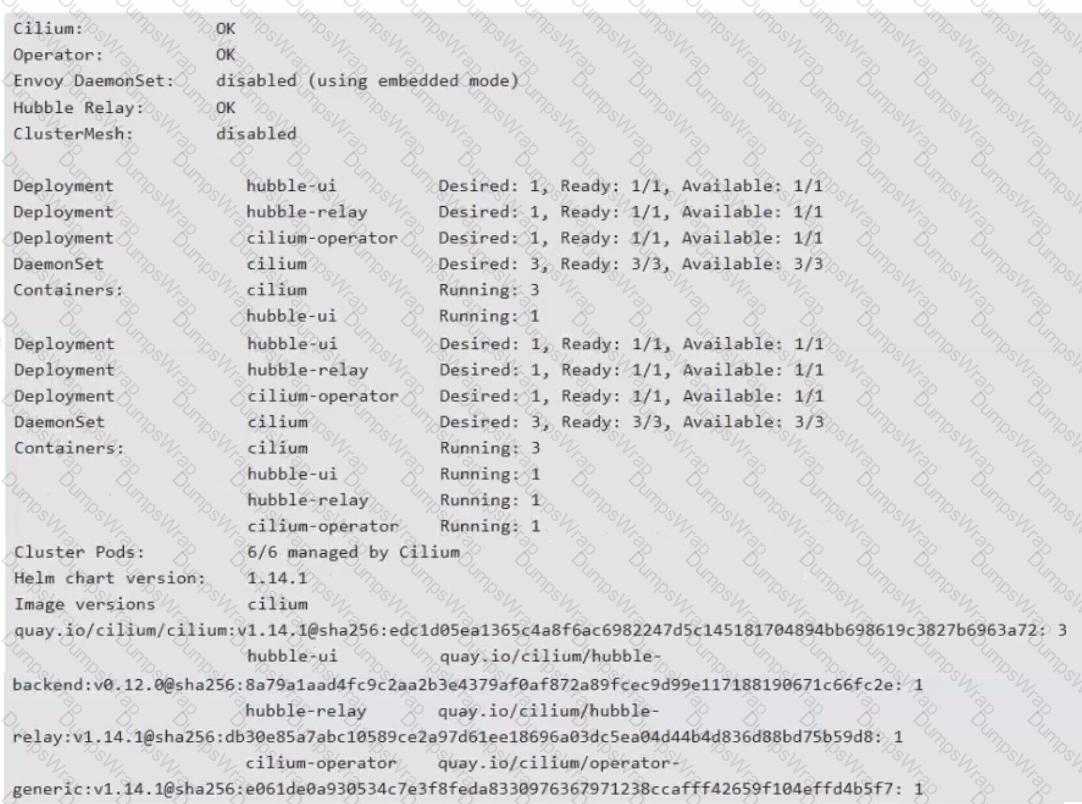
Please review the output of cilium status below and answer the question that follows. Please note, the output has been modified for accessibility purposes.
Question 2 cilium status exhibit
Assume the cluster is healthy. What is correct about the ci 1 ium status command output above?
Options:
The Kubernetes cluster where Cilium has been deployed should consist of four nodes.
When specific Cilium features require Layer 7 processing, the Cilium agent starts an Envoy proxy as a separate process within the Cilium agent pod.
The component that allows you to query multiple Hubble instances simultaneously and aggregate the results is unhealthy.
Cilium has been installed and configured in a multi-cluster deployment model to provide load balancing and service discovery.
Answer:
BExplanation:
Technical explanation
The status output shows Envoy DaemonSet: disabled (using embedded mode) . In embedded mode, Cilium starts Envoy as a separate process inside the Cilium agent pod when a feature requiring Layer 7 processing—such as an L7 network policy, protocol visibility, Ingress, or Gateway API—is used. This is precisely the behavior described in option B.
The remaining choices contradict the exhibit. The Cilium DaemonSet has a desired count of three, which ordinarily indicates three schedulable nodes running Cilium, not four. Hubble Relay: OK means the aggregation component is healthy. Hubble Relay connects to the Hubble instances associated with Cilium agents and presents a multi-node API to clients such as Hubble CLI and Hubble UI. Finally, ClusterMesh: disabled rules out the claim that the installation is currently configured for Cilium Cluster Mesh service discovery and cross-cluster load balancing.
Cilium can alternatively run Envoy through the independently life-cycled cilium-envoy DaemonSet. That is not the deployment displayed here because the DaemonSet is explicitly disabled and embedded mode is reported.
Official references
Envoy deployment modes ; Hubble internals .
Study Guide topic: Architecture.
The Cilium Agent is deployed as part of the Cilium installation. What of the following is true about the Cilium Agent?
Options:
Cilium Agent registers the Custom Resource Definitions that Cilium uses.
Cilium Agent creates the CiliumEndpoint objects for each pod in the cluster.
Cilium Agent manages IP addresses for LoadBalancer type services (if LB IPAM is used).
Cilium Agent synchronizes Kubernetes nodes information to the shared KVStore.
Answer:
BExplanation:
Technical explanation
For every pod managed by Cilium, the responsible node-local Cilium agent creates a CiliumEndpoint object with the same name and namespace. The object exposes endpoint state such as labels, the allocated security identity, addressing information, and effective policy. The agents also create endpoint objects for their inter-agent health endpoints. B is therefore correct.
The other responsibilities belong primarily to the Cilium Operator. The operator normally registers Cilium’s CustomResourceDefinitions, manages addresses for LoadBalancer Services when LB IPAM is active, and performs configured cluster-wide synchronization or shared-state operations. It also garbage-collects orphaned CiliumEndpoint resources when their associated pods no longer exist or have permanently completed.
The Cilium agent itself runs on each node. It responds to workload lifecycle events, creates and manages local endpoints, loads eBPF programs, applies policies, and maintains the node’s datapath. This division ensures that latency-sensitive forwarding and endpoint operations remain node-local while logically cluster-wide activities are consolidated in the operator.
Official references
CiliumEndpoint CRD , Cilium Operator Responsibilities
Study Guide topic: Cilium agent, Cilium Operator, and CiliumEndpoint lifecycle.
How does Cilium primarily improve security in Kubernetes clusters?
Options:
By using API Gateway configurations.
By securing and encrypting database data.
By providing backup solutions for persistent volumes.
By implementing network policies at multiple OSI model layers.
Answer:
DExplanation:
Technical explanation
Cilium primarily improves Kubernetes network security through identity-aware policy enforcement across Layers 3 through 7. Standard Kubernetes NetworkPolicy resources provide Layer 3 and Layer 4 controls, while CiliumNetworkPolicy extends enforcement to application-layer rules. Policies can select workloads by labels and identity, restrict protocols and destination ports, control communication with CIDRs or entities, apply DNS/FQDN rules, and authorize supported HTTP or gRPC operations. This multi-layer enforcement is the capability described by D.
API Gateway and Gateway API configurations can contribute to controlling north-south traffic, but they are not Cilium’s primary or comprehensive security mechanism. Database encryption is implemented by database, storage, or encryption-management systems rather than being a general function of Cilium. Persistent-volume backup is similarly outside Cilium’s CNI, network-policy, and observability responsibilities.
Cilium’s identity model is especially important in dynamic Kubernetes environments. Security policy follows workload identities derived from labels instead of depending exclusively on changing pod IP addresses. At Layer 7, traffic is redirected to Envoy when protocol-aware inspection or enforcement is required, while eBPF supplies the efficient kernel datapath for lower-layer processing.
Official references
Introduction to Cilium and Hubble ; Network Policy ; Layer 7 Policies .
Study Guide topic: Network Policy.
Which Cilium configuration is recommended to help identify the correct configuration of network policies without interrupting workload communications?
Options:
DNS enforcement mode
HTTP audit mode
Policy enforcement mode
Policy audit mode
Answer:
DExplanation:
Technical explanation
Policy Audit Mode allows administrators to evaluate the consequences of network policies before enforcing their deny decisions. Traffic that would ordinarily be rejected remains permitted, while Cilium records an audit verdict. These verdicts can be examined with Cilium monitoring tools and used to identify legitimate communications that are missing from the proposed policies.
This is especially valuable when introducing host policies or default-deny controls into an existing environment. An incomplete policy might otherwise block access to the Kubernetes API, node-management interfaces, DNS, monitoring systems, or other operational dependencies. The recommended workflow is to enable audit mode, observe traffic and policy verdicts, adjust the rules, confirm that all required communications receive allow verdicts, and then disable audit mode to begin enforcement.
DNS enforcement mode and HTTP audit mode are not the general Cilium configuration requested. “Policy enforcement mode” describes whether policies are normally enforced, but it does not provide the non-disruptive learning behavior in the question.
Audit mode should be treated as a temporary validation mechanism because it does not actually block disallowed traffic and does not persist across every agent-restart scenario.
Official references
Cilium Policy Audit Mode
Study Guide topic: Policy validation, audit verdicts, and safe policy rollout.
What are the differences between Ingress and Gateway API?
Options:
Ingress and Gateway API serve the same purpose, but they are Just different names for the same Kubernetes resource. Ingress is used in older Kubernetes versions, while Gateway API is the updated version for modern clusters, but the underlying functionality is identical.
Ingress primarily targets exposing HTTP applications with a simple, declarative syntax. Gateway API exposes a more general API for proxying that can be used for more protocols than just HTTP, and models more infrastructure components to provide better deployment and management options for cluster operators.
Cilium offers seamless integration with the Gateway API, enhancing Kubernetes networking and security through advanced features powered by eBPF. This integration provides a robust solution for network management. In contrast, Ingress relies on IPtables for its functionality.
Gateway API is primarily used for internal cluster routing, while Ingress is exclusively for external traffic management. Gateway API does not support routing for internet-exposed services, whereas Ingress is specifically designed for that purpose.
Answer:
BExplanation:
Technical explanation
Ingress provides a comparatively simple API for exposing HTTP and HTTPS applications through host- and path-based routing. Gateway API is a broader, extensible family of resources that separates infrastructure configuration from application routing. Resources such as GatewayClass , Gateway , HTTPRoute , GRPCRoute , TLSRoute , TCPRoute , and UDPRoute model listeners, routes, protocols, ownership, and attachment relationships explicitly.
Gateway API was designed around operational roles. An infrastructure provider can manage the GatewayClass , a cluster operator can provision a Gateway , and an application team can own a route attached to that Gateway. This offers clearer delegation than the single Ingress resource and supports protocols and traffic-management functions beyond the original Ingress model.
The two APIs are not simply different names for identical functionality, so A is false. Option C is also inaccurate because Cilium’s implementations of both Ingress and Gateway API integrate with its eBPF datapath and Envoy; Ingress is not inherently an iptables-only implementation. Option D incorrectly limits Gateway API to internal routing. It can expose internet-facing applications through generated LoadBalancer or NodePort Services or through host-network listeners.
Official references
Migrating from Ingress to Gateway ; Gateway API Support .
Study Guide topic: Service Mesh.
Among the definitions provided for the entities host, remote-node, cluster, and all, which description is accurate in the context of Cilium network policy?
Options:
The host entity Includes the local host. This also includes all containers running in host networking mode on the local host.
The remote-node entity represents endpoints not managed by Cilium. Unmanaged endpoints are considered part of the cluster and are included in the cluster entity.
The cluster entity represents the kube-apiserver in a Kubernetes cluster. This entity represents both deployments of the kube-apiserver: within the cluster and outside of the cluster
The all entity corresponds to all endpoints outside of the cluster. Allowing to all Is identical to allowing to CIDR 0.0.0.0/0.
Answer:
AExplanation:
Technical explanation
The host entity represents the local node on which the selected Cilium endpoint resides. It also includes processes and containers using the local host network namespace. Therefore, A reproduces the official entity definition accurately.
The remote-node entity does not represent arbitrary unmanaged endpoints. It represents hosts other than the local node across the local cluster and connected clusters, including host-networked containers on those nodes. Unmanaged endpoints instead have the reserved unmanaged identity.
Option C gives the definition of the separate kube-apiserver entity, not cluster . The cluster entity is the logical collection of endpoints and reserved identities inside the local cluster, including Cilium-managed endpoints, unmanaged local endpoints, hosts, remote nodes, health, ingress, initialization, and kube-apiserver identities. Current documentation separately provides a cluster-mesh entity for endpoints in connected clusters.
Option D confuses all with world . world represents endpoints outside the cluster. all covers all identities and is not simply equivalent to the IPv4 CIDR 0.0.0.0/0 , particularly in identity-aware, node, and IPv6 contexts.
Official references
Cilium Layer 3 Policy Entities , Cilium Reserved Identities
Study Guide topic: Reserved entities and identity-based Layer 3 policies.
What is the purpose of the 12 Announcements" feature?
Options:
To support Layer 2 multicast traffic within Kubernetes.
To make services visible and reachable on the local area network.
To provide DNS-based service discovery within the cluster.
To enforce Layer 2-based network security policies.
Answer:
BExplanation:
Technical explanation
The question’s “12 Announcements” wording is a source transcription error for L2 Announcements . This feature makes Kubernetes Services visible and reachable to clients on the local Layer 2 network, particularly in on-premises, office, campus, or bare-metal environments that do not use BGP-based service advertisement.
Cilium responds to ARP requests for IPv4 Service addresses and NDP requests for IPv6 addresses. A selected node advertises the LoadBalancer IP or ExternalIP using its MAC address and receives traffic for that virtual IP. Cilium then applies its service load-balancing functionality to forward the connection to an appropriate backend. Leadership is coordinated so that one node advertises a given Service at a time, and the virtual IP can move to another eligible node after failure.
The feature is not intended to provide general Layer 2 multicast, making A incorrect. DNS service discovery is handled through Kubernetes DNS and is independent of L2 announcements, eliminating C. It also does not define Layer 2 security policies, so D is incorrect.
Thus, the purpose is external Service reachability on the local area network, exactly as described by B.
Official references
L2 Announcements .
Study Guide topic: BGP and External Networking.
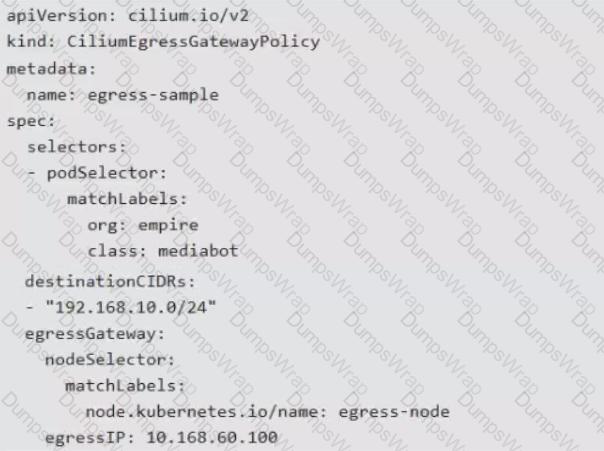
What does this Egress Gateway policy achieve?
Cilium Egress Gateway policy exhibit
Options:
It would cause all traffic originating from pods with the org: empire and class: mediabot labels in the default namespace and destined to 192.168.19.0/24 to be routed through the gateway node with the node.kubemetes.io/name: egress-node label, which will then SNAT said traffic with the 10.168.60.100 egress IP
It would cause all traffic sent to pods with the org: empire and class: mediabot labels In the default namespace and destined to 192.168.19.9/24 to be routed through the gateway node with the node.kubemetes.io/name: egress-node label, which will then DNAT said traffic with the 19.168.69.199 egress IP
It would cause all traffic sent to pods with the org: empire and class: mediabot labels in the default namespace and destined to 192.168.10.0/24 to be routed through the gateway node with the node.kubernetes.io/name: egress-node label, which will then SNAT said traffic with the 10.168.60.180 egress IP
It would cause all traffic originating from pods with the org: empire and class: nediabot labels in the default namespace and destined to 192.168.19.0/24 to be routed through the gateway node with the node.kubernetes.io/name: egress-node label, which will then DN AT said traffic with the 10.168.60.100 egress IP
Answer:
AExplanation:
Cilium's official documentation confirms that a CiliumEgressGatewayPolicy selects traffic originating from matching pods , routes traffic destined for the configured destinationCIDRs through the selected egress gateway node, and SNATs that traffic using the configured egressIP.
Which of these observability features is NOT supported by Hubble?
Options:
Hubble Is able to filter flows based on a given Kubernetes node name.
Hubble Is able to provide Layer 7 visibility In eBPF, without the need for a proxy.
Hubble is able to observe by HTTP Status code (like "404" or "200").
Hubble is able to filter traffic based on the network policy verdict.
Answer:
BExplanation:
Technical explanation
Hubble does not obtain Layer 7 protocol visibility exclusively through eBPF without a proxy. By default, Cilium’s datapath exposes Layer 3 and Layer 4 flow information. To produce supported application-layer events, traffic is selected through an L7 Cilium policy and redirected to the node-local Envoy proxy. Envoy parses the application protocol and forwards access-log information that Cilium and Hubble expose as Layer 7 flow events.
The other capabilities are supported. Hubble flow records contain the observing node, and the CLI provides node-based filtering. HTTP-aware flows can contain response status codes, enabling inspection or filtering for results such as 200 and 404. Hubble also records forwarding verdicts and drop reasons. Operators can filter for DROPPED traffic and distinguish policy-denied connections from forwarded traffic and other failure conditions.
This separation is fundamental to Cilium’s architecture: eBPF provides efficient kernel-level forwarding, security enforcement, and L3/L4 observability, while Envoy supplies protocol parsing when request-level context is required. The integration remains transparent to applications, but the proxy is still present in the traffic path for Layer 7 visibility.
Therefore, B describes the unsupported mechanism and is the correct answer.
Official references
Layer 7 Protocol Visibility ; Envoy ; Hubble CLI .
Study Guide topic: Network Observability.
What is correct about the Kubernetes Host Scope IP Address Management (IPAM) mode?
Options:
It supports multiple CIDRs (Classless Inter-Domain Routing) per cluster
It supports multiple CIDRs (Classless Inter-Domain Routing) per node.
It can beset by using the ipam: crd configuration flag.
It supports both tunnel and direct routing modes.
Answer:
DExplanation:
Technical explanation
Kubernetes host-scope IPAM can be used with both Cilium tunnel routing and native direct routing. The IPAM mechanism determines how each node receives and locally allocates pod addresses; it does not inherently require a particular packet-forwarding model. The current IPAM feature matrix explicitly marks both tunnel routing and direct routing as supported for Kubernetes host-scope mode.
In this mode, Kubernetes allocates a PodCIDR to each node and publishes it through the standard v1.Node resource, normally in spec.podCIDR or spec.podCIDRs . The Cilium agent waits for the relevant range and allocates individual pod addresses from that node-specific CIDR. The correct configuration is ipam: kubernetes or the Helm equivalent ipam.mode=kubernetes , not ipam: crd ; therefore, C is false.
The documented feature matrix does not provide multiple CIDRs per cluster or multiple CIDRs per node for this mode, eliminating A and B. Multi-pool IPAM is the Cilium mode designed for allocating per-node CIDRs from multiple configurable pools.
Because Kubernetes host-scope IPAM supports either overlay tunneling or direct routing while the other statements contradict its capabilities or configuration, D is correct.
Official references
IP Address Management ; Kubernetes Host Scope .
Study Guide topic: Installation and Configuration.
Which statement is true about Mutual Authentication with Cilium?
Options:
By default, data of SPIRE is stored In memory.
Cilium's Mutual authentication has been validated with SPIFFE, the production-ready implementation of SPIRE.
Enabling Mutual Authentication on Cilium requires installing, managing, and configuring a SPIRE server.
Through SPIRE, TLS certificates are automatically managed and frequently rotated.
Answer:
DExplanation:
Technical explanation
SPIRE supplies workload identities as SPIFFE Verifiable Identity Documents, including X.509 key material used for mutual authentication. SPIFFE’s identity model supports automatic issuance, rotation, and revocation, allowing short-lived certificates to be renewed without manually distributing static credentials. This makes D the correct statement.
Option A reverses the documented default. Cilium’s default SPIRE installation requires persistent-volume support. In-memory storage can be selected for laboratory environments by disabling server data storage, but that setting causes SPIRE data to be recreated if the server pod restarts. Option B also reverses the relationship between the projects: SPIFFE defines the identity standards and APIs, while SPIRE is a production-ready implementation of SPIFFE. Cilium’s mutual-authentication integration has been validated with SPIRE.
Option C overstates the operational requirement. A SPIRE server is involved, but Cilium’s Helm chart can deploy and configure the supported SPIRE server and per-node agents. Administrators may provide their own deployment, yet a completely manual installation is not mandatory.
Current documentation classifies this mutual-authentication implementation as beta and notes limitations, including incompatibility with Cluster Mesh trust domains. Those maturity constraints do not change the certificate-management behavior described in D.
Official references
Cilium Mutual Authentication .
Study Guide topic: Service Mesh.
Why is the iptables implementation of kube-proxy less scalable than eBPF?
Options:
eBPF makes use of the kernel, while iptables does not.
Iptables's complexity is linear while eBPF Is constant-time.
Iptables is incompatible with IPv6 services in Kubernetes.
Iptables is incompatible with eXpressDataPath for smartNICs.
Answer:
BExplanation:
Technical explanation
B expresses the principal scalability distinction intended by the question. In kube-proxy’s iptables mode, Kubernetes Services and endpoints are represented by chains of netfilter rules. As the number of Services and backends grows, rule creation, synchronization, and packet traversal can involve increasingly large rule sets. Matching through those chains is generally described as having linear scaling characteristics.
Cilium’s kube-proxy replacement stores service and backend state in eBPF maps. Hash-map lookups allow the datapath to locate service entries without sequentially scanning a rule for every Service, providing effectively constant-time lookup behavior for the relevant map operations. This makes the approach better suited to large and frequently changing Kubernetes environments.
Option A is false because iptables and netfilter also operate within the Linux kernel. Option C is false because kube-proxy’s iptables implementation supports IPv6 when the surrounding Kubernetes and host configuration supports it. Option D does not explain kube-proxy’s primary scaling limitation and introduces an unrelated SmartNIC/XDP claim.
The constant-time description is a useful architectural simplification; total performance still depends on map sizing, backend selection, connection tracking, and kernel behavior.
Official references
Cilium eBPF Datapath , Cilium Tuning Guide
Study Guide topic: kube-proxy replacement, eBPF maps, and datapath scalability.
Which statement is true of both the Ingress Controller and Gateway API?
Options:
It provides portable Layer 7 north-south routing logic for Kubernetes workloads.
Its routing logic can be restricted to a single namespace.
It is role-oriented, with some resources for administrators and others for users.
Its features are commonly extended by using resource annotations.
Answer:
AExplanation:
Technical explanation
Both Kubernetes Ingress and the north-south use of Gateway API provide declarative Layer 7 routing from clients outside the cluster to Kubernetes workloads. They express host- and path-based routing through Kubernetes resources and can be implemented by controllers such as Cilium’s Envoy-based ingress implementation. A therefore captures their shared purpose most accurately.
The remaining choices describe differences rather than universal similarities. Gateway API is explicitly role-oriented: infrastructure administrators manage GatewayClass and often Gateway , while application owners manage route resources such as HTTPRoute . The Ingress API does not provide the same formal separation of administrative and application-facing resources, making C unsuitable as a statement about both.
Implementation-specific annotations are historically common with Ingress because its core API is limited. Gateway API was deliberately designed with more expressive, portable resource fields so that implementations do not need to depend as heavily on vendor-specific annotations; D is consequently not true of both. Namespace behavior also differs because Gateway API provides controlled cross-namespace attachment and reference mechanisms. B is therefore not the defining common capability.
Official references
Cilium Kubernetes Ingress Support , Cilium Gateway API Support , Migrating from Ingress to Gateway API
Study Guide topic: Kubernetes north-south routing, Ingress, and Gateway API.
What is true about WireGuard encryption on Cilium?
Options:
Packets are encrypted when they are destined to the same node from which they were sent. This is to ensure confidentiality of traffic within the node.
It provides encryption for node-to-node, pod-to-node, node-to-pod, and pop-to-pod traffic as long as the pods are on different nodes.
When running in the tunneling mode, pod-to-pod traffic will be sent over the WireGuard tunnel before being transmitted over the overlay tunnel.
When WireGuard is enabled in Cilium, each pod will establish a secure WireGuard tunnel between it and all other known pods in the cluster.
Answer:
BExplanation:
Technical explanation
B is the best answer, with two qualifications. First, “pop-to-pod” is evidently a source typo for “pod-to-pod.” Second, default WireGuard mode encrypts traffic between Cilium-managed pods on different nodes; node-to-node, pod-to-node, and node-to-pod coverage requires enabling the additional encryption.nodeEncryption=true mode.
Cilium creates WireGuard peers per node, not per pod. Each Cilium agent generates a node key pair, advertises the public key through its CiliumNode resource, and forms secure tunnels with other known nodes. This makes D incorrect. Same-node packets do not traverse a WireGuard tunnel because encryption cannot protect them from an observer already able to inspect raw traffic on that host, so A reverses the documented behavior.
C also reverses the encapsulation sequence. In tunnel-routing mode, pod traffic is first encapsulated for the VXLAN or Geneve overlay and is then encapsulated by WireGuard. The result is double encapsulation, with WireGuard protecting the overlay packet while it crosses the network between nodes.
Thus, B describes WireGuard’s supported traffic coverage most closely, but exam candidates should remember the separate node-encryption configuration requirement.
Official references
WireGuard Transparent Encryption
Study Guide topic: WireGuard peer architecture, encrypted traffic matrix, same-node behavior, and encapsulation order.
If you are required to block ingress traffic from external IPs for all pods in your cluster, which of the following network policies would be the best fit?
Options:
CiliumNetworkPolicy
CiliumGlobalPolicy
NetworkPolicy
CiliumClusterWideNetworkPolicy
Answer:
DExplanation:
Technical explanation
A cluster-wide requirement is best implemented with CiliumClusterwideNetworkPolicy , whose correct resource spelling is CiliumClusterwideNetworkPolicy . Unlike a namespaced CiliumNetworkPolicy , this Cilium CRD is non-namespaced and can select endpoints across the entire cluster.
To deny external ingress for every Cilium-managed pod, a cluster-wide policy can use an empty endpointSelector and an ingressDeny rule selecting the world entity. Cilium defines world as network endpoints outside the cluster. An alternative allow-list construction can permit only the cluster entity, thereby excluding external sources, but an explicit deny rule usually communicates the requirement more directly.
A standard Kubernetes NetworkPolicy and a CiliumNetworkPolicy are namespaced, requiring repeated resources in every applicable namespace. CiliumGlobalPolicy is not a valid Cilium resource type. Although the option capitalizes “Wide” differently from the actual kind, D unmistakably identifies the intended cluster-scoped policy.
Official references
Cilium Deny Policies , Cilium Network Policy Types
Study Guide topic: Cluster-scoped policies, external traffic, and reserved entities.
Which command is used to enable logging at the debug log level of Cilium agents7
Options:
cilium log level --set=debug
cilium logging.level=debug
cilium config set debug true
cilium logging debug
Answer:
CExplanation:
Technical explanation
cilium config set debug true follows the supported Cilium CLI configuration syntax and sets the debug configuration key to true . The cilium config set command accepts a key/value pair and, by default, restarts the Cilium pods so that the changed configuration is applied. The Cilium configuration documentation defines debug as the setting that enables full debug mode. This increases agent logging verbosity and causes eBPF programs to emit additional visibility events for diagnostic use.
Options A, B, and D do not match documented Cilium CLI command structures. There is no cilium log level --set=debug command in the Cilium CLI hierarchy, and neither cilium logging.level=debug nor cilium logging debug is valid configuration syntax. A Helm-managed installation may also enable debugging through the chart value debug.enabled=true , but that does not make any of the alternative commands correct.
Debug mode should be enabled deliberately because it increases log volume and may generate additional datapath visibility information. After troubleshooting, operators should normally restore the previous setting to avoid unnecessary operational overhead.
The supplied answer key incorrectly identifies B. The verified answer is C.
Official references
Cilium configuration ; Cilium CLI `config set` ; Helm values .
Study Guide topic: Installation and Configuration.
