
Operationalizing Machine Learning and Generative AI Solutions Questions and Answers
Fabrikam Inc. must improve its deployment process because traditional machine learning models are deployed manually and the organization has limited rollback capability .
You need to recommend a deployment approach that supports staged rollout and rollback while minimizing operational overhead.
Which deployment approach should you recommend?
Fabrikam Inc. needs to improve the performance of a GPT-5 model based on the stated technical requirements.
Which action should you perform first?
You need to recommend an experiment-tracking strategy that ensures consistent experiment results.
What should you recommend?
You need to standardize how Fabrikam Inc. manages machine learning assets.
Which action should you perform first?
You need to configure an optimization method to meet Fabrikam Inc.’s technical requirements.
Which strategy should you apply first? To answer, select the appropriate options in the answer area.
NOTE: Each correct selection is worth one point.
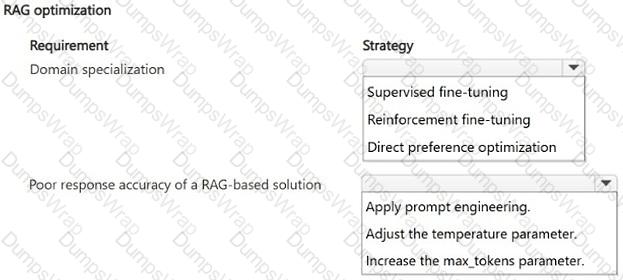
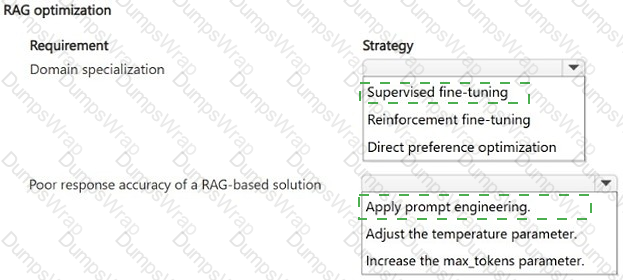
You need to isolate training workloads while remaining cost-aware to address Fabrikam Inc.’s issues, constraints, and technical requirements.
What should you implement?
You manage an Azure Machine Learning workspace. You design a training job that is configured with a serverless compute. The serverless compute must have a specific instance type and count
You need to configure the serverless compute by using Azure Machine Learning Python SDK v2. What should you do?
You plan to filter your traces to identify issues while observing how the application is responding. The solution must not use an external knowledge base.
You need to select an evaluation metric.
Which built-in evaluator should you use?
You are using Azure Machine Learning to monitor a trained and deployed model. You implement Event Grid to respond to Azure Machine Learning events.
Model performance has degraded due to model input data changes.
You need to trigger a remediation ML pipeline based on an Azure Machine Learning event.
Which event should you use?
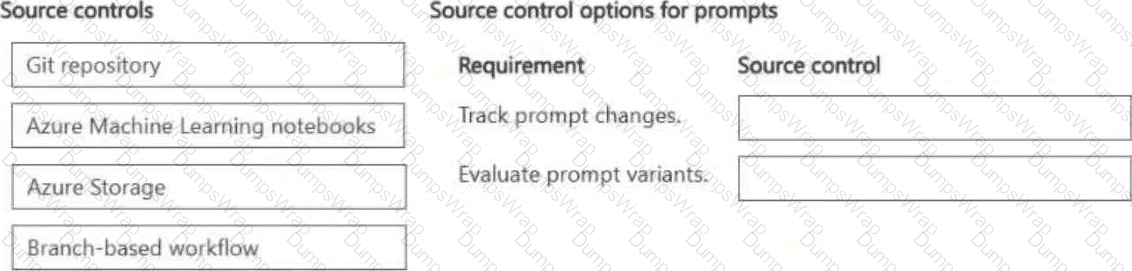
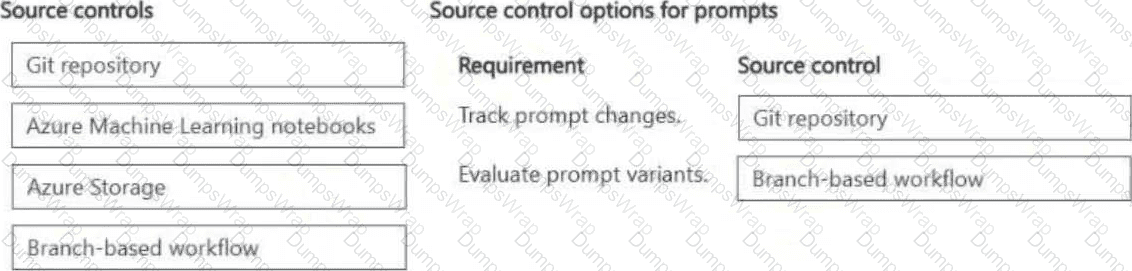
A team iterates prompts used by a generative AI agent. The team must support internal review before releasing changes.
The team must:
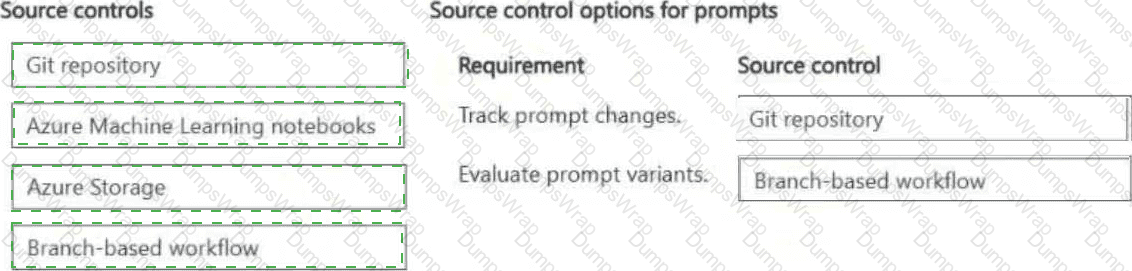
Track prompt changes with a clear history for audit and rollback.
Compare prompt variants in parallel without affecting the prompt used in the production environment.
You need to select the appropriate source control approach for each requirement.
What should you use for each requirement? To answer, move the appropriate source controls to the correct requirements. You may use each source control once, more than once, or not at all. You may need to move the split bar between panes or scroll to view content. NOTE: Each correct selection is worth one point.
You are designing a new machine learning solution to predict customer churn by using Azure Machine Learning. You have raw data in CSV format stored in Azure Data Lake.
You need to design the solution so that it can efficiently handle large-scale model training and iterative development.
Which two actions should you perform? Each correct answer presents part of the solution. Choose two.
NOTE: Each correct selection is worth one point
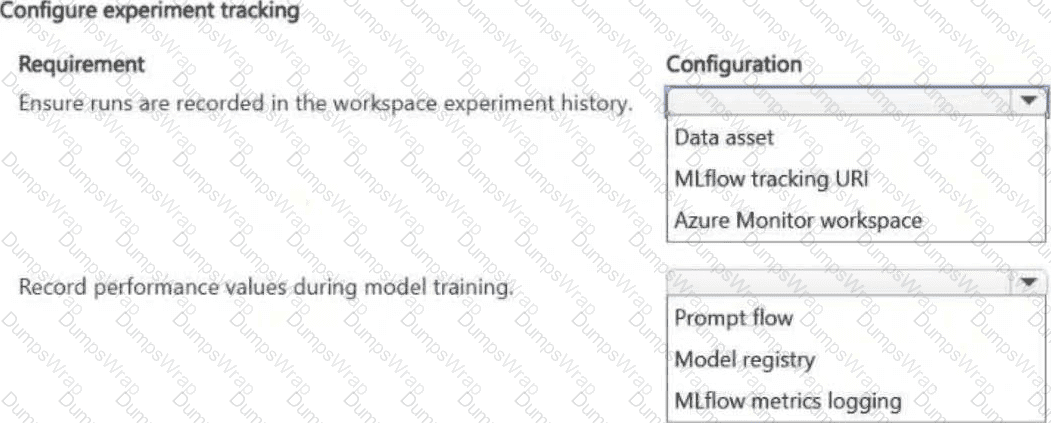
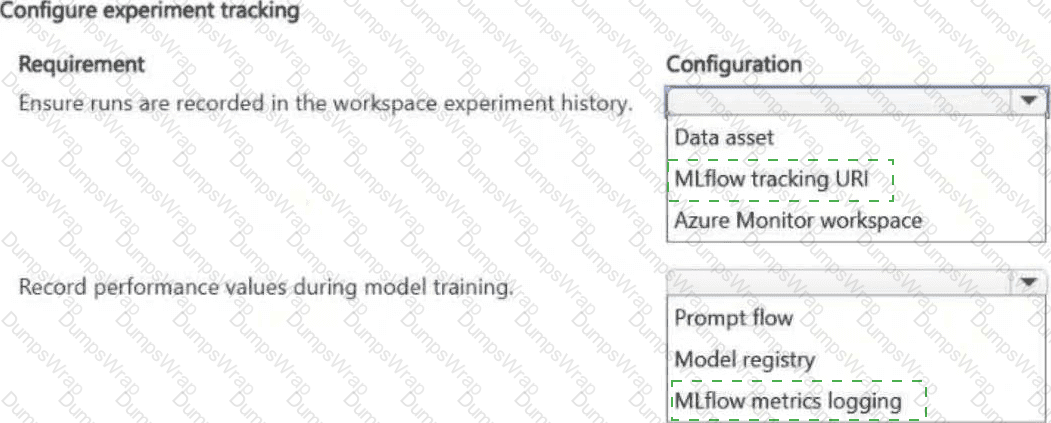
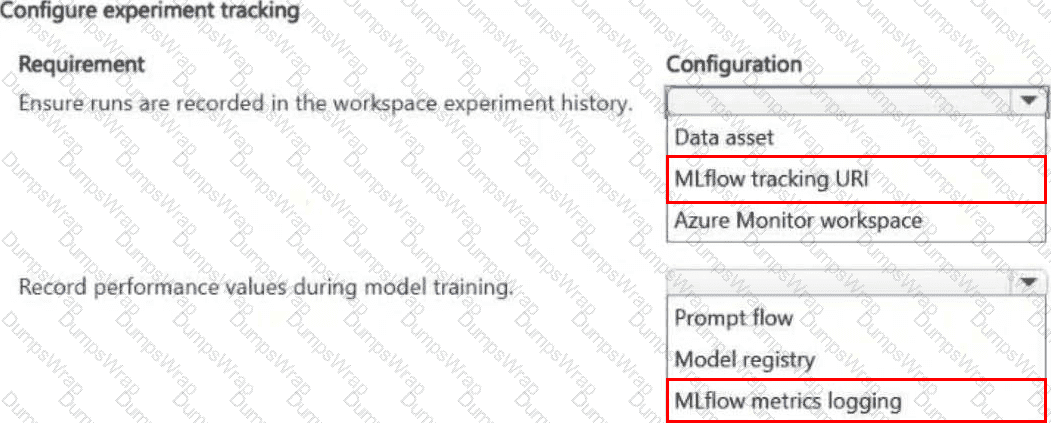
You use Azure Machine Learning to train models across multiple experiments by using the same workspace.
You must record training runs in a centralized location to compare results from different jobs.
During training, performance values must be captured so they appear in the experiment run history.
You need to configure experiment tracking.
What should you configure for each requirement? To answer, select the appropriate options in the answer area. NOTE: Each correct selection is worth one point.
You train and register an Azure Machine Learning model
You plan to deploy the model to an online endpoint
You need to ensure that applications will be able to use the authentication method with a non-expiring artifact to access the model.
Solution:
Create a managed online endpoint and set the value of its auth.mode parameter to aml.token. Deploy the model to the online endpoint.
Does the solution meet the goal?
You manage an Azure Machine Learning workspace. You have a folder that contains a CSV file. The folder is registered as a folder data asset.
You plan to use the folder data asset for data wrangling during interactive development.
You need to access and load the folder data asset into a Pandas data frame.
Which method should you use to achieve this goal?
When comparing prompt variants, the team plans to assess whether the generated responses are grammatically correct.
You need to evaluate the quality of the language from the generated responses.
Which evaluator should you use?
Note: This question is part of a series of questions that present the same scenario. Each question in the series contains a unique solution that might meet the stated goals. Some question sets might have more than one correct solution, while others might not have a correct solution.
After you answer a question in this section, you will NOT be able to return to it. As a result, these questions will not appear on the review screen.
You manage an Azure Machine Learning workspace. The Python script named script.py reads an argument named training_data.
The training_data argument specifies the path to the training data in a file named dataset1.csv.
You plan to run the script.py Python script as a command job that trains a machine learning model.
You need to provide the command to pass the path for the dataset as a parameter value when you submit the script as a training job.
Solution: python script.py --trainingdata ${{inputs.training_data}}
Does the solution meet the goal?
-
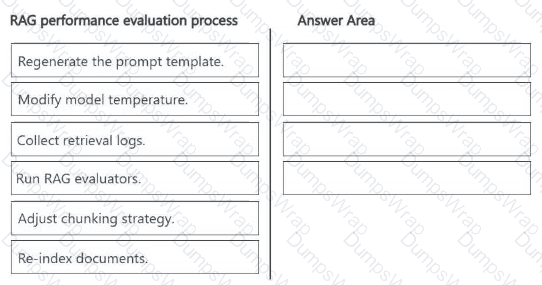
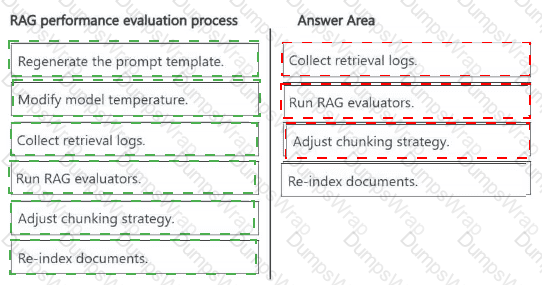
A team is developing a Retrieval-Augmented Generation (RAG) system.
The team requires improvements to the system ' s retrieval quality to ensure accurate, grounded responses.
You need to assess RAG performance before you can suggest an improvement strategy.
Which four actions should you perform in sequence? To answer, move the appropriate actions from the list of actions to the answer area and arrange them in the correct order.
: 211
You create an Azure Machine Learning workspace.
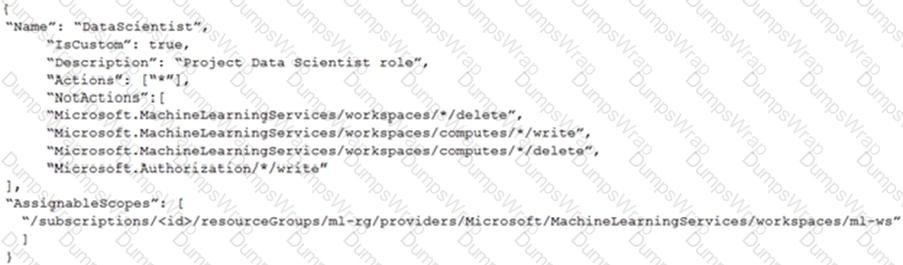
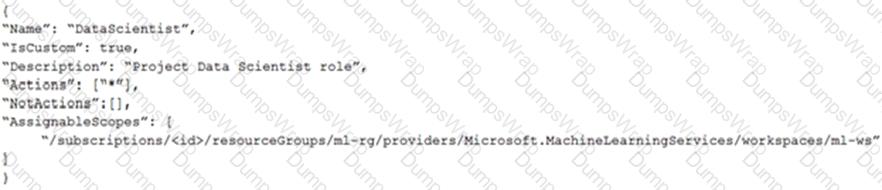
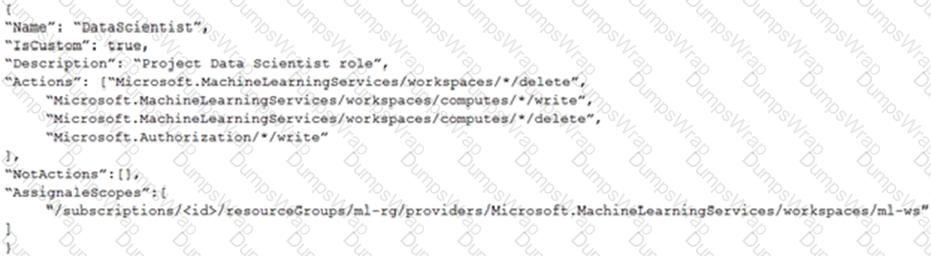
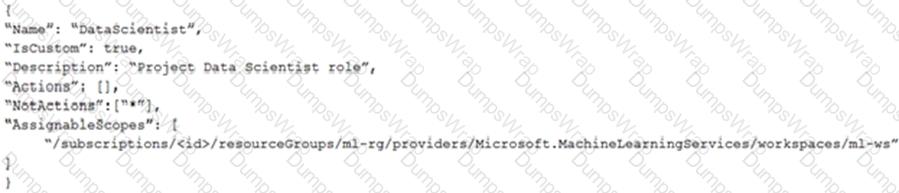
You must create a custom role named DataScientist that meets the following requirements:
Role members must not be able to delete the workspace.
Role members must not be able to create, update, or delete compute resource in the workspace.
Role members must not be able to add new users to the workspace.
You need to create a JSON file for the DataScientist role in the Azure Machine Learning workspace.
The custom role must enforce the restrictions specified by the IT Operations team.
Which JSON code segment should you use?
A)
B)
C)
D)
You manage an Azure Machine Learning workspace named workspace1 by using the Python SDK v2.
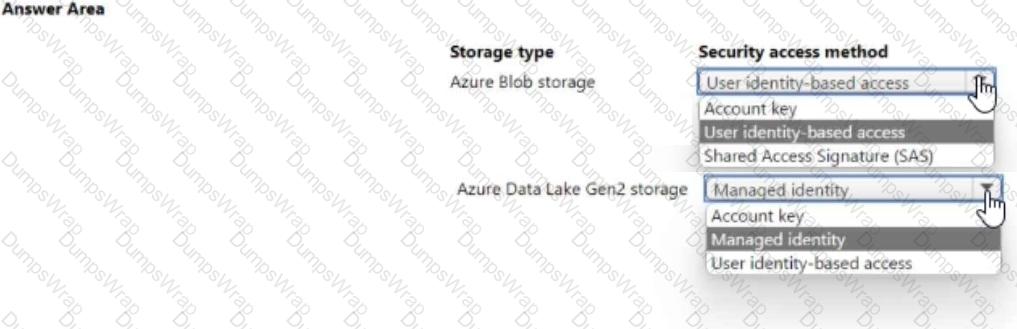
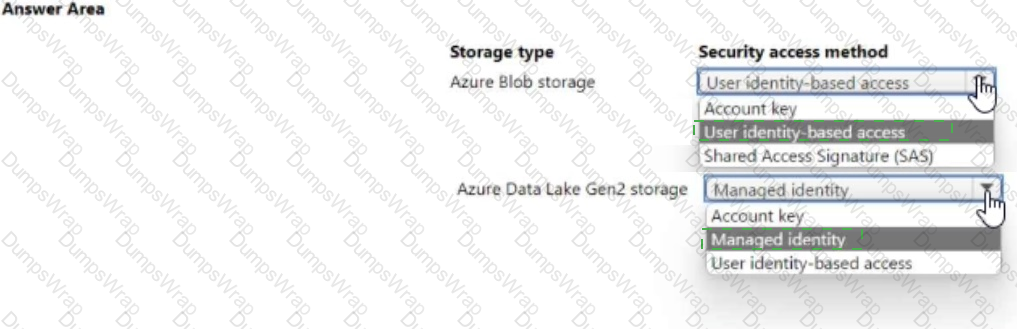
You must register datastores in workspace1 for Azure Blob and Azure Data Lake Gen2 storage to meet the following requirements:
• Data scientists accessing the datastore must have the same level of access.
• Access must be restricted to specified containers or folders.
You need to configure a security access method used to register the Azure Blob and Azure Data lake Gen? storage in workspace1. Which security access method should you configure? To answer, select the appropriate options in the answers area.
NOTE: Each correct selection is worth one point.
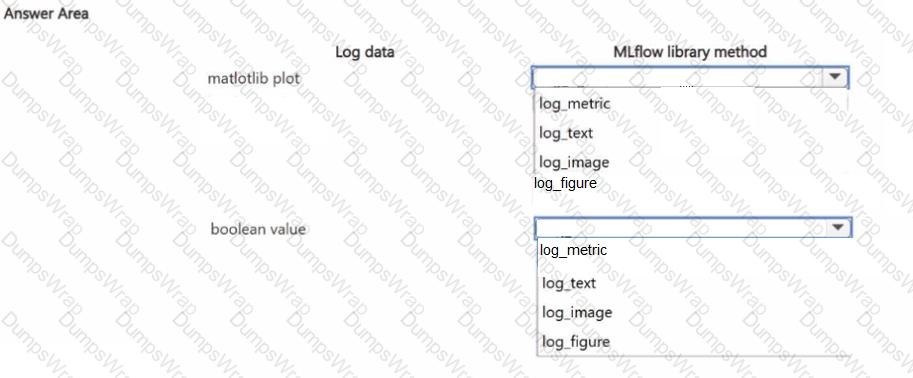
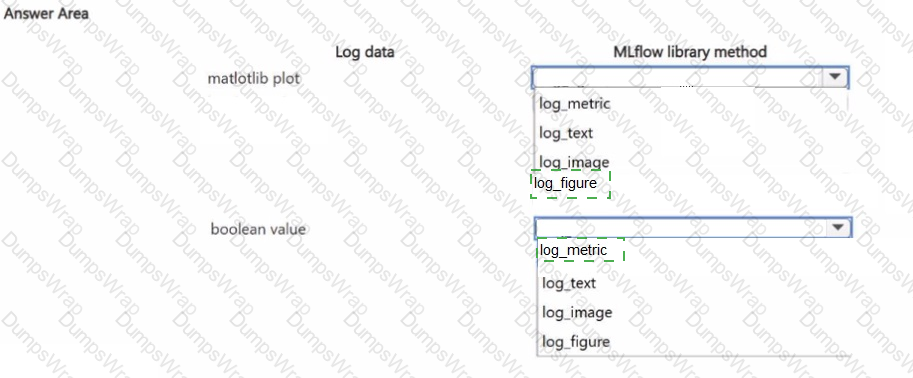
You create an Azure Machine Learning workspace and install the MLflow library.
You need to log different types of data by using the MLflow library.
Which method should you use? To answer, select the appropriate options in the answer area.
NOTE: Each correct selection is worth one point.
You create a multi-class image classification deep learning model.
The model must be retrained monthly with the new image data fetched from a public web portal. You create an Azure Machine Learning pipeline to fetch new data, standardize the size of images and retrain the model.
You need to use the Azure Machine Learning Python SEX v2 to configure the schedule for the pipeline. The schedule should be defined by using the frequency and interval properties with frequency set to month ' and interval set to " 1:
Which three classes should you instantiate in sequence " ' To answer, move the appropriate actions from the list of actions to the answer area and arrange them in the correct order.


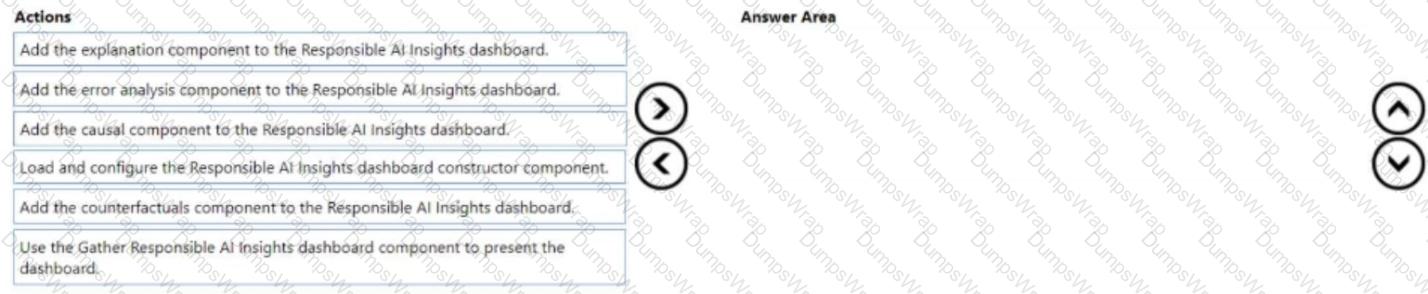
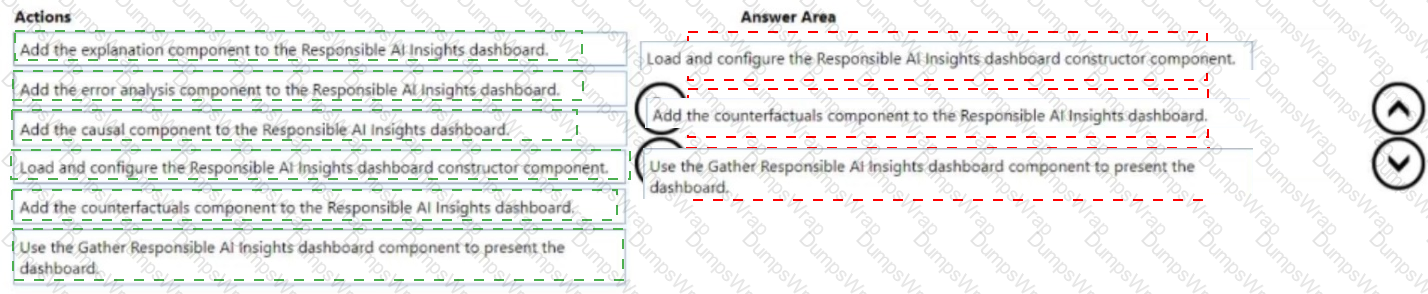
You manage an Azure Machine Learning workspace. You train a model named model1.
You must identify the features to modify for a differing model prediction result.
You need to configure the Responsible Al (RAI) dashboard for model1.
Which three actions should you perform in sequence? To answer move the appropriate actions from the list of actions to the answer area and arrange them in the correct order.
You have an Azure Machine Learning workspace named Workspace^ Workspace1 has a registered MLflow model named model1 with PyFunc flavor. You plan to deploy model1 to an online endpoint named endpoint1 without egress connectivity by using Azure Machine Learning Python SDK v2. You have the following code:
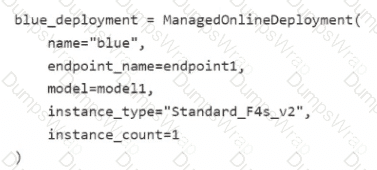
You need to add a parameter to the ManagedOnlineDeployment object to ensure the model deploys successfully.
Solution: Add the code_path parameter.
Does the solution meet the goal?
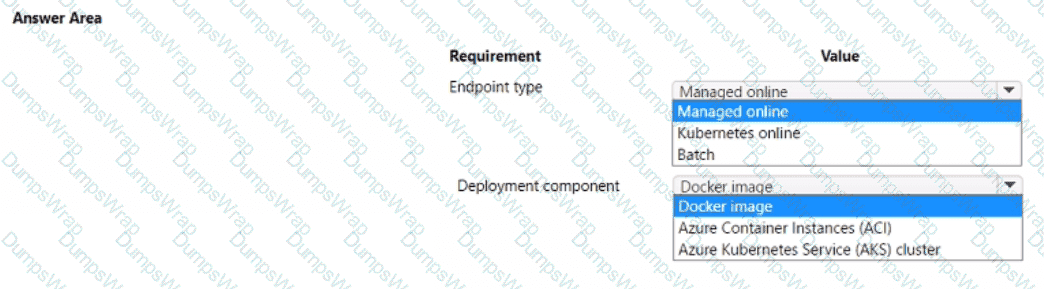
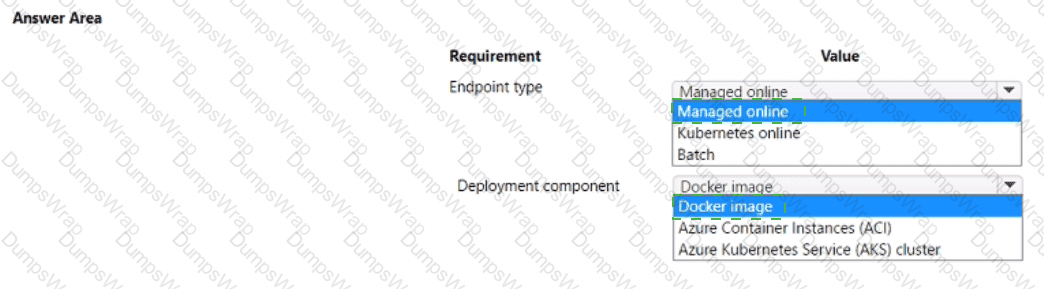
You create an Azure Machine Learning model to include model files and a scorning script. You must deploy the model. The deployment solution must meet the following requirements:
• Provide near real-time inferencing.
• Enable endpoint and deployment level cost estimates.
• Support logging to Azure Log Analytics.
You need to configure the deployment solution.
What should you configure? To answer, select the appropriate options in the answer area.
NOTE: Each correct selection is worth one point.
You have an Azure Machine Learning (ML) model deployed to an online endpoint.
You need to review container logs from the endpoint by using Azure Ml Python SDK v2. The logs must include the console log from the inference server with print/log statements from the models scoring script.
What should you do first?
You have an Azure Machine Learning workspace named Workspace 1 Workspace! has a registered Mlflow model named model 1 with PyFunc flavor
You plan to deploy model1 to an online endpoint named endpoint1 without egress connectivity by using Azure Machine learning Python SDK vl
You have the following code:
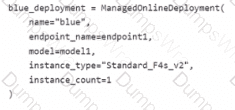
You need to add a parameter to the ManagedOnlineDeployment object to ensure the model deploys successfully
Solution: Add the environment parameter.
Does the solution meet the goal?
You have an Azure Machine Learning workspace.
You plan to run a job to tram a model as an MLflow model output.
You need to specify the output mode of the MLflow model.
Which three modes can you specify? Each correct answer presents a complete solution.
NOTE: Each correct selection is worth one point.
You create an Azure Machine Learning workspace.
You must use the Python SDK v2 to implement an experiment from a Jupyter notebook in the workspace. The experiment must log string metrics. You need to implement the method to log the string metrics. Which method should you use?
