Designing and Implementing Cloud-Native Applications Using Microsoft Azure Cosmos DB Questions and Answers
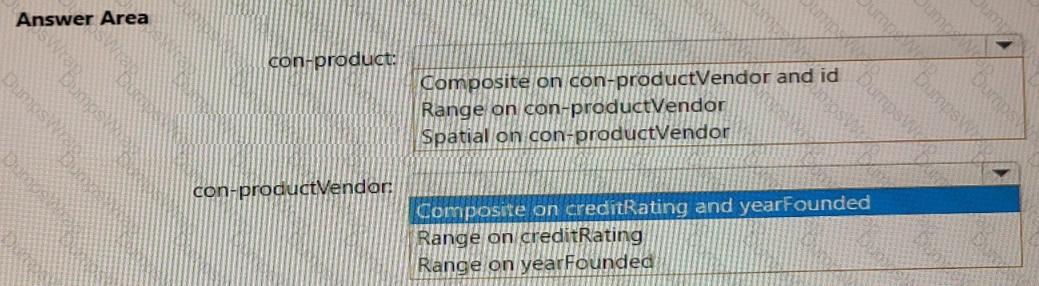
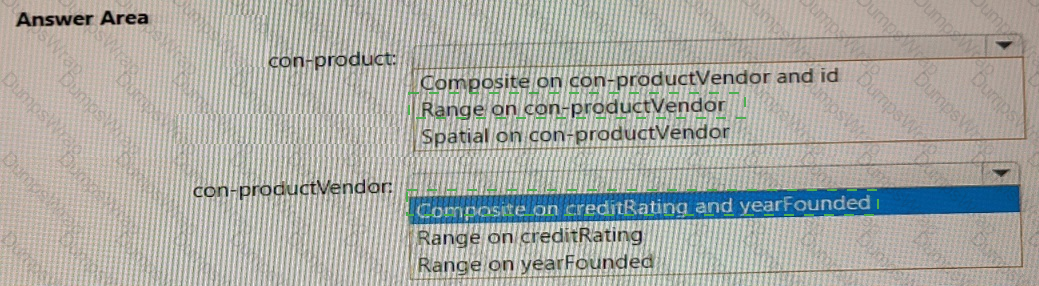
You need to recommend indexes for con-product and con-productVendor. The solution must meet the product catalog requirements and the business requirements.
Which type of index should you recommend for each container? To answer, select the appropriate options in the answer area.
NOTE: Each correct selection is worth one point.
You configure multi-region writes for account1.
You need to ensure that App1 supports the new configuration for account1. The solution must meet the business requirements and the product catalog requirements.
What should you do?
You need to provide a solution for the Azure Functions notifications following updates to con-product. The solution must meet the business requirements and the product catalog requirements.
Which two actions should you perform? Each correct answer presents part of the solution.
NOTE: Each correct selection is worth one point.
You need to identify which connectivity mode to use when implementing App2. The solution must support the planned changes and meet the business requirements.
Which connectivity mode should you identify?
You need to implement a solution to meet the product catalog requirements.
What should you do to implement the conflict resolution policy.
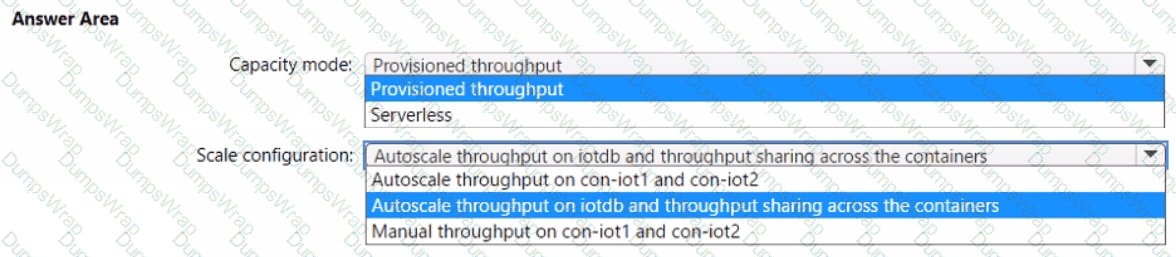
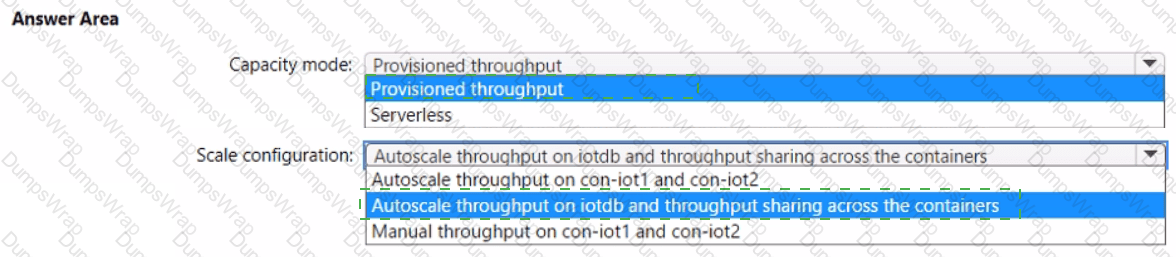
You need to select the capacity mode and scale configuration for account2 to support the planned changes and meet the business requirements. What should you select? To answer, select the appropriate options in the answer area. NOTE: Each correct selection is worth one point.
You are troubleshooting the current issues caused by the application updates.
Which action can address the application updates issue without affecting the functionality of the application?
You need to select the partition key for con-iot1. The solution must meet the IoT telemetry requirements.
What should you select?
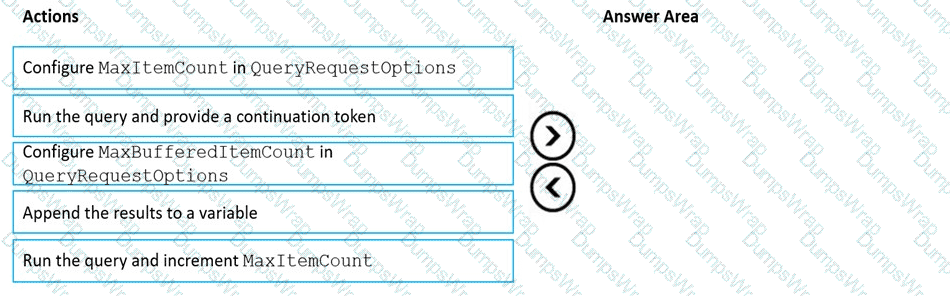
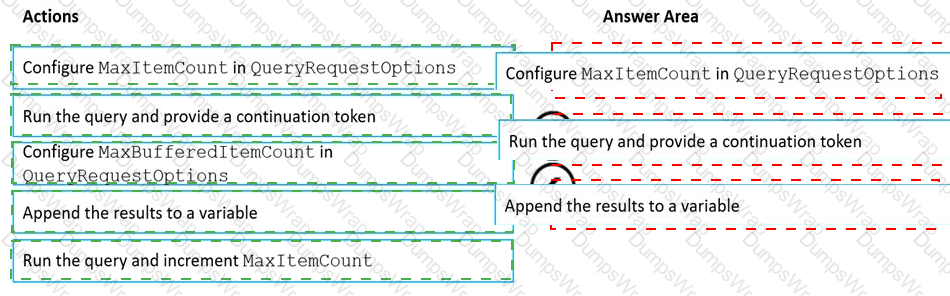
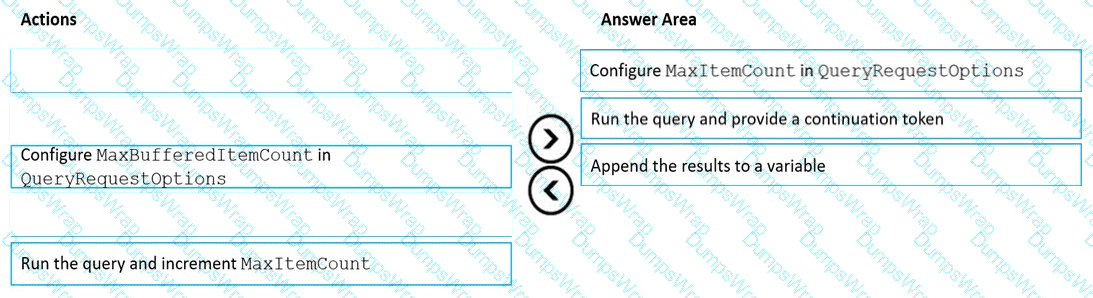
You have an app that stores data in an Azure Cosmos DB Core (SQL) API account The app performs queries that return large result sets.
You need to return a complete result set to the app by using pagination. Each page of results must return 80 items.
Which three actions should you perform in sequence? To answer, move the appropriate actions from the list of actions to the answer area and arrange them in the correct order.
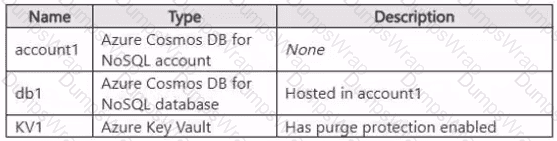
You have an Azure subscription that contains the resources shown in the following table.
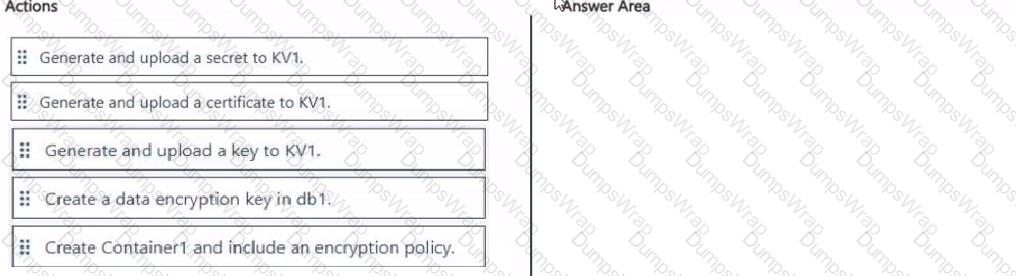
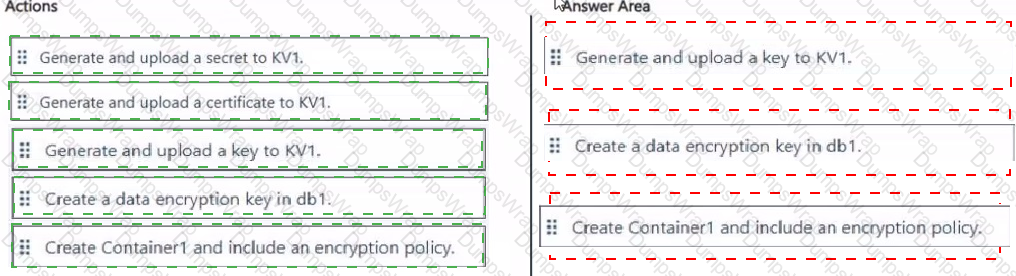
You need to create a container in db1 that has the following attributes:
• Name: Contained
• Encryption: Client-side encryption with Always Encrypted
Which three actions should you perform in sequence? To answer, move the appropriate actions from the list of actions to the answer area and arrange them in the correct order.
You have a development environment that uses multiple Azure subscriptions.
You plan to deploy a single Azure Cosmos DB account that will contain a single database in each subscription.
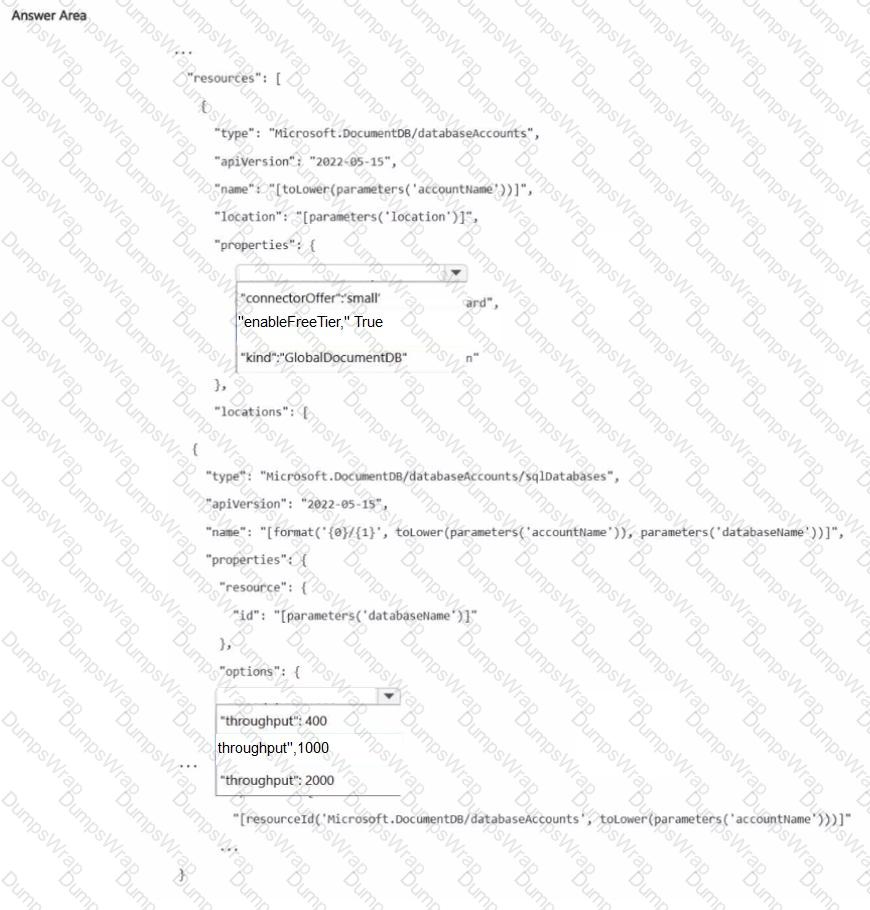
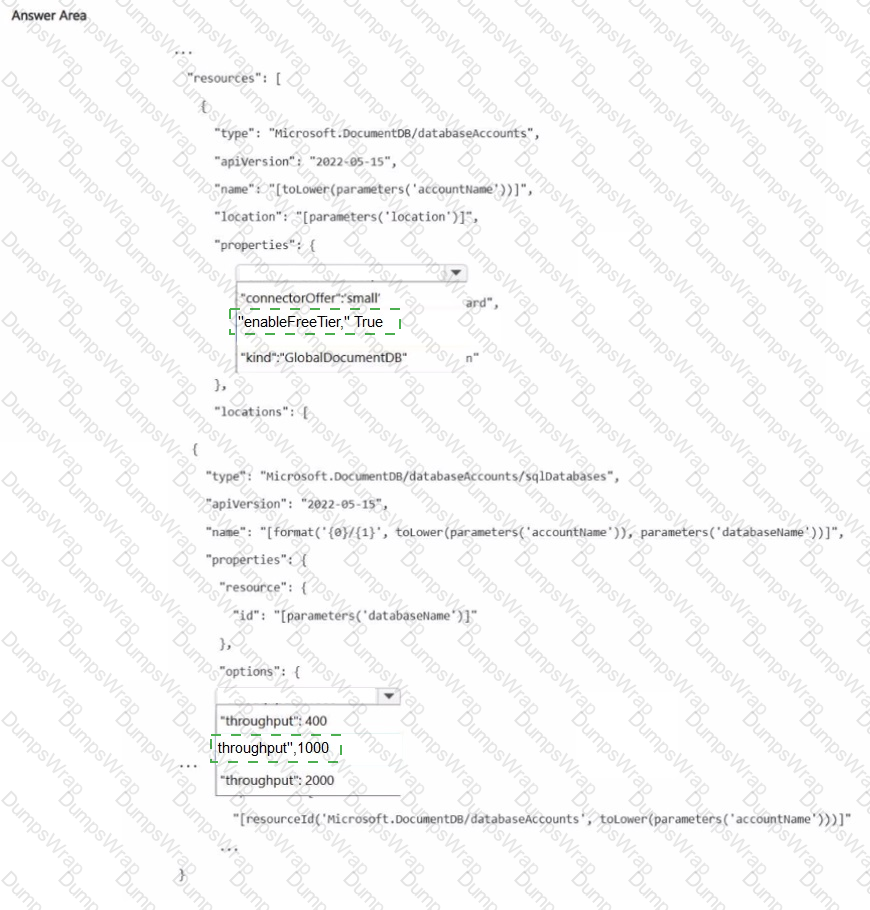
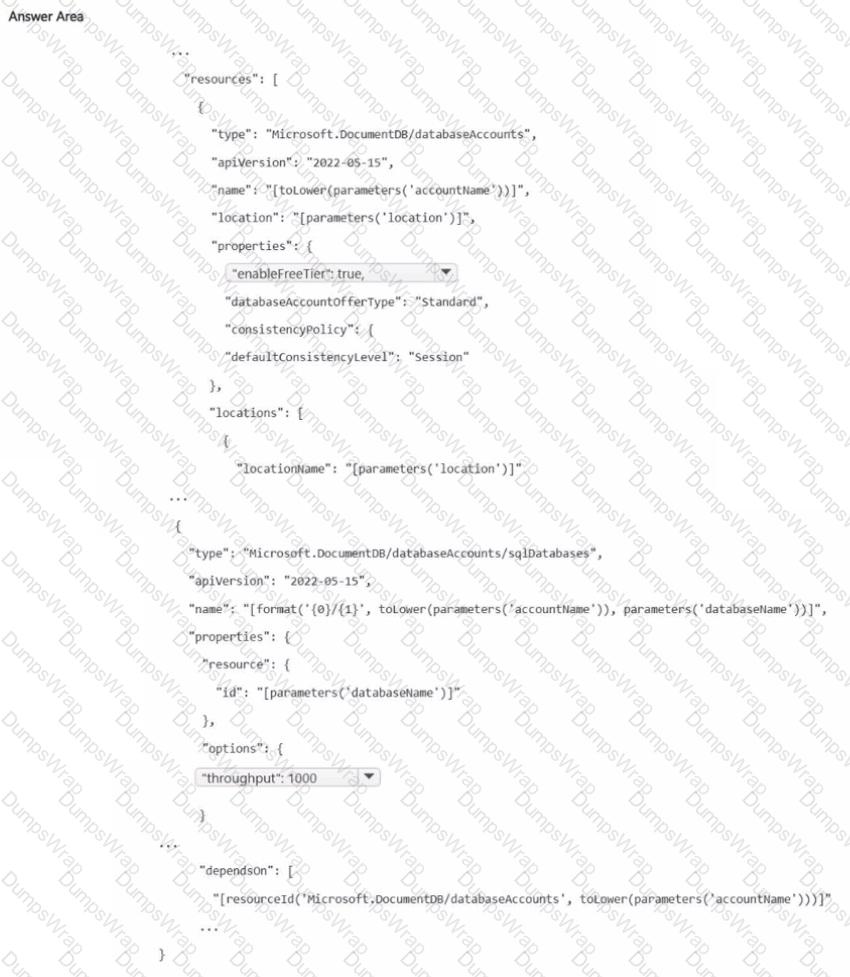
You need to automate the deployment by using an Azure Resource Manager (ARM) template. The solution must meet the following requirements:
• Minimize Azure Cosmos DB-related charges.
• Maximize the available request units per second (RU/s) without increasing costs.
How should you complete the template? To answer, select the appropriate options in the answer area. NOTE: Each correct selection is worth one point.
 C:\Users\Waqas Shahid\Desktop\Mudassir\Untitled.jpg
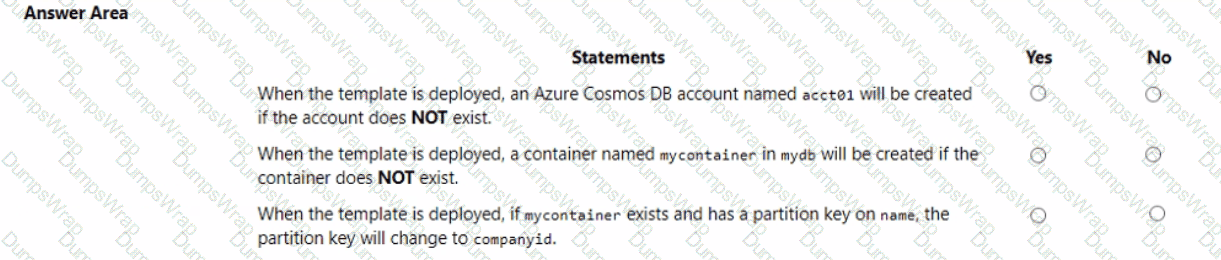
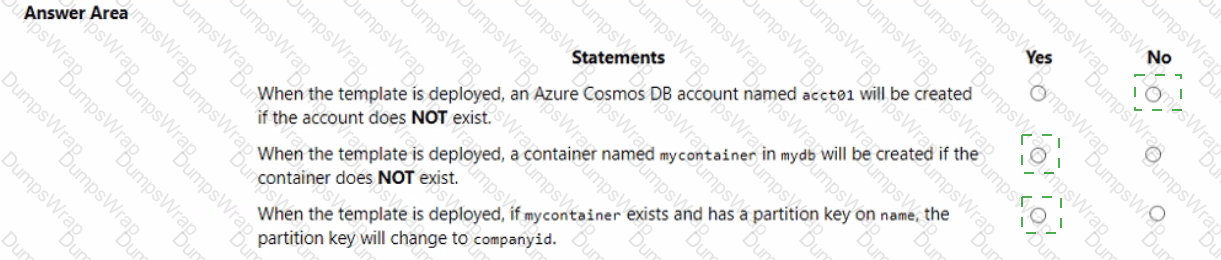
You have the following Azure Resource Manager (ARM) template.
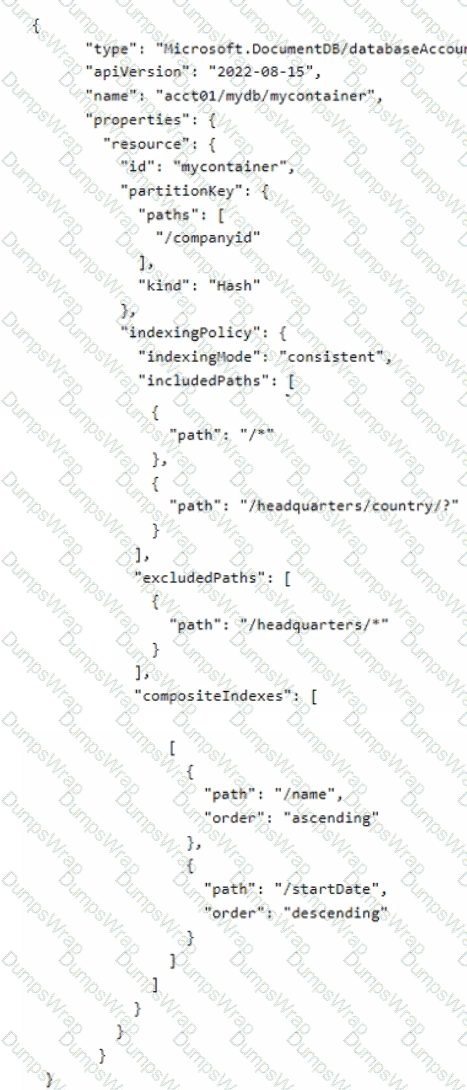
You plan to deploy the template in incremental mode.
For each of the following statements, select Yes if the statement is true. Otherwise, select No.
You have an Azure Cosmos DB for NoSQL database that hosts a container named Container1 For Container1. the DefaultTimeToLive property is -1.
You insert an item into Container1. The property of the inserted item is 10O0. When will the item be deleted automatically?
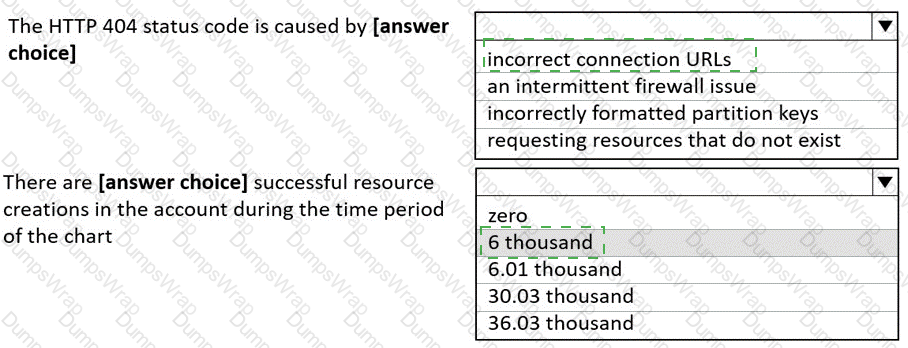
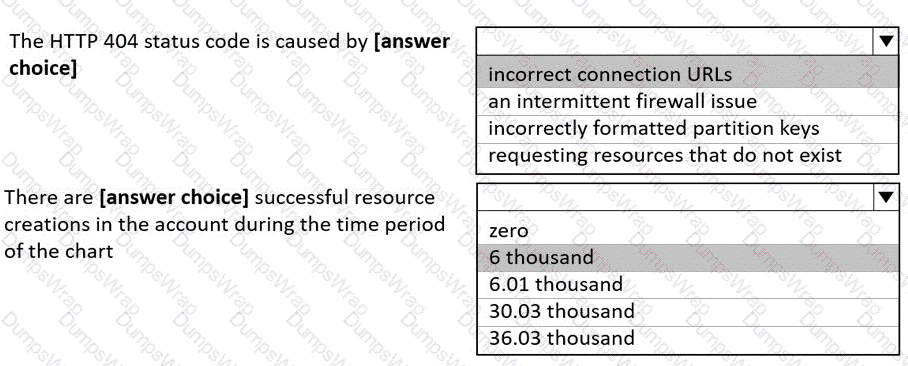
You have an Azure Cosmos DB Core (SQL) API account used by an application named App1.
You open the Insights pane for the account and see the following chart.
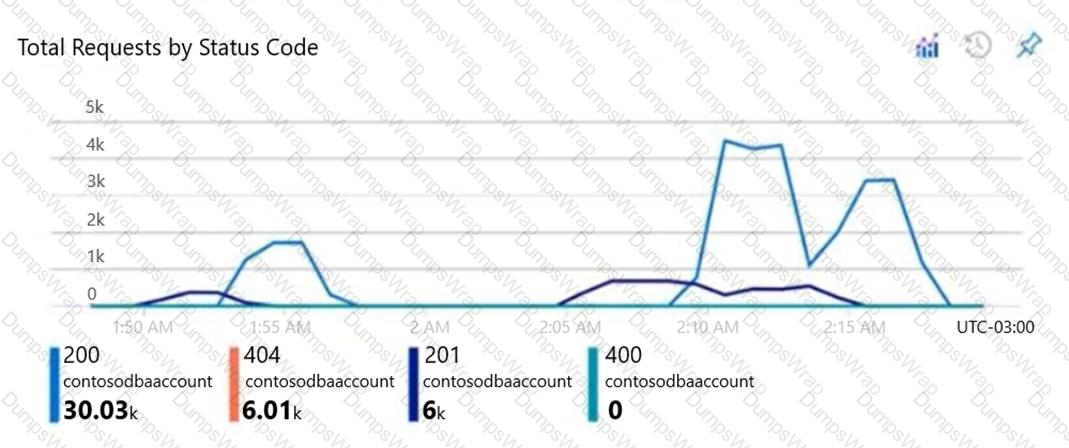
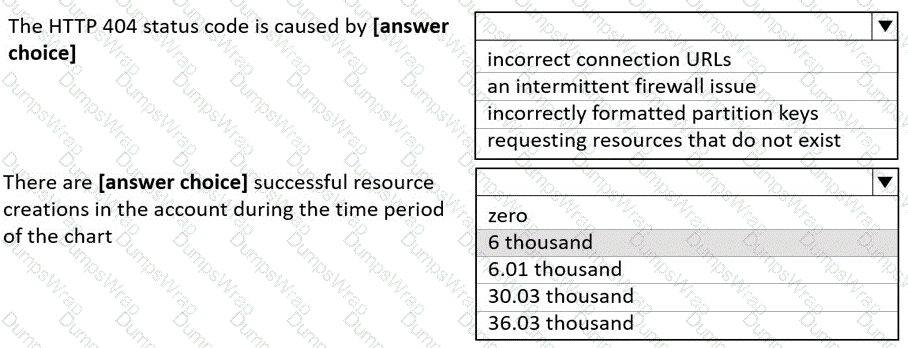
Use the drop-down menus to select the answer choice that answers each question based on the information presented in the graphic.
NOTE: Each correct selection is worth one point.
You have an Azure Cosmos DB for NoSQL database that hosts the containers shown in the following table.
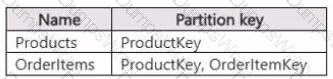
You need to ensure that when a product name changes in the Products container, the product name changes in all orders that have NOT been shipped.
What should you implement?
Note: This question is part of a series of questions that present the same scenario. Each question in the series contains a unique solution that might meet the stated goals. Some question sets might have more than one correct solution, while others might not have a correct solution.
After you answer a question in this section, you will NOT be able to return to it. As a result, these questions will not appear in the review screen.
You have a container named container1 in an Azure Cosmos DB Core (SQL) API account.
You need to make the contents of container1 available as reference data for an Azure Stream Analytics job.
Solution: You create an Azure Synapse pipeline that uses Azure Cosmos DB Core (SQL) API as the input and Azure Blob Storage as the output.
Does this meet the goal?

You have a container in an Azure Cosmos DB for NoSQL account.
You need to create an alert based on a custom Log Analytics query.
Which signal type should you use?
You have a database named db1in an Azure Cosmos DB for NoSQL account named account 1.
You need to write JSON data to db1 by using Azure Stream Analytics. The solution must minimize costs.
Which should you do before you can use db1 as an output of Stream Analytics?
You have an Azure Cosmos DB for NoSQL account named account1 that has a single read-write region and one additional read region. Account1 uses the strong default consistency level.
You have an application that uses the eventual consistency level when submitting requests to account1.
How will writes from the application be handled?
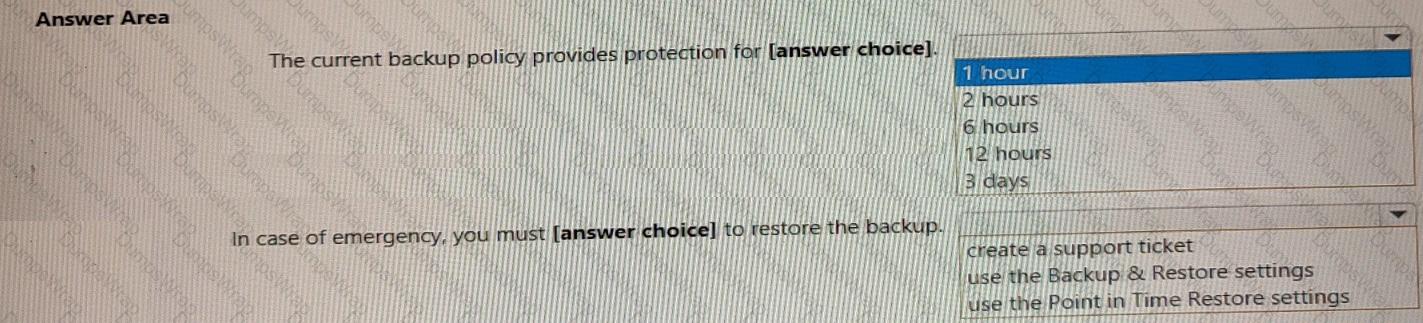
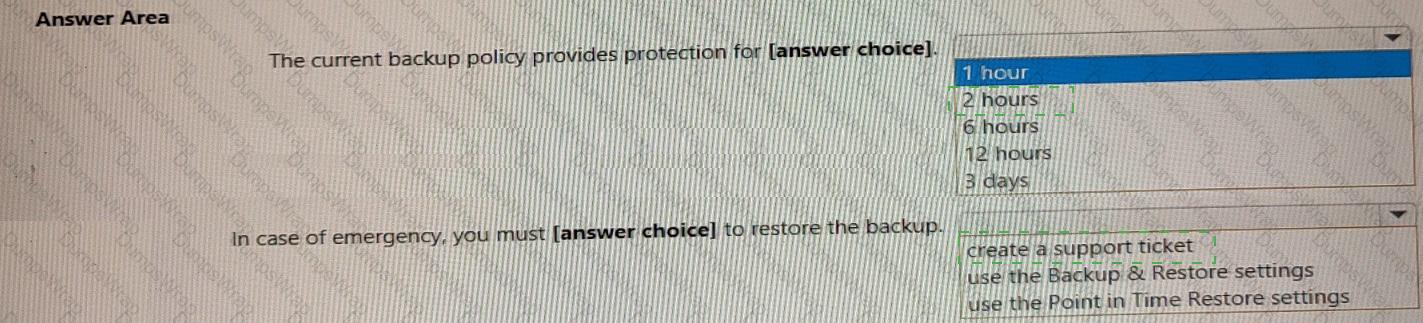
You configure a backup for an Azure Cosmos DB for NoSQL account as shown in the following exhibit.
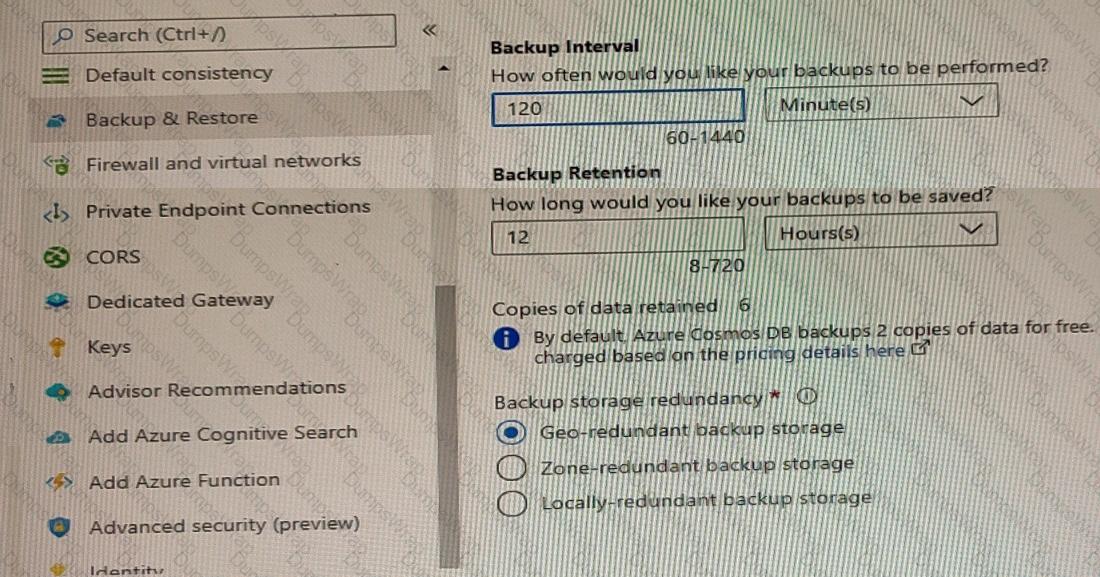
Use the drop-down menus to select the answer choice that completes each statement based on the information presented in the graphic.
NOTE: Each correct selection is worth one point.
Note: This question is part of a series of questions that present the same scenario. Each question in the series contains a unique solution that might meet the stated goals. Some question sets might have more than one correct solution, while others might not have a correct solution.
After you answer a question in this section, you will NOT be able to return to it. As a result, these questions will not appear in the review screen.
You have a container named container! in an Azure Cosmos DB for NoSQL account.
You need to make the contents of container1 available as reference data for an Azure Stream Analytics job.
Solution: You create an Azure function that uses the Azure Cosmos 08 for NoSQL change feed as a trigger and an Azure event hub as the output.
Does this meet the goal?
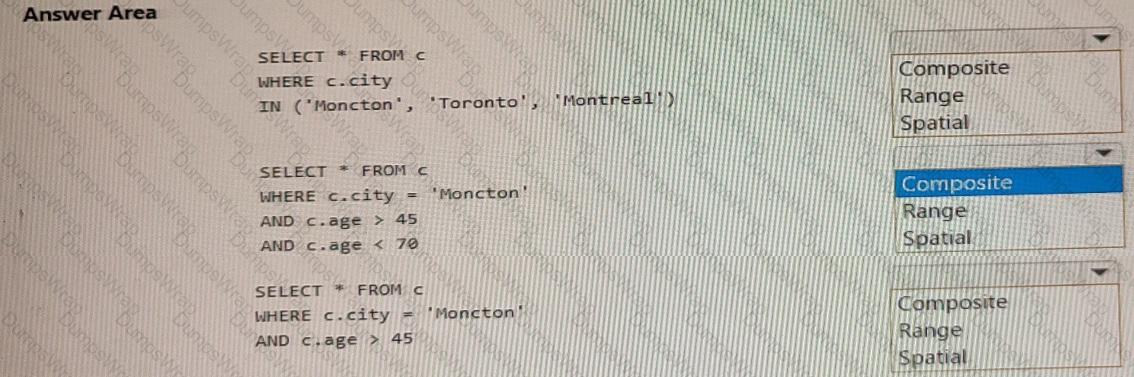
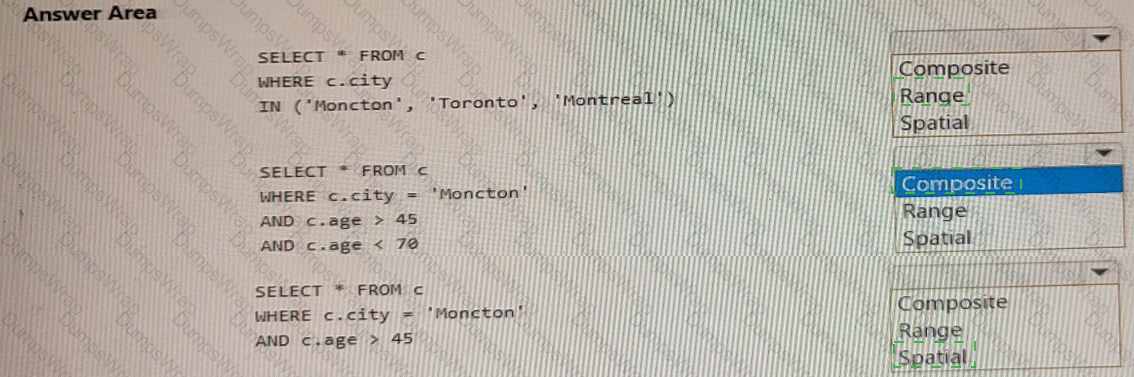
You have an Azure Cosmos DB for NoSQL account that frequently receives the same three queries.
You need to configure indexing to minimize RUs consumed by the queries.
Which type of index should you use for each query? To answer, select the appropriate options in the answer area.
NOTE: Each correct selection is worth one point.
Note: This question is part of a series of questions that present the same scenario. Each question in the series contains a unique solution that might meet the stated goals. Some question sets might have more than one correct solution, while others might not have a correct solution.
After you answer a question in this section, you will NOT be able to return to it. As a result, these questions will not appear in the review screen.
You have an Azure Cosmos DB Core (SQL) API account named account 1 that uses autoscale throughput.
You need to run an Azure function when the normalized request units per second for a container in account1 exceeds a specific value.
Solution: You configure an Azure Monitor alert to trigger the function.
Does this meet the goal?
You have an Azure Cosmos DB for NoSQL account that contains a database named DB1 and a container named Container1. You need to manage the account by using the Azure Cosmos DB SDK. What should you do?
You have an Azure Cosmos DB for NoSQL account that contains a database named DB1. Users run the following query against DB1.
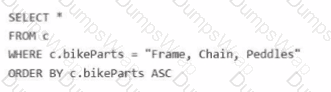
You add an index to the recordset.
You need to change the ORDER by syntax of the query to optimize the use of the index. The solution must NOT change the result set.
Which syntax should you use?
Which syntax should you use?
You have an Azure subscription that contains an Azure Cosmos DB for NoSQL account named account1.
For account 1, you plan to implement an integrated gateway that will use the D4s SKU.
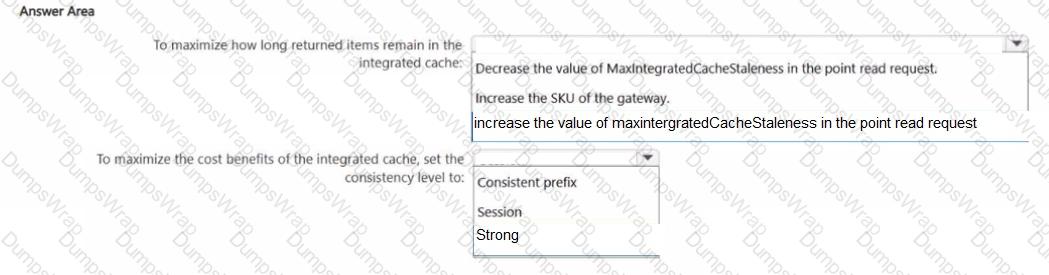
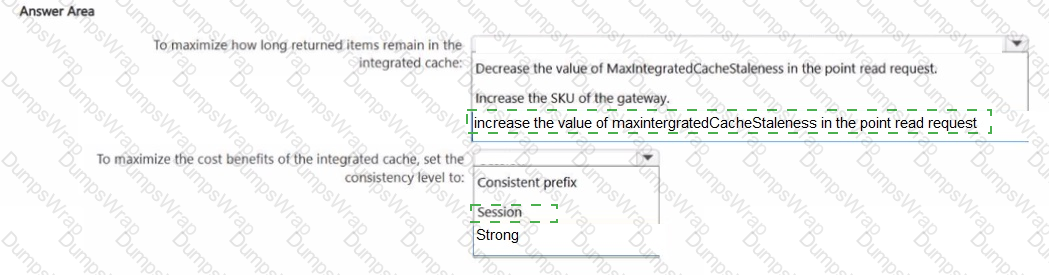
You need to optimize integrated gateway performance for point reads from account1. The solution must meet the following requirements:
• For new point reads, maximize how long returned items remain in the integrated cache.
• For new and repeating point reads, maximize the cost benefits of the integrated cache.
What should you do for each requirement? To answer, select the appropriate options in the answer area.
NOTE: Each correct selection is worth one point.
You plan to create an operational system that will store data in an Azure Cosmos OB ' or NoSQL account. You need to configure the account to meet the following requirements:
• Support Spark queries.
• Support the analysis of data from the last six months.
• Only pay for analytical compute when running queries.
Which three actions should you perform? Each correct answer presents part of the solution. NOTE Each correct selection is worth one point.
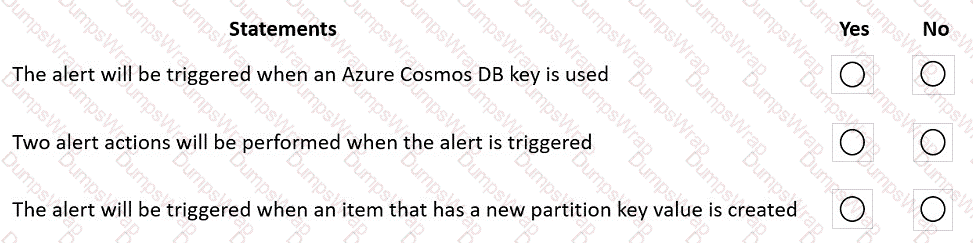
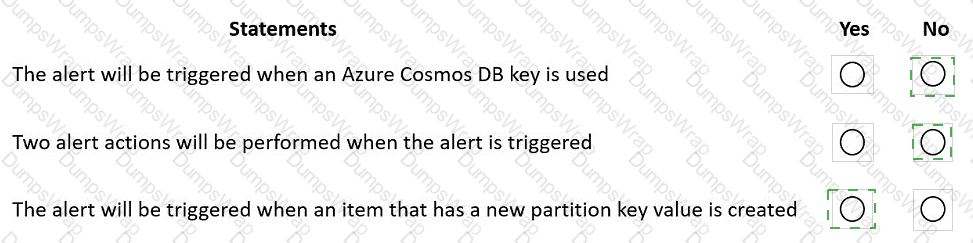
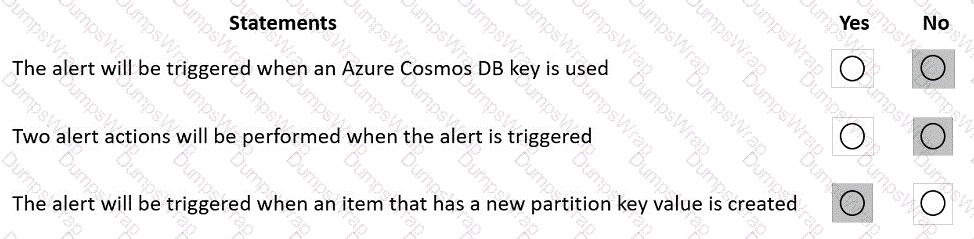
You provision Azure resources by using the following Azure Resource Manager (ARM) template.
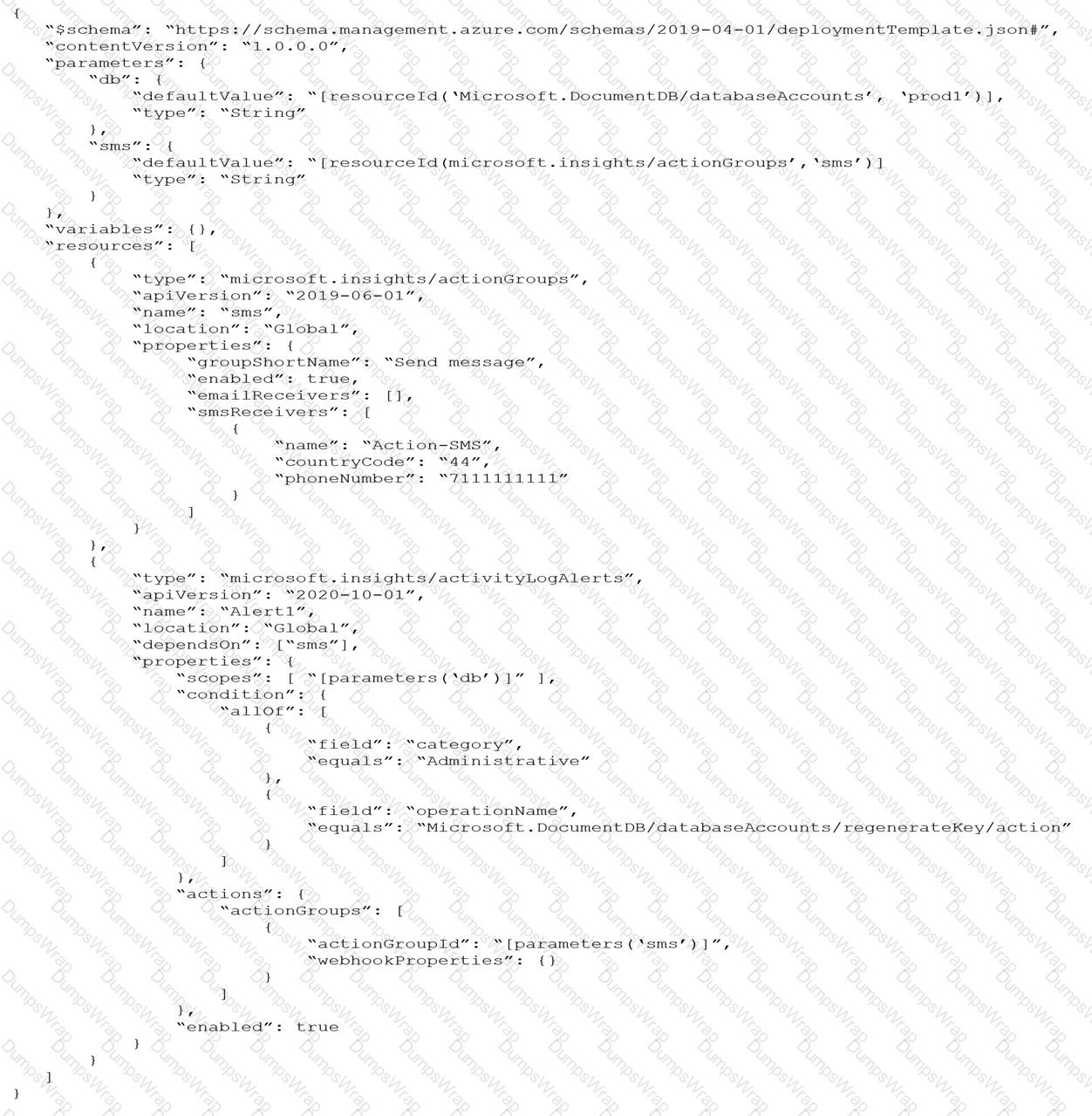
For each of the following statements, select Yes if the statement is true. Otherwise, select No.
NOTE: Each correct selection is worth one point.
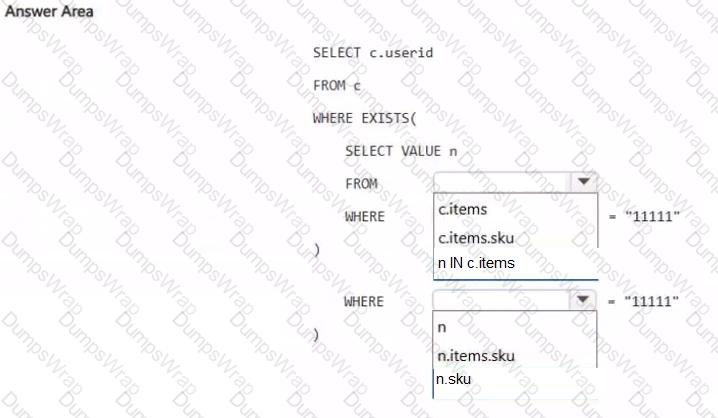
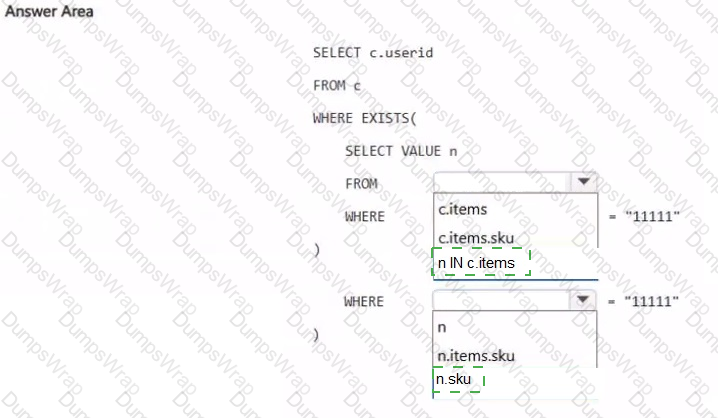
You plan to create an Azure Cosmos DB for NoSQL container that will contain items in the following format.
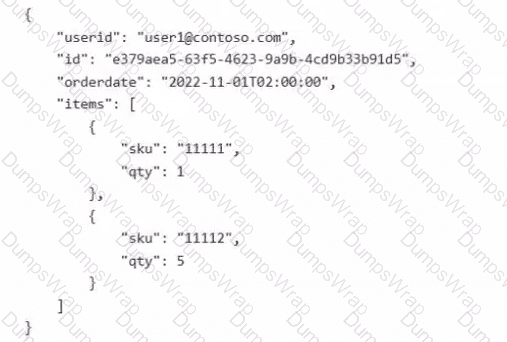
You need to define a query that will return the userid values of all the users who purchased an item that has a sku value of 11111. How should you complete the query? To answer, select the appropriate options in the answer area.
NOTE: Each correct selection is worth one point.