
Payroll Fundamentals 1Exam Questions and Answers
Anthony earns $750.00 per week. He has a cash taxable benefit of $25.00 per week. Anthony is exempt from CPP contributions. Calculate the net taxable income for the week.
The source deductions form completed by all new employees in Quebec is called:
Which of the following types of earnings are not considered income from employment?
Bonus and incentive pays are subject to which statutory deductions?
In Block 6 of the Record of Employment, what pay period type is entered for employees who are paid salary plus regularly paid commission?
Rosa joined Avion Electronics in April 1983. Her employment was terminated on November 30, 2015 and she was paid a $62,500.00 retiring allowance. Rosa joined her company’s pension plan in 1986 and was fully vested on termination of employment. Calculate the non-eligible portion of the retiring allowance.
The authorization for hiring form should contain a checklist to ensure the organization obtains all required information. What is an example of an item that could be on that checklist?
Phan was employed fromMarch 1, 1992throughJanuary 10, 2007. He was not a member of the organization’s pension plan. Calculate the number of years eligible for the$1,500.00portion of a retiring allowance.
The Canada Revenue Agency form that is completed to allow a commissioned employee to claim non-reimbursed expenses at source is a:
Duncan Drapak was employed in Ontario. Upon termination of his employment, he will be paid $7,760.00 legislated wages in lieu of notice together with his final weekly pay of $875.00. Calculate Duncan’s Canada Pension Plan (CPP) contribution if the yearly maximum contribution will not be exceeded.
What information is required to calculate thestandby charge, thereduced standby charge, and theoperating cost benefitfor a company-owned automobile?
What is piecework?
Matt earns $10.10 per hour and works 37.5 hours per week. Calculate Matt’s regular bi-weekly earnings.
Tanya submitted a letter of resignation to her employer on April 2 of the current year advising that she would be resigning her position effective April 27 for the pay period ending April 28. What date will appear in Block 11 of Tanya’s Record of Employment?
Dollar amounts that are paid to an employee to cover expenses that they incurred while performing their job, but are not considered in the calculation of an employee’s earnings are:
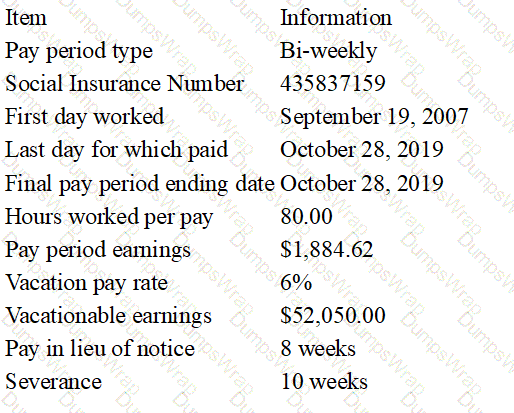
National Hardware, an Ontario organization, will be terminating the employment of Emilie St. Germain on October 28, 2019, the last day of the pay period. Emilie started with National Hardware on September 19, 2007. Complete the paper Record of Employment (ROE) for Emilie based on the information provided in the following chart.
Note: Vacationable earnings already include the pay in lieu of notice.
All dates must be entered in the format DDMMYYYY.
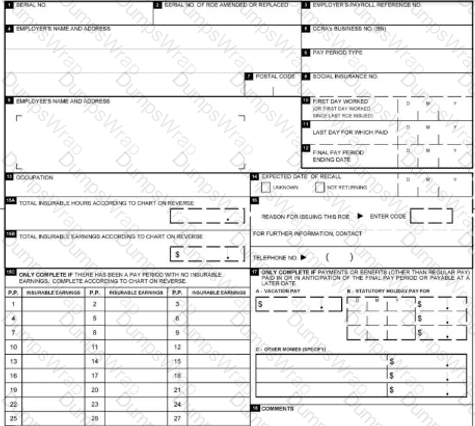
Paper ROE (Form Reference)
Complete the following paper ROE blocks for Emilie:
Block 6 – Pay period type
Block 8 – Social Insurance Number
Block 10 – First day worked
Block 11 – Last day for which paid
Block 12 – Final pay period ending date
Block 15A – Total insurable hours
Block 15B – Total insurable earnings
Block 17A – Vacation pay
Block 17C – Other monies (Pay in lieu of notice)
Block 17C – Other monies (Severance)
Step 1 — Complete Block 6
Enter the pay period type for Emilie.
Step 2 — Complete Block 8
Enter Emilie’s Social Insurance Number.
Step 3 — Complete Block 10
Enter Emilie’s first day worked in DDMMYYYY format.
Step 4 — Complete Block 11
Enter Emilie’s last day for which paid in DDMMYYYY format.
Step 5 — Complete Block 12
Enter the final pay period ending date in DDMMYYYY format.
Step 6 — Complete Block 15A
Calculate and enter total insurable hours.
Given:
Hours worked per pay period = 80.00
Bi-weekly ROE pay period chart captures 27 pay periods
Step 7 — Complete Block 15B
Calculate and enter total insurable earnings.
Given:
Pay period earnings = $1,884.62
Bi-weekly ROE pay period chart captures 27 pay periods
Step 8 — Complete Block 17A
Calculate and enter vacation pay.
Given:
Vacation pay rate = 6%
Vacationable earnings = $52,050.00
(already includes pay in lieu of notice)
Step 9 — Complete Block 17C
Enter the correct amount in 17C for “Other monies” specified as Pay in lieu of notice.
Given:
Pay in lieu of notice = 8 weeks
Use weekly earnings derived from the bi-weekly pay period earnings.
Step 10 — Complete Block 17C
Enter the correct amount in 17C for “Other monies” specified as Severance.
Given:
Severance = 10 weeks
Use the same weekly earnings used in Step 9.
Phillip is being paid a severance payment with his final pay. Which block should this payment be reported on the Record of Employment?
A retiring allowance includes:
A paper Record of Employment must be issued:
The deduction for living in a prescribed zone can be claimed by residents of which jurisdictions?
The capital cost of an employer-owned vehicle includes:
