
Netskope Certified Cloud Security Architect Exam Questions and Answers
Your CISO asks that you to provide a report with a visual representation of the top 10 applications (by number of objects) and their risk score. As the administrator, you decide to use a Sankey visualization in Advanced Analytics to represent the data in an efficient manner.
In this scenario, which two field types are required to produce a Sankey Tile in your report? {Choose two.)
What are three valid Instance Types for supported SaaS applications when using Netskope ' s API-enabled Protection? (Choose three.)
You want to enable the Netskope Client to automatically determine whether it is on-premises or off-premises. Which two options in the Netskope UI would you use to accomplish this task? (Choose two.)
You deployed IPsec tunnels to steer on-premises traffic to Netskope. You are now experiencing problems with an application that had previously been working. In an attempt to solve the issue, you create a Steering Exception in the Netskope tenant tor that application: however, the problems are still occurring
Which statement is correct in this scenario?
You are configuring Administrator SSO using SAML 2.0 with roles based on group membership. In this scenario, how is the administrator group passed from the IdP within the SAML assertion to Netskope?
Your company uses Microsoft 365 with Conditional Access to ensure that only users on the corporate network can reach OneDrive. You need to ensure that users are able to reach OneDrive while still enforcing real-time DLP policies. Which statement would satisfy these requirements?
Your company just had a new Netskope tenant provisioned and you are asked to create a secure tenant configuration. In this scenario, which two default settings should you change? {Choose two.)
You are deploying the Netskope Client in a multi-user VDI environment and need to determine the command to deploy the MSI.
Which three parameters are required in this scenario? (Choose three.)
Review the exhibit.
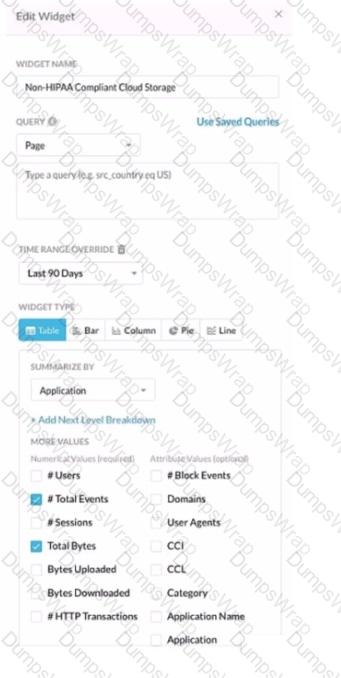
You work for a medical insurance provider. You have Netskope Next Gen Secure Web Gateway deployed to all managed user devices with limited block policies. Your manager asks that you begin blocking Cloud Storage applications that are not HIPAA compliant Prior to implementing this policy, you want to verify that no business or departmental applications would be blocked by this policy.
Referring to the exhibit, which query would you use in the Edit Widget window to narrow down the results?
Review the exhibit.
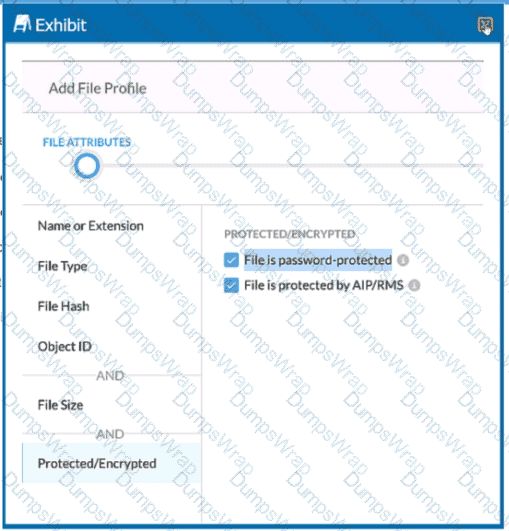
You are attempting to block uploads of password-protected files. You have created the file profile shown in the exhibit.
Where should you add this profile to use in a Real-time Protection policy?
You are consuming Audit Reports as part of a Salesforce API integration. Someone has made a change to a Salesforce account record field that should not have been made and you are asked to verify the previous value of the structured data field. You have the approximate date and time of the change, user information, and the new field value.
How would you accomplish this task?
You want to receive HTTP transaction logs in near real-time. What must you enable in the Netskope tenant to satisfy this requirement?
You deployed the Netskope Client for Web steering in a large enterprise with dynamic steering. The steering configuration includes a bypass rule for an application that is IP restricted. What is the source IP for traffic to this application when the user is on-premises at the enterprise?
You are assisting your network administrator to troubleshoot an issue with client-based NPA.
In the Netskope UI, what information do you need from the administrator to run the NPA troubleshooter for this user? (Choose two.)
You created a Real-time Protection policy that blocks all activities to non-corporate S3 buckets, but determine that the policy is too restrictive. Specifically, users are complaining that normal websites have stopped rendering properly.
How would you solve this problem?
You need to monitor the health of configured IPsec or GRE tunnels.
In this scenario, which two methods are supported by Netskope to accomplish this task? (Choose two.)
You have enabled CASB traffic steering using the Netskope Client, but have not yet enabled a Real-time Protection policy. What is the default behavior of the traffic in this scenario?
You are the network architect for a company using Netskope Private Access. Multiple users are reporting that they are unable to access an application using Netskope Private Access that was working previously. You have verified that the Real-time Protection policy allows access to the application, private applications are steered for the users, and the application is reachable from internal machines. You must verify that the application is reachable through Netskope Publisher
In this scenario, which two tools in the Netskope UI would you use to accomplish this task? (Choose two.)
Your company purchased Netskope ' s Next Gen Secure Web Gateway You are working with your network administrator to create GRE tunnels to send traffic to Netskope Your network administrator has set up the tunnel, keepalives. and a policy-based route on your corporate router to send all HTTP and HTTPS traffic to Netskope. You want to validate that the tunnel is configured correctly and that traffic is flowing.
In this scenario, which two statements are correct? (Choose two.)
You are responsible for data security at a large hospital. You need to protect patient personal data including patient ID numbers, e-mail addresses, billing addresses, and credit card numbers that are stored in your database. You want to reduce false positives because you have limited resources for incident response. Which Netskope DLP capability would you use in this scenario?
Review the exhibit.
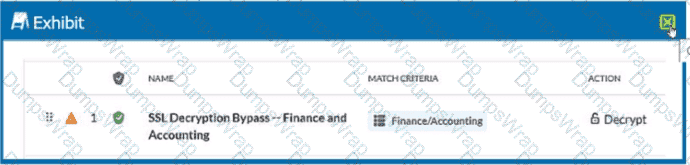
You created an SSL decryption policy to bypass the inspection of financial and accounting Web categories. However, you still see banking websites being inspected.
Referring to the exhibit, what are two possible causes of this behavior? (Choose two.)
A hospital has a patient form that they share with their patients over Gmail. The blank form can be freely shared among anyone. However, if the form has any information filled out. the document is considered confidential.
Which rule type should be used in the DLP profile to match such a document?
Review the exhibit.
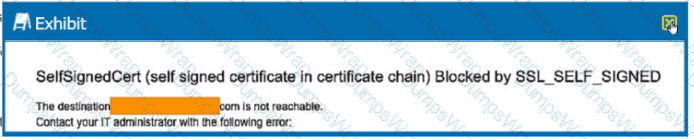
You are the proxy administrator for a medical devices company. You recently changed a pilot group of users from cloud app steering to all Web traffic. Pilot group users have started to report that they receive the error shown in the exhibit when attempting to access the company intranet site that is publicly available. During troubleshooting, you realize that this site uses your company ' s internal certificate authority for SSL certificates.
Which three statements describe ways to solve this issue? (Choose three.)
You have deployed Netskope to all users of the organization and you are now ready to begin ingesting all events, alerts, and Web transactions into your SIEM as a part of your requirements.
What are three ways in which you would accomplish this task? (Choose three.)
