
Nokia SR Linux EVPN and Data Center Interconnect Questions and Answers
Consider the exhibit.
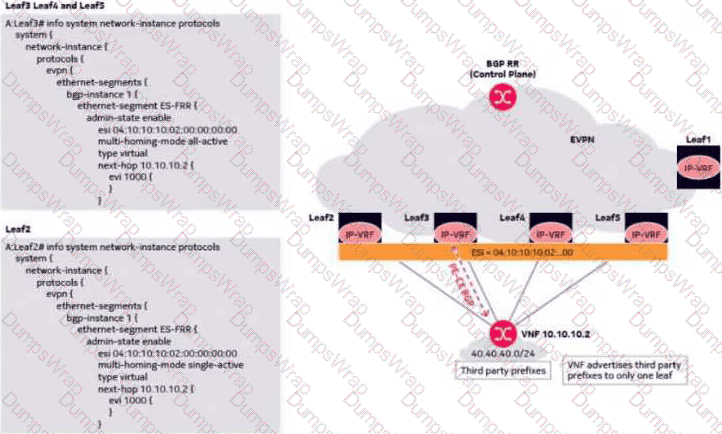
All IP-VRFs are configured properly and are operational.
Which of the following statements is FALSE?
Options:
One of the leaf routers will be elected DF.
All connected leaf routers will use single active redundancy.
The AD per EVI update will be used to identify which connected leaf is primary.
All traffic destined to 40.40.40.0/24 will be forwarded through Leaf3 due to the BGP connection to the CE VNF.
Answer:
BExplanation:
Comprehensive and Detailed 150 to 250 words of Explanation From [SR Linux EVPN and Data Center Interconnect/Course Guide/topics]:
The scenario describes Layer 3 EVPN multi-homing with an IP-VRF service and an external CE VNF advertising the 40.40.40.0/24 prefix through BGP. A DF election can occur among the leaf routers participating in the Ethernet Segment, and the active/primary forwarding node is used for the relevant service behavior. The AD per EVI route can participate in identifying service-level reachability for the Ethernet Segment, and the prefix traffic follows the valid advertised path toward the CE VNF. Because Leaf3 has the BGP connection to the CE VNF, traffic for 40.40.40.0/24 is forwarded through Leaf3. Option B is false because it incorrectly states that all connected leaf routers will use single-active redundancy. The exhibit and answer context indicate a more specific forwarding/primary selection for the service, not a blanket statement that every connected leaf operates using single-active redundancy. In L3 multi-homing, redundancy behavior depends on the ES mode, prefix advertisement, next-hop association, and CE connectivity. The forwarding decision for the customer prefix is tied to the active/valid route advertisement, not to every leaf uniformly acting as single-active. Reference: L3 EVPN multi-homing, DF election, AD per EVI role, PE-CE BGP prefix forwarding.
================
A host is connected to multiple PEs through multi-homing.
Which of the following is NOT a function of the EVPN route-type 4 route?
Options:
Allows the other PEs to discover which PEs are connected to the same Ethernet segment.
Triggers the election of a designated forwarder.
Identifies the type of algorithm to be used in the election process.
Identifies the redundancy mode of the Ethernet segment.
Answer:
CExplanation:
Comprehensive and Detailed 150 to 250 words of Explanation From [SR Linux EVPN and Data Center Interconnect/Course Guide/topics]:
EVPN route type 4 is the Ethernet Segment route. Its core role is to advertise Ethernet Segment membership so that PEs attached to the same multi-homed segment can discover each other. This discovery is essential for multi-homing procedures such as DF election, split-horizon behavior, and redundancy handling. When multiple PEs advertise the same ESI, the EVPN control plane can build the candidate set of PEs that participate in that Ethernet Segment. This enables DF election for BUM forwarding and supports the correct interpretation of the segment's redundancy model. The incorrect statement is option C. The election algorithm itself is not the basic function of the route type 4 advertisement in the way the question frames it. The route type is primarily about Ethernet Segment discovery and participation; the algorithmic decision process is derived from configured DF election behavior and candidate information, not from route type 4 acting as a generic algorithm identifier. Therefore, route type 4 enables DF procedures, but it is not described as the mechanism that identifies the election algorithm type. Reference: EVPN RT-4 Ethernet Segment route, DF election, multi-homing discovery.
================
Which of the following statements does NOT describe the functionality or operation of the integrated gateway-based data center interconnect solution?
Options:
The data center gateway and the WAN PE functions are performed on a single router.
The border leaf router will utilize eBGP or static routes to interconnect with the gateway.
The data center gateway needs to provide interworking between the VXLAN and the WAN tunneling protocol.
The data center gateway needs to be able to re-advertise Layer 3 EVPN routes of the leaf routers into VPN-IPv4 or VPN-IPv6 routes if required.
Answer:
BExplanation:
Comprehensive and Detailed 150 to 250 words of Explanation From [SR Linux EVPN and Data Center Interconnect/Course Guide/topics]:
In an integrated gateway-based DCI solution, the data center gateway and WAN PE functions reside on the same router. This device acts as the interworking point between the data center EVPN/VXLAN environment and the WAN transport service. It may need to translate or interwork between VXLAN encapsulation in the data center and MPLS or another WAN tunneling protocol in the WAN. For Layer 3 services, the integrated gateway may also re-advertise EVPN routes learned from the data center fabric into VPN-IPv4 or VPN-IPv6 routes for transport across the WAN. Option B does not describe the integrated gateway model. A border leaf using eBGP or static routes to interconnect with a gateway is a decoupled gateway-based design, where the data center border leaf and WAN PE/gateway are separate devices with a routing handoff between them. In the integrated model, that border-leaf-to-separate-gateway handoff is not the defining architecture because the gateway and WAN PE roles are combined on one router. Reference: integrated gateway DCI, VXLAN-to-WAN interworking, EVPN to VPN-IPv4/VPN-IPv6 re-advertisement, decoupled gateway distinction.
================
Leaf routers are configured to support Layer 2 multi-homing all-active mode.
Which of the following statements is FALSE?
Options:
A LAG must be configured on the participating leaf routers.
If VLAN tagging is to be used, then it must be enabled on the LAG interface.
If using LACP, the system-id-mac must uniquely identify each leaf router connected to the host.
The LAG interface must then be associated with the Ethernet segment.
Answer:
CExplanation:
Comprehensive and Detailed 150 to 250 words of Explanation From [SR Linux EVPN and Data Center Interconnect/Course Guide/topics]:
In all-active Layer 2 EVPN multi-homing, the host is typically dual-homed to two or more leaf routers using a LAG. The participating leaf routers must configure the LAG and associate it with the Ethernet Segment so EVPN can advertise the common ESI and apply aliasing, split-horizon, and DF procedures. If VLAN tagging is used for service separation, tagging must be configured on the LAG interface so that the correct subinterfaces can bind into the MAC-VRF and Ethernet Segment. Option C is false because it states that the LACP system-id-mac must uniquely identify each leaf router. In an all-active EVPN multihomed LAG, the opposite principle applies: from the host's LACP perspective, the multihomed leaf pair must appear as a single logical LACP system. That generally requires a shared LACP system ID or coordinated system MAC behavior across the participating PEs. If each leaf presented a unique LACP system identity, the host would treat them as separate LAG partners and the all-active bundle would not form correctly. Reference: all-active L2 EVPN multi-homing, LAG attachment, LACP system ID behavior, Ethernet Segment association.
================
Consider the exhibit.
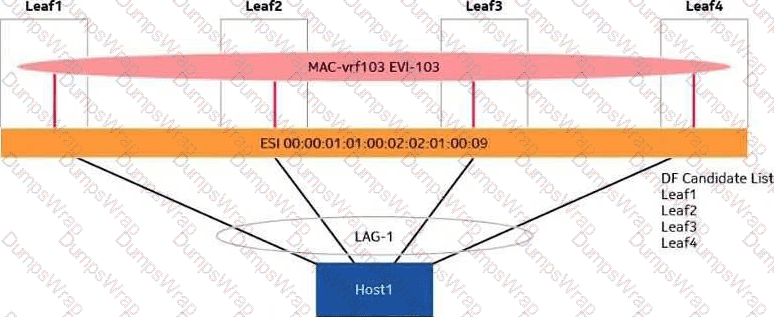
Leaf1 and Leaf2 have the Ethernet segment configured to use the default election algorithm while Leaf3 and Leaf4 are configured to use the preference-based algorithm with Leaf3 having the higher preference value. The DF candidate list is the same on all leaf routers.
Which of the following leafs is the DF for mac-vrf103?
Options:
Leaf1
Leaf2
Leaf3
Leaf4
Answer:
CExplanation:
Comprehensive and Detailed 150 to 250 words of Explanation From [SR Linux EVPN and Data Center Interconnect/Course Guide/topics]:
Designated Forwarder election determines which PE forwards BUM traffic from the EVPN overlay toward a multi-homed Ethernet Segment for a given service. In this scenario, all leaf routers share the same DF candidate list for mac-vrf103, but the election configuration is not identical. Leaf1 and Leaf2 use the default algorithm, while Leaf3 and Leaf4 use the preference-based algorithm. Under preference-based DF election, the candidate with the highest configured preference is selected over lower-preference candidates, assuming the candidate list is valid and consistent. The question states that Leaf3 has the higher preference value compared with Leaf4. Therefore, Leaf3 becomes the DF for mac-vrf103. This is the correct outcome because the preference-based election explicitly overrides simple default behavior by assigning operator-defined priority to a PE. In production designs, this is useful when the operator wants deterministic forwarding placement, maintenance control, or service-specific primary-path selection rather than relying only on the default modulo-based DF selection process. Reference: EVPN DF election, preference-based algorithm, MAC-VRF service forwarding.
================
Consider the exhibit.
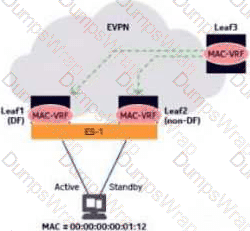
Which of the following statements about the configuration and operation of this setup is FALSE?
Options:
The Ethernet segment ES-1 is configured as single active.
The ports that connect to the host are associated to ES-1.
All traffic to and from the host will flow through Leaf1.
The host will be required to be configured with a LAG.
Answer:
DExplanation:
Comprehensive and Detailed 150 to 250 words of Explanation From [SR Linux EVPN and Data Center Interconnect/Course Guide/topics]:
This setup represents single-active Layer 2 EVPN multi-homing. In single-active mode, the Ethernet Segment is configured so that only one PE acts as the active forwarding node for a given service, while the other remains standby. The ports connecting to the host are associated with ES-1 so the EVPN control plane can perform Ethernet Segment discovery, DF election, and standby behavior. If Leaf1 is the active/DF node for the service, all traffic to and from the host flows through Leaf1 until a failure or DF transition occurs. Option D is false because a host LAG is not required for this single-active topology. A LAG is typically required for all-active L2 multi-homing, where the host must treat multiple physical links toward different leaf routers as one logical bundle. In single-active operation, the host can be connected through separate physical links or active/standby access behavior without requiring LACP bundling. The EVPN PEs enforce the active path selection through DF and ES state rather than relying on host-side LAG hashing. Reference: single-active EVPN multi-homing, Ethernet Segment port association, DF-controlled active forwarding.
================
Consider the exhibit.

Which of the following is NOT configured on dcgw10 to support the Layer 3 VPN connectivity?
Options:
The base BGP instance to support vpn-ipv4 and evpn address families.
A routed VXLAN interface for the VPRN instance.
A binding of the VPRN instance to the MPLS tunnels towards dcgw20.
A vrf-target matching the vrf-target on dcgw20 in the VPRN instance.
Answer:
BExplanation:
Comprehensive and Detailed 150 to 250 words of Explanation From [SR Linux EVPN and Data Center Interconnect/Course Guide/topics] :
In an integrated gateway-based data center interconnect design, the gateway must interwork between the data center EVPN/VXLAN domain and the WAN VPN transport domain. For Layer 3 VPN connectivity on a Nokia 7750 SR integrated gateway, the base BGP instance must support the relevant VPN address families, such as VPN-IPv4 and EVPN, because the gateway participates in control-plane exchange between the data center and WAN sides. The VPRN must also be associated with the WAN transport, normally through MPLS tunnel binding, and the VRF target must match the corresponding VPRN on the remote gateway so that VPN routes are imported and exported correctly. A routed VXLAN interface, however, is an SR Linux IP-VRF/VXLAN construct used for symmetric L3 EVPN forwarding inside a VXLAN-based data center fabric. In this question, dcgw10 is acting as the integrated WAN gateway for L3VPN connectivity, so a routed VXLAN interface is not the required configuration item on the VPRN instance. Reference: integrated gateway DCI, VPRN over MPLS, EVPN-to-VPN interworking.
================
Consider the exhibit.
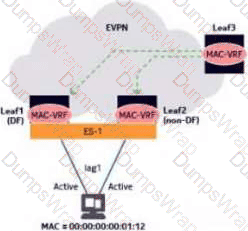
Which of the following statements about the configuration and operation of this setup is FALSE?
Options:
A sub-interface of lag1 is associated to the MAC-VRF on Leaf1 and Leaf2.
The Ethernet segment ES-1 is configured with multi-homing-mode all-active.
The MAC-VRF on Leaf3 will need to be configured with ECMP to be able to load balance between Leaf1 and Leaf2.
The host will forward all BUM traffic toward the DF.
Answer:
DExplanation:
Comprehensive and Detailed 150 to 250 words of Explanation From [SR Linux EVPN and Data Center Interconnect/Course Guide/topics]:
This scenario describes all-active Layer 2 EVPN multi-homing with a host connected through a LAG to Leaf1 and Leaf2. The LAG subinterface is associated with the MAC-VRF on both participating leaves, and the Ethernet Segment ES-1 is configured for all-active multi-homing. In all-active operation, both leaf routers can be active attachment points for host-originated traffic, and remote traffic can use EVPN multi-homing mechanisms to reach the segment. Option D is false because the host does not know or use the EVPN Designated Forwarder state when sending BUM traffic. The host forwards over its LAG based on its local LAG hashing and LACP behavior. DF election is an EVPN PE-side mechanism used mainly to control which PE forwards BUM traffic from the EVPN overlay toward the Ethernet Segment, preventing duplicate delivery to the multihomed access network. The host itself does not selectively forward all BUM traffic toward the DF. That distinction is critical: DF controls overlay-to-segment replication, while the host's LAG controls host-to-leaf link selection. Reference: all-active L2 EVPN multi-homing, host LAG behavior, DF election scope, BUM forwarding.
================
Consider the exhibit.
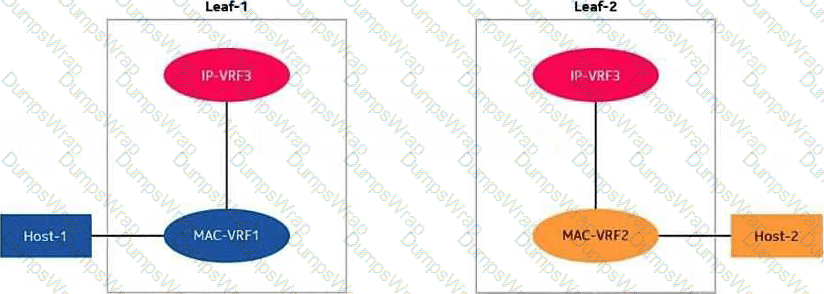
The network is going to be designed to use interface-less symmetric routing.
Which of the following statements is TRUE?
Options:
An instance of each mac-vrf is required on each leaf.
The ingress PE will perform layer 2 and layer 3 lookups while the egress PE will perform layer 2 lookup.
The IRB configuration does not require anycast gateway configuration on the ip-vrf.
Forwarding information will be exchanged between the PEs using EVPN route-type 2 updates.
Answer:
DExplanation:
Comprehensive and Detailed 150 to 250 words of Explanation From [SR Linux EVPN and Data Center Interconnect/Course Guide/topics]:
In interface-less symmetric routing, the EVPN fabric exchanges host forwarding information using EVPN route type 2 MAC/IP advertisements. RT-2 carries the host MAC address and, when present, the associated host IP address, allowing remote PEs to build the forwarding state needed for distributed gateway operation. Unlike asymmetric routing, interface-less symmetric routing does not require every MAC-VRF to be instantiated on every PE. The design scales better because each leaf only needs the locally attached MAC-VRFs plus the shared IP-VRF/routed VXLAN construct for inter-subnet forwarding. Option B describes an asymmetric forwarding pattern more than a symmetric one; in symmetric routing, both ingress and egress PEs perform routed forwarding functions through the IP-VRF. Option C is also incorrect because anycast gateway is fundamental when multiple leaves provide the same default-gateway service for a subnet. Therefore, the true statement is that forwarding information is exchanged using EVPN route type 2 updates. Reference: interface-less symmetric routing, EVPN RT-2 host MAC/IP signaling, distributed IRB operation.
================
Consider the exhibit.
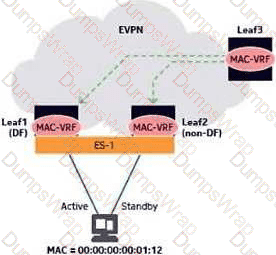
Which of the following statements about the configuration and operation of this setup is TRUE?
Options:
The MAC-VRF on Leaf1 and Leaf2 is configured with multi-homing-mode all-active.
The MAC-VRF on Leaf3 will need to be configured with ECMP to be able to load balance between Leaf1 and Leaf2.
The host will be required to be configured with a LAG.
The Ethernet segment ES-1 will be associated to the ports that connect to the host.
Answer:
DExplanation:
Comprehensive and Detailed 150 to 250 words of Explanation From [SR Linux EVPN and Data Center Interconnect/Course Guide/topics]:
This setup represents a Layer 2 EVPN multi-homing attachment where the host is connected to Leaf1 and Leaf2 through an Ethernet Segment named ES-1. In SR Linux EVPN multi-homing, the Ethernet Segment must be associated with the physical or logical attachment interfaces facing the host. This allows the PEs to advertise Ethernet Segment information into EVPN, participate in DF election, and apply the appropriate forwarding behavior for single-active or all-active redundancy. Option D is therefore correct. Option A is not necessarily true because the exhibit indicates an active/standby style attachment, not all-active operation. Option B is also incorrect because ECMP on the remote MAC-VRF is not the mechanism that defines the local ES association or single-active behavior. Option C is wrong in this setup because a host LAG is required for common all-active L2 multi-homing with LACP, but the shown design uses an active/standby-style attachment where the Ethernet Segment is bound to the host-facing ports. The technical anchor is that ES-1 must be associated to the access ports connecting the host into the multi-homed MAC-VRF service. Reference: L2 EVPN multi-homing, Ethernet Segment interface association, DF behavior.
================
Consider the exhibit.
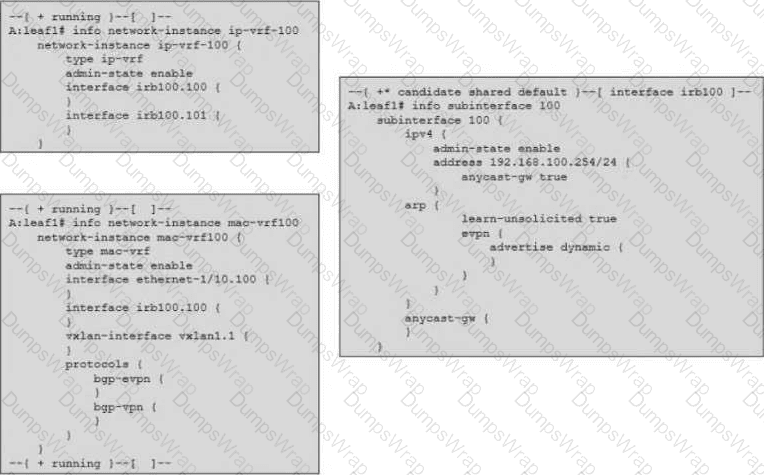
Based upon the information in the screen captures, which of the following statements is FALSE?
Options:
Leaf-1 will not generate any EVPN route-type 5 updates for IP-VRF-100.
The IRB interface will snoop all ARP and GARP messages received on IRB sub-interface 100.100.
Leaf-1 will advertise EVPN route-type 2 updates with host IP and MAC information for MAC-VRF100.
The ARP cache for ip-vrf 100 is only required to contain host prefixes for the local subnets.
Answer:
BExplanation:
Comprehensive and Detailed 150 to 250 words of Explanation From [SR Linux EVPN and Data Center Interconnect/Course Guide/topics]:
The exhibit describes an EVPN IRB environment where MAC-VRF100 and IP-VRF-100 exchange host reachability through local learning and EVPN advertisements. Leaf-1 can advertise EVPN route type 2 updates containing host MAC/IP information for MAC-VRF100. This is the normal mechanism used to distribute endpoint bindings learned from local hosts. If IP-VRF-100 is not configured for prefix advertisement, Leaf-1 will not generate EVPN route type 5 updates for that IP-VRF, so option A is consistent. The ARP cache in the IP-VRF is normally required for local subnet host resolution; remote host reachability can be learned through EVPN rather than requiring every remote ARP entry to be learned by local data-plane ARP. Option B is false because ARP/GARP snooping is not performed by the IRB interface in the manner stated. ARP/GARP learning for proxy ARP and MAC/IP advertisement is associated with the MAC-VRF bridge-domain behavior and the local access side, not with the IRB subinterface indiscriminately snooping all ARP/GARP messages as described. Reference: EVPN IRB operation, RT-2 host MAC/IP advertisement, RT-5 behavior, ARP/GARP learning scope.
================
Consider the exhibit.
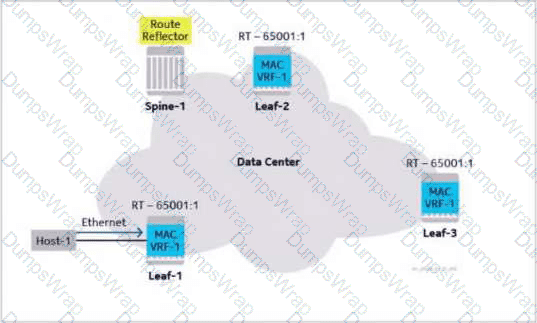
All three of the leafs have a MP-BGP EVPN session to the route-reflector Spine-1. Leaf-1, Leaf-2 and Leaf-3 have existing instances of an L2 EVPN named MAC VRF-1. Host-1 has just sent its first Ethernet frame into MAC VRF-1 on Leaf-1.
Which of the following steps is FALSE?
Options:
Leaf-1 populates Host-1's MAC address learnt on the local interface to its MAC table.
Leaf-1 generates an EVPN route-type 5 update with Host-1's MAC address and sends it to the route reflector.
The route-reflector forwards the EVPN update to Leaf-2 and Leaf-3.
Leaf-2 and Leaf-3 import the EVPN update based upon the route target.
Answer:
BExplanation:
Comprehensive and Detailed 150 to 250 words of Explanation From [SR Linux EVPN and Data Center Interconnect/Course Guide/topics]:
When Host-1 sends its first Ethernet frame into MAC VRF-1, Leaf-1 performs normal local data-plane MAC learning on the access interface and installs Host-1's MAC address into the MAC forwarding table. In an L2 EVPN MAC-VRF, host MAC reachability is then advertised into the EVPN control plane using EVPN route type 2, the MAC/IP Advertisement route. Route type 5 is not used for host MAC advertisement; RT-5 is used for IP prefix advertisement in Layer 3 EVPN services. Therefore, option B is false because it incorrectly states that Leaf-1 generates an EVPN RT-5 update with the host MAC address. In this topology, Leaf-1 sends the correct EVPN update to the route reflector, Spine-1. The route reflector then reflects the update to Leaf-2 and Leaf-3, and those remote leaves import the route if the route target matches their MAC VRF-1 import policy. The route target controls service membership, ensuring that only PEs participating in the same EVPN instance import the MAC route. Reference: L2 EVPN MAC learning, RT-2 MAC/IP advertisement, route-reflector distribution, route-target import.
================
Which of the following statements about an integrated routing and bridging (IRB) interface is FALSE?
Options:
An IRB interface is used to logically interconnect a MAC-VRF to an IP-VRF on a PE.
IP-VRFs and MAC-VRFs can have multiple IRB interfaces.
The IRB sub-interface must have at least one IP address.
The IRB sub-interfaces can be configured with access control lists.
Answer:
BExplanation:
Comprehensive and Detailed 150 to 250 words of Explanation From [SR Linux EVPN and Data Center Interconnect/Course Guide/topics]:
An IRB interface provides the logical L3 gateway function between a Layer 2 MAC-VRF and a Layer 3 IP-VRF on the same PE. It allows locally bridged hosts to route into the tenant IP-VRF while preserving EVPN control-plane signaling for MAC/IP reachability. The IRB subinterface must have at least one IP address because it acts as the routed gateway for the subnet, and it may also be configured with ACLs to apply traffic policy at the L3 boundary. Option B is false because it incorrectly generalizes the IRB relationship. In SR Linux EVPN service modeling, an IRB subinterface connects a MAC-VRF to an IP-VRF in a controlled one-to-one service attachment context; the design is not that both IP-VRFs and MAC-VRFs arbitrarily contain multiple IRB interfaces for the same relationship. A MAC-VRF has its IRB gateway association into the IP-VRF, and the IP-VRF may connect to multiple MAC-VRFs through distinct IRB contexts, but the statement as written is not the correct rule for IRB interface behavior. Reference: SR Linux IRB interface operation, MAC-VRF/IP-VRF interconnection, gateway IP and ACL support.
================
Which of the following is NOT part of the description of a BGP route-distinguisher?
Options:
The route-distinguisher is a unique identifier that is configured per PE and per EVI.
It is included in each EVPN route update advertisement.
It is used by MP-BGP to allow for overlapping addresses from multiple tenants.
It identifies the EVPN instance in the control plane.
Answer:
DExplanation:
Comprehensive and Detailed 150 to 250 words of Explanation From [SR Linux EVPN and Data Center Interconnect/Course Guide/topics]:
A route distinguisher is used in MP-BGP VPN and EVPN address families to make otherwise overlapping tenant routes unique in the BGP control plane. In EVPN, different tenants or EVPN instances may legitimately use the same MAC or IP values. The route distinguisher makes the NLRI globally unique by prepending a unique value to the tenant route. It is typically unique per PE and per EVI, and it is carried in EVPN route advertisements. However, the route distinguisher does not control route import, export, or service membership. That role belongs to the route target, which is a BGP extended community used by receiving PEs to decide which EVPN instance should import the route. Therefore, option D is not part of the correct description of a route distinguisher. Saying that the RD identifies the EVPN instance in the control plane confuses RD uniqueness with route-target membership. The RD makes routes unique; the route target associates those routes with the appropriate MAC-VRF or IP-VRF import policy. Reference: EVPN route distinguisher, overlapping tenant addresses, route target separation.
================
Which of the following statements about a distributed Layer 2 EVPN is FALSE?
Options:
When a host connected to a Layer 2 EVPN responds to an ARP request, it sends an ARP reply to the local leaf.
The local leaf replicates the ARP reply and sends it to all the leafs in the flooding list for that Layer 2 EVPN.
The local leaf learns the source MAC address from the Ethernet frame and populates it into its MAC forwarding table.
The local leaf generates an EVPN route type 2 and sends it to all of its configured BGP EVPN neighbors.
Answer:
BExplanation:
Comprehensive and Detailed 150 to 250 words of Explanation From [SR Linux EVPN and Data Center Interconnect/Course Guide/topics]:
In a distributed Layer 2 EVPN service, the local leaf learns host reachability from frames received on access interfaces. When a host replies to an ARP request, the local leaf can learn the source MAC address from the Ethernet frame and install it in the MAC forwarding table. If the ARP payload contains an IP/MAC binding, the PE can also use that information for proxy ARP and EVPN MAC/IP advertisement. The local PE then advertises the learned endpoint reachability using EVPN route type 2 to its BGP EVPN peers or route reflector. The false statement is B. The ARP reply is not replicated to every leaf in the flooding list as a normal operation. EVPN's purpose is to reduce unnecessary flooding by distributing endpoint reachability through the control plane. BUM replication is used for broadcast, unknown unicast, and multicast traffic when needed, but a learned ARP reply does not require blind replication to all remote leaves. Instead, the leaf advertises the learned MAC/IP state through MP-BGP EVPN, allowing remote PEs to install accurate forwarding and proxy ARP state. Reference: distributed L2 EVPN operation, ARP learning, EVPN RT-2 advertisement.
================
A host is connected to a MAC-VRF on leaf1 and leaf2. The MAC-VRF interfaces on leaf1 and leaf2 are associated to an Ethernet segment configured for active-standby multi-homing.
Which of the following statements is FALSE?
Options:
Leaf1 and leaf2 will hold an election to identify which leaf router will be the DF for the MAC-VRF.
Only the DF will accept traffic from the host.
The DF will forward all BUM traffic from the remote PEs to the host.
The non-DF is capable of forwarding unicast traffic from the remote PEs to the host.
Answer:
DExplanation:
Comprehensive and Detailed 150 to 250 words of Explanation From [SR Linux EVPN and Data Center Interconnect/Course Guide/topics]:
In active-standby, or single-active, Layer 2 EVPN multi-homing, only one PE is active for the Ethernet Segment and MAC-VRF at a time. Leaf1 and Leaf2 participate in DF election, and the elected DF becomes the active forwarding PE for that service attachment. Because this is not all-active multi-homing, the non-DF must not forward traffic to the host for the protected service. This prevents duplicate frames, incorrect MAC learning, and loops on the access side. The DF accepts traffic from the host and forwards BUM traffic received from remote PEs toward the host-facing segment. Option D is false because it claims that the non-DF can forward unicast traffic from remote PEs to the host. In single-active operation, remote peers must direct traffic to the active PE, and the standby PE remains ready to take over only after DF state changes. This is the operational distinction from all-active multi-homing, where more than one PE may be used for forwarding depending on the traffic type and aliasing behavior. Reference: single-active L2 EVPN multi-homing, DF role, non-DF forwarding suppression.
================
