Pre-Summer Sale Discount Flat 70% Offer - Ends in 0d 00h 00m 00s - Coupon code: 70diswrap

Nutanix NCP-BC-7.5 Dumps

Page: 1 / 11
Total 109 questions

Nutanix Certified Professional - Business Continuity (NCP-BC) 7.5 Questions and Answers

Question 1

An administrator notices that the link between the source and destination clusters gets overutilized during recovery point replication. The company secured a new 10G connection between the two clusters.

What configuration should the administrator use so that the replication traffic uses the new 10G link?

Options:

A.

Configure Flow Rules.

B.

Configure Network Segmentation for DR.

C.

Configure Network Segmentation for Volumes.

D.

Configure Backplane Network.

Question 2

An administrator needs to provide leadership with a report showing the timeframe of each step during Recovery Plan failover testing. How should the administrator produce this report?

Options:

A.

Filter the Events log in Prism Central for Recovery Plan activity.

B.

Review the built-in execution report from the test failover results.

C.

Generate a custom report within Prism Central Intelligent Operations.

D.

Use ncli on a CVM to query Recovery Plan execution history.

Question 3

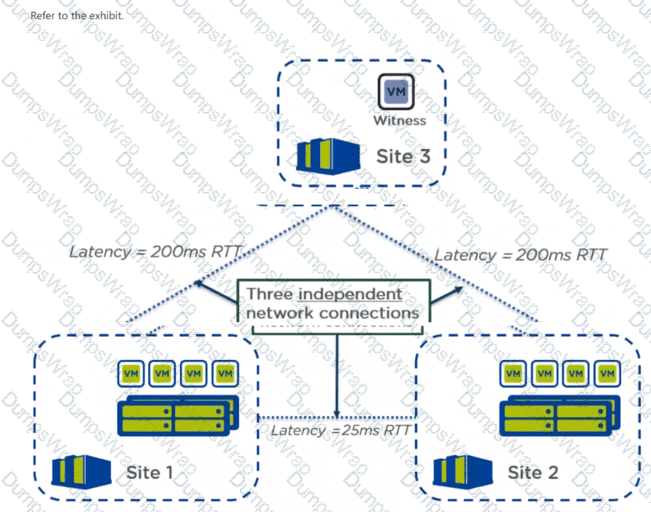
Refer to Exhibit:

as

An administrator is configuring Metro Availability in their environment, as shown in the diagram. What issue in the configuration will prevent Metro from working correctly?

Options:

A.

The Witness VM is located in a third site.

B.

The latency between Site 1 and Site 2 is too high.

C.

Each site should have a Witness VM.

D.

The latency from the Witness VM to both Site 1 and 2 is too high.

Question 4

An administrator is creating a recovery plan between two availability zones. The production VMs use a subnet that does not exist at the recovery AZ. To ensure the VMs can successfully connect after a failover, what must be configured?

Options:

A.

A local-only schedule in the protection policy

B.

A new protection policy with synchronous replication

C.

Network mappings to a valid subnet in the recovery plan

D.

A required matching subnet name at the recovery AZ

Question 5

A third-party backup solution is configured to use Nutanix application-consistent snapshots. Backups are failing for several Windows VMs, although crash-consistent snapshots succeed.

What is the most likely cause of the failure?

Options:

A.

Bandwidth throttling is configured too low.

B.

The protection policy uses asynchronous replication.

C.

Replication traffic encryption is disabled.

D.

NGT is not installed or not communicating.

Question 6

An administrator is planning to deploy some 2-node clusters and is reviewing data protection strategies for some of the critical VMs.

What can be the minimum RPO for these VMs?

Options:

A.

0 minute RPO

B.

1 minute RPO

C.

1 hour RPO

D.

6 hour RPO

Question 7

A mission-critical VM utilizing an NVIDIA vGPU profile for high-end graphical processing is replicated from a primary Nutanix cluster to a secondary disaster recovery site. After failover of a VM using an NVIDIA vGPU profile, the VM boots but hardware acceleration does not function. What action is required?

Options:

A.

Disable Nutanix Guest Tools (NGT) to prevent driver conflicts.

B.

Reinstall the guest operating system to recognize the new hardware ID.

C.

Increase the VM memory allocation to compensate for the lost GPU buffer.

D.

Manually update the vGPU configuration on the VM at the recovery site

Question 8

A remote office deployment consists of a two-node Nutanix hybrid cluster. An administrator attempts to configure a protection domain with a 5-minute RPO (Nearsync) replicating to a central datacenter.

Why is the administrator unable to successfully configure this Nearsync schedule?

Options:

A.

Nearsync replication requires a minimum of three nodes in the cluster.

B.

The minimum RPO supported for a two-node cluster is 15 minutes.

C.

Nearsync is only supported on All-Flash clusters, not hybrid models.

D.

Two-node clusters require a Witness VM to enable Nearsync replication

Question 9

Which ports must remain open to support replication between two Prism Element clusters?

Options:

A.

UDP 500 and UDP 4500

B.

TCP 2009 and TCP 2020

C.

TCP 22 and TCP 3389

D.

TCP 80 and TCP 443

Question 10

While attempting to execute a Commvault backup plan, an administrator received the following error for several VMs: " Virtual Machine not found " . After confirming the VMs exist, the administrator finds the following related error message: " Event Code 91:4 Virtual machine [Nutanix-Web-Server] was not found. Please verify that the virtual machine still exists and that the host is in the connected state. " Which action should the administrator take to enable successful backups?

Options:

A.

Ensure primary and recovery clusters are not registered to the same KMS.

B.

Ensure the VM is created with local Key Management Server (KMS).

C.

Upgrade Nutanix Guest Tools (NGT) on the VM to the latest version.

D.

Ensure Virtual Trusted Platform Module (vTPM) is disabled on the VMs.

Question 11

A Protection Policy is configured with a Nearsync replication schedule (15-minute RPO). An administrator observes that the system has temporarily transitioned to an hourly replication schedule. Which scenario would cause this automatic transition from Nearsync to Asynchronous (hourly) replication?

Options:

A.

The Nutanix Cloud Infrastructure license expired.

B.

The bandwidth is insufficient for the change rate.

C.

A new VM was added to the protection category, triggering a full initial sync.

D.

A Test Failover operation is currently running on the recovery site.

Question 12

An administrator is testing the failover scenarios from a source availability zone (AZ1) to a destination availability zone (AZ2). The administrator successfully performs an unplanned failover from AZ1 to AZ2. The administrator then immediately tries to use the unplanned failover option to fail the VM back to AZ1, but does not see the VM listed under Recovery Plan. What could be the cause?

Options:

A.

Recovery Plan is not bi-directional.

B.

Replication is not yet successful from AZ2 to AZ1.

C.

Clean up of Entities is needed to perform failback.

D.

Unplanned failover cannot be used to failback VMs.

Question 13

How does the system behave if the network cannot sustain the data change rate required to maintain a 1-minute RPO between the primary and recovery AZs?

Options:

A.

The VMs continue to be protected in 1-minute RPO, but write I/O is degraded.

B.

The system automatically switches to Asynchronous replication mode.

C.

The protected VMs are failed over.

D.

All write I/O to the protected VMs is paused.

Question 14

An administrator has VMs in a container named VMData on Cluster A that need to be replicated to Cluster B. In order to configure new replications to Cluster B, the administrator creates a container named VMData on Cluster B with an advertised capacity of 200GB.

The VMs on Cluster A in the VMData container have these characteristics:

    Large VMs taking up 4TB of space

    Low data churn rate

    100GB of recovery points

    NGT is installed

    Recovery points are application-consistent

After replications begin the administrator quickly notices replications are not progressing.

What best explains what happened?

Options:

A.

Low data churn rate of source VMs slows the replication rate to the remote site.

B.

Replications can ' t proceed if there are duplicate container names.

C.

First replication is a full copy of the VMs and the container isn ' t large enough.

D.

Application-consistent snapshots take up double the space on remote clusters.

Question 15

An organization is implementing a Disaster Recovery solution to protect critical workloads by failing them over to a NC2-on-Azure cluster. The administrator needs to ensure that when VMs failover to Azure, their IP addresses are predictable and consistent with the application requirements. Which configuration strategy should the administrator use in the Recovery Plan to achieve predictable IP assignment?

Options:

A.

Rely on the IPAM networks of the NC2 cluster to maintain the IP assignments.

B.

Configure custom IP mapping to assign specific IP addresses to the VMs.

C.

Rely on the default behavior where the last octet of the source IP is preserved.

D.

Configure In-Guest scripts for NGT to maintain the static IP assignments.

Question 16

Which two Data Protection technologies are compatible with Self-Service Restore? (Choose two.)

Options:

A.

Nearsync hourly recovery points

B.

Async replication schedules

C.

Synchronous data replication

D.

Volume Group manual snapshot

Question 17

An administrator is preparing to configure DR between an on-prem AZ and Nutanix Cloud AZ. Replication fails immediately after configuration. Which prerequisite should be verified?

Options:

A.

The clusters are running identical hypervisors.

B.

Both clusters have external IP addresses.

C.

Deduplication is disabled.

D.

Synchronous replication is configured.

Question 18

When designing a Disaster Recovery strategy to an NC2 cluster using MST, which technical limitation impacts the Recovery Plan and workload compatibility?

Options:

A.

The " Zero Compute " configuration requires manual restoration of workloads (automated failover is not supported), and MST currently only protects AHV VMs.

B.

To ensure resilience on NC2, both MST DR and " Cluster Protect " features must be configured simultaneously on the same cluster.

C.

Automated failover is natively supported in the " Zero Compute " configuration but strictly requires configuring an external IPAM to manage and reassign IP addresses.

D.

The " Pilot Light " configuration allows to select multiple on-premise clusters as sources within a single protection policy to automate the failover of AHV and ESXi VMs.

Question 19

Which native Nutanix tool is used to determine connectivity between two sites during disaster recovery testing?

Options:

A.

acli

/B. ccli

B.

ncc

C.

ecli

Question 20

A company ' s two clusters are part of the same availability zone. Prism Central, which holds the protection policy configuration and recovery plans, is located on Cluster A and protected by the Prism Central Backup and Restore mechanism. What is the first step to take to execute a disaster recovery plan on the datacenter hosting Cluster A?

Options:

A.

Restore the Prism Central instance from Prism Element on the surviving cluster.

B.

Deploy a new Prism Central instance on the surviving cluster and register the cluster to it to access the replicated VM snapshots.

C.

Log into Prism Element on the surviving cluster and execute the Recovery Plan.

D.

Access the Prism Central web interface via its Floating IP to trigger the " Unplanned Failover " workflow for the affected VMs.

Question 21

An administrator plans to migrate guest VMs from a legacy Protection Domain–based DR plan to the Prism Central–based Disaster Recovery solution. What should be done first before removing the legacy protection domains?

Options:

A.

Delete all legacy snapshots associated with the Protection Domains.

B.

Migrate the VMs from Protection Domains to Protection Policies.

C.

Recreate recovery plans in Prism Element.

D.

Perform a planned failover to the recovery AZ.

Question 22

Which statement describes the automatic detachment timeout period for a snapshot disk mounted to a VM using the Nutanix Guest Tools (NGT) Self-Service Restore (SSR) feature?

Options:

A.

The snapshot disk will remain attached in read-only mode until the VM is rebooted.

B.

The disk will be automatically detached during the next scheduled Stargate background scan or Curator full scan (typically within 6 hours).

C.

The system enforces a built-in timeout; if the user does not manually detach the disk from the VM, it is detached automatically by the system after 24 hours.

D.

The disk remains permanently attached to the VM until an administrator manually detaches it via Prism.

Question 23

What is the expected outcome that the administrator must manage?

Options:

A.

The primary site will continue to serve I/O locally to prevent downtime, while the secondary site remains in standby.

B.

The secondary site will acquire the lock after a built-in delay, and the primary site will halt all I/O.

C.

The Witness will automatically shut down the secondary site to protect data integrity on the primary site.

D.

Both sites will attempt to acquire the lock, but the primary site will acquire the lock and continue to serve I/O locally to prevent downtime.

Question 24

An administrator is validating a newly created Recovery Plan and receives the following warning:

IP addresses xxx.xxx.xxx.xxx cannot be preserved/mapped for VM REPORTVM01.

IP addresses cannot be preserved/mapped for entities

IP might be already in use or will be used by some other VM for recovery. IP cannot be mapped.

Only one IP address can be preserved for a vNIC in an IP address management enabled network.

What can the administrator do to resolve this warning without changing the existing IP address assigned to the VM?

Options:

A.

Disable IPAM on the recovery site subnet to allow Nutanix DR to preserve static IP addresses during failover.

B.

Add an additional vNIC to the VM and assign the IP address to the new vNIC to bypass the IPAM conflict.

C.

Configure Custom VM IP Mapping in the Recovery Plan to define explicit IP address mapping for the VM.

D.

Remove and re-add the VM to the Recovery Plan to trigger a fresh IP address mapping validation.

Question 25

An administrator needs to perform a test failover on a Recovery Plan. What is the primary goal of this action?

Options:

A.

Copy data from primary to recovery location before failover happens.

B.

Perform a live production cutover and permanently switch all workloads to the recovery site.

C.

Validate recoverability and network mappings without impacting production systems.

D.

Disable replication before a planned maintenance window.

Question 26

An administrator initiates an unplanned failover due to a primary AZ outage. What is the worst-case scenario for data loss and which recovery point will be used by default?

Options:

A.

Maximum data loss equals the RPO in the protection policy, VMs recover from the most recent recovery point.

B.

Maximum data loss equals the longest RPO, and the administrator must always manually select a recovery point.

C.

Data loss depends only on recovery plan, and the system uses recovery points at the recovery AZ by default.

D.

Maximum data loss is always zero, and the system uses the most recent recovery point by default.

Question 27

An administrator protects workloads between two ESXi clusters using asynchronous (async) replication. After failover, VMs power on successfully but are placed in the default folder and resource pool instead of their original vSphere folders. Why did this occur?

Options:

A.

Protection Domains must be recreated on the cluster.

B.

vCenter server permissions were not configured correctly.

C.

Async replication doesn ' t preserve inventory mapping.

D.

Snapshots were not consolidated before failover.

Question 28

Which log file should an administrator review to ensure consistent connectivity stability between primary and remote disaster recovery sites?

Options:

A.

mantle.out

B.

genesis.out

C.

prism_monitor.INFO

D.

cerebro.INFO

Question 29

An administrator has recently completed the initial configuration of Nutanix Disaster Recovery for a production environment. Protection Policies and Recovery Plans have been configured and validated by the senior infrastructure team.

The administrator has confirmed that the expected categories are correctly associated with both the Protection Policies and Recovery Plans. During a scheduled test failover, the administrator notices that several VMs are missing from the recovery.

The administrator reviews the environment and notes the following:

    The Protection Summary tab does not show any warnings or errors

    No replication tasks are currently ongoing

    The missing VMs were all deployed within the last two weeks as part of a new application rollout

    The missing VMs are running on the same cluster as other VMs that recovered successfully during the test failover

    The application team followed the standard VM deployment checklist but did not coordinate with the infrastructure team during provisioning

Given this information, what is the most likely cause of the missing VMs?

Options:

A.

The Recovery Plans were not re-synchronized after the new VMs were deployed.

B.

The Protection Policies experienced replication lag during the two-week period.

C.

The newly deployed VMs were not assigned the correct categories during provisioning.

D.

The new VMs require an initial full replication before they are eligible to appear in a test failover.

Question 30

An administrator is configuring Disaster Recovery between an on-prem availability zone (AZ) and an NC2 cluster hosted in a public cloud. The business requires cross-cluster live migration between on-prem and NC2 without IP changes. Which configuration must be satisfied to meet this requirement?

Options:

A.

Linear retention configured on the protection policy

B.

Layer 2 stretching between on-premises and the cloud

C.

Matching subnet names between on-premises and the cloud

D.

Synchronous replication configured

Question 31

An administrator is managing a Nutanix environment via Prism Central and has two VMs running on AHV:

    " ERP-PROD " : A mission-critical VM protected by a Synchronous replication schedule (0 RPO) to a secondary site.

    " REPORTING-DEV " : A non-critical VM protected by an Asynchronous replication schedule (hourly RPO) to the same secondary site.

Following a corrupted application update, the administrator decides to manually recover both VMs locally.

What will be the outcome of this manual recovery attempt?

Options:

A.

The " Revert " operation will succeed for " REPORTING-DEV " , but the option will be unavailable or blocked for " ERP-PROD " .

B.

The " Revert " operation will succeed for both VMs, but for " ERP-PROD " , the administrator needs to temporarily break the synchronous replication link before the snapshot can be applied.

C.

The " Revert " operation will succeed for " ERP-PROD " because synchronous replication natively locks the metadata, but it will fail for " REPORTING-DEV " .

D.

The " Revert " operation will fail for both VMs.

Question 32

During the Recovery Plan configuration, the administrator maps the " Test Network " setting to the " Production Network " VLAN on the Recovery Site. What is the expected outcome when the administrator executes a Test Failover for this plan?

Options:

A.

The Test Failover will fail the validation check because the production network is already in use.

B.

The Test VMs will turn on, but will be isolated from all other network traffic automatically.

C.

The Test VMs will remain turned off, maintaining isolation from all other network traffic automatically.

D.

The Test VMs will start, causing IP address conflicts with the live production VMs on the Primary Site.

Page: 1 / 11
Total 109 questions