Pre-Summer Sale Discount Flat 70% Offer - Ends in 0d 00h 00m 00s - Coupon code: 70diswrap

Nutanix NCP-NS-7.5 Dumps

Page: 1 / 11
Total 106 questions

Nutanix Certified Professional - Network and Security (NCP-NS) 7.5 Questions and Answers

Question 1

What is the role of the Network Controller in Flow Virtual Networking?

Options:

A.

Distribute the network traffic load across multiple guest VMs efficiently.

B.

It enables you to configure and manage common administrative tasks that are applicable to the platform and various Nutanix apps.

C.

It is used to create VPN, VTEP, or BGP gateways to connect subnets using VPN connections, Layer 2 subnet extensions over VPN or VTEP, or over BGP session.

D.

It manages configuration, monitoring, and optimization of network resources.

Question 2

An administrator is building a VPC... VPC CIDR: 10.10.0.0/16 Subnet CIDR: 10.10.10.0/24 "Ext_Net_Ext" (NAT): 192.168.1.0/24 "Ext_Net_Internal" (Routed): 172.16.1.0/24 The on-premises application server has an IP address of 172.16.2.50/24. A VM (10.10.10.100) in the VPC Subnet can reach the internet but cannot reach the on-premises server. Which static route needs to be added to the VPC route table to resolve this?

Options:

A.

Destination prefix: 172.16.2.0/24, Next-Hop: Ext_Net_Ext

B.

Destination Prefix: 10.10.0.0/16, Next-Hop: Ext_Net_Internal

C.

Destination prefix: 192.168.1.0/24 Next-Hop: Ext_Net_Ext

D.

Destination prefix: 172.16.2.0/24, Next-Hop: Ext_Net_Internal

Question 3

An administrator is configuring a Nutanix environment for Flow Network Security Next-Gen. Where should the MTU be set to ensure that Geneve encapsulation overhead is properly accounted for?

Options:

A.

On the CVM's virtual network interfaces

B.

On the AHV host's physical network interfaces

C.

On the virtual switch within Prism Central

D.

On the upstream virtual router

Question 4

What is the additional resource requirement for each Prism Central VM when enabling Flow Virtual Networking on a Small Prism Central deployment?

Options:

A.

2 GB of memory and 1 vCPUs

B.

3 GB of memory and 2 vCPUs

C.

4 GB of memory and 3 vCPUs

D.

5 GB of memory and 4 vCPUs

Question 5

What type of policy would be used to block all traffic between VMs in the category Environment:Sandbox and VMs in the category Environment:Production?

Options:

A.

Quarantine Policy

B.

Application Policy

C.

Isolation Policy

D.

Shared Services Policy

Question 6

An administrator needs to allow communication between several VPCs without requiring to configure routes in the physical network or using a dynamic routing protocol like BGP. How should the administrator satisfy this requirement?

Options:

A.

Merge all the subnets into a single VPC.

B.

Peer the VPCs directly.

C.

Configure a VPN network between each of the VPCs.

D.

Connect the VPCs to a single Transit VPC.

Question 7

Refer to Exhibit:

as

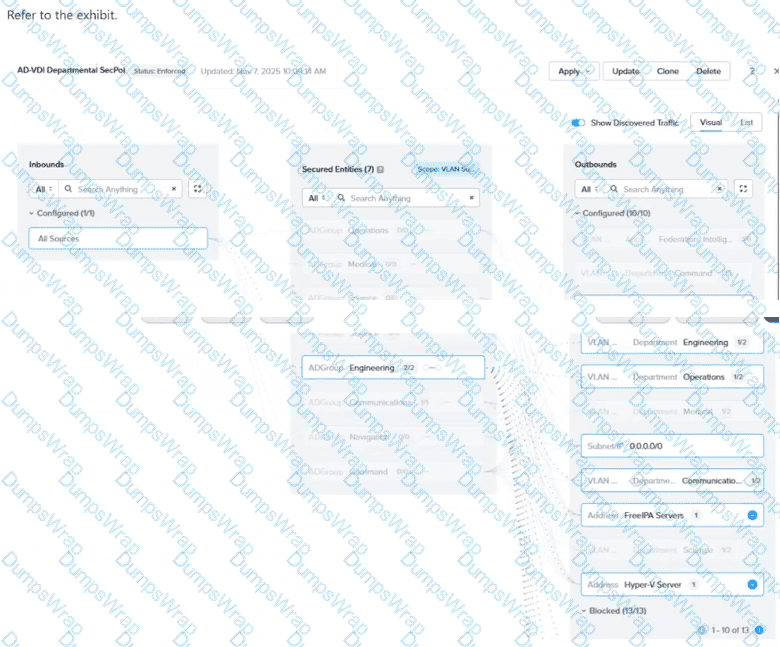
In the AD-VDI Departmental SecPol policy shown in the exhibit, ADGroup: Engineering is configured as a secured entity in a VDI Security Policy. Prism Central shows 2 / 2 active sessions under this group, but the administrator confirms that three Engineering users are currently logged in to persistent VDI desktops. The third user's VM shows no ADGroup assignment in its VM details in Prism Central, even after the user has successfully logged in. All three users are members of the same AD group, and the Domain Controller event logs confirm a successful interactive login for the third user. Which condition explains why the third user's VM is not being assigned the ADGroup: Engineering category?

Options:

A.

The Active Directory Service account used by Prism Central is locked.

B.

The third user's VM has been assigned an AppType category, preventing ID-Based categorization.

C.

The Flow Identity Service has been disabled in Prism Central for the VM the third user is logging in to.

D.

The Flow Network Security policy scope does not include the VLAN where the third user's VM resides.

Question 8

An administrator must delegate management of a single tenant VPC to a junior engineer. The engineer should be able to modify that VPC but must not see or change any other VPCs or networking configurations in Prism Central. The administrator wants to meet this requirement using RBAC. Which action should the administrator take to meet this requirement?

Options:

A.

Assign the Network Infrastructure Admin role and restrict its scope to the desired VPC.

B.

Assign the VPC Admin role and restrict its scope to the desired VPC.

C.

Assign a Custom Role cloned from Network Infrastructure Admin and restrict its scope to the desired VPC.

D.

Assign a Custom Role cloned from VPC Admin and restrict its scope to the desired VPC.

Question 9

Before creating a new Application Security Policy in Prism Central, what prerequisite must exist?

Options:

A.

A category key/value pair must be defined for use in the policy.

B.

Flow Network Security must be enabled on all registered clusters.

C.

Targeted VMs must have category assignments.

D.

The Network Controller must be deployed on each cluster in the policy's scope.

Question 10

An administrator has configured a VPC with multiple overlay subnets and attached a VPN gateway using IPSec. After enabling Jumbo Frames on the physical network, VMs are still experiencing packet drops. What is the most likely reason?

Options:

A.

MTU on guest VMs exceeds recommended size for IPSec.

B.

DHCP relay is misconfigured.

C.

Jumbo frames are not supported on overlay subnets.

D.

Floating IP is missing on the VPN gateway.

Question 11

An administrator has been tasked with upgrading the Nutanix cluster to a newer version of AOS. The cluster is running a mix of different versions across nodes... What is the recommended first step when upgrading a Nutanix cluster with different AOS versions across nodes?

Options:

A.

Begin by upgrading the storage and network components to the latest version before upgrading the controller VMs.

B.

Upgrade all nodes to the same version of AOS before proceeding with any other components.

C.

Upgrade the Nutanix Controller VMs first to ensure compatibility with the new AOS version.

D.

Upgrade the entire cluster at once to minimize downtime and ensure consistency.

Question 12

An administrator wants to configure the subnet 10.1.1.0/24 to stretch across two VPCs over a Network Gateway in VXLAN mode. The VMs on this subnet need to communicate with a traffic pattern of size 2000 Bytes. What is the minimum MTU required in the underlay network to ensure communication happens without fragmentation or traffic drops?

Options:

A.

2058 Bytes

B.

2108 Bytes

C.

2116 Bytes

D.

9216 Bytes

Question 13

Which step is required to prepare an AHV cluster for Flow Network Security Next-Gen?

Options:

A.

Enable microsegmentation and network controller on the cluster.

B.

Assign static IP addresses to all VMs before enabling Flow.

C.

Enable microsegmentation policies on all VM groups before enabling Flow.

D.

Disable all existing VLANs in the cluster to allow Flow to control traffic.

Question 14

An administrator is deploying a multi-tier (web, app, database) application on a Nutanix cluster using AHV. The administrator needs to allow internal communication between tiers and provide external access to the web tier. How should the administrator satisfy this requirement?

Options:

A.

Create separate VLAN networks for each tier and configure routing on the physical network.

B.

Create a VPC with a single subnet and assign workloads of each tier to this subnet.

C.

Create separate VPCs for each tier and connect them to the same external NAT network and configure routing policies for inter-tier traffic.

D.

Create a VPC with subnets for each tier and configure the Externally Routable Prefix to include only web subnets.

Question 15

After creating a BGP session in Flow Virtual Networking, the session status remains down. Which log should an administrator use first in Prism Central to troubleshoot the issue?

Options:

A.

BGP Gateway system logs from the CVM

B.

Prism Central task execution logs

C.

Routing Protocol Logs for the specific BGP session

D.

Network and Security event logs related to connectivity changes

Question 16

An administrator recently deployed a new set of virtual machines... 3-tier web application... restricted as follows: Only application VMs can talk to database VMs on port 3306 Frontend VMs should only communicate with application VMs on port 8080 Which action will correctly create and configure the Security Policies in Nutanix Flow to satisfy this task?

Options:

A.

Create VLANs for each tier and configure ACLs to restrict communication.

B.

Create IP-based rules for each VM category within a Security Policy.

C.

Configure a global "Allow All" Security Policy and rely on guest OS firewalls for tier-based restrictions.

D.

Create categories for each tier then define an Application Policy allowing specific ports between them.

Question 17

Which action allows an administrator to reuse a single existing policy in a different scope?

Options:

A.

Place policy in Enforce mode

B.

Clone

C.

Place policy in Monitor mode

D.

Export

Question 18

A service-insertion firewall VM protects user VMs access to the internet. The virtual and physical switches, as well as all user VMs, currently use the default MTU size of 1500. Everything functions normally until a user VM is migrated to another host. After the migration, the user reports that some websites fail to load while ping to those same sites still succeeds. Routing and security policies appear normal. Which two configuration changes could resolve the issue? (Choose two.)

Options:

A.

Increase the MTU across all vSwitch and physical uplinks on the relevant network path to 1558 or greater.

B.

Lower the MTU across all vSwitch and physical uplinks on the relevant network path to 1442 or lower.

C.

Decrease the MTU on the user VM's vNIC to 1442 or lower.

D.

Increase the MTU on the user VM's vNIC to 1558 or greater.

Question 19

An administrator is responsible for managing user access to a Nutanix cluster... configure custom user roles... What is the first step in configuring and managing user roles for a Nutanix cluster?

Options:

A.

Create the requisite Authorization Polices from custom or built-in roles.

B.

Modify the administrator role to restrict access to critical system functions.

C.

Disable default roles and create new roles for each team.

D.

Create the requisite Custom Roles from custom or built-in Authorization Polices.

Question 20

While configuring third-party services (Service Insertion) in Flow Network Security Next-Gen, an administrator notices dropped packets when redirecting traffic through a network function. Which configuration change would address this issue?

Options:

A.

Reduce the MTU size to 1400 to match Geneve encapsulation.

B.

Disable Geneve tunneling on the virtual switch.

C.

Increase the MTU by an additional 58 bytes for the Geneve header.

D.

Keep the default MTU at 1500. Encapsulation is handled automatically.

Question 21

An administrator is using Flow Network Security to secure a 3-tier application and has already created and assigned the categories. The administrator does not have the details of the rules that need to be allowed to secure the application. How can the administrator use Flow Network Security to monitor the traffic and help with the policy creation without impacting the applications connectivity?

Options:

A.

Use service insertion to redirect traffic through a monitoring service to capture the application traffic and create the Flow Network Security policy based on data captured in monitoring service.

B.

Create the Policy in Save mode, review the discovered traffic, allow the required traffic flows, and move Policy to Enforce mode.

C.

Create the Policy in Monitor mode, review the discovered traffic, allow the required traffic flows, and move Policy to Enforce mode.

D.

Redirect the traffic to a Syslog server and monitor the traffic on the syslog server and then create the Flow Network Security policy based on monitored data in syslog server.

Question 22

What is the first step in preparing a Nutanix cluster for Flow Virtual Networking?

Options:

A.

Enable the Network Controller in Prism Central.

B.

Install the latest version of Acropolis OS (AOS) on all nodes.

C.

Install the Nutanix Flow Controller on all cluster nodes.

D.

Configure the VLANs on the physical network switches.

Question 23

When cloning a Flow Network Security policy, what should be verified before enabling Enforce mode?

Options:

A.

The cloned policy's secured entities reference the intended categories.

B.

The cloned policy is configured to a different scope than the source policy.

C.

The cloned policy must first be saved before it can be enforced.

D.

The cloned policy must be renamed before it can be enforced.

Question 24

A newly-deployed Flow Virtual Networking VPC environment is experiencing connectivity issues... A packet capture on the physical switch shows packets are being fragmented. What is the probable cause of the packet fragmentation and performance issues?

Options:

A.

A Network Security Group is incorrectly filtering IP fragments.

B.

The MTU on the physical or virtual switch layer is set too low.

C.

The VM's guest OS network driver is faulty and requires an update.

D.

The VPC's external network uplink has an incorrect VLAN ID configured.

Question 25

A new multi-tier application is being deployed across several subnets in a Nutanix environment. The security team wants to create a Flow Network Security Policy to restrict traffic between the tiers, but the complete matrix of required network ports and protocols is not fully documented. Which strategy should the team employ first to accurately capture the necessary communication patterns without risking application outage?

Options:

A.

Create an IPFIX export of all the application traffic and monitor all traffic for 48 hours.

B.

Apply a Security policy in Monitor mode to discover all traffic between the application tiers.

C.

Create broad Security Policy to permit all TCP traffic between the tiers to ensure connectivity.

D.

Apply a Security Policy in Enforce mode adding the required flows as they appear in the flow logs.

Question 26

An administrator plans to upgrade a Nutanix cluster running AHV and Prism Central. The current cluster is on AOS 6.10, and the administrator wants to move to AOS 7.3 while ensuring all components remain compatible. What is the correct upgrade order to minimize downtime and maintain cluster functionality?

Options:

A.

Upgrade CVMs - > Upgrade cluster AOS - > Upgrade Prism Central - > Upgrade AHV hosts

B.

Upgrade cluster AOS - > Upgrade AHV hosts - > Upgrade Prism Central - > Upgrade CVMs

C.

Upgrade Prism Central - > Upgrade AHV hosts - > Upgrade CVMs - > Upgrade cluster AOS

D.

Upgrade AHV hosts - > Upgrade cluster AOS - > Upgrade Prism Central - > Upgrade CVMs

Question 27

What does placing a policy in Monitor mode accomplish?

Options:

A.

Visualizes discovered traffic that matches the policy.

B.

Blocks traffic that does not match the policy.

C.

Enables hitlogs for traffic that matches the policy.

D.

Redirects discovered traffic to a monitoring device.

Question 28

Which policy mode blocks all traffic that is not explicitly allowed by the policy?

Options:

A.

Monitor Mode

B.

Save Mode

C.

Block Mode

D.

Enforce Mode

Question 29

Which statement is correct about cloning Application Security Policies?

Options:

A.

The system prevents saving the cloned policy if it has the same secured entities as the original.

B.

The policy type can be changed while cloning a policy.

C.

Only one policy can be cloned at a time.

D.

The default name of the cloned policy must be manually entered; the system does not provide a default.

Question 30

Refer to Exhibit:

as

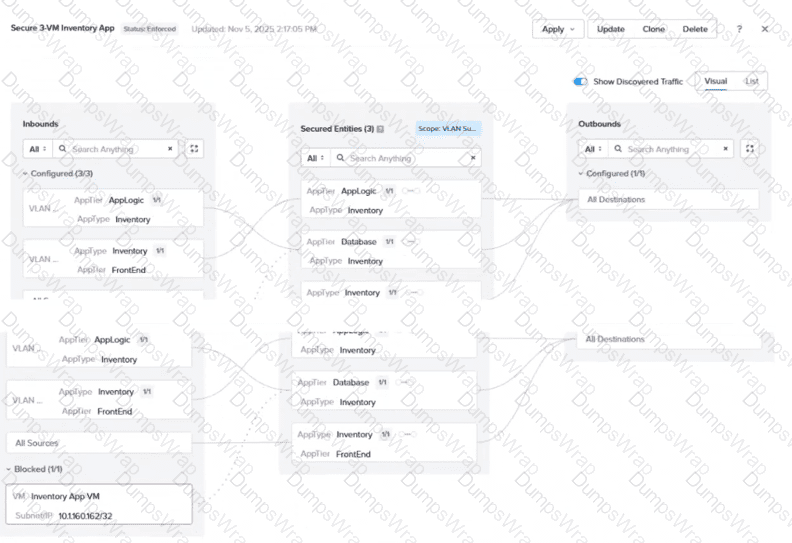
An administrator is reviewing an enforced security policy "Secure 3-VM Inventory App", as shown in the exhibit. The policy's inbound rules are configured to allow traffic from specific sources to each tier of the application. The visualization shows one blocked traffic flow. Based on the information presented in the exhibit, which statement best describes this behavior?

Options:

A.

The AppTier: FrontEnd and AppTier: AppLogic entities are on different subnets.

B.

The Inventory App VM is being blocked from initiating a connection to the AppTier: Database category.

C.

The AppTier: Database category is being blocked from initiating a connection to the Inventory App VM.

D.

The security policy is blocking traffic because the Inventory App VM is using a port not allowed by the policy.

Question 31

Which two options are supported as a Secured Entity in Flow Network Security Application Policies? (Choose two.)

Options:

A.

Subnet Category

B.

vNIC Category

C.

VPC Category

D.

VG Category

Page: 1 / 11
Total 106 questions