
Project Management Professional (PMP) July 2026 Update Questions and Answers
Agroup of specialists with years of experience is temporarily joining a project team. The project manager has been eager for their help in the production of a key
deliverable.
How should the project manager effectively lead these experienced team members?
A project manager leads an agile project. While the team is working on their daily assigned tasks, one team member proposed to change the priority of a task due to
its importance and dependency on other tasks.
What should the project manager do?
A project manager is responsible for building a new data center and developing new monitoring software before a fixed deadline. Although the software features are not fully defined, the project scope is set, and a contract has been signed.
What should the project manager do?
Acustomer has agreed in a contract that interactive displays will be delivered to 14 locations by the end of the year. The contract also states that only software
approved by the customer will be installed on these displays. The customer has not approved this new software because they lack the resources to test and approve
it.
What should the project manager do?
As part of a restructuring effort, a company has transitioned from a projectized to a functional organization. The project manager is concerned that the team members will become disengaged from their work on the current project because they are now reporting to a functional manager.
What should the project manager do?
Members of a cross-functional team are collaborating for the first time on a project. The project manager aims to enhance decision-making, communication, and
compliance within the team.
What should the project manager do?
A project to replace a legacy process is in the initiation phase. The project manager needs to send requests for proposals to potential vendors. The business case contains the project’s high-level goals, and all potential vendors have previously delivered similar projects.
What should the project manager do to ensure that activities and tools from the legacy process are retained when necessary?
A project manager is leading a project for a pharmaceutical company. Due to changes in the international market, the project has to be terminated. The project
manager is following company procedures to document the reasons for early termination.
What should the project manager do?
A project manager is working on a marketing mobile application development project. The application has recently launched a new feature enabling users to upload
photos. A content moderator is responsible for reviewing the photos, but management is concerned about the risk of human error. Management suggests a third-party
artificial intelligence (Al) tool to assist.
What should the project manager do?
During a project status meeting, two project stakeholders disagree about what should be included in the next deliverable. One of the stakeholders would like the team to include a finalized version of the new component in the release. Using the finalized version will impact the project timeline. The second stakeholder would like the team to include a beta version of the new component to allow the client to provide feedback before the component is finalized.
What should the project manager do next?
Health Records Modernization at Hospital Case Study
A project manager led a health records modernization project at a hospital with a project budget of $US5 million and an 18-month timeline. The project involved multiple stakeholder groups including medical, administrative, and IT staff; board members; patients; insurance companies; external vendors; regulatory bodies; and union representatives.
Stakeholder management was complex and a major undertaking for the project manager, but it was critical to achieve a positive project outcome. When the project started, the project manager conducted stakeholder analysis, using the information to create both a power/interest and an influence/impact matrix. The analysis showed that while the hospital board members and regulatory bodies had high power but moderate interest, the medical staff (doctors and nurses) had both high influence and high impact on the project. Administrative staff showed high interest but lower power, while patients and insurance companies had moderate interest and varying levels of influence. Based on the analysis, the project manager created a stakeholder engagement strategy that documented expectations, communication preferences, and influence levels in a stakeholder register. The project manager also made a RACI (responsible, accountable, consulted, informed) chart to show roles and responsibilities; and created communication channels and frequency for each stakeholder group, an issue escalation system, and a feedback system for continuous stakeholder input.
To execute the modernization process of health records, the project manager realized that medical staff members would need to change their daily workflows. To facilitate change management for these stakeholders, the project manager created a clinical advisory committee, appointed department-specific “champions,” created focus groups for requirements gathering, started a training program, and developed key performance indicators (KPIs) to measure satisfaction.
During project execution, several challenges emerged. The doctors expressed concerns about the system’s impact on patient care, the nurses’ union raised workload concerns, the IT department faced resource constraints, the insurance companies requested additional features, and the administrative staff worried about data security. The project manager responded to these challenges by increasing the frequency of stakeholder meetings, implementing a change management program, creating a beta system for stakeholder testing, developing contingency plans for various stakeholder scenarios, and establishing an issue resolution process.
Despite these mitigation efforts, the medical staff required additional training, leading to a change request for a 2-month extension and a 10% budget increase. The board of directors approved this to help ensure high adoption and satisfaction rates among staff members. The project helped establish new good practices in future programs for stakeholder management in the organization’s project management office (PMO). The documented lessons learned became a reference for future projects of similar scope and complexity.
On a project to modernize health records at a hospital, the project manager proposed a two-month timeline extension to provide training on the new solution for medical staff. Approval from the board of directors is required to make the timeline change.
Which statement represents the justification for extending the timeline? (Refer to the Health Records Modernization at Hospital Case Study exhibit.)
An agile project in progress has a large number of blocked items and the project manager does not have visibility on the underlying issues. What should the project manager do to allow transparency and remove the blockers?
Health Records Modernization at Hospital Case Study
A project manager led a health records modernization project at a hospital with a project budget of $US5 million and an 18-month timeline. The project involved multiple stakeholder groups including medical, administrative, and IT staff; board members; patients; insurance companies; external vendors; regulatory bodies; and union representatives.
Stakeholder management was complex and a major undertaking for the project manager, but it was critical to achieve a positive project outcome. When the project started, the project manager conducted stakeholder analysis, using the information to create both a power/interest and an influence/impact matrix. The analysis showed that while the hospital board members and regulatory bodies had high power but moderate interest, the medical staff (doctors and nurses) had both high influence and high impact on the project. Administrative staff showed high interest but lower power, while patients and insurance companies had moderate interest and varying levels of influence. Based on the analysis, the project manager created a stakeholder engagement strategy that documented expectations, communication preferences, and influence levels in a stakeholder register. The project manager also made a RACI (responsible, accountable, consulted, informed) chart to show roles and responsibilities; and created communication channels and frequency for each stakeholder group, an issue escalation system, and a feedback system for continuous stakeholder input.
To execute the modernization process of health records, the project manager realized that medical staff members would need to change their daily workflows. To facilitate change management for these stakeholders, the project manager created a clinical advisory committee, appointed department-specific “champions,” created focus groups for requirements gathering, started a training program, and developed key performance indicators (KPIs) to measure satisfaction.
During project execution, several challenges emerged. The doctors expressed concerns about the system’s impact on patient care, the nurses’ union raised workload concerns, the IT department faced resource constraints, the insurance companies requested additional features, and the administrative staff worried about data security. The project manager responded to these challenges by increasing the frequency of stakeholder meetings, implementing a change management program, creating a beta system for stakeholder testing, developing contingency plans for various stakeholder scenarios, and establishing an issue resolution process.
Despite these mitigation efforts, the medical staff required additional training, leading to a change request for a 2-month extension and a 10% budget increase. The board of directors approved this to help ensure high adoption and satisfaction rates among staff members. The project helped establish new good practices in future programs for stakeholder management in the organization’s project management office (PMO). The documented lessons learned became a reference for future projects of similar scope and complexity.
The project manager leading the project to modernize health records in a hospital has a particular concern about clinical stakeholders—the doctors and nurses. As part of the stakeholder engagement plan, the project manager created the clinical advisory committee.
What was the objective of the project manager’s action?
(Refer to the Health Records Modernization at Hospital Case Study exhibit.)
A project manager is completing a project that required machinery from several different vendors. Similar projects in the future may require the project manager to use
the same vendors again; however, the quality and performance of the vendor products varied, creating project risk.
What should the project manager do to facilitate the success of future projects?
A project team released the first phase of a newly developed IT system to their operations team a month ago. The project team is currently working on new tasks for
the next phase but is continually contacted by operations key users with their new findings.
What should the project manager do to avoid this situation in the future?
While facilitating the weekly team meeting, a developer raises the concern that a team lead from a different department is frequently asking for status updates on
ongoing tasks. The project manager was not aware of these interferences.
What should the project manager do next?
An engineering consulting firm is hired to support a client in designing technical documents for a new construction site. The project has a tight schedule. The client
does not have a complete scope, but the client cannot wait for the scope to be defined before starting the project.
What should the project manager do?
During a daily coordination meeting, the team reports delays for the weekly sprint. Some team members are concerned about the requirements being too complex,
making it difficult to complete tasks.
What should the project manager do?
A business stakeholder is unhappy that the team is using a predictive artificial intelligence (AI) model for cash-flow planning. However, the tool has been very effective and has prevented funding challenges.
How should the project manager address the stakeholder’s concerns?
A project team had been developing their deliverables on a 2-week sprint. The deliverables were tested and proven to be functional. However, during the sprint
review, they were rejected because they failed to meet the end-user requirements.
What actions should the project manager have done?
The project manager calculates the current cost performance index (CP!) and determines that it is > 1 compared with actual value added. What should the project
manager do first?
A project manager is leading a predictive project. The main stakeholders involved in the project complain that the weekly status report sent over email, is very
confusing and so they expect a weekly meeting to be arranged to understand the project status and to ask questions wherever needed.
Which two steps should the project manager take? (Choose 2)
A project manager is working for a multinational financial services company that does business in more than 100 countries. The company is rolling out a time
management system in multiple countries.
What should the project manager do?
Acompany merged with a larger company and new project management standards are enforced across the enterprise. The project sponsor is concerned that the
team is not meeting the expectations of the new leaders. The project is at risk of cancellation.
What should the project manager do?
A project team is in the process of selecting a module for the upcoming iteration. They have identified three potential modules as candidates. Despite several rounds
of review, the team remains undecided on which module to select.
What should the project manager do?
A new, highly innovative project just started and the customer is already complaining that the software company is not delivering as agreed. What should the project manager have done before starting the project?
During the execution of a project, the product manager receives a new product feature request from the organization ' s highest revenue-generating client. The team
estimates the work will take three days.
What should the project manager do?
Alpha Project — Risk Management Report
The Alpha Project risk management report includes the following information:
- Risk monitoring is built into risk sessions.
- Risk identification / assessment is performed.
- Monthly review and reassessment are performed.
- 21 risks have been identified so far.
- Probability and impact have been estimated for every risk.
- All response plans have been completed.
- A probability and impact matrix is provided using green, yellow, and red severity zones.
The project manager of Alpha project is running a monthly risk review and reassessment meeting. During the meeting, the team confirms that risk 5 has materialized.
What should the project manager do?
(Refer to the Alpha Project — Risk Management Report exhibit.)
A project manager is assigned to a project in which the business and the technology to be used are well-known. What should the project manager do to learn about
the customer ' s needs, the complexity, and the resulting impact of the project?
A project manager works for a communications company. The manager of the mobile equipment department is concerned about the current project ' s activities.
According to the current project management plan, the department will need to purchase special equipment, but the cost was not planned. The project sponsor insists
the project should move forward because customers will be impacted if the equipment is not available.
What should the project manager do?
During a team ' s weekly status meeting, team members have minor disagreements about how to perform work and some defer to the team lead while others speak
confidently. The project manager realizes that team members have different expectations of the team ' s dynamics and operating model.
What should the project manager do?
Ahigh-performing team is working diligently to deliver a project ahead of schedule. While the deliverables meet the necessary quality standards, the team member
responsible for this aspect of the project exhibits inadequate skills in quality management and lacks enthusiasm for the task.
What should the project manager do?
A digital health development team is tasked with designing a new product, which is a pioneering effort for the organization and one of the few available in a
‘competitive market. The planning and auditing processes have been notably time-consuming. The development team has reported limited rework and minimal
customer complaints; however, the current budget significantly exceeds the typical project baselines for previous product development initiatives within the
organization. The project manager is currently analyzing the total cost of quality for the project.
What should the project manager do?
A virtual team updates a kanban board weekly with project progress. Recently, team members have raised concerns about properly tracking interdependent activities
How should the project manager address this issue?
A project manager has been tasked by management with improving overall knowledge of project management methodologies and approaches and documenting good practices to build up the company ' s knowledge base.
Which three actions should the project manager take? (Choose 3)
Health Records Modernization at Hospital Case Study
A project manager led a health records modernization project at a hospital with a project budget of $US5 million and an 18-month timeline. The project involved multiple stakeholder groups including medical, administrative, and IT staff; board members; patients; insurance companies; external vendors; regulatory bodies; and union representatives.
Stakeholder management was complex and a major undertaking for the project manager, but it was critical to achieve a positive project outcome. When the project started, the project manager conducted stakeholder analysis, using the information to create both a power/interest and an influence/impact matrix. The analysis showed that while the hospital board members and regulatory bodies had high power but moderate interest, the medical staff (doctors and nurses) had both high influence and high impact on the project. Administrative staff showed high interest but lower power, while patients and insurance companies had moderate interest and varying levels of influence. Based on the analysis, the project manager created a stakeholder engagement strategy that documented expectations, communication preferences, and influence levels in a stakeholder register. The project manager also made a RACI (responsible, accountable, consulted, informed) chart to show roles and responsibilities; and created communication channels and frequency for each stakeholder group, an issue escalation system, and a feedback system for continuous stakeholder input.
To execute the modernization process of health records, the project manager realized that medical staff members would need to change their daily workflows. To facilitate change management for these stakeholders, the project manager created a clinical advisory committee, appointed department-specific “champions,” created focus groups for requirements gathering, started a training program, and developed key performance indicators (KPIs) to measure satisfaction.
During project execution, several challenges emerged. The doctors expressed concerns about the system’s impact on patient care, the nurses’ union raised workload concerns, the IT department faced resource constraints, the insurance companies requested additional features, and the administrative staff worried about data security. The project manager responded to these challenges by increasing the frequency of stakeholder meetings, implementing a change management program, creating a beta system for stakeholder testing, developing contingency plans for various stakeholder scenarios, and establishing an issue resolution process.
Despite these mitigation efforts, the medical staff required additional training, leading to a change request for a 2-month extension and a 10% budget increase. The board of directors approved this to help ensure high adoption and satisfaction rates among staff members. The project helped establish new good practices in future programs for stakeholder management in the organization’s project management office (PMO). The documented lessons learned became a reference for future projects of similar scope and complexity.
How should the project manager approach managing the regulatory bodies’ requirements for the health records associated with this project?
(Refer to the Health Records Modernization at Hospital Case Study exhibit.)
Health Records Modernization at Hospital Case Study
A project manager led a health records modernization project at a hospital with a project budget of $US5 million and an 18-month timeline. The project involved multiple stakeholder groups including medical, administrative, and IT staff; board members; patients; insurance companies; external vendors; regulatory bodies; and union representatives.
Stakeholder management was complex and a major undertaking for the project manager, but it was critical to achieve a positive project outcome. When the project started, the project manager conducted stakeholder analysis, using the information to create both a power/interest and an influence/impact matrix. The analysis showed that while the hospital board members and regulatory bodies had high power but moderate interest, the medical staff (doctors and nurses) had both high influence and high impact on the project. Administrative staff showed high interest but lower power, while patients and insurance companies had moderate interest and varying levels of influence. Based on the analysis, the project manager created a stakeholder engagement strategy that documented expectations, communication preferences, and influence levels in a stakeholder register. The project manager also made a RACI (responsible, accountable, consulted, informed) chart to show roles and responsibilities; and created communication channels and frequency for each stakeholder group, an issue escalation system, and a feedback system for continuous stakeholder input.
To execute the modernization process of health records, the project manager realized that medical staff members would need to change their daily workflows. To facilitate change management for these stakeholders, the project manager created a clinical advisory committee, appointed department-specific “champions,” created focus groups for requirements gathering, started a training program, and developed key performance indicators (KPIs) to measure satisfaction.
During project execution, several challenges emerged. The doctors expressed concerns about the system’s impact on patient care, the nurses’ union raised workload concerns, the IT department faced resource constraints, the insurance companies requested additional features, and the administrative staff worried about data security. The project manager responded to these challenges by increasing the frequency of stakeholder meetings, implementing a change management program, creating a beta system for stakeholder testing, developing contingency plans for various stakeholder scenarios, and establishing an issue resolution process.
Despite these mitigation efforts, the medical staff required additional training, leading to a change request for a 2-month extension and a 10% budget increase. The board of directors approved this to help ensure high adoption and satisfaction rates among staff members. The project helped establish new good practices in future programs for stakeholder management in the organization’s project management office (PMO). The documented lessons learned became a reference for future projects of similar scope and complexity.
During the execution phase of a project to modernize a hospital’s records system, the insurance company stakeholders requested additional features to support integration to their systems.
What should the project manager do first?
(Refer to the Health Records Modernization at Hospital Case Study exhibit.)
A project manager conducts weekly virtual project meetings with all stakeholders to keep them updated on project progress and discuss key issues. Some stakeholders appear disengaged or are occupied with other work during the meetings. Other stakeholders have stopped attending.
What should the project manager do?
A team member regularly interrupts the virtual project status meeting with new recommendations. This action prevents other team members from providing their detailed status information.
What should the project manager do?
The regional sales manager (RSM) calls the project manager and expresses the need to add functionalities to the project scope and change the project ' s priorities. Making these alterations as soon as possible will significantly increase the project ' s adoption.
What should the project manager do?
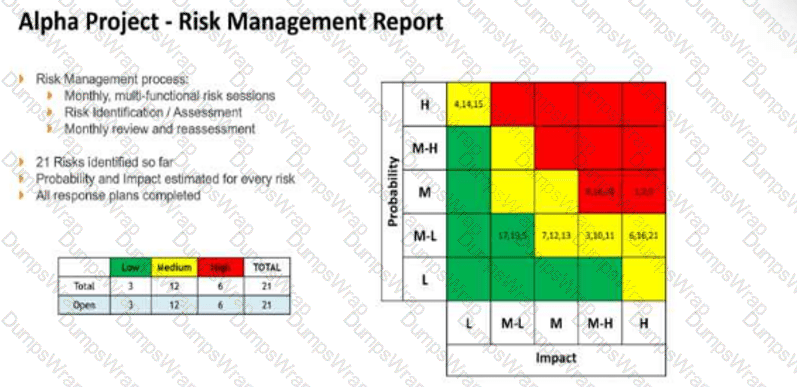
According to the Alpha project’s risk management report, which risks should the project manager prioritize?
(Refer to Alpha Project — Risk Management Report exhibit.)
After a sprintis finalized, the team members were discussing during the retrospective meeting that the prioritization of the backlog was coming from two different
sources. This is causing confusion to the project team.
What should the project manager do?
A project manager is leading a team using agile practices. During a sprint, a stakeholder approaches a team member with a request for a minor functional change.
What should the team member do?
An external development team is working on a large project to build a custom application for the organization. Since the requirements are not fully clear, the project
manager decides with the project sponsor to take a hybrid approach. The project manager also agrees with the vendor to fulfill minimum viable product (MVP)
requirements within the set number of sprints and to update the application according to newly identified requirements.
Which metrics should the project manager monitor and analyze?
After finishing a project, the project manager organized a lessons learned meeting. What should the project manager do next?
A project manager is concerned that the percentage of fixed defects encountered during the testing phase has barely reached the required percentage goal for
moving the product to production.
What should the project manager do?
Alocal city government is deploying a project management system in several departments. At the start of a new phase, the project manager asks a department
manager for input on the project schedule. In response, the department manager wants to know more about their role and responsibilities in the scheduling process.
What should the project manager do?
A project manager has been assigned to complete a project within the approved budget. Midway through the implementation, the project budget is reduced by the
sponsor.
What should the project manager do?
A project manager has proposed starting to use artificial intelligence (Al) on a project to senior management. Some of the team members are skeptical due to security
and privacy challenges.
What should the project manager do?
A project manager is leading an ongoing project for a highly reputable international client. A few hours before the final review meeting, during which the client is expected to accept the project and authorize a substantial payment, the project manager’s company suffers a cyberattack. The client is very strict and maintains that any missed deadlines will result in a considerable penalty.
What should the project manager do?
Top management is considering terminating a failing project. A newly hired project manager is invited to attend a meeting at which this will be discussed.
What should the new project manager do?
A project manager is leading a project focused on developing a machine learning platform. Midway through the project, the project manager learns of a new
regulatory policy that will significantly change the way data is stored, processed, and manipulated.
What should the project manager do?
During a sprint review, the customer described a strong market trend that will highly impact the product vision and the project management plan. What should the
project manager do?
During the first sprint review, the project sponsor requests an update to the product backlog. The team realizes that this may cause short-term resource constraints, but no additional budget is available.
What should the project team do?
A project team is equipping a small hospital. To complete the work, the team requires an additional service provided by an external supplier. The price quoted by the
supplier is surprisingly high, which may cause a significant increase in the budget.
What should the project manager do?
A scrum master is leading an agile project to develop a video game product. Midway through a sprint, the customer asks the team to immediately add a new feature
to the product. The team asks the scrum master for guidance.
What should the scrum master do first?
