PRINCE2 7 Practitioner (7th Edition) Exam Questions and Answers
When examining a project issue, which three aspects should be considered?
1. Performance targets
2. Business Case
3. Resources
4. Risk
Scenario:
The Ministry of Food Hygiene (MFH) has a quality management system which contains a document control process to manage all documentation requirements. The document control process was created by the MFH Quality Manager, who now maintains all of MFH's documents and performs an organization-wide configuration management role. The MFH Quality Manager will administer the configuration management procedure for the Restructuring project since this must comply with the MFH document control process.
According to PRINCE2, which statement about the Configuration Management Strategy for the Outsourcing project is correct?
Which of the following is the definition for an off-specification?
In which strategy would the change control process be recorded?
Who would be responsible for maintaining the Configuration Item Records?
Scenario:
The Ministry of Food Hygiene (MFH) has a quality management system which contains a document control process to manage all documentation requirements. The document control process was created by the MFH Quality Manager, who now maintains all of MFH's documents and performs an organization-wide configuration management role. The MFH Quality Manager will administer the configuration management procedure for the Restructuring project since this must comply with the MFH document control process.
What products will be impacted by this change?
If the Project Board are too busy to authorize all change requests themselves, they can appoint?
Scenario
Additional Information
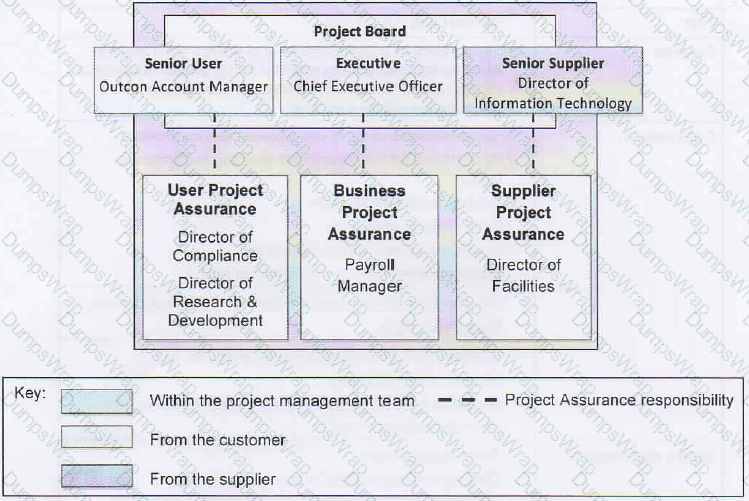
Further information on some resources who could be involved in the project:
Outcome Account Manager: He represents Outcome which is a recruitment agency that provides specialist outsourcing resources. Outcome provided the consultants who carried out the feasibility study and the same consultants will be providing support and guidance to the Information Technology and Facilities teams during the project.
Director of Finance Division: She was transferred from the Information Technology Division 12 months ago. She is responsible for ensuring a cost-conscious approach is adopted in all operational and project activities across the Ministry of Food Hygiene.
Hardware Manager: Reports to the Director of Information Technology. He provides computer hardware to all business functions but has little awareness of the needs of his colleagues working in software.
Payroll Manager: Reports to the Director of Finance. He is a very experienced and efficient qualified accountant who has much of the responsibility of running the Finance Division on behalf of the Director of Finance. He has been involved in drafting the Ministry's business strategy and assisting in a full business risk assessment. He also drafted the corporate Business Case standards.
Which 2 alternative actions apply to the proposed supplier assurance for this project?
Scenario
Additional Information
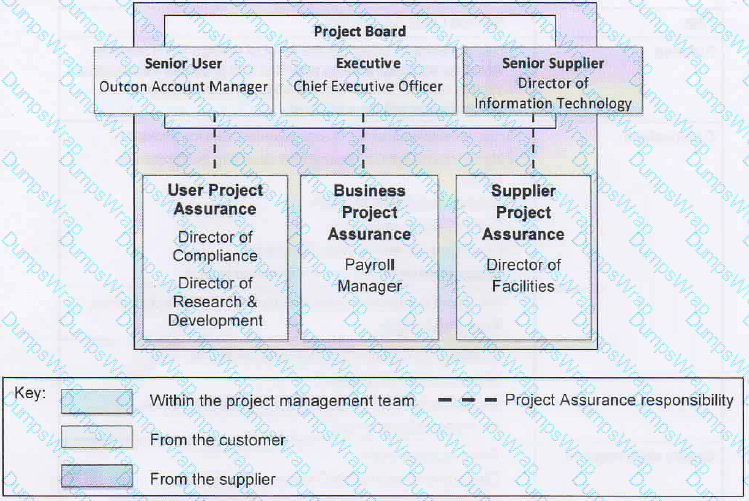
Further information on some resources who could be involved in the project:
Outcome Account Manager: He represents Outcome which is a recruitment agency that provides specialist outsourcing resources. Outcome provided the consultants who carried out the feasibility study and the same consultants will be providing support and guidance to the Information Technology and Facilities teams during the project.
Director of Finance Division: She was transferred from the Information Technology Division 12 months ago. She is responsible for ensuring a cost-conscious approach is adopted in all operational and project activities across the Ministry of Food Hygiene.
Hardware Manager: Reports to the Director of Information Technology. He provides computer hardware to all business functions but has little awareness of the needs of his colleagues working in software.
Payroll Manager: Reports to the Director of Finance. He is a very experienced and efficient qualified accountant who has much of the responsibility of running the Finance Division on behalf of the Director of Finance. He has been involved in drafting the Ministry's business strategy and assisting in a full business risk assessment. He also drafted the corporate Business Case standards.
Which 2 alternative actions apply to the proposed user assurance for this project?
Additional Information
Chief Executive Officer (CEO): He started the company 25 years ago and knows his job very well. He injured his leg two years ago which has restricted his visits to the engineering area. As CEO he has an overall perspective of the business strategic requirements and the authority to commit resources as required.
Marketing Director: She has been with the company for three years, following a successful career with a publicity company. She has the ability to represent the needs of the business, particularly as this is a marketing project. She has the authority to commit the annual business marketing budget, from which the project will be funded, as she sees appropriate. She will be responsible for monitoring the expected benefits of the calendar, in particular the improvement of the company's image.
Engineering Manager: He has been responsible for many engineering innovations in the company and is still as keen and energetic as the day he started. VVhilst he will not be part of the project team, his staff will feature in the photos for the promotional calendar.
Central Records: This group of five staff looks after all company records and document control. They now maintain all project files.
Bright Lights: This is the local office supplies company. It supplies all the stationery and office equipment needs of the company and will supply the stationery for this project.
Portraits ltd: This is a professional photographic company with a number of excellent photographers and a history of successful work. This company has been selected to take the photos for the company calendar. It has yet to be decided which of the photographers to use.
Using the additional Information provided for this question In the Scenario Booklet, answer the following question.
Lines 1 to 5 in the table below consist of an assertion statement and a reason statement. For each line identify the appropriate option, from options A to E, that applies. Each option can be used once, more than once or not at all.
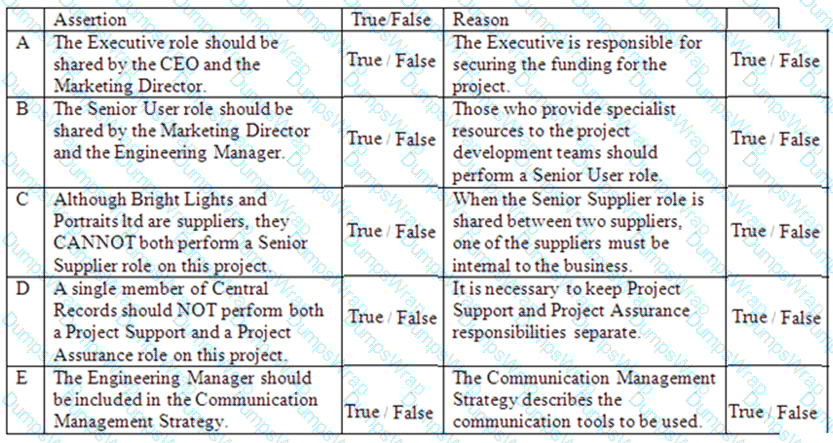
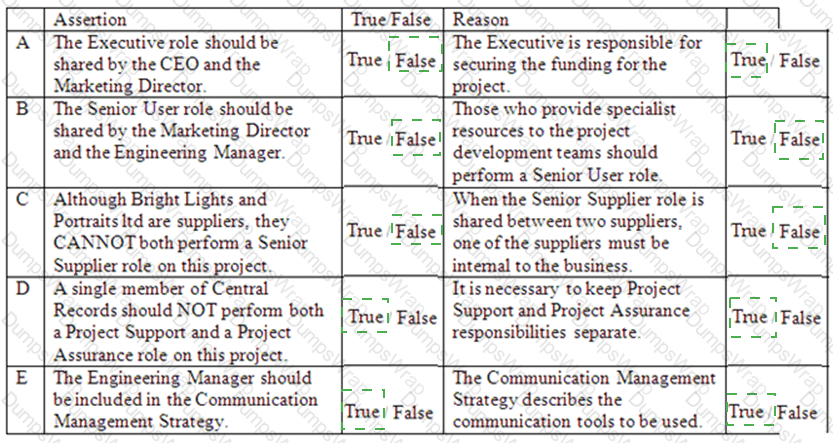
Which of the following roles cannot be combined?
Which of the following represents the four key characteristics a good Project board should display?
Additional Information
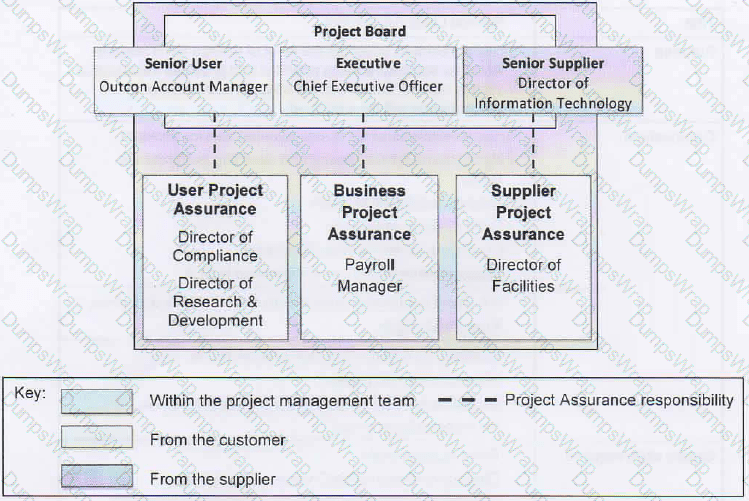
Further information on some resources who could be involved in the project:
Outcome Account Manager: He represents Outcome which is a recruitment agency that provides specialist outsourcing resources. Outcome provided the consultants who carried out the feasibility study and the same consultants will be providing support and guidance to the Information Technology and Facilities teams during the project.
Director of Finance Division: She was transferred from the Information Technology Division 12 months ago. She is responsible for ensuring a cost-conscious approach is adopted in all operational and project activities across the Ministry of Food Hygiene.
Hardware Manager: Reports to the Director of Information Technology. He provides computer hardware to all business functions but has little awareness of the needs of his colleagues working in software.
Payroll Manager: Reports to the Director of Finance. He is a very experienced and efficient qualified accountant who has much of the responsibility of running the Finance Division on behalf of the Director of Finance. He has been involved in drafting the Ministry's business strategy and assisting in a full business risk assessment. He also drafted the corporate Business Case standards.
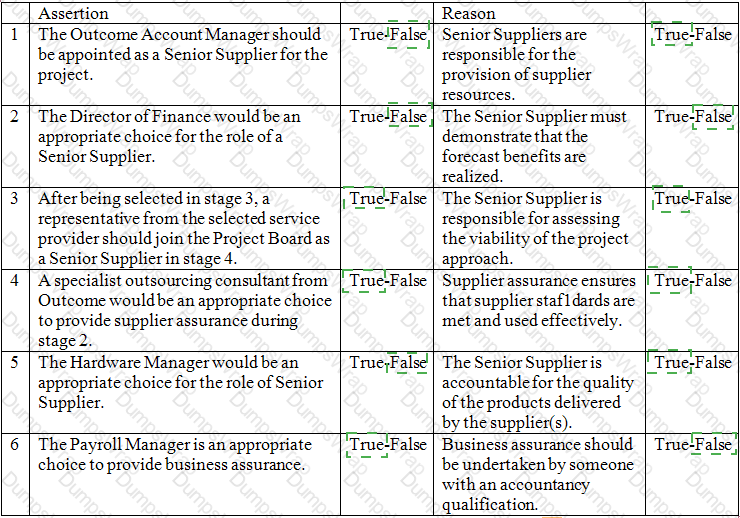
Using the Project Scenario and the additional information provided for this question in the Scenario Booklet, answer the following question about roles on the Outsourcing project.
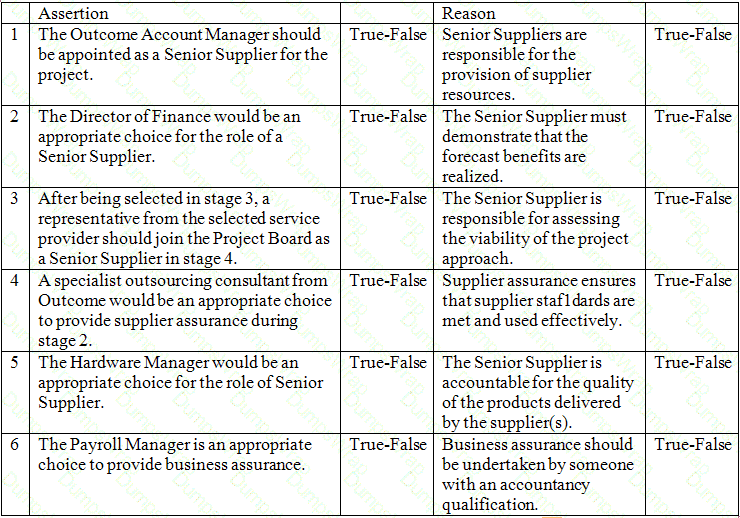
Scenario
Additional Information
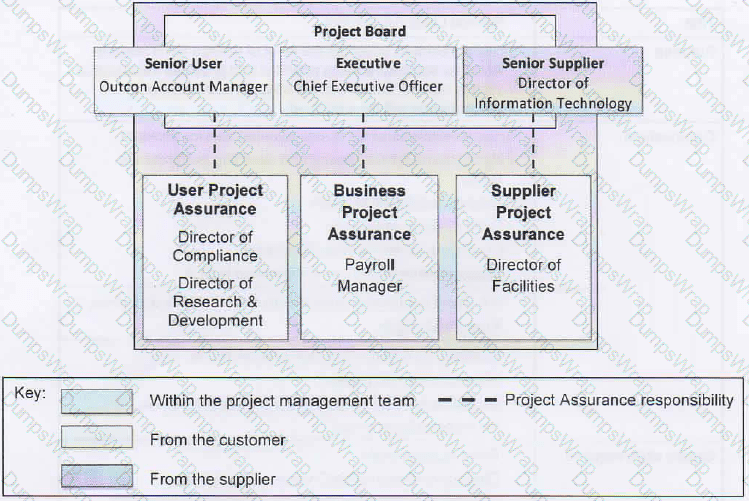
Further information on some resources who could be involved in the project:
Outcome Account Manager: He represents Outcome which is a recruitment agency that provides specialist outsourcing resources. Outcome provided the consultants who carried out the feasibility study and the same consultants will be providing support and guidance to the Information Technology and Facilities teams during the project.
Director of Finance Division: She was transferred from the Information Technology Division 12 months ago. She is responsible for ensuring a cost-conscious approach is adopted in all operational and project activities across the Ministry of Food Hygiene.
Hardware Manager: Reports to the Director of Information Technology. He provides computer hardware to all business functions but has little awareness of the needs of his colleagues working in software.
Payroll Manager: Reports to the Director of Finance. He is a very experienced and efficient qualified accountant who has much of the responsibility of running the Finance Division on behalf of the Director of Finance. He has been involved in drafting the Ministry's business strategy and assisting in a full business risk assessment. He also drafted the corporate Business Case standards.
Which 2 alternative actions apply to the proposed business assurance for this project?
Scenario:
Techniques, processes and procedures
1. Any threat that may result in a loss of MFH data must be escalated immediately.
Joint agreements
2. Work is to start at the beginning of week 2 (Stage 4).
3. The project will take two years to complete, at an estimated cost of £2.5m.
Tolerances
4. None.
Constraints
5. MFH staff must not be involved in any heavy lifting during the removal of existing IT equipment.
6. Installation work must take place during MFH normal working hours.
7. +£10,000 / -£25,000.
Reporting arrangements
8. Highlight Report every Monday by 10.00 am.
9. The report must contain a summary of all products worked on during the previous week.
10. Project Manager must be notified of any issues immediately by telephone.
Problem handling and escalation
11. Impact analysis of all issues must be completed within 24 hours.
Extracts or references
12. The Stage Plan for stage 4 is available from Project Support.
Approval method
13. Project Assurance will review the completed Work Package and confirm completion
Which 2 statements apply to either the Extracts or references or Approval method sections?
Who is responsible for confirming stage and project progress against agreed tolerances?
Project Scenario
Calendar Project (Note: The companies and people within the scenario are fictional.)
There has been a reduction in fie number of orders at the MNO Manufacturing Company due in part to the increased marketing activities of its competitors. To help counter this, the company has decided to create a promotional calendar for next year for all its current and prospective customers. The end product of this project will be a prepared calendar pack, ready for printing. The design of the calendar will be similar to one sent out previously, and must reflect the company image as described in the existing corporate branding standards. Another project is currently producing a new company logo when is to be printed on each page of the promotional calendar. The prepared calendar pack will consist of:
Design for each month - correctly showing at public holidays and new company logo
Selected photographs- 12 professionally-produced photographs, showing different members of staff
Selected paper and selected envelope - for printing and mailing the calendar
Chosen label design - a competition to design a label will be held as part of this project
List of customers - names and addresses of customers to whom the calendar will be sent.
The project is currently in initiation and will have two further stages:
Stage 2 will include tie activities to:
Create the customer fast using information from the Accounts and Marketing departments
Confirm compliance with the Data Protection Legislation
Create a design for each month - this will be done by the internal creative team
Select and appoint a professional photographer
Gather photograph design ideas from previous project and agree photographic session schedule
Prepare a production cost forecast
Select paper and envelope.
Stage 3 will include the activities to:
Produce and select tie professionally-taken photographs
Hold the label design competition and choose the label design
Assemble the prepared calendar pack.
A production cost forecast, based on the options and costs for the paper, envelope, printing and marketing of the calendar is to be produced in stage 2. However, the actual production and distribution of the calendars is not within the scope of the project. The product cost forecast will be reviewed by the Project Board to determine whether tie project should continue.
It is now 05 October and the prepared calendar pack must be delivered to the print company by 30 November, to enable printing and distribution of the calendar in time for Christmas. The cost of the activities to develop the specialist products and the cost of the project management activities are estimated to be £20,000. There is a project time tolerance of +1 week /-2 weeks and a project cost tolerance of +£6,000 / -£6,000. A change budget of £500 has been allocated but there is no risk budget.
During stage 2, if the Project Manager decides to recommend that the Project Plan is revised to finish three weeks later, which statement is correct?
If Project tolerances were threatened, who needs to be notified?
Which statement is TRUE with regard to technical stages?
Project Scenario
Calendar Project (Note: The companies and people within the scenario are fictional.)
There has been a reduction in fie number of orders at the MNO Manufacturing Company due in part to the increased marketing activities of its competitors. To help counter this, the company has decided to create a promotional calendar for next year for all its current and prospective customers. The end product of this project will be a prepared calendar pack, ready for printing. The design of the calendar will be similar to one sent out previously, and must reflect the company image as described in the existing corporate branding standards. Another project is currently producing a new company logo when is to be printed on each page of the promotional calendar. The prepared calendar pack will consist of:
Design for each month - correctly showing at public holidays and new company logo
Selected photographs- 12 professionally-produced photographs, showing different members of staff
Selected paper and selected envelope - for printing and mailing the calendar
Chosen label design - a competition to design a label will be held as part of this project
List of customers - names and addresses of customers to whom the calendar will be sent.
The project is currently in initiation and will have two further stages:
Stage 2 will include tie activities to:
Create the customer fast using information from the Accounts and Marketing departments
Confirm compliance with the Data Protection Legislation
Create a design for each month - this will be done by the internal creative team
Select and appoint a professional photographer
Gather photograph design ideas from previous project and agree photographic session schedule
Prepare a production cost forecast
Select paper and envelope.
Stage 3 will include the activities to:
Produce and select tie professionally-taken photographs
Hold the label design competition and choose the label design
Assemble the prepared calendar pack.
A production cost forecast, based on the options and costs for the paper, envelope, printing and marketing of the calendar is to be produced in stage 2. However, the actual production and distribution of the calendars is not within the scope of the project. The product cost forecast will be reviewed by the Project Board to determine whether tie project should continue.
It is now 05 October and the prepared calendar pack must be delivered to the print company by 30 November, to enable printing and distribution of the calendar in time for Christmas. The cost of the activities to develop the specialist products and the cost of the project management activities are estimated to be £20,000. There is a project time tolerance of +1 week /-2 weeks and a project cost tolerance of +£6,000 / -£6,000. A change budget of £500 has been allocated but there is no risk budget.
The team member collating the list of customers has now forecast that it will NOT be complete by the end of this stage as originally planned, due to a number of new prospective customers' details not yet being available. What action should the team member take?
Project Scenario
Calendar Project (Note: The companies and people within the scenario are fictional.)
There has been a reduction in fie number of orders at the MNO Manufacturing Company due in part to the increased marketing activities of its competitors. To help counter this, the company has decided to create a promotional calendar for next year for all its current and prospective customers. The end product of this project will be a prepared calendar pack, ready for printing. The design of the calendar will be similar to one sent out previously, and must reflect the company image as described in the existing corporate branding standards. Another project is currently producing a new company logo when is to be printed on each page of the promotional calendar. The prepared calendar pack will consist of:
Design for each month - correctly showing at public holidays and new company logo
Selected photographs- 12 professionally-produced photographs, showing different members of staff
Selected paper and selected envelope - for printing and mailing the calendar
Chosen label design - a competition to design a label will be held as part of this project
List of customers - names and addresses of customers to whom the calendar will be sent.
The project is currently in initiation and will have two further stages:
Stage 2 will include tie activities to:
Create the customer fast using information from the Accounts and Marketing departments
Confirm compliance with the Data Protection Legislation
Create a design for each month - this will be done by the internal creative team
Select and appoint a professional photographer
Gather photograph design ideas from previous project and agree photographic session schedule
Prepare a production cost forecast
Select paper and envelope.
Stage 3 will include the activities to:
Produce and select tie professionally-taken photographs
Hold the label design competition and choose the label design
Assemble the prepared calendar pack.
A production cost forecast, based on the options and costs for the paper, envelope, printing and marketing of the calendar is to be produced in stage 2. However, the actual production and distribution of the calendars is not within the scope of the project. The product cost forecast will be reviewed by the Project Board to determine whether tie project should continue.
It is now 05 October and the prepared calendar pack must be delivered to the print company by 30 November, to enable printing and distribution of the calendar in time for Christmas. The cost of the activities to develop the specialist products and the cost of the project management activities are estimated to be £20,000. There is a project time tolerance of +1 week /-2 weeks and a project cost tolerance of +£6,000 / -£6,000. A change budget of £500 has been allocated but there is no risk budget.
Whilst identifying the mailing costs for the calendars the Project Manager was surprised to find the costs could vary considerably depending on the size of the package and the delivery service used. For the purpose of this project, the Project Manager has selected an appropriate service but feels that a corporate standard for postage would have reduced the time and effort invested. It could reduce the company's overheads by up to £20k per year. How should the Project Manager record this observation within the project?
Scenario
A photographer from Portraits Ltd, a professional photographic company, has taken on the role of Team Manager after taking some time to understand the requirements of the project. A contract for their services has been set up and is being monitored by the Purchasing Manager and a Work Package has been agreed. This contract specifies that the photographer must arrange a meeting with the Engineering Manager to establish a schedule for the photo sessions to minimize the impact on the Engineering staff. This meeting should have occurred by now.
The Engineering Manager was made aware of this requirement but when asked he reported that he has received no communication from the photographer. The Project Manager has tried to call the photographer and has had no response. The Project Manager believes there is a risk that Portraits Ltd are overbooking work and prioritizing other clients' work. If Portraits ltd do not deliver on schedule the project will be delayed and the expected benefits will be reduced.
The contract is to be reviewed and Portraits Ltd reminded of their agreement.
The project is now in stage 2. The Project Manager has heard about the possibility of a competitor also producing a calendar to be delivered earlier than the target date for this project. There is a threat that the early release of a competitor's calendar may weaken the impact of the MNO Manufacturing Company calendar, thereby reducing the anticipated benefits of the Calendar project.
Which 2 statements should be recorded under the Proximity heading?
Scenario
A photographer from Portraits Ltd, a professional photographic company, has taken on the role of Team Manager after taking some time to understand the requirements of the project. A contract for their services has been set up and is being monitored by the Purchasing Manager and a Work Package has been agreed. This contract specifies that the photographer must arrange a meeting with the Engineering Manager to establish a schedule for the photo sessions to minimize the impact on the Engineering staff. This meeting should have occurred by now.
The Engineering Manager was made aware of this requirement but when asked he reported that he has received no communication from the photographer. The Project Manager has tried to call the photographer and has had no response. The Project Manager believes there is a risk that Portraits Ltd are overbooking work and prioritizing other clients' work. If Portraits ltd do not deliver on schedule the project will be delayed and the expected benefits will be reduced.
The contract is to be reviewed and Portraits Ltd reminded of their agreement.
The project is now in stage 2. The Project Manager has heard about the possibility of a competitor also producing a calendar to be delivered earlier than the target date for this project. There is a threat that the early release of a competitor's calendar may weaken the impact of the MNO Manufacturing Company calendar, thereby reducing the anticipated benefits of the Calendar project.
Which 2 statements should be recorded under the Roles and responsibilities heading?
Which of the following reports does not contain any information on risk?
Scenario
A photographer from Portraits Ltd, a professional photographic company, has taken on the role of Team Manager after taking some time to understand the requirements of the project. A contract for their services has been set up and is being monitored by the Purchasing Manager and a Work Package has been agreed. This contract specifies that the photographer must arrange a meeting with the Engineering Manager to establish a schedule for the photo sessions to minimize the impact on the Engineering staff. This meeting should have occurred by now.
The Engineering Manager was made aware of this requirement but when asked he reported that he has received no communication from the photographer. The Project Manager has tried to call the photographer and has had no response. The Project Manager believes there is a risk that Portraits Ltd are overbooking work and prioritizing other clients' work. If Portraits ltd do not deliver on schedule the project will be delayed and the expected benefits will be reduced.
The contract is to be reviewed and Portraits Ltd reminded of their agreement.
The project is now in stage 2. The Project Manager has heard about the possibility of a competitor also producing a calendar to be delivered earlier than the target date for this project. There is a threat that the early release of a competitor's calendar may weaken the impact of the MNO Manufacturing Company calendar, thereby reducing the anticipated benefits of the Calendar project.
Which 2 statements should be recorded under the Risk management procedure heading?
Additional Information
A photographer from Portraits Ltd, a professional photographic company, has taken on the role of Team Manager after taking some time to understand the requirements of the project. A contract for their services has been set up and is being monitored by the Purchasing Manager and a Work Package has been agreed. This contract specifies that the photographer must arrange a meeting with the Engineering Manager to establish a schedule for the photo sessions to minimize the impact on the Engineering staff. This meeting should have occurred by now.
The Engineering Manager was made aware of this requirement but when asked he reported that he has received no communication from the photographer. The Project Manager has tried to call the photographer and has had no response. The Project Manager believes there is a risk that Portraits Ltd are overbooking work and prioritizing other clients' work. If Portraits ltd do not deliver on schedule the project will be delayed and the expected benefits will be reduced.
The contract is to be reviewed and Portraits Ltd reminded of their agreement.
The project is now in stage 2. The Project Manager has heard about the possibility of a competitor also producing a calendar to be delivered earlier than the target date for this project. There is a threat that the early release of a competitor's calendar may weaken the impact of the MNO Manufacturing Company calendar, thereby reducing the anticipated benefits of the Calendar project.
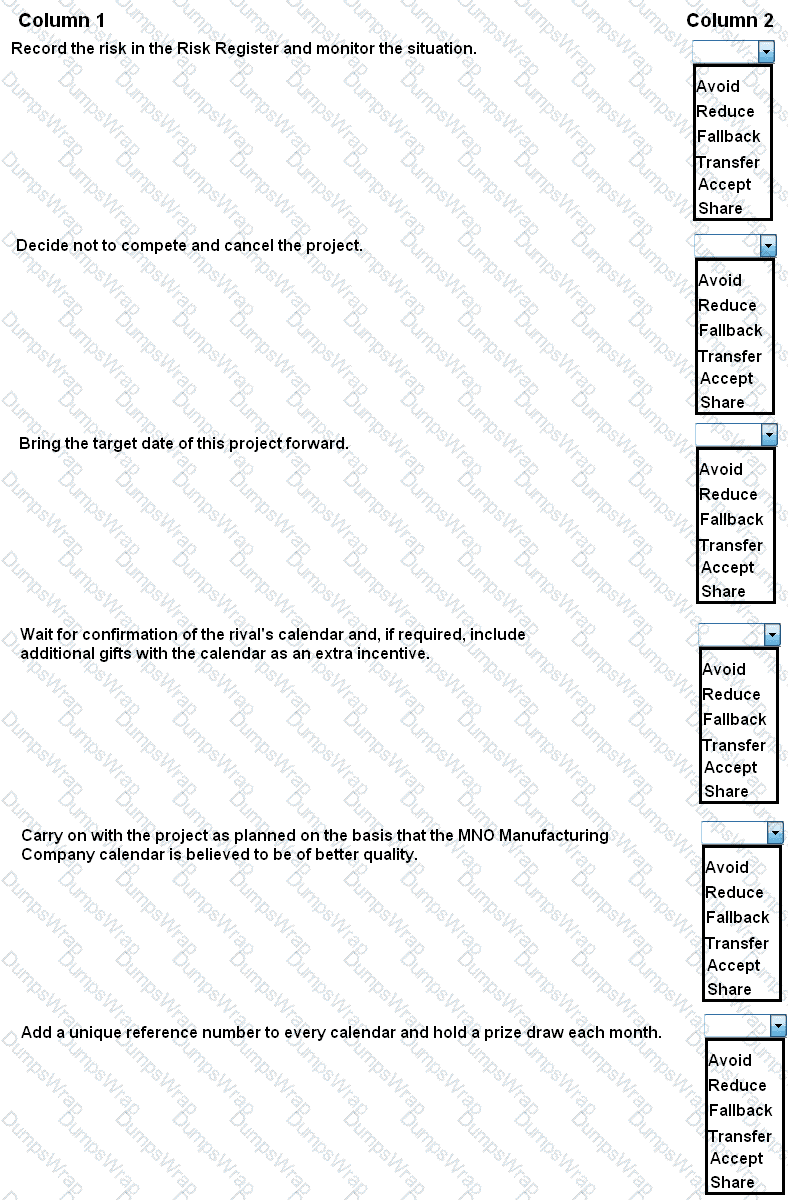
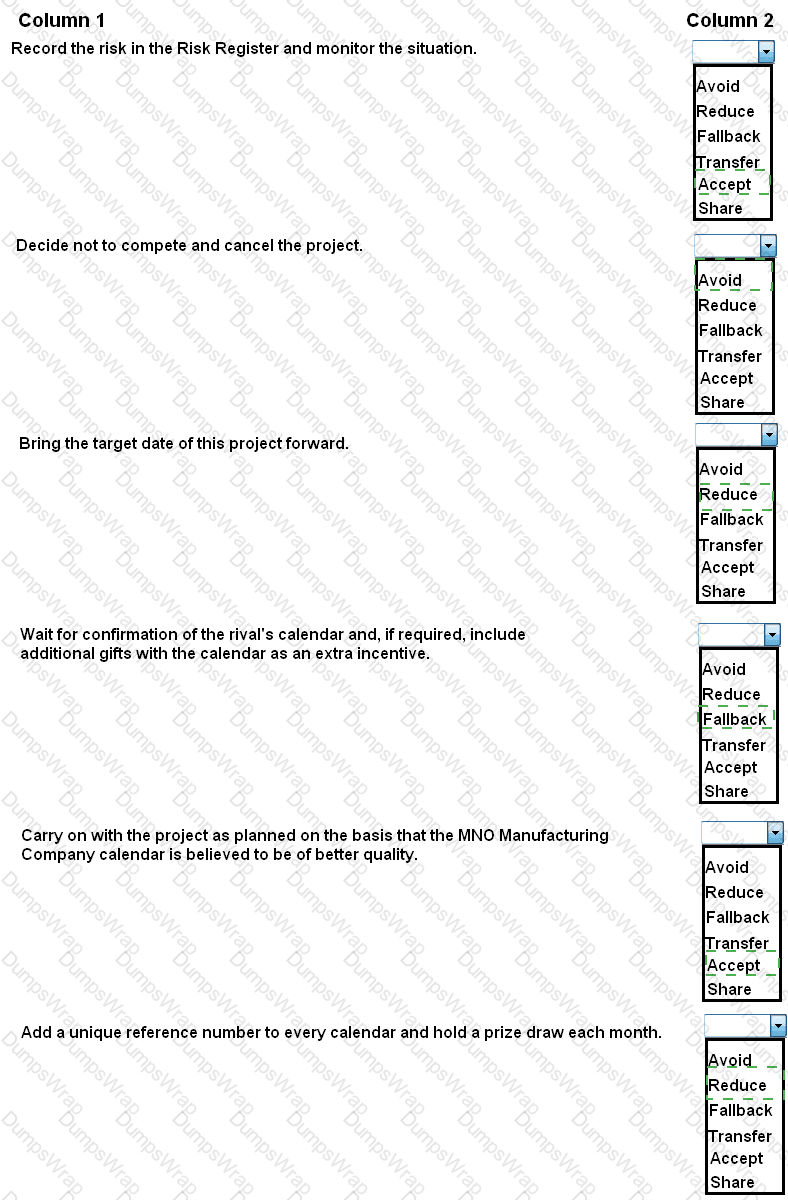
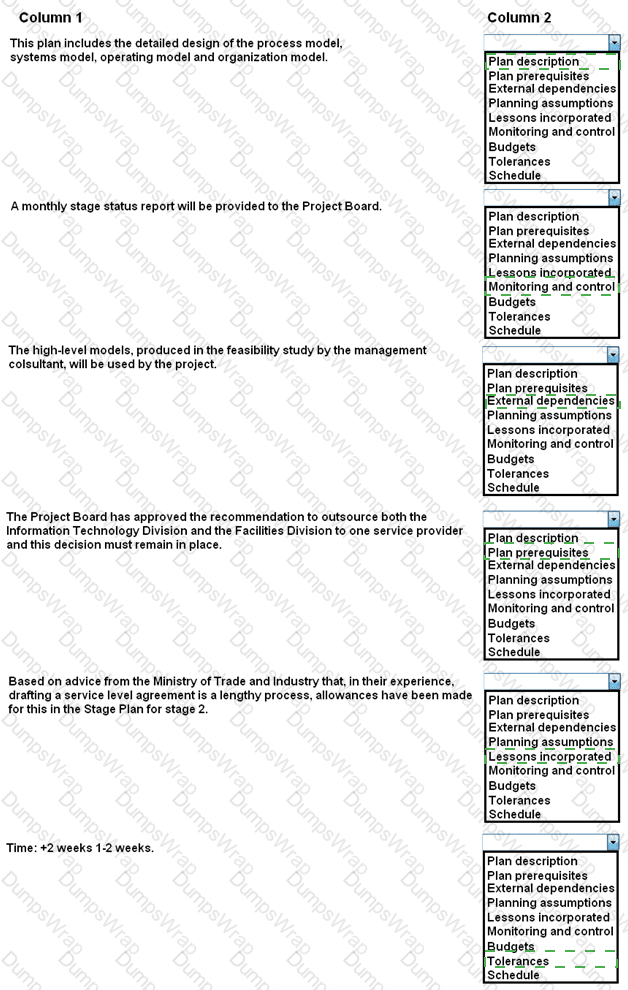
Column 1 contains a number of risk responses identified by the Project Manager following an assessment of this risk. Column 2 contains a list of threat response types. For each risk response in Column 1, select from Column 2 the type of response it represents. Each option from Column 2 can be used once, more than once or not at all.
Drop down the right answer.
There are four steps in the Risk Management procedure, what are they?
Which of the following statements is False regarding the Risk Management Strategy?
PRINCE2 proposes 3 levels of Plan, which are they?
Scenario
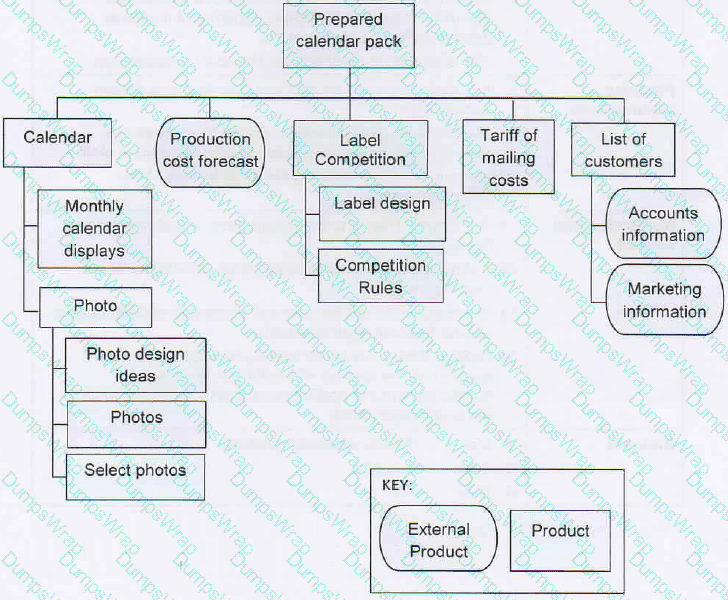
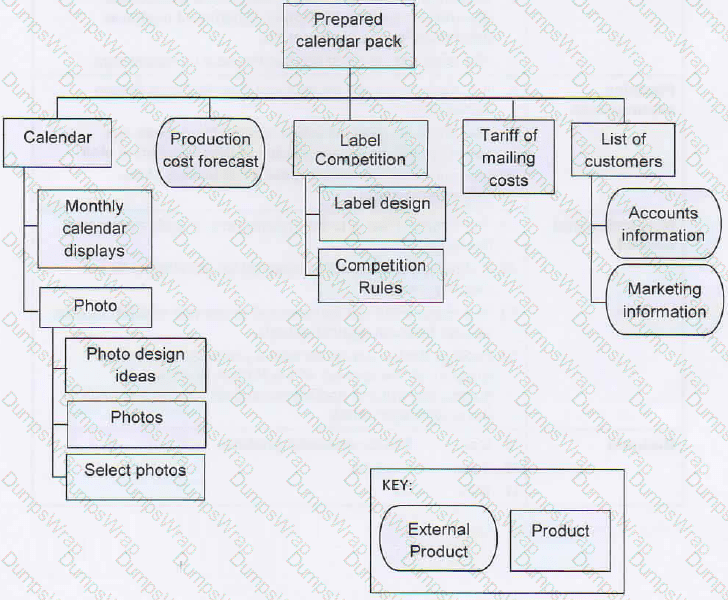
Product Summary
A list of customers will be collated. This will use existing information from the Accounts department about current customers, and existing information from the Marketing department about prospective customers.
Using the tariff of mailing costs available from the Post Office, a production cost forecast will be produced to allow the CEO and the Marketing Director to decide whether to continue with the project. If they decide to continue, they will give the approval to launch the internal label design competition. Competition rules will be required to communicate details of the competition to the staff. The chosen label design will then be selected from the competition entries.
The photos for the calendar must be based on existing photo design ideas available from the Marketing department. The selected photos will be chosen from these. Monthly calendar displays will be created to show the required layout of each page.
Product Breakdown Structure (contains errors)
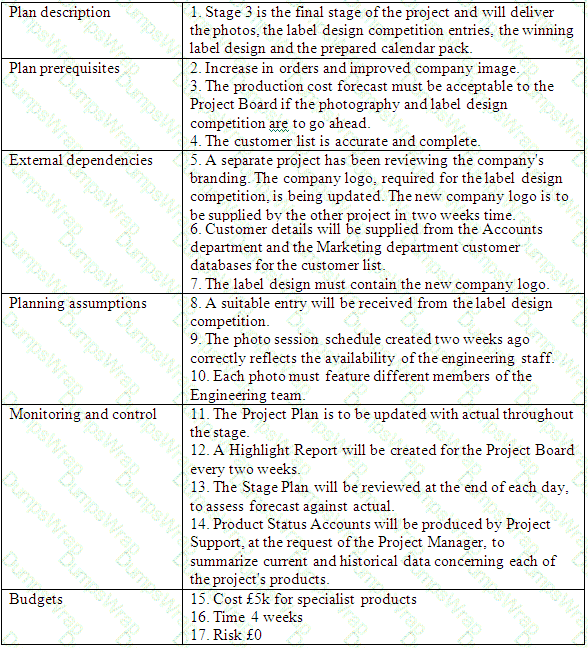
Extract from Stage Plan for stage 3.
(All entries are true statements but may not be shown under the correct heading or in the correct document).
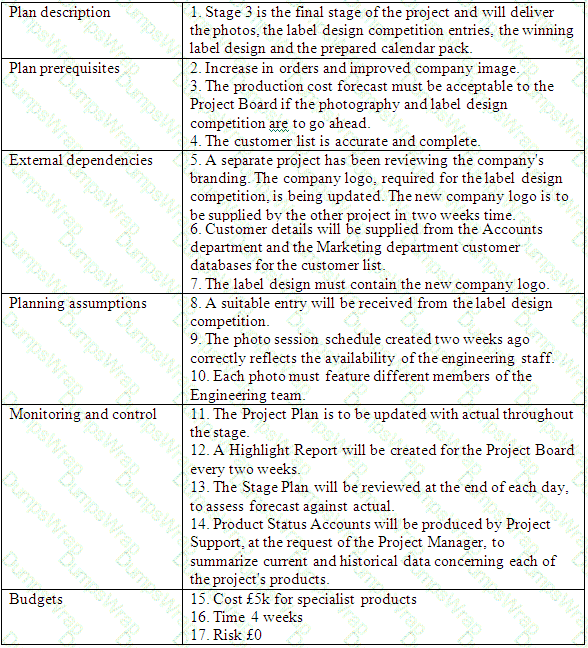
Using the Project Scenario and the Extract from Stage Plan for stage 3 provided as additional intonation for this question in the Scenario Booklet, answer the following 5 questions.
The Stage Plan for stage 3 has been produced.
The Engineering Manager insists that there are to be no interruptions to operations whilst photographs are being taken of the engineering staff performing their everyday duties and operating machinery. Two weeks ago the professional photographer produced the photo session schedule based on the operational staff schedule. The operational staff schedule is produced weekly and maintained by the Engineering Manager.
None of the £500 change budget has been used to date and this is available for the stage.
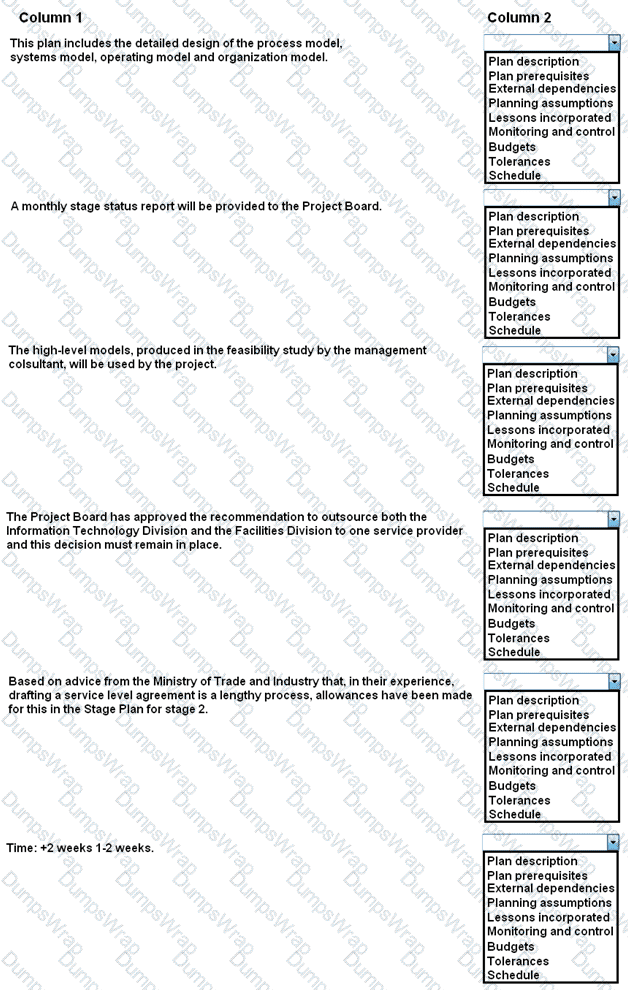
Which 2 statements apply to the External dependencies section?
Scenario
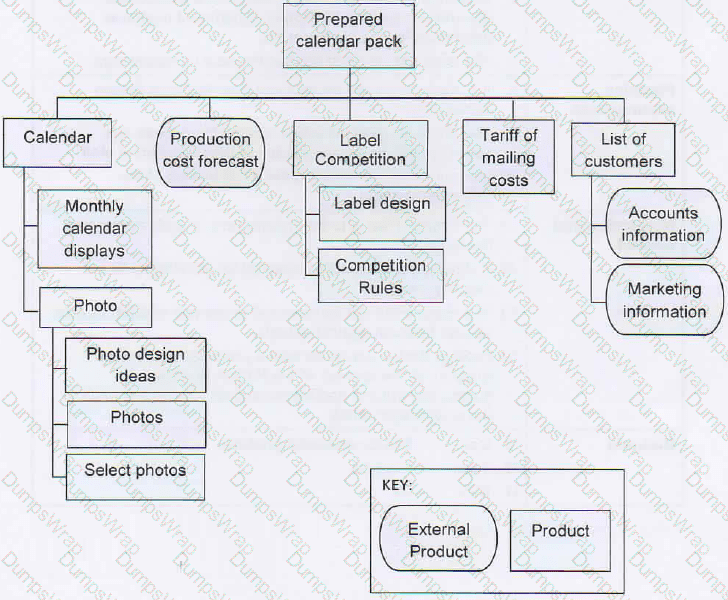
Product Summary
A list of customers will be collated. This will use existing information from the Accounts department about current customers, and existing information from the Marketing department about prospective customers.
Using the tariff of mailing costs available from the Post Office, a production cost forecast will be produced to allow the CEO and the Marketing Director to decide whether to continue with the project. If they decide to continue, they will give the approval to launch the internal label design competition. Competition rules will be required to communicate details of the competition to the staff. The chosen label design will then be selected from the competition entries.
The photos for the calendar must be based on existing photo design ideas available from the Marketing department. The selected photos will be chosen from these. Monthly calendar displays will be created to show the required layout of each page.
Product Breakdown Structure (contains errors)
Extract from Stage Plan for stage 3.
(All entries are true statements but may not be shown under the correct heading or in the correct document).
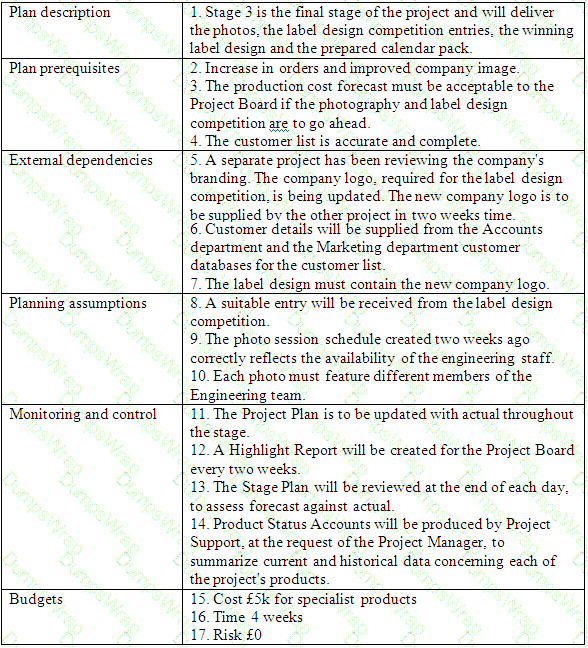
Using the Project Scenario and the Extract from Stage Plan for stage 3 provided as additional intonation for this question in the Scenario Booklet, answer the following 5 questions.
The Stage Plan for stage 3 has been produced.
The Engineering Manager insists that there are to be no interruptions to operations whilst photographs are being taken of the engineering staff performing their everyday duties and operating machinery. Two weeks ago the professional photographer produced the photo session schedule based on the operational staff schedule. The operational staff schedule is produced weekly and maintained by the Engineering Manager.
None of the £500 change budget has been used to date and this is available for the stage.
Which 2 statements apply to the Monitoring and control section?
Who sets the tolerances for a work package?
Having completed designing the plan, in which order should the next steps take place to produce a plan?
1. Prepare Estimates
2. Define and analyze Products
3. Prepare the schedule
4. Identify activities and dependencies
Drop down the right answer from Column 1 to column 2.
Scenario
Product Summary
A list of customers will be collated. This will use existing information from the Accounts department about current customers, and existing information from the Marketing department about prospective customers.
Using the tariff of mailing costs available from the Post Office, a production cost forecast will be produced to allow the CEO and the Marketing Director to decide whether to continue with the project. If they decide to continue, they will give the approval to launch the internal label design competition. Competition rules will be required to communicate details of the competition to the staff. The chosen label design will then be selected from the competition entries.
The photos for the calendar must be based on existing photo design ideas available from the Marketing department. The selected photos will be chosen from these. Monthly calendar displays will be created to show the required layout of each page.
Product Breakdown Structure (contains errors)
Extract from Stage Plan for stage 3.
(All entries are true statements but may not be shown under the correct heading or in the correct document).
Using the Project Scenario and the Extract from Stage Plan for stage 3 provided as additional intonation for this question in the Scenario Booklet, answer the following 5 questions.
The Stage Plan for stage 3 has been produced.
The Engineering Manager insists that there are to be no interruptions to operations whilst photographs are being taken of the engineering staff performing their everyday duties and operating machinery. Two weeks ago the professional photographer produced the photo session schedule based on the operational staff schedule. The operational staff schedule is produced weekly and maintained by the Engineering Manager.
None of the £500 change budget has been used to date and this is available for the stage.
Which 2 statements apply to the Budgets section?
The project is now in stage 2. The 'training venue specifications' will not be delivered to schedule and the stage is forecast to exceed its time tolerance. As a result, the project manager has agreed with the team manager that the 'training venue specifications' will be delivered in stage 3 instead of stage 2.
Is this an appropriate action, and why?
During the 'create the project plan' activity as part of the initiation stage, the project manager identifies several threats to the project timescales. These threats relate to stage 3 products. Therefore, the project manager decides to wait until the end of stage 2 to assess the risks to the project plan.
Is this an appropriate application of the plans theme, and why?
BUSINESS CASE
Here are three statements from the business case for the Health and Safety Project.
Under which heading in the business case (A-F) should they be recorded?
Choose only one heading for each statement. Each heading can be used once, more than once, or not at all.
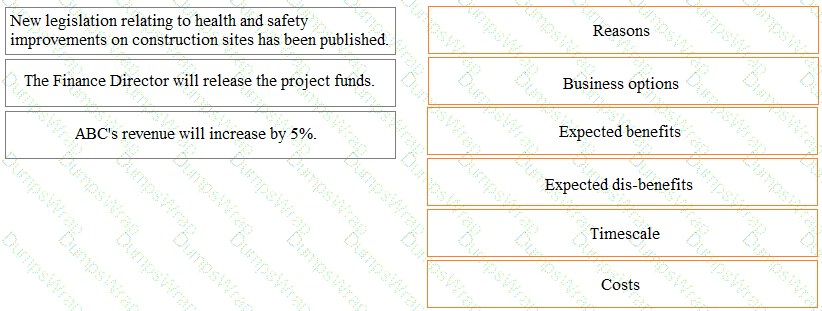
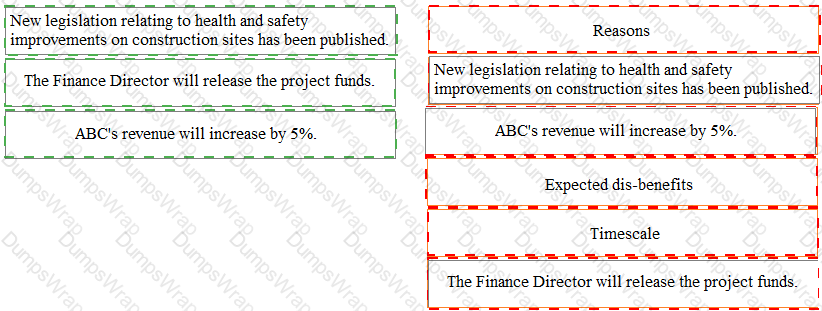
STARTING UP A PROJECT
Here are three actions carried out by the project manager during the ‘starting up a project’ process.
As part of which activity (A-F) should each action be carried out?
Choose only one activity for each action. Each activity can be used once, more than once, or not at all.
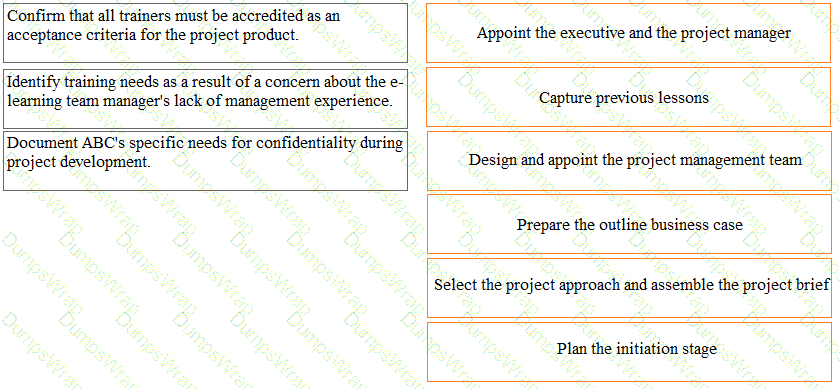
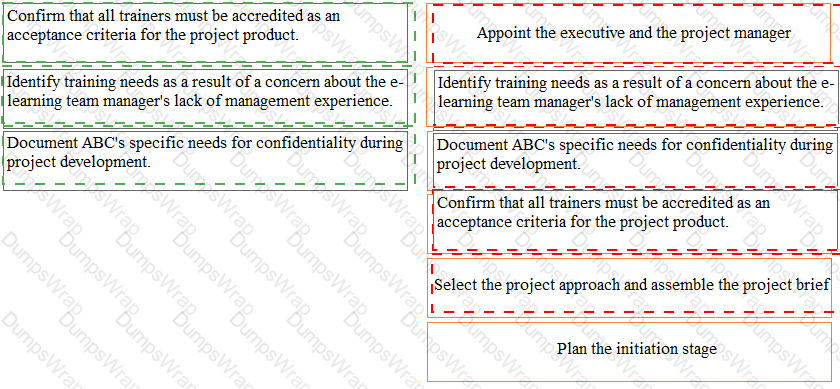
The project is in stage 3. Zero time tolerance has been given for this stage. When checking progress, the project manager noticed that the checkpoint report from the external supplier of the 'e-learning course' is late. As work package progress information is missing, the project manager has decided to raise an exception report.
Is this an appropriate action, and why?
Project Scenario – Health and Safety Training Project:
ABC Company is a well-established training company that uses a standard model to develop training materials and deliver courses to customers.
ABC Company has commissioned a project in response to recent changes in government legislation relating to health and safety on construction sites. The project will deliver “capability to provide health and safety training”, including the materials needed for classroom-based training and e-learning. The expected benefits for construction companies include a reduction in lost days and legal costs due to accidents.
The e-learning course will be developed by a specialist external consultancy. The materials for classroom-based training will be delivered by ABC Company’s development team. All course materials will be piloted before they are used. ABC Company will deliver training to its customers and also hopes to sell the course materials to other training companies as part of their operational business. ABC Company will use their own sales and marketing departments to promote the courses.
The legislation requires construction companies to comply with the new legislation within two years. The course materials and trainers have to be accredited by a government agency before courses can be delivered. ABC Company is planning to deliver pilot courses within five months of starting the project.
The ABC Company standard development model for new courses recommends the following stages:
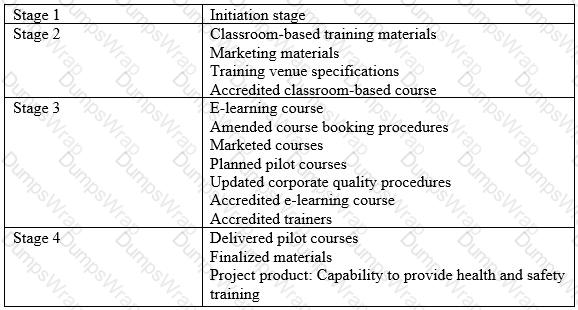
End of the Project scenario.
Additional Information:
The Chief Executive Officer (CEO) founded the company five years ago. Under her leadership, ABC Company has grown quickly into a successful training company. It delivers a range of accredited professional training.
The Finance Director is also a founder member of ABC Company and is responsible for authorizing budgets for the Operations and Development Teams. She authorizes all large contracts personally.
The Purchasing Manager reports to the Finance Director and is responsible for managing and monitoring supplier contracts.
The Operations Director is responsible for the delivery off all training and for the training development budget. His department organizes courses, venues and trainers. They work with the Product and the Sales teams to provide a comprehensive training schedule. ABC Company’s IT manager reports to the Operations Director.
The Business Development Director has recently been appointed to identify new training needs and propose new products. She will work with the Operations. Director to ensure a cost-conscious approach and that appropriate development technologies are used for the health and safety course.
The Training Development Manager reports to the Business Development Director and is responsible for developing training materials and gaining accreditation, in accordance with the standard course development model. Course developers in his team have skills in a range of development technologies and are allocated to projects as needed.
The Training Delivery Manager, who reports to the Operations Director, is responsible for ensuring that internal and external trainers deliver ABC Company training courses to the required standard. He also checks course materials to ensure they are fit for purpose and of the required quality.
The Central Services Director has responsibility for corporate communications, facilities management and configuration management. He recently led a project to consolidate all company quality systems into one quality management system and set up a corporate quality department, now managed by the Corporate Quality Manager.
The Corporate Document Manager reports to the Central Services Director. She helped establish the company’s document management system and now operates it across the business. She manages a team of administrators and contracts staff when workload is high.
The Sales Director joined ABC Company two months ago and is keen to establish himself by suggesting new markets for the courses and material. All account managers and the marketing team report to him. They promote existing training courses to other training companies and existing customers.
End of the additional information.
The Training Delivery Manager was identified as the senior user. However, before the project begins, this manager goes on long-term sick leave. The executive says that they do not need to replace the role of senior user on the project board.
Is this an appropriate application of the 'defined roles and responsibilities' principle, and why?
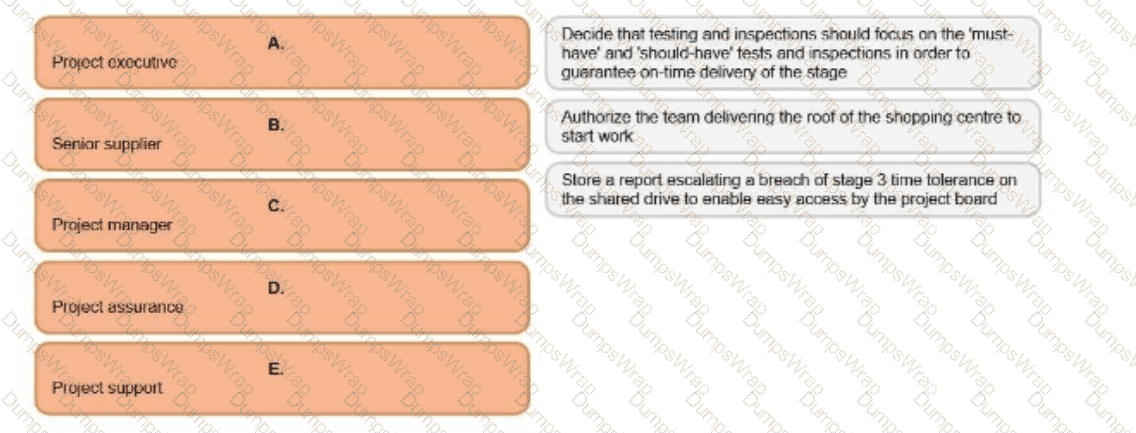
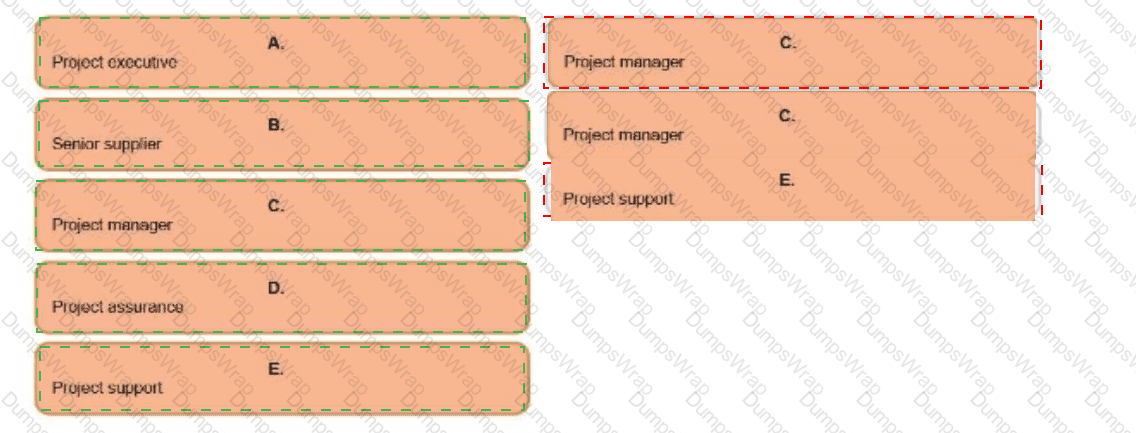
PROGRESS
Here are three actions related to the ‘progress’ practice for the LouisShopping project.
Which role (A–E) should be responsible for each action?
Choose only ONE role for each action. Each role can be used once, more than once, or not at all.
Scenario
Additional Information
Product Description
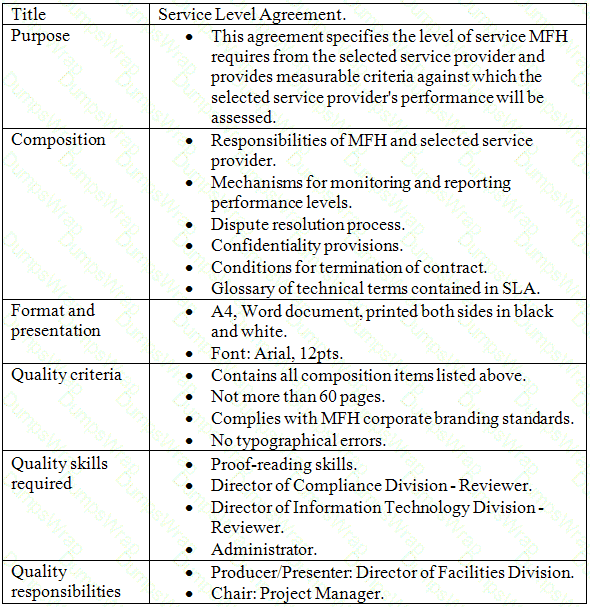
Quality notes from the Daily Log
The Director of Information Technology Division (DIT) has been asked to ensure that any changes to the outsourced staff employment contracts adhere to employment law. The DIT will review future job descriptions of the transferred staff before the final contract is signed with the selected service provider.
The service level agreement between MFH and the selected service provider will specify the type and quality of service required. The selected service provider must follow the industry standards for providing outsourced services.
MFH has a quality management system which contains a document control procedure for all its documentation, however this does not include change management.
All project documents will be subject to a quality review. Nominated products will require a formal approval record signed-off by the quality review chair.
Extract from the draft Quality Management Strategy (may contain errors)
Introduction
1. This document defines the approach to be taken to achieve the required quality levels during the project.
2. The Project Board will have overall responsibility for the Quality Management Strategy.
3. Project Assurance will provide assurance on the implementation of the Quality Management Strategy.
Quality management procedure - Quality standards
4. The selected service provider will operate to industry standards for providing outsourced services.
5. MFH document standards will be used.
Records
6. A Quality Register will be maintained to record the planned quality events and the actual results from the quality activities.
7. Configuration Item Records will be maintained for each product to describe its status, version and variant.
8. Approval records for products that require them will be stored in the quality database.
Roles and responsibilities
9. The DIT will check that the employment contracts for outsourced staff adhere to employment law.
10. Team Managers will provide details of quality checks that have been carried out.
11. Team Managers will ensure that the Quality Register is updated with the names of team members who are involved in the review process.
12. The Senior User will review the Product Descriptions of the products to be produced by the selected service provider to ensure that they can be achieved.
The service level agreement looks like any other MFH document.
Scenario
Additional Information
Product Description
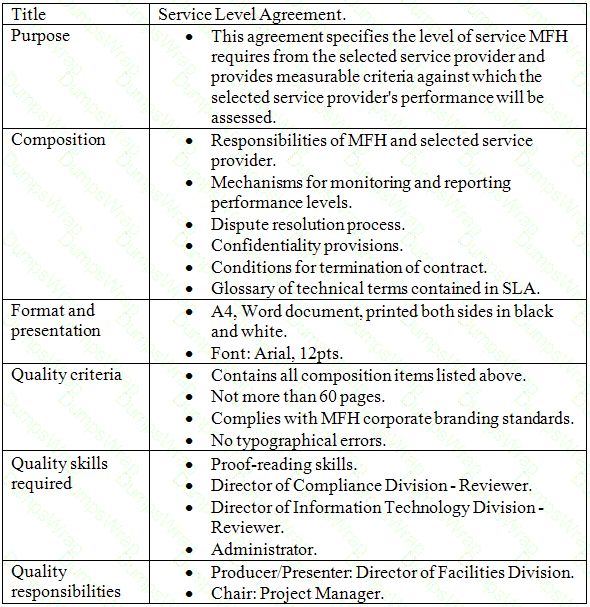
Quality notes from the Daily Log
The Director of Information Technology Division (DIT) has been asked to ensure that any changes to the outsourced staff employment contracts adhere to employment law. The DIT will review future job descriptions of the transferred staff before the final contract is signed with the selected service provider.
The service level agreement between MFH and the selected service provider will specify the type and quality of service required. The selected service provider must follow the industry standards for providing outsourced services.
MFH has a quality management system which contains a document control procedure for all its documentation, however this does not include change management.
All project documents will be subject to a quality review. Nominated products will require a formal approval record signed-off by the quality review chair.
Extract from the draft Quality Management Strategy (may contain errors)
Introduction
1. This document defines the approach to be taken to achieve the required quality levels during the project.
2. The Project Board will have overall responsibility for the Quality Management Strategy.
3. Project Assurance will provide assurance on the implementation of the Quality Management Strategy.
Quality management procedure - Quality standards
4. The selected service provider will operate to industry standards for providing outsourced services.
5. MFH document standards will be used.
Records
6. A Quality Register will be maintained to record the planned quality events and the actual results from the quality activities.
7. Configuration Item Records will be maintained for each product to describe its status, version and variant.
8. Approval records for products that require them will be stored in the quality database.
Roles and responsibilities
9. The DIT will check that the employment contracts for outsourced staff adhere to employment law.
10. Team Managers will provide details of quality checks that have been carried out.
11. Team Managers will ensure that the Quality Register is updated with the names of team members who are involved in the review process.
12. The Senior User will review the Product Descriptions of the products to be produced by the selected service provider to ensure that they can be achieved.
Which statement applies to the Introduction section?
Scenario
Additional Information
Product Description
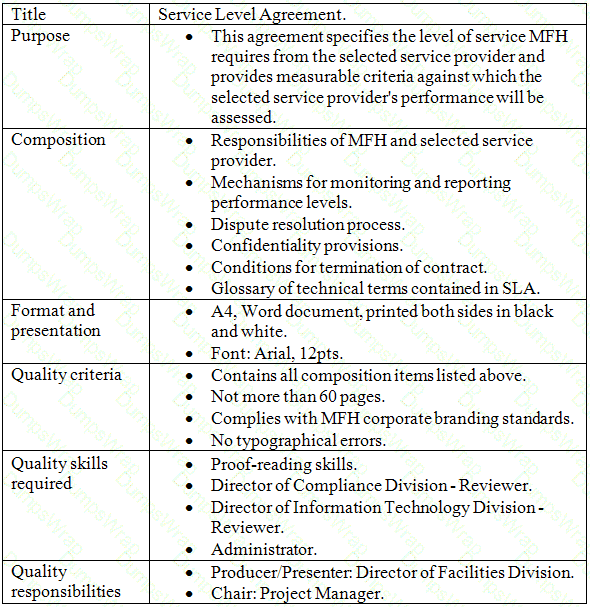
Quality notes from the Daily Log
The Director of Information Technology Division (DIT) has been asked to ensure that any changes to the outsourced staff employment contracts adhere to employment law. The DIT will review future job descriptions of the transferred staff before the final contract is signed with the selected service provider.
The service level agreement between MFH and the selected service provider will specify the type and quality of service required. The selected service provider must follow the industry standards for providing outsourced services.
MFH has a quality management system which contains a document control procedure for all its documentation, however this does not include change management.
All project documents will be subject to a quality review. Nominated products will require a formal approval record signed-off by the quality review chair.
Extract from the draft Quality Management Strategy (may contain errors)
Introduction
1. This document defines the approach to be taken to achieve the required quality levels during the project.
2. The Project Board will have overall responsibility for the Quality Management Strategy.
3. Project Assurance will provide assurance on the implementation of the Quality Management Strategy.
Quality management procedure - Quality standards
4. The selected service provider will operate to industry standards for providing outsourced services.
5. MFH document standards will be used.
Records
6. A Quality Register will be maintained to record the planned quality events and the actual results from the quality activities.
7. Configuration Item Records will be maintained for each product to describe its status, version and variant.
8. Approval records for products that require them will be stored in the quality database.
Roles and responsibilities
9. The DIT will check that the employment contracts for outsourced staff adhere to employment law.
10. Team Managers will provide details of quality checks that have been carried out.
11. Team Managers will ensure that the Quality Register is updated with the names of team members who are involved in the review process.
12. The Senior User will review the Product Descriptions of the products to be produced by the selected service provider to ensure that they can be achieved.
Which is a correctly defined acceptance criterion for the running cost of the outsourced service?
Which management product defines the detailed nature, purpose and function of a product?
Scenario
Extract from the Project Product Description (with errors)
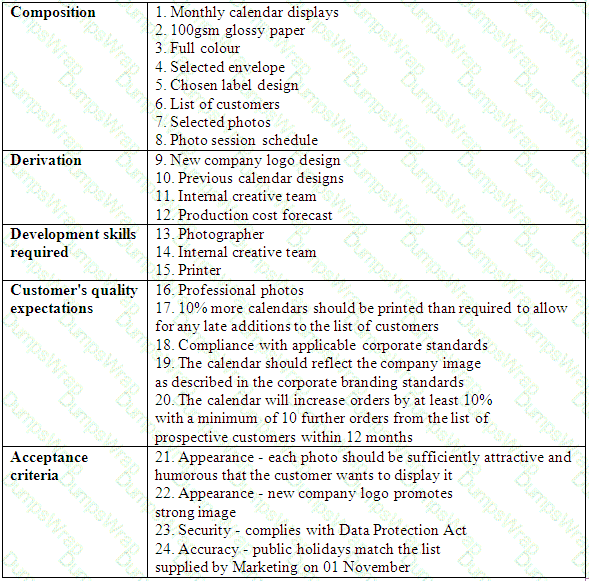
Which 2 statements apply to the Acceptance criteria section?
Extract from the Project Product Description (with errors)
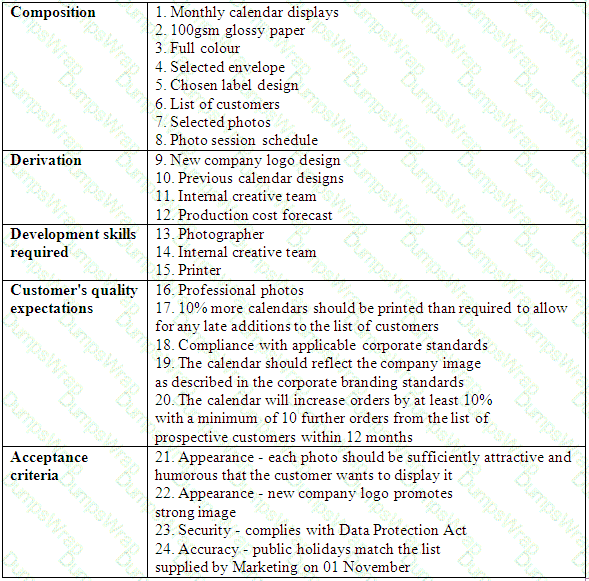
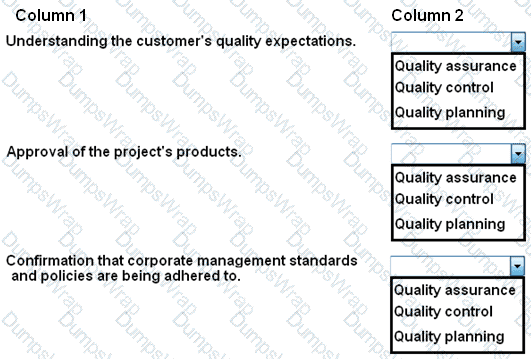
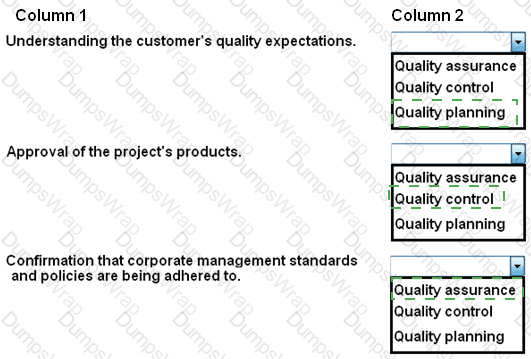
Column 1 is a list of objectives. For each objective in Column 1, select from Column 2 the quality activity that addresses it. Each selection from Column 2 can be used once, more than once or not at all. Drop down the right answer.
Scenario
Additional Information
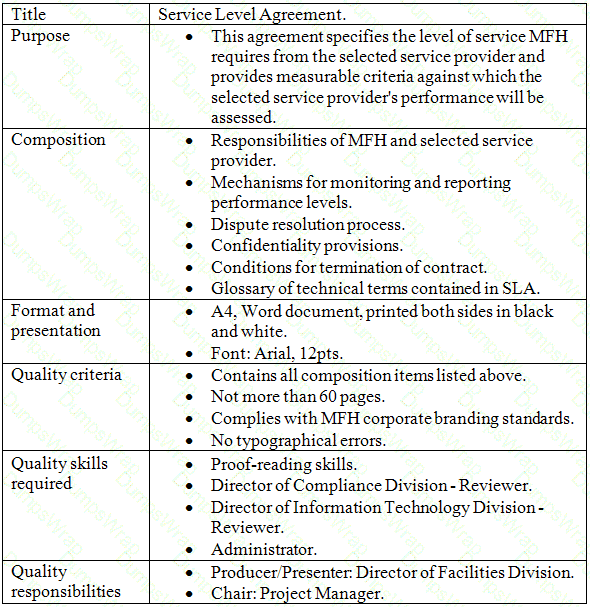
Product Description
Quality notes from the Daily Log
The Director of Information Technology Division (DIT) has been asked to ensure that any changes to the outsourced staff employment contracts adhere to employment law. The DIT will review future job descriptions of the transferred staff before the final contract is signed with the selected service provider.
The service level agreement between MFH and the selected service provider will specify the type and quality of service required. The selected service provider must follow the industry standards for providing outsourced services.
MFH has a quality management system which contains a document control procedure for all its documentation, however this does not include change management.
All project documents will be subject to a quality review. Nominated products will require a formal approval record signed-off by the quality review chair.
Extract from the draft Quality Management Strategy (may contain errors)
Introduction
1. This document defines the approach to be taken to achieve the required quality levels during the project.
2. The Project Board will have overall responsibility for the Quality Management Strategy.
3. Project Assurance will provide assurance on the implementation of the Quality Management Strategy.
Quality management procedure - Quality standards
4. The selected service provider will operate to industry standards for providing outsourced services.
5. MFH document standards will be used.
Records
6. A Quality Register will be maintained to record the planned quality events and the actual results from the quality activities.
7. Configuration Item Records will be maintained for each product to describe its status, version and variant.
8. Approval records for products that require them will be stored in the quality database.
Roles and responsibilities
9. The DIT will check that the employment contracts for outsourced staff adhere to employment law.
10. Team Managers will provide details of quality checks that have been carried out.
11. Team Managers will ensure that the Quality Register is updated with the names of team members who are involved in the review process.
12. The Senior User will review the Product Descriptions of the products to be produced by the selected service provider to ensure that they can be achieved.
Although it is not specified in the current corporate branding standards, the MFH corporate logo should be shown on the front page of the service level agreement.
Scenario
A central government department, the Ministry of Food Hygiene (MFH), faces increasing pressure to cut costs, better manage suppliers’ performance and reduce the confusion caused by inadequate internal controls, outdated standards and outdated technology. External consultants were employed to conduct a feasibility study to identify options to address the problems, and the likely costs and benefits. The following options were considered:
● Do nothing.
● Re-engineer selected business functions.
● Outsource selected business functions.
The feasibility study concluded that there was a case for outsourcing the MFH Information Technology Division and the Facilities Division (maintenance of buildings and grounds). The recommendations were:
● One service provider should be contracted to provide the services currently provided by the Information Technology Division and the Facilities Division.
● A 10-year service contract should be agreed with the selected service provider.
The feasibility study developed high-level designs of the current organization, processes, systems and operating models, plus an outline Business Case for the required project. The external consultants also made the following recommendations for the management of the project:
● Use PRINCE2.
● Set up the project with 4 management stages:
Stage 1. Standard PRINCE2 initiation activities.
Stage 2. Create detailed designs (future organization, processes, systems and operating models) and the service level agreement between MFH and the future service provider.
Stage 3. Request and evaluate proposals, select service provider and agree contract.
Stage 4. Transfer equipment and staff, transfer responsibility for service provision and run trial period.
Initial estimates indicated that the project would cost £2.5m and take two years to complete.
MFH senior management agreed that there was a case for outsourcing, and accepted the recommendations as a basis for the project. There is an expected saving of £20m over 10 years.
The Outsourcing project has completed the Starting up a Project process and is now in the initiation stage. Because of the strategic importance of the project, the MFH Chief Executive Officer has taken the role of Executive. A PRINCE2-experienced Project Manager has been appointed from within MFH. Staff within the business functions being outsourced will work with the external consultants who conducted the feasibility study to define the detailed designs.
Which 2 statements should be recorded under the Expected dis-benefits heading?
Scenario
Additional Information
During the initiation stage the Project Manager met with the Marketing Director to find out more about the requirements of the promotional calendar and recorded the following notes:
There has been a reduction in the order numbers at the MNO Manufacturing due in part to the increased marketing activities of its competitors. 10% of customers have not re-ordered in this financial year and staff morale is poor. A number of skilled staff have left as a result and replacement staff have not been recruited due to the reduced operation. If the project is successful, a recruitment campaign will be required to fill the existing staff vacancies and there may be a requirement for additional staff. Operational costs are likely to increase because skilled staff are expensive and difficult to find.
In financial terms, there were a total of 1,500 orders in the last financial year, each with an average profit of £2k. The Marketing department believes that sending a promotional calendar to our current and prospective customers would increase orders by at least 10% with a minimum of 10 further orders from the list of prospective customers within 12 months from the date of distribution.
The Marketing Director will be funding the project from the business marketing budget. She believes that the effect of a good company image portrayed by a successful calendar would last into a second year. She has forecast the same increase in orders for a second year and predicts that the annual employee satisfaction survey will show a measurable improvement in staff morale.
A number of alternatives were explored, including:
20% discount for all repeat customers - not cost-effective and very short term
A promotional calendar as a free Christmas gift - would target current and prospective customers and the benefits would last into a second year
A series of television and press advertisements was too expensive
A direct mail shot to all customers - benefit would be short term
Creation of an internet website - would not suit all customers
The calendar is seen as the favored option, as long as the company's competitors do not increase their marketing activity. Whilst the Marketing department wants a very high quality, glossy product, the project management team must be aware of the cost this will incur.
Using the Project Scenario and the additional Information provided for this question In the Scenario Booklet, answer the following question.
Which 2 statements should be recorded under the Expected dis-benefits heading?
Scenario
Additional Information
During the initiation stage the Project Manager met with the Marketing Director to find out more about the requirements of the promotional calendar and recorded the following notes:
There has been a reduction in the order numbers at the MNO Manufacturing due in part to the increased marketing activities of its competitors. 10% of customers have not re-ordered in this financial year and staff morale is poor. A number of skilled staff have left as a result and replacement staff have not been recruited due to the reduced operation. If the project is successful, a recruitment campaign will be required to fill the existing staff vacancies and there may be a requirement for additional staff. Operational costs are likely to increase because skilled staff are expensive and difficult to find.
In financial terms, there were a total of 1,500 orders in the last financial year, each with an average profit of £2k. The Marketing department believes that sending a promotional calendar to our current and prospective customers would increase orders by at least 10% with a minimum of 10 further orders from the list of prospective customers within 12 months from the date of distribution.
The Marketing Director will be funding the project from the business marketing budget. She believes that the effect of a good company image portrayed by a successful calendar would last into a second year. She has forecast the same increase in orders for a second year and predicts that the annual employee satisfaction survey will show a measurable improvement in staff morale.
A number of alternatives were explored, including:
20% discount for all repeat customers - not cost-effective and very short term
A promotional calendar as a free Christmas gift - would target current and prospective customers and the benefits would last into a second year
A series of television and press advertisements was too expensive
A direct mail shot to all customers - benefit would be short term
Creation of an internet website - would not suit all customers
The calendar is seen as the favored option, as long as the company's competitors do not increase their marketing activity. Whilst the Marketing department wants a very high quality, glossy product, the project management team must be aware of the cost this will incur.
Using the Project Scenario and the additional Information provided for this question In the Scenario Booklet, answer the following question.
Which 2 statements should be recorded under the Expected benefits heading?
Scenario
A central government department, the Ministry of Food Hygiene (MFH), faces increasing pressure to cut costs, better manage suppliers’ performance and reduce the confusion caused by inadequate internal controls, outdated standards and outdated technology. External consultants were employed to conduct a feasibility study to identify options to address the problems, and the likely costs and benefits. The following options were considered:
● Do nothing.
● Re-engineer selected business functions.
● Outsource selected business functions.
The feasibility study concluded that there was a case for outsourcing the MFH Information Technology Division and the Facilities Division (maintenance of buildings and grounds). The recommendations were:
● One service provider should be contracted to provide the services currently provided by the Information Technology Division and the Facilities Division.
● A 10-year service contract should be agreed with the selected service provider.
The feasibility study developed high-level designs of the current organization, processes, systems and operating models, plus an outline Business Case for the required project. The external consultants also made the following recommendations for the management of the project:
● Use PRINCE2.
● Set up the project with 4 management stages:
Stage 1. Standard PRINCE2 initiation activities.
Stage 2. Create detailed designs (future organization, processes, systems and operating models) and the service level agreement between MFH and the future service provider.
Stage 3. Request and evaluate proposals, select service provider and agree contract.
Stage 4. Transfer equipment and staff, transfer responsibility for service provision and run trial period.
Initial estimates indicated that the project would cost £2.5m and take two years to complete.
MFH senior management agreed that there was a case for outsourcing, and accepted the recommendations as a basis for the project. There is an expected saving of £20m over 10 years.
The Outsourcing project has completed the Starting up a Project process and is now in the initiation stage. Because of the strategic importance of the project, the MFH Chief Executive Officer has taken the role of Executive. A PRINCE2-experienced Project Manager has been appointed from within MFH. Staff within the business functions being outsourced will work with the external consultants who conducted the feasibility study to define the detailed designs.
Which 2 statements should be recorded under the Timescale heading?
Scenario
A central government department, the Ministry of Food Hygiene (MFH), faces increasing pressure to cut costs, better manage suppliers’ performance and reduce the confusion caused by inadequate internal controls, outdated standards and outdated technology. External consultants were employed to conduct a feasibility study to identify options to address the problems, and the likely costs and benefits. The following options were considered:
● Do nothing.
● Re-engineer selected business functions.
● Outsource selected business functions.
The feasibility study concluded that there was a case for outsourcing the MFH Information Technology
Division and the Facilities Division (maintenance of buildings and grounds). The recommendations were:
● One service provider should be contracted to provide the services currently provided by the Information Technology Division and the Facilities Division.
● A 10-year service contract should be agreed with the selected service provider.
The feasibility study developed high-level designs of the current organization, processes, systems and operating models, plus an outline Business Case for the required project. The external consultants also made the following recommendations for the management of the project:
● Use PRINCE2.
● Set up the project with 4 management stages:
Stage 1. Standard PRINCE2 initiation activities.
Stage 2. Create detailed designs (future organization, processes, systems and operating models) and the service level agreement between MFH and the future service provider.
Stage 3. Request and evaluate proposals, select service provider and agree contract.
Stage 4. Transfer equipment and staff, transfer responsibility for service provision and run
trial period.
Initial estimates indicated that the project would cost £2.5m and take two years to complete.
MFH senior management agreed that there was a case for outsourcing, and accepted the recommendations as a basis for the project. There is an expected saving of £20m over 10 years.
The Outsourcing project has completed the Starting up a Project process and is now in the initiation stage. Because of the strategic importance of the project, the MFH Chief Executive Officer has taken the role of Executive. A PRINCE2-experienced Project Manager has been appointed from within MFH. Staff within the business functions being outsourced will work with the external consultants who conducted the feasibility study to define the detailed designs.
Which 2 statements should be recorded under the Expected benefits heading?
Which of the following statements is TRUE with regard to expected benefits?
Scenario
A central government department, the Ministry of Food Hygiene (MFH), faces increasing pressure to cut costs, better manage suppliers’ performance and reduce the confusion caused by inadequate internal controls, outdated standards and outdated technology. External consultants were employed to conduct a feasibility study to identify options to address the problems, and the likely costs and benefits. The following options were considered:
● Do nothing.
● Re-engineer selected business functions.
● Outsource selected business functions.
The feasibility study concluded that there was a case for outsourcing the MFH Information Technology Division and the Facilities Division (maintenance of buildings and grounds). The recommendations were:
● One service provider should be contracted to provide the services currently provided by the Information Technology Division and the Facilities Division.
● A 10-year service contract should be agreed with the selected service provider.
The feasibility study developed high-level designs of the current organization, processes, systems and operating models, plus an outline Business Case for the required project. The external consultants also made the following recommendations for the management of the project:
● Use PRINCE2.
● Set up the project with 4 management stages:
Stage 1. Standard PRINCE2 initiation activities.
Stage 2. Create detailed designs (future organization, processes, systems and operating models) and the service level agreement between MFH and the future service
provider.
Stage 3. Request and evaluate proposals, select service provider and agree contract.
Stage 4. Transfer equipment and staff, transfer responsibility for service provision and run trial period.
Initial estimates indicated that the project would cost £2.5m and take two years to complete.
MFH senior management agreed that there was a case for outsourcing, and accepted the recommendations as a basis for the project. There is an expected saving of £20m over 10 years.
The Outsourcing project has completed the Starting up a Project process and is now in the initiation stage. Because of the strategic importance of the project, the MFH Chief Executive Officer has taken the role of Executive. A PRINCE2-experienced Project Manager has been appointed from within MFH. Staff within the business functions being outsourced will work with the external consultants who conducted the feasibility study to define the detailed designs.
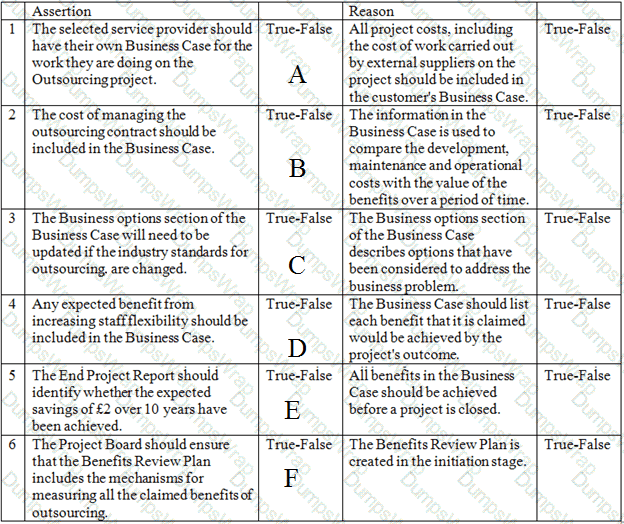
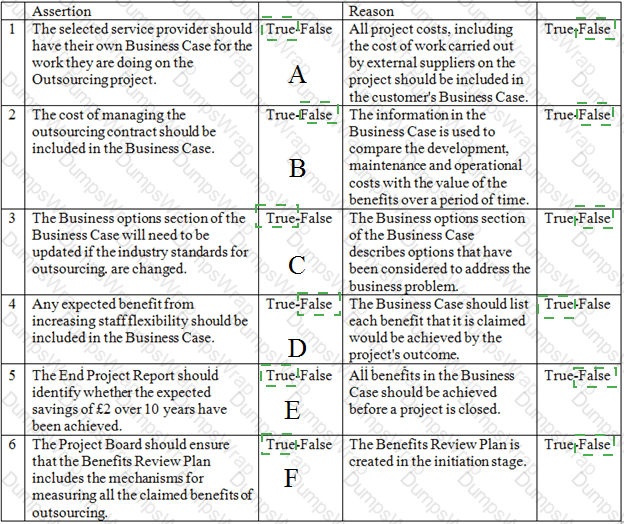
Lines 1 to 6 in the table below consist of an assertion statement and a reason statement. For each line identify the appropriate option, from options A to E, that applies. Each option can be used once, more than once or not at all.
The Work Package has been in progress for four weeks and has four weeks remaining. The Information Technology Team Manager is concerned that he has no idea what the service provider is doing about preparing to accept the transfer of Information Technology equipment and staff. He is uncertain about what should be happening.
Which 2 initial actions should the Team Manager take in response to this concern?
Which of the following principles describes this statement?
"xxx defines tolerances for each project objective to establish limits of delegated authority"
Which management product do the Project Board use to decide whether to authorize initiation?
The Team Manager has received notification that the new hardware and software solution has been installed and completed, but there is a concern that it has not been approved by the appropriate people.
Which 2 actions should the Team Manager take to check that the completed products have been approved as required?
It is now late October and the project is in stage 3. The label design competition has been held and the photos of the staff have been taken. The CEO and Marketing Director still need to choose the winning label design and the 12 photos for the calendar. However, the Executive has learned that two competitors are issuing calendars to MNO's customers by the middle of November. After analyzing the impact of this Issue, one of the options the Project Manager has presented to the Project Board is to close the project prematurely.
There are a number of key facts relating to this project that would need to be recorded if the project Y-e to be closed now.
Which product should show that the staff photo sessions were disruptive to the Engineering Department as they had been scheduled during peak work times without consultation with the Engineering Manager?
Which of the following statements is NOT correct?
The Learn from Experience principle suggests that lessons should be actively sought...
Two weeks after starting work the Team Manager noticed that each completed product had exceeded its estimated effort by around 10%. If this trend continues the Work Package will exceed its agreed cost tolerance of 5%.
Which 2 actions should the Team Manager take in response to this situation?
Which principle is supported by the activity Evaluate the Project?
When updating the project plan as part of Managing a stage boundary, what else might be updated?
Which of the following statements is FALSE regarding the Continued Business Justification?
The Manage by Exception principle sets tolerances for six areas of the project, Time. Cost and Quality are three of them, what are the other three?
Which of the following activities could trigger the production of an exception plan?
The Calendar project was delivered as originally planned, and Is now preparing for planned closure.
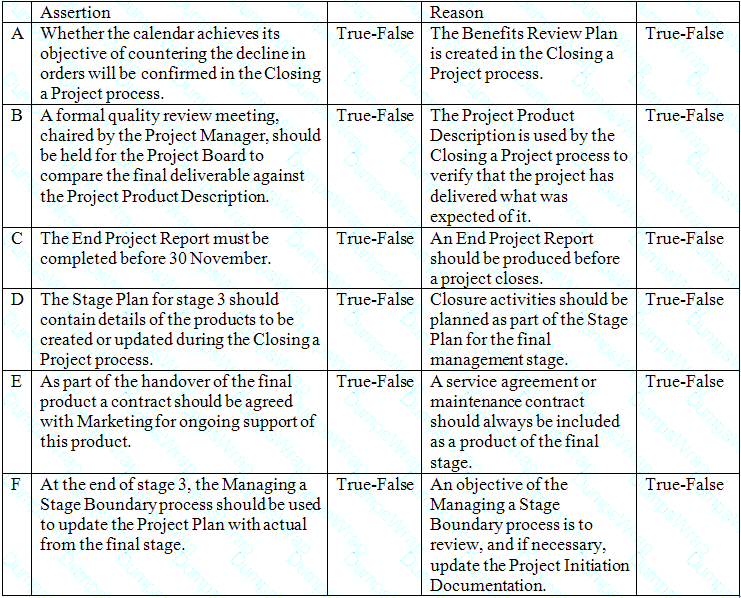
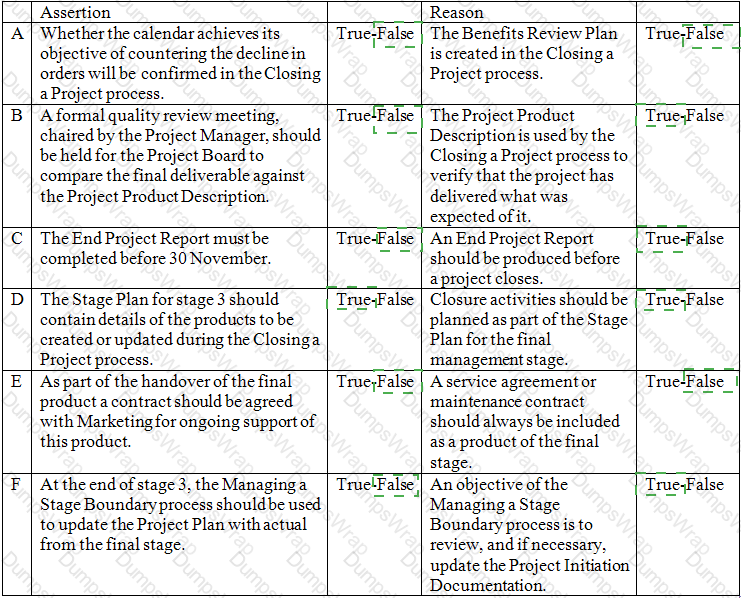
Lines 1 to 6 in the table below consist of an assertion statement and a reason statement. For each line identify the appropriate option, from options A to E, that applies. Each option can be used once, more than once or not at all.
Which of the following management products ARE updated as part of Managing a stage boundary?
1. Business Case
2. Benefits Review Plan
3. Configuration Item Records
4. Project Brief
Project Scenario – Health and Safety Training Project:
ABC Company is a well-established training company that uses a standard model to develop training materials and deliver courses to customers.
ABC Company has commissioned a project in response to recent changes in government legislation relating to health and safety on construction sites. The project will deliver “capability to provide health and safety training”, including the materials needed for classroom-based training and e-learning. The expected benefits for construction companies include a reduction in lost days and legal costs due to accidents.
The e-learning course will be developed by a specialist external consultancy. The materials for classroom-based training will be delivered by ABC Company’s development team. All course materials will be piloted before they are used. ABC Company will deliver training to its customers and also hopes to sell the course materials to other training companies as part of their operational business. ABC Company will use their own sales and marketing departments to promote the courses.
The legislation requires construction companies to comply with the new legislation within two years. The course materials and trainers have to be accredited by a government agency before courses can be delivered. ABC Company is planning to deliver pilot courses within five months of starting the project.
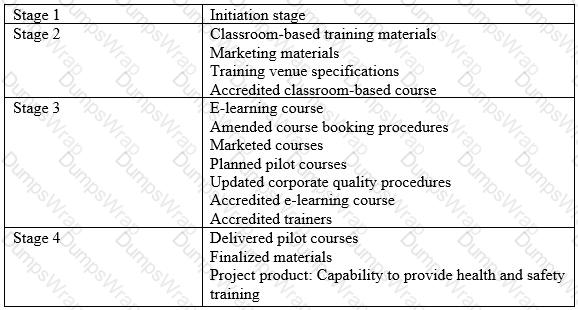
The ABC Company standard development model for new courses recommends the following stages:
End of the Project scenario.
Additional Information:
The Chief Executive Officer (CEO) founded the company five years ago. Under her leadership, ABC Company has grown quickly into a successful training company. It delivers a range of accredited professional training.
The Finance Director is also a founder member of ABC Company and is responsible for authorizing budgets for the Operations and Development Teams. She authorizes all large contracts personally.
The Purchasing Manager reports to the Finance Director and is responsible for managing and monitoring supplier contracts.
The Operations Director is responsible for the delivery off all training and for the training development budget. His department organizes courses, venues and trainers. They work with the Product and the Sales teams to provide a comprehensive training schedule. ABC Company’s IT manager reports to the Operations Director.
The Business Development Director has recently been appointed to identify new training needs and propose new products. She will work with the Operations. Director to ensure a cost-conscious approach and that appropriate development technologies are used for the health and safety course.
The Training Development Manager reports to the Business Development Director and is responsible for developing training materials and gaining accreditation, in accordance with the standard course development model. Course developers in his team have skills in a range of development technologies and are allocated to projects as needed.
The Training Delivery Manager, who reports to the Operations Director, is responsible for ensuring that internal and external trainers deliver ABC Company training courses to the required standard. He also checks course materials to ensure they are fit for purpose and of the required quality.
The Central Services Director has responsibility for corporate communications, facilities management and configuration management. He recently led a project to consolidate all company quality systems into one quality management system and set up a corporate quality department, now managed by the Corporate Quality Manager.
The Corporate Document Manager reports to the Central Services Director. She helped establish the company’s document management system and now operates it across the business. She manages a team of administrators and contracts staff when workload is high.
The Sales Director joined ABC Company two months ago and is keen to establish himself by suggesting new markets for the courses and material. All account managers and the marketing team report to him. They promote existing training courses to other training companies and existing customers.
End of the additional information.
RISK
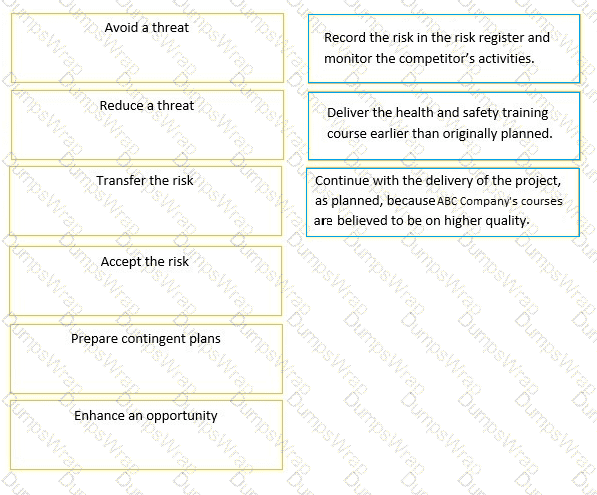
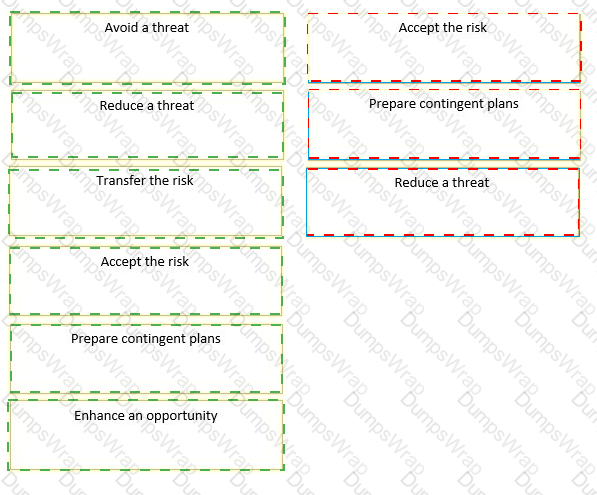
The project is in stage 2. The project manager has heard that a competitor may launch a similar e-learning course much sooner than ABC Company. There is a threat that the earlier launch of a competitor’s course may reduce the profitability of ABC Company training courses.
Here are three responses to this risk.
Which risk response type (A-F) are they?
Choose only one response type for each risk response. Each response type can be used once, more than once, or not at all.
Project Scenario – Health and Safety Training Project:
ABC Company is a well-established training company that uses a standard model to develop training materials and deliver courses to customers.
ABC Company has commissioned a project in response to recent changes in government legislation relating to health and safety on construction sites. The project will deliver “capability to provide health and safety training”, including the materials needed for classroom-based training and e-learning. The expected benefits for construction companies include a reduction in lost days and legal costs due to accidents.
The e-learning course will be developed by a specialist external consultancy. The materials for classroom-based training will be delivered by ABC Company’s development team. All course materials will be piloted before they are used. ABC Company will deliver training to its customers and also hopes to sell the course materials to other training companies as part of their operational business. ABC Company will use their own sales and marketing departments to promote the courses.
The legislation requires construction companies to comply with the new legislation within two years. The course materials and trainers have to be accredited by a government agency before courses can be delivered. ABC Company is planning to deliver pilot courses within five months of starting the project.
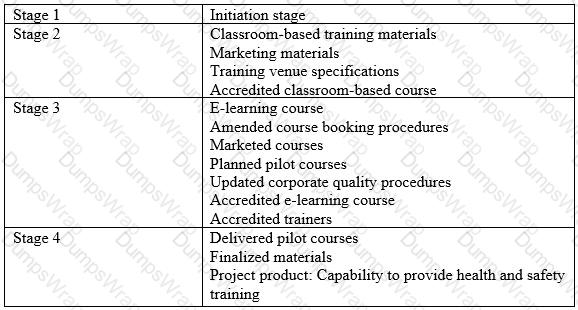
The ABC Company standard development model for new courses recommends the following stages:
End of the Project scenario.
Additional Information:
The Chief Executive Officer (CEO) founded the company five years ago. Under her leadership, ABC Company has grown quickly into a successful training company. It delivers a range of accredited professional training.
The Finance Director is also a founder member of ABC Company and is responsible for authorizing budgets for the Operations and Development Teams. She authorizes all large contracts personally.
The Purchasing Manager reports to the Finance Director and is responsible for managing and monitoring supplier contracts.
The Operations Director is responsible for the delivery off all training and for the training development budget. His department organizes courses, venues and trainers. They work with the Product and the Sales teams to provide a comprehensive training schedule. ABC Company’s IT manager reports to the Operations Director.
The Business Development Director has recently been appointed to identify new training needs and propose new products. She will work with the Operations. Director to ensure a cost-conscious approach and that appropriate development technologies are used for the health and safety course.
The Training Development Manager reports to the Business Development Director and is responsible for developing training materials and gaining accreditation, in accordance with the standard course development model. Course developers in his team have skills in a range of development technologies and are allocated to projects as needed.
The Training Delivery Manager, who reports to the Operations Director, is responsible for ensuring that internal and external trainers deliver ABC Company training courses to the required standard. He also checks course materials to ensure they are fit for purpose and of the required quality.
The Central Services Director has responsibility for corporate communications, facilities management and configuration management. He recently led a project to consolidate all company quality systems into one quality management system and set up a corporate quality department, now managed by the Corporate Quality Manager.
The Corporate Document Manager reports to the Central Services Director. She helped establish the company’s document management system and now operates it across the business. She manages a team of administrators and contracts staff when workload is high.
The Sales Director joined ABC Company two months ago and is keen to establish himself by suggesting new markets for the courses and material. All account managers and the marketing team report to him. They promote existing training courses to other training companies and existing customers.
End of the additional information.
ORGANIZATION
The communication management approach is being developed. ABC Company’s corporate management has agreed the information about proposed courses can be shared externally, provided that a non-disclosure agreement is signed and corporate management is informed.
Here are three items of information relating to the sharing of course materials.
Under which heading of the communication management approach (A-F) should they be included?
Choose only one heading for each item of information. Each heading can be used once, more than once, or not at all.
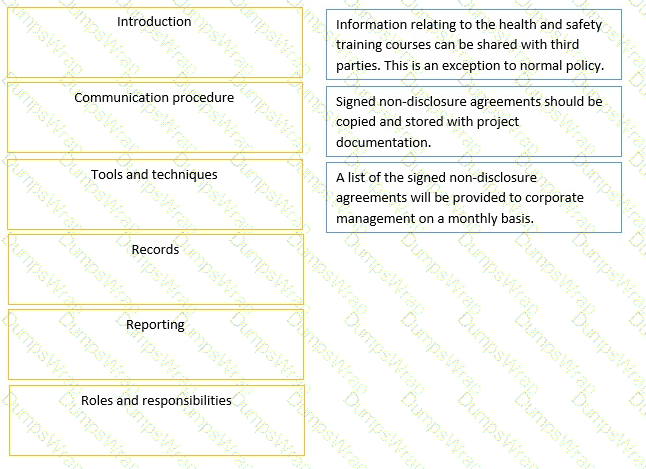
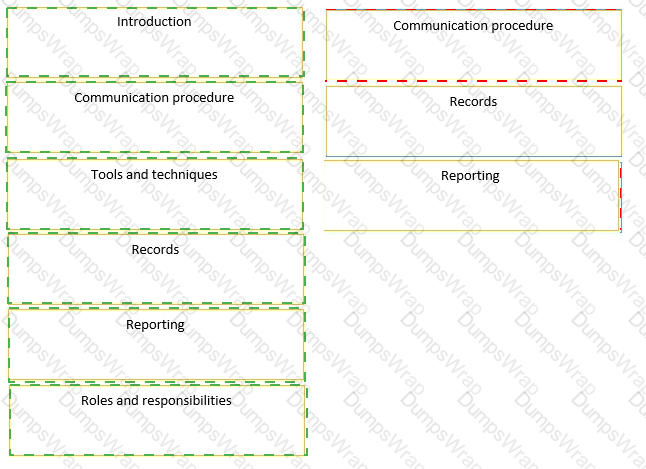
Project Scenario – Health and Safety Training Project:
ABC Company is a well-established training company that uses a standard model to develop training materials and deliver courses to customers.
ABC Company has commissioned a project in response to recent changes in government legislation relating to health and safety on construction sites. The project will deliver “capability to provide health and safety training”, including the materials needed for classroom-based training and e-learning. The expected benefits for construction companies include a reduction in lost days and legal costs due to accidents.
The e-learning course will be developed by a specialist external consultancy. The materials for classroom-based training will be delivered by ABC Company’s development team. All course materials will be piloted before they are used. ABC Company will deliver training to its customers and also hopes to sell the course materials to other training companies as part of their operational business. ABC Company will use their own sales and marketing departments to promote the courses.
The legislation requires construction companies to comply with the new legislation within two years. The course materials and trainers have to be accredited by a government agency before courses can be delivered. ABC Company is planning to deliver pilot courses within five months of starting the project.
The ABC Company standard development model for new courses recommends the following stages:
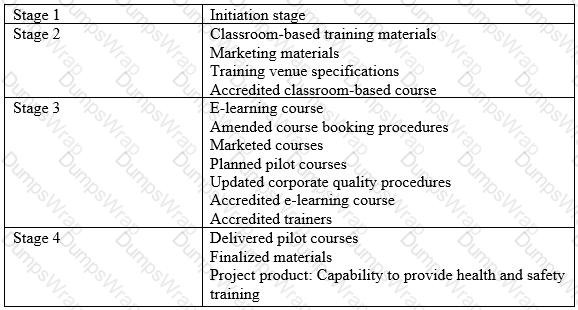
End of the Project scenario.
Additional Information:
The Chief Executive Officer (CEO) founded the company five years ago. Under her leadership, ABC Company has grown quickly into a successful training company. It delivers a range of accredited professional training.
The Finance Director is also a founder member of ABC Company and is responsible for authorizing budgets for the Operations and Development Teams. She authorizes all large contracts personally.
The Purchasing Manager reports to the Finance Director and is responsible for managing and monitoring supplier contracts.
The Operations Director is responsible for the delivery off all training and for the training development budget. His department organizes courses, venues and trainers. They work with the Product and the Sales teams to provide a comprehensive training schedule. ABC Company’s IT manager reports to the Operations Director.
The Business Development Director has recently been appointed to identify new training needs and propose new products. She will work with the Operations. Director to ensure a cost-conscious approach and that appropriate development technologies are used for the health and safety course.
The Training Development Manager reports to the Business Development Director and is responsible for developing training materials and gaining accreditation, in accordance with the standard course development model. Course developers in his team have skills in a range of development technologies and are allocated to projects as needed.
The Training Delivery Manager, who reports to the Operations Director, is responsible for ensuring that internal and external trainers deliver ABC Company training courses to the required standard. He also checks course materials to ensure they are fit for purpose and of the required quality.
The Central Services Director has responsibility for corporate communications, facilities management and configuration management. He recently led a project to consolidate all company quality systems into one quality management system and set up a corporate quality department, now managed by the Corporate Quality Manager.
The Corporate Document Manager reports to the Central Services Director. She helped establish the company’s document management system and now operates it across the business. She manages a team of administrators and contracts staff when workload is high.
The Sales Director joined ABC Company two months ago and is keen to establish himself by suggesting new markets for the courses and material. All account managers and the marketing team report to him. They promote existing training courses to other training companies and existing customers.
End of the additional information.
One of the senior managers of the company that is developing the ‘e-learning course’ has worked with ABC Company before. The team manager for the delivery of the ‘e-learning course’ has looked on ABC Company’s intranet, but cannot find any reference to this work. The team manager has contacted the senior manager to discuss this project.
Is this an appropriate application of the ‘learn from experience’ principle, and why?
Project Scenario – Health and Safety Training Project:
ABC Company is a well-established training company that uses a standard model to develop training materials and deliver courses to customers.
ABC Company has commissioned a project in response to recent changes in government legislation relating to health and safety on construction sites. The project will deliver “capability to provide health and safety training”, including the materials needed for classroom-based training and e-learning. The expected benefits for construction companies include a reduction in lost days and legal costs due to accidents.
The e-learning course will be developed by a specialist external consultancy. The materials for classroom-based training will be delivered by ABC Company’s development team. All course materials will be piloted before they are used. ABC Company will deliver training to its customers and also hopes to sell the course materials to other training companies as part of their operational business. ABC Company will use their own sales and marketing departments to promote the courses.
The legislation requires construction companies to comply with the new legislation within two years. The course materials and trainers have to be accredited by a government agency before courses can be delivered. ABC Company is planning to deliver pilot courses within five months of starting the project.
The ABC Company standard development model for new courses recommends the following stages:
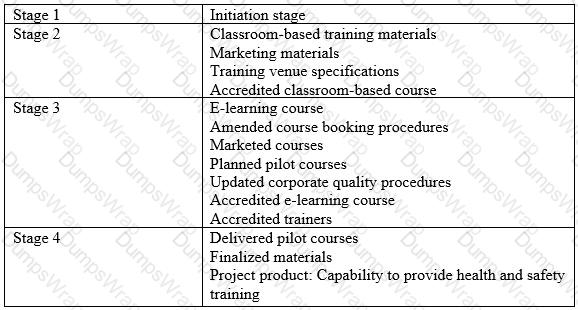
End of the Project scenario.
Additional Information:
The Chief Executive Officer (CEO) founded the company five years ago. Under her leadership, ABC Company has grown quickly into a successful training company. It delivers a range of accredited professional training.
The Finance Director is also a founder member of ABC Company and is responsible for authorizing budgets for the Operations and Development Teams. She authorizes all large contracts personally.
The Purchasing Manager reports to the Finance Director and is responsible for managing and monitoring supplier contracts.
The Operations Director is responsible for the delivery off all training and for the training development budget. His department organizes courses, venues and trainers. They work with the Product and the Sales teams to provide a comprehensive training schedule. ABC Company’s IT manager reports to the Operations Director.
The Business Development Director has recently been appointed to identify new training needs and propose new products. She will work with the Operations. Director to ensure a cost-conscious approach and that appropriate development technologies are used for the health and safety course.
The Training Development Manager reports to the Business Development Director and is responsible for developing training materials and gaining accreditation, in accordance with the standard course development model. Course developers in his team have skills in a range of development technologies and are allocated to projects as needed.
The Training Delivery Manager, who reports to the Operations Director, is responsible for ensuring that internal and external trainers deliver ABC Company training courses to the required standard. He also checks course materials to ensure they are fit for purpose and of the required quality.
The Central Services Director has responsibility for corporate communications, facilities management and configuration management. He recently led a project to consolidate all company quality systems into one quality management system and set up a corporate quality department, now managed by the Corporate Quality Manager.
The Corporate Document Manager reports to the Central Services Director. She helped establish the company’s document management system and now operates it across the business. She manages a team of administrators and contracts staff when workload is high.
The Sales Director joined ABC Company two months ago and is keen to establish himself by suggesting new markets for the courses and material. All account managers and the marketing team report to him. They promote existing training courses to other training companies and existing customers.
End of the additional information.
CHANGE
A request has been received from a user to add the function to pay by credit card to the ‘amended course booking procedures’ for the ‘e-learning course’. The user has suggested that sales of the course will be reduced if this change is not implemented.
Here are three actions relating to this request for change.
Which role (A-E) should carry out each action?
Choose only one role for each action. Each role can be used once, more than once, or not at all.
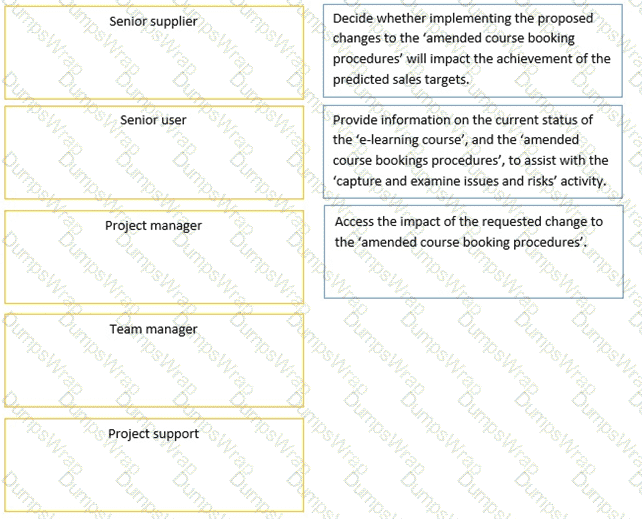
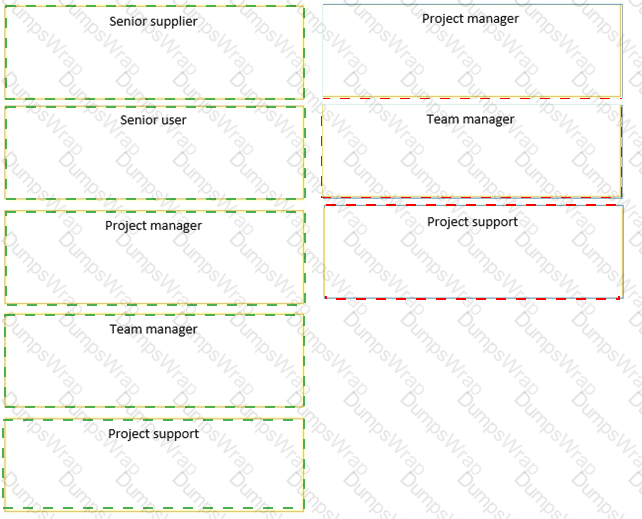
Project Scenario – Health and Safety Training Project:
ABC Company is a well-established training company that uses a standard model to develop training materials and deliver courses to customers.
ABC Company has commissioned a project in response to recent changes in government legislation relating to health and safety on construction sites. The project will deliver “capability to provide health and safety training”, including the materials needed for classroom-based training and e-learning. The expected benefits for construction companies include a reduction in lost days and legal costs due to accidents.
The e-learning course will be developed by a specialist external consultancy. The materials for classroom-based training will be delivered by ABC Company’s development team. All course materials will be piloted before they are used. ABC Company will deliver training to its customers and also hopes to sell the course materials to other training companies as part of their operational business. ABC Company will use their own sales and marketing departments to promote the courses.
The legislation requires construction companies to comply with the new legislation within two years. The course materials and trainers have to be accredited by a government agency before courses can be delivered. ABC Company is planning to deliver pilot courses within five months of starting the project.
The ABC Company standard development model for new courses recommends the following stages:
End of the Project scenario.
Additional Information:
The Chief Executive Officer (CEO) founded the company five years ago. Under her leadership, ABC Company has grown quickly into a successful training company. It delivers a range of accredited professional training.
The Finance Director is also a founder member of ABC Company and is responsible for authorizing budgets for the Operations and Development Teams. She authorizes all large contracts personally.
The Purchasing Manager reports to the Finance Director and is responsible for managing and monitoring supplier contracts.
The Operations Director is responsible for the delivery off all training and for the training development budget. His department organizes courses, venues and trainers. They work with the Product and the Sales teams to provide a comprehensive training schedule. ABC Company’s IT manager reports to the Operations Director.
The Business Development Director has recently been appointed to identify new training needs and propose new products. She will work with the Operations. Director to ensure a cost-conscious approach and that appropriate development technologies are used for the health and safety course.
The Training Development Manager reports to the Business Development Director and is responsible for developing training materials and gaining accreditation, in accordance with the standard course development model. Course developers in his team have skills in a range of development technologies and are allocated to projects as needed.
The Training Delivery Manager, who reports to the Operations Director, is responsible for ensuring that internal and external trainers deliver ABC Company training courses to the required standard. He also checks course materials to ensure they are fit for purpose and of the required quality.
The Central Services Director has responsibility for corporate communications, facilities management and configuration management. He recently led a project to consolidate all company quality systems into one quality management system and set up a corporate quality department, now managed by the Corporate Quality Manager.
The Corporate Document Manager reports to the Central Services Director. She helped establish the company’s document management system and now operates it across the business. She manages a team of administrators and contracts staff when workload is high.
The Sales Director joined ABC Company two months ago and is keen to establish himself by suggesting new markets for the courses and material. All account managers and the marketing team report to him. They promote existing training courses to other training companies and existing customers.
End of the additional information.
The development of the ‘e-learning course’ will be outsourced to an external supplier and their key members will join the project management team. The supplier wants to keep their work processes confidential and not share these with ABC Company. ABC Company has agreed.
Who should approve the external supplier’s team plan?
Project Scenario – Health and Safety Training Project:
ABC Company is a well-established training company that uses a standard model to develop training materials and deliver courses to customers.
ABC Company has commissioned a project in response to recent changes in government legislation relating to health and safety on construction sites. The project will deliver “capability to provide health and safety training”, including the materials needed for classroom-based training and e-learning. The expected benefits for construction companies include a reduction in lost days and legal costs due to accidents.
The e-learning course will be developed by a specialist external consultancy. The materials for classroom-based training will be delivered by ABC Company’s development team. All course materials will be piloted before they are used. ABC Company will deliver training to its customers and also hopes to sell the course materials to other training companies as part of their operational business. ABC Company will use their own sales and marketing departments to promote the courses.
The legislation requires construction companies to comply with the new legislation within two years. The course materials and trainers have to be accredited by a government agency before courses can be delivered. ABC Company is planning to deliver pilot courses within five months of starting the project.
The ABC Company standard development model for new courses recommends the following stages:
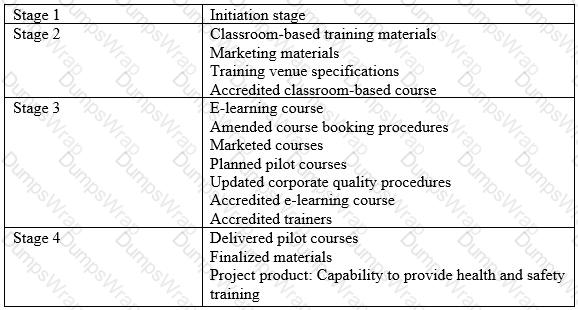
End of the Project scenario.
Additional Information:
The Chief Executive Officer (CEO) founded the company five years ago. Under her leadership, ABC Company has grown quickly into a successful training company. It delivers a range of accredited professional training.
The Finance Director is also a founder member of ABC Company and is responsible for authorizing budgets for the Operations and Development Teams. She authorizes all large contracts personally.
The Purchasing Manager reports to the Finance Director and is responsible for managing and monitoring supplier contracts.
The Operations Director is responsible for the delivery off all training and for the training development budget. His department organizes courses, venues and trainers. They work with the Product and the Sales teams to provide a comprehensive training schedule. ABC Company’s IT manager reports to the Operations Director.
The Business Development Director has recently been appointed to identify new training needs and propose new products. She will work with the Operations. Director to ensure a cost-conscious approach and that appropriate development technologies are used for the health and safety course.
The Training Development Manager reports to the Business Development Director and is responsible for developing training materials and gaining accreditation, in accordance with the standard course development model. Course developers in his team have skills in a range of development technologies and are allocated to projects as needed.
The Training Delivery Manager, who reports to the Operations Director, is responsible for ensuring that internal and external trainers deliver ABC Company training courses to the required standard. He also checks course materials to ensure they are fit for purpose and of the required quality.
The Central Services Director has responsibility for corporate communications, facilities management and configuration management. He recently led a project to consolidate all company quality systems into one quality management system and set up a corporate quality department, now managed by the Corporate Quality Manager.
The Corporate Document Manager reports to the Central Services Director. She helped establish the company’s document management system and now operates it across the business. She manages a team of administrators and contracts staff when workload is high.
The Sales Director joined ABC Company two months ago and is keen to establish himself by suggesting new markets for the courses and material. All account managers and the marketing team report to him. They promote existing training courses to other training companies and existing customers.
End of the additional information.
DIRECTING A PROJECT
Here are three actions that are carried out as part of the ‘directing a project’ process.
During which activity (A-E) should they be carried out?
Choose only one activity for each action. Each activity can be used once, more than once, or not at all.
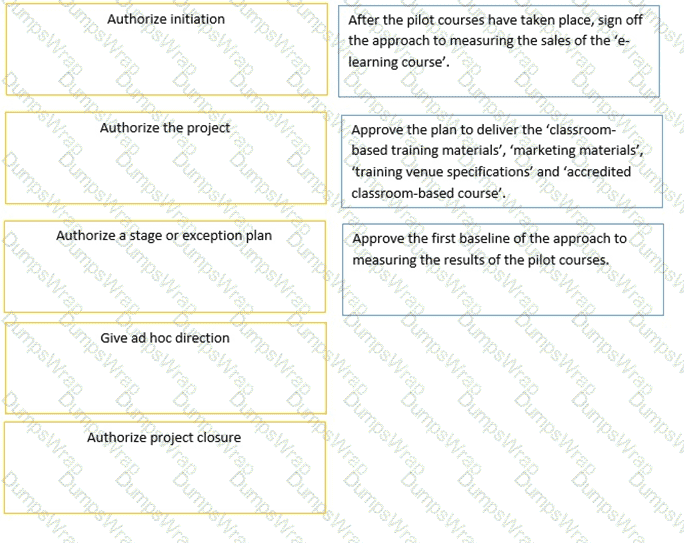
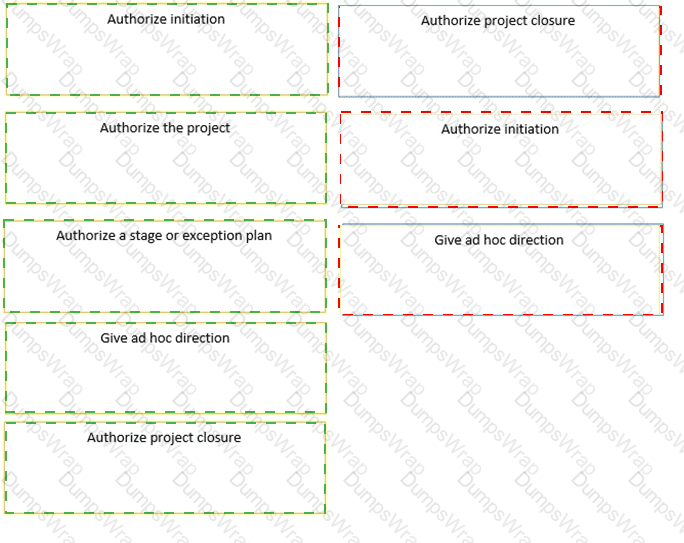
Project Scenario – Health and Safety Training Project:
ABC Company is a well-established training company that uses a standard model to develop training materials and deliver courses to customers.
ABC Company has commissioned a project in response to recent changes in government legislation relating to health and safety on construction sites. The project will deliver “capability to provide health and safety training”, including the materials needed for classroom-based training and e-learning. The expected benefits for construction companies include a reduction in lost days and legal costs due to accidents.
The e-learning course will be developed by a specialist external consultancy. The materials for classroom-based training will be delivered by ABC Company’s development team. All course materials will be piloted before they are used. ABC Company will deliver training to its customers and also hopes to sell the course materials to other training companies as part of their operational business. ABC Company will use their own sales and marketing departments to promote the courses.
The legislation requires construction companies to comply with the new legislation within two years. The course materials and trainers have to be accredited by a government agency before courses can be delivered. ABC Company is planning to deliver pilot courses within five months of starting the project.
The ABC Company standard development model for new courses recommends the following stages:
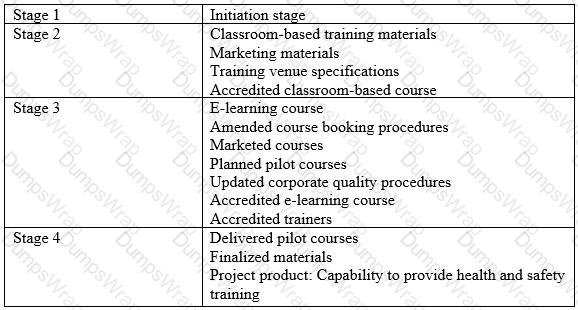
End of the Project scenario.
Additional Information:
The Chief Executive Officer (CEO) founded the company five years ago. Under her leadership, ABC Company has grown quickly into a successful training company. It delivers a range of accredited professional training.
The Finance Director is also a founder member of ABC Company and is responsible for authorizing budgets for the Operations and Development Teams. She authorizes all large contracts personally.
The Purchasing Manager reports to the Finance Director and is responsible for managing and monitoring supplier contracts.
The Operations Director is responsible for the delivery off all training and for the training development budget. His department organizes courses, venues and trainers. They work with the Product and the Sales teams to provide a comprehensive training schedule. ABC Company’s IT manager reports to the Operations Director.
The Business Development Director has recently been appointed to identify new training needs and propose new products. She will work with the Operations. Director to ensure a cost-conscious approach and that appropriate development technologies are used for the health and safety course.
The Training Development Manager reports to the Business Development Director and is responsible for developing training materials and gaining accreditation, in accordance with the standard course development model. Course developers in his team have skills in a range of development technologies and are allocated to projects as needed.
The Training Delivery Manager, who reports to the Operations Director, is responsible for ensuring that internal and external trainers deliver ABC Company training courses to the required standard. He also checks course materials to ensure they are fit for purpose and of the required quality.
The Central Services Director has responsibility for corporate communications, facilities management and configuration management. He recently led a project to consolidate all company quality systems into one quality management system and set up a corporate quality department, now managed by the Corporate Quality Manager.
The Corporate Document Manager reports to the Central Services Director. She helped establish the company’s document management system and now operates it across the business. She manages a team of administrators and contracts staff when workload is high.
The Sales Director joined ABC Company two months ago and is keen to establish himself by suggesting new markets for the courses and material. All account managers and the marketing team report to him. They promote existing training courses to other training companies and existing customers.
End of the additional information.
BUSINESS CASE
Here are three actions related to applying the business case theme.
Which role (A-F) should carry out each action?
Choose only one role for each action. Each role can be used once, more than once, or not at all.