
Salesforce Certified MuleSoft Platform Architect (Mule-Arch-201) Questions and Answers
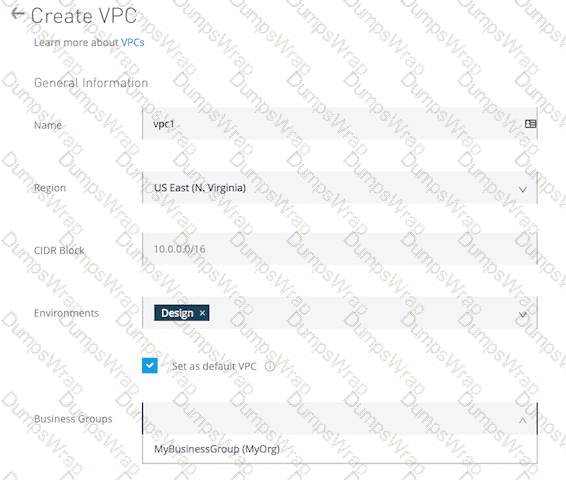
What is true about the technology architecture of Anypoint VPCs?
Several times a week, an API implementation shows several thousand requests per minute in an Anypoint Monitoring dashboard, Between these bursts, the
dashboard shows between two and five requests per minute. The API implementation is running on Anypoint Runtime Fabric with two non-clustered replicas, reserved vCPU 1.0
and vCPU Limit 2.0.
An API consumer has complained about slow response time, and the dashboard shows the 99 percentile is greater than 120 seconds at the time of the complaint. It also shows
greater than 90% CPU usage during these time periods.
In manual tests in the QA environment, the API consumer has consistently reproduced the slow response time and high CPU usage, and there were no other API requests at
this time. In a brainstorming session, the engineering team has created several proposals to reduce the response time for requests.
Which proposal should be pursued first?
A company stores financial transaction data in two legacy systems. For each legacy system, a separate, dedicated System API (SAPI) exposes data for that legacy system. A Process API (PAPI) merges the data retrieved from ail of the System APIs into a common format. Several API clients call the PAPI through its public domain name.
The company now wants to expose a subset of financial data to a newly developed mobile application that uses a different Bounded Context Data Model. The company wants to follow MuleSoft's best practices for building out an effective application network.
Following MuleSoft's best practices, how can the company expose financial data needed by the mobile application in a way that minimizes the impact on the currently running API clients, API implementations, and support asset reuse?
Options:
Add two new Experience APIs (EAPI-i and EAPI-2}. Add Mobile PAPI-2 to expose the Intended subset of financial data as requested. Both PAPIs access the Legacy Systems via SAPI-1 and SAP]-2.
Add two new Experience APIs (EAPI-i and EAPI-2}. Add Mobile PAPI-2 to expose the Intended subset of financial data as requested. Both PAPIs access the Legacy Systems via SAPI-1 and SAP]-2.
Create a new mobile Experince API (EAPI) chat exposes that subset of PAPI endpoints.Add transformtion login to the mobile Experince API implementation to make mobile data compatible with the required PAPIs.
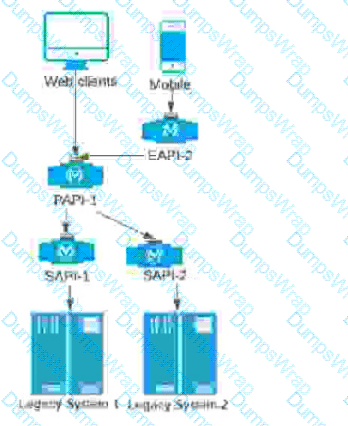
Develop and deploy is new PAPI implementation with data transformation and ... login to support this required endpoints of both mobile and web clients.Deploy an API Proxy with an endpoint from API Manager that redirect the existing PAPI endpoints to the new PAPI.
What is a key requirement when using an external Identity Provider for Client Management in Anypoint Platform?
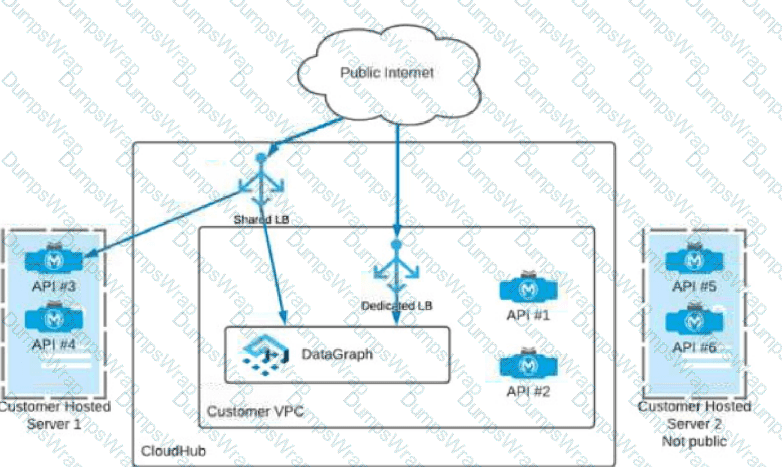
Which APIs can be used with DataGraph to create a unified schema?
A new upstream API Is being designed to offer an SLA of 500 ms median and 800 ms maximum (99th percentile) response time. The corresponding API implementation needs to sequentially invoke 3 downstream APIs of very similar complexity.
The first of these downstream APIs offers the following SLA for its response time: median: 100 ms, 80th percentile: 500 ms, 95th percentile: 1000 ms.
If possible, how can a timeout be set in the upstream API for the invocation of the first downstream API to meet the new upstream API's desired SLA?
A system API is deployed to a primary environment as well as to a disaster recovery (DR) environment, with different DNS names in each environment. A process API is a client to the system API and is being rate limited by the system API, with different limits in each of the environments. The system API's DR environment provides only 20% of the rate limiting offered by the primary environment. What is the best API fault-tolerant invocation strategy to reduce overall errors in the process API, given these conditions and constraints?
A Rate Limiting policy is applied to an API implementation to protect the back-end system. Recently, there have been surges in demand that cause some API client
POST requests to the API implementation to be rejected with policy-related errors, causing delays and complications to the API clients.
How should the API policies that are applied to the API implementation be changed to reduce the frequency of errors returned to API clients, while still protecting the back-end
system?
An organization wants to make sure only known partners can invoke the organization's APIs. To achieve this security goal, the organization wants to enforce a Client ID Enforcement policy in API Manager so that only registered partner applications can invoke the organization's APIs. In what type of API implementation does MuleSoft recommend adding an API proxy to enforce the Client ID Enforcement policy, rather than embedding the policy directly in the application's JVM?
An organization is deploying their new implementation of the OrderStatus System API to multiple workers in CloudHub. This API fronts the organization's on-premises Order Management System, which is accessed by the API implementation over an IPsec tunnel.
What type of error typically does NOT result in a service outage of the OrderStatus System API?
A developer from the Central IT team has created an initial version of the RAML definition in Design Center for an OAuth 2.0-protected System API and published it
to Exchange. Another developer from LoB IT discovered the System API in Exchange and would like to leverage it in the Process API.
What is the MuleSoft-recommended approach for Process API to invoke the System API?
What is typically NOT a function of the APIs created within the framework called API-led connectivity?
When can CloudHub Object Store v2 be used?
Question 10: Skipped
An API implementation returns three X-RateLimit-* HTTP response headers to a requesting API client. What type of information do these response headers indicate to the API client?
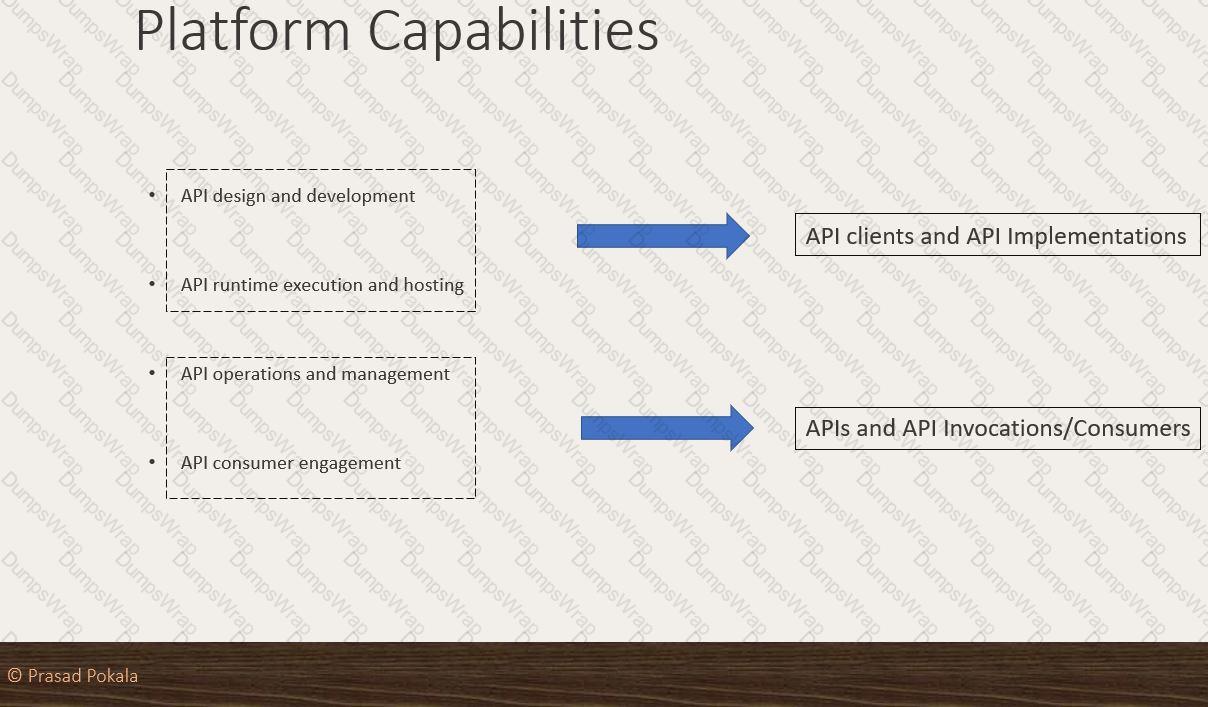
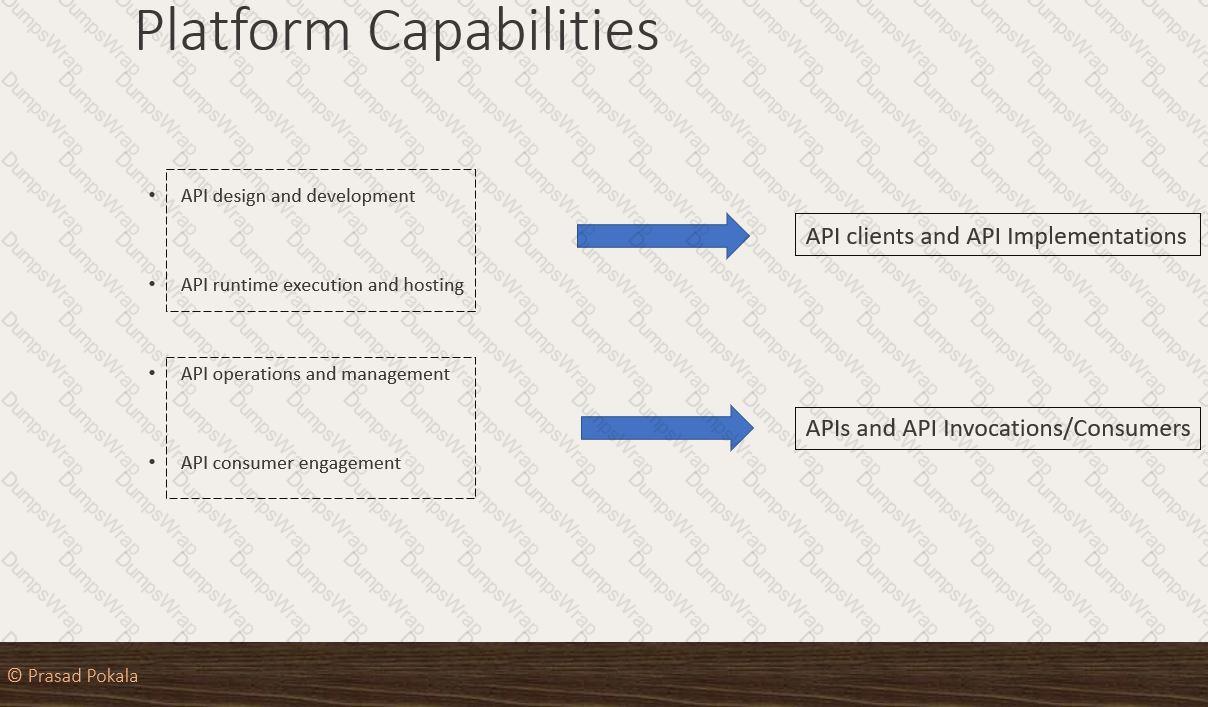
What Anypoint Platform Capabilities listed below fall under APIs and API Invocations/Consumers category? Select TWO.
Which three tools automate the deployment of Mule applications?
Choose 3 answers
What API policy would be LEAST LIKELY used when designing an Experience API that is intended to work with a consumer mobile phone or tablet application?
How are an API implementation, API client, and API consumer combined to invoke and process an API?
A customer wants to monitor and gain insights about the number of requests coming in a given time period as well as to measure key performance indicators
(response times, CPU utilization, number of active APIs).
Which tool provides these data insights?
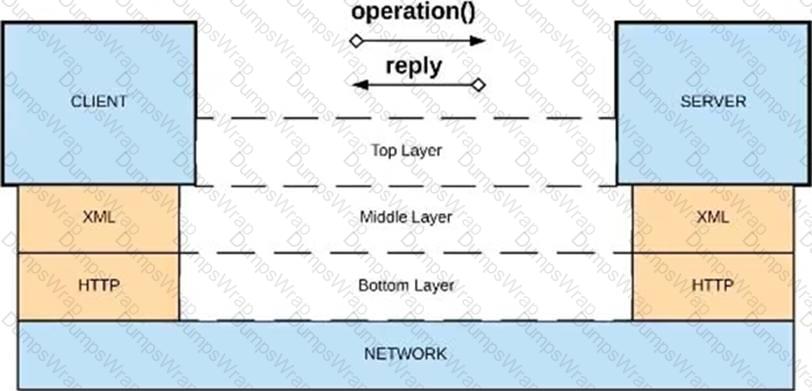
Refer to the exhibit.
What is a valid API in the sense of API-led connectivity and application networks?
A) Java RMI over TCP
B) Java RMI over TCP

C) CORBA over HOP
D) XML over UDP
A company uses a hybrid Anypoint Platform deployment model that combines the EU control plane with customer-hosted Mule runtimes. After successfully testing a Mule API implementation in the Staging environment, the Mule API implementation is set with environment-specific properties and must be promoted to the Production environment. What is a way that MuleSoft recommends to configure the Mule API implementation and automate its promotion to the Production environment?
What are the major benefits of MuleSoft proposed IT Operating Model?
An Anypoint Platform organization has been configured with an external identity provider (IdP) for identity management and client management. What credentials or token must be provided to Anypoint CLI to execute commands against the Anypoint Platform APIs?
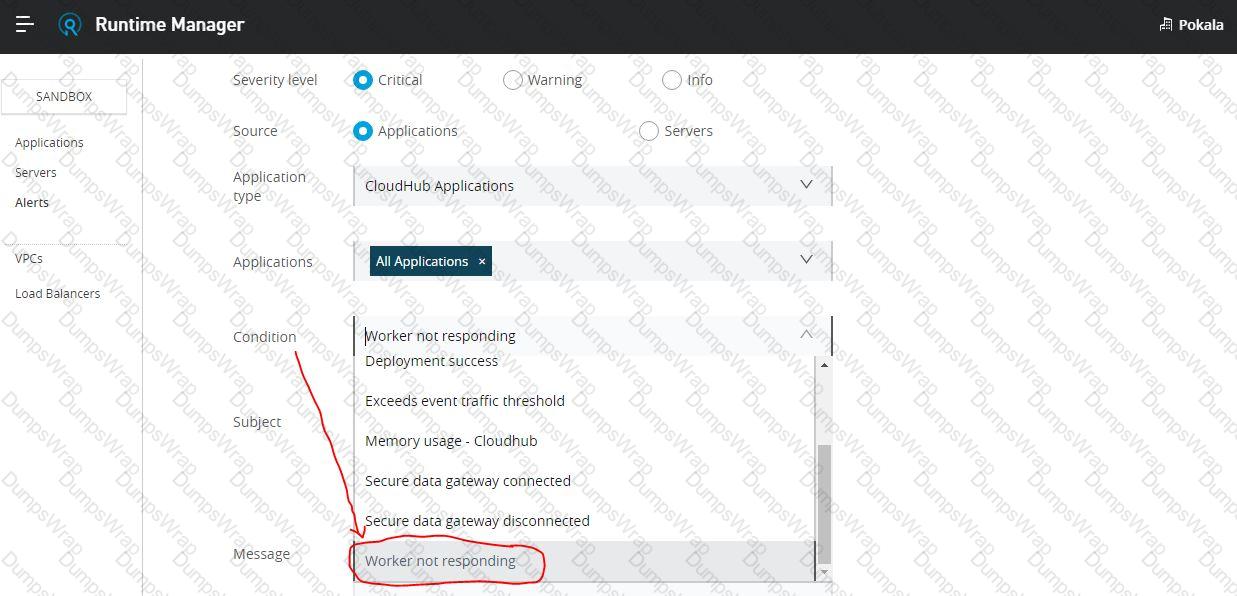
An API implementation is deployed on a single worker on CloudHub and invoked by external API clients (outside of CloudHub). How can an alert be set up that is guaranteed to trigger AS SOON AS that API implementation stops responding to API invocations?
A client has several applications running on the Salesforce service cloud. The business requirement for integration is to get daily data changes from Account and Case
Objects. Data needs to be moved to the client's private cloud AWS DynamoDB instance as a single JSON and the business foresees only wanting five attributes from the
Account object, which has 219 attributes (some custom) and eight attributes from the Case Object.
What design should be used to support the API/ Application data model?
An eCommerce company is adding a new Product Details feature to their website, A customer will launch the product catalog page, a new Product Details link will
appear by product where they can click to retrieve the product detail description. Product detail data is updated with product update releases, once or twice a year, Presently
the database response time has been very slow due to high volume.
What action retrieves the product details with the lowest response time, fault tolerant, and consistent data?
What best explains the use of auto-discovery in API implementations?
4A developer for a transportation organization is implementing exactly one processing functionality in a Reservation Mule application to process and store passenger
records. This Reservation application will be deployed to multiple CloudHub workers/replicas. It is possible that several external systems could send duplicate passenger records
to the Reservation application.
An appropriate storage mechanism must be selected to help the Reservation application process each passenger record exactly once as much as possible. The selected storage
mechanism must be shared by all the CloudHub workers/replicas in order to synchronize the state information to assist attempting exactly once processing of each passenger
record by the deployed Reservation Mule application.
Which type of simple storage mechanism in Anypoint Platform allows the Reservation Mule application to update and share data between the CloudHub workers/replicas exactly
once, with minimal development effort?
An organization has several APIs that accept JSON data over HTTP POST. The APIs are all publicly available and are associated with several mobile applications and web applications.
The organization does NOT want to use any authentication or compliance policies for these APIs, but at the same time, is worried that some bad actor could send payloads that could somehow compromise the applications or servers running the API implementations.
What out-of-the-box Anypoint Platform policy can address exposure to this threat?
An application updates an inventory running only one process at any given time to keep the inventory consistent. This process takes 200 milliseconds (.2 seconds) to
execute; therefore, the scalability threshold of the application is five requests per second.
What is the impact on the application if horizontal scaling is applied, thereby increasing the number of Mule workers?
When must an API implementation be deployed to an Anypoint VPC?
What is the most performant out-of-the-box solution in Anypoint Platform to track transaction state in an asynchronously executing long-running process implemented as a Mule application deployed to multiple CloudHub workers?
What is a best practice when building System APIs?
An enterprise is embarking on the API-led digital transformation journey, and the central IT team has started to define System APIs. Currently there is no Enterprise
Data Model being defined within the enterprise, and the definition of a clean Bounded Context Data Model requires too much effort.
According to MuleSoft's recommended guidelines, how should the System API data model be defined?
An organization has built an application network following the API-led connectivity approach recommended by MuleSoft. To protect the application network against
attacks from malicious external API clients, the organization plans to apply JSON Threat Protection policies.
To which API-led connectivity layer should the JSON Threat Protection policies most commonly be applied?
What CANNOT be effectively enforced using an API policy in Anypoint Platform?
An API has been updated in Anypoint Exchange by its API producer from version 3.1.1 to 3.2.0 following accepted semantic versioning practices and the changes have been communicated via the API's public portal.
The API endpoint does NOT change in the new version.
How should the developer of an API client respond to this change?
A business process is being implemented within an organization's application network. The architecture group proposes using a more coarse-grained application
network design with relatively fewer APIs deployed to the application network compared to a more fine-grained design.
Overall, which factor typically increases with a more coarse-grained design for this business process implementation and deployment compared with using a more fine-grained
design?
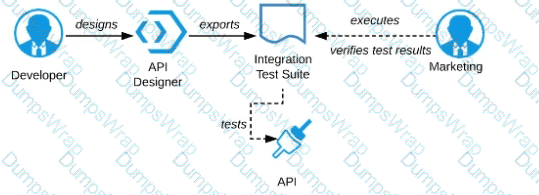
Refer to the exhibit.
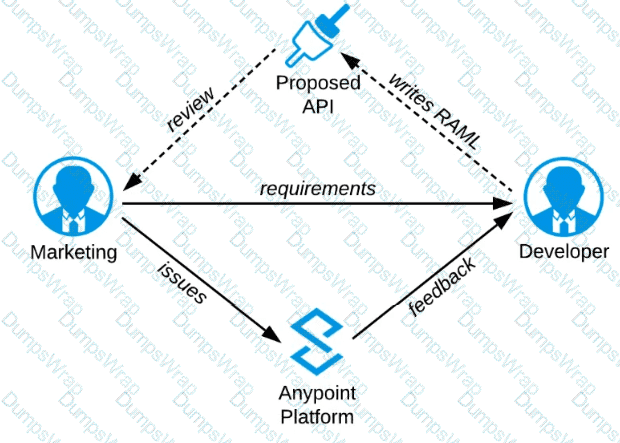
A RAML definition has been proposed for a new Promotions Process API, and has been published to Anypoint Exchange.
The Marketing Department, who will be an important consumer of the Promotions API, has important requirements and expectations that must be met.
What is the most effective way to use Anypoint Platform features to involve the Marketing Department in this early API design phase?
A) Ask the Marketing Department to interact with a mocking implementation of the API using the automatically generated API Console

B) Organize a design workshop with the DBAs of the Marketing Department in which the database schema of the Marketing IT systems is translated into RAML
C) Use Anypoint Studio to Implement the API as a Mule application, then deploy that API implementation to CloudHub and ask the Marketing Department to interact with it
D) Export an integration test suite from API designer and have the Marketing Department execute the tests In that suite to ensure they pass

Which of the below, when used together, makes the IT Operational Model effective?
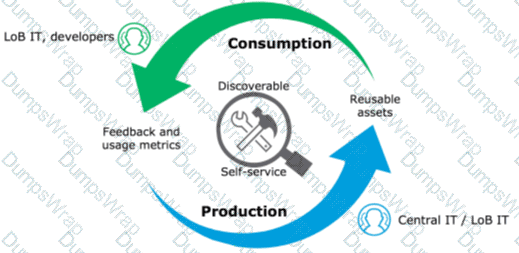 Diagram, arrow Description automatically generated
A large organization with an experienced central IT department is getting started using MuleSoft. There is a project to connect a siloed back-end system to a new
Customer Relationship Management (CRM) system. The Center for Enablement is coaching them to use API-led connectivity.
What action would support the creation of an application network using API-led connectivity?
The Line of Business (LoB) of an eCommerce company is requesting a process that sends automated notifications via email every time a new order is processed through the
customer's mobile application or through the internal company's web application. In the future, multiple notification channels may be added: for example, text messages and
push notifications.
What is the most effective API-led connectivity approach for the scenario described above?
Options:
Create one Experience API for the web application and one for the mobile application. Create a Process API to orchestrate and retrieve the email template from = database. Create a System API that sends the email using the Anypoint Connector for Email.Create one Experience API for the web application and one for the mobile application. Create a Process API to orchestrate and retrieve the email template from = database. Create a System API th
Create one Experience API for the web application and one for the mobile application, Create a Process API to orchestrate, retrieve the email template from a database, and send the email using the Anypoint Connector for Email.
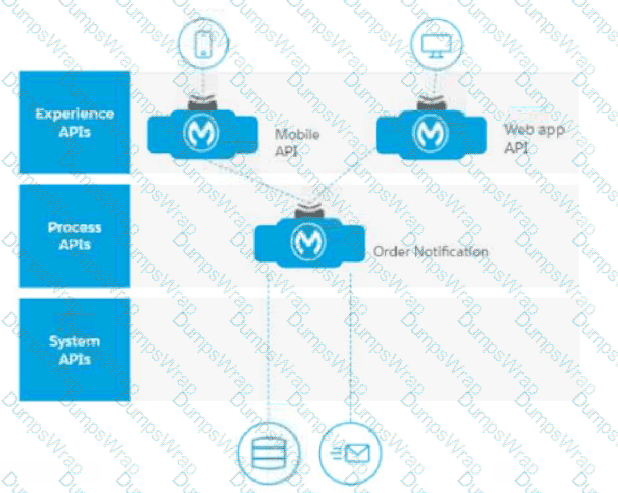
Create Experience APIs for both the web application and mobile application. Create a Process API ta orchestrate, retrieve the email template from e database, and send the email using the Anypoint Connector for Email.\
Create Experience APIs for both the web application and mobile application. (Create 3 Process API to orchestrate and retrieve the email template from 2 databese. Create a System API that sends the email using the Anypoint Connector for Email.
In an organization, the InfoSec team is investigating Anypoint Platform related data traffic.
From where does most of the data available to Anypoint Platform for monitoring and alerting originate?
What is true about automating interactions with Anypoint Platform using tools such as Anypoint Platform REST APIs, Anypoint CU, or the Mule Maven plugin?
Due to a limitation in the backend system, a system API can only handle up to 500 requests per second. What is the best type of API policy to apply to the system API to avoid overloading the backend system?
