New Year Sale Discount Flat 70% Offer - Ends in 0d 00h 00m 00s - Coupon code: 70diswrap

Salesforce MuleSoft-Integration-Architect-I Dumps

Salesforce Certified MuleSoft Platform Integration Architect (Mule-Arch-202) Questions and Answers

Question 1

A Mule application is running on a customer-hosted Mule runtime in an organization's network. The Mule application acts as a producer of asynchronous Mule events. Each Mule event must be broadcast to all interested external consumers outside the Mule application. The Mule events should be published in a way that is guaranteed in normal situations and also minimizes duplicate delivery in less frequent failure scenarios.

The organizational firewall is configured to only allow outbound traffic on ports 80 and 443. Some external event consumers are within the organizational network, while others are located outside the firewall.

What Anypoint Platform service is most idiomatic (used for its intended purpose) for publishing these Mule events to all external consumers while addressing the desired reliability goals?

Options:

A.

CloudHub VM queues

B.

Anypoint MQ

C.

Anypoint Exchange

D.

CloudHub Shared Load Balancer

Question 2

A marketing organization is designing a Mule application to process campaign data. The Mule application will periodically check for a file in a SFTP location and process the records in the file. The size of the file can vary from 10MB to 5GB. Due to the limited availabiltty of vCores, the Mule application is deployed to a single CloudHub worker configured with vCore size 0.2.

The application must transform and send different formats of this file to three different downstream SFTP locations.

What is the most idiomatic (used for its intended purpose) and performant way to configure the SFTP operations or event sources to process the large files to support these deployment requirements?

Options:

A.

Use an in-memory repeatable stream

B.

Use a file-stored non-repeatable stream

C.

Use an in-memory non-repeatable stream

D.

Use a file-stored repeatable stream

Question 3

According to MuleSoft, which system integration term describes the method, format, and protocol used for communication between two system?

Options:

A.

Component

B.

interaction

C.

Message

D.

Interface

Question 4

A project uses Jenkins to implement CI/CD process. It was observed that each Mule package contains some of the Jenkins files and folders for configurations of CI/CD jobs.

As these files and folders are not part of the actual package, expectation is that these should not be part of deployed archive.

Which file can be used to exclude these files and folders from the deployed archive?

Options:

A.

muleignore

B.

_unTrackMule

C.

mulelnclude

D.

_muleExclude

Question 5

An external REST client periodically sends an array of records in a single POST request to a Mule application API endpoint.

The Mule application must validate each record of the request against a JSON schema before sending it to a downstream system in the same order that it was received in the array

Record processing will take place inside a router or scope that calls a child flow. The child flow has its own error handling defined. Any validation or communication failures should not prevent further processing of the remaining records.

To best address these requirements what is the most idiomatic(used for it intended purpose) router or scope to used in the parent flow, and what type of error handler should be used in the child flow?

Options:

A.

First Successful router in the parent flowOn Error Continue error handler in the child flow

B.

For Each scope in the parent flowOn Error Continue error handler in the child flow

C.

Parallel For Each scope in the parent flowOn Error Propagate error handler in the child flow

D.

Until Successful router in the parent flowOn Error Propagate error handler in the child flow

Question 6

A Mule application is being designed To receive nightly a CSV file containing millions of records from an external vendor over SFTP, The records from the file need to be validated, transformed. And then written to a database. Records can be inserted into the database in any order.

In this use case, what combination of Mule components provides the most effective and performant way to write these records to the database?

Options:

A.

Use a Parallel for Each scope to Insert records one by one into the database

B.

Use a Scatter-Gather to bulk insert records into the database

C.

Use a Batch job scope to bulk insert records into the database.

D.

Use a DataWeave map operation and an Async scope to insert records one by one into the database.

Question 7

A system API EmployeeSAPI is used to fetch employee's data from an underlying SQL database.

The architect must design a caching strategy to query the database only when there is an update to the employees stable or else return a cached response in order to minimize the number of redundant transactions being handled by the database.

What must the architect do to achieve the caching objective?

Options:

A.

Use an On Table Row on employees table and call invalidate cacheUse an object store caching strategy and expiration interval to empty

B.

Use a Scheduler with a fixed frequency every hour triggering an invalidate cache flowUse an object store caching strategy and expiration interval to empty

C.

Use a Scheduler with a fixed frequency every hour triggering an invalidate cache flowUse an object store caching strategy and set expiration interval to 1-hour

D.

Use an on table rule on employees table call invalidate cache and said new employees data to cacheUse an object store caching strategy and set expiration interval to 1-hour

Question 8

What comparison is true about a CloudHub Dedicated Load Balancer (DLB) vs. the CloudHub Shared Load Balancer (SLB)?

Options:

A.

Only a DLB allows the configuration of a custom TLS server certificate

B.

Only the SLB can forward HTTP traffic to the VPC-internal ports of the CloudHub workers

C.

Both a DLB and the SLB allow the configuration of access control via IP whitelists

D.

Both a DLB and the SLB implement load balancing by sending HTTP requests to workers with the lowest workloads

Question 9

How does timeout attribute help inform design decisions while using JMS connector listening for incoming messages in an extended architecture (XA) transaction?

Options:

A.

After the timeout is exceeded, stale JMS consumer threads are destroyed and new threads are created

B.

The timeout specifies the time allowed to pass between receiving JMS messages on the same JMS connection and then after the timeout new JMS connection is established

C.

The time allowed to pass between committing the transaction and the completion of the mule flow and then after the timeout flow processing triggers an error

D.

The timeout defines the time that is allowed to pass without the transaction ending explicitly and after the timeout expires, the transaction rolls back

Question 10

A Kubernetes controller automatically adds another pod replica to the resource pool in response to increased application load.

Which scalability option is the controller implementing?

Options:

A.

Down

B.

Diagonal

C.

Vertical

D.

Horizontal

Question 11

A developer needs to discover which API specifications have been created within the organization before starting a new project.

Which Anypoint Platform component can the developer use to find and try out the currently released API specifications?

Options:

A.

Anypoint Exchange

B.

Runtime Manager

C.

API Manager

D.

Object Store

Question 12

A Mule application currently writes to two separate SQL Server database instances across the internet using a single XA transaction. It is 58. proposed to split this one transaction into two separate non-XA transactions with no other changes to the Mule application.

What non-functional requirement can be expected to be negatively affected when implementing this change?

Options:

A.

Throughput

B.

Consistency

C.

Response time

D.

Availability

Question 13

An external web UI application currently accepts occasional HTTP requests from client web browsers to change (insert, update, or delete) inventory pricing information in an inventory system's database. Each inventory pricing change must be transformed and then synchronized with multiple customer experience systems in near real-time (in under 10 seconds). New customer experience systems are expected to be added in the future.

The database is used heavily and limits the number of SELECT queries that can be made to the database to 10 requests per hour per user.

What is the most scalable, idiomatic (used for its intended purpose), decoupled. reusable, and maintainable integration mechanism available to synchronize each inventory pricing change with the various customer experience systems in near real-time?

Options:

A.

Write a Mule application with a Database On Table Row event source configured for the inventory pricing database, with the watermark attribute set to an appropriate database columnIn the same now, use a Scatter-Gather to call each customer experience system's REST API with transformed inventory-pricing records

B.

Add a trigger to the inventory-pricing database table so that for each change to the inventory pricing database, a stored procedure is called that makes a REST call to a Mule applicationWrite the Mule application to publish each Mule event as a message to an Anypoint MQ exchangeWrite other Mule applications to subscribe to the Anypoint MQ exchange, transform each received message, and then update the Mule application's corresponding custome

C.

Replace the external web UI application with a Mule application to accept HTTP requests from client web browsersIn the same Mule application, use a Batch Job scope to test if the database request will succeed, aggregate pricing changes within a short time window, and then update both the inventory pricing database and each customer experience system using a Parallel For Each scope

D.

Write a Mule application with a Database On Table Row event source configured for the inventory pricing database, with the ID attribute set to an appropriate database columnIn the same flow, use a Batch Job scope to publish transformed Inventory-pricing records to an Anypoint MQ queueWrite other Mule applications to subscribe to the Anypoint MQ queue, transform each received message, and then update the Mule application's corresponding cust

Question 14

What is a core pillar of the MuleSoft Catalyst delivery approach?

Options:

A.

Business outcomes

B.

Technology centralization

C.

Process thinking

D.

Scope reduction

Question 15

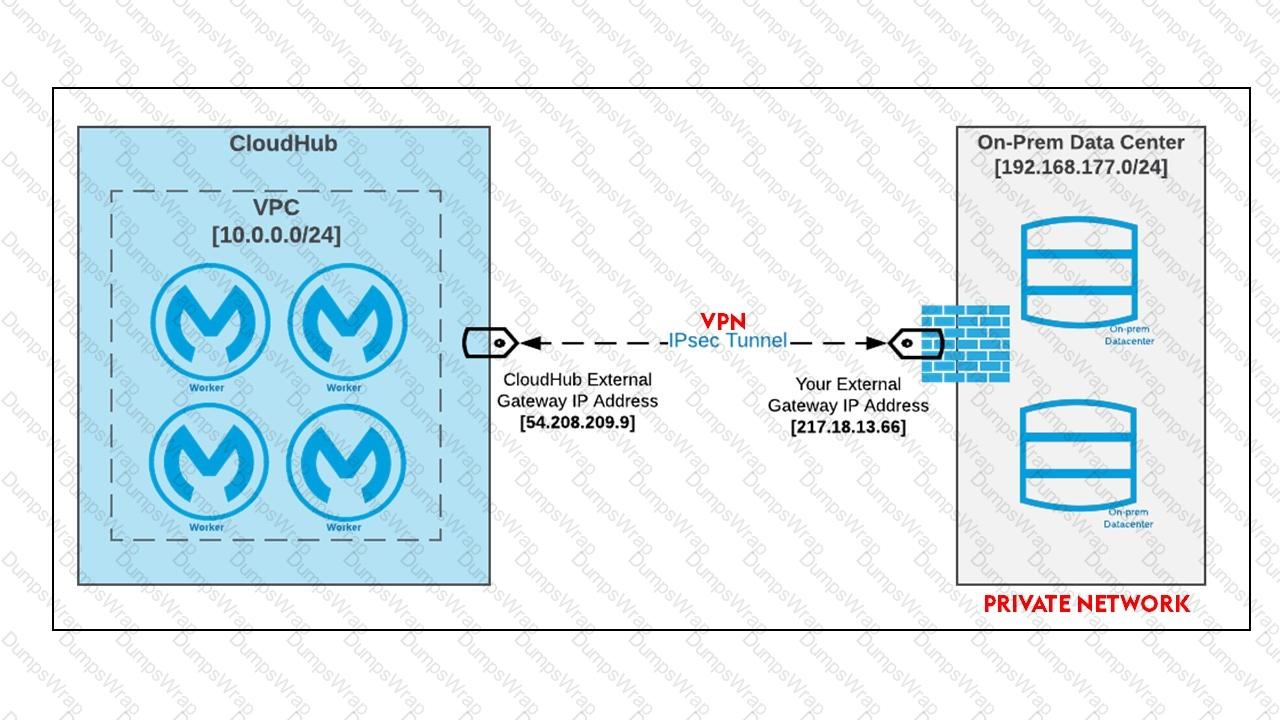
Mule applications need to be deployed to CloudHub so they can access on-premises database systems. These systems store sensitive and hence tightly protected data, so are not accessible over the internet.

What network architecture supports this requirement?
Options:

A.

An Anypoint VPC connected to the on-premises network using an IPsec tunnel or AWS DirectConnect, plus matching firewall rules in the VPC and on-premises network

B.

Static IP addresses for the Mule applications deployed to the CloudHub Shared Worker Cloud, plus matching firewall rules and IPwhitelisting in the on-premises network

C.

An Anypoint VPC with one Dedicated Load Balancer fronting each on-premises database system, plus matching IP whitelisting in the load balancer and firewall rules in the VPC and on-premises network

D.

Relocation of the database systems to a DMZ in the on-premises network, with Mule applications deployed to the CloudHub Shared Worker Cloud connecting only to the DMZ

Question 16

An organization has implemented the cluster with two customer hosted Mule runtimes is hosting an application.

This application has a flow with a JMS listener configured to consume messages from a queue destination. As an integration architect can you advise which JMS listener configuration must be used to receive messages in all the nodes of the cluster?

Options:

A.

Use the parameter primaryNodeOnly= "false" on the JMS listener

B.

Use the parameter primaryNodeOnly= "false" on the JMS listener with a shared subscription

C.

Use the parameter primaryNodeOnly= "true" on the JMS listener with a non­shared subscription

D.

Use the parameter primaryNodeOnly= "true" on the JMS listener

Question 17

A payment processing company has implemented a Payment Processing API Mule application to process credit card and debit card transactions, Because the Payment Processing API handles highly sensitive information, the payment processing company requires that data must be encrypted both In-transit and at-rest.

To meet these security requirements, consumers of the Payment Processing API must create request message payloads in a JSON format specified by the API, and the message payload values must be encrypted.

How can the Payment Processing API validate requests received from API consumers?

Options:

A.

A Transport Layer Security (TLS) - Inbound policy can be applied in API Manager to decrypt the message payload and the Mule application implementation can then usethe JSON Validation module to validate the JSON data

B.

The Mule application implementation can use the APIkit module to decrypt and then validate the JSON data

C.

The Mule application implementation can use the Validation module to decrypt and then validate the JSON data

D.

The Mule application implementation can use DataWeave to decrypt the message payload and then use the JSON Scheme Validation module to validate the JSON data

Question 18

Which productivity advantage does Anypoint Platform have to both implement and manage an AP?

Options:

A.

Automatic API proxy generation

B.

Automatic API specification generation

C.

Automatic API semantic versioning

D.

Automatic API governance

Question 19

As part of a growth strategy, a supplier signs a trading agreement with a large customer. The customer sends purchase orders to the supplier according to the ANSI X12 EDI standard, and the supplier creates the orders in its ERP system using the information in the EDI document.

The agreement also requires that the supplier provide a new RESTful API to process request from the customer for current product inventory level from the supplier’ s ERP system.

Which two fundamental integration use cases does the supplier need to deliver to provide an end-to-end solution for this business scenario? (Choose two.)

Options:

A.

Synchronized data transfer

B.

Sharing data with external partners

C.

User interface integration

D.

Streaming data ingestion

E.

Data mashups

Question 20

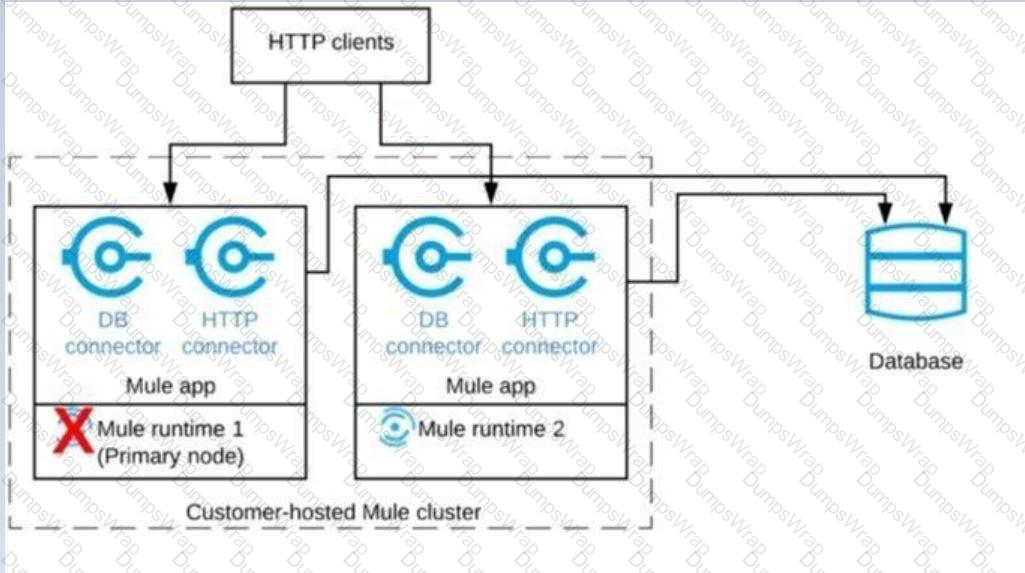
Refer to the exhibit.

as

A Mule application is deployed to a cluster of two customer-hosted Mute runtimes. The Mute application has a flow that polls a database and another flow with an HTTP Listener.

HTTP clients send HTTP requests directly to individual cluster nodes.

What happens to database polling and HTTP request handling in the time after the primary (master) node of the cluster has railed, but before that node is restarted?
Options:

A.

Database polling continues Only HTTP requests sent to the remaining node continue to be accepted

B.

Database polling stops All HTTP requests continue to be accepted

C.

Database polling continues All HTTP requests continue to be accepted, but requests to the failed node Incur increased latency

D.

Database polling stops All HTTP requests are rejected

Question 21

How are the API implementation , API client, and API consumer combined to invoke and process an API ?

Options:

A.

The API consumer creates an API implementation , which receives API invocations from an API such that they are processed for an API client

B.

The API consumer creates an API client which sends API invocations to an API such that they are processed by an API implementation

C.

An API client creates an API consumer, which receives API invocation from an API such that they are processed for an API implementation

D.

The API client creates an API consumer which sends API invocations to an API such that they are processed by API implementation

Question 22

A platform architect includes both an API gateway and a service mesh in the architect of a distributed application for communication management.

Which type of communication management does a service mesh typically perform in this architecture?

Options:

A.

Between application services and the firewall

B.

Between the application and external API clients

C.

Between services within the application

D.

Between the application and external API implementations.

Question 23

An organization is creating a Mule application that will be deployed to CloudHub. The Mule application has a property named dbPassword that stores a database user’s password.

The organization's security standards indicate that the dbPassword property must be hidden from every Anypoint Platform user after the value is set in the Runtime Manager Properties tab.

What configuration in the Mule application helps hide the dbPassword property value in Runtime Manager?

Options:

A.

Use secure::dbPassword as the property placeholder name and store the cleartext (unencrypted) value in a secure properties placeholder file

B.

Use secure::dbPassword as the property placeholder name and store the property encrypted value in a secure properties placeholder file

C.

Add the dbPassword property to the secureProperties section of the pom.xml file

D.

Add the dbPassword property to the secureProperties section of the mule-artifact.json file

Question 24

In Anypoint Platform, a company wants to configure multiple identity providers(Idps) for various lines of business (LOBs) Multiple business groups and environments have been defined for the these LOBs. What Anypoint Platform feature can use multiple Idps access the company’s business groups and environment?

Options:

A.

User management

B.

Roles and permissions

C.

Dedicated load balancers

D.

Client Management

Question 25

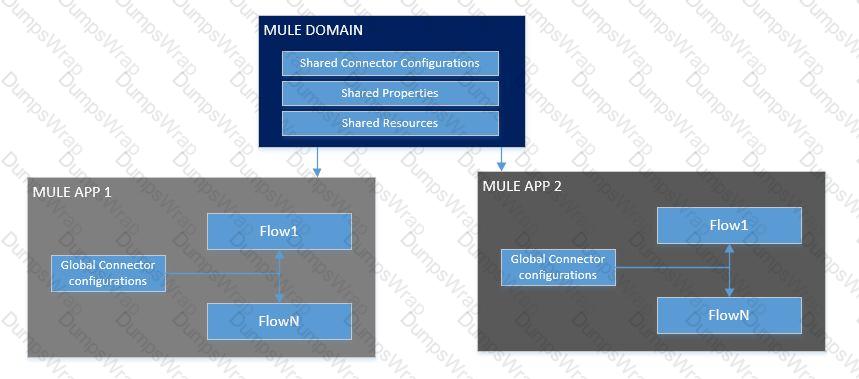
What is not true about Mule Domain Project?
Options:

A.

This allows Mule applications to share resources

B.

Expose multiple services within the Mule domain on the same port

C.

Only available Anypoint Runtime Fabric

D.

Send events (messages) to other Mule applications using VM queues

Question 26

In a Mule Application, a flow contains two (2) JMS consume operations that are used to connect to a JMS broker and consume messages from two(2) JMS destination. The Mule application then joins the two JMS messages together.

The JMS broker does not implement high availability (HA) and periodically experiences scheduled outages of upto 10 mins for routine maintenance.

What is the most idiomatic (used for its intented purpose) way to build the mule flow so it can best recover from the expected outages?

Options:

A.

Configure a reconnection strategy for the JMS connector

B.

Enclose the two(2) JMS operation in an Until Successful scope

C.

Consider a transaction for the JMS connector

D.

Enclose the two(2) JMS operations in a Try scope with an Error Continue error handler

Question 27

An organization has strict unit test requirement that mandate every mule application must have an MUnit test suit with a test case defined for each flow and a minimum test coverage of 80%.

A developer is building Munit test suit for a newly developed mule application that sends API request to an external rest API.

What is the effective approach for successfully executing the Munit tests of this new application while still achieving the required test coverage for the Munit tests?

Options:

A.

Invoke the external endpoint of the rest API from the mule floors

B.

Mark the rest API invocations in the Munits and then call the mocking service flow that simulates standard responses from the REST API

C.

Mock the rest API invocation in the Munits and return a mock response for those invocations

D.

Create a mocking service flow to simulate standard responses from the rest API and then configure the mule flows to call the marking service flow

Question 28

An Organization has previously provisioned its own AWS VPC hosting various servers. The organization now needs to use Cloudhub to host a Mule application that will implement a REST API once deployed to Cloudhub, this Mule application must be able to communicate securely with the customer-provisioned AWS VPC resources within the same region, without being interceptable on the public internet.

What Anypoint Platform features should be used to meet these network communication requirements between Cloudhub and the existing customer-provisioned AWS VPC?

Options:

A.

Add a Mulesoft hosted Anypoint VPC configured and with VPC Peering to the AWS VPC

B.

Configure an external identity provider (IDP) in Anypoint Platform with certificates from the customer provisioned AWS VPC

C.

Add a default API Whitelisting policy to API Manager to automatically whitelist the customer provisioned AWS VPC IP ranges needed by the Mule applicaton

D.

Use VM queues in the Mule application to allow any non-mule assets within the customer provisioned AWS VPC to subscribed to and receive messages

Question 29

What condition requires using a CloudHub Dedicated Load Balancer?

Options:

A.

When cross-region load balancing is required between separate deployments of the same Mule application

B.

When custom DNS names are required for API implementations deployed to customer-hosted Mule runtimes

C.

When API invocations across multiple CloudHub workers must be load balanced

D.

When server-side load-balanced TLS mutual authentication is required between API implementations and API clients

Question 30

A system administrator needs to determine when permissions were last changed for an Anypoint Platform user.

Which Anypoint Platform component should the administrator use to obtain this information?

Options:

A.

Audit Logging

B.

Anypoint Monitoring

C.

Anypiont Studio

D.

Mule Stack Traces

Question 31

A leading eCommerce giant will use MuleSoft APIs on Runtime Fabric (RTF) to process customer orders. Some customer-sensitive information, such as credit card information, is required in request payloads or is included in response payloads in some of the APIs. Other API requests and responses are not authorized to access some of this customer-sensitive information but have been implemented to validate and transform based on the structure and format of this customer-sensitive information (such as account IDs, phone numbers, and postal codes).

What approach configures an API gateway to hide sensitive data exchanged between API consumers and API implementations, but can convert tokenized fields back to their original value for other API requests or responses, without having to recode the API implementations?

Later, the project team requires all API specifications to be augmented with an additional non-functional requirement (NFR) to protect the backend services from a high rate of requests, according to defined service-level

agreements (SLAs). The NFR's SLAs are based on a new tiered subscription level "Gold", "Silver", or "Platinum" that must be tied to a new parameter that is being added to the Accounts object in their enterprise data model.

Following MuleSoft's recommended best practices, how should the project team now convey the necessary non-functional requirement to stakeholders?

Options:

A.

Create and deploy API proxies in API Manager for the NFR, change the baseurl in eachAPI specification to the corresponding API proxy implementation endpoint, and publish each modified API specification to Exchange

B.

Update each API specification with comments about the NFR's SLAs and publish each modified API specification to Exchange

C.

Update each API specification with a shared RAML fragment required to implement the NFR and publish the RAML fragment and each modified API specification to Exchange

D.

Create a shared RAML fragment required to implement the NFR, list each API implementation endpoint in the RAML fragment, and publish the RAML fragment to Exchange

Question 32

A corporation has deployed Mule applications to different customer-hosted Mule runtimes. Mule applications deployed to these Mule runtimes are managed by Anypoint Platform.

What needs to be installed or configured (if anything) to monitor these Mule applications from Anypoint Monitoring, and how is monitoring data from each Mule application sent to Anypoint Monitoring?

Options:

A.

Enable monitoring of individual Mule applications from the Runtime Managerapplication settings.Runtime Manager sends monitoring data to Anypoint Monitoring for each deployed Mule application.

B.

Install a Runtime Manager agent on each Mule runtime.Each Runtime Manager agent sends monitoring data from the Mule applicationsrunning in its Mule runtime to Runtime Manager, then Runtime Manager sendsmonitoring data to Anypoint Monitoring.

C.

Leave the out-of-the-box Anypoint Monitoring agent unchanged in its default Muleruntime installation.Each Anypoint Monitoring agent sends monitoring data from the Mule applicationsrunning in its Mule runtime to Runtime Manager, then Runtime Manager sendsmonitoring data to Anypoint Monitoring.

D.

Install an Anypoint Monitoring agent on each Mule runtime.Each Anypoint Monitoring agent sends monitoring data from the Mule applicationsrunning in its Mule runtime to Anypoint Monitoring.

Question 33

An API client is implemented as a Mule application that includes an HTTP Request operation using a default configuration. The HTTP Request operation invokes an external API that follows standard HTTP status code conventions, which causes the HTTP Request operation to return a 4xx status code.

What is a possible cause of this status code response?

Options:

A.

An error occurred inside the external API implementation when processing the HTTP request that was received from the outbound HTTP Request operation of the Mule application

B.

The external API reported that the API implementation has moved to a different external endpoint

C.

The HTTP response cannot be interpreted by the HTTP Request operation of the Mule application after it was received from the external API

D.

The external API reported an error with the HTTP request that was received from the outbound HTTP Request operation of the Mule application

Question 34

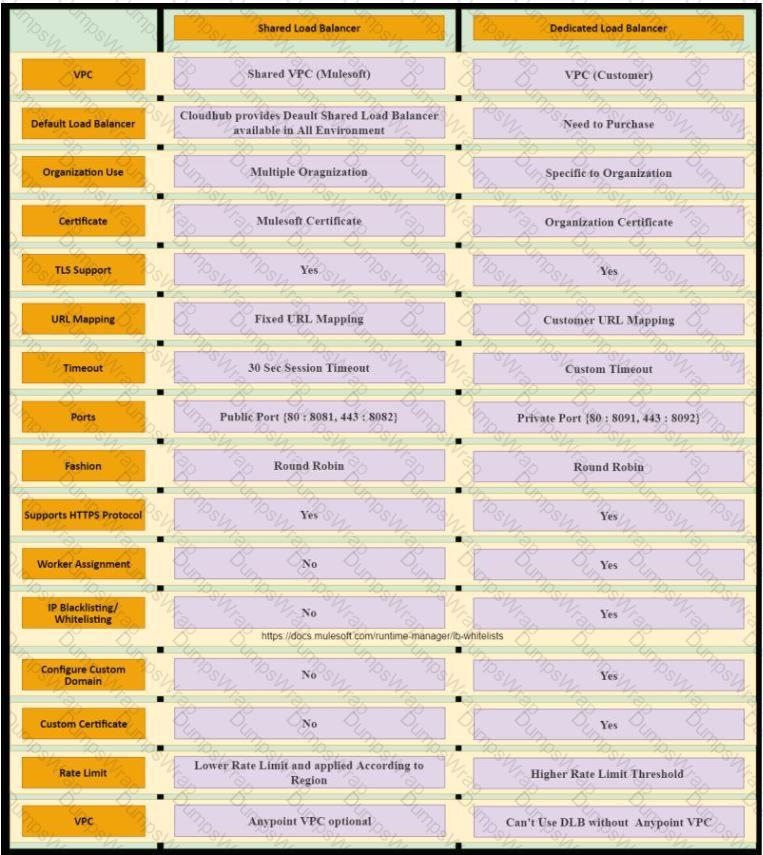
An organization is evaluating using the CloudHub shared Load Balancer (SLB) vs creating a CloudHub dedicated load balancer (DLB). They are evaluating how this choice affects the various types of certificates used by CloudHub deployed Mule applications, including MuleSoft-provided, customer-provided, or Mule application-provided certificates. What type of restrictions exist on the types of certificates for the service that can be exposed by the CloudHub Shared Load Balancer (SLB) to external web clients over the public internet?
Options:

A.

Underlying Mule applications need to implement own certificates

B.

Only MuleSoft provided certificates can be used for server side certificate

C.

Only self signed certificates can be used

D.

All certificates which can be used in shared load balancer need to get approved by raising support ticket

Question 35

An organization if struggling frequent plugin version upgrades and external plugin project dependencies. The team wants to minimize the impact on applications by creating best practices that will define a set of default dependencies across all new and in progress projects.

How can these best practices be achieved with the applications having the least amount of responsibility?

Options:

A.

Create a Mule plugin project with all the dependencies and add it as a dependency in each application's POM.xml file

B.

Create a mule domain project with all the dependencies define in its POM.xml file and add each application to the domain Project

C.

Add all dependencies in each application's POM.xml file

D.

Create a parent POM of all the required dependencies and reference each in each application's POM.xml file

Question 36

Refer to the exhibit.

What is the type data format shown in the exhibit?

Options:

A.

JSON

B.

XML

C.

YAML

D.

CSV

Question 37

What aspects of a CI/CD pipeline for Mule applications can be automated using MuleSoft-provided Maven plugins?

Options:

A.

Compile, package, unit test, validate unit test coverage, deploy

B.

Compile, package, unit test, deploy, integration test (Incorrect)

C.

Compile, package, unit test, deploy, create associated API instances in API Manager

D.

Import from API designer, compile, package, unit test, deploy, publish to Anypoint Exchange

Question 38

A company is designing a mule application to consume batch data from a partner's ftps server The data files have been compressed and then digitally signed using PGP.

What inputs are required for the application to securely consumed these files?

Options:

A.

ATLS context Key Store requiring the private key and certificate for the companyPGP public key of partnerPGP private key for the company

B.

ATLS context first store containing a public certificate for partner ftps server and the PGP public key of the partnerTLS contact Key Store containing the FTP credentials

C.

TLS context trust or containing a public certificate for the ftps server The FTP username and password The PGP public key of the partner

D.

The PGP public key of the partnerThe PGP private key for the companyThe FTP username and password

Question 39

What aspect of logging is only possible for Mule applications deployed to customer-hosted Mule runtimes, but NOT for Mule applications deployed to CloudHub?

Options:

A.

To send Mule application log entries to Splunk

B.

To change tog4j2 tog levels in Anypoint Runtime Manager without having to restart the Mule application

C.

To log certain messages to a custom log category

D.

To directly reference one shared and customized log4j2.xml file from multiple Mule applications

Question 40

When using Anypoint Platform across various lines of business with their own Anypoint Platform business groups, what configuration of Anypoint Platform is always performed at the organization level as opposed to at the business group level?

Options:

A.

Environment setup

B.

Identity management setup

C.

Role and permission setup

D.

Dedicated Load Balancer setup

Question 41

An organization plans to migrate all its Mule applications to Runtime Fabric (RTF). Currently, all Mule applications have been deployed to CloudHub using automated CI/CD scripts.

What steps should be taken to properly migrate the applications from CloudHub to RTF, while keeping the same automated CI/CD deployment strategy?

Options:

A.

A runtimefabric dependency should be added as a mule-plugin to the pom.xml file in all the Mule applications.

B.

runtimeFabric command-line parameter should be added to the CI/CD deployment scripts.

C.

A runtimefFabricDeployment profile should be added to Mule configuration properties YAML files in all the Mule applications.CI/CD scripts must be modified to use the new configuration properties.

D.

runtimefabricDeployment profile should be added to the pom.xml file in all the Mule applications. CI/CD scripts must be modified to use the new RTF profile.

E.

- The pom.xml and Mule configuration YAML files can remain unchanged in each Mule application.A --runtimeFabric command-line parameter should be added to the CI/CD deployment scripts

Question 42

An organization heeds to procure an enterprise software system to increase cross-selling opportunities and better rack prospect data.

Which category of enterprise software has these core capabilities, when used for its typical and intended purpose?

Options:

A.

Supply Chain Management (SCM)

B.

IT Service Management (ITSM)

C.

Business-to-Business (A2B)

D.

Customer Relationship Management (CRM)

Question 43

A gaming company has implemented an API as a Mule application and deployed the API implementation to a CloudHub 2.0 private space. The API implementation must connect to a mainframe application running in the customer’s on-premises corporate data center and also to a Kafka cluster running in an Amazon AWS VPC.

What is the most efficient way to enable the API to securely connect from its private space to the mainframe application and Kafka cluster?

Options:

A.

In Runtime Manager, set up VPC peering between the CloudHub 2.0 private network and the on-premises data center.In the AWS account, set up VPC peering between the AWS VPC and the CloudHub 2.0 private network. B)In the AWS account, attach the CloudHub 2.0 private space to an AWS transit gateway that routes from the CloudHub 2.0 private space to the on-premises data center. InRuntime Manager, configure an Anypoint VPN to route from the CloudH

B.

Option A

C.

Option B

D.

Option C

E.

Option D

Question 44

What Mule application can have API policies applied by Anypoint Platform to the endpoint exposed by that Mule application?

Options:

A.

A Mule application that accepts requests over HTTP/1x

B.

A Mule application that accepts JSON requests over TCP but is NOT required to provide a response.

C.

A Mule application that accepts JSON requests over WebSocket

D.

A Mule application that accepts gRPC requests over HTTP/2

Question 45

An organization's security requirements mandate centralized control at all times over authentication and authorization of external applications when invoking web APIs managed on Anypoint Platform.

What Anypoint Platform feature is most idiomatic (used for its intended purpose), straightforward, and maintainable to use to meet this requirement?

Options:

A.

Client management configured in access management

B.

Identity management configured in access management

C.

Enterprise Security module coded in Mule applications

D.

External access configured in API Manager

Question 46

An insurance company is using a CIoudHub runtime plane. As a part of requirement, email alert should

be sent to internal operations team every time of policy applied to an API instance is deleted As an integration architect suggest on how this requirement be met?

Options:

A.

Use audit logs in Anypoint platform to detect a policy deletion and configure the Audit logs alert feature to send an email to the operations team

B.

Use Anypoint monitoring to configure an alert that sends an email to the operations team every time a policy is deleted in API manager

C.

Create a custom connector to be triggered every time of policy is deleted in API manager

D.

Implement a new application that uses the Audit log REST API todetect the policy deletion and send an email to operations team the SMTP connector

Question 47

A customer wants to use the mapped diagnostic context (MDC) and logging variables to enrich its logging and improve tracking by providing more context in the logs.

The customer also wants to improve the throughput and lower the latency of message processing.

As an Mulesoft integration architect can you advise, what should the customer implement to meet these requirements?

Options:

A.

Use synchronous logging and use pattern layout with [%MDC] in the log4j2.xml configuration file and then configure the logging variables

B.

Useasync logger at the level greater than INFO and use pattern layout with [%MDC] in the log4j2,xml configuration file and then configure the logging variables

C.

Useasync logger at the level equal to DEBUG orTRACEand use patternlayout with [%MDC] in the log4j2.xml configuration file and then configure the logging variables

D.

Use synchronous logging at the INFO DEBUG or Trace level and use pattern layout with [%MDC] in the log4j2.xml configuration file and then configure the logging variables

Question 48

What approach configures an API gateway to hide sensitive data exchanged between API consumers and API implementations, but can convert tokenized fields back to their original value for other API requests or responses, without having to recode the API implementations?

Options:

A.

Create both masking and tokenization formats and use both to apply a tokenization policy in an API gateway to mask sensitive values in message payloads withcharacters, and apply a corresponding detokenization policy to return the originalvalues to other APIs

B.

Create a masking format and use it to apply a tokenization policy in an API gateway to mask sensitive values in message payloads with characters, and apply a corresponding detokenization policy to return the original values to other APIs

C.

Use a field-level encryption policy in an API gateway to replace sensitive fields in message payload with encrypted values, and apply a corresponding field-leveldecryption policy to return the original values to other APIs

D.

Create a tokenization format and use it to apply a tokenization policy in an API gateway to replace sensitive fields in message payload with similarly formattedtokenized values, and apply a corresponding detokenization policy to return the original values to other APIs

Question 49

Refer to the exhibit.

as

A business process involves two APIs that interact with each other asynchronously over HTTP. Each API is implemented as a Mule application. API 1 receives the initial HTTP request and invokes API 2 (in a fire and forget fashion) while API 2, upon completion of the processing, calls back into API l to notify about completion of the asynchronous process.

Each API Is deployed to multiple redundant Mule runtimes and a separate load balancer, and is deployed to a separate network zone.

In the network architecture, how must the firewall rules be configured to enable the above Interaction between API 1 and API 2?

Options:

A.

To authorize the certificate to be used both APIs

B.

To enable communication from each API’s Mule Runtimes and Network zone to the load balancer of the other API

C.

To open direct two-way communication between the Mule Runtimes of both API’s

D.

To allow communication between load balancers used by each API

Question 50

An integration Mute application is being designed to process orders by submitting them to a backend system for offline processing. Each order will be received by the Mute application through an HTTPS POST and must be acknowledged immediately. Once acknowledged, the order will be submitted to a backend system. Orders that cannot be successfully submitted due to rejections from the backend system will need to be processed manually (outside the backend system).

The Mule application will be deployed to a customer-hosted runtime and is able to use an existing ActiveMQ broker if needed.

The backend system has a track record of unreliability both due to minor network connectivity issues and longer outages.

What idiomatic (used for their intended purposes) combination of Mule application components and ActiveMQ queues are required to ensure automatic submission of orders to the backend system, while minimizing manual order processing?

Options:

A.

An On Error scope Non-persistent VM ActiveMQ Dead Letter Queue for manual processing

B.

An On Error scope MuleSoft Object Store ActiveMQ Dead Letter Queue for manual processing

C.

Until Successful component MuleSoft Object Store ActiveMQ is NOT needed or used

D.

Until Successful component ActiveMQ long retry Queue ActiveMQ Dead Letter Queue for manual processing

Question 51

Refer to the exhibit.

A Mule application is being designed to expose a SOAP web service to its clients.

What language is typically used inside the web service's interface definition to define the data structures that the web service Is expected to exchange with its clients?

as

Options:

A.

WSDL

B.

XSD

C.

JSON Schema

D.

RAMI

Question 52

A leading e-commerce giant will use Mulesoft API's on runtime fabric (RTF) to process customer orders. Some customer's sensitive information such as credit card information is also there as a part of a API payload.

What approach minimizes the risk of matching sensitive data to the original and can convert back to the original value whenever and wherever required?

Options:

A.

Apply masking to hide the sensitive information and then use API

B.

manager to detokenize the masking format to return the original value

C.

create a tokenization format and apply a tokenization policy to the API Gateway

D.

Used both masking and tokenization

E.

Apply a field level encryption policy in the API Gateway

Question 53

An organization currently uses a multi-node Mule runtime deployment model within their datacenter, so each Mule runtime hosts several Mule applications. The organization is planning to transition to a deployment model based on Docker containers in a Kubernetes cluster. The organization has already created a standard Docker image containing a Mule runtime and all required dependencies (including a JVM), but excluding the Mule application itself.

What is an expected outcome of this transition to container-based Mule application deployments?

Options:

A.

Required redesign of Mule applications to follow microservice architecture principles

B.

Required migration to the Docker and Kubernetes-based Anypoint Platform - Private Cloud Edition

C.

Required change to the URL endpoints used by clients to send requests to the Mule applications

D.

Guaranteed consistency of execution environments across all deployments of a Mule application

Question 54

A Mule application is deployed to a cluster of two(2) cusomter-hosted Mule runtimes. Currently the node name Alice is the primary node and node named bob is the secondary node. The mule application has a flow that polls a directory on a file system for new files.

The primary node Alice fails for an hour and then restarted.

After the Alice node completely restarts, from what node are the files polled, and what node is now the primary node for the cluster?

Options:

A.

Files are polled from Alice nodeAlice is now the primary node

B.

Files are polled form Bob nodeAlice is now the primary node

C.

Files are polled from Alice nodeBob is the now the primary node

D.

Files are polled form Bob nodeBob is now the primary node

Question 55

A leading bank implementing new mule API.

The purpose of API to fetch the customer account balances from the backend application and display them on the online platform the online banking platform. The online banking platform will send an array of accounts to Mule API get the account balances.

As a part of the processing the Mule API needs to insert the data into the database for auditing purposes and this process should not have any performance related implications on the account balance retrieval flow

How should this requirement be implemented to achieve better throughput?

Options:

A.

Implement the Async scope fetch the data from the backend application and to insert records in the Audit database

B.

Implement a for each scope to fetch the data from the back-end application and to insert records into the Audit database

C.

Implement a try-catch scope to fetch the data from the back-end application and use the Async scope to insert records into the Audit database

D.

Implement parallel for each scope to fetch the data from the backend application and use Async scope to insert the records into the Audit database

Question 56

What metrics about API invocations are available for visualization in custom charts using Anypoint Analytics?

Options:

A.

Request size, request HTTP verbs, response time

B.

Request size, number of requests, JDBC Select operation result set size

C.

Request size, number of requests, response size, response time

D.

Request size, number of requests, JDBC Select operation response time

Question 57

Which Exchange asset type represents configuration modules that extend the functionality of an API and enforce capabilities such as security?

Options:

A.

Rulesets

B.

Policies

C.

RESTAPIs

D.

Connectors

Question 58

An organization will deploy Mule applications to Cloudhub, Business requirements mandate that all application logs be stored ONLY in an external splunk consolidated logging service and NOT in Cloudhub.

In order to most easily store Mule application logs ONLY in Splunk, how must Mule application logging be configured in Runtime Manager, and where should the log4j2 splunk appender be defined?

Options:

A.

Keep the default logging configuration in RuntimeManagerDefine the splunk appender in ONE global log4j.xml file that is uploaded once to Runtime Manager to support at Mule application deployments.

B.

Disable Cloudhub logging in Runtime ManagerDefine the splunk appender in EACH Mule application’s log4j2.xml file

C.

Disable Cloudhub logging in Runtime ManagerDefine the splunk appender in ONE global log4j.xml file that is uploaded once to Runtime Manger to support at Mule application deployments.

D.

Keep the default logging configuration in Runtime ManagerDefine the Splunk appender in EACH Mule application log4j2.xml file

Question 59

What requires configuration of both a key store and a trust store for an HTTP Listener?

Options:

A.

Support for TLS mutual (two-way) authentication with HTTP clients

B.

Encryption of requests to both subdomains and API resource endpoints fhttPs://aDi.customer.com/ and https://customer.com/api)

C.

Encryption of both HTTP request and HTTP response bodies for all HTTP clients

D.

Encryption of both HTTP request header and HTTP request body for all HTTP clients

Question 60

An organization's governance process requires project teams to get formal approval from all key stakeholders for all new Integration design specifications. An integration Mule application Is being designed that interacts with various backend systems. The Mule application will be created using Anypoint Design Center or Anypoint Studio and will then be deployed to a customer-hosted runtime.

What key elements should be included in the integration design specification when requesting approval for this Mule application?

Options:

A.

SLAs and non-functional requirements to access the backend systems

B.

Snapshots of the Mule application's flows, including their error handling

C.

A list of current and future consumers of the Mule application and their contact details

D.

The credentials to access the backend systems and contact details for the administrator of each system

Question 61

A new Mule application under development must implement extensive data transformation logic. Some of the data transformation functionality is already available as external transformation services that are mature and widely used across the organization; the rest is highly specific to the new Mule application.

The organization follows a rigorous testing approach, where every service and application must be extensively acceptance tested before it is allowed to go into production.

What is the best way to implement the data transformation logic for this new Mule application while minimizing the overall testing effort?

Options:

A.

Implement and expose all transformation logic as mlaoservices using DataWeave, so it can be reused by any application component that needs it, including the new Mule application

B.

Implement transformation logic in the new Mute application using DataWeave, replicating the transformation logic of existing transformation services

C.

Extend the existing transformation services with new transformation logic and Invoke them from the new Mule application

D.

Implement transformation logic in the new Mute application using DataWeave, invoking existing transformation services when possible

Question 62

An organization needs to enable access to their customer data from both a mobile app and a web application, which each need access to common fields as well as certain unique fields. The data is available partially in a database and partially in a 3rd-party CRM system. What APIs should be created to best fit these design requirements?

Options:

A.

A Process API that contains the data required by both the web and mobile apps, allowing these applications to invoke it directly and access the data they need thereby providing the flexibility to add more fields in the future without needing API changes.

B.

One set of APIs (Experience API, Process API, and System API) for the web app, and another set for the mobile app.

C.

Separate Experience APIs for the mobile and web app, but a common Process API that invokes separate System APIs created for the database and CRM system

D.

A common Experience API used by both the web and mobile apps, but separate Process APIs for the web and mobile apps that interact with the database and the CRM System.

Question 63

A mule application is being designed to perform product orchestration. The Mule application needs to join together the responses from an inventory API and a Product Sales History API with the least latency.

To minimize the overall latency. What is the most idiomatic (used for its intended purpose) design to call each API request in the Mule application?

Options:

A.

Call each API request in a separate lookup call from Dataweave reduce operator

B.

Call each API request in a separate route of a Scatter-Gather

C.

Call each API request in a separate route of a Parallel For Each scope

D.

Call each API request in a separate Async scope

Question 64

Which Anypoint Platform component should a MuleSoft developer use to create an API specification prior to building the API implementation?

Options:

A.

MUnit

B.

API Designer

C.

API Manager

D.

Runtime Manager

Question 65

Which Salesforce API is invoked to deploy, retrieve, create, update, or delete customization information, such as custom object definitions using Mule Salesforce Connectors in a Mule application?

Options:

A.

sObject Platform Action API

B.

User Interface API

C.

Metadata API

D.

Process Rules API

Question 66

An automation engineer needs to write scripts to automate the steps of the API lifecycle, including steps to create, publish, deploy and manage APIs and their implementations in Anypoint Platform.

What Anypoint Platform feature can be used to automate the execution of all these actions in scripts in the easiest way without needing to directly invoke the Anypoint Platform REST APIs?

Options:

A.

Automated Policies in API Manager

B.

Runtime Manager agent

C.

The Mule Maven Plugin

D.

Anypoint CLI

Question 67

An organization uses one specific CloudHub (AWS) region for all CloudHub deployments. How are CloudHub workers assigned to availability zones (AZs) when the organization's Mule applications are deployed to CloudHub in that region?

Options:

A.

Workers belonging to a given environment are assigned to the same AZ within that region.

B.

AZs are selected as part of the Mule application's deployment configuration.

C.

Workers are randomly distributed across available AZs within that region.

D.

An AZ is randomly selected for a Mule application, and all the Mule application's CloudHub workers are assigned to that one AZ

Question 68

A project team uses RAML specifications to document API functional requirements and deliver API definitions. As per the current legal requirement, all designed API definitions to be augmented with an additional non-functional requirement to protect the services from a high rate of requests according to define service level agreements.

Assuming that the project is following Mulesoft API governance and policies, how should the project team convey the necessary non-functional requirement to stakeholders?

Options:

A.

Create proxies in API manager for the non functional requirement and publish to exchange

B.

Add all non functional requirements as comments to RAML specification and publish to exchange

C.

Create various SLA's in API manager for the non functional requirement and publish to exchange

D.

Update API definitions with the fragment for the appropriate policy and publish to exchange

Question 69

An organization is designing an integration solution to replicate financial transaction data from a legacy system into a data warehouse (DWH).

The DWH must contain a daily snapshot of financial transactions, to be delivered as a CSV file. Daily transaction volume exceeds tens of millions of records, with significant spikes in volume during popular shopping periods.

What is the most appropriate integration style for an integration solution that meets the organization's current requirements?

Options:

A.

Event-driven architecture

B.

Microservice architecture

C.

API-led connectivity

D.

Batch-triggered ETL

Question 70

An organization is using Mulesoft cloudhub and develops API's in the latest version. As a part of requirements for one of the API's, third party API needs to be called. The security team has made it clear that calling any external API needs to have include listing

As an integration architect please suggest the best way to accomplish the design plan to support these requirements?

Options:

A.

Implement includelist IP on the cloudhub VPC firewall to allow the traffic

B.

Implement the validation of includelisted IP operation

C.

Implement the Any point filter processor to implement the include list IP

D.

Implement a proxy for the third party API and enforce the IPinclude list policy and call this proxy from the flow of the API

Question 71

An API has been updated in Anypoint Exchange by its API producer from version 3.1.1 to 3.2.0 following accepted semantic versioning practices and the changes have been communicated via the API's public portal. The API endpoint does NOT change in the new version. How should the developer of an API client respond to this change?

Options:

A.

The update should be identified as a project risk and full regression testing of the functionality that uses this API should be run.

B.

The API producer should be contacted to understand the change to existing functionality.

C.

The API producer should be requested to run the old version in parallel with the new one.

D.

The API client code ONLY needs to be changed if it needs to take advantage of new features.

Question 72

A team would like to create a project skeleton that developers can use as a starting point when creating API Implementations with Anypoint Studio. This skeleton should help drive consistent use of best practices within the team.

What type of Anypoint Exchange artifact(s) should be added to Anypoint Exchange to publish the project skeleton?

Options:

A.

A custom asset with the default API implementation

B.

A RAML archetype and reusable trait definitions to be reused across API implementations

C.

An example of an API implementation following best practices

D.

a Mule application template with the key components and minimal integration logic

Question 73

Mule application muleA deployed in cloudhub uses Object Store v2 to share data across instances. As a part of new requirement , application muleB which is deployed in same region wants to access this Object Store.

Which of the following option you would suggest which will have minimum latency in this scenario?

Options:

A.

Object Store REST API

B.

Object Store connector

C.

Both of the above option will have same latency

D.

Object Store of one mule application cannot be accessed by other mule application.

Question 74

What is an advantage of using OAuth 2.0 client credentials and access tokens over only API keys for API authentication?

Options:

A.

If the access token is compromised, the client credentials do not to be reissued.

B.

If the access token is compromised, I can be exchanged for an API key.

C.

If the client ID is compromised, it can be exchanged for an API key

D.

If the client secret is compromised, the client credentials do not have to be reissued.

Question 75

An integration team follows MuleSoft’s recommended approach to full lifecycle API development.

Which activity should this team perform during the API implementation phase?

Options:

A.

Validate the API specification

B.

Use the API specification to build the MuleSoft application

C.

Design the API specification

D.

Use the API specification to monitor the MuleSoft application

Question 76

A retailer is designing a data exchange interface to be used by its suppliers. The interface must support secure communication over the public internet. The interface must also work with a wide variety of programming languages and IT systems used by suppliers.

What are suitable interface technologies for this data exchange that are secure, cross-platform, and internet friendly, assuming that Anypoint Connectors exist for these interface technologies?

Options:

A.

EDJFACT XML over SFTP JSON/REST over HTTPS

B.

SOAP over HTTPS HOP over TLS gRPC over HTTPS

C.

XML over ActiveMQ XML over SFTP XML/REST over HTTPS

D.

CSV over FTP YAML over TLS JSON over HTTPS

Question 77

A team has completed the build and test activities for a Mule application that implements a System API for its application network.

Which Anypoint Platform component should the team now use to both deploy and monitor the System AP\ implementation?

Options:

A.

API Manager

B.

Design Center

C.

Anypoint Exchange

D.

Runtime Manager

Question 78

In which order are the API Client, API Implementation, and API interface components called in a typical REST request?

Options:

A.

API Client > API implementation > API Interface

B.

API interface > API Client > API Implementation

C.

API Client > API Interface > API implementation

D.

API Implementation > API Interface > API Client

Question 79

According to the Internet Engineering Task Force (IETF), which supporting protocol does File Transfer Protocol (FTP) use for reliable communication?

Options:

A.

A Secure Sockets Layer (SSL)

B.

B Transmission Control Protocol (TCP)

C.

Lightweight Directory Access Protocol (LDAP)

D.

Hypertext Transfer Protocol (HTTP)

Question 80

As a part of project requirement, Java Invoke static connector in a mule 4 application needs to invoke a static method in a dependency jar file. What are two ways to add the dependency to be visible by the connectors class loader?

(Choose two answers)

Options:

A.

In the Java Invoke static connector configuration, configure a path and name of the dependency jar file

B.

Add the dependency jar file to the java classpath by setting the JVM parameters

C.

Use Maven command to include the dependency jar file when packaging the application

D.

Configure the dependency as a shared library in the project POM

E.

Update mule-artefact.json to export the Java package

Question 81

An integration Mule application is deployed to a customer-hosted multi-node Mule 4 runtime duster. The Mule application uses a Listener operation of a JMS connector to receive incoming messages from a JMS queue.

How are the messages consumed by the Mule application?

Options:

A.

Depending on the JMS provider's configuration, either all messages are consumed by ONLY the primary cluster node or else ALL messages are consumed by ALL cluster nodes

B.

Regardless of the Listener operation configuration, all messages are consumed by ALL cluster nodes

C.

Depending on the Listener operation configuration, either all messages are consumed by ONLY the primary cluster node or else EACH message is consumed by ANY ONE cluster node

D.

Regardless of the Listener operation configuration, all messages are consumed by ONLY the primary cluster node

Page: 1 / 27
Total 273 questions