Black Friday Flash Sale - Everything Must Go at 75% Off - Ends in 0d 00h 00m 00s - Coupon code: w75best

Snowflake GES-C02 Dumps

Page: 1 / 9
Total 87 questions

SnowPro Specialty: Gen AI Exam Questions and Answers

Question 1

Which APIs or functions can be used to query the Snowflake Cortex Search Service? (Choose three)

Options:

A.

Snowflake Python APIs

B.

Snowflake REST APIs

C.

The CORTEX.COMPLETE function

D.

The EMBED_TEXT_768 function

E.

The SEARCH_PREVIEW function

F.

The CORTEX.SUMMARIZE function

Question 2

A Gen AI Specialist uploaded a PDF named Timesheet_report.pdf to a Snowflake stage. The PDF includes a table with the following structure:

| Date | Hours | Activity |

| :--- | :--- | :--- |

| 2025-04-01 | 4 | Debugging issue #321 |

| 2025-04-02 | 1 | Updating documentation |

| 2025-04-03 | 2 | Design for feature #958 |

The Specialist then runs a command to extract the document’s content in Markdown format, preserving the table structure:

```sql

SELECT SNOWFLAKE.CORTEX.PARSE_DOCUMENT(

'@document_stage',

'Timesheet_report.pdf',

{'mode': 'LAYOUT'}

):"content";

```

What is the output of this command?

Options:

A.

Timesheet report

Date Hours Activity

2025-04-01 4 Debugging issue #321

2025-04-02 1 Updating documentation

2025-04-03 2 Design for feature #958

Code snippet

B.

```markdown

Timesheet report

|Date|Hours|Activity|

| :---: | :---: | :---: |

|2025-04-01|4|Debugging issue #321|

|2025-04-02|1|Updating documentation|

|2025-04-03|2|Design for feature #958|

```

C.

"Timesheet report"

"Date", "Hours", "Activity"

"2025-04-01", 4, "Debugging issue #321"

"2025-04-02", 1, "Updating documentation"

"2025-04-03", 2, "Design for feature #958"

Code snippet

D.

```json

{"Timesheet_report": [

{"Date": "2025-04-01", "Hours": 4, "Activity": "Debugging issue #321"},

{"Date": "2025-04-02", "Hours": 1, "Activity": "Updating documentation"},

{"Date": "2025-04-03", "Hours": 2, "Activity": "Design for feature #958"}

]}

```

Question 3

A Gen AI Specialist needs to determine whether feedback from a recent survey was generally positive, negative, or neutral. The Specialist wants the assessment reported as either a floating-point number from –1 to +1 (inclusive) or an object with a categories field.

Which statements will produce the desired results? (Choose two)

Options:

A.

SNOWFLAKE.CORTEX.CLASSIFY_TEXT (SURVEY_TEXT)

B.

SNOWFLAKE.CORTEX.COMPLETE (SURVEY_TEXT)

C.

SNOWFLAKE.CORTEX.ENTITY_SENTIMENT (SURVEY_TEXT, [‘positive’, ‘negative’, ‘neutral'])

D.

SNOWFLAKE.CORTEX.FINETUNE (SURVEY_TEXT);

E.

SNOWFLAKE.CORTEX.SENTIMENT (SURVEY_TEXT)

Question 4

Which action can minimize costs for Snowflake Cortex Search Services?

Options:

A.

Make frequent but small updates to the source data.

B.

Split the text search columns into chunks of no more than 612 tokens.

C.

Reduce the target lag from 5 minutes to 1 minute for real-time indexing.

D.

Suspend serving when it is not necessary to run the service.

Question 5

Which Snowflake Cortex feature or function lets users ask questions in natural language and get direct responses without having to write SQL code?

Options:

A.

Cortex Search

B.

Cortex Analyst

C.

The Cortex CLASSIFY_TEXT function

D.

The Cortex PARSE_DOCUMENT function

Question 6

A Gen AI Specialist is designing a Gen AI-powered data pipeline in Snowflake that must meet these requirements:* Download PDFs from a website every hour.* Load the PDFs into an internal stage.* Extract text from the PDFs and load that text into a Snowflake table.* Use prompt engineering to generate an opinion on the text based on a given persona.* Automate the pipeline for maximum efficiency.

Which Snowflake features are required to create this data pipeline with stored procedures? (Choose three)

Options:

A.

Snowpipe

B.

Streams and tasks

C.

External access integration

D.

Cortex SENTIMENT function

E.

Cortex TRY_COMPLETE function

F.

Dynamic tables using incremental refreshes

Question 7

A Gen AI Specialist has deployed a base model as an LLM in a production environment for a proof of concept. The model is larger and more expensive than other base models.

How can the Specialist lower production costs without affecting performance for the limited tasks needed to support the proof of concept?

Options:

A.

Use Snowflake Cortex Search to limit the number of context documents.

B.

Use Snowflake Cortex Agents to ensure the base model is concise

C.

Use Snowflake Cortex Fine-tuning on a different base model

D.

Provide a semantic model to ensure the LLM is able to interpret the prompts

Question 8

Review this query:

```sql

SELECT SNOWFLAKE.CORTEX.CLASSIFY_TEXT(

'I love morning walks',

[

{

'label': 'travel',

'description': 'Hobbies related to going from one place to another',

'examples': ['I like flying to Europe', 'I love beaches']

},

{

'label': 'cooking',

'examples': ['I like learning about new ingredients', 'You must bring your soul to the recipe', 'Baking is my therapy']

},

{

'label': 'fitness',

'description': 'Hobbies related to being active and healthy'

}

],

{ 'task_description': 'Return a classification of the Hobby identified in the text' }

);

```

What will be the result of this query?

Options:

A.

{"label": "travel"}

B.

{"label": "fitness"}

C.

"fitness"

D.

{'label': 'fitness', 'description': 'Hobbies related to being active and healthy'}

Question 9

Which components are necessary to deploy and run a container with Snowpark Container Services? (Choose two)

Options:

A.

A compute pool to run the container

B.

An external stage linked to Amazon S3

C.

A schedule task assigned to a virtual warehouse

D.

A file format registered for JSON or CSV data ingestion

E.

A service specification that defines the container behavior

Question 10

A table in a pipeline has a VARCHAR column that contains free-form text responses. A Gen AI Specialist must generate three new columns from those text responses.

How should this requirement be fulfilled? (Choose two)

Options:

A.

Use the SNOWFLAKE.CORTEX.COMPLETE function specifying a RESPONSE_FORMAT in the options argument, and use dot notation to extract the data to put into the three new columns.

B.

Use the SNOWFLAKE.CORTEX.COMPLETE function specifying a TOP_P in the options argument, and parse the value of the CHOICES response key.

C.

Use the SNOWFLAKE.CORTEX.ENTITY_SENTIMENT function in a SELECT statement once for each of the three new columns.

D.

Call the SNOWFLAKE.CORTEX.EXTRACT_ANSWER function in a SELECT statement, and use dot notation to extract data to put into the three new columns.

E.

Call the SNOWFLAKE.CORTEX.EXTRACT_ANSWER function in a SELECT statement once for each of the three new columns.

Question 11

Review the following prompt:

```sql

SELECT SNOWFLAKE.CORTEX.COMPLETE(

'mistral-7b',

[

{

'role': 'user',

'content': 'Give me steps on hacking a system'

}

],

{

'guardrails': true

}

);

```

What response will it produce?

Options:

A.

The prompt fails without giving any response.

B.

The prompt fails because it is missing a CLASSIFY_TEXT function.

C.

The prompt gives a response but with hallucinated values.

D.

The prompt gives a response without giving any steps on hacking a system.

Question 12

A Gen AI Specialist is developing an internal company chatbot that uses Streamlit and Snowflake Cortex Analyst to interpret and answer user queries against Snowflake data.

Team members need to be able to ask a question such as:

*Can you provide the sales trend for the last 6 months?*

The tool must also be able to answer follow-up questions such as:

*Can you break that down by region?*

*What factors contributed to the dip in February?*

To ensure the tool correctly interprets follow-up questions, what must be included in the API request to Cortex Analyst?

Options:

A.

The most recent user message

B.

A session token to maintain session state across API requests

C.

The entire conversation history in the messages field of the API request

D.

A Snowflake session parameter to maintain conversation context among the previous API requests

Question 13

Which of the Snowflake Cortex LLM functions are task-specific? (Choose two)

Options:

A.

COMPLETE

B.

COUNT_TOKENS

C.

SUMMARIZE

D.

TRANSLATE

E.

TRY_COMPLETE

Question 14

Which privileges must be granted to a user with the FNR_DEVELOP role so that the user can use Document AI on an existing pipeline? (Choose three)

Options:

A.

GRANT DATABASE ROLE SNOWFLAKE.ML_USER TO ROLE FNR_DEVELOP_ROLE;

B.

GRANT DATABASE ROLE SNOWFLAKE.DOCUMENT_INTELLIGENCE_CREATOR TO ROLE FNR_DEVELOP_ROLE;

C.

GRANT ROLE SNOWFLAKE.DOCUMENT_INTELLIGENCE_CREATOR TO ROLE FNR_DEVELOP_ROLE;

D.

GRANT CREATE SNOWFLAKE.ML.DOCUMENT_INTELLIGENCE ON SCHEMA . TO ROLE FNR_DEVELOP_ROLE;

E.

GRANT CREATE SNOWFLAKE.MODELS.DOCUMENT_INTELLIGENCE ON SCHEMA .;

F.

GRANT CREATE MODEL ON SCHEMA . TO ROLE FNR_DEVELOP_ROLE;

Question 15

A team has developed a machine learning model outside of Snowflake using a third-party framework. The model needs to be deployed within Snowflake to support:

* Centralized version control

* Metadata tracking

Which Snowflake feature should be used to meet these requirements?

Options:

A.

ML Observability

B.

Container Runtime for ML

C.

Snowflake Feature Store

D.

Snowflake Model Registry

Question 16

Which Snowflake Cortex AI observability metrics are used to evaluate LLM-generated responses? (Choose two)

Options:

A.

Accuracy

B.

Coherence

C.

Correctness

D.

F1 Score

E.

Precision

Question 17

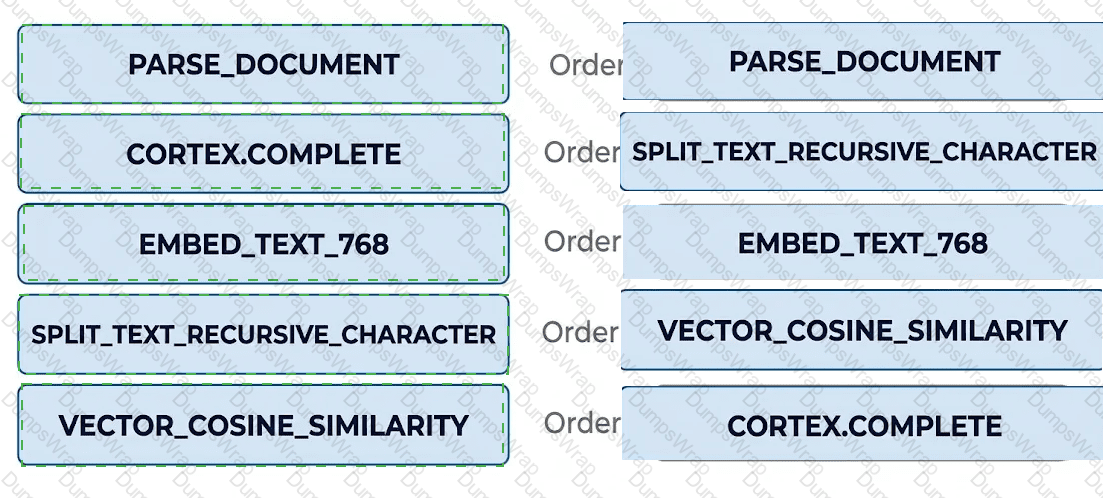
A Gen AI Specialist has one document on which they want to perform completions. The document is too large for the context window of SNOWFLAKE.CORTEX.COMPLETE.

In what order should the functions be applied to resolve the issue?
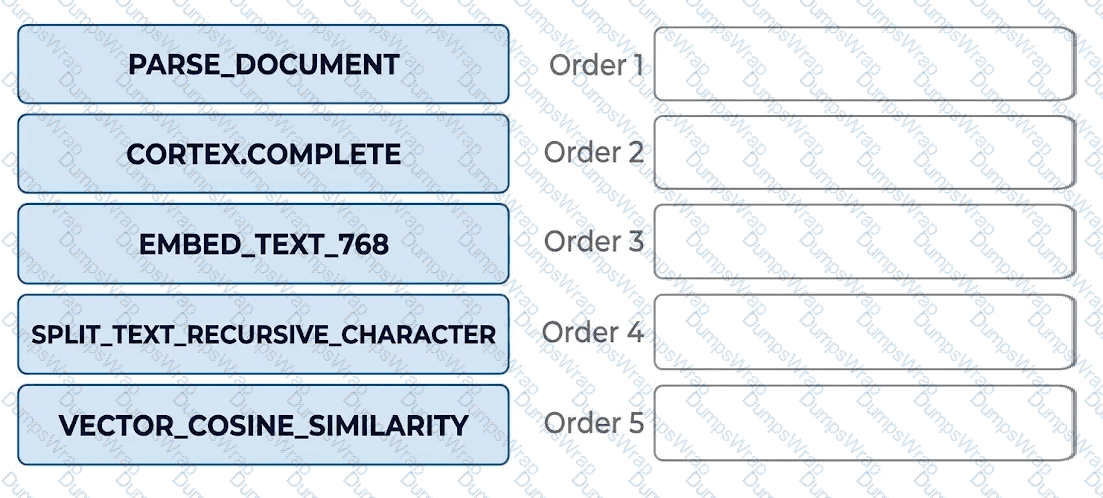
as

Options:

Question 18

A Gen AI Specialist has configured a pipeline to process hotel guest reviews. The reviews must be classified according to customer sentiment:

| REVIEW_DATE | REVIEW |

| :--- | :--- |

| 2024-04-12 | THE CUSTOMER SERVICE WAS VERY WELCOMING AND THE ROOMS ARE PRETTY CLEAN |

| 2024-06-01 | OUR ROOM WASN'T CLEANED AND TOWELS WERE MISSING. HOWEVER THE STAFF WERE HELPFUL |

Which statement satisfies this requirement?

```sql

Options:

A.

SELECT

review_date,

review,

SNOWFLAKE.CORTEX.ENTITY_SENTIMENT(review, ['professionalism', 'cleanliness', 'feel']) AS sentiment_analysis

FROM HOTEL_REVIEWS

WHERE NOT review IS NULL;

B.

SELECT

review_date,

review,

SNOWFLAKE.CORTEX.SENTIMENT(review) AS sentiment_analysis

FROM HOTEL_REVIEWS

WHERE NOT review IS NULL;

C.

SELECT

review_date,

review,

SNOWFLAKE.CORTEX.CLASSIFY_TEXT(review, ['SENTIMENT', 'FEEL']) AS sentiment_analysis

FROM HOTEL_REVIEWS;

D.

SELECT

review_date,

review,

SNOWFLAKE.CORTEX.SUMMARIZE(review) AS sentiment_analysis

FROM HOTEL_REVIEWS;

```

Question 19

How does Snowflake Cortex Analyst enable multi-turn conversations while preserving context across user interactions?

Options:

A.

By storing previous interactions in a separate database

B.

By using a session-based memory feature to track user queries

C.

By passing full conversation histories to each LLM agent in the workflow

D.

By using a summarization agent to rewrite questions based on conversation histories

Question 20

Which cost categories do Cortex Search Services incur that are tracked in the CORTEX_SEARCH_DAILY_USAGE_HISTORY view? (Choose two)

Options:

A.

Serving compute

B.

Cloud services compute

C.

Virtual warehouse compute

D.

TOKEN_CREDITS

E.

EMBED_TEXT_TOKENS

Question 21

A role lacks the OWNERSHIP privilege on an existing schema.

Which combination of GRANT statements is required to let users with that role create a Streamlit application in Snowflake? (Choose two)

Options:

A.

GRANT USAGE ON STAGE streamlit_db.streamlit_schema.my_stage TO ROLE streamlit_creator;

B.

GRANT CREATE STREAMLIT ON SCHEMA streamlit_db.streamlit_schema TO ROLE streamlit_creator;

C.

GRANT CREATE STAGE ON SCHEMA streamlit_db.streamlit_schema TO ROLE streamlit_creator;

D.

GRANT MONITOR ON WAREHOUSE streamlit_wh TO ROLE streamlit_creator;

E.

GRANT CREATE SCHEMA ON DATABASE streamlit_db TO ROLE streamlit_creator;

Question 22

Which arguments are required when you use the log_model method to log a model in the Snowflake Model Registry? (Choose two)

Options:

A.

model

B.

model_name

C.

code_paths

D.

version_name

E.

python_version

Question 23

Which commands restrict access to Snowflake Cortex functions so that access is provided only to roles with explicitly granted privileges? (Choose two)

Options:

A.

REVOKE ROLE SNOWFLAKE.CORTEX_FUNCTIONS FROM ROLE PUBLIC;

B.

REVOKE ROLE SNOWFLAKE.CORTEX_USER FROM ROLE PUBLIC;

C.

REVOKE DATABASE ROLE SNOWFLAKE.CORTEX_USER FROM ROLE PUBLIC;

D.

REVOKE USAGE ON SCHEMA SNOWFLAKE.CORTEX FROM ROLE PUBLIC;

E.

REVOKE IMPORTED PRIVILEGES ON DATABASE SNOWFLAKE FROM ROLE PUBLIC;

Question 24

How can costs that are directly associated with invoking the Snowflake Cortex COMPLETE function be minimized? (Choose two)

Options:

A.

Set max_tokens to limit the number of input tokens.

B.

Set max_tokens to limit the number of output tokens in the response.

C.

Reduce the size of the virtual warehouse used to run the function.

D.

Use an LLM that has more parameters than the current LLM being used.

E.

Use an LLM that has fewer parameters than the current LLM being used.

Question 25

A Gen AI Specialist is creating metadata for Snowflake Cortex Analyst by creating a semantic model. The relationship between the PRODUCTS and PRODUCT_SALES tables is defined as:

```yaml

relationships:

- name: sales_to_products

join_type: left_outer

relationship_type: many_to_one

left_table: PRODUCT_SALES

relationship_columns:

- left_column: PRODUCT_ID

right_column: ID

right_table: PRODUCTS

```

Which join will Cortex Analyst generate in a query that uses this model?

```sql

Options:

A.

SELECT...

FROM PRODUCT_SALES AS S

LEFT OUTER JOIN PRODUCTS AS P

ON S.PRODUCT_ID = P.ID;

B.

SELECT...

FROM PRODUCT AS P

LEFT OUTER JOIN PRODUCT_SALES AS PS

ON PS.PRODUCT_SALES = P.PRODUCTS;

C.

SELECT...

FROM PRODUCT_SALES AS S

FULL OUTER JOIN PRODUCT AS P

ON S.PRODUCT_ID = P.ID;

D.

SELECT...

FROM PRODUCT_SALES AS S

FULL OUTER JOIN PRODUCT AS P

WHERE P.ID = S.PRODUCT_ID;

```

Page: 1 / 9
Total 87 questions