
Weekend Sale Special - 75% Discount Offer - Ends in 0d 00h 00m 00s - Coupon code: w75best

Splunk SPLK-5002 Dumps

Page: 1 / 11
Total 105 questions

Splunk Certified Cybersecurity Defense Engineer Questions and Answers

Question 1

Which Enterprise Security components provide enrichment to the Risk Framework?

Options:

A.

Assets & Identities Framework, Risk Factoring, Annotations

B.

Risk Object, Notable Framework, Data Models

C.

Assets & Identities Framework, Threat Intelligence, Notes

D.

Risk Object, Threat Intelligence, Data Models

Question 2

Which of the following is the most efficient search to return a list of all visible indexes and the sourcetypes contained within them?

Options:

A.

A raw-event search followed by aggregation.

B.

A non-index-grouped metadata search.

C.

An index=* event search followed by stats.

D.

A tstats search returning sourcetypes and grouping them by index.

Question 3

A cyber defense engineer plays a role in maintaining a secure SOAR Cloud configuration. Which network security statement is correct about SOAR Cloud?

Options:

A.

Splunk Cloud initiates an outbound SSL connection to both the Automation Broker and managed endpoints.

B.

The Automation Broker initiates an outbound SSL connection to Splunk Cloud, and also initiates an outbound connection to the managed endpoints.

C.

The Automation Broker initiates an inbound SSL connection to Splunk Cloud, and also initiates an outbound connection to the managed endpoints.

D.

The Automation Broker initiates an outbound SSL connection to Splunk Cloud, and the managed endpoint initiates an outbound connection to the Automation Broker.

Question 4

While working with the SOC analysts to review current contextualization processes, a request for automation has been raised by the SOC team. They are asking for a new automation that will check a potentially malicious URL against a remote URL filtering list. Which of the following options will work for them?

Options:

A.

Neither Adaptive Action or Input Playbook

B.

Adaptive Response Action or Input Playbook

C.

Adaptive Response Action

D.

Input Playbook

Question 5

The following SPL is designed to report on a certain SOC metric. Which metric is the most likely topic for this report?

| tstats summariesonly=true earliest(_time) as _time

FROM datamodel=Incident_Management

BY " Notable_Events.Meta.rule_id "

| rename " Notable_Events.Meta.* " as " * "

| lookup update=true incident_updates_lookup rule_id OUTPUTNEW time

| search time=*

| stats earliest(_time) as create_time, min(time) as triage_time by rule_id

| eval diff=triage_time-create_time,

stat_type=if(

create_time < relative_time(now(), " -7d@d " ),

" past " ,

" current "

),

past=if(stat_type= " past " , 1, 0),

current=if(stat_type= " current " , 1, 0),

past_diff=if(stat_type= " past " , diff, 0),

current_diff=if(stat_type= " current " , diff, 0)

| stats sum(past) AS past,

sum(current) AS current,

sum(past_diff) AS past_diff,

sum(current_diff) AS current_diff

| eval past=round(past_diff/past/60),

current=round(current_diff/current/60)

| table past, current

| transpose

Options:

A.

Mean time to Triage

B.

Mean time to Respond

C.

Mean time to Resolve

D.

Dwell Time

Question 6

An engineer is writing a correlation search and needs to use T1059 from MITRE ATT & CK as a field in Incident Review. Assuming they are writing a correlation search that does not use the Risk data model, which example statement should be appended to the correlation search?

Options:

A.

The expression assigning T1059 to the correlation search ' s MITRE ATT & CK annotation field.

B.

The expression assigning T1059 to an unrelated event field.

C.

The expression applying T1059 only through a risk-model field.

D.

The expression using a non-annotation field for the ATT & CK technique.

Question 7

Which of the following actions will allow access to a list of alert actions via the API?

Options:

A.

| rest /services/alerts/adaptive_response_action

B.

| rest /services/alerts/correlationsearches

C.

| rest /services/alerts/alert actions/_acl

D.

| rest /services/alerts/alert_actions

Question 8

An engineer creates a new event type. What defines the association of this event type to an applicable data model?

Options:

A.

The tag(s)

B.

The search string

C.

The field alias

D.

The saved search name

Question 9

The SOC notices over the course of an investigation there are numerous logs similar to the following:

UDP: query: reallybad.c2.com IN A response: SERVFAIL

What detection should be created to alert on this behavior for the future?

Options:

A.

Excessive DNS Failures

B.

Excessive Authentication Failures

C.

Excessive Network Failures

D.

Excessive Endpoint Failures

Question 10

An engineer adds a custom event status of ' Testing ' and accidentally makes it the new default status. Their SOC calculates some metrics based on Notable status change sequences, starting from the old default status of ' New ' . Which metrics can be affected by this mistake?

Options:

A.

Mean Time to Respond, Mean Time to Resolve

B.

No metrics are impacted

C.

Mean Time to Triage, Dwell Time

D.

Mean Time to Resolve, Dwell Time

Question 11

Which of the following cURL commands would allow an engineer to effectively disable the REST API endpoint they ' ve been utilizing for testing a detection named TestSearchDevelopment?

Question 12

For detections that leverage a CIM data model, which aspect of the configuration is responsible for determining which indexes are being searched?

Options:

A.

The data model ' s constraint macro.

B.

The data model ' s index list.

C.

The data model ' s root expression.

D.

The data model ' s dataset hierarchy.

Question 13

When using SOAR to automate a response with a zero trust approach, which of the following represents a valid order of operations?

Options:

A.

Contain, triage initial incident, identify scope, remediate and/or restore

B.

Triage initial incident, identify scope, contain, remediate and/or restore

C.

Identify, scope, remediate and/or restore, triage

D.

Observe, orient, decide, act

Question 14

Risk scores are associated with how many levels of risk in Enterprise Security by default?

Options:

A.

(4) Info, Medium, High, Critical

B.

(3) Low, Medium, High

C.

(5) Info, Low, Medium, High, Critical

D.

(6) Info, Low, Medium, High, Critical, Unknown

Question 15

What does the following search do?

source=WinEventLog:security* sourcetype= " WinEventLog* " EventCode=4688

| stats count, values(process) as process by parent_process_name

Options:

A.

Displays a count of processes created by the same user.

B.

Displays a list of newly created processes and the user that created them.

C.

Displays a count of processes created by the same child process.

D.

Displays a list of processes and their parent processes.

Question 16

What external support consideration should an engineer account for if they plan to automate the disabling of a system or user?

Options:

A.

Communicate the actions to the IT Help Desk.

B.

Enable logging on the playbook.

C.

Validate that the system or user is not already disabled.

D.

Add the " support " tag to the playbook.

Question 17

A new playbook needs to be developed for automated phishing analysis and response. Configured in SOAR are integrations with Splunk Enterprise Security and actions from assets that pull in user-reported emails, perform automated threat analysis, add blocks on the proxy, and an EDR vendor to take various actions. Which would be the best workflow for the new playbook?

Options:

A.

Ingest the email from the mail vendor

Detonate email in the automated threat analysis system and collect verdict, looking for malicious indicators

Search the mail system for all users that received the email

Block any malicious URLs and processes with the proxy and EDR solutions

B.

Submit the user reported email from Splunk Enterprise Security

Search the mail system for all users that received the email

Review results from the automated threat analysis

Block any malicious URLs and processes with the proxy and EDR solutions

C.

Submit the email from Splunk Enterprise Security

Search the mail system for all users that received the email

Review results from the automated threat analysis

Block any malicious URLs and processes with the proxy and EDR solutions

D.

Ingest the email from the mail vendor

Detonate email in the automated threat analysis system and collect verdict, looking for malicious indicators

Search the mail system for all users that received the email

Block all URLs and processes with the proxy and EDR solutions

Question 18

Which of the following macro values will exclude all of the company networks if it is called from the following search?

index=firewall sourcetype=pan\:traffic NOT " company_networks "

Options:

A.

(src_ip IN (151.157.30.0/24, 26.06.18.0/24))

B.

NOT (src_ip IN (151.157.30.0/24, 26.06.18.0/24))

C.

NOT (src_ip=151.157.30.0/24 AND src_ip=26.06.18.0/24)

D.

(src_ip=151.157.30.0/24 AND src_ip=26.06.18.0/24)

Question 19

An effective method for building automation workflows is to follow the OODA (Observe, Orient, Decide, Act) loop stages. When transitioning between the Decide and Act stages, what additional step should be included before automating the Act stage?

Options:

A.

Validate response data paths from the Decide stage.

B.

Validate if the asset, identity, or service has an exemption.

C.

Create a new automation playbook.

D.

Create a new response template.

Question 20

An engineer needs to create a new report capturing the vendors and products that detect a particular CVE in their environment. How can they ensure that the search associated with the report only includes accelerated data?

Options:

A.

Search vendor_product within the Vulnerabilities data model using a standard search.

B.

Search the Updates data model for vendor/product information.

C.

Search for the CVE within the Vulnerabilities data model using tstats, grouped by vendor_product.

D.

Search vendor_product within the Updates data model using tstats.

Question 21

Below is an example of a Sysmon process create log. Which EventCode would be associated with this log entry?
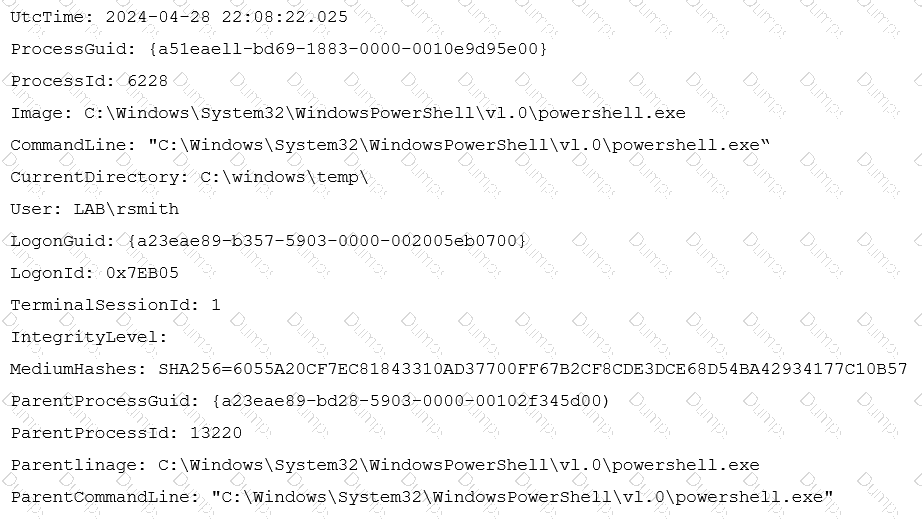
as

Options:

A.

EventCode=1

B.

EventCode=4

C.

EventCode=3

D.

EventCode=2

Question 22

How does Mission Control decipher which response template to assign to findings?

Options:

A.

This is determined when creating a detection in ES, which gets carried over to Mission Control.

B.

Mission Control uses AI to decipher which response templates are assigned.

C.

Response templates are assigned to specific incident types.

D.

The only way to configure this is with SOAR.

Question 23

An engineer has discovered that an acquired company uses a duplicate IP address space. Which feature of the asset and identity framework could be turned on that would allow for the separation of company IP address ranges within a lookup?

Options:

A.

Entity Definitions

B.

Asset Classes

C.

Entity Zones

D.

Asset Annotations

Question 24

An automation engineer for the Wonderland SOC has configured a new asset and is getting an HTTP 403 response code. Which of the following is a possible cause of the error code?

Options:

A.

The endpoint that the asset is configured for does not exist.

B.

Either the asset username or password is incorrect.

C.

The asset endpoint requires a token rather than a username and password.

D.

Asset credentials do not have adequate permissions.

Question 25

When creating a new playbook to be called directly from Mission Control or Enterprise Security, which type of playbook must be used?

Options:

A.

Input

B.

Automation

C.

Process

D.

Response

Question 26

What is the primary purpose of data indexing in Splunk?

Options:

A.

To ensure data normalization

B.

To store raw data and enable fast search capabilities

C.

To secure data from unauthorized access

D.

To visualize data using dashboards

Question 27

Which phase of the incident response lifecycle would cause the least amount of friction when replacing manual steps with automation?

Options:

A.

Rendering a verdict

B.

Triage

C.

Containment

D.

Remediation

Question 28

Consider the following series of events:

4:00 GMT Detection runs for interval 3:30–4:00

4:30 GMT Detection runs for interval 4:00–4:30

4:35 GMT Event 1 occurs on an endpoint

4:45 GMT Event 1 is indexed

5:00 GMT Detection runs for interval 4:30–5:00

5:05 GMT Event 1 finding is added to ES with timestamp 4:35

5:24 GMT Event 2 occurs on an endpoint

5:30 GMT Detection runs for interval 5:00–5:30

5:35 GMT Event 2 is indexed

6:00 GMT Detection runs for interval 5:30–6:00

What is the problem with the detection schedule chosen and how can it be solved?

Options:

A.

The logs are delayed so the detection time window needs to be decreased.

B.

The time window for the detection is too small, causing duplicate alerts.

C.

The time window for the detection is too large, causing duplicate alerts.

D.

The logs are delayed so the detection time window needs to be increased.

Question 29

When developing security metrics, why would a Key Performance Indicator (KPI) that focuses on total perimeter firewall blocks be an ineffective metric?

Options:

A.

This a Key Result Indicator, not a KPI. It is a metric that is measuring the results of the perimeter firewall ' s actions, not the performance of the firewall.

B.

Perimeter firewalls are exposed on the internet directly and thus subject to automated scanners and attack tools.

C.

The metric is too high level, it should be broken down by the type of block. For example, blocks of remote systems that have repeated failed connections to services that do not exist.

D.

Perimeter firewalls should be measured on both the number of connections that they permit as well as the number they block.

Question 30

If a correlation search cannot be run at the configured time, which scheduling option should an engineer use to ensure there are no backfill gaps in data?

Options:

A.

Default

B.

Continuous

C.

Real-time

D.

Auto

Question 31

The SOC Manager requested a better method to standardize the list of tasks that analysts follow when they evaluate events or cases. Which Splunk SOAR feature allows the creation of SOPs based on criteria like the type of event or attack vector?

Options:

A.

Workbooks

B.

Events

C.

Cases

D.

Incidents

Page: 1 / 11
Total 105 questions