
Pre-Summer Sale Discount Flat 70% Offer - Ends in 0d 00h 00m 00s - Coupon code: 70diswrap

The Beryl Institute CPXP Dumps

Page: 1 / 15
Total 150 questions

Certified Patient Experience Professional Questions and Answers

Question 1

A nurse is tasked with looking into a patient grievance and reporting the findings to the patient advocacy department. What is the BEST way to get detailed information about what occurred?

Options:

A.

Go to the Gemba.

B.

Conduct a Kaizen event.

C.

Read the patient’s grievance.

D.

Interview the patient advocate.

Question 2

Which method is BEST used to engage patients and family members about their concerns and suggestions for improvement in a healthcare organization?

Options:

A.

Interview employees who have been patients.

B.

Hold quarterly patient and family focus groups.

C.

Conduct weekly point of care surveys.

D.

Establish a patient and family advisory council.

Question 3

Management views turnover as a cause for low patient experience scores. Which is the BEST question for the patient experience professional to ask to give insight into this issue?

Options:

A.

Why do staff leave?

B.

What is the turnover rate?

C.

Is there a retention bonus in place?

D.

Is the rate improved over the prior year?

Question 4

Administrators voice concern that physicians in a medical practice group seem stuck at the same scores on patient experience surveys. What is the BEST next step for the patient experience professional to build engagement and move forward with improvement actions?

Options:

A.

Meet with medical practice leaders to learn their expectations and identify physician leaders within the practice.

B.

Publicly share individual physician patient experience scores and percentile rankings.

C.

Share improvement tips focused on communicating with patients.

D.

Work with the front-line team and survey vendor to improve survey response rates.

Question 5

An increasing number of patients and family members believe that their treatment plans are wrong. Unit leaders report high census, staffing challenges, and difficult patient behaviors. What is the FIRST step a patient experience professional should take to address this situation?

Options:

A.

Create communications training for front-line staff and physicians.

B.

Seek additional information by reaching out to patients and families to ask about their involvement in the care process.

C.

Work with unit leaders to develop and add a custom question to the patient experience survey.

D.

Seek additional information by reaching out to friends and colleagues who have been patients and ask whether they have had similar experiences.

Question 6

A patient experience professional has received complaints from patients and their families about a lack of communication from the nurses concerning the patients’ care. In an effort to build powerful relationships with the care staff, which of the following is the BEST way to engage the patients and their families in communication?

Options:

A.

Bedside shift report

B.

Hourly rounding

C.

Leadership rounding

D.

Whiteboard use

Question 7

When is the BEST time to do service recovery follow-up?

Options:

A.

Immediately after the issue arises

B.

24 hours after the issue arises

C.

After fully researching and validating concerns

D.

After discharge/appointment ends

Question 8

Which of the following BEST explains the distinction between patient experience and patient satisfaction?

Options:

A.

Patient experience is subjective while patient satisfaction is objective.

B.

Patient experience is focused on service outcomes while patient satisfaction is focused on happiness.

C.

Patient experience is about individual encounters while patient satisfaction addresses overall perceptions.

D.

Patient experience is about the integrated encounter while patient satisfaction addresses individual expectations.

Question 9

What is Gemba when used within the Lean process methodology?

Options:

A.

Collaboration to improve

B.

Continuous improvement designs

C.

Location where value is created

D.

Reduced waste in future mapping

Question 10

What is the FIRST step in creating cultural change in an organization?

Options:

A.

Creating a sense of commitment

B.

Creating a sense of engagement

C.

Creating a sense of urgency

D.

Creating empathy among employees

Question 11

A non-English-speaking patient is asking questions that indicate a lack of understanding of the procedure that the patient is about to undergo. Which component of the patient ' s rights has been neglected?

Options:

A.

Respect for cultural diversity

B.

Confidentiality of personal health information

C.

Informed consent

D.

Patient’s right to file a complaint

Question 12

A patient experience professional is meeting with a group of front-line nurses on a medical/surgical unit to identify why they are having difficulty hourly rounding on their patients. Which process improvement tool should be used to determine the root cause?

Options:

A.

A regression analysis

B.

A “5 Whys” exercise

C.

A Six Sigma control plan

D.

An inter-rater reliability tool

Question 13

What is an identified challenge to including patients, family members, and care partners in the co-design process?

Options:

A.

Communicating the process objectives to patients

B.

Securing a diverse range of patients and experiences

C.

Creating the necessary incentive program for engagement

D.

Reaffirming the value of the time one will invest in the effort

Question 14

A new patient check-in process was implemented to reduce wait time. What is the BEST approach to examine if the updated process is meeting its intended goal?

Options:

A.

Direct observation

B.

Quantitative survey

C.

Role play scenario

D.

Patient focus group

Question 15

Which data visualization illustrates the impact of process change to staff related to patient experience improvement efforts?

Options:

A.

Bar graphs

B.

Pie charts

C.

Run charts

D.

Box and whisker diagrams

Question 16

Which is the BEST example of an employee engagement strategy?

Options:

A.

Sharing patient letters in an organizational newsletter

B.

Reviewing employee satisfaction data with individual units/departments

C.

Demonstrating appreciation for individual staff contributions

D.

Discussing complaint and grievance data during staff meetings

Question 17

While facilitating a virtual patient and family advisory council meeting, which approach may help elicit group engagement?

Options:

A.

Encourage cameras be turned on.

B.

Direct responses to the chat function.

C.

Private message individual participants.

D.

Create an agenda with multiple presentations.

Question 18

When individualizing care to advance a culture of patient, long-term care resident, and family partnership, what is the MOST important thing to consider?

Options:

A.

Integrating the patient ' s or resident ' s personal goals and ensuring engagement in their care

B.

Developing the plan of care and letting the patient know what to expect

C.

Encouraging the family to participate in the patient or resident experience

D.

Adjusting the level of staffing in order to allow time for patient, resident, and family connections

Question 19

A patient experience professional is asked by leadership to develop an action plan for improvement based on the measurement of a key driver question. Which step should the patient experience professional take FIRST?

Options:

A.

Implement a patient and family focus group.

B.

Create patient satisfaction measurement tools.

C.

Reward and recognize staff to reinforce good behavior.

D.

Obtain the latest satisfaction measurements.

Question 20

Which of the following represents an element of leading change?

Options:

A.

Sustaining acceleration

B.

Picking a leader

C.

Formulating a communication plan

D.

Implementing rapid cycle improvement

Question 21

Which statement BEST reflects The Beryl Institute’s definition of patient experience?

Options:

A.

The patient’s satisfaction score after discharge

B.

The sum of all interactions, shaped by an organization’s culture, that influence patient perceptions across the continuum of care

C.

The clinical outcome achieved during treatment

D.

The efficiency of registration, billing, and discharge processes only

Question 22

Which is the BEST practice for conducting post-visit phone calls?

Options:

A.

A nurse who personally cared for the patient calls the patient within 1–2 days of discharge to inquire how he or she is doing, clarify discharge instructions as needed, and answer any other questions the patient might have.

B.

The nurse manager (or other nurse leader on the unit where the patient received care) calls the patient within 1–2 days of discharge to inquire how he or she is doing, clarify discharge instructions as needed, and answer any other questions the patient might have.

C.

The discharge nurse calls the immediate caregiver of the patient within 1–2 days of discharge to inquire how the patient is doing, review the discharge instructions, and answer any other questions the caregiver might have.

D.

A third party with whom the organization has contracted calls the patient within 7–14 days of discharge to inquire how the patient is doing, review the discharge instructions, and answer any other questions the caregiver might have.

Question 23

Which leadership action MOST supports a sustainable culture of patient experience improvement?

Options:

A.

Reviewing patient experience scores privately at the executive level only

B.

Delegating all patient experience work solely to the patient relations department

C.

Setting clear expectations, conducting regular leadership rounding, and acting on feedback with visible accountability

D.

Waiting to address recurring concerns during the annual strategic planning cycle only

Question 24

The patient and family advisory council (PFAC) of a large healthcare institution is asked to give input on the design of a new ICU. Using experience-based co-design, it would be best for the PFAC to focus its energies on which component FIRST?

Options:

A.

Aesthetics of experience, focusing on usability

B.

Engineering, focusing on reliability and safety

C.

Performance, focusing on functionality

D.

Structure, focusing on building construction

Question 25

Which of the following can ONLY be achieved through qualitative data collection methods?

Options:

A.

Determining the healthcare priorities of the community served

B.

Identifying top opportunities for patient experience improvement

C.

Understanding why patients feel a certain way about their care experiences

D.

Measuring a healthcare organization’s performance on patient satisfaction

Question 26

What are the steps of the PDSA cycle?

Options:

A.

Perceive, design, scale, adapt

B.

Plan, do, study, act

C.

Prepare, direct, sustain, activate

D.

Prioritize, delegate, select, assess

Question 27

Which of the following is the MOST critical consideration when communicating information to a diverse audience?

Options:

A.

Keep wording straightforward.

B.

Provide detailed explanations.

C.

Use stories to convey a point.

D.

Include analogies or metaphors.

Question 28

Which statement BEST describes HCAHPS?

Options:

A.

An internal employee engagement survey used only for hospital workforce culture

B.

A national, standardized, publicly reported survey of patients’ perspectives of hospital care

C.

A complaint-resolution workflow used only in ambulatory clinics

D.

A financial benchmarking tool for payer reimbursement performance

Question 29

Which is the MOST important element in achieving an exceptional patient experience?

Options:

A.

Financial resources

B.

Community engagement

C.

Employee engagement

D.

Technological advances

Question 30

How can patient experience survey results BEST be used to influence organizational efforts?

Options:

A.

Analyze organizational and unit-level performance to monitor and follow up on performance.

B.

Align behaviors to survey results throughout the organization to drive desired outcomes.

C.

Recognize and reward outstanding behaviors that drive desired results.

D.

Establish clear goals, align behaviors, and consistently review performance.

Question 31

A healthcare organization wants to leverage their patient experience scores to support their brand messaging that the organization is a world-class health provider. Which data element would BEST support this campaign?

Options:

A.

A year-to-date top-box score for Overall Rating 0 to 10

B.

A previous fiscal year’s percentile ranking for Likelihood to Recommend on the state benchmark

C.

A 3-to-5-year series trend of the organization’s overall percentile ranking on the national benchmark

D.

A list of key drivers’ performance within the past two fiscal years

Question 32

Which are the MOST utilized data sources for evaluating service?

Options:

A.

Compliment data and focus groups

B.

Service recovery logs and community advisory committees

C.

Post-visit phone call feedback

D.

Patient (or family) complaints and patient satisfaction data

Question 33

Which is a key FIRST step for a patient experience professional in implementing a patient and family advisory council?

Options:

A.

Assembling written training materials

B.

Inviting community members to join

C.

Meeting with current volunteers to gather ideas

D.

Working with leadership and staff to get buy-in

Question 34

Which of the following BEST describes four core concepts of patient- and family-centered care?

Options:

A.

Safe care, high quality care, optimal experience/satisfaction, and value

B.

Dignity and respect, information sharing, collaboration, and participation

C.

Patient experience, population health, cost reduction, and employee engagement

D.

Patient engagement, family support, relationship-based care, and efficiency

Question 35

In analyzing an organization ' s patient experience data, the patient experience professional observes that the standard deviation gets smaller as the responses become more similar for each question. Which is the BEST explanation for this phenomenon?

Options:

A.

As responses become more similar, the mean increases, resulting in the standard deviation becoming smaller.

B.

As responses become more similar, the median and mode become smaller. Thus, the standard deviation also becomes smaller.

C.

As responses become more similar, they are closer to the mean, resulting in the standard deviation becoming smaller as well.

D.

As responses become more similar, the more different respondents are from each other, resulting in the standard deviation becoming smaller.

Question 36

What would be the BEST composition for a multidisciplinary rounding team to round on ICU patients?

Options:

A.

The attending physician, pulmonologist, immunologist, and cardiologist

B.

The medical chief of staff, attending physician, house supervisor, patient registrar, and spiritual care provider

C.

The attending physician, nurse leader, primary nurse, case manager, pharmacist, and spiritual care provider

D.

The ICU nurse leader, primary nurse, respiratory therapist, and patient care assistant

Question 37

What are three MOST important dimensions for improving the relationship between the patient and provider?

Options:

A.

Emotional connection, partnership, and using the scientific method

B.

Emotional connection, agreement on treatment, and willingness to listen

C.

Partnership, Socratic questioning, and support

D.

Agreement on treatment, partnership, and Socratic questioning

Question 38

Which nonverbal cue demonstrates empathy while performing service recovery?

Options:

A.

Maintaining eye contact

B.

Acknowledging the concern

C.

Writing notes for reference

D.

Remaining in a standing position

Question 39

Of the following process improvement methodologies, which MOST directly engages the customer in the process?

Options:

A.

Lean

B.

Six Sigma

C.

Experience-Based Design

D.

Total Quality Management

Question 40

Which qualitative research method helps provide the BEST understanding of patients’ experiences when a design thinking approach is used?

Options:

A.

Focus groups

B.

Case studies

C.

Research articles

D.

Organizational policy

Question 41

Which comment by a surgeon represents the BEST way to convey effective emotional support to a patient?

Options:

A.

" I ' ve performed this procedure hundreds of times. I ' ll take great care of you. "

B.

" We are going to do our best. Don ' t worry about a thing. "

C.

" Don ' t worry; I could do this procedure in my sleep. "

D.

" I ' ve done this before. We rarely have complications and you ' ll be fine. "

Question 42

Referencing the Change Model graph below, where in these zones does “The Point of Decision” usually occur?
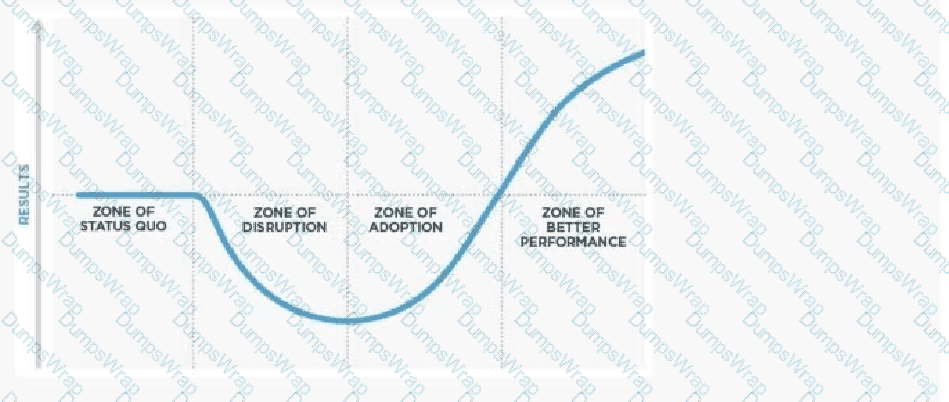
as

Options:

A.

At the midpoint of the “Zone of Status Quo”

B.

In between the “Zone of Status Quo” and “Zone of Disruption”

C.

In between the “Zone of Disruption” and “Zone of Adoption”

D.

In between the “Zone of Adoption” and “Zone of Better Performance”

Question 43

Significant differences between what end-users may desire and what healthcare systems are willing to do based on their expertise and resources is a challenge for design-thinking. What is the BEST strategy below to help bridge the gap and provide balance?

Options:

A.

Empathy for end-user desires, a clear awareness of current state experiences, and identification of issues that can interfere

B.

Needs assessment based on observational data and interviews, ideation, and prototyping

C.

Review of system budget and resources, identification of solution, implementation, and 6- month check

D.

Staff interviews and PDCA cycle implementation

Question 44

In which of the following methodologies for process improvement is emotional mapping used as an analytical tool?

Options:

A.

Plan-Do-Check-Act

B.

Experience-based co-design

C.

Total quality management

D.

Lean management

Question 45

Which is the BEST way to de-escalate a situation in which a patient is acting in an agitated, aggressive manner?

Options:

A.

Maintain a smile.

B.

Stand close to the patient.

C.

Use short, simple sentences.

D.

Keep hands in pockets.

Page: 1 / 15
Total 150 questions