
TOGAF 9.2 Combined Part 1 and Part 2 Questions and Answers
Scenario
Please read this scenario prior to answering the Question
You are serving as an Enterprise Architect at a large aerospace company. It designs, manufactures and sells civil and military aviation products worldwide and manufactures in multiple countries both inside and outside of the European Union. The company has grown rapidly by acquisition and has inherited numerous different procurement processes and related IT systems.
Recently, several procurement processes, within the civil aviation business, have has problems related to the timing of purchases, which has led to excess inventory. The Vice President in charge of Supply Chain Management has made the decision to consolidate and reduce redundant procurement processes and systems. He has committed to the CEO that the business will move to a " Just-in-time " procurement system so as to keep inventory costs low.
The TOGAF standard is used for internal Enterprise Architecture activities. At present, there are no architectural assets in the Architecture Repository related to this initiative. All assets will need to be acquired, customized, or created from scratch. The company prefers to implement commercial off the shelf package applications with little customization. The CIO, who is the project sponsor, has stated that she is not concerned about preserving the existing procurement processes or systems.
This project is using an iterative approach for executing the Architecture Development Method (ADM). The architecture development project has completed the Architecture Vision Phase and has started a number of iteration cycles to develop the Architecture. As a packaged application is being considered, the next iteration will include both the Business and Application Architectures.
Stakeholders concerns that should be addressed by these architectures include:
1. What groups of people should be involved in procurement-related business processes?
2. What applications will these groups use once the architecture development is complete?
3. What non-procurement applications will need to be integrated with the new procurement applications?
4. What are the dependences between the non-procurement and the new procurement applications?
Refer to the Scenario
[Note: You may need to refer to the Architectural Artifacts chapter, section 31.6 (located in Part IV) within the reference text in order to answer this question.]
You have been asked to identify the most appropriate catalogs, matrices, and diagrams to support the next iteration of Architecture development.
Based on the TOGAF standard, which of the following is the best answer?
Complete the sentence. The Architecture Landscape is divided into levels, Strategic Architectures, _____________
Which of the following best describes the Standards Information Base?
Please read this scenario prior to answering the question
You are serving as the Lead Enterprise Architect for a life insurance, annuities, and
pensions company, which has been formed through the merger of three companies.
The company consists of three divisions with the same names and division
headquarters as their predecessors.
The lack of integration between the three divisions has increasingly caused problems
in the handling of customer and financial information. At present, each division
maintains its own applications. Despite an earlier initiative to install a common
application to manage customer, products, and claims information, each division has
different ways of defining its data elements and has customized the common
application to the point where the ability to exchange information is error-prone.
The Chief Information Officer (CIO) has formed an Enterprise Architecture
department, and one of the primary goals in its charter is to coordinate efforts
between the teams in each division. The CIO has also formed a cross-functional
Architecture Board to oversee and perform governance. The TOGAF standard is used
as the basis for the core framework of the Enterprise Architecture program. The
company has an existing team of security architects.
The company has made the decision to introduce a common web portal, contact
center software suite, and document management system. Also the company has
selected a single enterprise-wide customer relationship management (CRM)
application to consolidate information from several applications that exist across the
divisions. The application will be used by each of the divisions and accessed by third
party partners through well-defined interfaces.
The CIO is concerned that the new application must be able to manage and
safeguard customer information in a secure manner that meets or exceeds the legal
requirements of the countries in which the company operates. This will be an
increasingly important capability as the company expands its online services in
cooperation with its external partners.
Refer to the Scenario
As part of the process for initiating the Enterprise Architecture project to rollout the
new application, you are developing a set of architecture principles.
You need to recommend the best approach for this work.
Based on the TOGAF Standard, Version 9.2, which of the following is the best
answer?
Scenario:
Please read this scenario prior to answering the Question
You are serving as the Chief Architect for a large, global commodities trading company which has been growing rapidly through a series of acquisitions.
Each business is performing well in its markets. However, the lack of integration between headquarters and the business units has increasingly caused problems in the handling of customer and financial information. The inability to share information across businesses has resulted in lost opportunities to " leverage the synergies " that had been intended when the businesses were acquired. At present, each business unit maintains its own applications. Despite an earlier initiative to install a common application to manage customer, products, supplier, and inventory information, each business unit has different ways of defining each of these core elements and has customized the common application to the point where the ability to exchange information is difficult, costly, and error-prone.
As a result, the company has made the decision to introduce a single enterprise-wide application to consolidate information from several applications that exist across the lines of business. The application will be used by all business units and accessed by suppliers through well defined interfaces.
The Corporate Board is concerned that the new application must be able to manage and safeguard confidential customer information in a secure manner that meets or exceeds the legal requirements of the countries in which the company operates. This will be an increasingly important capability as the company expands its online services in cooperation with its trading partners.
The CIO has formed an Enterprise Architecture department, and one of the primary goals in its charter is to coordinate efforts between the implementation team and the business unit personnel who will be involved in the migration process. The CIO has also formed a cross-functional Architecture Board to oversee and govern the architecture. The company has an existing team of security architects.
TOGAF 9 has been selected for use for the Enterprise Architecture program. The CIO has endorsed this choice with the full support of top management.
Refer to the Scenario
In the Preliminary Phase you need to define suitable policies and ensure that the company has the appropriate capability to address the concerns of the Corporate Board.
Based on TOGAF 9, which of the following is the best answer?
Please read this scenario prior to answering the question.
You are employed as an Enterprise Architect working within the Enterprise Architecture team at an electric vehicle manufacturer. The company focuses on designing, manufacturing, and advancing battery technology for sustainable transportation, while also investing in charging infrastructure, autonomous driving systems, and renewable energy integration.
The company is introducing a major change to its vehicle design over a five-year period. This will be a cross-functional effort between hardware and software teams, delivering significant new features in the vehicles they manufacture. It is planned to be developed in phases. An architecture to support strategy has been completed with a roadmap for a set of projects.
The Enterprise Architecture team has taken over the architecture for the hardware and software automotive platform used by current vehicles, some of which will be reused in the new vehicle design. The Enterprise Architecture team has started to identify which parts of the architecture can be reused.
The presentation and access to different variations of data that the company plans to offer through its vehicles creates a design challenge. The application portfolio and supporting infrastructure must connect with multiple cloud services and data repositories in different countries to handle data at scale.
Enough of the Business Architecture has been defined so that work can commence on the Information Systems and Technology Architectures. Those architectures need to be defined to support the primary business services that the company plans to provide. These services will handle and use the data created by vehicles, preparing the way for self-driving vehicles in the future.
The company uses the TOGAF standard as the basis for its Enterprise Architecture framework. The Enterprise Architecture team reports to the Chief Technology Officer, who is the sponsor of the Enterprise Architecture program. The Chief Technology Officer requires that the Enterprise Architecture team follow the purpose-based Enterprise Architecture Capability model as described in the TOGAF Series Guide: A Practitioners’ Approach to Developing Enterprise Architecture Following the TOGAF ADM .
Refer to the scenario.
How would you plan, organize, and manage the architecture development at this stage?
Based on the TOGAF standard, which of the following is the best answer?
Scenario:
Please read this scenario prior to answering the question
The ABC company is a large, global commodities trading company which has been growing rapidly through a series of acquisitions.
Each new business is performing well in its markets. However, the lack of integration between headquarters and the business units has increasingly caused problems in the handling of customer and financial information. The inability to share information across businesses has resulted in lost opportunities to " leverage the synergies " that had been intended when the businesses were acquired. At present, each business unit maintains its own applications. Despite an earlier initiative to install a common application to manage customer, products, supplier, and inventory information, each business unit has different ways of defining each of these core elements and has customized the common application to the point where the ability to exchange information is difficult, costly, and error-prone.
As a result, the company has begun implementing a single Enterprise Resource Planning (ERP) system to consolidate information from several applications that exist across the lines of business.
The Corporate Board is concerned that the new ERP system must be able to manage and safeguard customer information in a manner that meets or exceeds the legal requirements of the countries in which the company operates. This will be an increasingly important capability as the company expands its online services offered to clients and trading partners.
The CIO has formed an Enterprise Architecture department, and one of the primary goals in its charter is to coordinate efforts between the ERP implementation team and the business unit personnel who will be involved in the migration process. The CIO has also formed a cross-functional Architecture Review Board to oversee and govern the architecture. The company has selected TOGAF 9 as the basis for its Enterprise Architecture program. The CIO has endorsed this choice with the full support of top management.
Refer to the Scenario
You are serving as the Chief Architect.
You have been asked to recommend the approach to take in the Preliminary Phase to ensure that the Corporate Board ' s concern is addressed.
Based on TOGAF 9, which of the following is the best answer?
Complete the sentence. Capability-Based Planning is a technique that _______
In which phase of the ADM cycle do building blocks become implementation-specific?
What does the TOGAF standard provide to guide architectural activity within the enterprise in terms of structures, roles, responsibilities, and processes?
Which of the following best describes the purpose of the Architecture Roadmap?
You are an Enterprise Architect at a food production and distribution company. The primary goal of the company is to maximize profit while satisfying the needs of consumers for its products. Its customers are demanding food that is produced sustainably, safely, and transparently while reducing environmental impact.
The business is highly mechanized, and this mechanization has caused a decrease in the number of workers needed, together with a focus on agricultural engineering to improve the efficiency of its farms, its processing facilities, and the overall enterprise. As part of this, the company has established an Enterprise Architecture (EA) practice based on the TOGAF standard, using it as the method and guiding framework. The Chief Information Officer (CIO) is the sponsor of EA practice. The introduction of EA has enabled the decision-makers to have valuable insights into the different aspects of the business.
Global warming has caused a lot of poor harvests, and the company is producing fewer crops than before. This combined with an increase in costs for energy, feed, fuel, and fertilizer has led to a significant decrease in profits. The rising costs and reduced profits mean that the company is unable to take as much planned action on climate measures as it would like, such as reducing its carbon footprint. In response to the situation, the Chief Executive Officer (CEO) has decided that big changes are needed that will lead both to improved crop production and profitability. They must look to all aspects of the business. This includes looking at the mix of crops to mitigate for the change in climate.
The company will also cease to process its own crops and will sell off its processing facilities. Thus, the target market will change, and the end-products will be different and more varied. A formal request for architecture change has been approved. At this stage, there is no fixed scope, shared vision, or objectives.
Refer to the scenario:
You have been asked to propose the best approach for architecture development to realize the CEO ' s change in direction for the company.
Please read this scenario prior to answering the question
Your role is that of an Enterprise Architect In a company that develops wind turbines for use in wind farms. The company has multiple manufactunng facilities, in North America, Asia, and Europe. Each of these facilities supplies the power industry In Its region. Most of the facilities are wholly owned by the company, but those In Asia are jointly owned with local partners.
The company has a mature Enterprise Architecture practice supported by a cross-functional Architecture Board and uses the TOGAF standard.
The company recognizes that the long-term technical potential of wind energy can address the current global dependency on carbon fuels. In order to do so this will require wind turbines to be installed over large areas and in areas of higher wind resources. In particular offshore wind farms can contribute substantially more energy than land stationed turbines.
The research arm of the company has pioneered the development of an offshore wind turbine design, with an improved turbine blade and power system, that will produce up to 20% more energy. This new design is ready to go Into production.
As part of putting the new design into production, adjustments to the automated assembly processes need to be made. A pilot architecture project at a single location has defined an updated approach for controlling the automated systems used to perform final assembly and quality assurance. The Chief Engineer, sponsor of the activity, and the Architecture Board have approved the plan for immediate implementation at each plant.
Architecture Contracts have been developed that detail the wortc needed to implement and deploy the new automated system controller for each location. The Chief Engineer has expressed concern that a uniform process be employed at each location to ensure consistency and a low blade failure rate.
Refer to the Scenario
You have been asked to recommend the best approach to address the Chief Engineer ' s concern.
Based on the TOGAF Standard, Version 9.2. which of the following is the best answer?
During a TOGAF ADM cycle, an architecture is denoted as Version 10. What does this indicate?
Scenario:
Please read this scenario prior to answering the Question
Your role is that of Lead Enterprise Architect within a vacation property management firm that has been growing through acquisition. The firm manages over 200 resort properties across North America. Many of the resort properties use the same internal IT systems that they used before they were acquired. Until recently, the only requirement that has been placed on each property is that they use a standard financial reporting system to report their financial results to the headquarters on a weekly basis.
The CEO has stated his concerns about the inefficiencies of the current approach and identified the need to change. He has defined a new strategic vision that will enhance the business by standardizing its operations across the network to provide consolidated financial, human resources, logistics, sales and marketing, and yield management. He has also stated that he expects results by the end of the current fiscal year.
These changes will provide the company with improved utilization of its capacity and more efficient operations. The addition of a corporate-wide data warehouse will provide analytics that will enable the marketing group to improve its ability to target advertising into key markets to improve yields.
The firm has a mature enterprise architecture practice and uses TOGAF 9 as the method and guiding framework. The CIO is the sponsor of the activity.
In planning this change, the Chief Architect engaged the services of a well-known consulting firm that specializes in business strategy. An initial study has been conducted to identify the strategic changes needed to implement the CEO ' s vision. This recently completed with approval of a strategic architecture encompassing the entire firm, including detailed requirements and recommendations.
Based on the recommendations from the initial study, the firm has taken the decision to adopt a packaged suite of integrated applications that is tailored to the needs of the hospitality industry.
Refer to the scenario
You have been asked by the Chief Architect to justify the best approach for architecture development to realize the CEO ' s vision.
Based on TOGAF 9, which of the following is the best answer?
Scenario:
Please read this scenario prior to answering the question
Your role is that of the Lead Enterprise Architect at a multinational automotive corporation. The company is headquartered in Germany, and manufactures cars, trucks and buses. It has manufacturing plants across North America, South America, Europe and Asia. Each of these plants has been operating its own planning and production scheduling systems, as well as custom developed applications that drive the automated production equipment at each plant.
The company has an ongoing initiative to improve the efficiency of all of its production operations, and in particular to reduce its carbon footprint. During a recent exercise held for internal quality improvement, it was determined that a significant reduction in energy usage could be achieved by replacing the current planning and scheduling systems with a common Enterprise Resource Planning (ERP) system located in one central data center. This central system would provide support to each of the plants replacing the functionality in the existing systems. It would also eliminate the need for full data centers at each of the plant facilities.
The Enterprise Architecture department has been operating for several years and has mature, well-developed architecture governance and development processes that are strongly based on TOGAF standard.
At a recent meeting, the Architecture Board approved a Request for Architecture Work sponsored by the global CIO. The request covered the initial architectural investigations and the development of a comprehensive architecture to plan the transformation.
The architecture project team has now been formed, and has been asked to develop an Architecture Vision that will achieve the desired outcomes and benefits. Some of the plant managers have expressed concern about the security and reliability of driving their planning and production scheduling from a remote centralized system. The CIO wants to know how these concerns can be addressed. During the initial project team meeting a number of alternative recommendation for how to proceed have been put forward by members of the team.
Refer to the Scenario
You have been asked to select the most appropriate recommendation to ensure that the team evaluates different approaches to the problem and clarifies the requirements for the architecture.
Based on the TOGAF standard, which of the following is the best answer?
Scenario
Please read this scenario prior to answering the question
Your role is consultant to the Lead Architect within a company that manufactures electromechanical devices. The company is organized as independent operational divisions.
The company has a mature Enterprise Architecture (EA) practice and uses the TOGAF standard for the basis of its architecture framework. In addition to the EA program, the company has a number of management frameworks in use, including business planning, portfolio/project management, and operations management. The EA program is sponsored by the CIO.
A strategic architecture has been approved that includes consolidation of multiple Enterprise Resource Planning (ERP) applications that have been operating in several of the divisions’ production facilities. The goal is to replace the functionality of the existing applications with a new ERP product running as a single instance in the company’s primary data center.
Each division has completed the Architecture Definition documentation required to tailor and configure the environment to meet its own specific manufacturing requirements.
The enterprise architects have analyzed the key corporate change attributes and implementation constraints. A consolidated gap analysis has been completed which has identified the gaps across the Business, Data, Application, and Technology domains.
Using the results of the gap analysis, the architects have reviewed the requirements, dependencies and interoperability requirements needed to integrate the new ERP environment into the existing environment. The architects have completed the Business Transformation Readiness Assessment started in Phase A. Based on all of these factors they have produced a risk assessment.
The implementation process is estimated to take four years. Because of the risks posed by the complexity of the current environment, a phased approach is needed to implement the target architectures. The Implementation and Migration Plan v0.1, the draft Architecture Roadmap, and the Capability Assessment deliverables are now complete.
You have been asked to recommend the next steps to prepare the final Implementation and Migration Plan.
Based on the TOGAF standard, which of the following is the best answer?
Please read this scenario prior to answering the question
Your role is consultant to the Lead Enterprise Architect within a multinational manufacturing company. The company has several manufacturing divisions.
The company has a mature Enterprise Architecture practice and uses the TOGAF standard as the basis of Its architecture frame work. In conjunction with the EA program, the company uses several management frameworks. Including business planning, portfolio/project management, and operations management. The EA program is sponsored by the CIO.
The company has defined a strategic architecture to improve ils ability to meet customer demand and improve its ability to manage its supply chain. The strategic architecture called for the consolidation of multiple applications that have been operating independently in the divisions ' production facilities. The goal is to replace the functionality of the existing applications with a new application running as a single instance in the company’s primary data center.
Each division has completed the Architecture Definition documentation required to tailor and configure the environment to meet its own specific manufactunng requirements.
The key corporate change attributes and implementation constraints have been confirmed. The gap analysis results have been consolidated and integrated, which has identified the gaps across the Business, Data. Application, and Technology domains. The requirements, dependencies and interoperability requirements needed to integrate the new application have been reviewed, consolidated, and validated. The Business Transformation Readiness Assessment started in Phase A has been completed. The risks associated with the transformation effort have been identified, classified, mitigated for, and documented. The Implementation and Migration Plan v0.1, the draft Architecture Roadmap, and the Capability Assessment deliverables have been completed.
Because of the risks posed by the complexity of the current environment. It has been determined that a phased approach is needed to implement the target architectures. The overall implementation process Is estimated to take several years.
Refer to the Scenario
You have been asked to recommend the next steps to prepare the final Implementation and Migration Plan.
Based on the TOGAF Standard. Version 9.2. which of the following is the best answer?
Scenario:
Please read this scenario prior to answering the Question
You are serving as the Chief Architect for a large, global commodities trading company which has been growing rapidly through a series of acquisitions.
Each business is performing well in its markets. However, the lack of integration between headquarters and the business units has increasingly caused problems in the handling of customer and financial information. The inability to share information across businesses has resulted in lost opportunities to " leverage the synergies " that had been intended when the businesses were acquired. At present, each business unit maintains its own applications. Despite an earlier initiative to install a common application to manage customer, products, supplier, and inventory information, each business unit has different ways of defining each of these core elements and has customized the common application to the point where the ability to exchange information is difficult, costly, and error-prone.
As a result, the company has made the decision to introduce a single enterprise-wide application to consolidate information from several applications that exist across the lines of business. The application will be used by all business units and accessed by suppliers through well defined interfaces.
Refer to the Scenario
As part of the process for establishing the Enterprise Architecture department, you are developing a set of architecture principles to guide the activities.
You need to specify the best approach for this work.
Based on TOGAF 9, which of the following is the best answer?
Please read this scenario prior to answering the question
You are serving as the Lead Architect for an Enterprise Architecture project team
within a multinational energy company. The company is organized into two major
business operations:
· Upstream operations which include exploration for crude oil and natural gas and
operating the infrastructure necessary to deliver oil and gas to the market
· Downstream operations which include the manufacturing, distribution and marketing
activities for oil products and chemicals
The downstream business includes oil refining, a retail filling station network,
lubricants manufacture and marketing, industrial fuel and lubricants sales. The
practice for the downstream business has been to operate locally, managed by local
" operating companies " .
There is an established Enterprise Architecture program within the company, and the
TOGAF standard has been adopted as the framework.
Safety is a priority for the company, with the aim to ensure it causes zero harm to
people and the environment. The company has to satisfy the regulatory requirements
of each of the countries it operates in.
The Governing Board is concerned about the risk posed by operating in this complex
global environment with a large part of the downstream business represented by local
operating companies.
The Chief Executive Officer (CEO) has requested to be informed about the status of
downstream operations that could impact regulatory compliance. He also wants the
corporate legal staff and auditors to analyze all proposed new downstream operations
to ensure that they are within the legal guidelines for each country. In addition, the
local operating companies should be able to see that the architecture is appropriate
for their needs.
The architecture project team has completed a detailed Request for Architecture Work
providing the high level project description. As the project commences the next phase,
the necessary approvals from management have been received.
Refer to the Scenario
You have been asked to recommend an approach that would enable the development
of an architecture that addresses the needs of the Chief Compliance Officer, legal
staff, auditors and the local operating companies.
Based on the TOGAF Standard, Version 9.2, which of the following is the best
answer?
You are an Enterprise Architect working at a vehicle manufacturing company. The company specializes in buses and coaches. You are part of an Enterprise Architecture (EA) team that has responsibilities across multiple divisions of the company.
The company has a corporate strategy that focuses on switching to electric power for its vehicles. It has invested heavily in a new standardized design, production efforts, and major components to use across all its product range. The company has multiple manufacturing plants in North America, Europe, and Asia.
Customer demand has caused a backlog of orders because many customers want to have more environmentally friendly public transportation. There are not enough electronic components available, which is making it hard to produce products and meet customer demand. To address this issue, the company has started making the battery packs themselves and has hired new suppliers.
The company has a well-established EA practice. It uses the TOGAF Standard as the foundation for its work, including the internal EA framework. Additionally, the company uses various management frameworks such as business planning, project management, and operations management. The Chief Information Officer (CIO) and the Chief Operating Officer (COO) jointly sponsor the Enterprise Architecture program.
The EA team is working on a project to improve the process and systems to design, produce, and test the battery pack. As part of putting the new battery pack into production, changes to the assembly processes need to be made. A trial has been completed at a single location. The Chief Engineer, sponsor of the activity, and the Architecture Board have approved the plan to roll out these changes to all plants.
Preliminary Architecture Contracts have been developed that detail the work needed to put in place the new processes for each location. The company mixes internal teams with a few third-party contractors at the locations. The Chief Engineer is worried that the deployment will not be consistent and of satisfactory quality.
Refer to the scenario:
The EA team leader has asked you to review the preliminary Architecture Contracts and recommend the best approach to address the Chief Engineer ' s concern.
Complete the sentence.
A good set of architecture principles that cover every situation perceived throughput the enterprise meet the recommended criteria of____
Your role is that of an Enterprise Architect, reporting to the Chief Enterprise Architect, at a technology company. The company provides staff, as well as cloud-based services for many government agencies.
The company uses the TOGAF standard as the method and guiding framework for its Enterprise Architecture (EA) practice. The Chief Technology Officer (CTO) is the sponsor of the activity. The practice uses an iterative approach for its architecture development. This has enabled the decision-makers to gain valuable insights into the different aspects of the business.
The nature of the business is such that the data and the information stored on the company systems are the company’s major asset and are highly confidential. The company employees work remotely and need constant access to the company systems, which is done by the public infrastructure. They use message encryption, secure internet connections using Virtual Private Networks (VPNs), and other standard security measures. The company has provided computer security awareness training for all its staff.
The Chief Security Officer (CSO) has noted an increase in distributed denial-of-service (DDoS) attacks on companies with a similar profile. The CSO understands that even with thorough preparation, a major attack could stop employees from being able to do their jobs. This could lead to a large financial loss, damage to the company’s reputation with customers, and employees being unable to work.
A risk assessment has been completed, and the company has looked for cyber insurance that covers such attacks. The price for this insurance is very high. The CTO has decided not to get cyber insurance to cover such attacks.
You have been asked to describe the steps you would take to strengthen the current architecture to improve data protection.
Scenario:
Please read this scenario prior to answering the Question.
The ABC Ltd. is a leading medical device manufacturer in the highly competitive market for Migraine Headache Pain Management (MHPM) devices. These tiny wireless devices are implanted in the brain and can deliver a precise electric shock when the wearable Pain Control Unit (PCU) detects an increase in stress induced by the onset of a migraine headache. This technology will be a breakthrough in the treatment of this condition, and several competitors are striving to be the first to introduce a product into the market. However, all of them must demonstrate the effectiveness and safety of their products in a set of clinical trials that will satisfy the regulatory requirements of the countries in the target markets.
The Enterprise Architecture group at the company has been engaged in an architecture development project to create a secure networked collaboration system that will allow researchers at its product development laboratories worldwide to share information about their independent clinical trials. The Enterprise Architecture group is a mature organization that has been utilizing TOGAF for several years. The company Architecture Development Method is strictly based on TOGAF 9 with extensions required to support current good manufacturing practices and good laboratory practices in their target markets. The project team has now completed the Business, Information Systems, and Technology Architecture phases and has produced a complete set of deliverables for each phase. Due to the highly sensitive nature of the information that is managed, special care was taken to ensure that each architecture domain included an examination of the security and privacy issues that are relevant for each domain. A corresponding Security Architecture has been defined.
The Executive Vice President for Clinical Research is the sponsor of the Enterprise Architecture activity. He has stated that the changes to the enterprise architecture for the new system will need to be rolled out on a geographic basis that will minimize disruptions to ongoing clinical trials. The work will need to be done in stages and rolled out in geographical regions.
Refer to the Scenario
You are serving as the Lead Architect for the project team.
You have been asked to recommend the approach to identify the work packages that will be included in the Transition Architecture(s).
Based on TOGAF 9, which of the following is the best answer?
Which of the following is an objective of Phase G, Implementation Governance?
Scenario:
Please read this scenario prior to answering the question
The ABC company specializes in the development of wind turbine blades for use in large-scale commercial wind energy production systems. The company has manufacturing facilities located in Palm Springs, California, Omaha, Nebraska, and Winnipeg, Manitoba. Each of these plants supplies a different manufacturer that builds and sells complete systems. The turbine blades are custom engineered to meet each manufacturer ' s design specifications.
Until recently, most turbine blades were fabricated manually using molded fiber-reinforced plastics. However, recent improvements in composite materials, coupled with enhanced automated methods for precision application of materials during the molding process, have led to significant reduction in weight, increase in strength, and greatly improved blade longevity. The company has pioneered the development of a proprietary automated process for continuous extrusion of the turbine blades. Patents have been filed to protect the process, but certain trade secrets must be closely guarded.
The company has a mature Enterprise Architecture organization that is supported by a cross-functional Architecture Review Board. The Chief Information Officer and the Chief Operating Officer co-sponsor the Enterprise Architecture program.
The company has used T0GAF and its Architecture Development Method (ADM) to develop its automated manufacturing processes and systems that are used to design, manufacture, and test the blade assemblies. They have adapted their Enterprise Architecture to closely follow the TOGAF 9 framework. All of the company ' s enterprise architects have been trained and certified on TOGAF 9. Recently, an architecture project was completed that defined a standard approach for controlling the Automated Test System that is used at each plant to perform final quality assurance tests on each completed blade assembly. The Manufacturing Architecture Board approved the plan for immediate implementation at each plant.
An Architecture Contract was developed that detailed the work needed to implement and deploy the new Automated Test System controller. The Chief Engineer, sponsor of the activity, has expressed concern that a uniform process be employed at each site to ensure consistency.
Refer to the Scenario
You are the Lead Architect for this activity.
You have been asked to recommend the best approach to adopt to address the Chief Engineer ' s concern.
Based on TOGAF 9, which of the following is the best answer?
Which of the following is the representation of a related set of concerns?
Which of the following best describes the purpose of an Architecture Definition Document?
Scenario:
Please read this scenario prior to answering the question
You are serving as the Lead Enterprise Architect at a major supplier in the automotive industry. The company is headquartered in Cleveland, Ohio with manufacturing plants across the United States, Brazil, Germany, Japan and South Korea. Each of these plants has been operating its own planning and production scheduling systems, as well as custom developed applications that drive the automated production equipment at each plant.
The company is implementing lean manufacturing principles to minimize waste and improve the efficiency of all of its production operations. During a recent exercise held for internal quality improvement, it was determined that a significant reduction in process waste could be achieved by replacing the current planning and scheduling systems with a common Enterprise Resource Planning (ERP) system located in the Cleveland data center. This central system would provide support to each of the plants replacing the functionality in the existing systems. It would also eliminate the need for full data centers at each of the plant facilities. A reduced number of IT staff could support the remaining applications. In some cases, a third-party contractor could provide those staff.
The Enterprise Architecture department has been operating for several years and has mature, well-developed architecture governance and development processes that are strongly based on TOGAF 9.
At a recent meeting, the Architecture Board approved a Request for Architecture Work sponsored by the Chief Engineer of Global Manufacturing Operations. The request covered the initial architectural investigations and the development of a comprehensive architecture to plan the transformation.
The Common ERP Deployment architecture project team has now been formed, and the project team has been asked to develop an Architecture Vision that will achieve the desired outcomes and benefits. Some of the plant managers have expressed concern about the security and reliability of diving their planning and production scheduling from a remote centralized system. The Chief Engineer wants to know how these concerns can be addressed.
Refer to the Scenario
[Note: You should assume that the company has adopted the example set of principles that are listed and defined in TOGAF 9, Section 23.6.]
One of the earliest initiatives in the Enterprise Architecture program was the definition of a set of architecture principles. These now need to be updated to address the concerns raised.
You have been asked to select a set of principles most appropriate for guiding the team to define a robust solution.
Based on TOGAF 9, which of the following is the best answer?
What ADM Phase generates the initial complete version of the Architecture Roadmap?
Scenario
Please read this scenario prior to answering the Question
You have been assigned the role of Chief Enterprise Architect within a leading outsourcing services company. The company has over 20,000 outsourcing professionals and works on some of the world ' s largest outsourcing projects. Outsourcing services include business processes, infrastructure, and service management. The company also provides business consulting services.
With numerous service areas and a large number of diverse engagements in progress at any given time, overall engagement management within the company has become challenging. The company does not want to risk Its outstanding reputation or its international certifications and CMM ratings.
The company has an established an Enterprise Architecture program based on TOGAF 9, sponsored jointly by the Chief Executive Officer and Chief Information Officer. An Architecture Board has been formed comprised of IT staff executives and executives from the major service areas and consulting practice.
The Enterprise Architecture (EA) team has been working with the Strategic Planning team to create a strategic enterprise architecture to address these issues. The EA team has defined a framework and held workshops with key stakeholders to define a set of architecture principles to govern the architecture work. They have completed an Architecture Vision at a strategic level and laid out Architecture Definitions for the four domains. They have set out an ambitious vision of the future of the company over a five-year period. This includes a solution architecture including three distinct transformations.
The CIO has made it clear that prior to the approval of the detailed Implementation and Migration plan, the EA team will need to assess the risks associated with the proposed architecture. He has received concerns from some of the vice presidents across the company that the proposed architecture may be too ambitious and they are not sure it can produce sufficient value to warrant the attendant risks.
Refer to the Scenario
You have been asked to recommend an approach to satisfy these concerns.
Based on TOGAF, which of the following is the best answer?
Scenario
Please read this scenario prior to answering the question
Your role is that of the Lead Architect working for a government agency responsible for immigration, customs, and border control. The agency was formed by consolidating several smaller government agencies. The agency has established an Enterprise Architecture practice based on TOGAF 9. The CIO is the executive sponsor and has appointed an EA steering team to oversee the practice.
There has been a considerable increase in security requirements and immigration service requests in recent years, which have expanded the scope and size of the operations of the agency. As a result, the existing Information Technology architecture no longer meets the required service levels. A significant Enterprise Architecture (EA) initiative is in progress with the opal to improve customer responsiveness and satisfaction, and improve the overall operational efficiency of the agency.
The current EA staff members were internal appointments based on a request from the EA steering team to supply a number of suitable individuals for the EA effort. Collectively, they possess a broad range of IT and business analysis skills. However, the CIO has expressed concern about the diverse range of experience within the team. There is concern that the EA staff may be lacking in some of the critical skills that are required to properly conduct EA activities. It had been assumed that any EA-related skill gaps would be overcome by on-the-job mentoring from the senior members of the EA staff. Each architect was expected to attend a TOGAF training course and participate in other skill development activities.
A recent review of the EA program revealed that many EA staff members, despite attending multi-day training courses, were not proficient in analyzing or creating the models and artifacts required for their assigned architecture projects. Stakeholders have observed errors and inconsistencies in artifacts and deliverables being submitted for review.
Refer to the Scenario
The CIO has asked you to recommend a professional development plan for the EA staff in order to address the findings raised in the recent review.
Based on TOGAF, which of the following is the best answer?
Scenario:
Please read this scenario prior to answering the question
The ABC company is a major supplier in the automotive industry, headquartered in Cleveland, Ohio with manufacturing plants in Chicago, Sao Paulo, Stuttgart, Yokohama, and Seoul. Each of these plants has been operating its own planning and production scheduling systems, as well as custom developed applications that drive the automated production equipment at each plant.
The company is implementing lean manufacturing principles to minimize waste and improve the efficiency of all of its production operations. During a recent exercise held for internal quality improvement, it was determined that a significant reduction in process waste could be achieved by replacing the current planning and scheduling systems with a common Enterprise Resource Planning (ERP) system located in the Cleveland data center. This central system would provide support to each of the plants replacing the functionality in the existing systems. It would also eliminate the need for full data centers at each of the plant facilities. A reduced number of IT staff could support the remaining applications. In some cases, a third-party contractor could provide those staff.
The company Enterprise Architecture department has been operating for several years and has mature, well-developed architecture governance and development processes that are strongly based on TOGAF 9. At a recent meeting, the Architecture Review Board approved a Request for Architecture Work from the Chief Engineer of Global Manufacturing Operations who is the project sponsor. The request covered the initial architectural investigations and the development of a comprehensive architecture to plan the transformation.
The Common ERP Deployment architecture project team has now been formed, and the project team has been asked to develop an Architecture Vision that will achieve the desired outcomes and benefits. Some of the plant managers have expressed concern about the security and reliability of driving their planning and production scheduling from a central system located in Cleveland. The Chief Engineer wants to know how these concerns can be addressed.
Refer to the Scenario
You are serving as the Lead Enterprise Architect of the newly-formed Common ERP Deployment architecture project team.
As the Common ERP Deployment architecture project team assembles for its initial meeting, many of the participants have voiced concerns about the sweeping scope of the initiative. Others are confident that they know a solution that will work. During the meeting, a number of alternative recommendations for how to proceed are put forward by members of the team.
You have been asked to select the most appropriate recommendation to ensure that the team evaluates different approaches to the problem and clarifies the requirements for the architecture.
Based on TOGAF 9, which of the following is the best answer?
Which of the following best describes the Reference Library within the Architecture Repository?
Scenario
Please read this scenario prior to answering the Question
You are serving as the Lead Architect for an insurance company, which has been formed through the merger of three previously independent companies. The company now consists of three divisions with the same names and division headquarters as their predecessors.
The lack of integration between the three divisions has increasingly caused problems in the handling of customer and financial information. The inability to share information has resulted in lost opportunities to leverage the synergies that should have been possible as a result of the merger. At present, each division maintains its own applications. Despite an earlier initiative to install a common application to manage customer, products, and claims information, each division has different ways of defining these core elements and has customized the common application to the point where the ability to exchange information is difficult, costly, and error-prone.
As a result, the company has made the decision to introduce a common web portal, contact center software suite, and document management system. Also the company has selected a single enterprise-wide customer relationship management (CRM) application to consolidate information from several applications that exist across the divisions. The application will be used by each of the divisions and accessed by third party partners through well defined interfaces.
The Corporate Board is concerned that the new application must be able to manage and safeguard confidential customer information in a secure manner that meets or exceeds the legal requirements of the countries in which the company operates. This will be an increasingly important capability as the company expands its online services in cooperation with its partners.
The CIO has formed an Enterprise Architecture department, and one of the primary goals in its charter is to coordinate efforts between the implementation team and the migration teams in each division. The CIO has also formed a cross-functional Architecture Board to oversee and govern the architecture. The company has an existing team of security architects.
TOGAF 9 has been selected as the core framework for use for the Enterprise Architecture program. The CIO has endorsed this choice with the full support of top management.
Refer to the Scenario
As part of the process for establishing the Enterprise Architecture department, you are developing a set of architecture principles to guide the activities.
You need to recommend the best approach for this work.
Based on TOGAF, which of the following is the best answer?
Please read this scenario prior to answering the question
Your role is that of an Enterprise Architect at an multinational company. The company
designs, manufactures and sells products worldwide. It has grown rapidly by
acquisition and has inherited numerous different business processes and related IT
systems. This has led in many instances to a duplication of resources.
The Chief Operating Officer (COO) has made the decision to consolidate and reduce
redundant business processes and IT systems in the sales operations. She has
committed to the CEO that the business will migrate to a set of standardized solutions
that will reduce costs and improve efficiency.
The Enterprise Architecture practice at the company has been assigned to manage
the project. At present, there are no architectural assets in the Architecture Repository
related to this initiative. All assets will need to be acquired, customized, or created
from scratch. The CIO, who is the project sponsor, has identified the need for a set of
commercial off the shelf package applications as candidates for the target. She has
also stated that she is not concerned about preserving the existing business
processes or IT systems within the sales operations.
Your team leader has asked you to assist with developing a response to the following
questions:
Which groups of users will use the different applications and IT systems?
How many licenses and type of licenses are needed for the packaged applications?
What level of support is needed for the users?
Where should the support center(s) be located?
What new capabilities will be required to support this business change?
How much will the migration cost?
This project is using an iterative approach for executing the TOGAF Architecture
Development Method. The architecture development project has completed the
Architecture Vision Phase. A set of packaged applications has been identified and is
being considered, the next iteration will include development of the Business and
Application Target Architectures.
Refer the Scenario.
[Note: You may need to refer to the Architectural Artifacts chapter, section 31.6
(located in Part IV) of the reference text in order to answer this question.]
You have been asked to identify the most appropriate catalogs, matrices, and
diagrams to support the Architecture development.
Based on the TOGAF Standard, Version 9.2, which of the following is the best
answer?
You are an Enterprise Architect working within a multinational company. The company has been very successful and has been buying companies around the world. It has led to a growing number of manufacturing divisions in various locations with a complex supply chain.
The top management recently expressed concerns about the company ' s effectiveness because of its multiple data centers and duplicate applications. The EA team has been working on a project to solve this issue. An analysis shows that supply chain issues have led to not enough products being produced to meet all the customer demand.
A strategic architecture has been defined to help meet customer demand and manage the supply chain more effectively. The strategic architecture involves combining different Enterprise Resource Planning (ERP) applications that are currently used separately in the company ' s production sites.
Each division has finished the Architecture Definition documentation to address their own specific manufacturing needs. The enterprise architects have defined a set of work packages that address the gaps found. They have noted the value produced, work needed, and dependencies between work packages to achieve a target architecture for adding a new ERP environment into the company.
Because of the risks posed by this change from the current environment, the architects have recommended that a phased approach should be taken to implement the target architecture with several stages of change. The entire implementation process is estimated to take over two years.
The company has an established Enterprise Architecture (EA) practice and follows the TOGAF Architecture Development Method. The company also uses various management frameworks such as business planning, project/portfolio management, and operations management. The EA program is sponsored by the Chief Information Officer (CIO). In your role as an Enterprise Architect within the EA team, you work closely with the important stakeholders from the various divisions within the company.
You have been asked about the next steps in planning the migration.
What does the TOGAF standard describe as a structure which can be used for developing a broad range of architectures?
Scenario:
Please read this scenario prior to answering the question
The ABC company is an international agricultural company exporting bulbs, flowers and seeds worldwide. It is headquartered in Rotterdam in the Netherlands, and has sales and distribution centers in over 60 countries worldwide. Several of these centers include administrative, manufacturing, and research facilities.
To achieve full integration of their research capabilities with their development centers located in various climate zones, the company wants to develop strong self-directed teams in each location. It also wants to define new business models that are profitable while reducing their impact on the environment. The management is deeply committed to ensuring that the company is a world leader in socially responsible seed development with a business strategy that focuses on profitability through environmentally friendly operating processes.
The company international operations are subject to various legal and regulatory requirements. In areas such as genetically modified seeds, governmental controls are strictly enforced and compliance is critical. Recently a competitor was heavily fined for violating the regulations in a country where it was developing pest-resistant seeds.
The Governing Board is concerned, and as a result has approved the expenditure of resources to establish an Enterprise Architecture program. They have requested information about the status of projects that could impact regulatory compliance. They also want to enable the corporate legal staff and auditors to analyze proposed architectures to ensure that they are within the legal guidelines for a given location. In addition, the research organization should be able to see that the architecture is appropriate for its needs. TOGAF 9 has been mandated as the guiding framework for the development and evolution of the Enterprise Architecture practice.
Refer to the Scenario
You have been appointed as the Lead Consultant.
You have been asked to recommend an approach that would enable the development of an architecture that addresses the needs of all these parties.
Based on TOGAF 9, which of the following is the best answer?
You are working as an Enterprise Architect at a technology company. The company has multiple subsidiary companies, engaged in mobile, online shopping, cloud computing services, and a social media platform. The company has grown rapidly and claims to be adding 20 million new users a month.
The company has an established Enterprise Architecture (EA) program based on the TOGAF standard, sponsored jointly by the Chief Executive Officer (CEO) and Chief Information Officer (CIO). In your role as an Enterprise Architect within the EA team, you work closely with the business stakeholders in the company as well as the sponsors.
The senior leadership within the company is worried about the ability of the company to address the challenges of climate change and the opportunities around artificial intelligence. They are concerned that the business will not be sustainable without making significant changes. Most senior leaders feel that the operations must become more efficient, and the organization needs to change in order to achieve its future goals.
The CEO has decided that reorganizing its subsidiaries around artificial intelligence and machine learning will improve the way the company creates and delivers value. The sponsors have approved an EA project for the reorganization. The EA team has created a strategic architecture with the CEO and CIO. It includes an Architecture Vision and high-level definitions of the domain architectures. This sets out an ambitious plan over a three-year period and covers three distinct transformations to implement the reorganization.
The sponsors have read reports that up to 70% of companies are failing at digital and artificial intelligence transformation. They have made it clear that prior to the approval of the detailed Implementation and Migration Plan, the EA team needs to assess and mitigate the risks associated with the reorganization. They want assurance that the reorganization will succeed and deliver the promised increases in value for the business.
You have been asked by the EA team leader to recommend the approach to address the request from the sponsors.
Scenario
Please read this scenario prior to answering the Question
You are serving as the Lead Architect for an enterprise architecture project team within a leading multinational pharmaceutical and medical devices manufacturer. Its brands include numerous household names for medications and first aid supplies.
The company has a long history of innovating new treatments for many common illnesses and diseases. Prior to launching a new treatment, the company has to demonstrate Its effectiveness and safety in a set of clinical trials that satisfy the regulatory requirements of the countries in the target markets. All clinical trials are undertaken by its research laboratories, which employ over 10,000 people at separate facilities in the United Kingdom, United States, Sweden, France, Canada, India, China and Japan. In addition to internal research and development activities the company is also involved in publicly funded collaborative research projects, with other industrial and academic partners.
The Enterprise Architecture group within the company has been engaged in an architecture development project to create a secure networked collaboration system that will allow researchers at its product development laboratories worldwide to share information about their clinical trials. This system will also connect with external partners.
The Enterprise Architecture group within the company has been engaged in an architecture development project to create a secure networked collaboration system that will allow researchers at its product development laboratories worldwide to share information about their clinical trials. This system will also connect with external partners.
The Enterprise Architecture group is a mature organization. They use the TOGAF 9 ADM with extensions required to support current good manufacturing practices and good laboratory practices in their target markets. Due to the highly sensitive nature of the information that is managed, special care was taken to ensure that each architecture domain included an examination of the security and privacy issues that are relevant.
The Executive Vice President for Clinical Research is the sponsor of the Enterprise Architecture activity. She has stated that the changes to the enterprise architecture for the new system will need to be rolled out in stages on a regional basis that minimizes disruptions to ongoing clinical trials.
Refer to the Scenario
You have been asked to recommend the approach to identify the work packages that will be included in the Transition Architecture(s).
Based on TOGAF, which of the following is the best answer?
Complete the sentence. Actions arising from the Business Transformation Readiness Assessment technique should be incorporated in the ___________
Scenario
Please read this scenario prior to answering the Question
You are serving as the Lead Architect for an Enterprise Architecture project team within a multinational oil and gas corporation. It is organized into two major business groupings:
-Upstream operations which include exploration for crude oil and natural gas and operating the infrastructure necessary to deliver oil and gas to the market.
-Downstream operations which include the manufacturing, distribution and marketing activities for oil products and chemicals
Safety is a priority for the company, with the aim to ensure id causes zero harm to people and the environment. The company has to satisfy the regulatory requirements of each of the countries it operates in.
The downstream business generates a third of the company’s profits worldwide and includes more than 30,000 petrol stations and various oil refineries. In some countries it also includes oil refining, a retail station network, lubricants manufacture and marketing, industrial fuel and lubricants sales. The practice for the downstream business has been to operate locally managed by local “operating companies”.
The Governing Board is concerned about the risk posed by operating in this complex global environment with a large part of the downstream business represented by local operating companies. As a result, the Chief Executive Officer (CEO) has appointed a Chief Compliance Officer (CEO) to be responsible for overseeing and managing compliance issues for the corporation. The CCO reports directly to the CEO.
The CCO has approved the expenditure of resources to establish an Enterprise Architecture program, and has mandated the use of the TOGAF standard as the framework. He has requested to be informed about the status of downstream operations that could impact regulatory compliance. He also wants the corporate legal staff and auditors to analyze all proposed new downstream operations to ensure that they are within the legal guidelines for each country. In addition, the local operating companies should be able to see that the architecture is appropriate for their needs.
The architecture project team has worked within the sponsor to complete a detailed Request for Architecture Work providing the high level project description. As the project commences the next phase, the necessary approvals from corporate and line management have been …..
Refer to the Scenario
You have been asked to recommend an approach that would enable the development of an architecture that addresses the needs of the Chief Compliance Officer, legal staff, auditors and the local operating companies.
Based on the TOGAF standard, which of the following is the best answer?
Which part of the TOGAF standard provides a full description of each architecture phase?
Scenario
Please read this scenario prior to answering the Question
You have been appointed as a consultant to the Chief Enterprise Architect of a multinational pharmaceutical corporation. The corporation includes 30 subsidiary companies with operations in over 60 countries and products sold in over 125 countries. It has major research and development sites in over 45 locations worldwide.
The management team is deeply committed to ensuring that the corporation is a world leader in socially responsible pharmaceutical development with a business strategy that focuses on profitability through environmentally friendly operating processes as well as a commitment to disease eradication.
The operations of the corporation are subject to legal and regulatory requirements for each country where they operate. The production of prescription pharmaceutical products has governmental controls that are strictly enforced and compliance is critical. Recently a competitor was heavily fined for violating the regulations in a country where it was conducting a clinical trial for a new regulated drug.
The Governing Board is concerned about the risks posed in this complex global environment. As a result the Chief Executive Officer (CEO) has appointed a Chief Compliance Officer (CCO) to be responsible for overseeing and managing compliance issues for the corporation. The CCO reports directly to the CEO.
The CCO has approved the expenditure of resources to establish an Enterprise Architecture program. He has requested to be informed about the status of projects that could impact regulatory compliance. He also wants the corporate legal staff and auditors to analyze all proposed architectures to ensure that they are within the legal guidelines for each country. In addition, the research organization should be able to see that the architecture is appropriate for its needs.
TOGAF 9 has been mandated as the framework for the development and evolution of the Enterprise Architecture practice. The Preliminary Phase has been completed to establish the enterprise architecture capability for this project.
Refer to the Scenario
You have been asked to recommend an approach that would enable the development of an architecture that addresses the needs of the Chief Compliance Officer, legal staff, auditors and the research organization.
Based on TOGAF, which of the following is the best answer?
Scenario
Please read this scenario prior to answering the question
You are serving as the Lead Enterprise Architect for a chain of convenience stores. The stores operate 24 hours a day and 7 days a week and use cloud-based point-of-sale (POS) technology to manage their sales and inventory. Cloud-based POS systems store all user data, including sales and inventory in a remote server.
The cloud-based systems collect real-time data to support ordering and product selection decisions including the tailoring of product assortment based on sales history, customer demographics as well as the next day ' s weather forecast. In many cases, several stores are located in neighboring areas. This strategy makes distribution to each store cheaper, as well as making multiple deliveries per day possible. The stores also act as self-service delivery locations for a large online retailer which further increases the number of potential customers entering the stores.
An Enterprise Architecture practice exists within the company, with the CEO and CIO as joint sponsors. They have decided to adopt TOGAF standard within the practice and the first project is to restructure the Enterprise Architecture so that it can better support the existing environment and accommodate future changes of strategy within the company.
The CIO has stated that the following issues need to be addressed in the restructuring:
They need to address problems with data quality and inconsistent data in order to support better decision making and analysis.
The architecture should focus on the needs of the business, not technology
To remain competitive, new products and promotions must undergo market trials before deployment across the retail chain. Information systems must be able to manage changes and updates without undue delays.
[Note: You should assume that the company has adopted the example set of principles that are listed and defined in TOGAF standard, Architecture Principles chapter. You may need to refer to the Architecture Principles chapter, section 20.6 (located in Part III) within the reference text in order to answer this question.]
You have been asked to identify the most relevant architecture principles for the current situation.
Based on the TOGAF standard, which of the following is the best answer? [Note: The ordering of the principles listed in each answer is not significant.]
Please read this scenario prior to answering the question
Your role is that of an Enterprise Architect for a firm that is a major OEM parts supplier to the auto
industry. Europe has been the primary market for its products, with just 20% of its output being
exported to North America. The firm is planning to expand its exports to North America and to
establish sales in other regions.
The Enterprise Architecture (EA) program within the firm has been functioning for several years. It
has made significant progress in consolidating the technology portfolio and establishing key
standards. The Chief Information Officer (CIO) and the Chief Operating Officer (COO) are joint
sponsors of the EA program. The EA program is mature, with an active Architecture Board and a
well-defined architecture process and standard content templates based on the TOGAF
Architecture Content Framework. The EA program is well coordinated with the Project Management
Office, Systems Development, and Operations functions.
The firm is organized into business units with each addressing different auto industry sectors. Each
business unit has acquired other producers to expand its manufacturing capacity. This has resulted
in a complex environment with a high diversity of business and manufacturing systems.
The firm has completed a strategic plan to reorganize its Sales and Marketing organization
according to the target geographic markets. One of the goals of this reorganization is to improve
the ability of Marketing to collect more meaningful market analytics that will enable each sector to
better address market needs with effective marketing campaigns and global product presence.
A Request for Architecture Work to address the goals of the reorganization has been approved. As
the architecture team commences its work, the CIO has expressed concerns about whether the
firm will be able to adapt to the proposed change and how to manage the associated risks.
Refer to the Scenario
You have been asked how to address the concerns of the CIO.
Based on the TOGAF Standard, Version 9.2, which of the following is the best answer?
Scenario
Please read this scenario prior to answering the Question
You are serving as the Lead Architect for the enterprise architecture team at a multinational company. The company has grown rapidly by acquisition and has inherited numerous supply chain processes and related IT systems. Several supply chain processes have had problems related to the timing of purchases, which has led to excess inventory. The Vice President in charge of Supply Chain Management has made the decision to consolidate and reduce redundant processes and systems. The company will move to a " Just-in-time " supply chain management system so as to keep inventory costs low.
The TOGAF standard is used for internal Enterprise Architecture activities. This project is using an iterative approach for executing the Architecture Development Method (ADM).
At present, there are no particularly useful architectural assets in the Architecture Repository related to this initiative. All assets will need to be acquired, customized, or created.The company prefers to implement commercial off the shelf package applications with little customization. The CIO, who is the project sponsor, has stated that she is not concerned about preserving the existing supply chain management processes or systems.
The architecture development project has completed Phase A and has started a number of iteration cycles to develop the Architecture. As a packaged application is being considered, the next iteration will include both the Business, Application and Data Architectures. Key stakeholder concerns that should be addressed by these architectures include:
1. What groups of people should be involved in supply chain management-related business processes?
2. What non-supply chain management applications will need to be integrated with the new supply chain management applications?
3. What data will need to be shared?
Refer to the Scenario
[Note: You may need to refer to Chapter 35 of the reference text in order to answer this question.] You have been asked to identify the most appropriate catalogs, matrices, and diagrams to support the next iteration of Architecture development.
Based on TOGAF, which of the following is the best answer?
Which of the following types of architecture defines technology standards for building blocks and reflects general computing requirements?
In Phase D of the ADM cycle, if you are following the order of the steps defined and the current step is to perform gap analysis, what is the next step?
Scenario
Please read this scenario prior to answering the Question
Your role is that of Lead Enterprise Architect for a chain of convenience stores. The chain includes over 15,000 retail outlets throughout the Asia-Pacific region. Each store in the chain is an independently owned and operated franchise. The stores operate 24 hours a day and 7 days a week. Many of the stores have been with the franchise for more than 10 years and still use the original IT systems deployed at that time.
The CEO of the chain has stated his concerns about the inefficiencies of the current systems and identified the need to change. He has defined a new strategic vision that will enhance the business by providing its franchisees new services to help them compete with other retail outlets and online retailers. This strategy is part of the long-term commitment to enhance the brand image and increase revenue for the chain. He has also stated that he expects improved financial results by the end of the current fiscal year.
These changes will provide the chain with improved products, and more efficient operations. The stores will also act as delivery and return locations for a large online retailer which will further increase the number of potential customers. The addition of a corporate-wide data warehouse will provide analytics that will enable the marketing group to improve its ability to target advertising and new products to specific regions.
The chain has a mature Enterprise Architecture practice based in its headquarters and uses the TOGAF standard as the method and guiding framework. The CIO is the sponsor of the activity.
The Chief Architect engaged the services of a leading consulting firm that specializes in business strategy. An initial study has been conducted to identify the strategic changes needed to implement the CEO ' s vision. This recently completed with approval of a strategic architecture encompassing the entire chain, including detailed requirements and recommendations.
Based on the recommendations from the initial study, the decision for the chain to adopt a packaged suite of integrated applications that is tailored to the needs of the franchise has been taken.
Refer to the scenario
You have been asked by the Chief Architect to propose the best approach for architecture development to realize the CEO ' s vision.
Based on TOGAF, which of the following is the best answer?
Please read this scenario prior to answering the question
Your role is an Enterprise Architect for a chain of convenience stores. Many of the stores
remain open 24 hours a day. Each store has a standardized retail solution using cloud-
based point-of-sale (POS) technology to manage sales and inventory. The cloud-based
systems collect real-time data to support ordering and product selection decisions
including the tailoring of product assortment based on sales history, customer
demographics as well as the short-term weather forecast.
The company has acquired a smaller competitor, that has similar product lines and
operates in a different geographic region. The CEO believes that a merger will enable
growth through combined offerings and cost savings. This growth includes market share,
geographic expansion, as well as product diversification. The decision has been taken to
quickly integrate the two organizations, including merging retail operations and systems.
The merger will replace duplicated systems with the standardized cloud-based point-of-
sale technology. One innovation that the competitor has deployed is the use of hand-
held tablets within stores, together with a suite of store management applications, and
this is to be adopted across the whole of the merged organization. It has been observed
that this has increased employee satisfaction due to the time savings this has brought
compared to the previous fixed screens used for data entry.
The company has a mature Enterprise Architecture practice based on the TOGAF
Standard, with the CEO and CIO as joint sponsors. A project is underway to manage the
merger of the operations and systems.
The CIO anticipates significant cost savings will be made by moving to the standardized
retail solution across the merged organization. The CIO has also stated that the staff
training for the hand-held tablets should be kept to a minimum due to the large number
of employees, which include a large proportion of part-time employees.
Refer to the Scenario
[Note: You should assume that the company has adopted the example set of principles
that are listed and defined in the TOGAF standard, Architecture Principles chapter. You
may need to refer to the Architecture Principles chapter, section 20.6 (located in Part III)
within the reference text in order to answer this question.]
You have been asked to identify the most relevant architecture principles for the current
situation.
Based on the TOGAF Standard, Version 9.2, which of the following is the best answer?
[Note: The ordering of the principles listed in each answer is not significant.]
Scenario
Please read this scenario prior to answering the Question
Your role is that of Lead Enterprise Architect within the staff headquarters of a large hotel chain. The chain manages over 500 hotels across North America and Canada, with another 230 hotels internationally in the United Kingdom, Europe, Australia and New Zealand. Unlike other hotel chains, which are often a mix of company-owned and franchised units, each hotel in the chain is an independently owned and operated franchise. Many of the hotels use the same internal IT systems that they used before they joined the franchise. Until recently, the only requirement that has been placed on each hotel is that they use a standard financial reporting system to report their financial results to the headquarters on a weekly basis.
The CEO of the chain has stated his concerns about the inefficiencies of the current approach and identified the need to change. He has defined a new strategic vision that will enhance the business by providing its franchisees new support services including worldwide reservations, global, national and regional marketing as well as consolidated financial, logistics, and yield management. This strategy is part of the long-term commitment to enhance the brand image and drive superior revenue for the chain. He has also stated that he expects improved financial results by the end of the current fiscal year.
These changes will provide the chain with improved utilization of its capacity and more efficient operations. The addition of a corporate-wide data warehouse will provide analytics that will enable the marketing group to improve its ability to target advertising into key national and regional markets to improve yields.
The chain has a mature enterprise architecture practice based in its headquarters and uses TOGAF 9 as the method and guiding framework. The CIO is the sponsor of the activity.
In planning this change, the Chief Architect engaged the services of a well-known consulting firm that specializes in business strategy. An initial study has been conducted to identify the strategic changes needed to implement the CEO ' s vision. This recently completed with approval of a strategic architecture encompassing the entire chain, including detailed requirements and recommendations.
Based on the recommendations from the initial study, the chain has taken the decision to adopt a packaged suite of integrated applications that is tailored to the needs of the hospitality industry.
Refer to the scenario
You have been asked by the Chief Architect to propose the best approach for architecture development to realize the CEO ' s vision.
Based on TOGAF, which of the following is the best answer?
Please read this scenario prior to answering the question.
You are employed as an Enterprise Architect within a large law firm. The firm operates in many countries and has a complicated structure. Every office must follow the local regulations in its country.
The firm has an established Enterprise Architecture department, which has been operating for several years. It has architecture governance and development processes based on the TOGAF standard. In addition to the Enterprise Architecture program, the firm has several management frameworks in use, including business planning, project and portfolio management, and operations management. The Architecture Board includes representatives from all parts of the firm.
The Chief Information Officer is the sponsor of the Enterprise Architecture program. The Chief Information Officer has actively encouraged architecting with agility within the Enterprise Architecture department as her preferred approach for projects. The Chief Information Officer has given approval for a Request for Architecture Work to explore the adoption of an AI-based system for managing legal cases and financial processes.
Senior management has become increasingly worried about how well the business is running, especially with the advancements in Artificial Intelligence. Many of the firm’s competitors have started using AI to assist with legal strategies, streamline processes, and boost productivity. One of the most important benefits AI has for the business is its ability to increase accuracy and minimize mistakes.
Some of the top managers are worried about a change in the way of working and whether it will achieve the goals. Their staff also fear that management will use the system to measure their performance. The Chief Information Officer wants to know how to address these concerns and reduce risks. The new system would provide guidance to legal professionals and analysts on which tasks to focus on. The main goals are to improve productivity and make better use of staff. In addition, the Chief Information Officer hopes these changes will lead to higher customer satisfaction.
Refer to the scenario.
The Chief Information Officer has asked you how to address the concerns and lower risks when introducing Artificial Intelligence in the firm.
Based on the TOGAF standard, which of the following is the best answer?
Scenario
Please read this scenario prior to answering the Question
You are serving as the Lead Architect for a chain of convenience stores. The stores operate 24 hours a day and 7 days a week and use cloud-based point-of-sale (POS) technology to manage their sales and inventory. Cloud-based POS systems store all user data, including sales and inventory in a remote server.
The cloud-based systems collect real-time data to support ordering and product selection decisions including the tailoring of product assortment based on sales history, customer demographics as well as the next day ' s weather forecast. In many cases, several stores are located in neighboring areas. This strategy makes distribution to each store cheaper, as well as making multiple deliveries per day possible. The stores also act as self-service delivery locations for a large online retailer which further increases the number of potential customers entering the stores.
An Enterprise Architecture practice exists within the company, with the CEO and CIO as joint sponsors. They have decided to adopt TOGAF standard within the practice and the first project is to restructure the Enterprise Architecture so that it can better support the existing environment and accommodate future changes of strategy within the company.
The CIO has stated that the following issues need to be addressed in the restructuring:
They need to address problems with data quality and inconsistent data in order to support better decision making and analysis.
The architecture should focus on the needs of the business, not technology
To remain competitive, new products and promotions must undergo market trials and if these are successful, deployed across the retail chain. Information systems must be able to manage changes and updates without undue delays.
Refer to the Scenario
[Note: You should assume that the company has adopted the example set of principles that are listed and defined in TOGAF, Section 23.6. You may need to refer to Chapter 23 of the reference text in order to answer this question.]
You have been asked to identify the most relevant architecture principles for the current situation.
Based on TOGAF, which of the following is the best answer? [Note: The ordering of the principles listed in each answer is not significant.]
Which of the following does the TOGAF standard classify as catalogs, matrices and diagrams?
Please read this scenario prior to answering the question
Your role is that of Enterprise Architect for a chain of convenience stores. The chain
includes over five thousand retail outlets. Each store in the chain is an independently
owned and operated franchise. The stores operate 24 hours a day and 7 days a week.
Many of the stores have been with the franchise for more than 10 years and still use the
original IT systems deployed at that time.
The chain has a mature Enterprise Architecture practice based in its headquarters and
uses the TOGAF standard as the method and guiding framework.
The CEO of the chain has stated concerns about the inefficiencies of the current
systems and identified the need to change. He has defined a strategic vision that will
enhance the business by providing its franchisees new services to help them compete
with other retail outlets and online retailers. This strategy is part of the long-term
commitment to enhance the brand image and increase revenue for the chain.
The Chief Architect engaged the services of a leading consulting firm that specializes in
business strategy. An initial study has been conducted to identify the strategic changes
needed to implement the CEO ' s vision. This recently completed with approval of a
strategic architecture encompassing the entire chain, including detailed requirements
and recommendations. Based on the recommendations from the study, the decision has
been made for the chain to adopt a packaged suite of integrated applications that is
tailored to the needs of the franchise.
The changes will help provide the chain with improved products, and more efficient
operations. The stores will also act as delivery and return locations for a large online
retailer which will further increase the number of potential customers. The addition of a
corporate-wide data warehouse will provide analytics that will enable the marketing
group to improve its ability to target advertising and new products to specific regions.
Refer to the scenario
You have been asked by the Chief Architect to propose the best approach for
architecture development to realize the CEO ' s vision.
Based on the TOGAF Standard, Version 9.2, which of the following is the best
answer?
Which of the following describes an objective of the Preliminary Phase?
According to the TOGAF standard, what term describes an individual with an interest in a system?
Which of the following best describes the TOGAF Architecture Development Method?
Scenario
Please read this scenario prior to answering the Question
You are working as a consultant to the Chief Architect at a government agency responsible for securing all government communications and information systems. The agency has recently received funding for a program that will upgrade the reliability and performance of its secure communication systems which provide real-time, highly secure communication of voice, video, and message data to remote locations around the world.
The agency has an established enterprise architecture (EA) capability based on TOGAF 9. The Executive Director of the agency is the sponsor of the EA capability.
Since reliable, high-performance, and secure communications are essential to preserving national security, the Executive Director has placed more stringent requirements for the architecture for the upgraded system. It must be able to provide assurance and verification of specific performance measures on the key services that are most crucial for system operation. Focusing on these service-level details and specific measurements will allow more stringent requirements to be enforced in service contracts. It will also provide a high degree of assurance that necessary performance is being delivered and that notifications will occur if any critical service fails to perform as required.
A portion of the program budget has been allocated to context a review of the EA. The scope of the review is to evaluate the processes, content and governance of the EA capability to ensure that the higher target performance and service levels required by the upgraded system can be achieved.
The Chief Architecture has noted that the core EA artifacts that have been used since TOGAF 9 was introduced are not adequate to describe these new capabilities. The artifacts do not have explicit provisions for defining the in-depth measurement requirements regarding specific services required for the system. She has learned that certain services within the current system have service measurement implementations that match some of the new requirements, but they are only used in a few areas.
Recent EA efforts at another national agency have produced generalized high-performance communication system models to realize similar requirements in a critical defense system involving secure communications. It is possible that these models may be useful for the upgrade program.
Refer to the Scenario
You have been asked to make recommendations for tailoring the Architecture Content Metamodel to accommodate the requirements of the upgraded system.
Based on TOGAF, which of the following is the best answer?
Please read this scenario prior to answering the question.
You are employed as an Enterprise Architect at a leading global technology enterprise specializing in digital infrastructure, cloud computing, and data-centric innovation. The company provides a vast ecosystem of platforms that serve billions of users across the globe. These platforms span online marketplaces, advanced advertising networks, AI-driven services, productivity tools, and digital entertainment experiences.
The senior leadership within the company is worried about the company’s ability to address all the opportunities around artificial intelligence. They feel that the business is at risk of falling behind its competitors and that significant changes are necessary for the business to remain competitive. Most senior leaders feel that operations need to be more efficient and that the organization needs to change to achieve its future goals.
The company has an established Enterprise Architecture program based on the TOGAF standard, sponsored jointly by the Chief Information Officer and senior executives. In your role as an Enterprise Architect within the Enterprise Architecture team, you work closely with the business stakeholders in the company as well as the sponsors.
The Chief Executive Officer has decided that reorganizing its subsidiaries around artificial intelligence and machine learning will improve the way the company creates and delivers value. The sponsors have approved a project for the reorganization, which is being led by the Enterprise Architecture team.
The Enterprise Architecture team has developed a strategic architecture that has been approved by the sponsors. It includes an Architecture Vision and high-level definitions of the domain architectures. This sets out a plan over a multi-year period and covers three distinct transformations to implement the reorganization.
The sponsors have read reports that the majority of transformation projects dealing with digital and artificial intelligence are failing. They have made it clear that, prior to approval of the detailed Implementation and Migration Plan, the Enterprise Architecture team needs to address the risks associated with the reorganization. They want assurance that the reorganization will succeed and deliver the promised increases in value for the business.
Refer to the scenario.
The Enterprise Architecture team leader has asked how you would address the request from the sponsors.
Based on the TOGAF standard, which of the following is the best answer?
NO: 346
Scenario:
Please read this scenario prior to answering the question
Your role is that of a consultant to the Lead Enterprise Architect in a company that speicializes in luxury electric cars and their powertrain components, and also produces battery-charging equipment. It has its own distribution network, its own showrooms, and sells directly to customers via the internet. The company has four manufacturing facilities, two in the North America, one in Europe, and one in Asia.
A challenge that the company is facing to scale up the number of vehicles coming off the production line to meed customer demand, while maintaining quality. At the moment there are supply chain storages for key electronic components related to the autonomous drive system. In response the this, the research arm of the company has pioneered the development of a new self-driving platform. This new design uses common off-the-shelf components that will allow for a significant increase in overall vehicle production. This new design is ready to go into production.
The company has a mature Enterprise Architecture practice that is supported by a cross-functional Architecture Board. The TOGAF standard is used for developing the automated manufacturing process and systems used to design, manufacture and test the new design. The Chief Information Officer and the Chief Operating Officer co-sponsor the Enterprise Architecture program.
As part of putting the new self-driving platform into production, adjustments to the automated assembly processes need to be made. A pilot architecture project at a single location has defined an updated approach for controlling the automated test systems used to perform final quality assurance. The Chief Engineer, sponsor of the activity, and the Architecture Board have approved the plan for immediate implementation at each plant.
Architecture Contracts have been developed that detail the work needed to implement and deploy the new automated test system controller for each location. The Chief Engineer has expressed concern that a uniform process be employed at each location to ensure consistency and quality.
Refer to the Scenario
The Lead Enterprise Architect has asked you to recommend the best approach to address the Chief Engineer’s concern.
Based on the TOGAF standard, which of the following is the best answer?
Which of the following best describes an architectural change categorized as a re-architecting change?
Which of the following statements best describes the Requirements Management process?
Please read this scenario prior to answering the question.
You are employed as an Enterprise Architect in a team at a large company. The company sells luxury food and drinks in more than 10,000 stores worldwide. The company is a leader in using technology to connect with its customers. This includes online ordering, mobile apps, and rewards programs. The company is also famous for bringing new ideas to the market, such as ordering through apps, using AI to suggest personalized options, self-service pickup stations, and changing prices based on demand.
The stores are open every day. They send timely sales data to a central system that manages inventory. This system can predict what products are needed, adjust stock levels, and automatically order more stock. The stores and the main inventory system work directly with the mobile apps, allowing orders to be made online. The central inventory system is located at the company’s main data center.
The company will merge with a major competitor. This competitor has a synergistic business. Leaders from both companies have told shareholders that the merger will happen quickly and that there will be minimal impact on customers. All stores will keep the current brand names. They will combine their systems, choosing the best ones to use. This means their store management and back-office systems will become one. They will stop using duplicate systems and use one main system to manage the stores. They will also reduce the number of back-office applications they use.
The company has a mature Enterprise Architecture practice, using an adaptation of the TOGAF Architecture Development Method with a focus on digital products. The Enterprise Architecture program is sponsored by the Chief Information Officer.
The Request for Architecture Work to oversee the merger has been approved. Stakeholders, concerns, and business requirements have been identified. The stakeholders have made it clear that they expect to continue to innovate quickly and that changes should not restrict that capability. The scope of what is inside and outside the architecture effort has been confirmed. The next step is to revisit and review the Architecture Principles, as they form part of the constraints on architecture work.
Business Continuity is essential given that the business depends on real-time ordering and automated inventory management. During the systems integration, maintaining service for customers and inventory operations must be prioritized.
Refer to the scenario.
You have been asked to identify the most relevant Architecture Principles for the merger besides Business Continuity.
Based on the TOGAF standard, which of the following is the best answer?
In which ADM phase is the Implementation and Migration Plan coordinated with other activities in the enterprise?
The TOGAF Architecture Capability Framework recommends use of an ADM cycle for establishing an architecture practice. In this scenario, which of the following would describe the organizational structure for the architecture practice?
Which of the following statements about architecture partitioning are correct?
1. Partitions are used to simplify the management of the Enterprise Architecture.
2. Partitions are equivalent to architecture levels.
3. Partitions enable different teams to work on different element of the architecture at the same time.
4. Partitions reflect the organization ' s structure.
Which of the following statements best describes risk management in the ADM?
What is an objective of ADM Phase G, Implementation Governance?
Complete the sentence. The Requirements Management Phase _____________________.
Which of the following describes a purpose of an Architecture Compliance review?
Which one of the following is the practice by which the enterprise architecture and other architectures are managed and controlled at an enterprise level?
Which one of the following describes a purpose of an Architecture Compliance review?
Complete the sentence. The purpose of the Preliminary Phase is to_______________.
Complete the sentence, The Architecture Landscape is divided into three levels, Capability Architectures, Segment Architectures, and ____________.
According to TOGAF, which of the following types of architecture has major characteristics that include open system standards and general building blocks?
According to TOGAF, in which phase of the ADM should an initial assessment of business transformation readiness occur?
Which of the following best describes a purpose of the Gap Analysis technique?
Which of the following reasons best describes why the ADM numbering scheme for versioning output is an example and not mandatory?
Which phase of the ADM is an on-going activity that is visited throughout a TOGAF architecture project?
Which of the following does the TOGAF document define as the representation of a related set of concerns?
Which of the following best describes Requirements Management within the TOGAF ADM?
Complete the sentence. A set of architecture principles that cover every situation perceived throughout the enterprise meet the recommended criteria of__________.
Which of the following best describes TOGAF?
According to TOGAF, which of the following best describes the purpose of an Architecture Roadmap?
Which of the following does the TOGAF standard describe as a package of functionality defined to meet business needs across an organization?
Complete the sentence. The TOGAF Technical Reference Model _____
Which of the following does TOGAF recommend for use in developing the Architecture Vision?
Complete the sentence. All of the following are parts of the conceptual structure of the TOGAF Architecture Governance Framework, except ______
Which one of the following is the most relevant model for use in Phase C, Application Architecture?
Which of the following describes the Phase H classification for an Incremental change?
Which of the following are sections of the TOGAF Library?
Complete the sentence. A server consolidation project that does not change the operating characteristics of the applications would require _____.
Which of the following is an objective of the Preliminary Phase?
What ADM phase defines the scope for the architecture development initiative and identifies the stakeholders?
Which one of the following is an objective of Phase A, Architecture Vision?
Consider the following classification model for Architecture Landscapes.
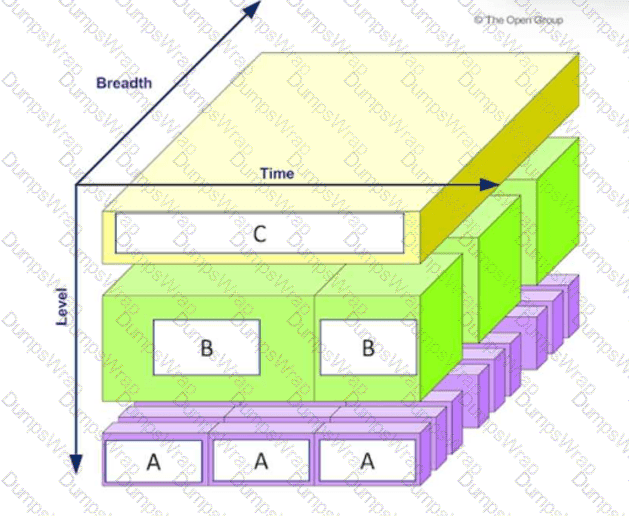
What are the items labelled A, B, and C?
What technique used in Phase B provides stakeholder context into why the organization needs business capabilities?
Complete the sentence. All of the following are sections of the recommended template for defining Architecture Principles, except ___________
Complete the sentence. In the Preliminary Phase, all of the following are part of preparing the organization to undertake successful enterprise architecture, except __________.
Which of the following describes an objective of Phase F: Migration Planning Phase?
According to the TOGAF Document Categorization Model, which category describes a technique that is referenced by processes categorized as TOGAF Core and TOGAF Mandated?
Which of the following is NOT an objective for Phase B, Business Architecture?
Complete the sentence. The purpose of Enterprise Architecture is to _____________.
Which one of the following best describes the purpose of ADM Phase E?
Which of the following is the architecture domain that describes the logical software and hardware capabilities?
What document is sent from the sponsoring organization to the architecture organization to trigger the start of an ADM cycle?
Which of the following statements does NOT correctly describe Architecture Principles?
TOGAF Part VII, Architecture Capability Framework recommends use of an ADM cycle for establishing an architecture practice. In this scenario which architecture would describe the organizational structure for the architecture practice?
Which of the following statements best describes how Architecture Principles are used within the ADM?
Consider the following statements:
The TOGAF ADM requires a partitioning model for architecture development.
Architectures are partitioned when different teams need to work on different elements of the architecture at the same time.
Partitions can be used to facilitate architecture re-use.
Which statements about Architecture Partitioning are correct?
Which ADM phase provides architectural oversight of the implementation?
Which of the following best describes the state of architecture artifacts as a project progresses through ADM Phases A to D?
According to TOGAF, in which sequence should Application Architecture and Data Architecture be developed in Phase C?
Which of the following best describes the Integrated Information Infrastructure Reference Model?
Which deliverable is first produced in Phase A, also updated in Phase E, and helps the architect to understand the baseline and target for the enterprise?
Which one of the following is the most generic artifact in the Architecture Continuum?
What should be put in place through organization structures, roles, responsibilities, skills, and processes to carry out architectural activity effectively?
In Phase G, what document establishes the connection between the architecture organization and the implementation organization?
What document is used to initiate a TOGAF ADM cycle?
Which section of the TOGAF template for Architecture Principles should highlight the business benefits for adhering to the principle?
Which one of the following is a key objective of Phase A of the TOGAF ADM?
Complete the sentence. The four purposes that typically frame the planning horizon, depth and breadth of an Architecture Project, and the contents of the EA Repository are Strategy Portfolio._____________________
Complete the sentence. The ADM can be viewed as the process of populating the enterprise ' s own _______________with relevant re-usable building blocks taken from the more generic side of the Enterprise Continuum.
Complete the sentence. In TOGAF, every architecture view has an associated ____ that describes it, at least implicitly.
Which ADM Phase includes obtaining approval for the Statement of Architecture Work?
Consider the following statements:
1. Groups of countries, governments, or governmental organizations (such as militaries) working together to create common or shareable deliverables or infrastructures
2. Partnerships and alliances of businesses working together, such as a consortium or supply chain
What are those examples of according to the TOGAF Standard?
The statement, " Getting information to the right people at the right time in a secure, reliable manner in order to support the operations that are core to the extended enterprise " describes the
concept of_____
An ADM cycle can be used to establish an Architecture Capability within an organization. Which architecture produced in such a cycle would describe the architecture processes and organization structure?
What is the purpose of the Standards Library within the Architecture Repository?
In which ADM phase are the business principles, business goals and strategic drivers first validated?
Complete the sentence. In TOGAF, architecture viewpoints represent ______
Which of the following is a true statement about the TOGAF Technical Reference Model?
OG0-093 Free PDF Answers
Total 453 questions
DumpsWrap All Rights Reserved
Copyright © 2014-2026 DumpsWrap. All Rights Reserved
