Pre-Summer Sale Discount Flat 70% Offer - Ends in 0d 00h 00m 00s - Coupon code: 70diswrap

Versa Networks VNX301 Dumps

Page: 1 / 6
Total 60 questions

Versa Certified SD-WAN Specialist (VNX300) Questions and Answers

Question 1

You are asked to ensure symmetric traffic flows between two SD-WAN branches. Which feature should be enabled to achieve this objective?

Options:

A.

Symmetric Forwarding

B.

Symmetric Routing

C.

Equal-Cost Multipath

D.

Packet Striping

Question 2

A branch device is powered on with factory-default staging configuration. The device establishes an IKE session to the staging server and receives an IP address, but it does not proceed to establish an IKE session with the Versa Controller. Which staging phase is failing?

Options:

A.

Stage 1

B.

Stage 2

C.

Stage 3

D.

Post-activation template commit

Question 3

A Versa Director operator wants to monitor CPU, memory, disk, recent events, uptime, HA status, package information, and license details from the Director GUI. Which top-level tab should be used?

Options:

A.

Monitor

B.

Workflows

C.

Analytics Search

D.

Administration > Connectors

Question 4

You want to ensure that devices in your branch sites cannot source traffic from IP addresses that are not assigned to the branch sites. What will solve this problem?

Options:

A.

Apply a captive portal function to verify the user identity for outbound traffic.

B.

Apply a stateful firewall policy that only allows traffic sourced from your branch IP address range.

C.

Apply an IP filter profile that only permits applications used by branch employees.

D.

Apply a stateful firewall policy that allows traffic to the assigned LAN IP address range.

Question 5

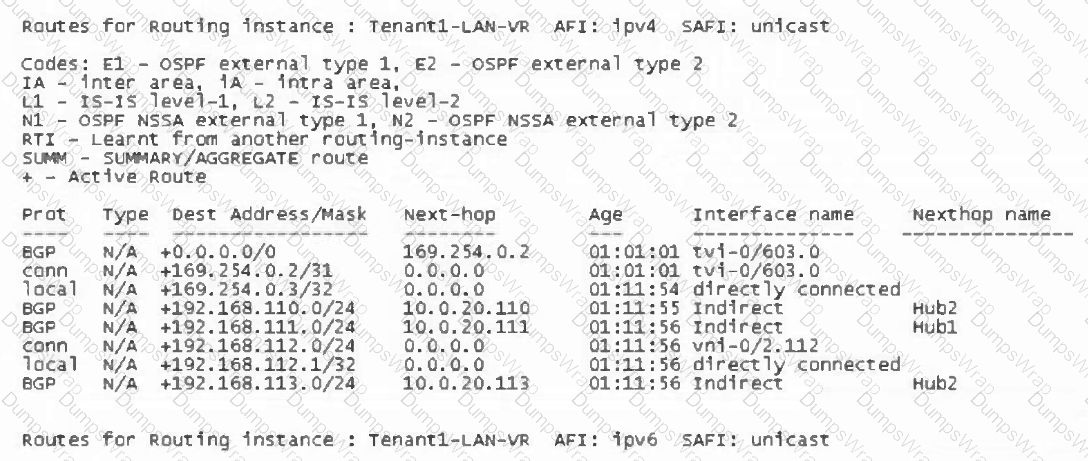
Examine the exhibit below.

Which two statements correctly explain the routing shown in the exhibit. (Choose two.)
as

Options:

A.

The tvi-0/603 interface is paired with an interface in another VR for the default route.

B.

The IP address configured on the tvi-0-603 interface its misconfigured by the template.

C.

Any unknown IP unicast destination will use the tvi-0/603 interface for its exit.

D.

The tvi-0/603 interface is a stub interface for black holing an unknown IP unicast destination.

Question 6

During branch onboarding, you need to verify whether the Controller has sent branch-connect and branch-disconnect notifications to Versa Director. Which CLI command should be used?

Options:

A.

show alarms

B.

show system storage

C.

show interfaces detail

D.

show cgnat acl info

Question 7

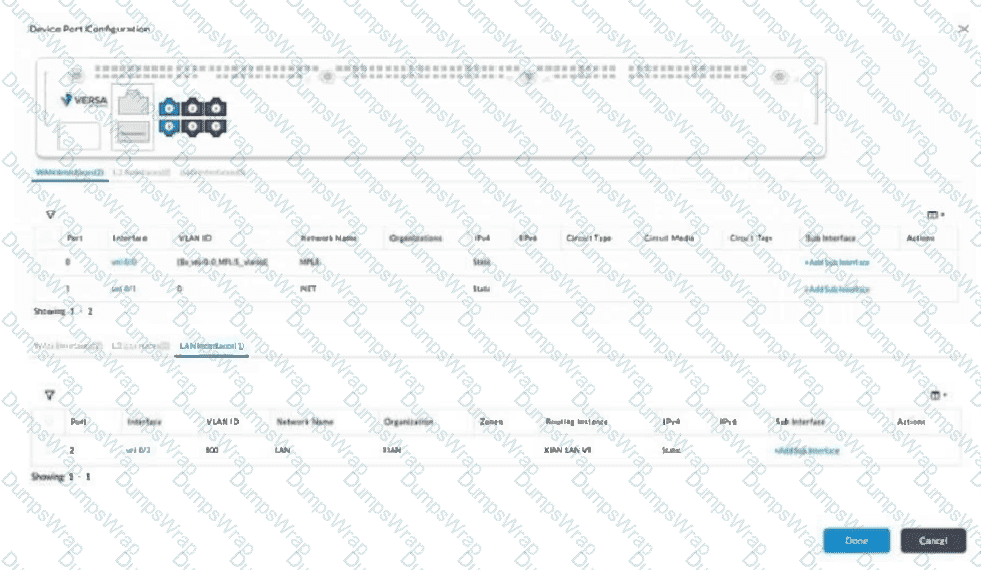
Examine the exhibit below.

Referring to the exhibit, which two statements are correct? (Choose two.)
as

Options:

A.

All branches will have the same VLAN ID for the LAN network.

B.

All branches can have separate VLAN IDs on the MPLS WAN network.

C.

The VLAN ID must be provided for the INET WAN network.

D.

The VLAN ID field MPLS-WAN network is incorrect.

Question 8

A branch has Direct Internet Access enabled. Users can resolve DNS, but application traffic fails. You find that the internet speed test also fails to fetch the server list. Which two configurations should be checked first?

Options:

A.

CGNAT and DNS configuration

B.

OSPF area ID and BGP MED

C.

SNMP community and syslog server

D.

VRRP priority and DHCP lease time

Question 9

You are troubleshooting a branch that cannot form SD-WAN overlay tunnels. The branch has WAN interfaces up, but you suspect remote endpoint objects were not learned. Which VSM command should you use to verify whether remote site objects were learned from BGP or from configuration?

Options:

A.

show vsm p2mp tunnel-remote-endpoint tenant < tenant-id >

B.

show interfaces brief

C.

show system storage

D.

show orgs org-services cgnat summary

Question 10

A VOS branch has two WAN circuits. You suspect the configured transport domain mapping is wrong because one link is not building the expected SD-WAN path. Which VSM control-plane command is most useful to check local WAN circuit information, transport domains, NAT status, and local tunnel-site details?

Options:

A.

show vsm p2mp local-tunnel-sites 0

B.

show system package-info

C.

show orgs org-services cgnat summary

D.

show device cpuload

Question 11

You are configuring a CGNAT rule for branch internet access and want to verify which access-list entry will match traffic before translation. Which information is shown by the CGNAT ACL command?

Options:

A.

Rule ID, category, precedence, VRF, source IP, and destination IP

B.

Only system uptime and CPU usage

C.

Only SD-WAN SLA latency, jitter, and loss

D.

Only BGP AS path and local preference

Question 12

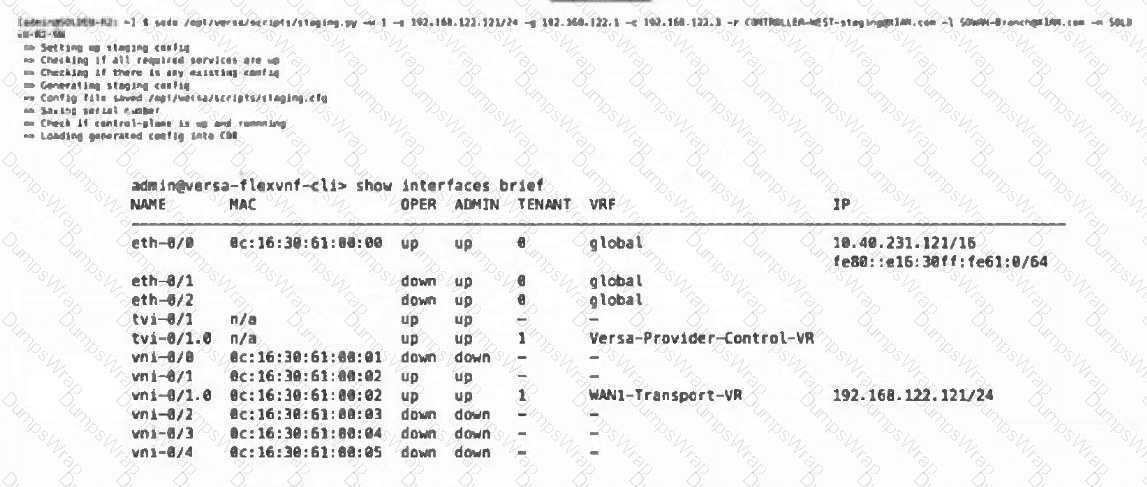
Examine the exhibit below.

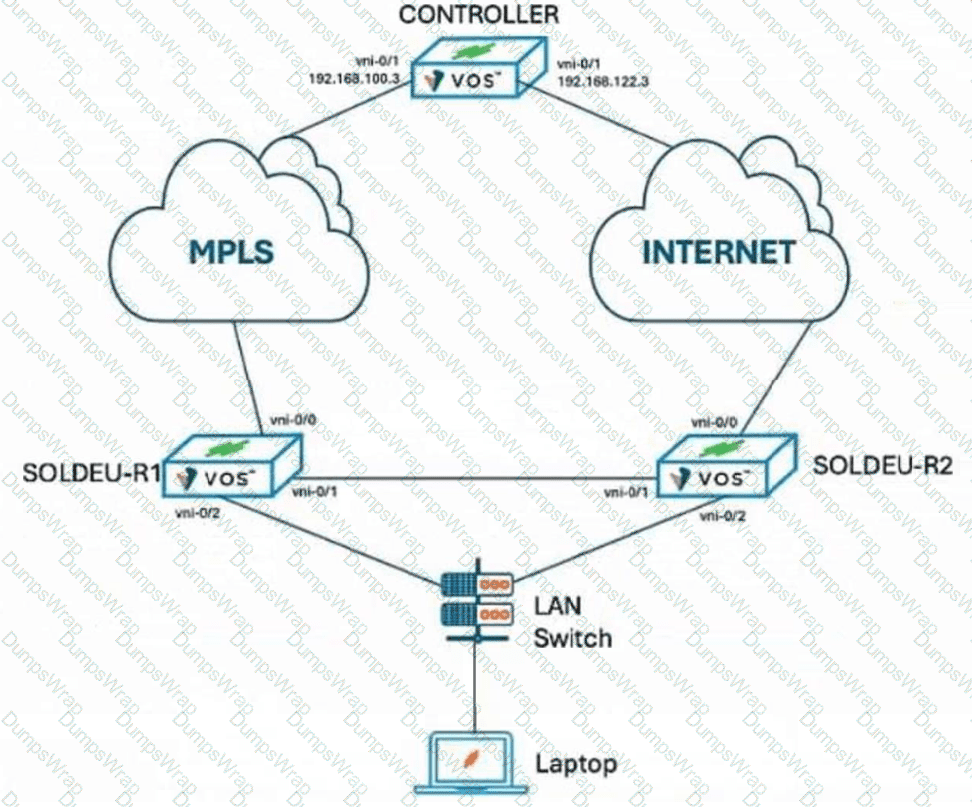
You are onboarding the SOLDEU-R2 branch device using the staging script. You cannot get a Versa-Provider-Controller-VR IP address assigned, indicating that the IPsec tunnel to the corrector has not come up. You verified that the cables have been connected to the correct ports.

What has caused this issue?
as

as

Options:

A.

The Controller IP address is incorrectly specified in the staging script.

B.

The default gateway is in not in the same subnet as the WAN IP address.

C.

The serial number was corrupted in the line feed.

D.

The incorrect port was specified in the staging script.

Question 13

During onboarding, Versa Director shows the first branch-connect notification for a new CPE, but no later staged branch-connect notification appears. Which troubleshooting area should be investigated first?

Options:

A.

Versa Analytics log collector disk usage

B.

Data path or IPsec connectivity from the branch to the Controller

C.

LDAP authentication configuration on the tenant

D.

URL filtering database download status

Question 14

A new SD-WAN branch has completed factory-default onboarding and Versa Director has pushed the staging configuration. After reboot, the branch still tries to connect to the staging server instead of the Controller. Which configuration item is most likely incorrect or missing in the stage-two configuration?

Options:

A.

Controller IP address in the IPsec profile remote IP field

B.

Analytics log collector IP address

C.

Tenant LAN DHCP pool

D.

URL filtering profile

Question 15

Examine the exhibit below.

You are configuring Class of Service on a WAN-facing network interface, and you want to perform DSCP rewrite on the packets that are forwarded to the WAN.

However, you are not able to turn on DSCP rewrite.

Referring to the exhibit, what is the cause of this issue?
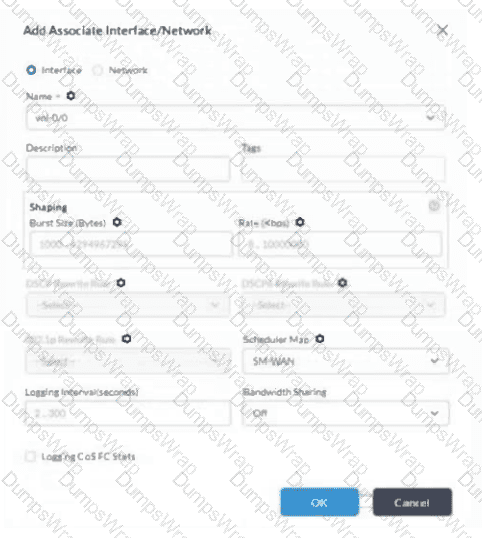
as

Options:

A.

Rewrite requires the configuration of shaping on the interface.

B.

Scheduler Map and Rewrite cannot be configured at the same time.

C.

The Associate interface/Network setting is set to Interface and not Network.

D.

There are no rewrite rules configured.

Question 16

A branch using DIA with CGNAT reports that new internet sessions intermittently fail. CGNAT pool counters show increasing out-of-ports errors, while out-of-address errors remain zero. What is the most likely problem?

Options:

A.

The NAT pool has no available source ports left for allocation.

B.

The NAT pool has no IP addresses assigned.

C.

The CGNAT rule is matching the wrong destination zone.

D.

The LAN routing instance is missing OSPF.

Question 17

Examine the exhibit below.

The exhibit shows a device group created for a new group of hubs. The device template called “BMBF-TEMPLATE” has an Address object called “Server”. A network administrator creates the Class of Service Template called “Ship-CoS-IT” that has an Address object with the same name. Then it tries to onboard a new device to this device group.

Which statement is true about the configuration that this device will have?
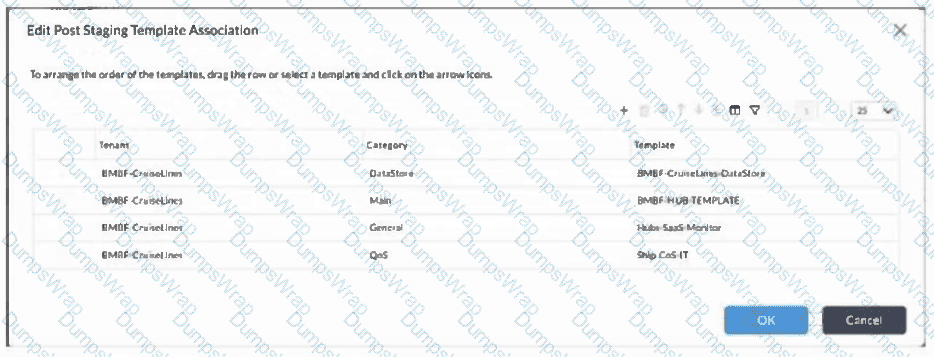
as

Options:

A.

The device configuration commit will fail.

B.

The device configuration will have the Address object that was created last.

C.

The device configuration will automatically create two copies of the same Address object.

D.

The device configuration will have the version of the Address object in the QoS template.

Question 18

Examine the exhibit below.

Spoke1 and Spoke2 are part of Spoke-to-Hub-Only spoke group, the hub is advertising a default route to both the spokes.

Referring to the exhibit, which statement is true?
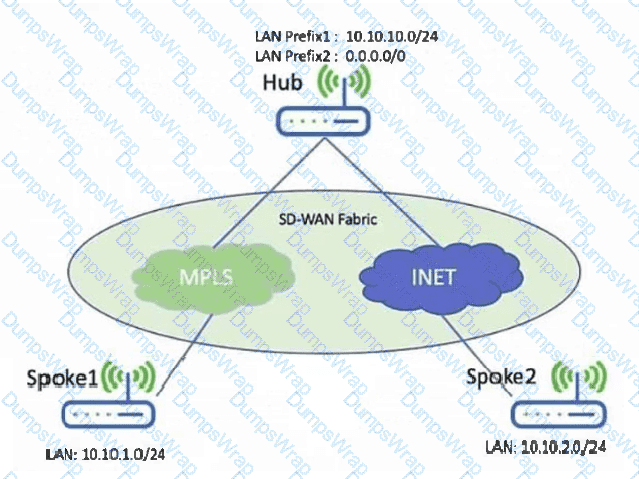
as

Options:

A.

Spoke1 can communicate with Spoke2 since they are part of the same SDWAN fabric.

B.

Spoke1 can communicate with Spoke2 since the hub is advertising a default route.

C.

Spoke1 cannot communicate with Spoke2 since the spoke group is Spoke-to-Hub-Only.

D.

Spoke1 cannot communicate with Spoke2 since they do not have a common underlay.

Page: 1 / 6
Total 60 questions