
Advanced VMware Cloud Foundation 9.0 Storage Questions and Answers
An administrator is managing a stretched vSAN ESA cluster where each site has three hosts.
The following parameters apply to the storage policy being configured at the datastore level:
• The policy is configured at the datastore level
• Site disaster tolerance = Site mirroring - stretched cluster
• Failures to tolerate = 1 failure - RAID-1 (mirroring)
• Number of disk stripes = 1
When inspecting some of the Virtual Machines (VMs), why do objects have 3 disk stripes?
An administrator is working on a VMware Cloud Foundation (VCF) Workload Domain that was configured to use vSAN for principal storage. The administrator wishes to create and configure a datastore cluster to host tenant VMs using that vSAN backed storage across multiple clusters, mixed OSA and ESA, in the domain.
What should the administrator consider?
An administrator is preparing to enable vSAN Data-at-Rest Encryption and must verify that the identity and key provider prerequisites are met before proceeding with the configuration.
Which two requirements must be met? (Choose two.)
A financial organization successfully deployed a new Workload Domain in VMware Cloud Foundation (VCF) using NFS storage. All ESX hosts are commissioned and connected to the same storage network. The system administrator is tasked to configure a new NFS datastore in the existing cluster.
Which two steps are correct? (Choose two.)
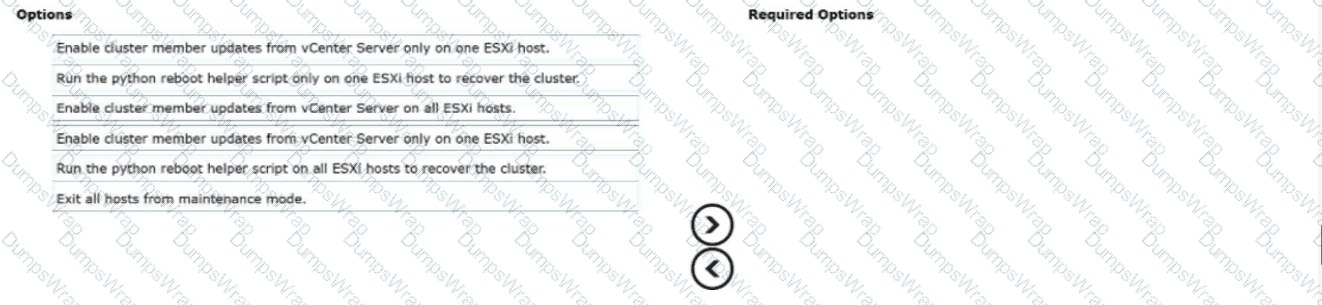
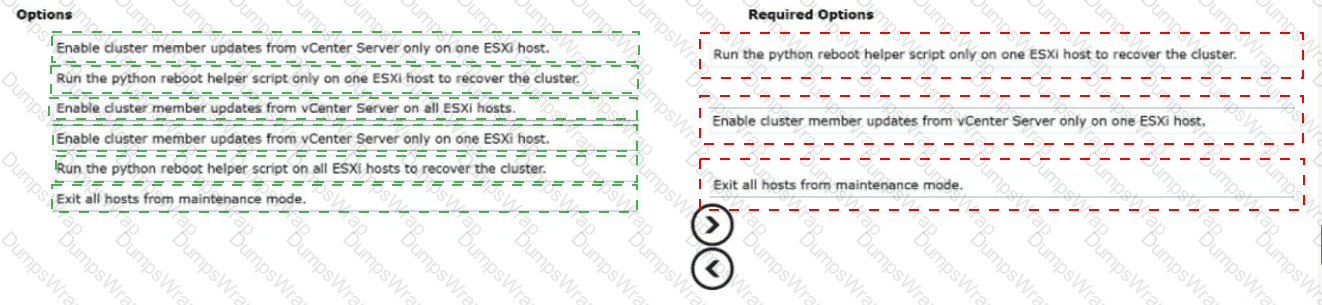
After a planned power outage, an administrator decided to restart the vSAN cluster manually.
Drag and drop the three correct options from the Options list on the left and place them into the Required Options on the right in any order. (Choose three.)
An administrator has been tasked with making changes to a VMware Cloud Foundation (VCF) Workload Domain cluster that is configured with NFS for both Principal storage and Supplemental storage.
The cluster has the following configuration:
• There are 3 x ESX host servers.
• There are 3 x NFS Datastores allocated to host Virtual Machines workloads.
• There is a single NFS Datastore allocated for hosting ISO files.
The administrator has the following concerns with the existing configuration:
• Every time a new Virtual Machine is deployed to the Workload Domain, the administrator must choose which datastore should be used.
• When reviewing the Datastores in VCF Operations:
One of the datastores has no Virtual Machines running in it.
The other two datastores have an imbalance of Virtual Machines and this is causing resource contention. The administrator has the following requirements: • Virtual Machines must be placed automatically on the most appropriate datastore based on utilization. • Migration recommendations on Virtual Machine placement should be made when one datastore reaches 50% utilization. • Virtual Machines must only be migrated to another datastore after being approved by an administrator. What four actions must the administrator take to meet all of the requirements? (Choose four.)
During maintenance on hosts in a four-node vSAN cluster, a host is placed in maintenance mode with the “Ensure Accessibility” option.
All VMs are running with the Default Storage Policy (RAID-1, FTT=1) which has not been modified from the default settings.
While one of the hosts in the cluster is down for firmware upgrade, a second host in the cluster loses network connectivity.
How will the cluster be affected?
An administrator is troubleshooting a vSAN performance issue. In the vSAN cluster performance charts there is a high latency on the vSAN cluster.
What is a possible cause of the performance issue?
An administrator is tasked with vertically scaling a vSAN ESA deployment. The current cluster contains 6 hosts each with the following configuration:
• 8 x 7.68 TB drives
• 2 x 25 GB NICs
• 2 x Intel Gold CPUs
What are the three reasons to add the same model and capacity drives when scaling each host? (Choose three.)
An administrator is managing a local vSAN 3-node cluster running the Express Storage Architecture (ESA) as part of a VMware
Cloud Foundation (VCF) Workload Domain.
The following parameters apply at the cluster level:
• HA is enabled
• Reserved Failover Capacity = 25% for both CPU and Memory
The administrator is tasked with configuring the VSAN storage policy so it will tolerate the maximum number of failures.
What two protection levels can the administrator configure? (Choose two.)
An administrator needs to quickly test a possibly destructive change to a Virtual Machine (VM) in production. The VM is currently protected by vSAN Data Protection.
Which feature of vSAN Data Protection can be leveraged to achieve this objective?
An architect is presented with the following requirements for the storage solution in a VMware Cloud Foundation (VCF) Workload Domain.
The solution must:
• Allow for rapid recovery in case of an availability zone failure.
• Provide an extremely high amount of IOPS to all applications.
• Allow for additional storage to be added as application needs grow.
• Provide the lowest latency possible for configured applications.
• Provide recovery in case of datastore failure.
• Encrypt data in transit and at rest.
What two vSAN advanced technologies must be deployed to meet these requirements? (Choose two.)
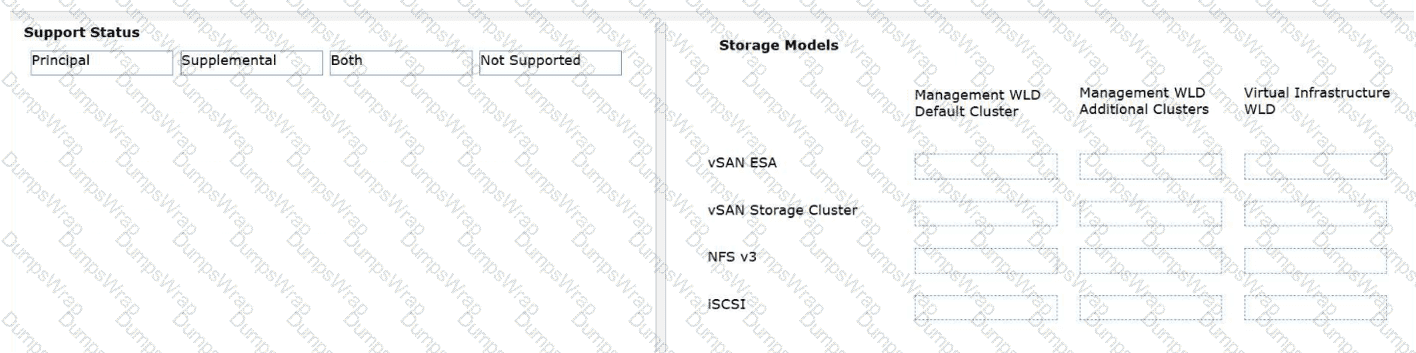
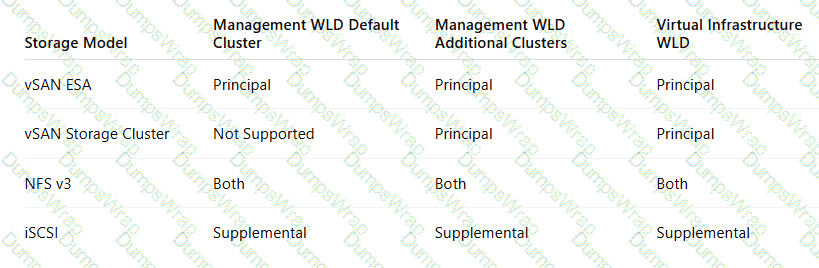
An administrator is responsible for a VMware Cloud Foundation (VCF) Private Cloud and has been tasked with identifying which storage model is supported in the different VCF Workload Domains.
Drag and drop the Support Status of each storage model on the left to each type of Workload Domain on the right.

The Windows team is planning to deploy a Windows Server Failover Cluster. This requires a disk shared between all members of the cluster.
Which two options are available to fulfill this requirement on a vSAN ESA cluster? (Choose two.)
An administrator is tasked with deploying a VMware Cloud Foundation (VCF) Workload Domain that meets the following requirements:
• vSAN ESA as principal storage
• RAID-6 with FTT=2
• Support for Storage Traffic Separation
The administrator is provided the following hardware to perform the task:
• Four ESX hosts, each host contains:
24 CPU cores
96 GB memory
Two 25GbE network NICs
12 NVMe devices 4 TB each, connected to a single SATA/SAS/NVMe Tri-mode controller What four changes must the administrator make to the hardware before deploying the new Workload Domain? (Choose four.)
An administrator is monitoring a vSAN ESA backed workload domain that is dedicated for running AI inferencing. When the administrator navigates to the Storage Performance dashboard in VMware Cloud Foundation Operations, the performance dashboard shows:
• High backend write latency ( > 8 ms)
• Low read latency ( < 1 ms)
• Normal network throughput
• Disk Group Health = Green
Based on the readings above, what would be the explanation?
A multinational corporation is deploying a VMware Cloud Foundation (VCF) Workload Domain cluster to host tier-1 business applications with the following requirements:
• Deliver high performance to all workloads.
• Integration with automated VM placement.
• Reuse of existing infrastructure including multiple Fibre Channel (FC) arrays partitioned by business unit.
• The storage architecture must avoid vSAN.
• Meet organizational separation requirements.
Which two deployment approaches meet these requirements? (Choose two.)
A storage architect is designing a vSAN solution that enforces quotas and Access Based Enumeration (ABE) on all file shares.
What should the architect highlight as a design decision implication?
A storage administrator is being presented with the following VMware Cloud Foundation (VCF) architectural details:
• The applications data will require 2.5 PB of capacity.
• The production applications will be hosting archival solutions and gateways.
• There will be some applications deployed for the purpose of testing and development.
What is the optimal principal storage that the administrator can recommend?
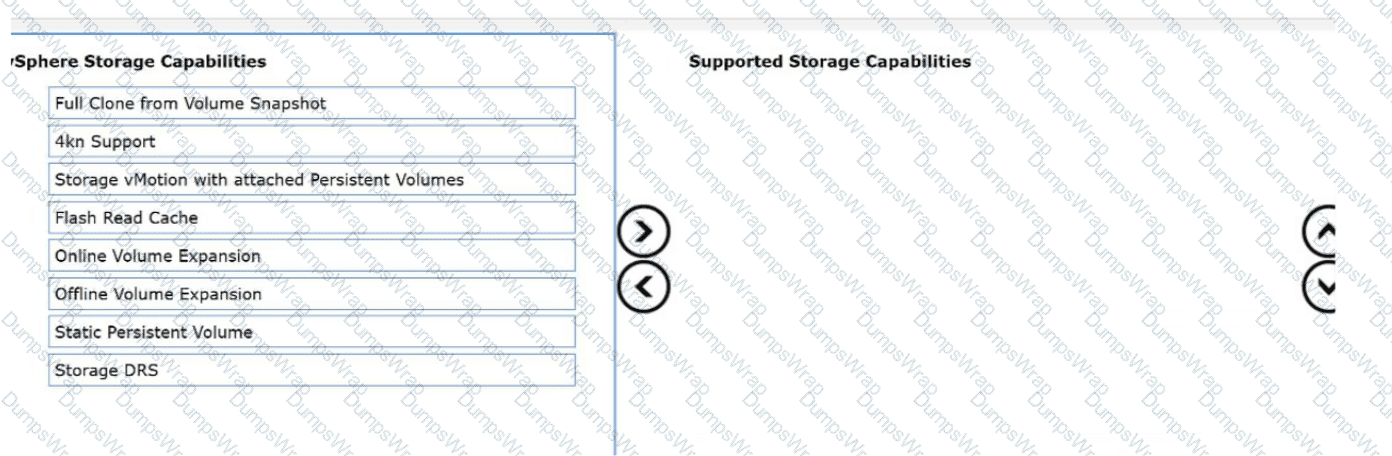
Select the storage capabilities supported for use with persistent volumes in the VMware Kubernetes Service (VKS) in VMware Cloud Foundation (VCF).
Drag and drop the five supported capabilities from the vSphere Storage Capabilities list on the left and place them into the Supported Storage Capabilities list on the right in any order. (Choose five.)

A storage architect has been called into a meeting with the accounting team who is trying to determine why 20% of their raw capacity is not available for consumption. Their vSAN cluster was created with the following characteristics:
• 2 x 2 TB NVMe disks in 6 hosts in their vSAN cluster.
• FTT=1, RAID-1 for the default policy.
• Host Rebuild Reserve not activated for this cluster.
Which two items should the Architect say accounts for most of the unusable capacity? (Choose two.)
An administrator has been tasked with deploying vSAN Data Protection in a VMware Cloud Foundation (VCF) Workload Domain. The administrator deploys the VMware Live Recovery OVA and logs into the management interface to start the Configure Appliance process, but the appliance fails to register with vCenter.
What are two possible causes the administrator can check to resolve the issue? (Choose two.)
