
Advanced VMware Cloud Foundation 9.0 vSphere Kubernetes Service Questions and Answers
An administrator is upgrading to VKS 3.4 and encounters the following error during cluster creation using workload, yami:

How should the administrator resolve this issue to successfully complete the upgrade " ?
A VKS administrator is tasked to leverage day-2 controls to monitor, scale, and optimize Kubernetes clusters across multiple operating systems and workload characteristics.
What two steps should the administrator take? (Choose two.)
Which two types of Kubernetes member objects can be used when creating groups to collect and manage objects for service-level networking/security policies (for example, in a service mesh or Kubernetes-aware policy model)? (Choose two.)
A platform operator runs a kubectl command and receives the error " Couldn’t get current server API list " . Which command resolves the error?
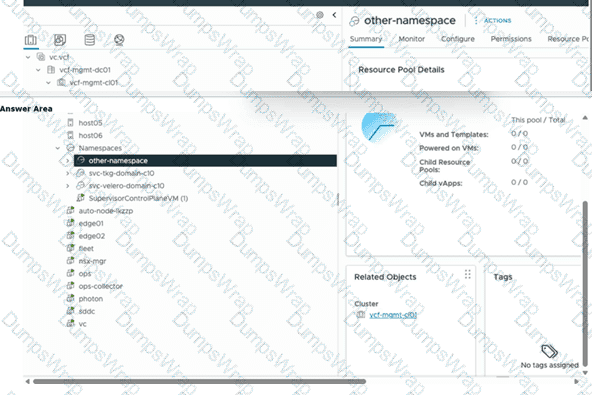
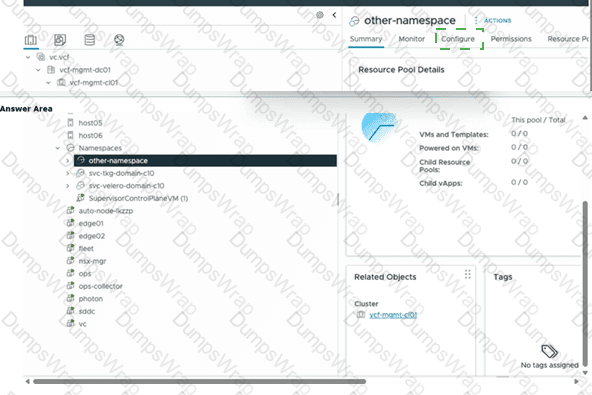
An administrator is tasked to create a new vSphere Zone for the highlighted namespace. Click the section of the interface where the administrator would navigate to start creating a new zone.
After upgrading the vSphere Supervisor, an administrator notices that the vSphere Kubernetes Service, configured as a Core Supervisor Service, is stuck in a“Configuring”state.
What should the administrator do to finish the upgrade?
What open-source project enables automated lifecycle management of VMware vSphere Kubernetes Service (VKS) clusters?
An architect is working on the data protection design for a VMware Cloud Foundation (VCF) solution. The solution consists of a single Workload Domain that has vSphere Supervisor activated. During a customer workshop, the customer requested thatvSphere Podsmust be used for a number of third-party applications that have to be protected via backup.
Which backup method or tool should be proposed by the architect to satisfy this requirement?
An administrator is configuring the Supervisor Service in vCenter.
Click the option an administrator uses to begin creating a vSphere Supervisor Zone.


An administrator runs several critical workloads on vSphere Kubernetes Service (VKS). An audit identified an outdated container image with a known CVE that exposed internal APIs to unauthorized access. To mitigate this risk and enhance image security, the administrator enabled Harbor as a Supervisor Service.
Which two Harbor registry capabilities help the organization prevent a recurrence of this type of security incident? (Choose two.)
How should an administrator enable autoscaling for a vSphere Kubernetes Service (VKS) cluster?
What is the function ofContourin a VMware vSphere Kubernetes Service (VKS) cluster?
Refer to the exhibit in the following StorageClass manifest, which field is used to specify the Volume Plugin driver used for the underlying storage array?
YAML
apiVersion: storage.k8s.io/v1
kind: StorageClass
metadata:
name: standard
provisioner: kubernetes.io/aws-ebs
parameters:
type: gp2
reclaimPolicy: Retain
allowVolumeExpansion: true
mountOptions:
- debug
volumeBindingMode: Immediate
What are three resource limitations defined on a vSphere Namespace? (Choose three.)
An architect is meeting with a customer to deploy a mission-critical application using the vSphere Kubernetes Service. The architect learns that the ticketing application runs at a steady state 80% of the time but has significant spikes when an event is announced. The application is unable to meet demand even though resources are available.
What will address the issue of peak demand?
An administrator is tasked with making an existing vSphere Supervisor highly available by adding two additional vSphere Zones. How should the administrator perform this task?
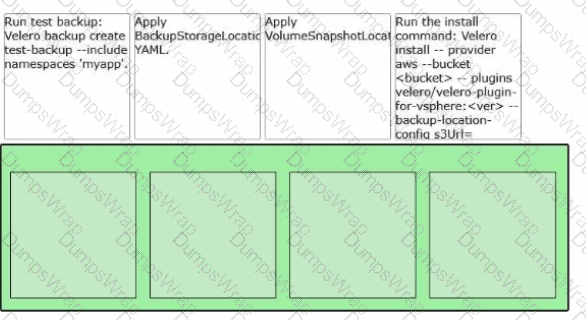
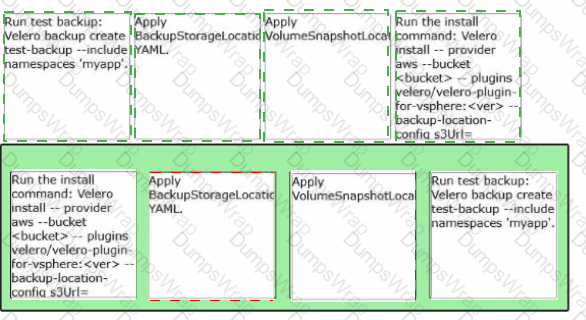
A VMware Administrator is tasked with implementing a backup and restore strategy using Velero and external object storage for the namespace ' myapp1. Arrange the steps In the correct order of operations to enable Vetero.
A company standardized on the following configurations:
• vSphere Kubernetes Service (VKS) upgrade is separate from vCenter upgrades.
• A private registry will be utilized.
How should an administrator adhere to these standards?
A cloud platform team is deploying multiple Supervisors in a VMware Cloud Foundation (VCF) environment to support a multi-tenant VKS architecture. Each Supervisor will host a distinct set of namespaces mapped to different organizational tenants such as Finance, Public Services, and R & D, where each tenant consumes resources from dedicated workload domains.
What is the purpose of the vcf context create command?
How would an administrator obtain the kubectl config file in the VMware vSphere Kubernetes Service (VKS)?
Which protocols are supported for use as an external identity provider for VMware vSphere Kubernetes Service (VKS) clusters?
What tool can be used to back up and restore workloads on clusters provisioned by vSphere Supervisor?
An administrator is deploying vSphere Kubernetes Service (VKS) to support containerized workloads across multiple regions. Each region hosts a dedicated Workload Domain with Supervisor instances deployed on vSphere Distributed Switch (VDS) networking. The organization’s security policy requires that pod-to-pod and pod-to-service communications be fully observable and controllable at the Kubernetes layer, without introducing additional licensing or overlay complexity.
When deploying a Supervisor, which CNI should the administrator select as the default supported option?
What statement describes the vSphere Supervisor in VMware Cloud Foundation (VCF)?
