Spring Sale Discount Flat 70% Offer - Ends in 0d 00h 00m 00s - Coupon code: 70diswrap

WGU Financial-Management Dumps

WGU Financial Management VBC1 Questions and Answers

Question 1

What distinguishes free cash flow to equity (FCFE) from free cash flow to the firm (FCFF)?

Options:

A.

FCFE is distributable only to debt holders, whereas FCFF is distributable only to equity holders.

B.

FCFE includes depreciation, amortization, and other non-cash expenses, while FCFF does not.

C.

FCFE measures cash distributable to equity holders after all obligations are met, including debt payments.

D.

FCFE represents the total cash flow from operations that is available at the end of the period.

Question 2

What is the goal of just-in-time (JIT) inventory management?

Options:

A.

To increase the quantity of on-hand inventory

B.

To minimize holding costs by reducing inventory levels

C.

To maximize the storage space utilized

D.

To extend the cash conversion cycle

Question 3

A recent news article reported that a popular tech start-up has not yet reached profitability or experienced a period of positive cash flows from operations. Instead, the company has been focused primarily on capturing market share and attracting new customers.

What does the continued negative cash flow from operations (CFO) signal about this firm?

Options:

A.

It indicates the firm is effectively managing its assets and using them to generate earnings for the firm.

B.

It implies the firm is investing minimally in the future growth of the company and its operations.

C.

It suggests the firm is burning cash in its operations and may eventually run out of funding sources.

D.

It shows the firm is generating too much cash from operations and will not be able to continue to do so.

Question 4

What is a function of the Financial Industry Regulatory Authority (FINRA)?

Options:

A.

Issuing currency

B.

Insuring bank deposits

C.

Managing federal monetary policy

D.

Regulating brokerage firms

Question 5

In the capital asset pricing model (CAPM), what does a beta (β) greater than 1 signify for a portfolio?

Options:

A.

The portfolio will always outperform the market.

B.

The portfolio has more risk than the market.

C.

The portfolio has less risk than the market.

D.

The portfolio is expected to move in the opposite direction of the market.

Question 6

A financial analyst is trying to understand the return that shareholders of a stock receive through dividend payments. The analyst is given the following information:

Company Information—Previous Year

• Revenue: $500,000

• Net Income: $50,000

• Change in Retained Earnings: $30,000

• Change in Total Assets: $40,000

What is the amount of dividends paid during the previous year to shareholders?

Options:

A.

$20,000

B.

$30,000

C.

$40,000

D.

$50,000

Question 7

Why would a company choose to maintain a certain level of cash as a reserve balance?

Options:

A.

To pay for major capital expenditures without external financing

B.

To distribute as dividends at the end of the fiscal year

C.

To safeguard against unforeseen expenses and maintain liquidity

D.

To cover the cost of repurchasing shares from the stock market

Question 8

What is the dividend yield of a stock that pays annual dividends of $4 per share and has a current market price of $80?

Options:

A.

2.5%

B.

5%

C.

10%

D.

20%

Question 9

What costs are considered part of an asset’s initial investment?

Options:

A.

Discounted salvage value

B.

Delivery and installation

C.

Depreciation

D.

Market research

Question 10

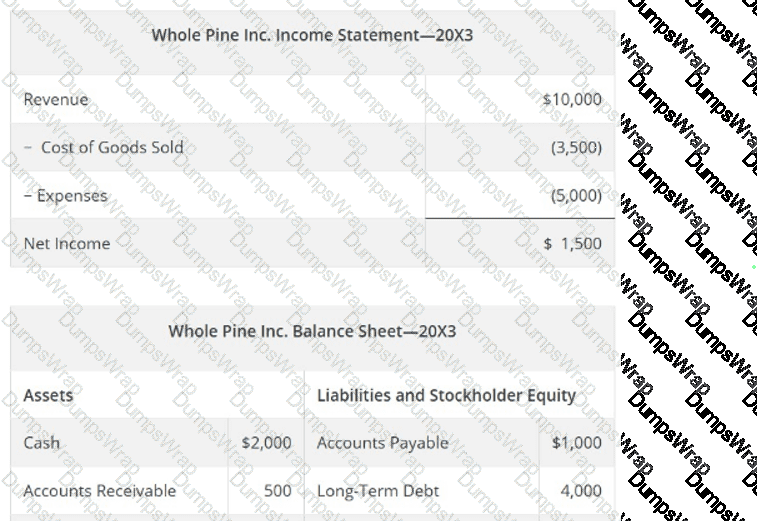
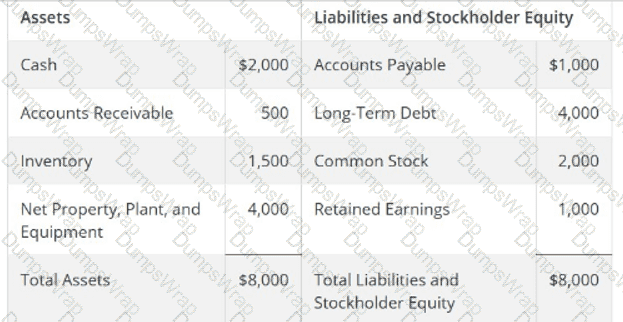
Use Whole Pine Inc.’s financial statements for 20X3 below to answer the following question.

What is Whole Pine Inc.’stotal asset turnoverfor 20X3?

as

as

Options:

A.

0.50

B.

1.25

C.

2.33

D.

2.50

Question 11

What is the usual impact of high asset tangibility on capital structure?

Options:

A.

Increased debt capacity due to assets serving as collateral

B.

Higher cost of debt due to increased risk of asset value fluctuation

C.

Preference for hybrid securities to leverage tangible assets

D.

Easier access to equity markets due to tangible collateral

Question 12

A company has a return on assets (ROA) of 10% and total assets of $500 million.

What is its net income?

Options:

A.

$5 million

B.

$10 million

C.

$50 million

D.

$100 million

Question 13

Kretsmart anticipates its sales will grow by10% each year for the next two years. Information from the company’s current income statement is given below, andCost of Goods Sold (COGS) is assumed to be a spontaneous account.

as

What would the company’sprojected gross margin for Year 2?

Options:

A.

$59.45

B.

$66.55

C.

$71.25

D.

$76.00

Question 14

What is the bid-ask spread?

Options:

A.

The range between the highest and lowest stock prices in a day

B.

The current market price of a stock less its initial public offering listing price

C.

The commission charged by brokers for each transaction

D.

The difference between the price at which a specialist buys and sells a stock

Question 15

Why must analysts be cautious about accounting practices when analyzing ratios?

Options:

A.

Because different firms may use varying accounting methods, affecting the comparability of ratios

B.

Because accrual accounting rules eliminate any variation in reported results

C.

Because accounting practices are identical across all firms

D.

Because ratio analysis follows a fixed rule set that eliminates judgment

Question 16

Which practice can help an analyst identify the most relevant financial data and ratios when assessing the financial health of a firm?

Options:

A.

Focusing only on the most recent fiscal year’s data

B.

Assuming financial statements from different firms are directly comparable without adjustments

C.

Ignoring all ratios except liquidity ratios

D.

Identifying why differences exist in comparisons between firms and analyzing macroeconomic conditions

Question 17

What is a benefit of a firm extending credit to customers in a competitive market?

Options:

A.

Immediate cash inflows from sales

B.

Decreased sales due to increased prices

C.

Increased sales to non-cash buyers

D.

Reduced customer base due to credit terms

Page: 1 / 6
Total 58 questions