
WGU Organizational Behavior (GTO1, C715) Questions and Answers
A team is struggling to resolve procedural issues that govern their performance. What should the team leader do to resolve the problem?
Options:
Research the problem and impose a solution
Rearrange roles within the team by adding members
Appoint an assistant team leader to track the struggles and report back
Ask questions and help team members talk through the problem
Answer:
DExplanation:
When a team struggles with procedural issues—the "how" of their work—the most effective leadership approach is often facilitative rather than directive. Instead of imposing a solution (Option A), which can lead to resistance or a lack of "buy-in," the leader shouldask questions and help team members talk through the problem. This technique is rooted in the concept ofteam coachingand process consultation.
By facilitating a dialogue, the leader encourages the team to take ownership of their own processes. This collaborative problem-solving approach helps identify the root cause of the procedural friction, whether it be ambiguous roles, inefficient workflows, or conflicting expectations. Furthermore, helping the team talk through the issue strengthens their internal communication and conflict-resolution skills, making them more resilient in the future. A leader who acts as a facilitator helps the team move from the "storming" phase of development—where procedural conflicts are common—into the "norming" phase, where clear, agreed-upon standards of behavior and performance are established by the group itself.
Organizational Culture
Management has noticed that the quality improvement work group is struggling because members seem to be working in different directions. Which suggested action can the company take to increase group cohesiveness?
Options:
Increase the difficulty of becoming a group member
Physically isolate the group
Make the group larger
Establish more rigid roles for group members
Answer:
BExplanation:
Group Cohesivenessis the degree to which members are attracted to each other and motivated to stay in the group. When a group is "working in different directions," it lacks the unity and shared purpose characteristic of cohesive teams. To increase cohesiveness, Organizational Behavior literature suggests several specific strategies.
One effective method is toPhysically isolate the group. By providing the group with its own workspace or isolating them from other units, the members are forced to interact more frequently with one another rather than with outsiders. This increased interaction often leads to a stronger shared identity and a "we-feeling" that helps align their efforts. Other common ways to increase cohesiveness include making the group smaller (not larger, which refutes option C), increasing the time members spend together, and increasing the status of the group or the difficulty of gaining admission. While option A (increasing difficulty of membership) is a valid way to increase cohesiveness, the provided source materials and the context of members "working in different directions" prioritize physical isolation as a primary structural intervention to foster unity. Creating more rigid roles (Option D) might help with clarity but does not necessarily increase the emotional and social attraction (cohesion) between members.
What is one of the six primary characteristics that define an organization's culture?
Options:
Political orientation
Competitor benchmarking
Aggressiveness
Team orientation
Answer:
CExplanation:
Research suggests that seven (often grouped into six or seven in various texts) primary characteristics capture the essence of an organization's culture. One of these key characteristics isAggressiveness, which describes the degree to which people are aggressive and competitive rather than easygoing.
Other characteristics include:
Innovation and Risk Taking:The degree to which employees are encouraged to be innovative and take risks.
Attention to Detail:The degree to which employees are expected to exhibit precision and analysis.
Outcome Orientation:The degree to which management focuses on results rather than techniques and processes.
People Orientation:The degree to which management decisions take into account the effect of outcomes on people within the organization.
Team Orientation:The degree to which work activities are organized around teams rather than individuals.
Stability:The degree to which organizational activities emphasize maintaining the status quo in contrast to growth.
By assessing an organization on these dimensions, a complete picture of its culture emerges, providing a basis for shared understanding among members.
What is a positive effect of a cohesive group?
Options:
Reducing group norm effect
Promoting value flexibility
Bringing heterogeneity to the process
Improving group productivity
Answer:
DExplanation:
Cohesiveness is generally viewed as a desirable trait in organizational groups because of its potential toimprove group productivity. In a highly cohesive group, members are more likely to communicate effectively, experience less internal friction, and display higher levels of commitment to group goals. This internal synergy typically leads to a more efficient work process and higher quality output.
However, the relationship between cohesiveness and productivity is moderated byperformance-related norms. If a cohesive group has high performance norms (standards for hard work and quality), productivity will be significantly higher than in a group with low cohesiveness. Conversely, if a highly cohesive group has low performance norms, their productivity may actually decrease because they are united in their desire to work less. Despite this nuance, the fundamental positive organizational outcome associated with fostering cohesion is the enhancement of the group's ability to produce results.
Which conflict-resolution techniques might a manager use to control the level of conflict that has become dysfunctional?
Options:
Confrontation and smoothing
Smoothing and confrontation
Satisfying goals and smoothing
Compromise and superordinate goals
Answer:
DExplanation:
Conflict within an organization can be functional (supporting goals) or dysfunctional (hindering performance). When conflict becomes dysfunctional, managers must use conflict-resolution techniques to bring it back to a manageable or productive level. Two such techniques areCompromiseandSuperordinate goals.
Compromiseinvolves each party giving up something of value to reach a solution where no one is a clear winner or loser. It is often used when goals are important but not worth the potential disruption of more assertive methods.Superordinate goalsinvolve creating a shared goal that cannot be attained without the cooperation of each of the conflicting parties. By focusing on a higher-level objective, the competing groups or individuals are forced to set aside their differences to achieve a common success. Other techniques include problem-solving (face-to-face meetings), smoothing (playing down differences), and avoidance. Choosing the right technique depends on the nature of the conflict and the desired long-term relationship between the parties. In many organizational settings, shifting the focus to superordinate goals is particularly effective because it aligns individual interests with organizational outcomes.
Which method should be used to maximize team member participation in a global meeting?
Options:
Online using computer technologies and/or phone communication
Alpha-direct technologies to maintain communication links
Unilateral electronic messaging to facilitate communication
A Delphi-like sequence of notes via carrier mail to encourage dialog between members
Answer:
AExplanation:
In the context of global operations, teams are often physically dispersed across different time zones and geographic locations. To maximize participation, organizations rely onvirtual teamtechnologies. Usingonline computer technologies and/or phone communication(such as video conferencing, instant messaging, and collaborative platforms) allows for real-time or near-real-time interaction that bridges the physical distance. These technologies enable members to share ideas, provide immediate feedback, and engage in the "give-and-take" necessary for effective decision-making.
While unilateral messaging (Option C) or physical mail (Option D) might transmit information, they lack the interactive richness required to sustain high levels of participation and engagement. Effective global leadership involves selecting the communication channel that best balances the need for speed with the need for social presence. By utilizing synchronous online tools, global teams can simulate the "face-to-face" experience, which helps in building the rapport and trust that are often difficult to establish in a virtual environment. This approach ensures that all members, regardless of their location, have an equal platform to contribute to the team's objectives.
What is the impact of high group cohesiveness and well-defined performance norms on the productivity of a team?
Options:
The productivity of the team will improve significantly
The productivity of the team will improve slightly
The productivity of the team will remain low
The productivity of the team will remain as is
Answer:
AExplanation:
The interaction between cohesiveness and performance norms is a critical concept in Organizational Behavior. As shown in the research regarding group dynamics,the productivity of the team will improve significantlywhen both cohesiveness and performance norms are high. Cohesiveness provides the social "glue" that keeps the team together, while performance norms provide the "direction" by establishing clear expectations for effort, output, and quality.
When these two factors coincide, the group becomes a powerful force; members motivate one another to meet the high standards they have collectively accepted. This is the "ideal" state for any work team. If cohesiveness is high but performance norms are low, the group is unified but unproductive. If cohesiveness is low but norms are high, productivity improves only slightly because members lack the social bond to sustain high-level collaboration. Therefore, the combination of a strong bond and high standards yields the most significant productivity gains.
A project team was formed to complete a specific project. At the end of the first 6 months, the team was unable to deliver the results. The main cause was several team members spending significant time mistakenly working on the same tasks. Which role of a team lead is most useful in the given case?
Options:
Coordinator
Planner
Controller
Motivator
Answer:
AExplanation:
In group dynamics, the failure described—redundant efforts and a lack of task synchronization—points to a failure incoordination. TheCoordinatorrole is responsible for clarifying goals, delegating tasks, and ensuring that the efforts of individual team members are integrated rather than duplicated. Without effective coordination, even highly motivated and skilled teams can fail because their energy is dissipated through "working in different directions".
While a "Planner" (Option B) sets the initial schedule and a "Controller" (Option C) monitors outcomes, the Coordinator acts as the glue during the execution phase. The Coordinator ensures that every member knows their specific contribution and how it fits into the whole. In this case, because the members were "mistakenly working on the same tasks," a Coordinator would have intervened to clarify boundaries and manage the interdependencies of the work. Effective coordination is the primary antidote to the "process losses" that occur when team members overlap in their efforts.
Management is considering a change in one plant and plans to organize employees into teams. Management wants the teams to review processes, apply critical thinking, and take full responsibility for outcomes. Which type of team should they organize?
Options:
Virtual teams
Problem-solving teams
Self-managed teams
Production teams
Answer:
CExplanation:
The distinguishing factor between different types of teams is the level of authority and the scope of their responsibility.Problem-solving teamstypically only make recommendations; they do not have the authority to implement their suggestions or take full responsibility for the results.Virtual teamsare defined by their use of technology to bridge physical distance rather than their level of autonomy.
In this scenario, because management wants the team to "take full responsibility for outcomes," they must organizeself-managed teams. These teams are designed to operate without direct supervision, handling the planning, execution, and monitoring of their work. They go beyond critical thinking and process review—which a problem-solving team might do—by actually making the operating decisions and being held accountable for the final performance. This structure requires a high degree of trust from management and extensive training for employees, as the team essentially performs the roles previously held by first-line supervisors.
Which characteristic describes an advantage of a virtual team as compared with other types of teams?
Options:
People can work together who might otherwise not be able to collaborate on a work task.
The greater opportunity for interaction helps increase rapport.
Verbal and nonverbal communication cues are easier to understand within a virtual team.
Virtual team members generally report greater satisfaction with the group interaction process.
Answer:
AExplanation:
Virtual teams use computer technology to unite physically dispersed members in order to achieve a common goal. The defining advantage of virtual teams is their ability to overcome the constraints of time and space, allowingpeople to work together who might otherwise not be able to collaborateon a work task. This is particularly beneficial for global organizations that need to pull together the best experts regardless of where they are located in the world.
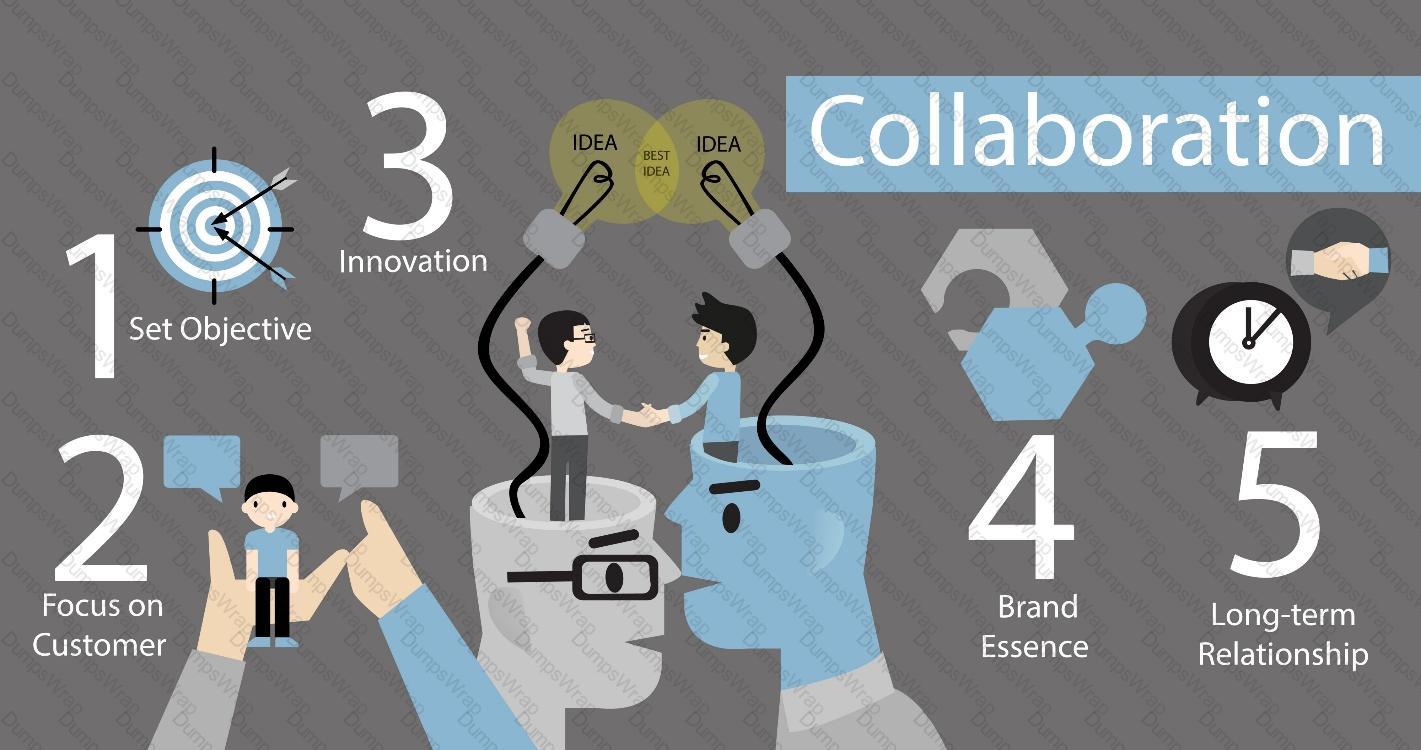 Image of virtual team collaboration
However, virtual teams face unique challenges compared to face-to-face teams. Because they rely on electronic communication, they often suffer from a lack of nonverbal cues (like body language and tone of voice), which makes communication less rich and more prone to misunderstanding. Consequently, virtual teams often report lower levels of satisfaction with the interaction process and may take longer to build trust and rapport (refuting options B and D). To be effective, managers of virtual teams must ensure that the team has the right technology, that progress is closely monitored, and that efforts are made to create "social presence" through occasional video calls or face-to-face meetings to build the trust that forms more naturally in traditional office settings. Despite these hurdles, the strategic benefit of accessing diverse talent from across the globe makes the virtual team an essential tool in the modern organizational landscape.
After physiological desires such as hunger, thirst, and shelter are met, the next level of desires becomes the basis for motivation. This is an example of which theory?
Options:
X and Y hierarchy
Bigelow's three factor theory
Two factor theory
Maslow's hierarchy of needs
Answer:
DExplanation:
Abraham Maslow’s Hierarchy of Needs is perhaps the best-known theory of motivation. Maslow hypothesized that within every human being, there exists a hierarchy of five needs:Physiological(hunger, thirst, shelter),Safety(security and protection),Social(affection, belongingness),Esteem(self-respect, autonomy), andSelf-actualization(achieving one's potential).
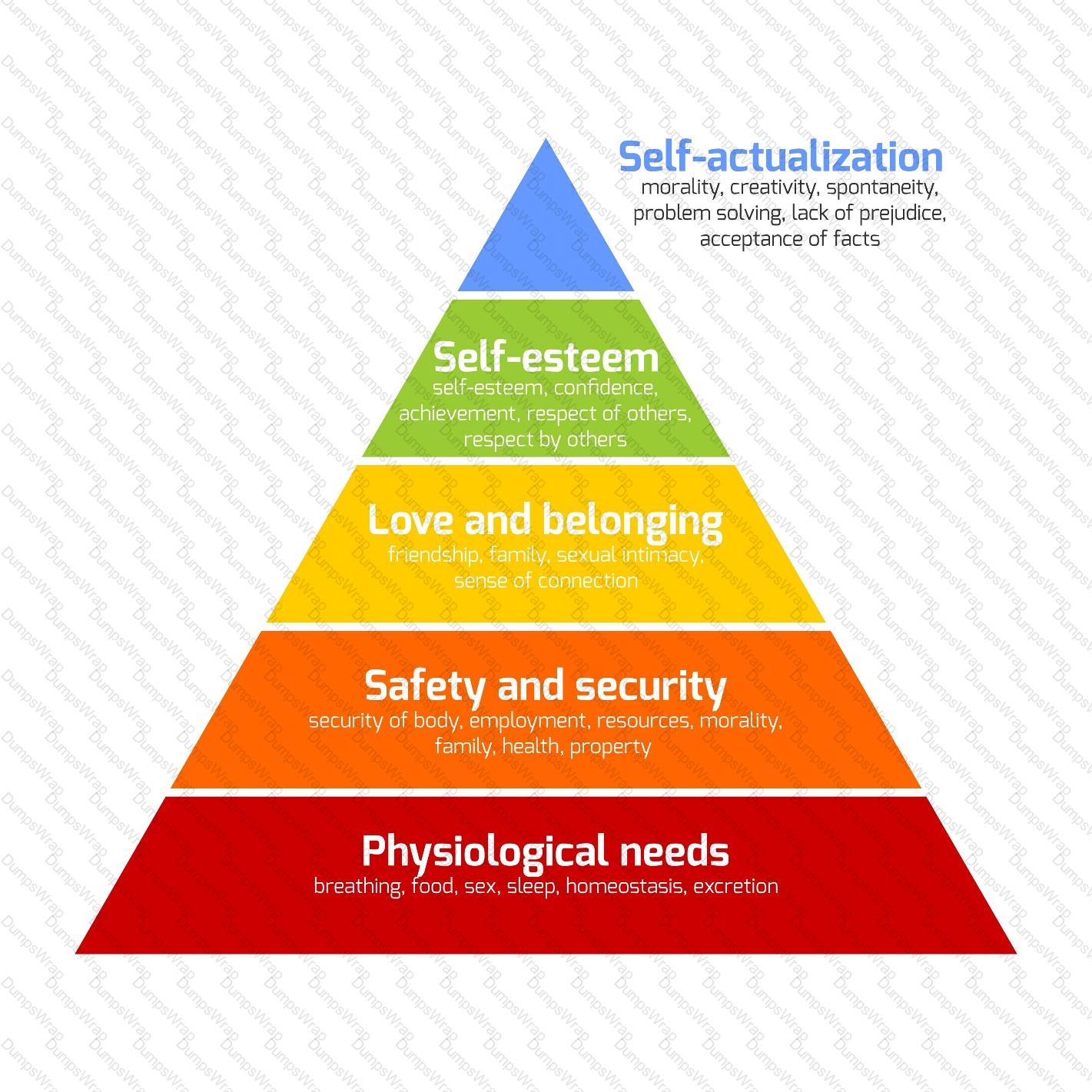 Image of Maslow's hierarchy of needs
Shutterstock
Explore
The core premise of this theory is the "progression principle," which states that as each of these needs becomes substantially satisfied, the next need in the hierarchy becomes dominant as a motivator. The question highlights that once physiological desires (the lowest level) are met, the individual moves to the next level. In Maslow’s original model, the level immediately following physiological needs isSafety and Security. This level involves seeking a predictable environment free from physical and emotional harm. In an organizational context, this translates to job security, health benefits, and a safe working environment. According to Maslow, once an employee feels physically safe and secure, they will no longer be motivated by these factors and will instead seek to satisfy "social" or "belonging" needs. While contemporary research suggests that people don't always follow this rigid linear progression, Maslow's model remains a foundational tool for managers to understand that an employee’s needs change as their circumstances improve.
Which statement is true about groupshift?
Options:
It cannot be toward greater risk.
It is a side-stepping technique.
It can be toward caution or toward risk.
It is not a real-world phenomenon.
Answer:
CExplanation:
Groupshift is a phenomenon related to groupthink, specifically describing the way group members tend to exaggerate their initial positions when discussing a given set of alternatives. In a group setting, the collective decision often shows a shift toward a more extreme version of the position held by members before the discussion began. While many people assume groups always lead to more conservative decisions, groupshift demonstrates that the shift can move in either direction: toward greater caution or toward greater risk.
The shift toward risk is more common in many organizational settings. This occurs for several reasons: first, the shared responsibility of a group diffuses the accountability for any single individual, making them feel bolder. Second, members who are more willing to take risks may be perceived as more confident and thus exert more influence over the group's final decision. Conversely, if the initial atmosphere of the group is conservative, the discussion tends to reinforce that caution, leading to a "shift" toward even more extreme avoidance of risk. Understanding groupshift is vital for managers because it highlights that group decisions are not necessarily "average" or "moderate" versions of individual opinions; rather, the social dynamics within a group can drive the collective toward extremes that no single member might have chosen independently. Recognizing this allows leaders to implement checks and balances, such as appointing a devil’s advocate, to ensure that the group does not drift into a dangerous or overly timid position due to the social reinforcement of the shift phenomenon.
